


 Скачать презентацию Lecture 1 EPSY 625 MEASUREMENT THEORY TIMELINE
66da72a63f8c7fec1ab1c3101776d067.ppt
- Количество слайдов: 19
 Lecture 1 EPSY 625
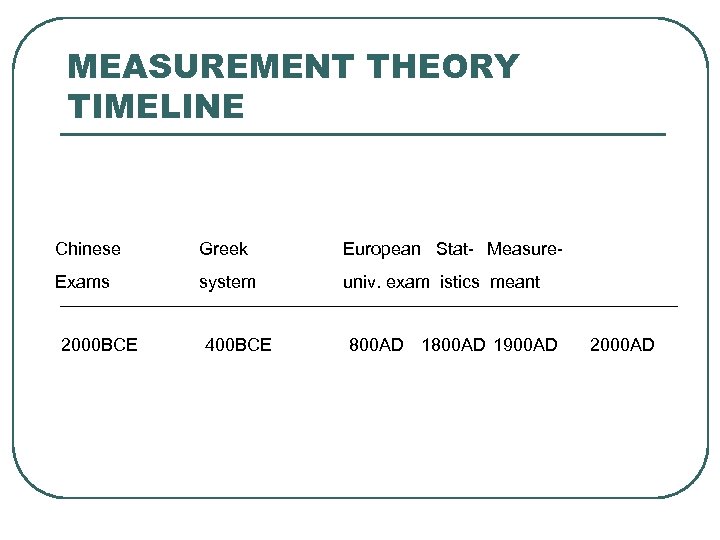 MEASUREMENT THEORY TIMELINE Chinese Greek European Stat- Measure- Exams system univ. exam istics meant 2000 BCE 400 BCE 800 AD 1900 AD 2000 AD
 1000 BC Chinese civil service exam l l l Democratic in principle: anyone could sit for the exam limitation: opportunity to learn; access to schooling low for peasants many modern issues: • reliability: test-retest, interrater agreement • validity: content, face, predictive • test formats: written vs. oral
 GREEK-ROMAN EDUCATION SYSTEMS l l Greek emphasis on oral examination Roman emulation of Greek systems (used Greek slaves as teachers for private tutoring) • l Carryover to European university systems created about 800 AD- 1800 • l Use of papyrus for written work Oral examinations for degrees- paper was very expensive Arabic university systems somewhat like European systems in 1000 -1500 AD
 1800 Error of Measurement astronomy & gambling l Discovery of Normal distribution • scoring agreement among astronomers; • disagreements as poor work vs. individual differences gambling with dice or cards: statistics and probability were invented- gambling noblemen wanted an edge
 1850 Wundt's lab physiological measurement l l Measurement of human performance and perception jnd: just noticeable difference in perception
 WRITTEN EXAMINATIONS 1850 l l Cheap paper and lead pencil invented in 1840 s Written essay advocated by American educators such as Horace Mann Reduction in emphasis on oral presentation, recitation Essay examination becomes important
 1880 Galton's anthropometry human physical measurement l l Measurement of human physiognomy notion of relationships among variables: • correlation and causation: • ratio scaling led to Pearson’s correlation • nominal scaling led to chi square association
 1890 test" l l reaction time, "mental J. M. Cattell - child intelligence Binet - Simon - “ : individual testing • developmental perspective • deviation at an age compared to cross-age development l factor analysis - Spearman; concept of construct underlying observed measurement
 1905 educational psychology Thorndike l learning and assessment First educational psychology text- 1906 1914 text topics: • The Original Nature of Man • The Psychology of Learning • Individual Differences and Their Causes • sex and race • ancestry (genetics) or family etc.
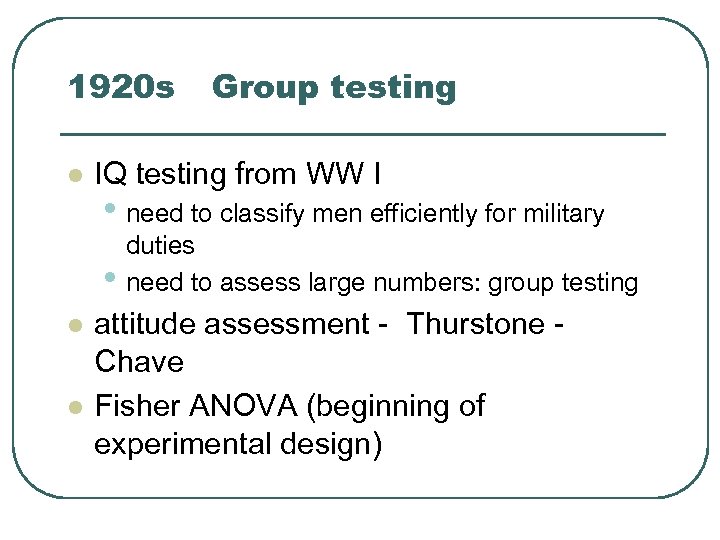 1920 s l IQ testing from WW I • need to classify men efficiently for military • l l Group testing duties need to assess large numbers: group testing attitude assessment - Thurstone Chave Fisher ANOVA (beginning of experimental design)
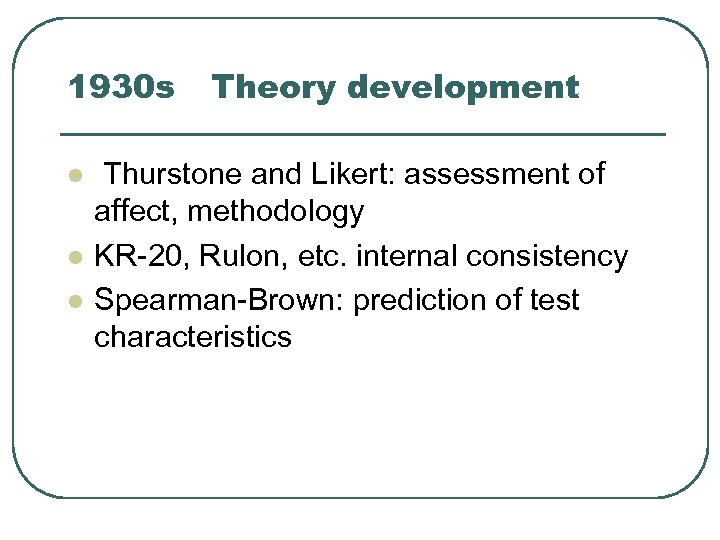 1930 s l l l Theory development Thurstone and Likert: assessment of affect, methodology KR-20, Rulon, etc. internal consistency Spearman-Brown: prediction of test characteristics
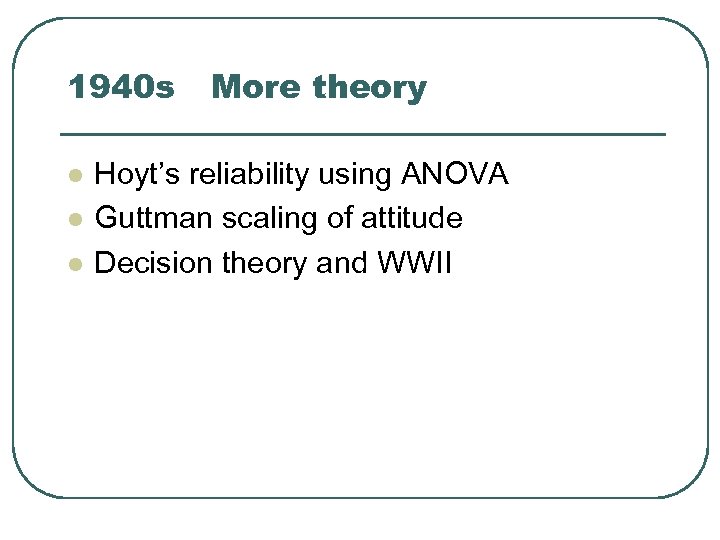 1940 s l l l More theory Hoyt’s reliability using ANOVA Guttman scaling of attitude Decision theory and WWII
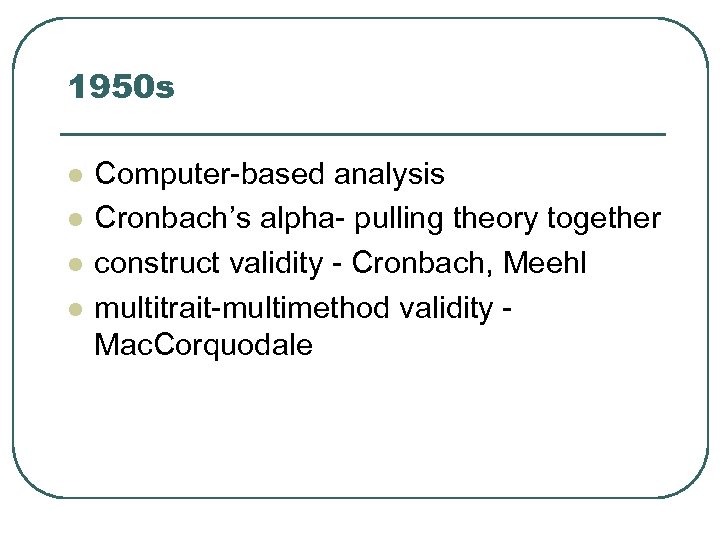 1950 s l l Computer-based analysis Cronbach’s alpha- pulling theory together construct validity - Cronbach, Meehl multitrait-multimethod validity Mac. Corquodale
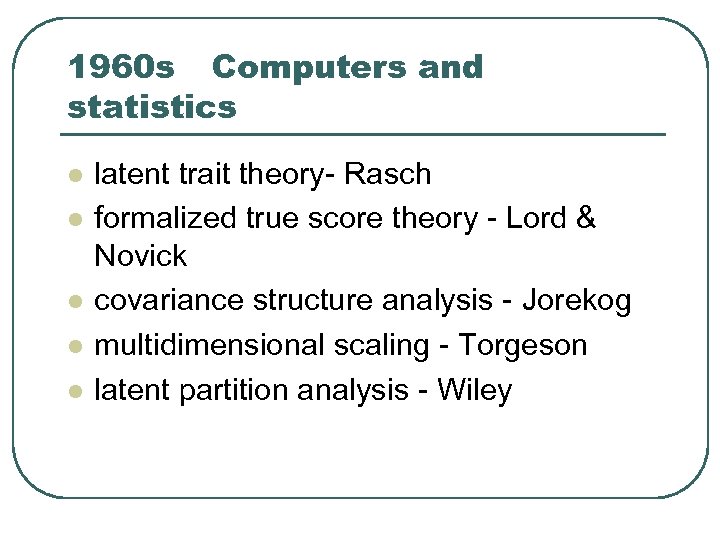 1960 s Computers and statistics l l latent trait theory- Rasch formalized true score theory - Lord & Novick covariance structure analysis - Jorekog multidimensional scaling - Torgeson latent partition analysis - Wiley
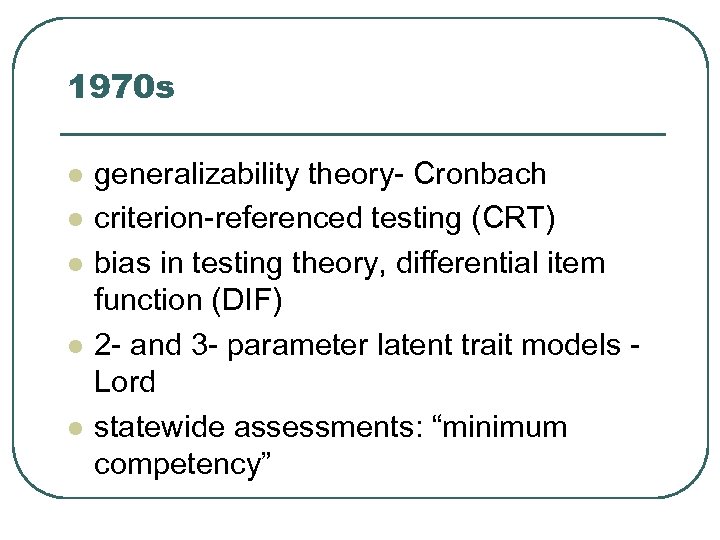 1970 s l l l generalizability theory- Cronbach criterion-referenced testing (CRT) bias in testing theory, differential item function (DIF) 2 - and 3 - parameter latent trait models Lord statewide assessments: “minimum competency”
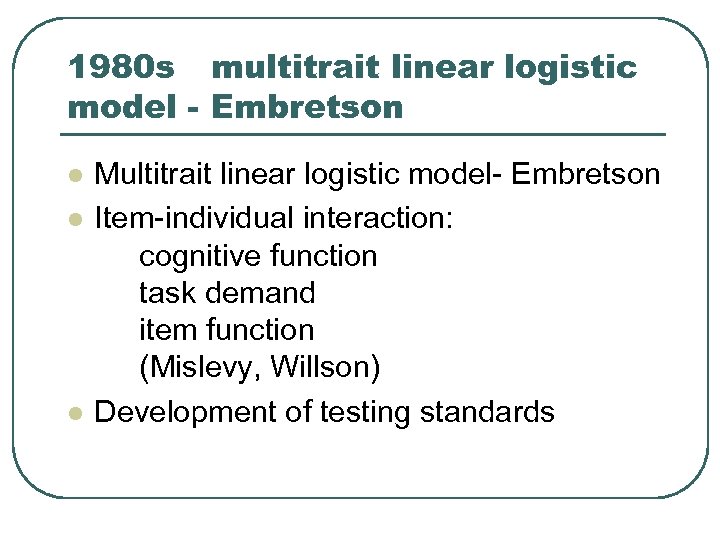 1980 s multitrait linear logistic model - Embretson l l l Multitrait linear logistic model- Embretson Item-individual interaction: cognitive function task demand item function (Mislevy, Willson) Development of testing standards
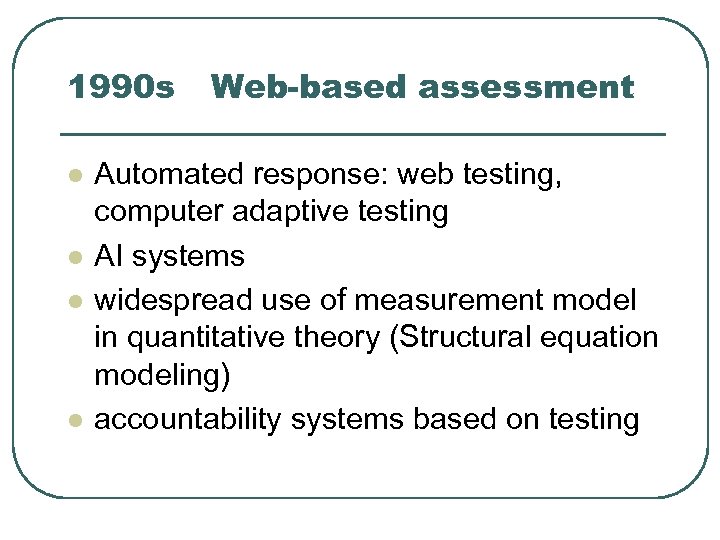 1990 s l l Web-based assessment Automated response: web testing, computer adaptive testing AI systems widespread use of measurement model in quantitative theory (Structural equation modeling) accountability systems based on testing
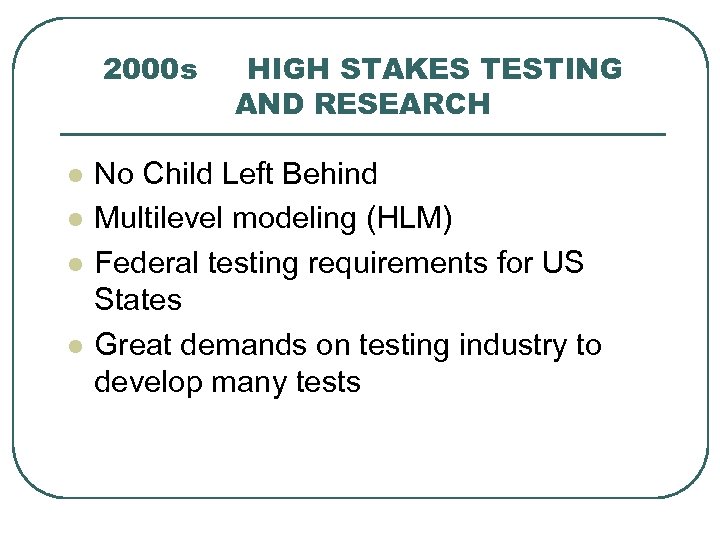 2000 s l l HIGH STAKES TESTING AND RESEARCH No Child Left Behind Multilevel modeling (HLM) Federal testing requirements for US States Great demands on testing industry to develop many tests