


 Скачать презентацию LECTURE 1 DIFFERENT ENGLISHES Тетяна Козлова Запорізький національний
Lingvo L 1-2 ST.pptx
- Количество слайдов: 14
 LECTURE 1. DIFFERENT ENGLISHES Тетяна Козлова Запорізький національний університет ethstlab@yahoo. com
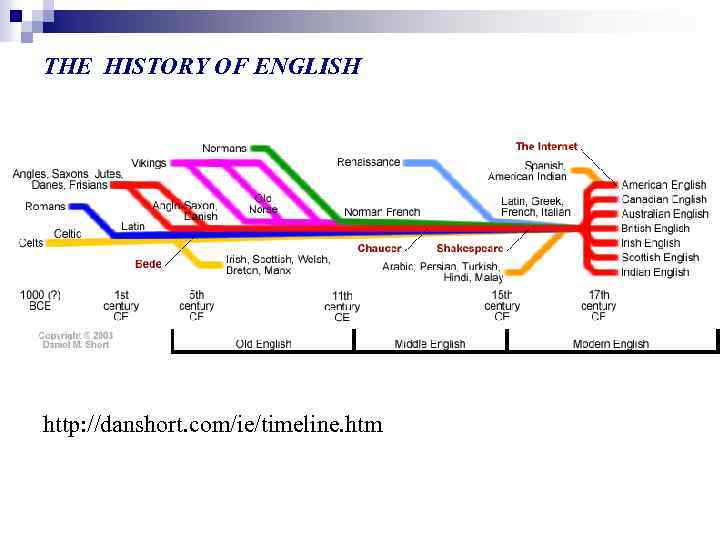 THE HISTORY OF ENGLISH http: //danshort. com/ie/timeline. htm
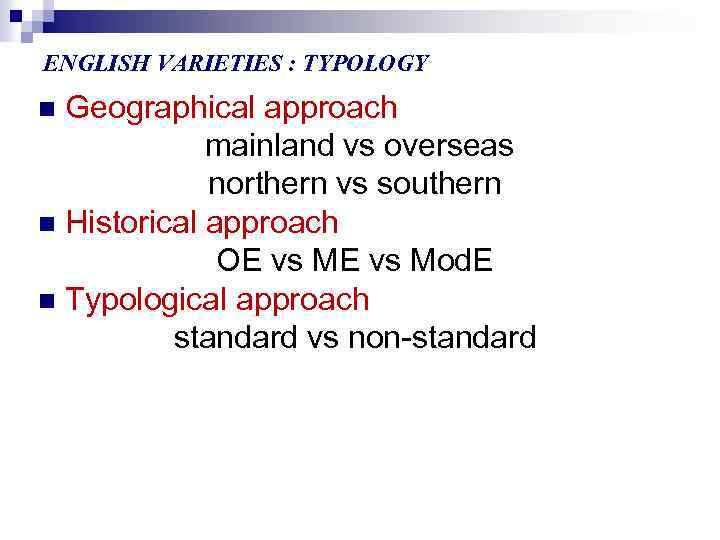 ENGLISH VARIETIES : TYPOLOGY Geographical approach mainland vs overseas northern vs southern n Historical approach OE vs Mod. E n Typological approach standard vs non-standard n
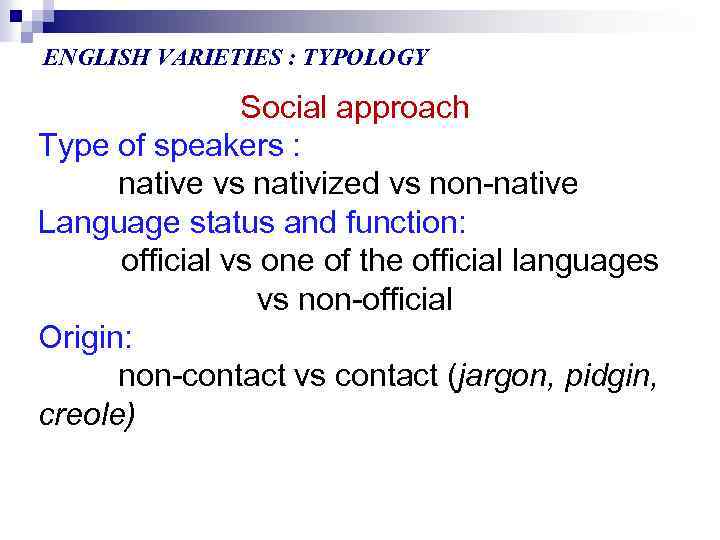 ENGLISH VARIETIES : TYPOLOGY Social approach Type of speakers : native vs nativized vs non-native Language status and function: official vs one of the official languages vs non-official Origin: non-contact vs contact (jargon, pidgin, creole)
 LECTURE 2. ANCIENT BRITAIN Тетяна Козлова Запорізький національний університет ethstlab@yahoo. com
 POINTS FOR DISCUSSION: 1/ Prehistoric Britain n The Iberians n The Celts n The Romans n 2/ Anglo-Saxon Britain n
 THE FIRST INHABITANTS. THE DAWN OF ENGLISH HISTORY the Megalithic men (3000 – 2000 BC) n The Apline stock / the Beaker folk (after 2000 BC) n cultural & linguistic merge n impressive monuments n
 FIRST FARMERS FROM THE CONTINENT: MEGALITHIC MEN settled partly on the chalk cliffs (long barrows) n merged with other immigrant groups and settled along the coast from Cornwall to the Orkneys (stone graves) n By 2500 BC - Stonehenge n megalith - μέγας "great" + λίθος "stone" a large stone that has been used to construct a structure or monument, either alone or together with other stones n
 ANOTHER PREHISTORIC STONE MONUMENT DURRINGTON WALLS less than two miles from Stonehenge n about 4, 500 years old n 30 intact stones and 60 fragments n up to 14 feet high n lined up to form a C-shaped "arena" surrounding a valley and springs leading to the River Avon n
 THE CELTS n n 800 BC Kent, southern England, Cornwall, to the north Druids abstract, curvilinear art
 MAIDEN CASTLE the largest Iron Age hill fort in Europe n covers an area of 47 acres n maiden < Celtic mai dun 'great hill'. n 2 miles south of Dorchester in Dorset n n late Stone Age/ early Bronze Age people a massive ditch and bank some 545 metres in length Durotriges tribe (the Roman invasion in 43 AD)
 THE CELTIC INVASION: 3 WAVES The GOIDELS / GAELS Goidelic Celtic / Gaelic n The BRYTHONIC CELTS / BRYTHONS > Celtic in Wales n The BELAGAE (TEUTONIC) > central part of GB – HOME COUNTIES n
 RECOMMENDED READING Britain becomes Roman http: //www. iadb. co. uk/romans/main. php? P=4 n Life in Roman Britain http: //www. iadb. co. uk/romans/main. php? P=6 n Technology and the arts in Roman Britain http: //www. iadb. co. uk/romans/main. php? P=6 n
 SUMMING UP The Iberians (3000 BC) – Stonehenge, graves n The Beaker folk (2500 BC) – pottery, Stonehenge n The Celts (800 BC) – bronze craft, Lludh, Britain n The Romans (55 BC, 43 AD) – streets, roads, cities, walls, fortresses, villages, slavery, baths Londinuum, wall, villa, -chester, street, Albion n