


 Скачать презентацию Lecture 1 An Overview of High-Performance Computer Architecture
750fd0f9661431b8507095b816870574.ppt
- Количество слайдов: 57
 Lecture 1 An Overview of High-Performance Computer Architecture ECE 463/521 Fall 2002 Edward F. Gehringer © 2002 Edward F. Gehringer ECE 463/521 Lecture Notes, Fall 2002
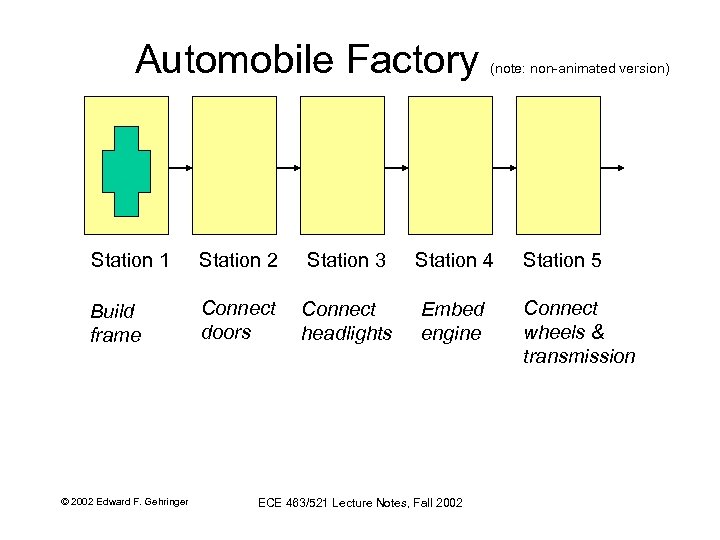 Automobile Factory (note: non-animated version) Station 1 Station 2 Station 3 Station 4 Station 5 Build frame Connect doors Connect headlights Embed engine Connect wheels & transmission © 2002 Edward F. Gehringer ECE 463/521 Lecture Notes, Fall 2002
 Automobile Factory (note: non-animated version) Station 1 Station 2 Station 3 Station 4 Station 5 Build frame Connect doors Connect headlights Embed engine Connect wheels & transmission © 2002 Edward F. Gehringer ECE 463/521 Lecture Notes, Fall 2002
 Automobile Factory (note: non-animated version) Station 1 Station 2 Station 3 Station 4 Station 5 Build frame Connect doors Connect headlights Embed engine Connect wheels & transmission © 2002 Edward F. Gehringer ECE 463/521 Lecture Notes, Fall 2002
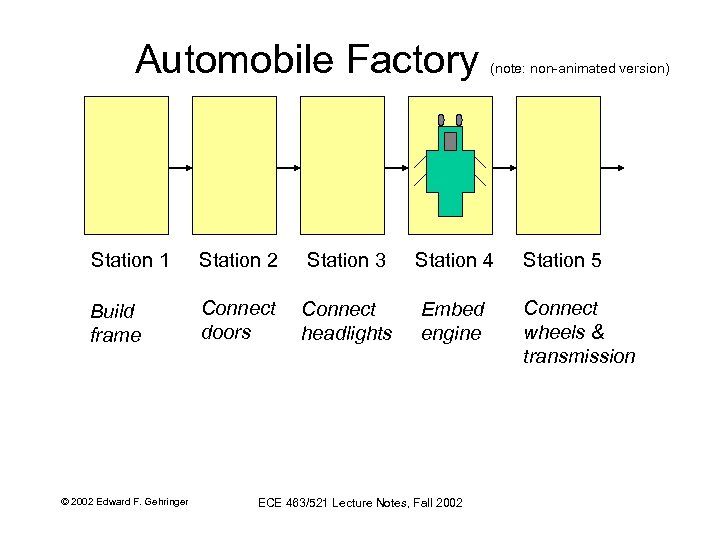 Automobile Factory (note: non-animated version) Station 1 Station 2 Station 3 Station 4 Station 5 Build frame Connect doors Connect headlights Embed engine Connect wheels & transmission © 2002 Edward F. Gehringer ECE 463/521 Lecture Notes, Fall 2002
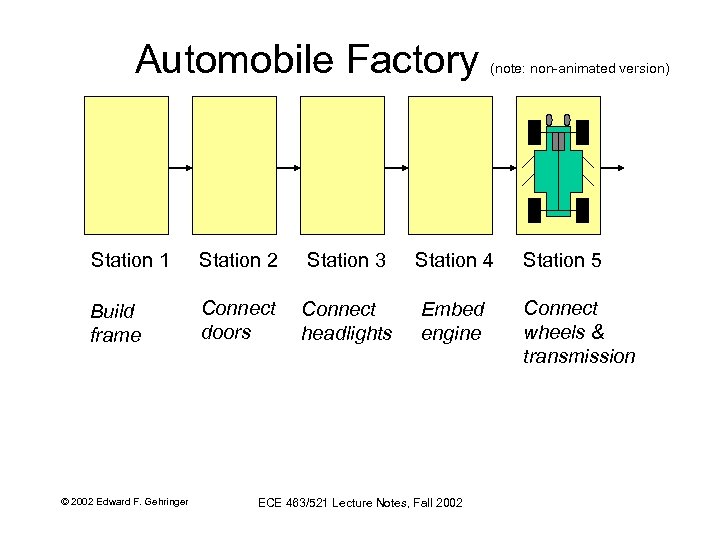 Automobile Factory (note: non-animated version) Station 1 Station 2 Station 3 Station 4 Station 5 Build frame Connect doors Connect headlights Embed engine Connect wheels & transmission © 2002 Edward F. Gehringer ECE 463/521 Lecture Notes, Fall 2002
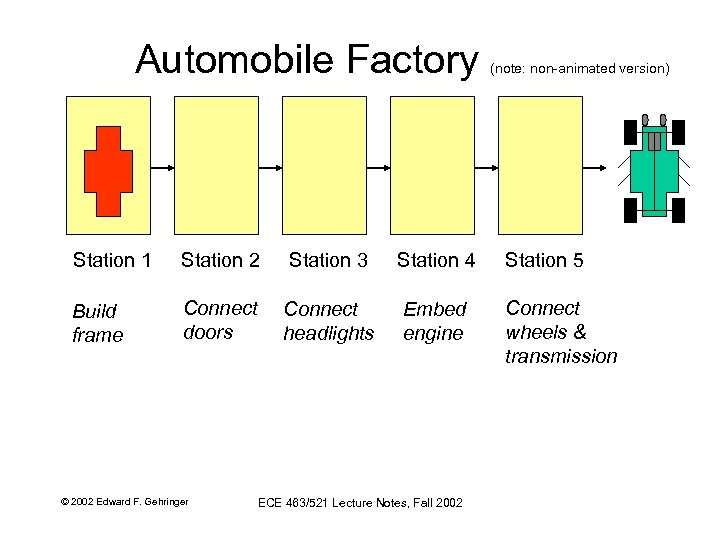 Automobile Factory (note: non-animated version) Station 1 Station 2 Station 3 Station 4 Station 5 Build frame Connect doors Connect headlights Embed engine Connect wheels & transmission © 2002 Edward F. Gehringer ECE 463/521 Lecture Notes, Fall 2002
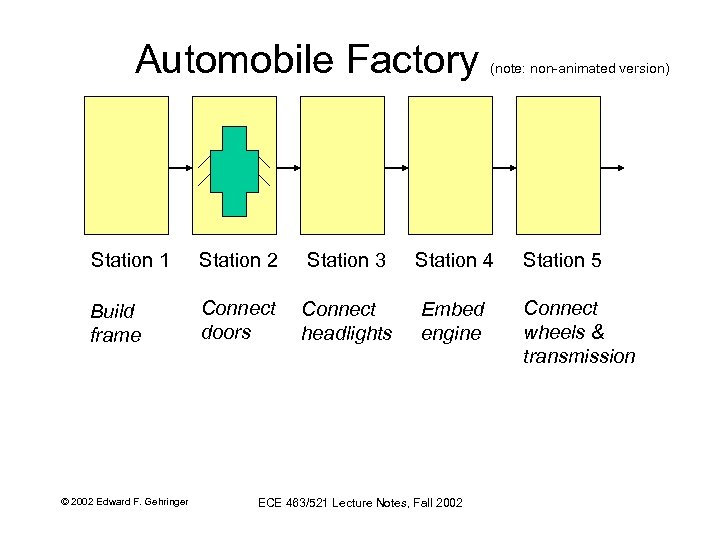
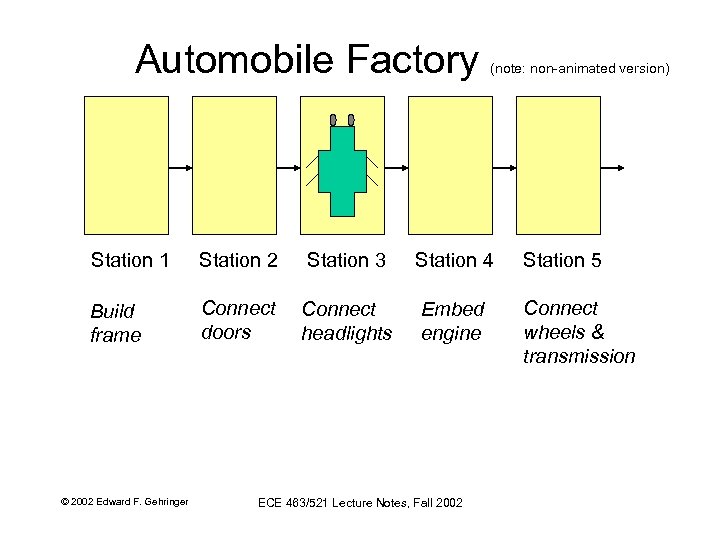
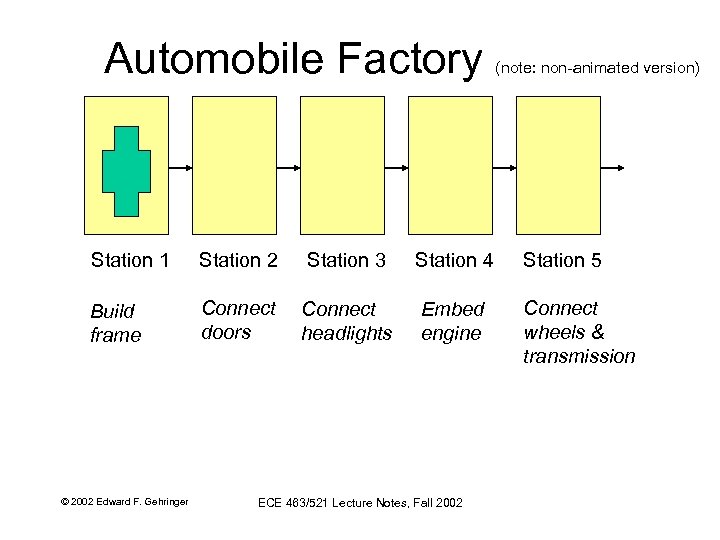
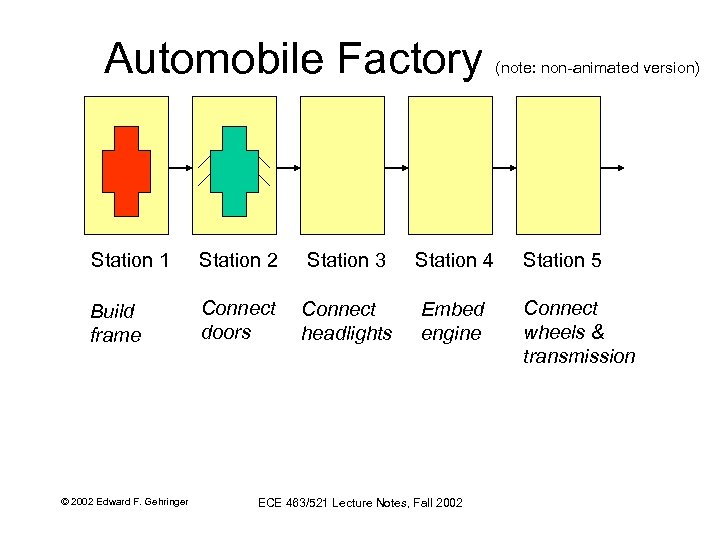
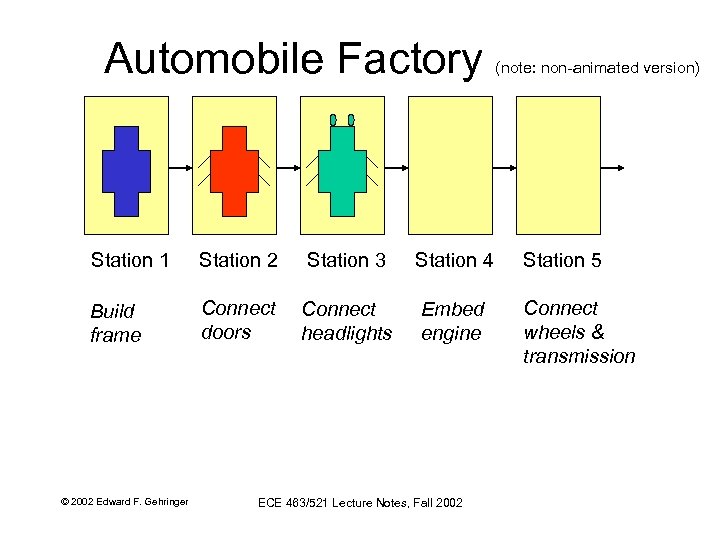
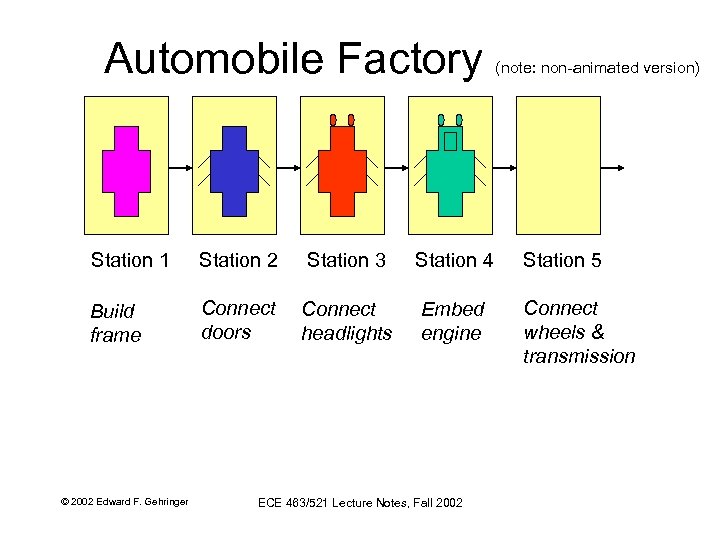
 Basic Assembly Line • Unchangeable truth – It takes a long time to build one car – Example: Time spent in assembly line is 1 hour (12 min. per station) • Basic assembly line – Throughput = 1 car per hour – We wait until first car is fully assembled before starting the next one: – only 1 car in assembly line at a time – only 1 station is active at a time; other 4 are idle © 2002 Edward F. Gehringer ECE 463/521 Lecture Notes, Fall 2002
 Automobile Factory (note: non-animated version) Station 1 Station 2 Station 3 Station 4 Station 5 Build frame Connect doors Connect headlights Embed engine Connect wheels & transmission © 2002 Edward F. Gehringer ECE 463/521 Lecture Notes, Fall 2002
 Automobile Factory (note: non-animated version) Station 1 Station 2 Station 3 Station 4 Station 5 Build frame Connect doors Connect headlights Embed engine Connect wheels & transmission © 2002 Edward F. Gehringer ECE 463/521 Lecture Notes, Fall 2002
 Automobile Factory (note: non-animated version) Station 1 Station 2 Station 3 Station 4 Station 5 Build frame Connect doors Connect headlights Embed engine Connect wheels & transmission © 2002 Edward F. Gehringer ECE 463/521 Lecture Notes, Fall 2002
 Automobile Factory (note: non-animated version) Station 1 Station 2 Station 3 Station 4 Station 5 Build frame Connect doors Connect headlights Embed engine Connect wheels & transmission © 2002 Edward F. Gehringer ECE 463/521 Lecture Notes, Fall 2002
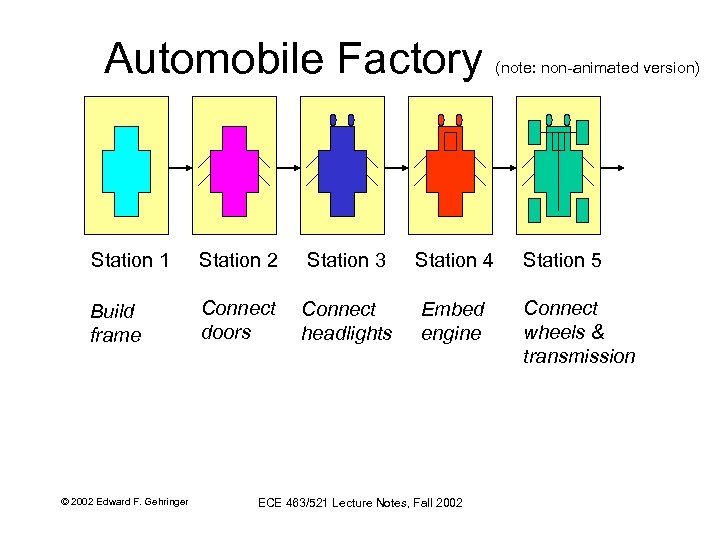 Automobile Factory (note: non-animated version) Station 1 Station 2 Station 3 Station 4 Station 5 Build frame Connect doors Connect headlights Embed engine Connect wheels & transmission © 2002 Edward F. Gehringer ECE 463/521 Lecture Notes, Fall 2002
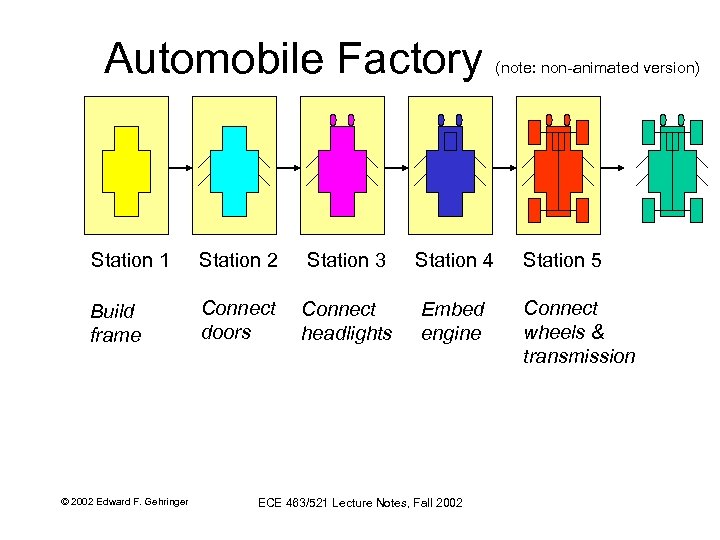 Automobile Factory (note: non-animated version) Station 1 Station 2 Station 3 Station 4 Station 5 Build frame Connect doors Connect headlights Embed engine Connect wheels & transmission © 2002 Edward F. Gehringer ECE 463/521 Lecture Notes, Fall 2002
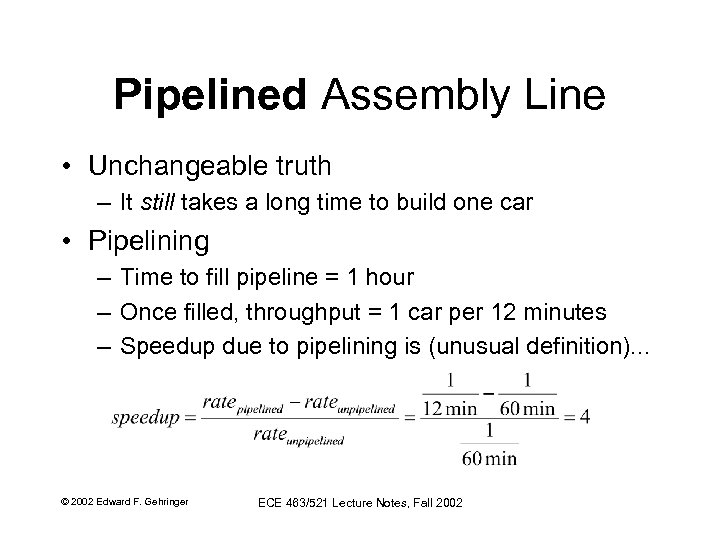 Pipelined Assembly Line • Unchangeable truth – It still takes a long time to build one car • Pipelining – Time to fill pipeline = 1 hour – Once filled, throughput = 1 car per 12 minutes – Speedup due to pipelining is (unusual definition). . . © 2002 Edward F. Gehringer ECE 463/521 Lecture Notes, Fall 2002
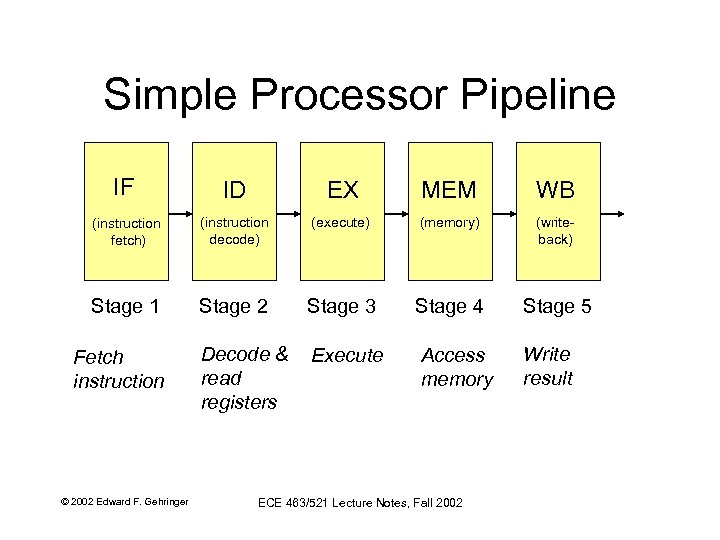 Simple Processor Pipeline IF ID EX MEM WB (instruction fetch) (instruction decode) (execute) (memory) (writeback) Stage 1 Stage 2 Stage 3 Stage 4 Stage 5 Decode & read registers Execute Access memory Write result Fetch instruction © 2002 Edward F. Gehringer ECE 463/521 Lecture Notes, Fall 2002
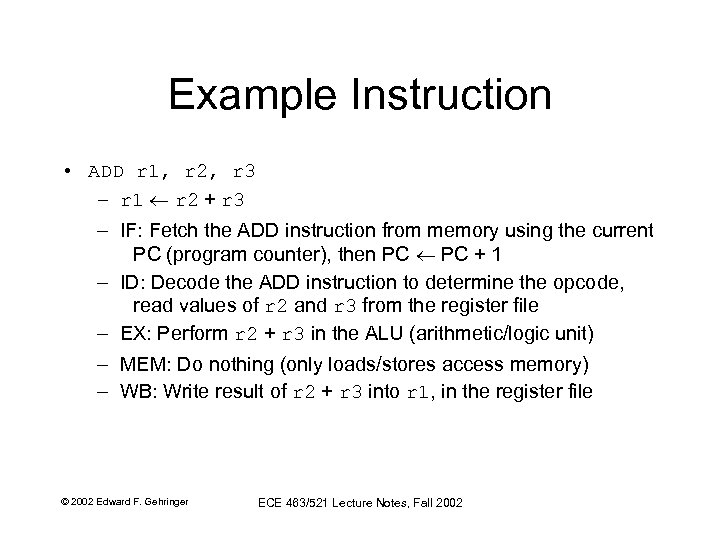 Example Instruction • ADD r 1, r 2, r 3 – r 1 r 2 + r 3 – IF: Fetch the ADD instruction from memory using the current PC (program counter), then PC + 1 – ID: Decode the ADD instruction to determine the opcode, read values of r 2 and r 3 from the register file – EX: Perform r 2 + r 3 in the ALU (arithmetic/logic unit) – MEM: Do nothing (only loads/stores access memory) – WB: Write result of r 2 + r 3 into r 1, in the register file © 2002 Edward F. Gehringer ECE 463/521 Lecture Notes, Fall 2002
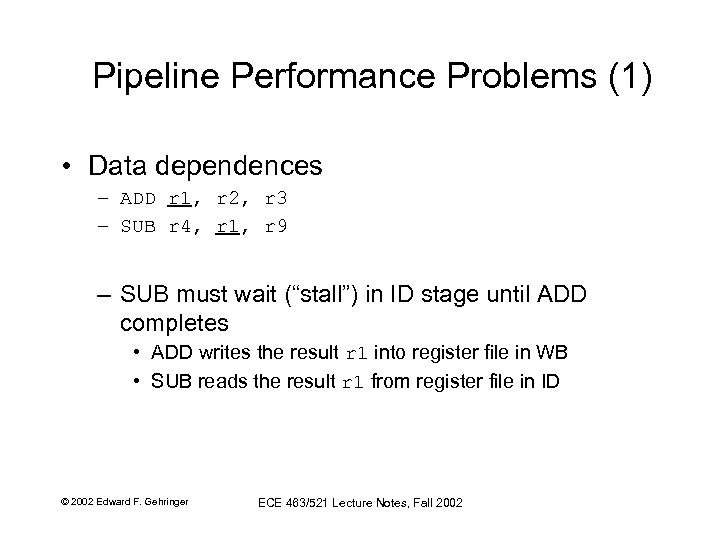 Pipeline Performance Problems (1) • Data dependences – ADD r 1, r 2, r 3 – SUB r 4, r 1, r 9 – SUB must wait (“stall”) in ID stage until ADD completes • ADD writes the result r 1 into register file in WB • SUB reads the result r 1 from register file in ID © 2002 Edward F. Gehringer ECE 463/521 Lecture Notes, Fall 2002
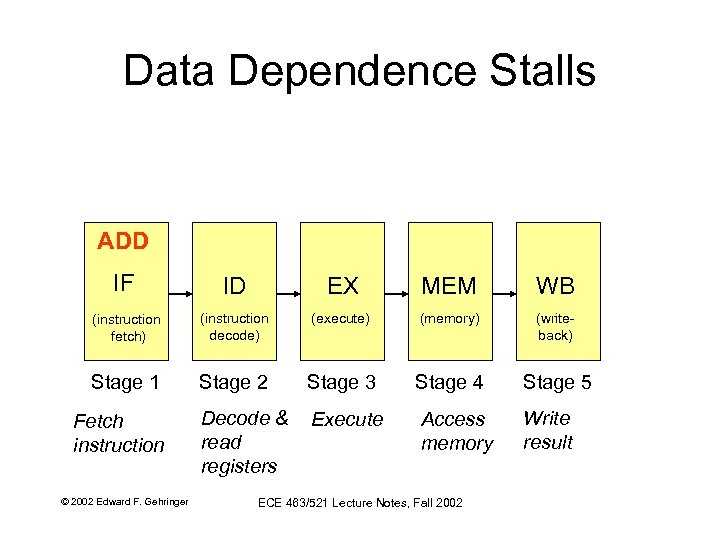 Data Dependence Stalls ADD IF ID EX MEM WB (instruction fetch) (instruction decode) (execute) (memory) (writeback) Stage 1 Stage 2 Stage 3 Stage 4 Stage 5 Decode & read registers Execute Access memory Write result Fetch instruction © 2002 Edward F. Gehringer ECE 463/521 Lecture Notes, Fall 2002
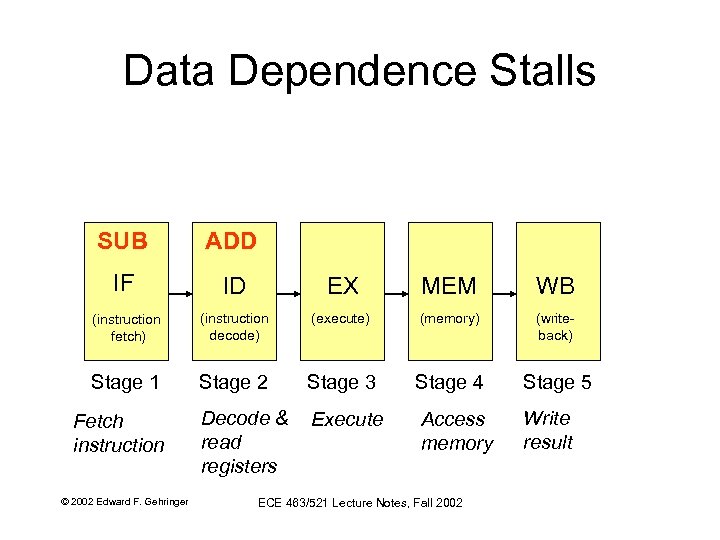 Data Dependence Stalls SUB ADD IF ID EX MEM WB (instruction fetch) (instruction decode) (execute) (memory) (writeback) Stage 1 Stage 2 Stage 3 Stage 4 Stage 5 Decode & read registers Execute Access memory Write result Fetch instruction © 2002 Edward F. Gehringer ECE 463/521 Lecture Notes, Fall 2002
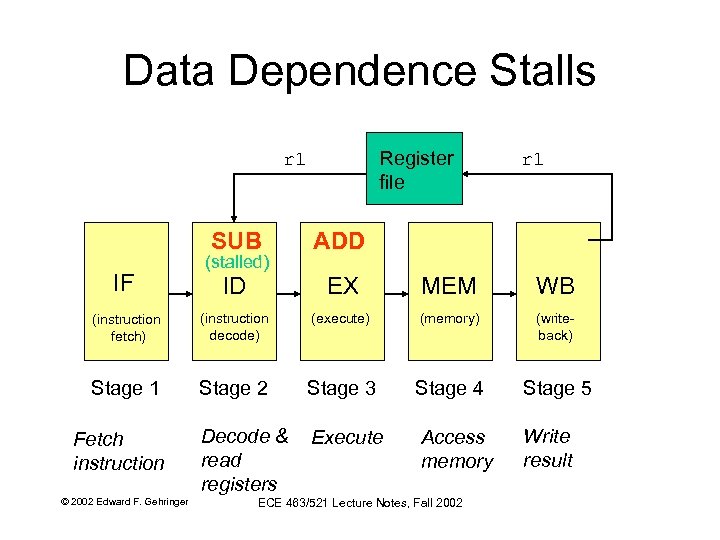 Data Dependence Stalls Register file r 1 SUB ADD ID EX MEM WB (instruction fetch) (instruction decode) (execute) (memory) (writeback) Stage 1 Stage 2 Stage 3 Stage 4 Stage 5 Decode & read registers Execute Access memory Write result IF Fetch instruction © 2002 Edward F. Gehringer (stalled) ECE 463/521 Lecture Notes, Fall 2002
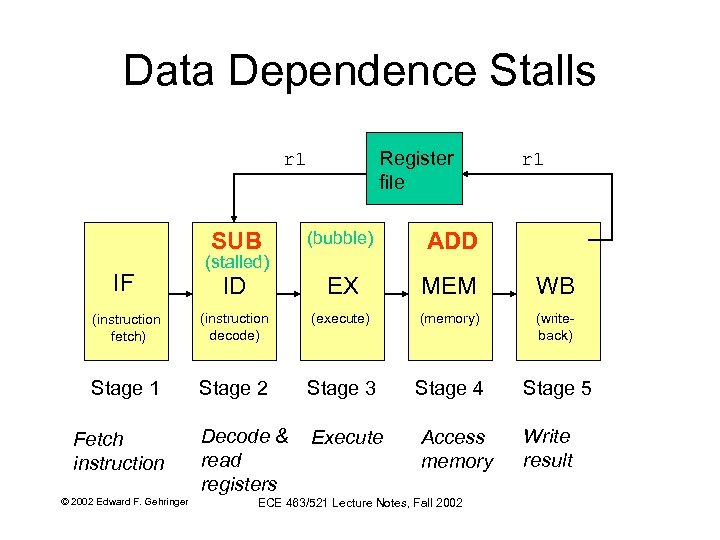 Data Dependence Stalls Register file r 1 SUB (bubble) ADD ID EX MEM WB (instruction fetch) (instruction decode) (execute) (memory) (writeback) Stage 1 Stage 2 Stage 3 Stage 4 Stage 5 Decode & read registers Execute Access memory Write result IF Fetch instruction © 2002 Edward F. Gehringer (stalled) ECE 463/521 Lecture Notes, Fall 2002
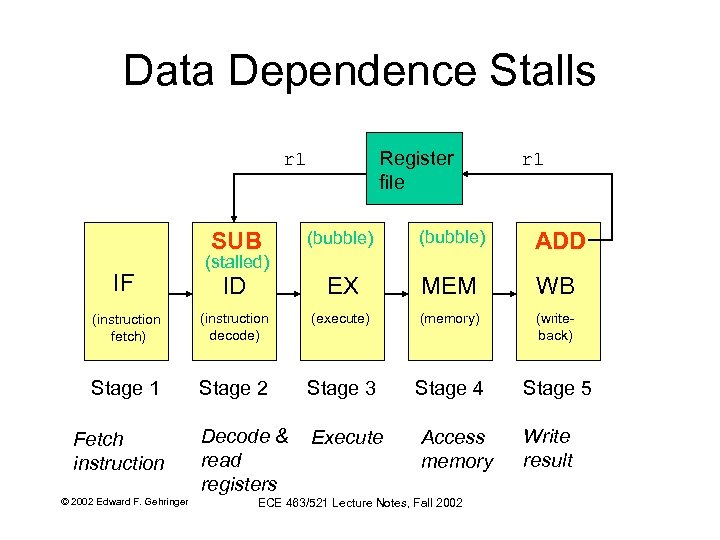 Data Dependence Stalls Register file r 1 SUB (bubble) ADD ID EX MEM WB (instruction fetch) (instruction decode) (execute) (memory) (writeback) Stage 1 Stage 2 Stage 3 Stage 4 Stage 5 Decode & read registers Execute Access memory Write result IF Fetch instruction © 2002 Edward F. Gehringer (stalled) ECE 463/521 Lecture Notes, Fall 2002
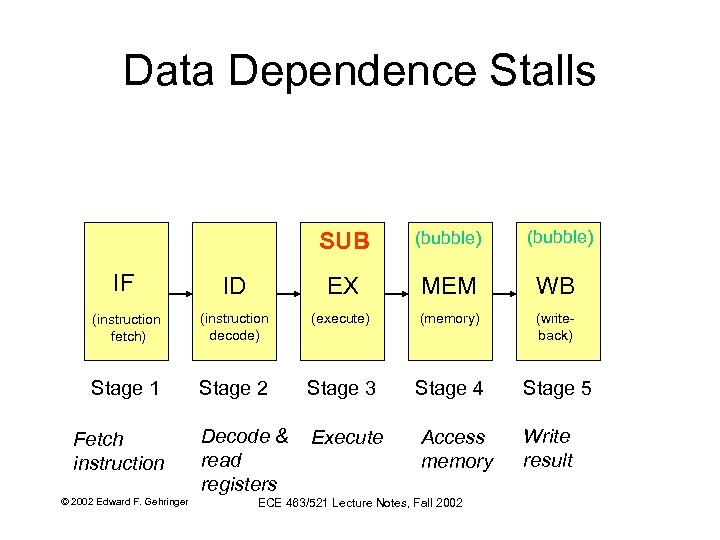 Data Dependence Stalls SUB (bubble) IF ID EX MEM WB (instruction fetch) (instruction decode) (execute) (memory) (writeback) Stage 1 Stage 2 Stage 3 Stage 4 Stage 5 Decode & read registers Execute Access memory Write result Fetch instruction © 2002 Edward F. Gehringer ECE 463/521 Lecture Notes, Fall 2002
 Speedup with data dependences • What is the speedup of this pipeline (Tsequential/Tpipelined) if 1/10 th of all instructions contain a data dependence? • Can you give a general formula for a k-stage pipeline? What other information do you need to know? © 2002 Edward F. Gehringer ECE 463/521 Lecture Notes, Fall 2002
 Reducing Data Dependence Stalls • We could directly forward results from producer to consumer, bypassing the register file. – The hardware is called “data bypass, ” “result bypass, ” or “register file bypass. ” – The technique is called “bypassing” or “forwarding. ” © 2002 Edward F. Gehringer ECE 463/521 Lecture Notes, Fall 2002
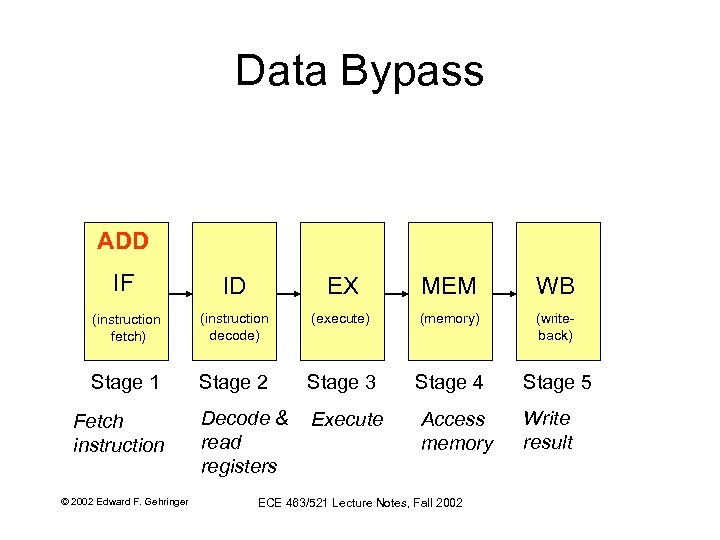 Data Bypass ADD IF ID EX MEM WB (instruction fetch) (instruction decode) (execute) (memory) (writeback) Stage 1 Stage 2 Stage 3 Stage 4 Stage 5 Decode & read registers Execute Access memory Write result Fetch instruction © 2002 Edward F. Gehringer ECE 463/521 Lecture Notes, Fall 2002
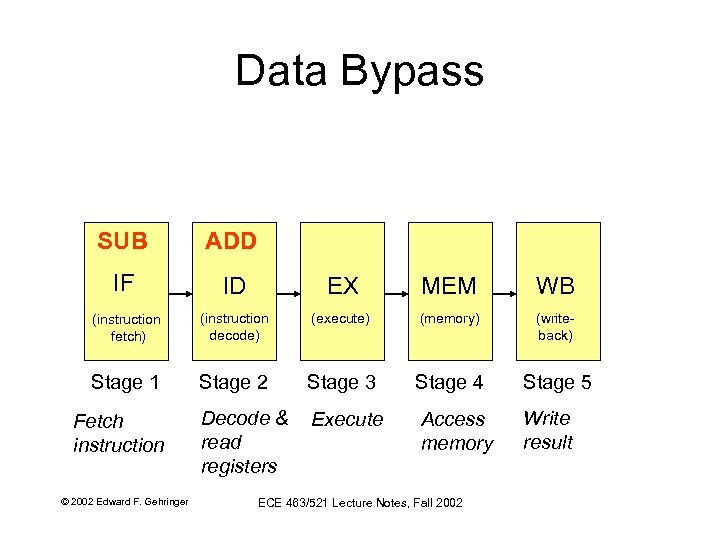 Data Bypass SUB ADD IF ID EX MEM WB (instruction fetch) (instruction decode) (execute) (memory) (writeback) Stage 1 Stage 2 Stage 3 Stage 4 Stage 5 Decode & read registers Execute Access memory Write result Fetch instruction © 2002 Edward F. Gehringer ECE 463/521 Lecture Notes, Fall 2002
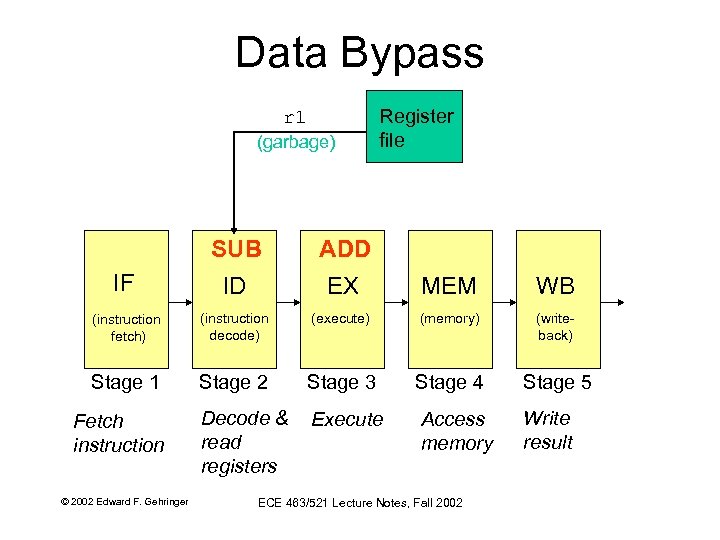 Data Bypass r 1 (garbage) Register file SUB ADD IF ID EX MEM WB (instruction fetch) (instruction decode) (execute) (memory) (writeback) Stage 1 Stage 2 Stage 3 Stage 4 Stage 5 Decode & read registers Execute Access memory Write result Fetch instruction © 2002 Edward F. Gehringer ECE 463/521 Lecture Notes, Fall 2002
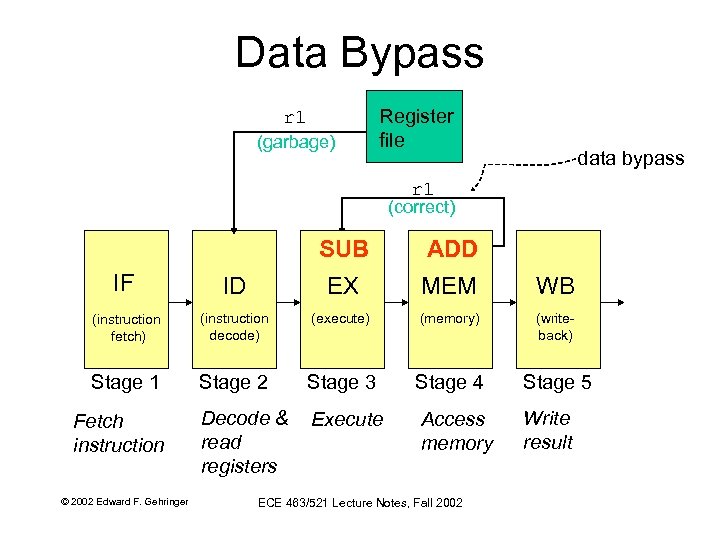 Data Bypass r 1 (garbage) Register file data bypass r 1 (correct) SUB ADD IF ID EX MEM WB (instruction fetch) (instruction decode) (execute) (memory) (writeback) Stage 1 Stage 2 Stage 3 Stage 4 Stage 5 Decode & read registers Execute Access memory Write result Fetch instruction © 2002 Edward F. Gehringer ECE 463/521 Lecture Notes, Fall 2002
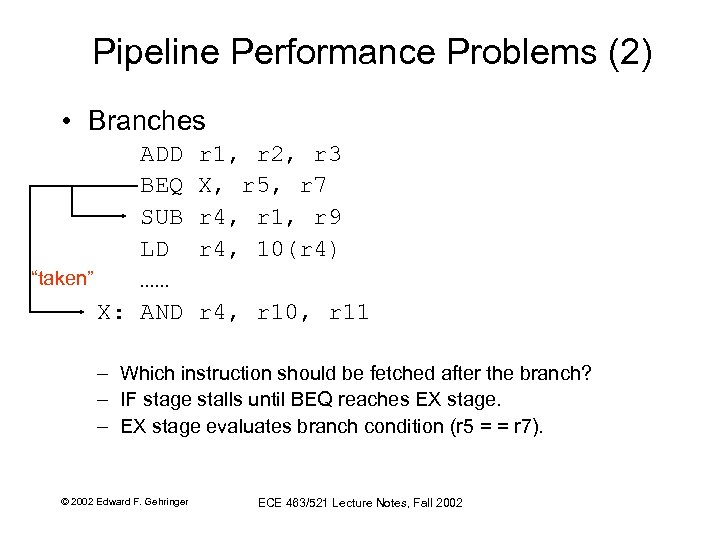 Pipeline Performance Problems (2) • Branches ADD BEQ SUB LD “taken” …… X: AND r 1, r 2, r 3 X, r 5, r 7 r 4, r 1, r 9 r 4, 10(r 4) r 4, r 10, r 11 – Which instruction should be fetched after the branch? – IF stage stalls until BEQ reaches EX stage. – EX stage evaluates branch condition (r 5 = = r 7). © 2002 Edward F. Gehringer ECE 463/521 Lecture Notes, Fall 2002
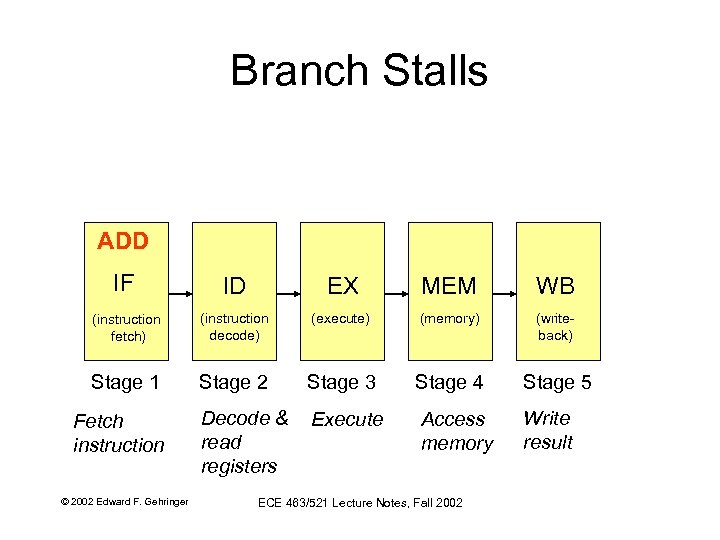 Branch Stalls ADD IF ID EX MEM WB (instruction fetch) (instruction decode) (execute) (memory) (writeback) Stage 1 Stage 2 Stage 3 Stage 4 Stage 5 Decode & read registers Execute Access memory Write result Fetch instruction © 2002 Edward F. Gehringer ECE 463/521 Lecture Notes, Fall 2002
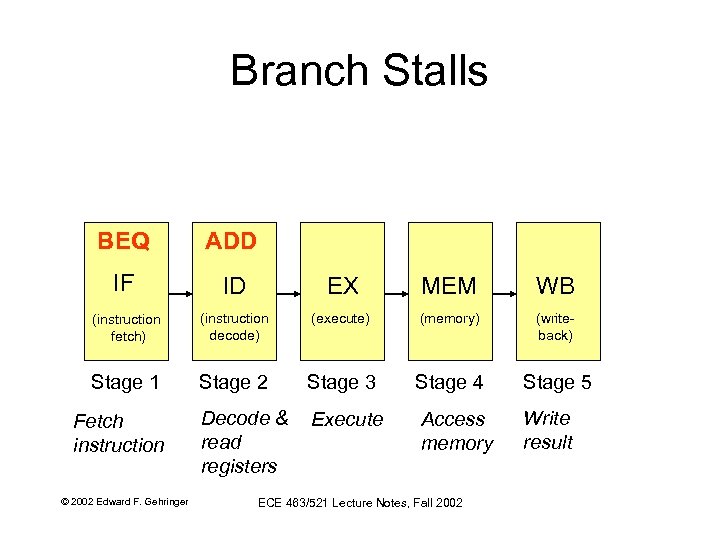 Branch Stalls BEQ ADD IF ID EX MEM WB (instruction fetch) (instruction decode) (execute) (memory) (writeback) Stage 1 Stage 2 Stage 3 Stage 4 Stage 5 Decode & read registers Execute Access memory Write result Fetch instruction © 2002 Edward F. Gehringer ECE 463/521 Lecture Notes, Fall 2002
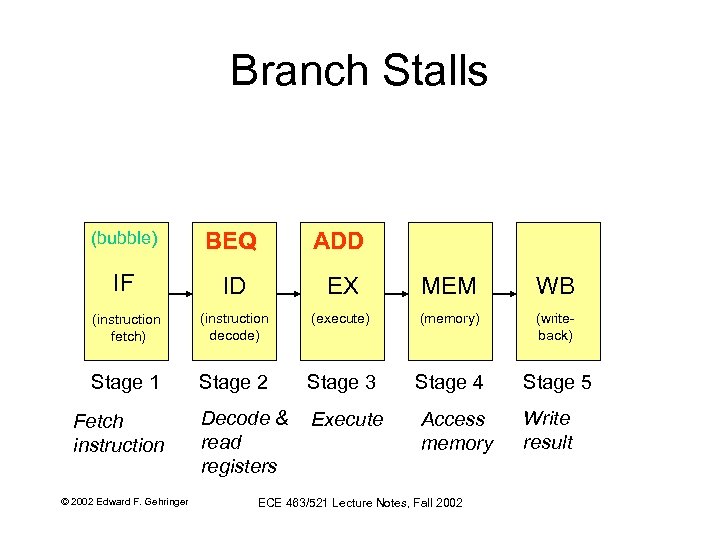 Branch Stalls (bubble) BEQ ADD IF ID EX MEM WB (instruction fetch) (instruction decode) (execute) (memory) (writeback) Stage 1 Stage 2 Stage 3 Stage 4 Stage 5 Decode & read registers Execute Access memory Write result Fetch instruction © 2002 Edward F. Gehringer ECE 463/521 Lecture Notes, Fall 2002
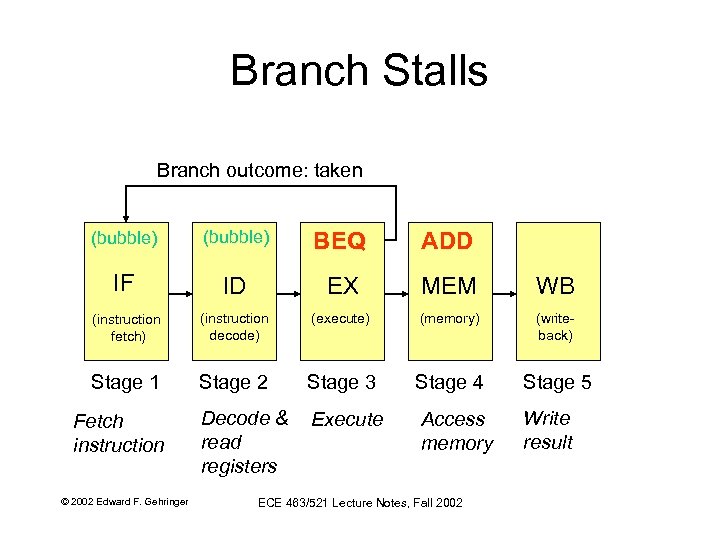 Branch Stalls Branch outcome: taken (bubble) BEQ ADD IF ID EX MEM WB (instruction fetch) (instruction decode) (execute) (memory) (writeback) Stage 1 Stage 2 Stage 3 Stage 4 Stage 5 Decode & read registers Execute Access memory Write result Fetch instruction © 2002 Edward F. Gehringer ECE 463/521 Lecture Notes, Fall 2002
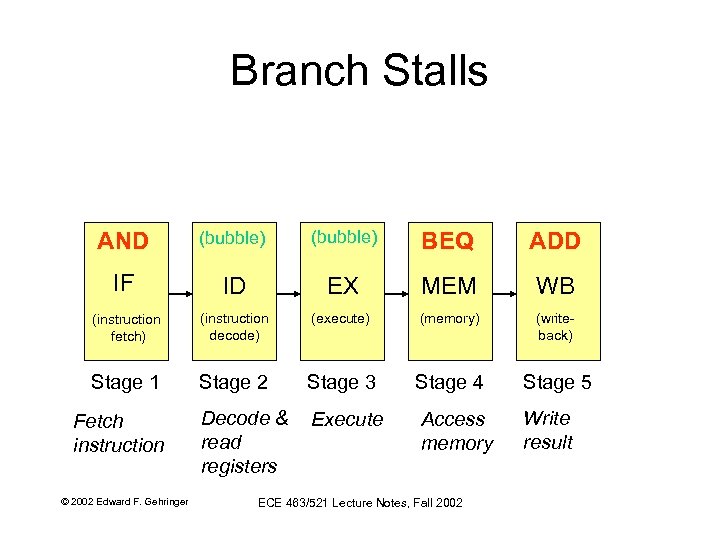 Branch Stalls AND (bubble) BEQ ADD IF ID EX MEM WB (instruction fetch) (instruction decode) (execute) (memory) (writeback) Stage 1 Stage 2 Stage 3 Stage 4 Stage 5 Decode & read registers Execute Access memory Write result Fetch instruction © 2002 Edward F. Gehringer ECE 463/521 Lecture Notes, Fall 2002
 Reducing Branch Stalls • Branch prediction – “Learn” which way a given branch tends to go. – Like predicting the economy, branch prediction is based on past history. – Even simple predictors can be 80% accurate. – If correct: no branch stalls. – In incorrect: • “Quash” instructions in previous pipeline stages. • Performance degrades to the stall case. • May have additional penalties to “clean up” the pipeline. © 2002 Edward F. Gehringer ECE 463/521 Lecture Notes, Fall 2002
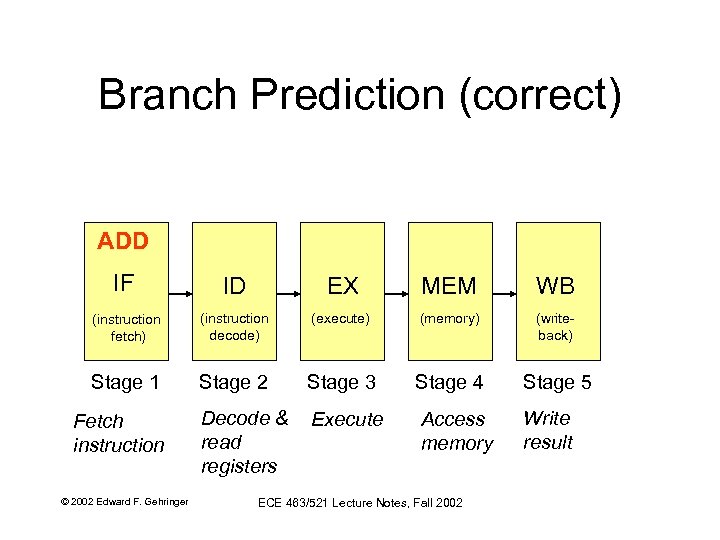 Branch Prediction (correct) ADD IF ID EX MEM WB (instruction fetch) (instruction decode) (execute) (memory) (writeback) Stage 1 Stage 2 Stage 3 Stage 4 Stage 5 Decode & read registers Execute Access memory Write result Fetch instruction © 2002 Edward F. Gehringer ECE 463/521 Lecture Notes, Fall 2002
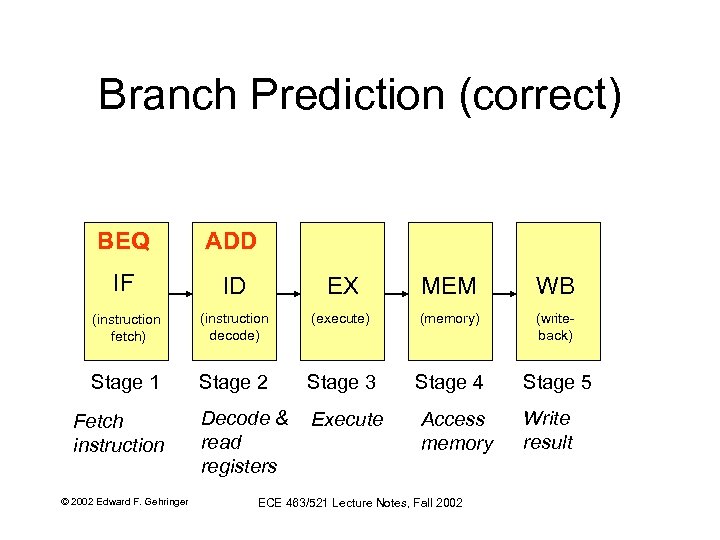 Branch Prediction (correct) BEQ ADD IF ID EX MEM WB (instruction fetch) (instruction decode) (execute) (memory) (writeback) Stage 1 Stage 2 Stage 3 Stage 4 Stage 5 Decode & read registers Execute Access memory Write result Fetch instruction © 2002 Edward F. Gehringer ECE 463/521 Lecture Notes, Fall 2002
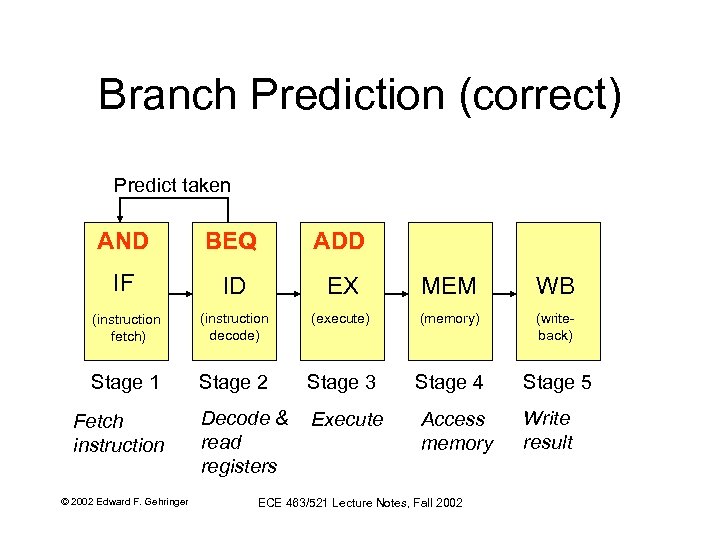 Branch Prediction (correct) Predict taken AND BEQ ADD IF ID EX MEM WB (instruction fetch) (instruction decode) (execute) (memory) (writeback) Stage 1 Stage 2 Stage 3 Stage 4 Stage 5 Decode & read registers Execute Access memory Write result Fetch instruction © 2002 Edward F. Gehringer ECE 463/521 Lecture Notes, Fall 2002
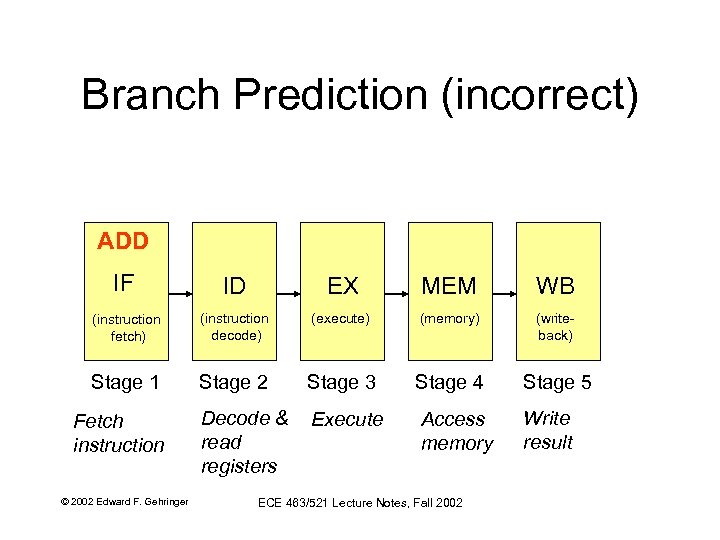 Branch Prediction (incorrect) ADD IF ID EX MEM WB (instruction fetch) (instruction decode) (execute) (memory) (writeback) Stage 1 Stage 2 Stage 3 Stage 4 Stage 5 Decode & read registers Execute Access memory Write result Fetch instruction © 2002 Edward F. Gehringer ECE 463/521 Lecture Notes, Fall 2002
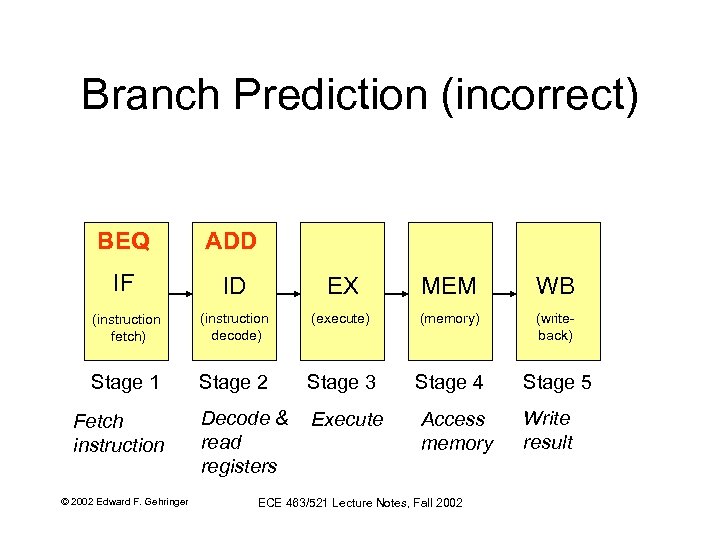 Branch Prediction (incorrect) BEQ ADD IF ID EX MEM WB (instruction fetch) (instruction decode) (execute) (memory) (writeback) Stage 1 Stage 2 Stage 3 Stage 4 Stage 5 Decode & read registers Execute Access memory Write result Fetch instruction © 2002 Edward F. Gehringer ECE 463/521 Lecture Notes, Fall 2002
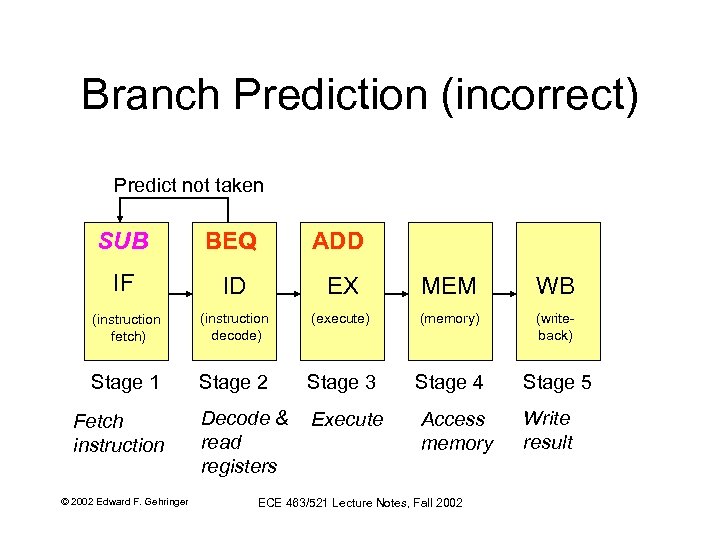 Branch Prediction (incorrect) Predict not taken SUB BEQ ADD IF ID EX MEM WB (instruction fetch) (instruction decode) (execute) (memory) (writeback) Stage 1 Stage 2 Stage 3 Stage 4 Stage 5 Decode & read registers Execute Access memory Write result Fetch instruction © 2002 Edward F. Gehringer ECE 463/521 Lecture Notes, Fall 2002
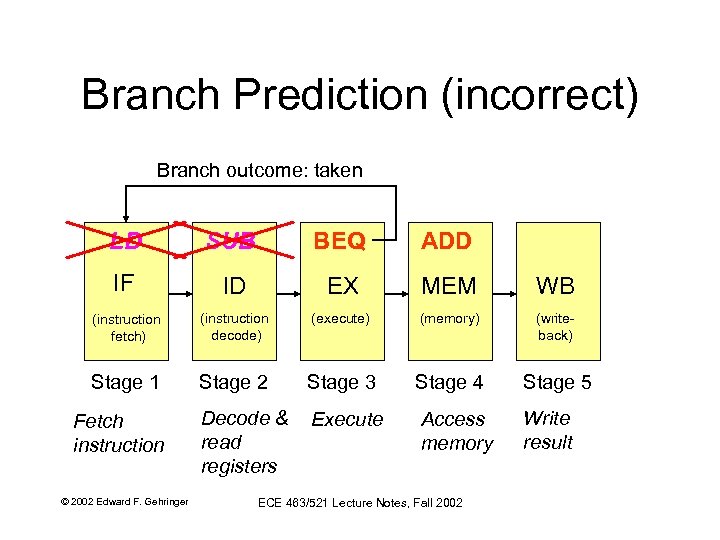 Branch Prediction (incorrect) Branch outcome: taken LD SUB BEQ ADD IF ID EX MEM WB (instruction fetch) (instruction decode) (execute) (memory) (writeback) Stage 1 Stage 2 Stage 3 Stage 4 Stage 5 Decode & read registers Execute Access memory Write result Fetch instruction © 2002 Edward F. Gehringer ECE 463/521 Lecture Notes, Fall 2002
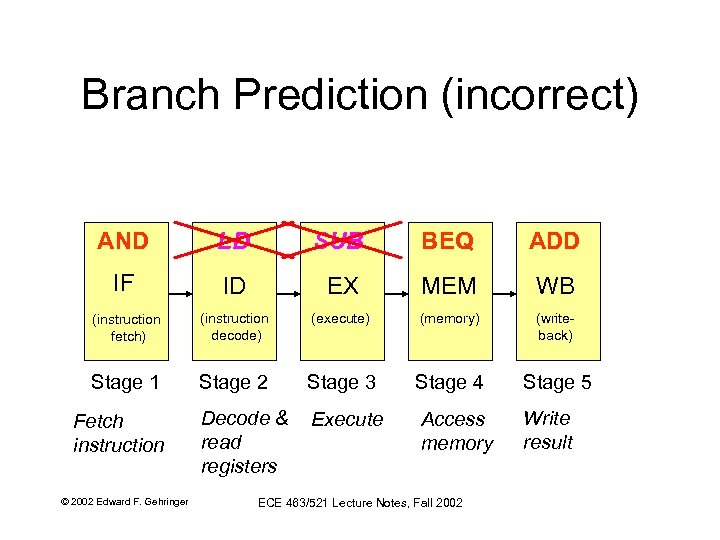 Branch Prediction (incorrect) AND LD SUB BEQ ADD IF ID EX MEM WB (instruction fetch) (instruction decode) (execute) (memory) (writeback) Stage 1 Stage 2 Stage 3 Stage 4 Stage 5 Decode & read registers Execute Access memory Write result Fetch instruction © 2002 Edward F. Gehringer ECE 463/521 Lecture Notes, Fall 2002
 Speedup with branch stalls • What is the speedup of the pipeline if 1/5 of the instructions are branches, and 4/5 of those are correctly predicted? • Can you give a general formula for a k-stage pipeline? What other information do you need to know? © 2002 Edward F. Gehringer ECE 463/521 Lecture Notes, Fall 2002
 Sears Tower Repairman • Repair shop is in the basement – Has many tools. – A few are used frequently, • e. g. , hammer, crescent wrench, screwdriver – Most are used infrequently, • e. g. , socket wrenches © 2002 Edward F. Gehringer ECE 463/521 Lecture Notes, Fall 2002
 Sears Tower Repairman • Problem – Sears Tower has 110 stories! – Today, you are working on the top floor. – Can’t bring entire shop with you. – Don’t know exactly which tools to bring with you from the basement. © 2002 Edward F. Gehringer ECE 463/521 Lecture Notes, Fall 2002
 Sears Tower Repairman • Solution – Carry frequently used tools in your tool belt. – Tool-belt becomes a “cache” of tools — drastically reduces the number of trips down to the basement. – When you have to fetch ¼" socket wrench, common sense says to also fetch ½", ¾", etc. , just in case. © 2002 Edward F. Gehringer ECE 463/521 Lecture Notes, Fall 2002
 Caches • The processor-memory speed gap – Processor is very fast • Intel Pentium-4: 1 GHz, 1 clock cycle = 1 ns – Large memory is slow! • Main memory: 50 ns to access, 50 times slower than Pentium-4! – Processor wants large and fast memory. • LARGE: O/S and applications consume lots of memory • FAST: Otherwise, processor stalls nearly 100% of time waiting for memory. © 2002 Edward F. Gehringer ECE 463/521 Lecture Notes, Fall 2002
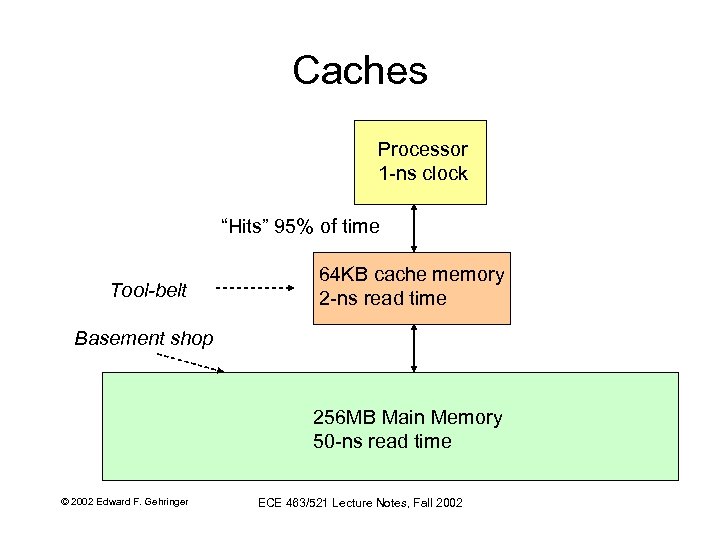 Caches Processor 1 -ns clock “Hits” 95% of time Tool-belt 64 KB cache memory 2 -ns read time Basement shop 256 MB Main Memory 50 -ns read time © 2002 Edward F. Gehringer ECE 463/521 Lecture Notes, Fall 2002
 Average access time • What is the average access time in this memory system? © 2002 Edward F. Gehringer ECE 463/521 Lecture Notes, Fall 2002
 Caches • Caches are effective because of locality of reference. – Temporal locality: If you access an item, you are likely to access it again in near future. • Tool-belt contains frequently used tools. – Spatial locality: If you access an item, you are likely to access a nearby item in the near future. • This is why repairman also fetched ½" and ¾" socket wrenches when (s)he only needed ¼". © 2002 Edward F. Gehringer ECE 463/521 Lecture Notes, Fall 2002
 Overview of Topics in 463/521 1. Measuring performance and cost 2. Caches and memory hierarchies 3. Instruction-set architecture (ISA) – Defines software/hardware interface 4. Simple pipelining – – – Data and control (branch) dependences Data bypasses Branch prediction © 2002 Edward F. Gehringer ECE 463/521 Lecture Notes, Fall 2002
 Overview of Topics in 463/521 5. Complex pipelining and instruction-level parallelism (ILP). – – Data hazards Dynamic instruction scheduling, register renaming, Tomasulo’s algorithm. Precise interrupts Superscalar, VLIW, and vector processors. © 2002 Edward F. Gehringer ECE 463/521 Lecture Notes, Fall 2002
 Projects • Three projects – Cache simulator – Branch predictor simulator – Dynamic instruction scheduling pipeline simulator • Programming for projects is harder than anything most of you have encountered before. © 2002 Edward F. Gehringer ECE 463/521 Lecture Notes, Fall 2002
 Course Web site • http: //courses. ncsu. edu/ece 463/lec/001 • http: //courses. ncsu. edu/ece 521/lec/001 • These two homepages are linked to a “common” Web site. • Any info specific to one course will be listed in the announcements section of that course’s home page. © 2002 Edward F. Gehringer ECE 463/521 Lecture Notes, Fall 2002