


 Скачать презентацию Lection 8 Monitoring of land surface water Ukraine
Презентация 8 mon.pptx
- Количество слайдов: 16
 Lection 8 Monitoring of land surface water Ukraine has 63119 rivers, including 9 big ones (water catchment areas above 50 thous. km 2), 81 medium ones (from 2 to 50 thous. km 2), and 63029 small ones (less than 2 thous. km 2). Their total length is 206. 4 thous. km, 90 % of which fall on small rivers. Geographically almost all river basins (except South Bug) belong to international water basins - the fact that stipulates activity of transboundary water-environmental relations and need for accelerated development of the basin water resources management.
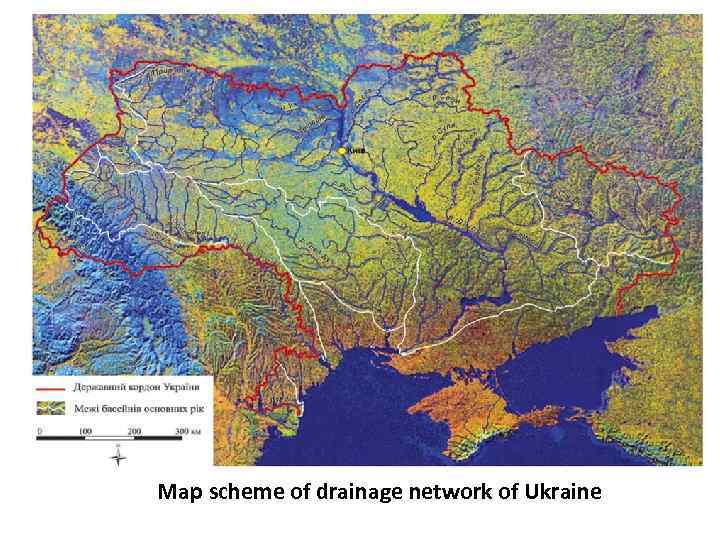 Map scheme of drainage network of Ukraine
 Water stock of Ukraine includes about 8073 lakes and firths; the total watertable area of which is 4021. 5 km 2, the watertable area of firths is 1073 km 2. The number of water bodies that have water volumes of 1 mln km 3 and more is 944. A relatively small part of the territory is occupied by the swamps, swampy terrain and excessively humidified lands - 3. 6 mln ha, but they play a significant resources stabilizing role. Ukraine belongs to the least provided with water resources European countries. Its main component is river run-off.
 Local water resources - those that are formed within Ukraine - amount to 52. 4 km 3 in an average watervolume year. Water resources are distributed in a very unequal way within the country’s territory. Resources are higher in the north and less in the south, where the bigger water-consumers are located. Ukraine also has underground water reserves. The general amount of forecasted exploitable subterranean water resources on the country’s territory comes to 57. 2 million cubic meters per day. The territorial division of subterranean water is uneven.
 Judging by the amount of water per Ukrainian citizen, Ukraine, according to international standards, is among those countries insufficiently supplied with water resources. As a result of limited water resources and the way they are distributed, river flow is widely regulated. Reservoirs and ponds, in aggregate, hold close to 58 billion cubic meters, which exceeds the local river flow of all the country’s rivers. Regulating the flow of the majority of rivers has reached, and even exceeded, the top-end economic- and ecologybased permissible limits. Such regulation has drastically decreased and often completely destroyed rivers’ capacity to purify themselves. In addition, many reservoirs (over 1100) and ponds (around 28 thousand) have caused increases in underground water levels in large areas, and changes in underground water systems.
 Water use Ukraine has multi-plan approach to water resource use. The consumer properties of water resources predetermine the possibilities for their complex and multipurpose use by many economic branches. The basic priorities of water use in Ukraine are the population, agriculture and industry. The water consumption structure data analysis and the water supply and drainage system basic parameters dynamics, as well as the data on water quality dynamics, have shown that water use structure does not address the peculiarities of forming and territorial-time dividing the country’s water resources and causes the creation of catastrophic situations within the population’s water supply and economic entities for quantitative and qualitative indicators. The water use situation is an intense one, and further developing it will be impossible if new stresses are added.
 Surface waters are much polluted, with the chief pollutants being poisonous chemicals, oil products, heavy metallic salts, phenols, and biogenic elements. The connection of surface water pollution with economic activity in the past 10 -12 years breaks down as follows: 60 -65% is due to industry; 16 -20% to agriculture; 18 -20% to communal activity; and around 1% to various spread-out contamination sources.
 Low forestation and a high degree of tilled landscapes in small and medium rivers’ sub-watershed systems provide ideal conditions for a stable surface water resource pollution level. With an average 70 percent of Ukraine’s territory tilled, the indicators concerning reservoirs of some rivers vary between 58 and 78 percent, and the level of their agricultural cultivation reaches between 72 and 84 percent and more. As a result of rapid anthropogenic element changes, pollution of surface water resources varies drastically, within a large range – from “mildly polluted” to “very polluted” (that is, from class II to VI, according to the current Ukrainian waterquality classification system). Calculations based on this classification show that 88% of tested rivers in Ukraine (and their basins) have ecological conditions ranging from “bad” to “catastrophic. ”
 In the current structure of the processes of underground water pollution of Ukraine’s territories, two levels are distinguished: • almost complete pollution of subsoil waters (first from the day’s surface water horizon), by remnants of mineral fertilizers, pesticides, heavy metals, oils, etc. ; • local pollution of the first urgent and deeper horizons of the active water cycle zone as a result of accelerated pollution migration under the influence of operating water off takes, mines, etc.
 Monitoring of surface waters In Ukraine the national activity in the field of water quantity and water quality monitoring is regulated by Water Code of Ukraine, Law on Environmental Protection, Law on Hydrometeorological Activity, and a number of Regulations of the Cabinet of Ministers of Ukraine. The institutional activities in this field are undertaken by a number of governmental bodies. Generally, the present surface water quantity and water quality monitoring systems in Ukraine were inherited from the former Soviet Union.
 State Hydrometeorological Service monitors hydrochemical state of water at 151 water objects and hydrobiological state at 45 water objects. The quantity of stationary sites of hydrochemical observations is 347 units. Hydrobiological observations are conducted at 259 sites. Control measurements are made once a month on 30 -40 parameters that assess the chemical state of water, biogenic parameters, presence of suspended particles and organic substances, main pollutants, heavy metals and pesticides. Indicators of radioactive pollution of surface waters are also being identified. Chronic toxicity of water is measured at 8 water objects; transboundary pollution is controlled at 15 sites. The samples are taken manually 4 -12 times a year.
 State Environmental Inspection takes individual samples at more than 2200 sites and receives data on 60 parameters that are being measured.
 State Water Agency monitors the state of rivers, water reservoirs, channels, irrigation systems within multi-purpose water economy systems, water supply systems, transboundary watercourses and reservoirs, in areas affected by nuclear power plants. Water quality is controlled according to physical and chemical parameters at 72 water reservoirs, 164 rivers, 14 irrigation systems, 1 bay and 5 multi-purpose canals. Level of radionuclides in the surface waters is controlled by the water management organizations as part of radiation monitoring. Number of observation sites – 328, quantity of parameters controlled – over 40, frequency of observations – once a month.
 Sanitary and Epidemiological Service monitors centralized and de-centralized sources of drinking water supply, recreation areas along rivers and water reservoirs. Observations are of selective seasonal character and reflect the state of water objects in summer period only as it is the most complicated from the environmental point of view. Sanitary and epidemiological service controls chemical composition of ground waters that are designated for drinking purposes.
 Enterprises of the State Geological Service monitor the state of ground waters. The depths of ground waters and their natural geochemical composition are assessed twice a year at the monitoring sites. Twenty two parameters, including concentration of heavy metals and pesticides, are being measured.
 The Ministry of Environment Protection coordinates of water quality monitoring activities of different governmental bodies. It is also responsible for organization of monitoring of sources of anthropogenic impact and zones of their direct influence, and organization of the services for special inspections of analytical control. Each governmental body involved in water quality monitoring uses its own software and data bank. As a result, the water quality data are distributed over various sources, unintegrated, and not comparable. There is no harmonized methodology for water quality monitoring