


 Скачать презентацию Lection 7 ORGANIZATION OF THE ATMOSPHERIC AIR MONITORING
Презентация 7 mon.pptx
- Количество слайдов: 9
 Lection 7 ORGANIZATION OF THE ATMOSPHERIC AIR MONITORING The existing network of air pollution survey includes: - stationary sites, - route sites, - mobile sites (under plume sites). Site (or observation post) is the selected location (point of detail), where the pavilion or car equipped with the appropriate instruments is located.
 Stationary site is intended to provide for a regular air sampling to identify and register pollution content. Route site is intended to provide for a regular air sampling in areas where impossible or impractical to set a stationary site. Mobile site (under plume site) is designed for sampling in smoke (gas) plume to identify zone of influence of a particular source of industrial emissions.
 Selecting of site location depends on: 1) the level of air pollution, which is representative of the respective region or 2) concentration of contaminants in a particular point that is influenced by emissions of individual industrial enterprise, highway or other source. The most cities in the CIS have 3− 6 stationary sites, the largest of them – 6− 20 (Kiev − 16), most cities in Western Europe have 1− 3 stationary sites. CIS – The Commonwealth of Independent States (Співдружність Незалежних Держав, СНД)
 Regular observations at stationary sites held by one of the four monitoring programs: • complete monitoring program • incomplete monitoring program • reduced monitoring program • daily monitoring program Simultaneously with air sampling such meteorological parameters are determined: wind speed and wind direction, air temperature, weather conditions and the underlying surface conditions.
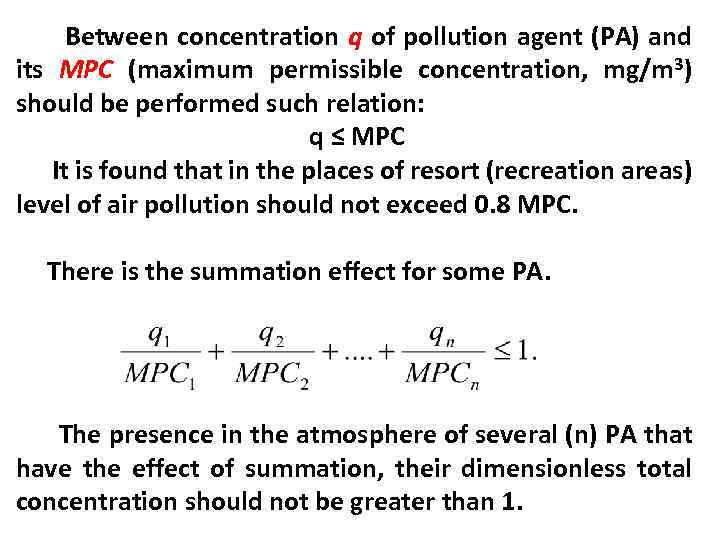 Between concentration q of pollution agent (PA) and its MPC (maximum permissible concentration, mg/m 3) should be performed such relation: q ≤ MPC It is found that in the places of resort (recreation areas) level of air pollution should not exceed 0. 8 MPC. There is the summation effect for some PA. The presence in the atmosphere of several (n) PA that have the effect of summation, their dimensionless total concentration should not be greater than 1.
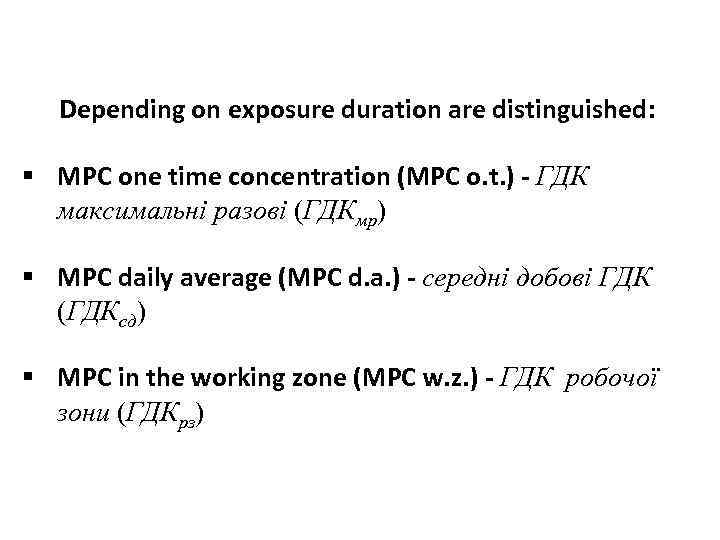 Depending on exposure duration are distinguished: § MPC one time concentration (MPC o. t. ) - ГДК максимальні разові (ГДКмр) § MPC daily average (MPC d. a. ) - середні добові ГДК (ГДКсд) § MPC in the working zone (MPC w. z. ) - ГДК робочої зони (ГДКрз)
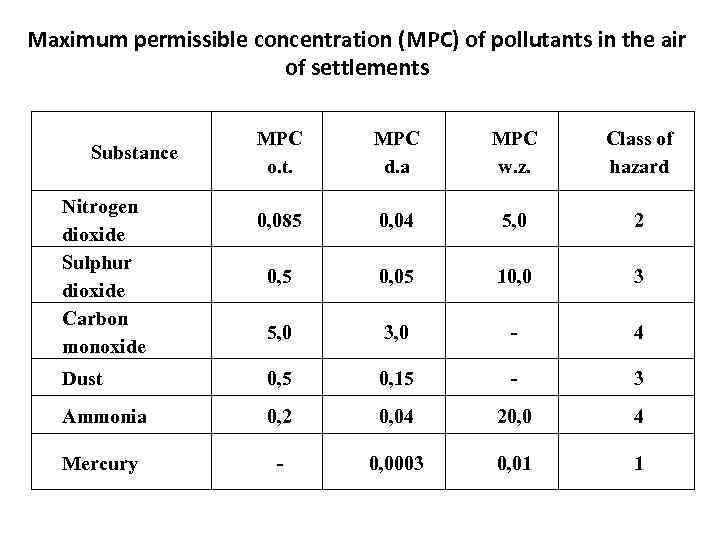 Maximum permissible concentration (MPC) of pollutants in the air of settlements MPC o. t. MPC d. a MPC w. z. Class of hazard 0, 085 0, 04 5, 0 2 0, 5 0, 05 10, 0 3 5, 0 3, 0 - 4 Dust 0, 5 0, 15 - 3 Ammonia 0, 2 0, 04 20, 0 4 Mercury - 0, 0003 0, 01 1 Substance Nitrogen dioxide Sulphur dioxide Carbon monoxide
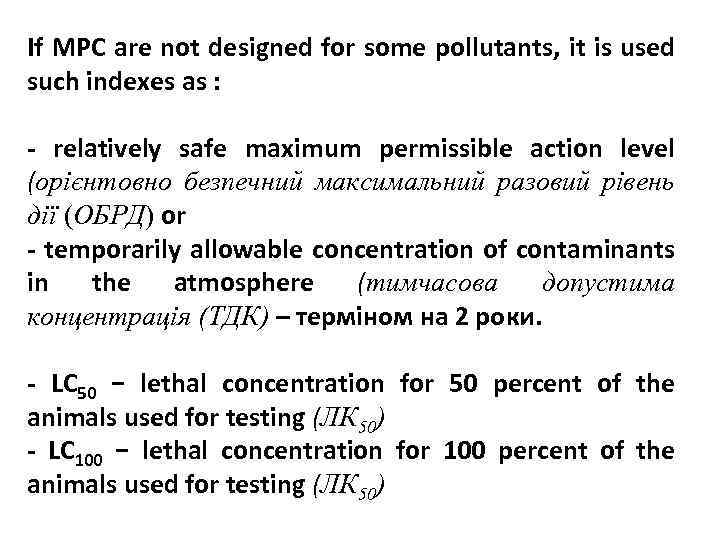 If MPC are not designed for some pollutants, it is used such indexes as : - relatively safe maximum permissible action level (орієнтовно безпечний максимальний разовий рівень дії (ОБРД) or - temporarily allowable concentration of contaminants in the atmosphere (тимчасова допустима концентрація (ТДК) – терміном на 2 роки. - LC 50 − lethal concentration for 50 percent of the animals used for testing (ЛК 50) - LC 100 − lethal concentration for 100 percent of the animals used for testing (ЛК 50)
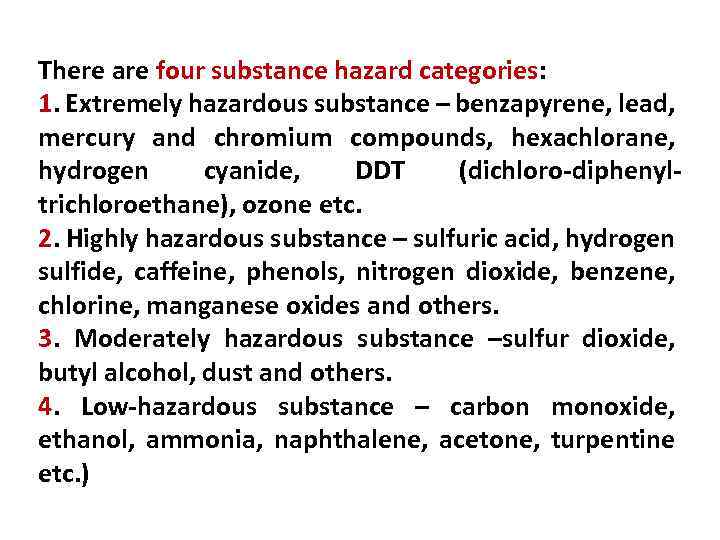 There are four substance hazard categories: 1. Extremely hazardous substance – benzapyrene, lead, mercury and chromium compounds, hexachlorane, hydrogen cyanide, DDT (dichloro-diphenyltrichloroethane), ozone etc. 2. Highly hazardous substance – sulfuric acid, hydrogen sulfide, caffeine, phenols, nitrogen dioxide, benzene, chlorine, manganese oxides and others. 3. Moderately hazardous substance –sulfur dioxide, butyl alcohol, dust and others. 4. Low-hazardous substance – carbon monoxide, ethanol, ammonia, naphthalene, acetone, turpentine etc. )