


 Скачать презентацию Lection 6 AIR POLLUTION AND AIR MONITORING High-quality
Презентация 6 mon.pptx
- Количество слайдов: 20
 Lection 6 AIR POLLUTION AND AIR MONITORING High-quality air, along with water, is a crucial element for human life and all components of the biosphere. The high speed of mass movement within the atmospheric strata leads to air pollution migration across significant distances, within the ozone layer as well, and negative consequences, namely acid rain or acceleration of karstic processes. Envelope of air around the Earth forms the atmosphere with thickness up to 20 km.
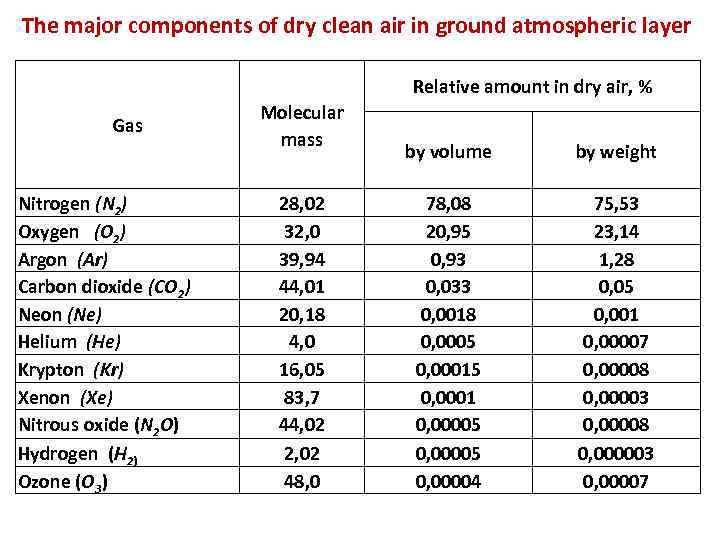 The major components of dry clean air in ground atmospheric layer Relative amount in dry air, % Gas Nitrogen (N 2) Oxygen (O 2) Argon (Ar) Carbon dioxide (CO 2) Neon (Ne) Helium (Не) Krypton (Kr) Xenon (Xe) Nitrous oxide (N 2 O) Hydrogen (H 2) Ozone (O 3) Molecular mass 28, 02 32, 0 39, 94 44, 01 20, 18 4, 0 16, 05 83, 7 44, 02 2, 02 48, 0 by volume by weight 78, 08 20, 95 0, 93 0, 033 0, 0018 0, 0005 0, 0001 0, 00005 0, 00004 75, 53 23, 14 1, 28 0, 05 0, 001 0, 00007 0, 00008 0, 00003 0, 00008 0, 000003 0, 00007
 Air pollution is contamination of the indoor or outdoor environment by any chemical, physical or biological agent that modifies the natural characteristics of the atmosphere. Air pollution includes all contaminants found in the atmosphere. These dangerous substances can be either in the form of gases or particles. The sources of air pollution are both natural and humanbased. As one might expect, humans have been producing increasing amounts of pollution as time has progressed, and they now account for the majority of pollutants released into the air. Air pollution has been a problem throughout history. Even in Ancient Rome people complained about smoke put into the atmosphere. The effects of air pollution are diverse and numerous. Air pollution can have serious consequences for the health of human beings, and also severely affects natural ecosystems.
 Particulate matter and ground-level ozone are now generally recognized as the two pollutants that most significantly affect human health. Long-term and peak exposures to these pollutants range in severity of impact, from impairing the respiratory system to premature death. For instance, in recent years, up to 40 % of Europe’s urban population may have been exposed to ambient concentrations of coarse PM (PM 10) above the EU limit set to protect human health. Up to 50 % of the population living in urban areas may have been exposed to levels of ozone that exceed the EU target value. Fine particulate matter (PM 2. 5) in air has been estimated to reduce life expectancy in the EU by more than eight months.
 Air pollution also damages the environment. Acidification is caused by acid deposition of excess sulphur and nitrogen compounds. Eutrophication, is an environmental problem that caused by the input of excessive nutrients into ecosystems, in particular by excessive atmospheric nitrogen Crop damage is caused by exposure to high ozone concentrations.
 Sources of air pollution There are various sources of air pollution, both anthropogenic and of natural origin: - burning of fossil fuels in electricity generation, transport, industry and households; - industrial processes and solvent use, for example in chemical and mineral industries; - agriculture; - waste treatment; - volcanic eruptions, windblown dust, sea-salt spray and emissions of volatile organic compounds from plants are examples of natural emission sources.
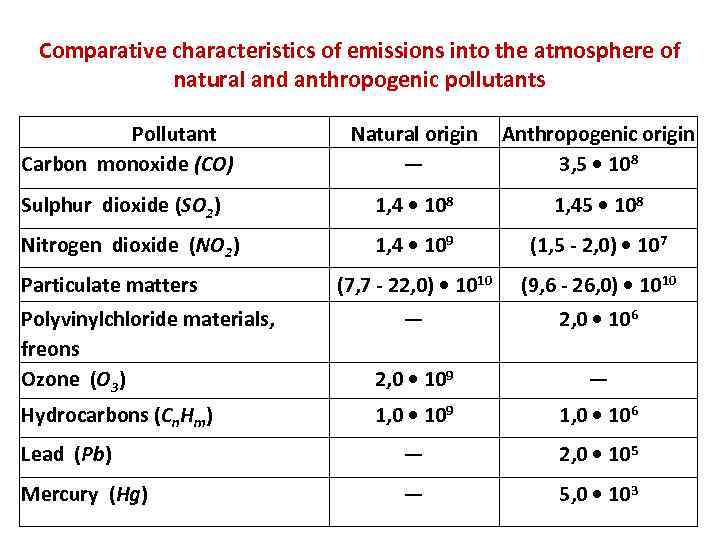 Comparative characteristics of emissions into the atmosphere of natural and anthropogenic pollutants Pollutant Carbon monoxide (CO) Natural origin — Anthropogenic origin 3, 5 • 108 Sulphur dioxide (SO 2) 1, 4 • 108 1, 45 • 108 Nitrogen dioxide (NO 2) 1, 4 • 109 (1, 5 - 2, 0) • 107 (7, 7 - 22, 0) • 1010 (9, 6 - 26, 0) • 1010 Particulate matters Polyvinylchloride materials, freons Ozone (O 3) — 2, 0 • 106 2, 0 • 109 — Hydrocarbons (Сn. Hm) 1, 0 • 109 1, 0 • 106 Lead (Pb) — 2, 0 • 105 Mercury (Hg) — 5, 0 • 103
 Monitoring of atmospheric air in Ukraine Monitoring of atmospheric air - is an informational and technical system of observation, evaluation and prediction of the air pollution level and providing on this basis recommendations for measures to protect air quality. In Ukraine monitoring of air quality is carried out by three bodies of State environmental monitoring system:
 1) State Hydrometeorological Service (Ukr. HMS) carries out monitoring of air pollution in 53 cities of Ukraine by 163 stationary, 2 observational mobile posts and 2 stations of transboundary transport. At the stationary posts, observations are carried out 4 times a day except Sundays and public holidays. Sampling is performed with the absorption filters within 20 minutes with subsequent determination of substance concentration. The program of air quality monitoring consists of seven main pollutants: dust, nitrogen dioxide, sulfur dioxide, carbon monoxide, formaldehyde, lead and benzo(a)pyrene. The heavy metals for mandatory monitoring include cadmium, iron, manganese, copper, nickel, lead, chromium and zinc.
 Furthermore, according to local peculiarities of human settlements, stationary posts also monitor specific pollutants (e. g. ammonia, benzene, phenol, hydrogen sulfide, anhydrous hydrogen fluoride, toluene and other). In addition, the analysis of pollutant presence is carried out in precipitation and snow cover; hydro-meteorological parameters are also observed. The concentrations of 31 harmful air contaminants are determined in 53 cities. The observations are carried out in accordance with the requirements of the GD 52. 04. 186 -89 "Guidelines for atmospheric pollution control".
 Monitoring of air quality is carried out in accordance with the approved list of hazardous substances, which is approved for each of the 53 Ukrainian cities, including: • Dust, nitrogen dioxide, sulfur dioxide in 53 cities; • Carbon monoxide in 49 cities; • Nitrogen oxide in 28 cities; • Heavy metals and benz (a) pyrene in 50 cities; • Formaldehyde in 43 cities; • Phenol in 23 cities; • Ammonia in 23 cities; • Anhydrous hydrogen fluoride in 14 cities; • Hydrogen sulfide in 16 cities; • Hydrogen chloride in 11 cities; • Soot in 6 cities; • Dissolved sulfate in 20 cities; • Sulfuric acid in 2 cities; • Benzene, toluene, ethyl benzene and xylene in 2 cities; • Aniline in 1 city. In Ukraine, concentrations of ozone, РМ 2, 5 and РМ 10 are not controlled in human settlements.
 2) Sanitary-Epidemiological Service (SES) carries out periodic monitoring of air quality in residential and recreational areas, particularly near major roads, sanitary protection zones and residential buildings, on the territory of schools, preschool and medical institutions in urban areas. In addition, the analysis of air quality is carried out in residential areas upon inhabitants’ complaints. The flare observations are also carried out near the sources of emissions. Usually observations are carried out accordingly to the various social and health monitoring programs (5 -15 air pollutants). The SES air quality monitoring programs are approved for each city and major settlement. Monitoring of air quality is carried out on mobile or stationary control posts. Observations on the stationary posts are carried out by sampling with absorption filters during 24 hours with subsequent determination of daily average concentrations by laboratory methods.
 3) State Ecological Inspectorate (SEI) provides selective sampling at the emission sources. It measures over 65 parameters at more than 3, 000 major sources of emissions, which belong to more than 1, 500 enterprises. Governance of state ecological monitoring of the MENR, as well as Regional governances of ecology and natural resources collect data from monitoring entities. The MENR does not have its own network of air quality monitoring.
 It should be noted that Ukraine is a participant of some international conventions directed towards protecting the quality of atmospheric air, among which – the Montreal Protocol, the United Nations Framework Convention on Climate Change and others. Ukraine’s international cooperation leads to implementing a corresponding national policy and concrete actions in this direction. However there is no any special strategic document for air quality protection in Ukraine which would be analogous to the Thematic Strategy on Air Pollution (2005). There is a strategic program document that is related to emissions of dust, sulfur and nitrogen dioxides, ammonia, hydrocarbons and light organic compounds (Resolution of the CMU № 610 -p on 15. 10. 2003), but the document is outdated and requires revision. In Ukraine, there are no any special strategic documents in the domain of air quality control that concern heavy metals and persistent organic compounds. In 2012, the MENR started to develop new state environmental programs on conducting environmental monitoring in Ukraine until 2020.
 Key standard acts and normative-technical documents regulating air quality monitoring: • The Law of Ukraine “On air protection”; • The CMU Decree on 09. 03. 1999 № 343 “On approval of the Procedure of organization and execution of monitoring in the domain of air protection”; • State standard 17. 2. 3. 01 -86 "The nature conservancy. Atmosphere. Air quality control regulations of human settlements"; • GD 52. 04. 186 -89 "Guidelines for atmospheric pollution control", Moscow: 1991
 The state of air pollution in Ukraine Not so long ago, Ukraine was among those countries with high absolute and weighted air pollution levels. The tendency toward reduced pollution emissions witnessed during 1992 -2000, has ended. Today, pollution is again rising. In 2000, fuel and energy complex enterprises released 35 percent of pollution emissions into the atmospheric air, particularly 55. 6 percent of the atmosphere’s mechanical pollution, 75 percent of sulfur dioxide emissions, 58 percent of nitrogen oxide pollution and 5. 4 percent of carbon oxide pollution. Dust content exceeded specifications in 23 Ukrainian cities, particularly increasing in Dniprodzerzhinsk (50 percent), Kremenchug (33 percent), Krasnoperekopsk (36 percent), Poltava and Yalta (25 percent). The atmospheric air of Ukraine’s industrial regions contains such harmful substances as formaldehyde, benzapyrene, hydrogen fluoride, carbon oxide, and from time to time, they exceed their maximum allowed concentrations.
 In 2011, 6. 9 million tons of pollutants were released into the atmosphere. Among them, 4. 4 millions are from stationary sources and 2. 5 million are from mobile sources. Compared to 2005 year, total volumes of PE are increased only on 4% while PE volumes from stationary sources are decreased on 0. 1 million tons and increased on 0. 35 million tons for mobile sources. Besides pollutants, 236. 0 million tons of carbon dioxide is released into the atmosphere in 2011. In 2011, there were 8699 enterprises that released pollutants into the atmosphere from stationary sources (almost on 2300 enterprises less than in 2006). The emissions content is dominated by sulfur compounds (30. 7%), carbon monoxide (24. 4%), methane (20. 1%), dust (13. 9%), nitrogen (8. 7%), metals and their compounds (0. 7%). In 2011 compared to 2005, the analysis of the emission compositions shows the decrease of dust (12. 3%) and carbon monoxide (19%), increase of sulfur compounds (20%), methane (8%) and nitrogen oxides (11. 7%). In 2011 compared to 2005, there is almost 56% increase in carbon dioxide emissions.
 The main air polluters in Ukraine are enterprises that produce electricity, gas and water (41%), enterprises of metallurgical, mining and chemical industries (25% , 20% and 4% accordingly among all emissions). Among human settlements of the Ukraine, the atmosphere of 14 cities, mainly of Donetsk, Dnepropetrovsk, Zaporozhye and Lugansk regions suffers from the highest anthropogenic load from stationary sources of emissions (over 100 thousand tons of emissions per year). Mainly these cities have power plants and enterprises of metallurgy and coke.
 The majority of PE from mobile sources are from automobile transport (90. 1% of all emissions) and mobile production equipment (6. 8%). In Ukraine, statistical data on emissions from mobile sources are collected since 2007. They take into account road, rail, aviation and water transport, as well as production equipment. The emissions structure of the main chemical substances that came into the air during the exploitation of vehicles and production equipment was dominated by carbon monoxide (73. 6%), nitrogen dioxide (12. 0%), light nonmethane organic compounds (11. 4%), soot (1. 4%) and sulfur dioxide (1. 2%).
 If data are compared with WHO recommendations on air quality in Europe, air quality improves regarding typical polluting substances, except for nitrogen oxide. But when the question is about specific and toxic substances, even WHO standards are exceeded in almost all of Ukraine’s large cities. The worst air pollution is in Kiev, Kharkov, Dnipropetrovsk, Donetsk, Kryvyi Rih, Lviv, Mariupol, Odessa, and Zaporizhzhia. Industrial regions produce greater ecological hazards, with emissions densities exceeding average country indicators. In general, emission volumes person exceed indicators for developed countries by several times. Close to 20% of elements that enter the atmosphere from stationary sources, meanwhile, are mutagenic. The growing number of automobiles has resulted in an increase of atmospheric air pollution, in the nation’s big cities primarily. The quantity of automobile transportation will probably grow, and accordingly, the volume of air pollution from automobile sources will grow as well.