


 Скачать презентацию Leaving Certificate Applied Overview The Professional Development Service
77eea197a237fa1e7f623a90aeac531c.ppt
- Количество слайдов: 20
 Leaving Certificate Applied Overview The Professional Development Service for Teachers is funded by the Department of Education and Science under the National Development Plan
 What is the Leaving Certificate Applied? Ø It is a distinct, self-contained two-year Leaving Certificate programme aimed at preparing learners for adult and working life Ø It emphasises forms of achievement and excellence which the established Leaving Certificate has not recognised in the past Ø It offers learners specific opportunity to prepare for and progress to further education and training
 Key Underlying Principles Ø student centred curriculum Ø personal and social development Ø integration and cross curricular links Ø team work Ø literacy & numeracy development Ø active teaching/learning methodologies Ø reflection Ø community links
 Vocational Specialism Options Ø Agriculture/Horticulture Ø Hotel Catering and Tourism Ø Engineering Ø Technology Ø Office Administration and Customer Care Ø Childcare/Community Care Ø Graphics and Construction Studies Ø Craft and Design Ø Hair and Beauty Ø Information and Communications Technology Ø Active Leisure Studies
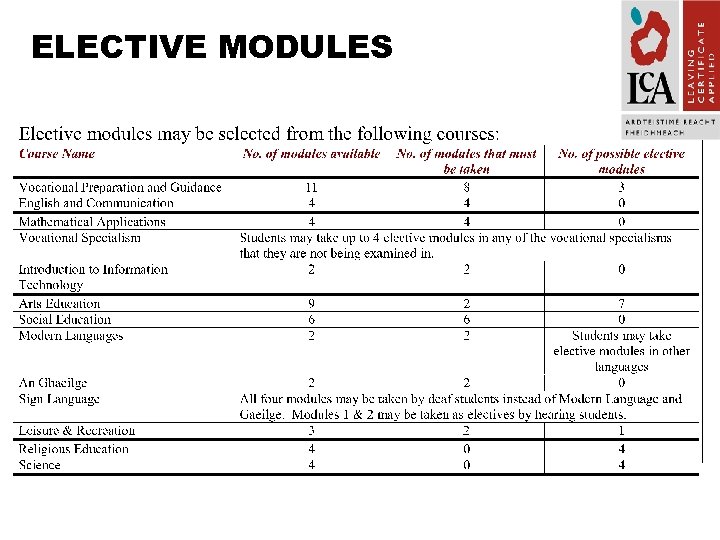 ELECTIVE MODULES
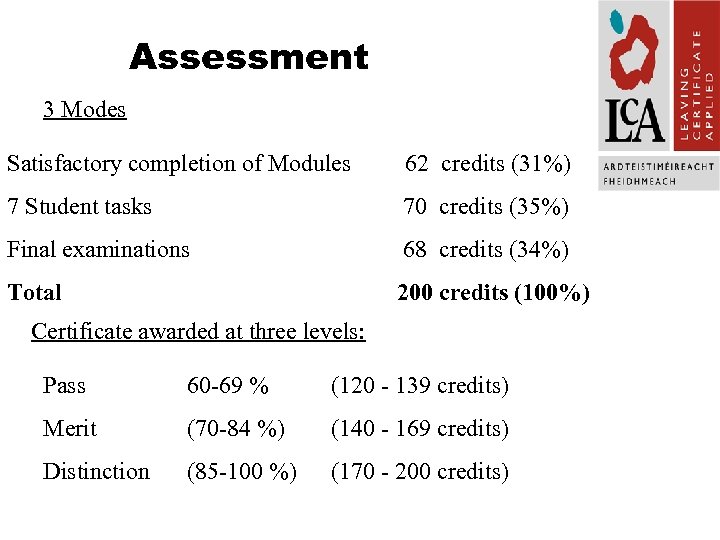 Assessment 3 Modes Satisfactory completion of Modules 62 credits (31%) 7 Student tasks 70 credits (35%) Final examinations 68 credits (34%) Total 200 credits (100%) Certificate awarded at three levels: Pass 60 -69 % (120 - 139 credits) Merit (70 -84 %) (140 - 169 credits) Distinction (85 -100 %) (170 - 200 credits)
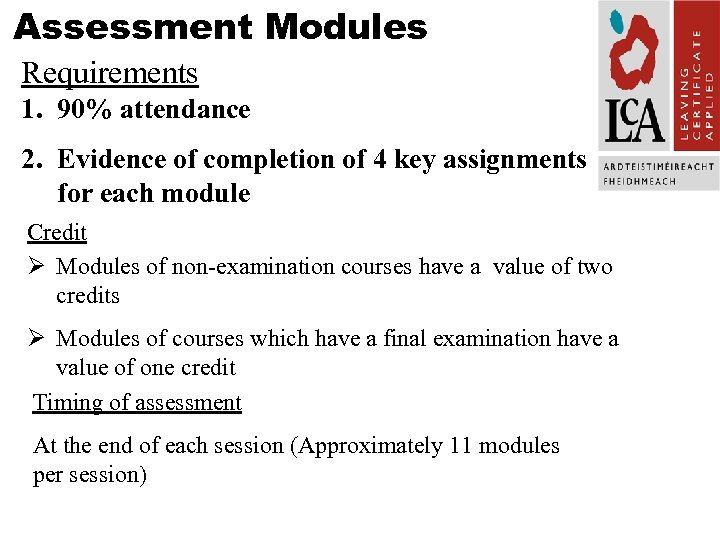 Assessment Modules Requirements 1. 90% attendance 2. Evidence of completion of 4 key assignments for each module Credit Ø Modules of non-examination courses have a value of two credits Ø Modules of courses which have a final examination have a value of one credit Timing of assessment At the end of each session (Approximately 11 modules per session)
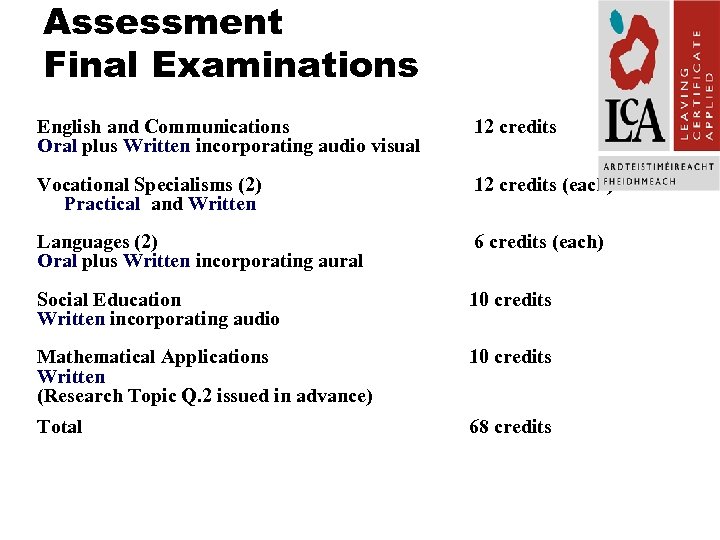 Assessment Final Examinations English and Communications Oral plus Written incorporating audio visual 12 credits Vocational Specialisms (2) Practical and Written 12 credits (each) Languages (2) Oral plus Written incorporating aural 6 credits (each) Social Education Written incorporating audio 10 credits Mathematical Applications Written (Research Topic Q. 2 issued in advance) 10 credits Total 68 credits
 STUDENT TASK Definition A practical activity by which learning is applied to : Types of Tasks ØThe development of a product ØThe investigation of an issue ØThe provision of a service ØThe staging of an event Purpose Vehicle for curriculum integration of as many courses as possible
 Task Criteria Ø Substantial piece of work (10 hours activity per student excluding the report) Ø Individual task or group task (10 hours activity for each student) Ø Individual report on each task Ø Relevant Ø Doable within the time frame
 Ø Title Assessment Criteria for Task Report Ø Statement of Aim Ø Action Plan Ø Research Activity Undertaken Ø Execution of the Task Ø Presentation and Analysis of Findings Ø Statement of Learning Outcomes Ø Evaluation of the Student’s own contribution Ø Integration Across the Curriculum
 Assessment Tasks Requirements 4 Evidence of task completion 4 Individual task report 4 Individual presentation of task at interview with external examiner 4 7 tasks in total Credits for Tasks 1 Voc Prep task 2 Voc Ed tasks 1 General Ed task 1 Personal Reflection task 1 Contemporary Issue task 1 Practical Achievement task 10 credits (5%) 10 credits each (5%) 10 credits (5%)
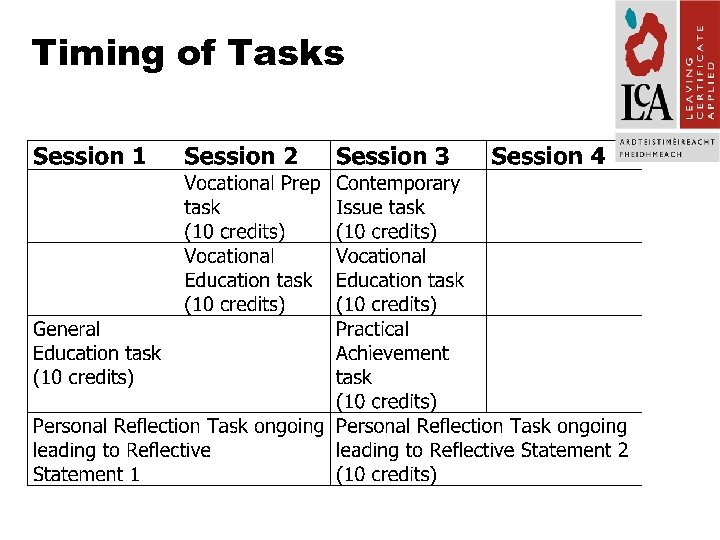 Timing of Tasks
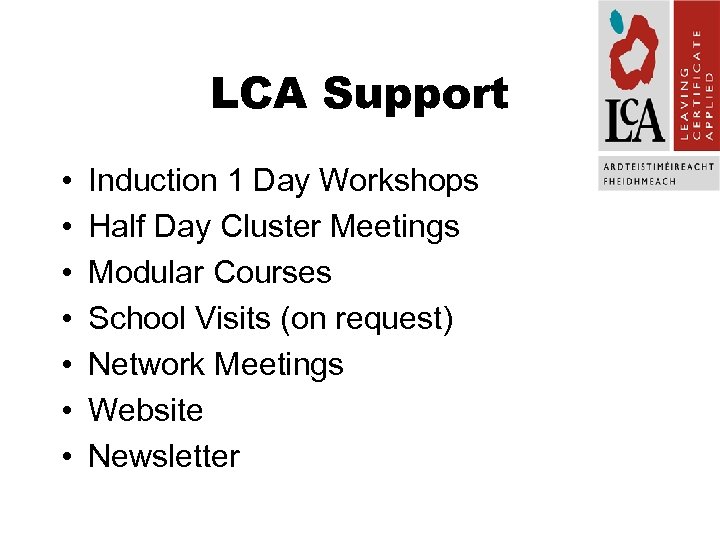 LCA Support • • Induction 1 Day Workshops Half Day Cluster Meetings Modular Courses School Visits (on request) Network Meetings Website Newsletter
 LCA Office • LCA Office, Clare Education Centre, Government Buildings, Kilrush Road, Ennis, Co. Clare. • Phone: 065 -6845504 Fax: 065 -6842930 • Website: www. pdst. ie (click on Leaving Certificate Applied tab). • Harry Freeman 0872908528 • harryfreeman@pdst. ie
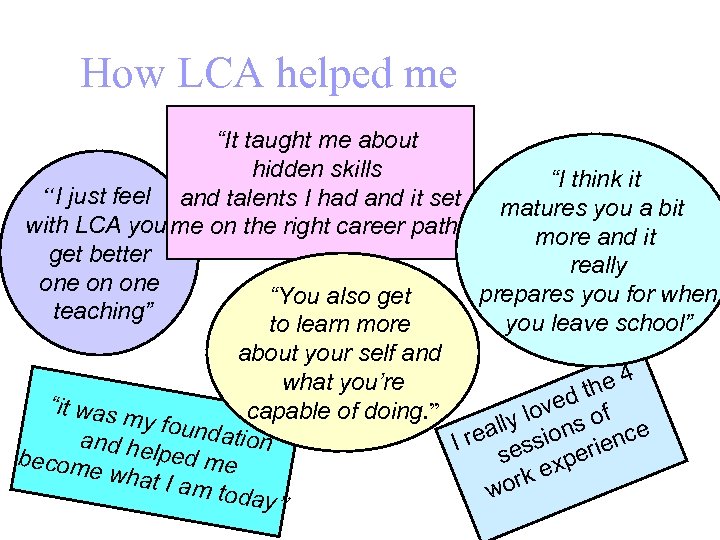 How LCA helped me “It taught me about hidden skills “I think it “I just feel and talents I had and it set matures you a bit with LCA you me on the right career path” more and it get better really one on one prepares you for when “You also get teaching” you leave school” to learn more about your self and 4 what you’re he t ed f “it was capable of doing. ” lov s o my fou y ndation eall ssion ence and he Ir lped m se xperi becom e e what rk e I am to wo day”
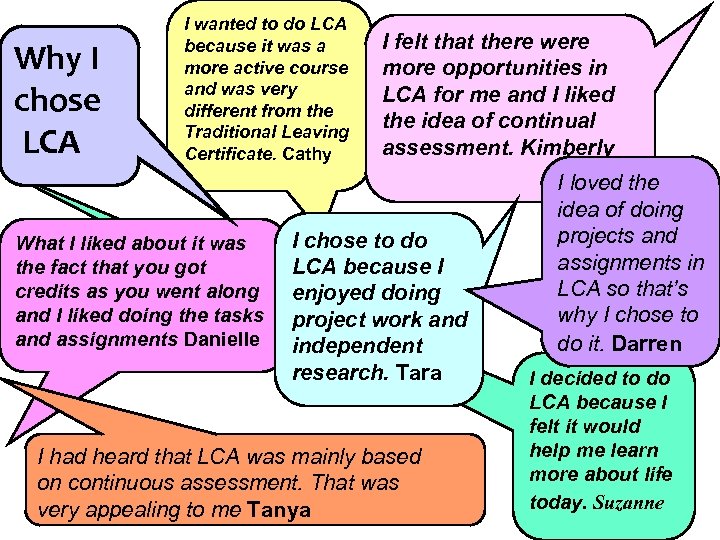 Why I chose LCA I wanted to do LCA because it was a more active course and was very different from the Traditional Leaving Certificate. Cathy What I liked about it was the fact that you got credits as you went along and I liked doing the tasks and assignments Danielle I felt that there were more opportunities in LCA for me and I liked the idea of continual assessment. Kimberly I chose to do LCA because I enjoyed doing project work and independent research. Tara I had heard that LCA was mainly based on continuous assessment. That was very appealing to me Tanya I loved the idea of doing projects and assignments in LCA so that’s why I chose to do it. Darren I decided to do LCA because I felt it would help me learn more about life today. Suzanne
 Leaving Certificate Applied and the Local Community Learning in Leaving Certificate Applied involves students in many out-of-school activities including: • Work Experience • • Enterprise Visits outside school Investigations in the community Working with community groups Outings e. g. outdoor education etc. Interviews Surveys Visitors etc.
 Leaving Certificate Applied In-School Learning Experiences Learning in Leaving Certificate Applied involves students in new and different learning experiences in school including: • • • Group work/Discussion Brainstorming Oral Presentations Visitor to the classroom Role Play Questionnaires/Surveys/Displays/Exhibitions
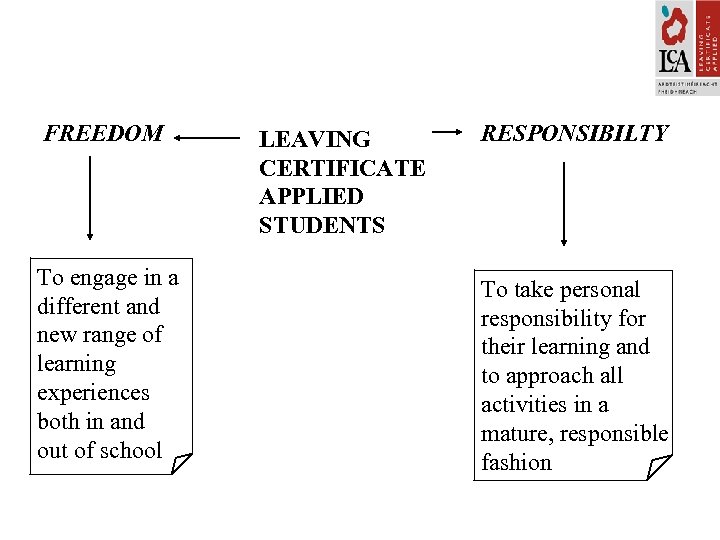 FREEDOM To engage in a different and new range of learning experiences both in and out of school LEAVING CERTIFICATE APPLIED STUDENTS RESPONSIBILTY To take personal responsibility for their learning and to approach all activities in a mature, responsible fashion