 Скачать презентацию Learning to Extract a Broad-Coverage Knowledge Base from
c90e7229f396209e95a9a42fde0ac509.ppt
- Количество слайдов: 33



Learning to Extract a Broad-Coverage Knowledge Base from the Web William W. Cohen Carnegie Mellon University Machine Learning Dept and Language Technology Dept
Learning to Extract a Broad-Coverage Knowledge Base from the Web William W. Cohen joint work with: Tom Mitchell, Richard Wang, Frank Lin, Ni Lao, Estevam Hruschka, Jr. , Burr Settles, Derry Wijaya, Edith Law, Justin Betteridge, Jayant Krishnamurthy, Bryan Kisiel, Andrew Carlson, Weam Abu Zaki
Outline • Web-scale information extraction: – discovering factual by automatically reading language on the Web • NELL: A Never-Ending Language Learner – Goals, current scope, and examples • Key ideas: – Redundancy of information on the Web – Constraining the task by scaling up – Learning by propagating labels through graphs • Current and future directions: – Additional types of learning and input sources
Information Extraction • Goal: – Extract facts about the world automatically by reading text – IE systems are usually based on learning how to recognize facts in text • . . and then (sometimes) aggregating the results • Latest-generation IE systems need not require large amounts of training • … and IE does not necessarily require subtle analysis of any particular piece of text
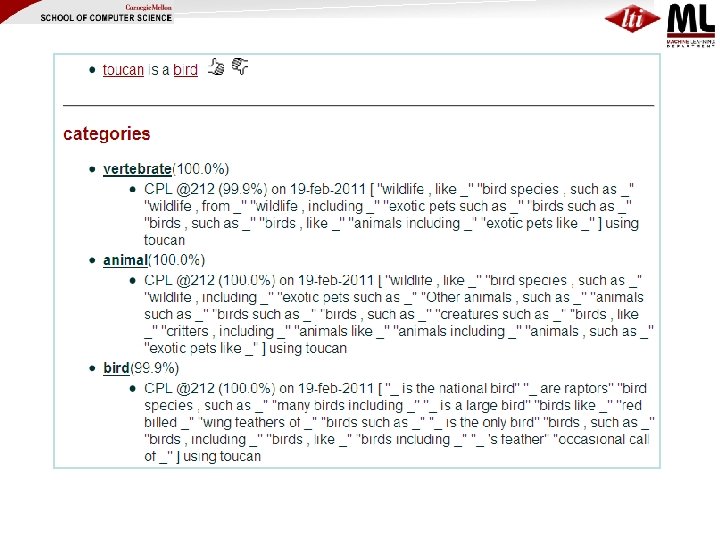
Never Ending Language Learning (NELL) • NELL is a large-scale IE system – Simultaneously learning 500 -600 concepts and relations (person, celebrity, emotion, aquired. By, located. In, capital. City. Of, . . ) – Starting point: containment/disjointness relations between concepts, types for relations, and O(10) examples per concept/relation – Uses 500 M web page corpus + live queries – Running (almost) continuously for over a year – Has learned more than 3. 2 M low-confidence “beliefs” and more than 500 K high-confidence beliefs • about 85% of high-confidence beliefs are correct
More details on corpus size • 500 M English web pages – 25 TB uncompressed – 2. 5 B sentences POS/NP-chunked • Noun phrase/context graph – – 2. 2 B noun phrases, 3. 2 B contexts, 100 GB uncompressed; hundreds of billions of edges • After thresholding: – 9. 8 M noun phrases, 8. 6 M contexts
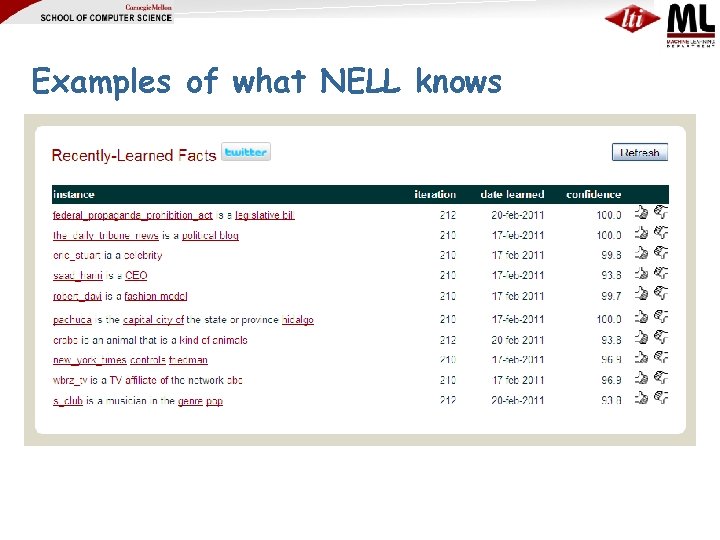
Examples of what NELL knows
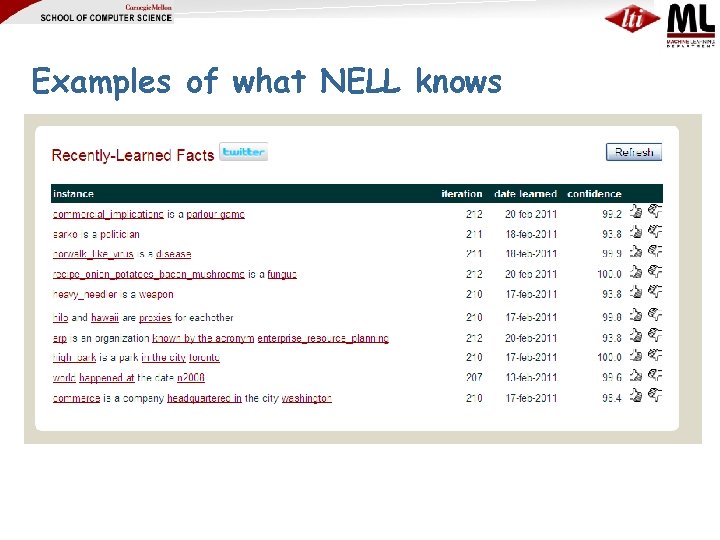
Examples of what NELL knows
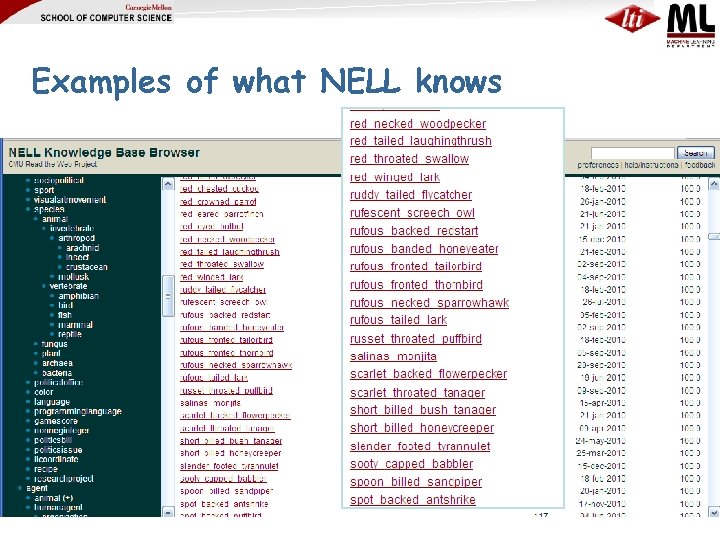
Examples of what NELL knows
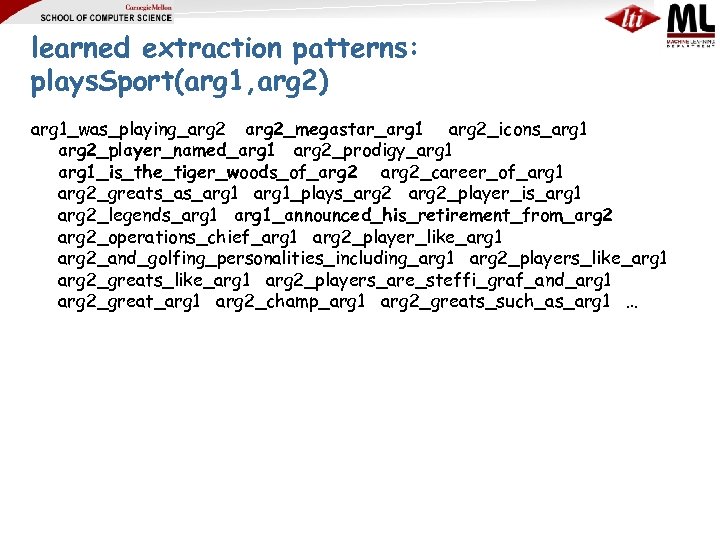
learned extraction patterns: plays. Sport(arg 1, arg 2) arg 1_was_playing_arg 2_megastar_arg 1 arg 2_icons_arg 1 arg 2_player_named_arg 1 arg 2_prodigy_arg 1_is_the_tiger_woods_of_arg 2_career_of_arg 1 arg 2_greats_as_arg 1_plays_arg 2_player_is_arg 1 arg 2_legends_arg 1_announced_his_retirement_from_arg 2_operations_chief_arg 1 arg 2_player_like_arg 1 arg 2_and_golfing_personalities_including_arg 1 arg 2_players_like_arg 1 arg 2_greats_like_arg 1 arg 2_players_are_steffi_graf_and_arg 1 arg 2_great_arg 1 arg 2_champ_arg 1 arg 2_greats_such_as_arg 1 …
Outline • Web-scale information extraction: – discovering factual by automatically reading language on the Web • NELL: A Never-Ending Language Learner – Goals, current scope, and examples • Key ideas: – Redundancy of information on the Web – Constraining the task by scaling up – Learning by propagating labels through graphs • Current and future directions: – Additional types of learning and input sources
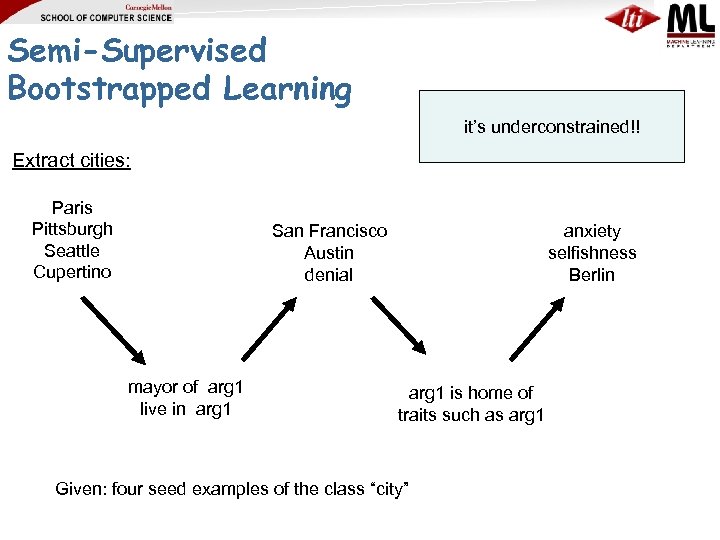
Semi-Supervised Bootstrapped Learning it’s underconstrained!! Extract cities: Paris Pittsburgh Seattle Cupertino San Francisco Austin denial mayor of arg 1 live in arg 1 anxiety selfishness Berlin arg 1 is home of traits such as arg 1 Given: four seed examples of the class “city”
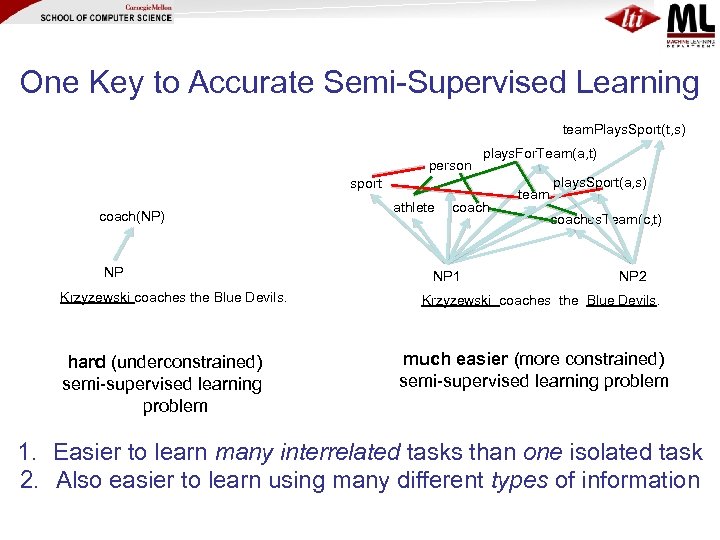
One Key to Accurate Semi-Supervised Learning team. Plays. Sport(t, s) person plays. For. Team(a, t) sport coach(NP) NP Krzyzewski coaches the Blue Devils. hard (underconstrained) semi-supervised learning problem athlete coach NP 1 team plays. Sport(a, s) coaches. Team(c, t) NP 2 Krzyzewski coaches the Blue Devils. much easier (more constrained) semi-supervised learning problem 1. Easier to learn many interrelated tasks than one isolated task 2. Also easier to learn using many different types of information
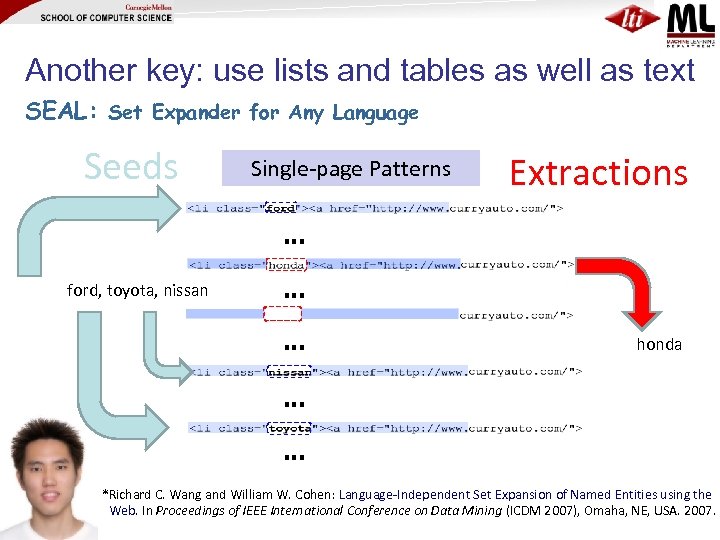
Another key: use lists and tables as well as text SEAL: Set Expander for Any Language Seeds Single-page Patterns Extractions … ford, toyota, nissan … … honda … … *Richard C. Wang and William W. Cohen: Language-Independent Set Expansion of Named Entities using the Web. In Proceedings of IEEE International Conference on Data Mining (ICDM 2007), Omaha, NE, USA. 2007.
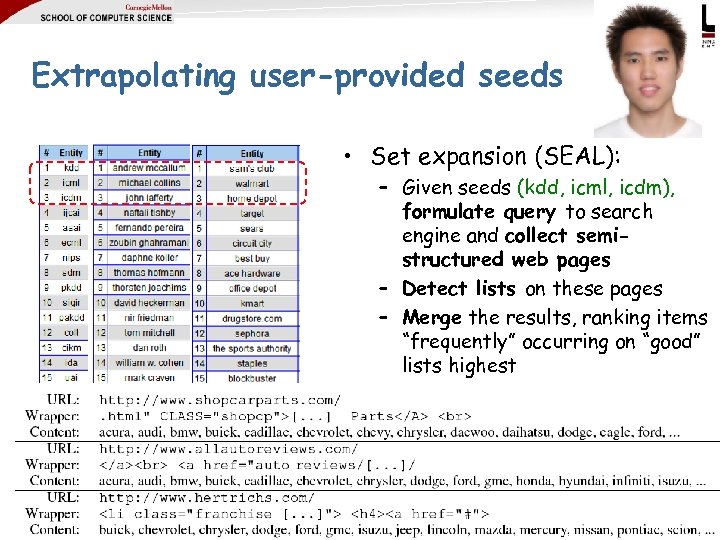
Extrapolating user-provided seeds • Set expansion (SEAL): – Given seeds (kdd, icml, icdm), formulate query to search engine and collect semistructured web pages – Detect lists on these pages – Merge the results, ranking items “frequently” occurring on “good” lists highest – Details: Wang & Cohen ICDM 2007, 2008; EMNLP 2008, 2009
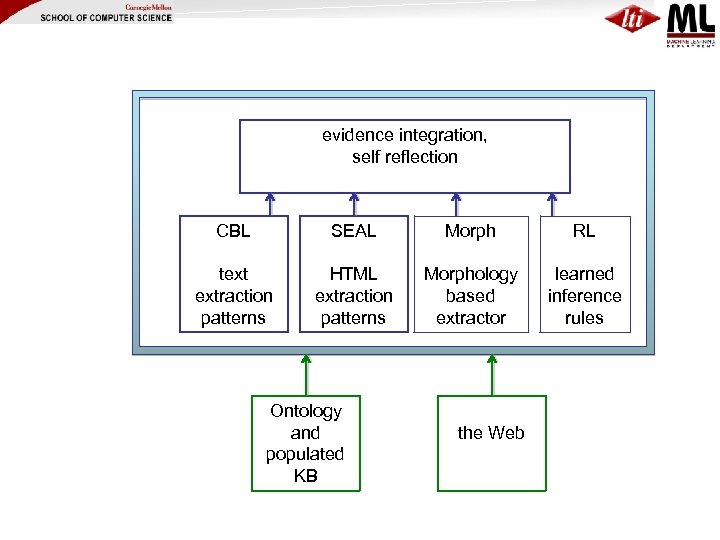
evidence integration, self reflection CBL SEAL Morph RL text extraction patterns HTML extraction patterns Morphology based extractor learned inference rules Ontology and populated KB the Web
Outline • Web-scale information extraction: – discovering factual by automatically reading language on the Web • NELL: A Never-Ending Language Learner – Goals, current scope, and examples • Key ideas: – Redundancy of information on the Web – Constraining the task by scaling up – Learning by propagating labels through graphs • Current and future directions: – Additional types of learning and input sources
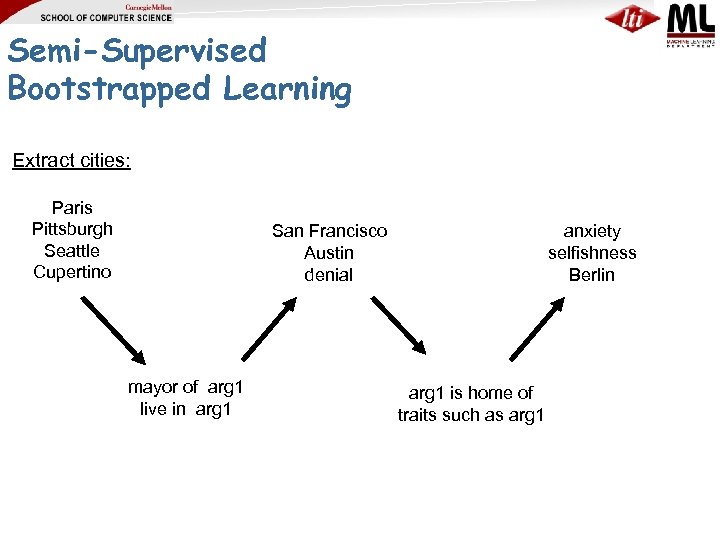
Semi-Supervised Bootstrapped Learning Extract cities: Paris Pittsburgh Seattle Cupertino San Francisco Austin denial mayor of arg 1 live in arg 1 anxiety selfishness Berlin arg 1 is home of traits such as arg 1
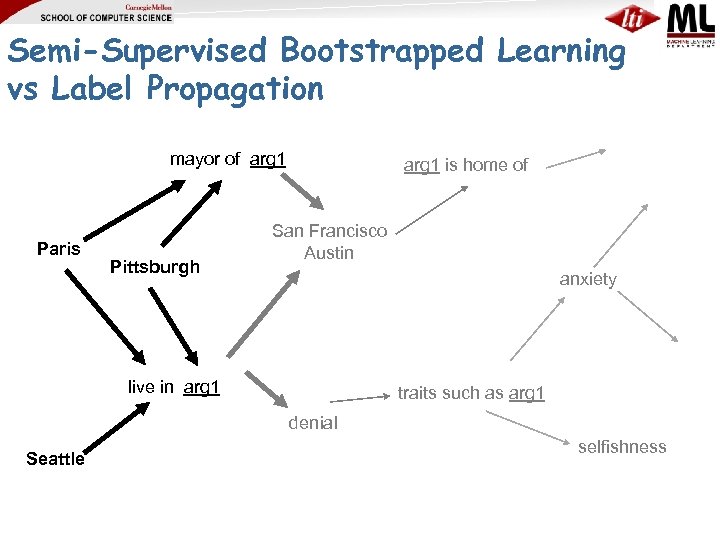
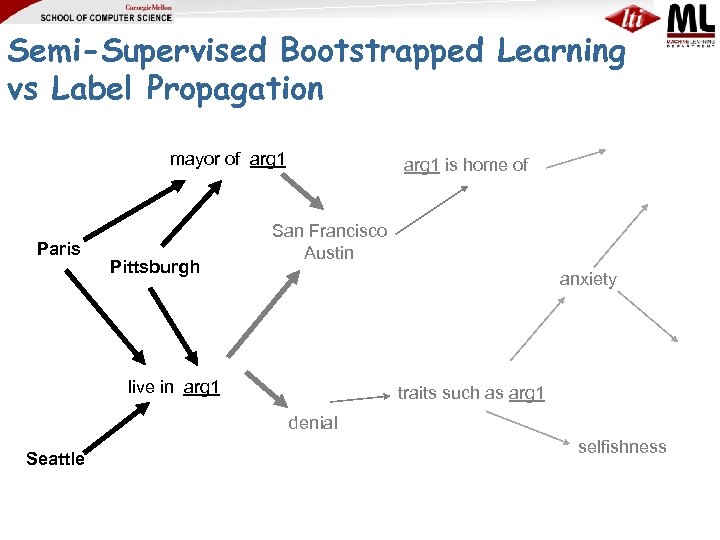
Semi-Supervised Bootstrapped Learning vs Label Propagation mayor of arg 1 Paris Pittsburgh arg 1 is home of San Francisco Austin anxiety live in arg 1 traits such as arg 1 denial Seattle selfishness
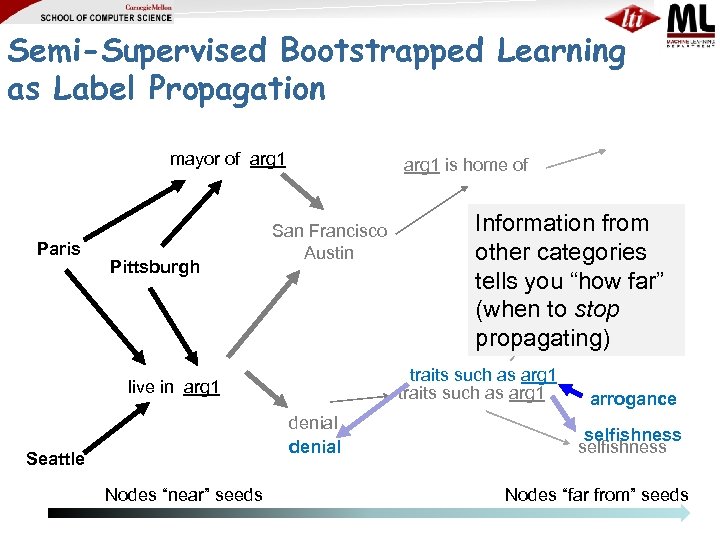
Semi-Supervised Bootstrapped Learning as Label Propagation mayor of arg 1 Paris Pittsburgh arg 1 is home of San Francisco Austin traits such as arg 1 live in arg 1 denial Seattle Nodes “near” seeds Information from other categories tells youanxiety far” “how (when to stop propagating) arrogance selfishness Nodes “far from” seeds
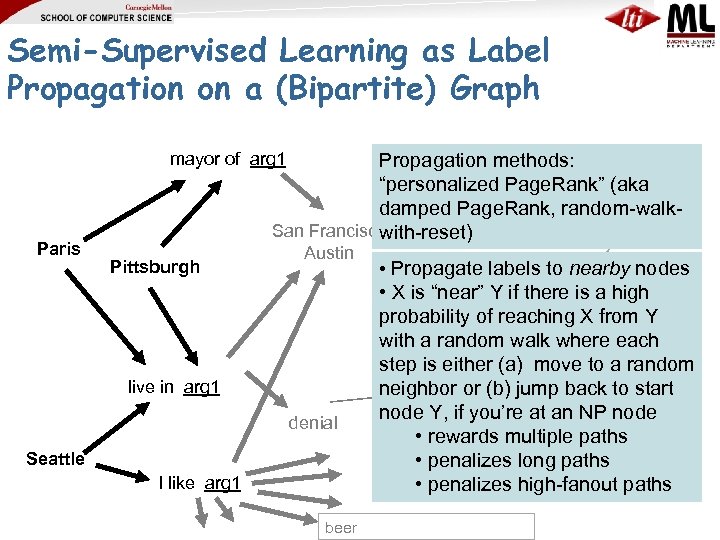
Semi-Supervised Learning as Label Propagation on a (Bipartite) Graph Propagation methods: arg 1 is home of “personalized Page. Rank” (aka damped Page. Rank, random-walk. San Francisco with-reset) mayor of arg 1 Paris Pittsburgh Austin live in arg 1 denial Seattle I like arg 1 beer • Propagate labels to nearby nodes anxiety • X is “near” Y if there is a high probability of reaching X from Y with a random walk where each step is either (a) move to a random neighbor or as arg 1 back to start traits such (b) jump node Y, if you’re at an NP node • rewards multiple selfishness paths • penalizes long paths • penalizes high-fanout paths
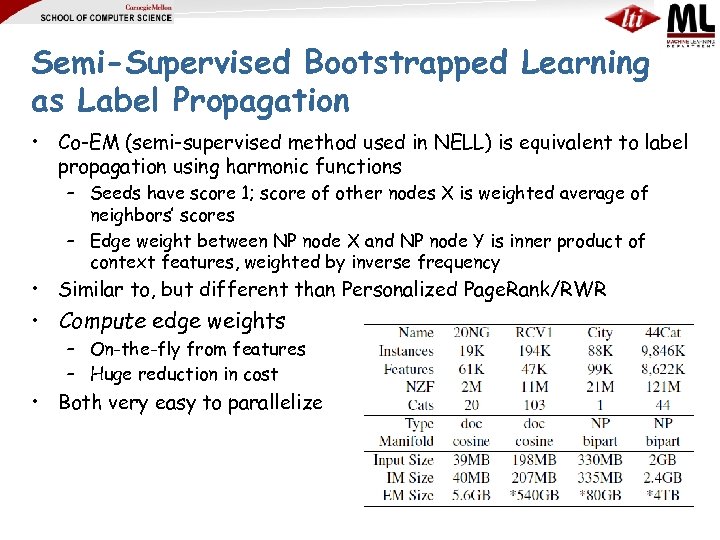
Semi-Supervised Bootstrapped Learning as Label Propagation • Co-EM (semi-supervised method used in NELL) is equivalent to label propagation using harmonic functions – Seeds have score 1; score of other nodes X is weighted average of neighbors’ scores – Edge weight between NP node X and NP node Y is inner product of context features, weighted by inverse frequency • Similar to, but different than Personalized Page. Rank/RWR • Compute edge weights – On-the-fly from features – Huge reduction in cost • Both very easy to parallelize
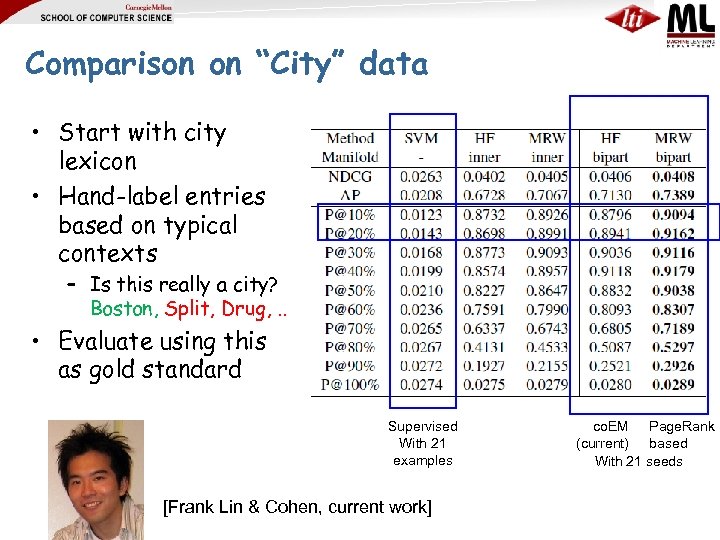
Comparison on “City” data • Start with city lexicon • Hand-label entries based on typical contexts – Is this really a city? Boston, Split, Drug, . . • Evaluate using this as gold standard Supervised With 21 examples [Frank Lin & Cohen, current work] co. EM Page. Rank (current) based With 21 seeds
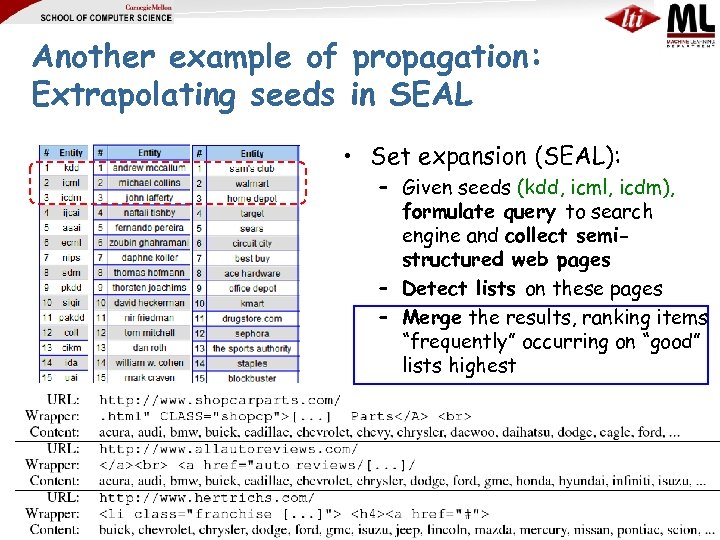
Another example of propagation: Extrapolating seeds in SEAL • Set expansion (SEAL): – Given seeds (kdd, icml, icdm), formulate query to search engine and collect semistructured web pages – Detect lists on these pages – Merge the results, ranking items “frequently” occurring on “good” lists highest – Details: Wang & Cohen ICDM 2007, 2008; EMNLP 2008, 2009
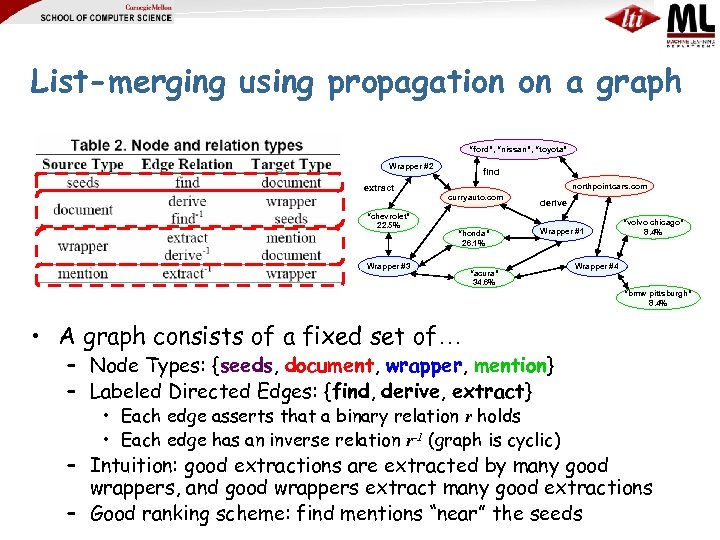
List-merging using propagation on a graph “ford”, “nissan”, “toyota” Wrapper #2 find northpointcars. com extract curryauto. com “chevrolet” 22. 5% “honda” 26. 1% Wrapper #3 derive Wrapper #1 “acura” 34. 6% “volvo chicago” 8. 4% Wrapper #4 “bmw pittsburgh” 8. 4% • A graph consists of a fixed set of… – Node Types: {seeds, document, wrapper, mention} – Labeled Directed Edges: {find, derive, extract} • Each edge asserts that a binary relation r holds • Each edge has an inverse relation r-1 (graph is cyclic) – Intuition: good extractions are extracted by many good wrappers, and good wrappers extract many good extractions – Good ranking scheme: find mentions “near” the seeds
Outline • Web-scale information extraction: – discovering factual by automatically reading language on the Web • NELL: A Never-Ending Language Learner – Goals, current scope, and examples • Key ideas: – Redundancy of information on the Web – Constraining the task by scaling up – Learning by propagating labels through graphs • Current and future directions: – Additional types of learning and input sources
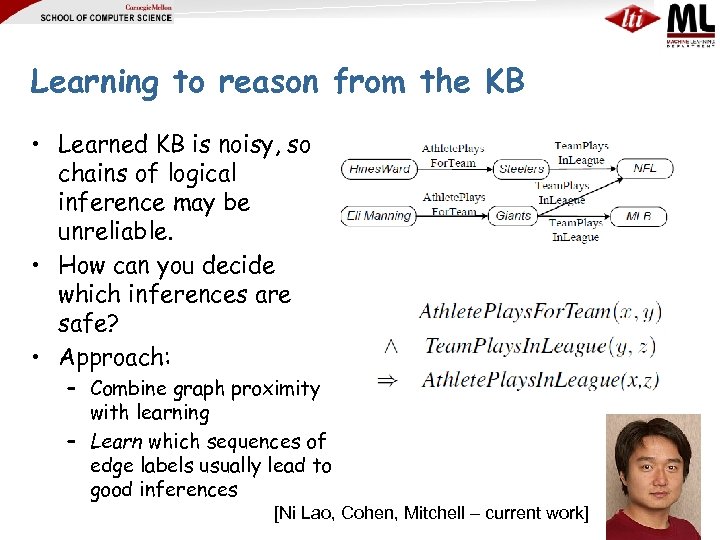
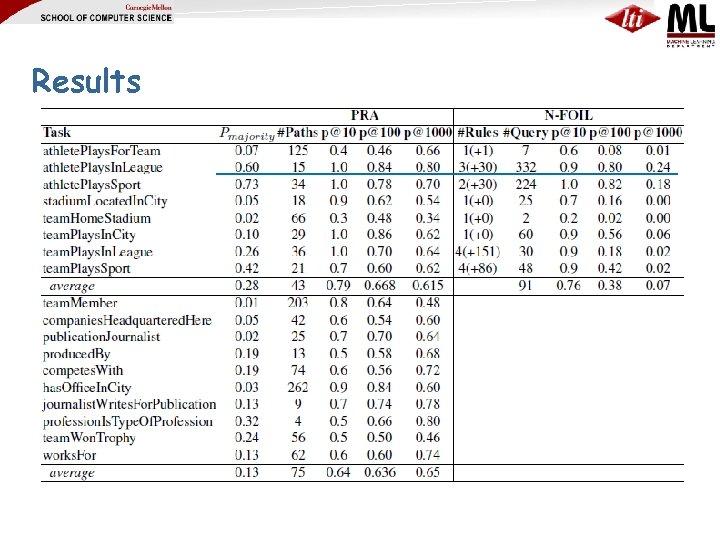
Learning to reason from the KB • Learned KB is noisy, so chains of logical inference may be unreliable. • How can you decide which inferences are safe? • Approach: – Combine graph proximity with learning – Learn which sequences of edge labels usually lead to good inferences [Ni Lao, Cohen, Mitchell – current work]
Results
Semi-Supervised Bootstrapped Learning vs Label Propagation mayor of arg 1 Paris Pittsburgh arg 1 is home of San Francisco Austin anxiety live in arg 1 traits such as arg 1 denial Seattle selfishness
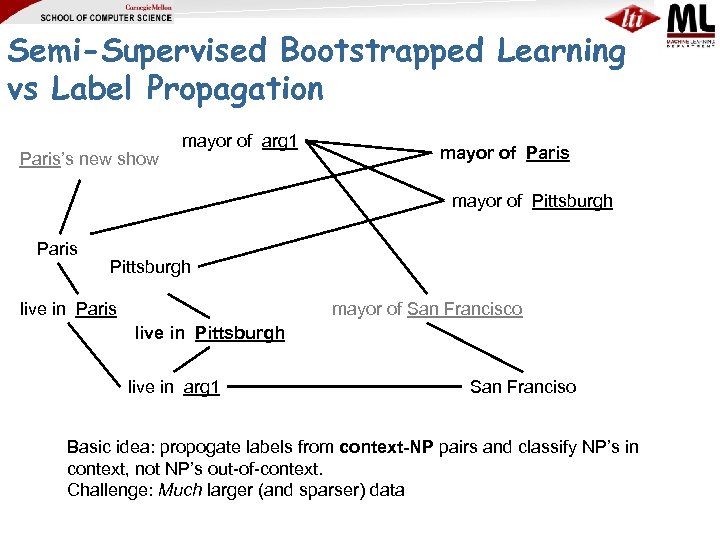
Semi-Supervised Bootstrapped Learning vs Label Propagation Paris’s new show mayor of arg 1 mayor of Paris mayor of Pittsburgh Paris Pittsburgh mayor of San Francisco live in Paris live in Pittsburgh live in arg 1 San Franciso Basic idea: propogate labels from context-NP pairs and classify NP’s in context, not NP’s out-of-context. Challenge: Much larger (and sparser) data
Looking forward • Huge value in mining/organizing/making accessible publically available information • Information is more than just facts – It’s also how people write about the facts, how facts are presented (in tables, …), how facts structure our discourse and communities, … – IE is the science of all these things • NELL is based one premise that doing it right means scaling – From small to large datasets – From fewer extraction problems to many interrelated problems – From one view to many different views of the same data
Thanks to: • Tom Mitchell and other collaborators – Frank Lin, Ni Lao, (alumni) Richard Wang • DARPA, NSF, Google, the Brazilian agency CNPq (project funding) • Yahoo! and Microsoft Research (fellowships)
Скачать презентацию Learning to Extract a Broad-Coverage Knowledge Base from
c90e7229f396209e95a9a42fde0ac509.ppt