


 Скачать презентацию Learning Taxonomies What are they Why use them
ab79e4a468ba0f5535fb211b61574cae.ppt
- Количество слайдов: 42
 Learning Taxonomies What are they? Why use them? Mary Pat Wenderoth Department of Biology University of Washington Scholars 2010
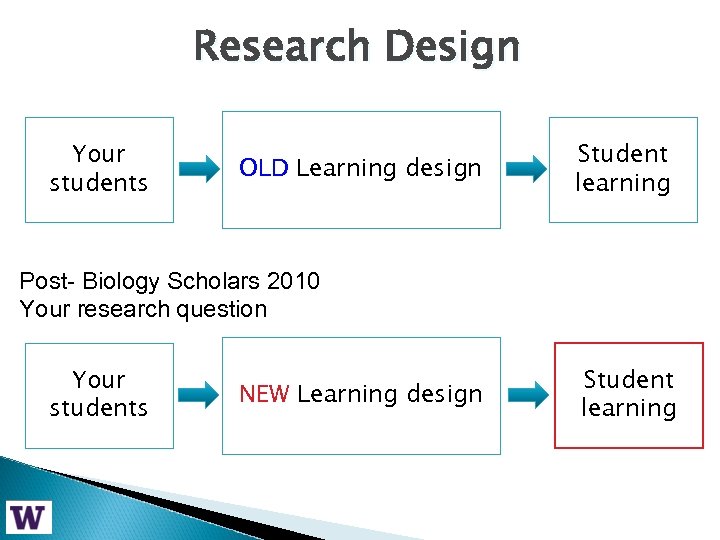 Research Design Your students OLD Learning design Student learning Post- Biology Scholars 2010 Your research question Your students NEW Learning design Student learning
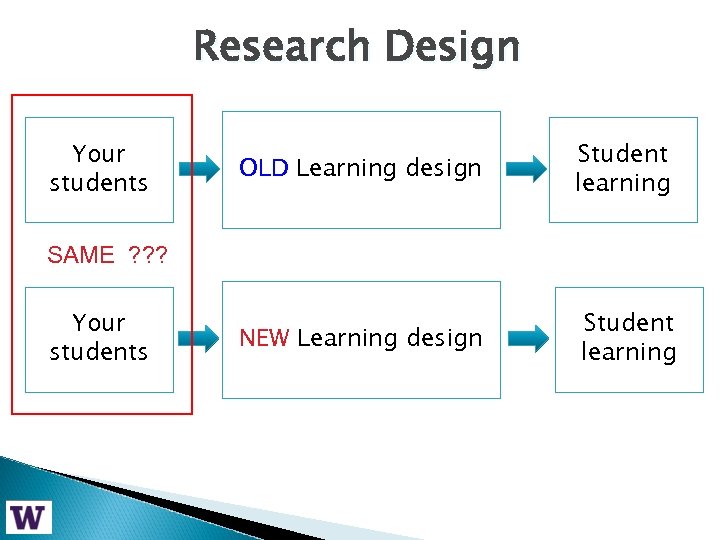 Research Design Your students OLD Learning design Student learning NEW Learning design Student learning SAME ? ? ? Your students
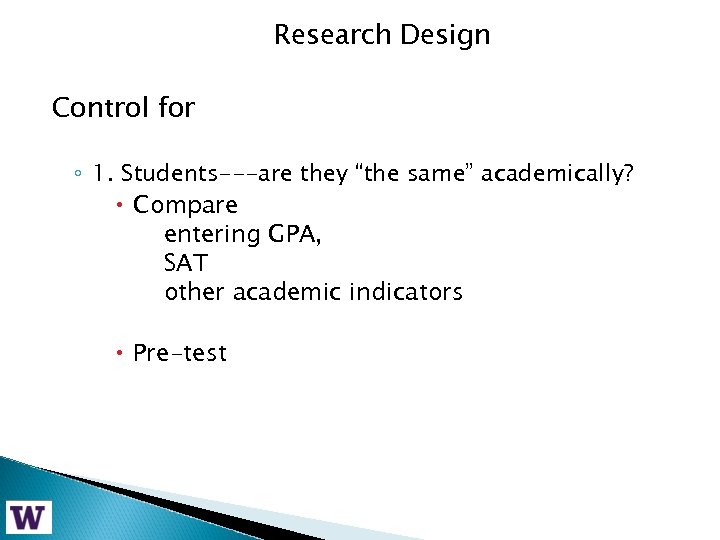 Research Design Control for ◦ 1. Students---are they “the same” academically? Compare entering GPA, SAT other academic indicators Pre-test
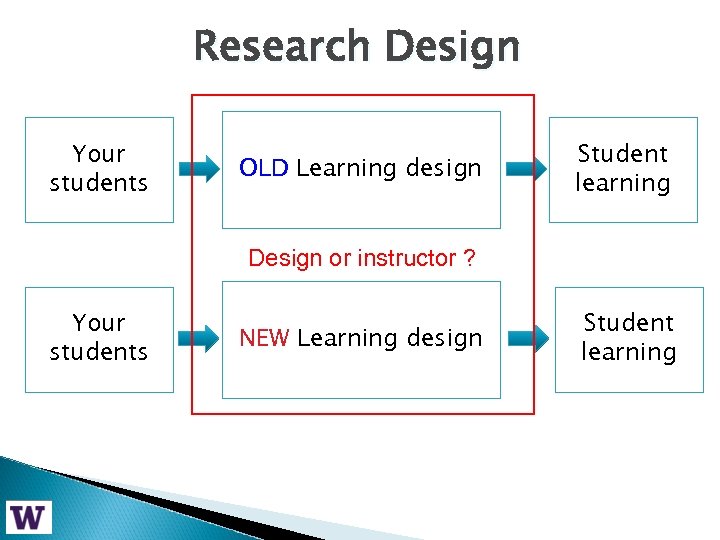 Research Design Your students OLD Learning design Student learning Design or instructor ? Your students NEW Learning design Student learning
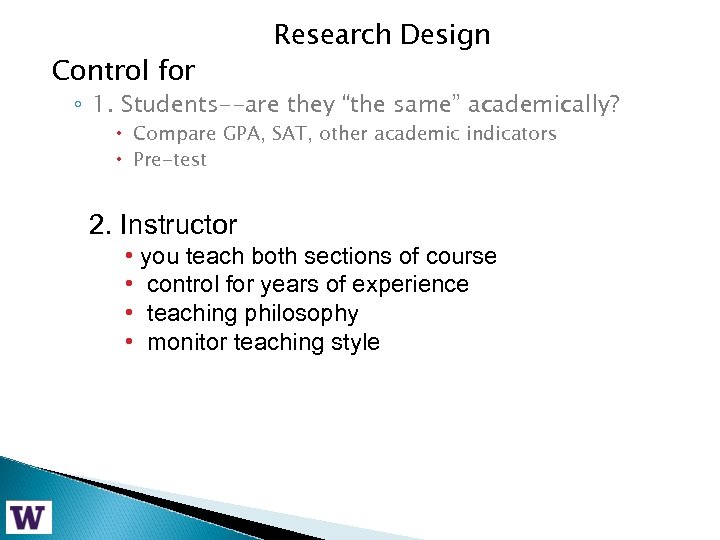 Control for Research Design ◦ 1. Students--are they “the same” academically? Compare GPA, SAT, other academic indicators Pre-test 2. Instructor • you teach both sections of course • control for years of experience • teaching philosophy • monitor teaching style
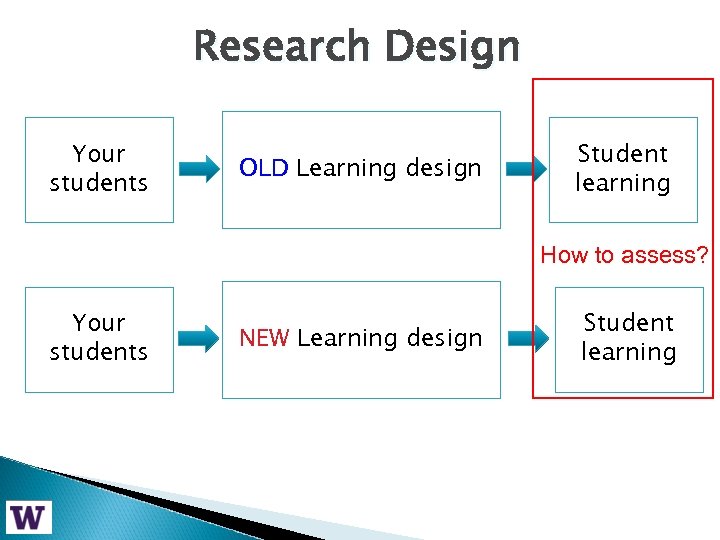 Research Design Your students OLD Learning design Student learning How to assess? Your students NEW Learning design Student learning
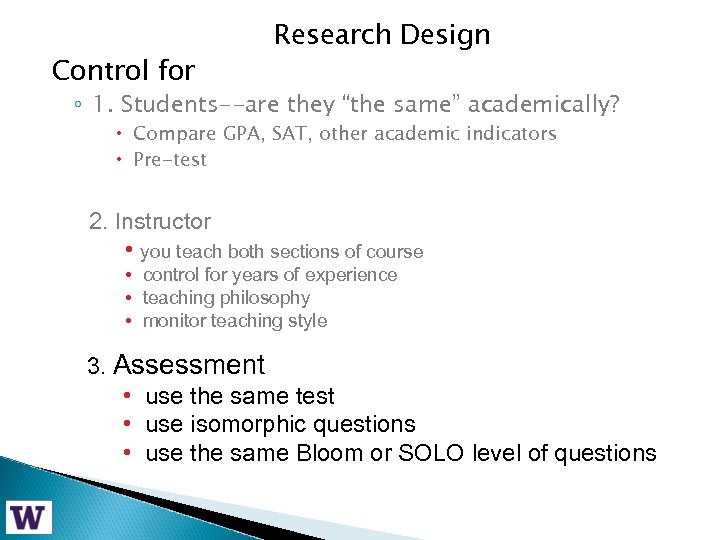 Control for Research Design ◦ 1. Students--are they “the same” academically? Compare GPA, SAT, other academic indicators Pre-test 2. Instructor • you teach both sections of course • control for years of experience • teaching philosophy • monitor teaching style 3. Assessment • use the same test • use isomorphic questions • use the same Bloom or SOLO level of questions
 Major Learning Taxonomies 1 - SOLO, Structure of Observed Learning Outcomes Biggs & Collis 1982 2 - Bloom’s Taxonomy of Learning Domains cognitive (knowledge) affective (attitudes) psychomotor (skills) Bloom & Krathwohl 1956
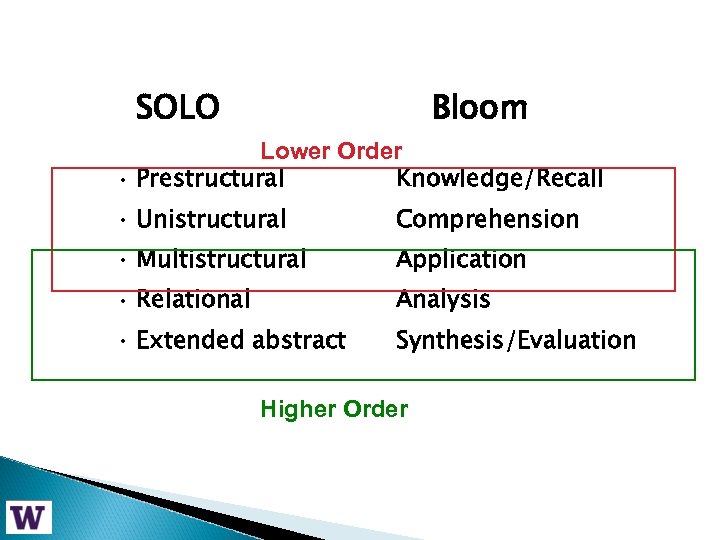
 The SOLO model consists of 5 levels of understanding • Prestructural – the student acquires bits of unconnected information that have no organisation and make no sense. • Unistructural – students make simple and obvious connections between pieces of information • Multistructural – a number of connections are made, but not the meta-connections between them • Relational – the students sees the significance of how the various pieces of information relate to one another • Extended abstract – at this level students can make connections beyond the scope of the problem or question, to generalise or transfer learning into a new situation
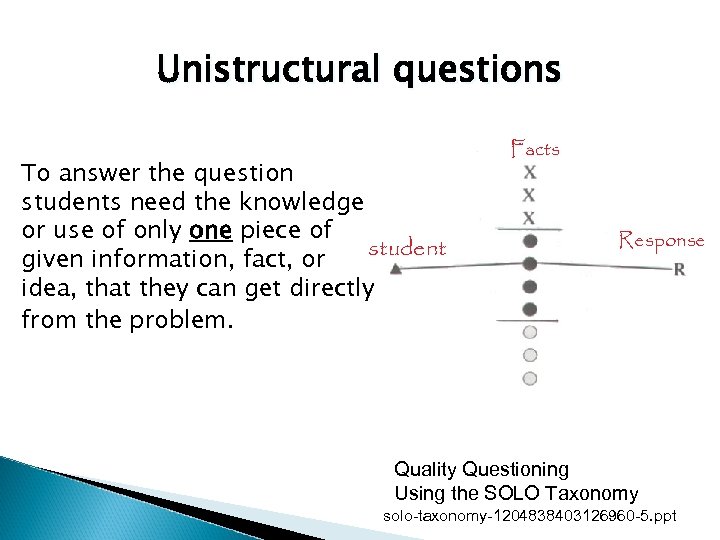 Unistructural questions To answer the question students need the knowledge or use of only one piece of student given information, fact, or idea, that they can get directly from the problem. Facts Response Quality Questioning Using the SOLO Taxonomy solo-taxonomy-1204838403126960 -5. ppt
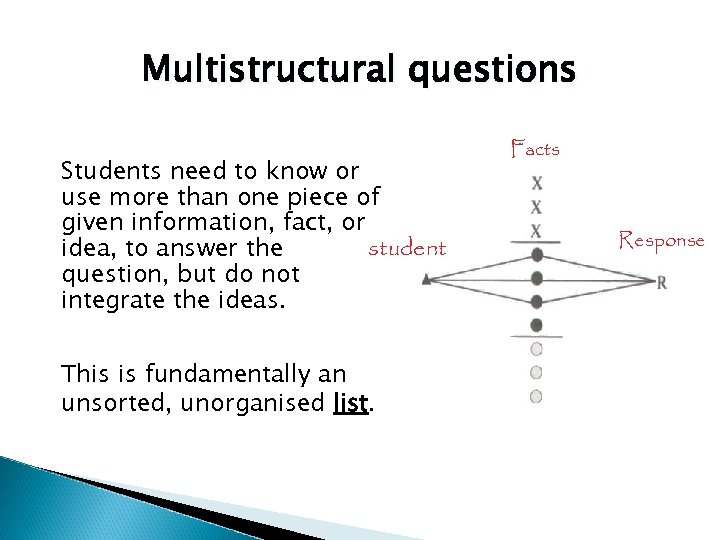 Multistructural questions Students need to know or use more than one piece of given information, fact, or student idea, to answer the question, but do not integrate the ideas. This is fundamentally an unsorted, unorganised list. Facts Response
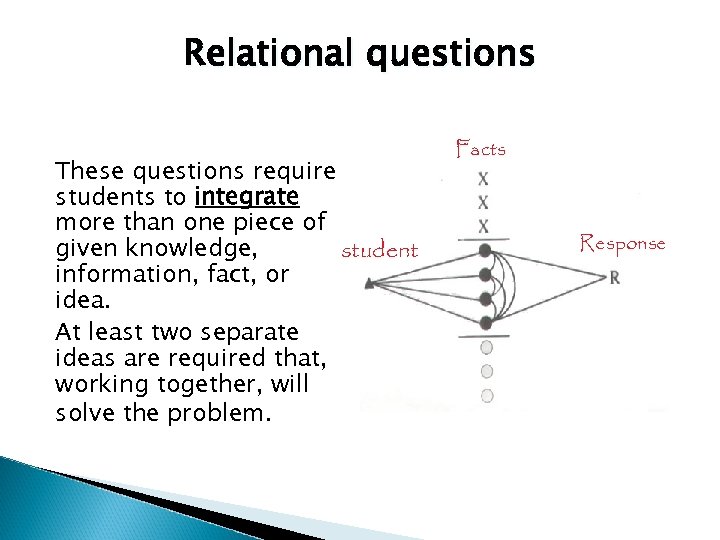 Relational questions These questions require students to integrate more than one piece of given knowledge, student information, fact, or idea. At least two separate ideas are required that, working together, will solve the problem. Facts Response
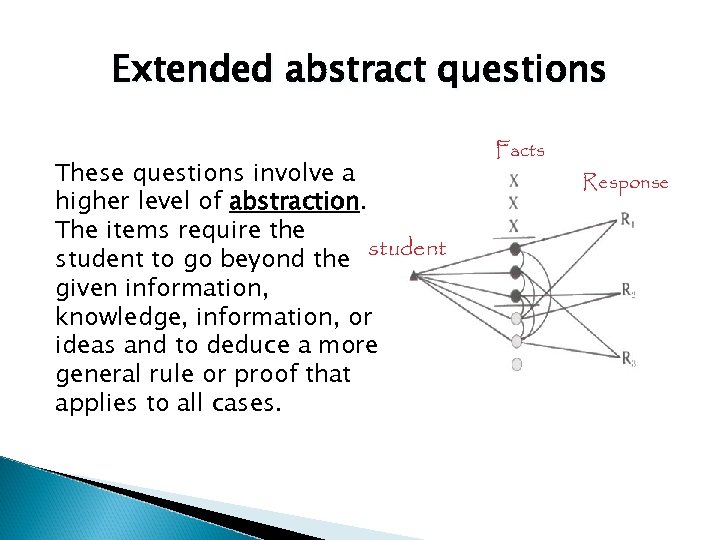 Extended abstract questions These questions involve a higher level of abstraction. The items require the student to go beyond the given information, knowledge, information, or ideas and to deduce a more general rule or proof that applies to all cases. Facts Response
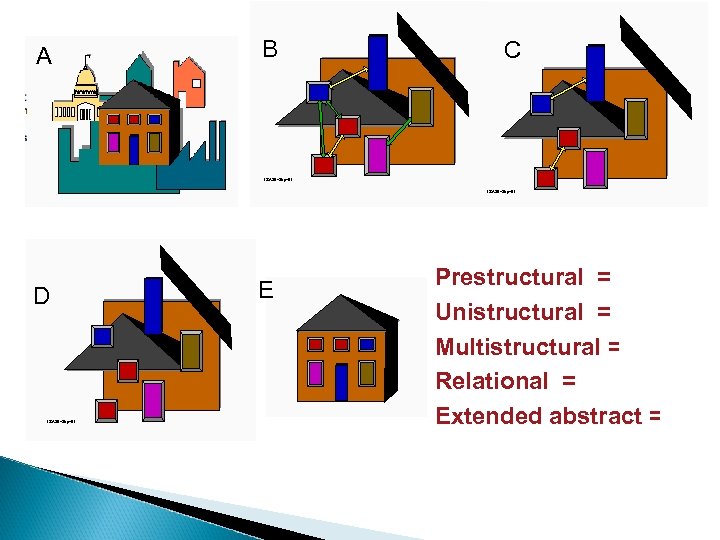 A B D E C Prestructural = D Unistructural = C Multistructural = B Relational = E Extended abstract = A
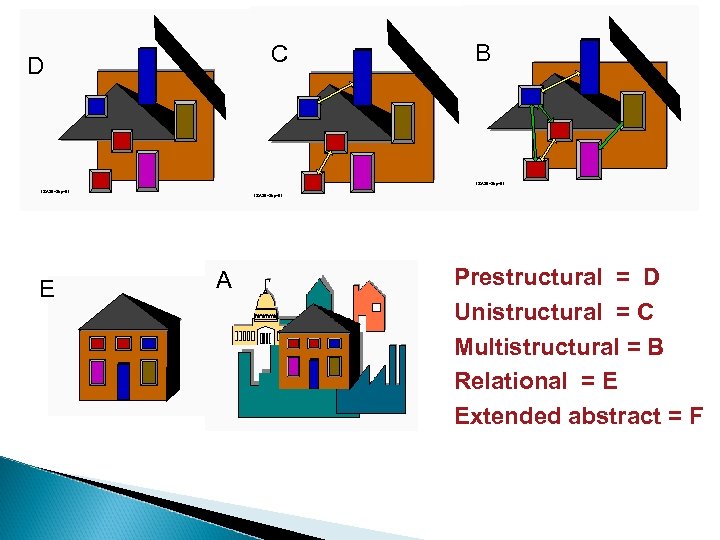 C D E A B Prestructural = D Unistructural = C Multistructural = B Relational = E Extended abstract = F
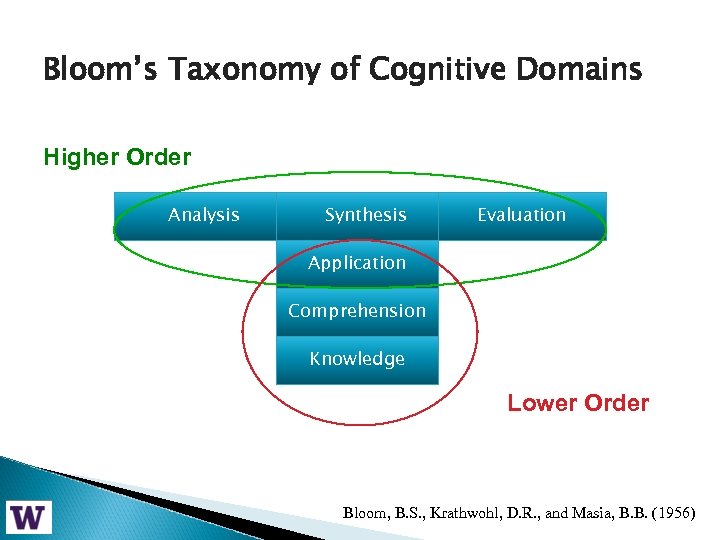
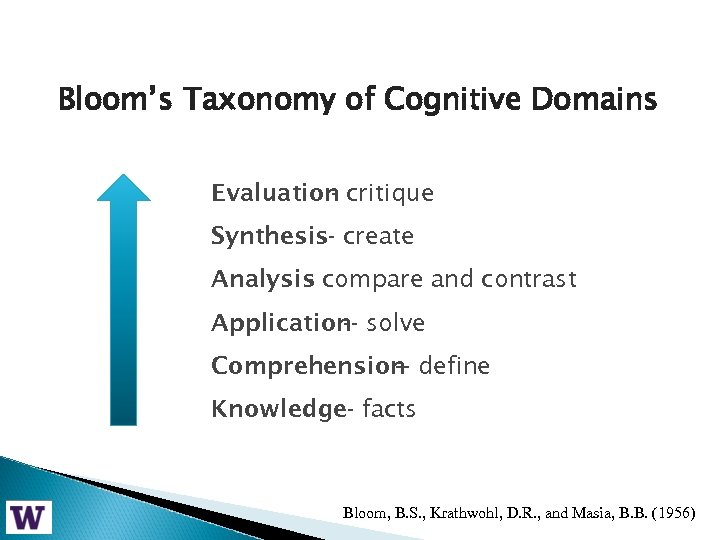 Bloom’s Taxonomy of Cognitive Domains Evaluation critique Synthesis- create Analysis compare and contrast Application solve -Comprehension define -Knowledge facts -- Bloom, B. S. , Krathwohl, D. R. , and Masia, B. B. (1956)
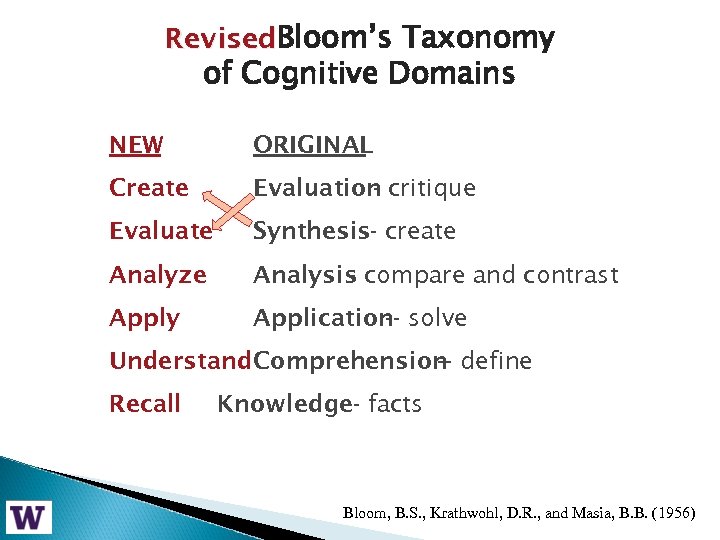 Revised. Bloom’s Taxonomy of Cognitive Domains NEW ORIGINAL Create Evaluation critique - Evaluate Synthesis- create Analyze Analysis compare and contrast - Apply Application solve -- Understand. Comprehension define -Recall Knowledge facts -- Bloom, B. S. , Krathwohl, D. R. , and Masia, B. B. (1956)
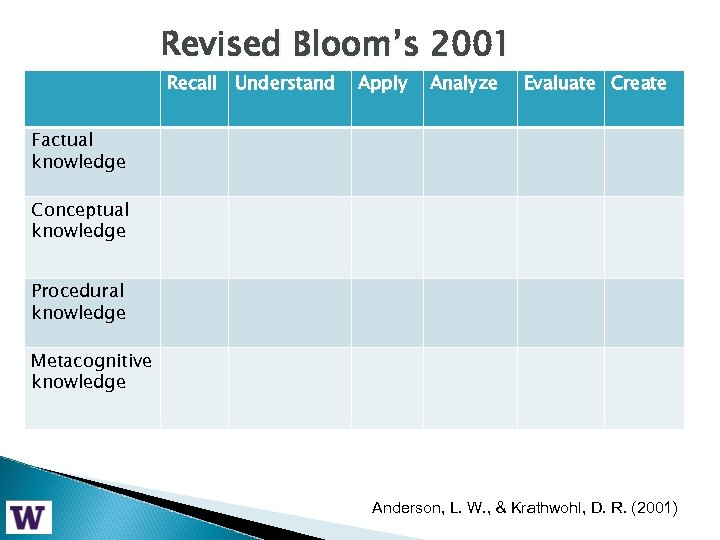 Revised Bloom’s 2001 Recall Understand Apply Analyze Evaluate Create Factual knowledge Conceptual knowledge Procedural knowledge Metacognitive knowledge Anderson, L. W. , & Krathwohl, D. R. (2001)
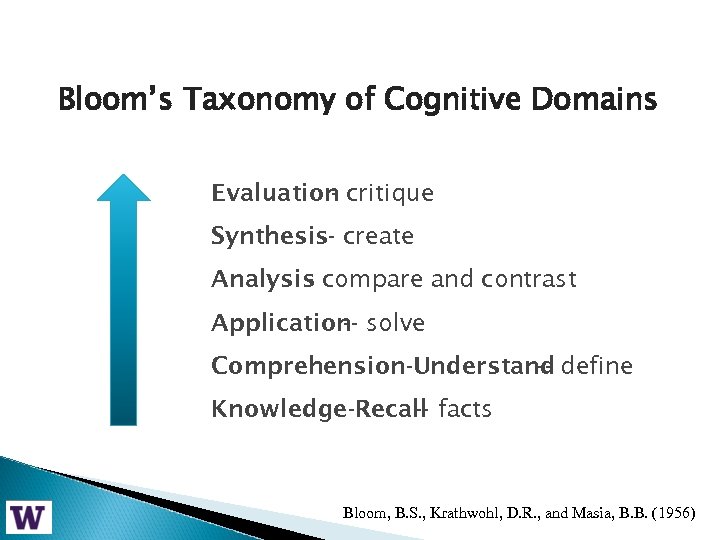 Bloom’s Taxonomy of Cognitive Domains Evaluation critique Synthesis- create Analysis compare and contrast Application solve -Comprehension-Understand define -Knowledge-Recall facts -- Bloom, B. S. , Krathwohl, D. R. , and Masia, B. B. (1956)
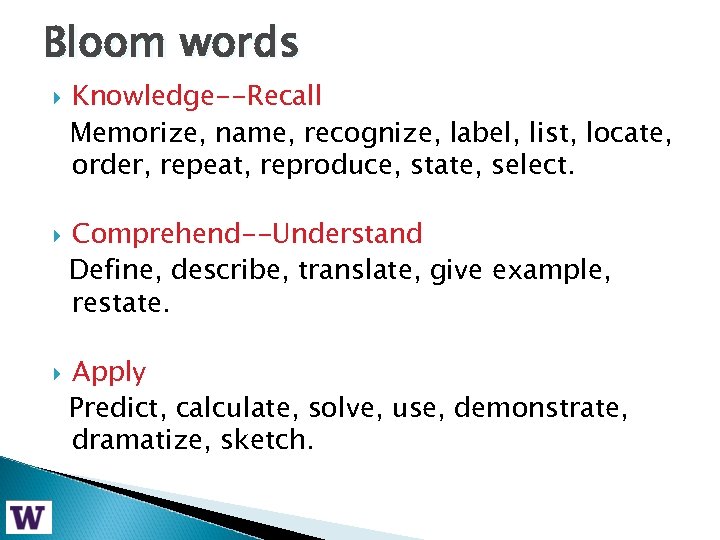 Bloom words Knowledge--Recall Memorize, name, recognize, label, list, locate, order, repeat, reproduce, state, select. Comprehend--Understand Define, describe, translate, give example, restate. Apply Predict, calculate, solve, use, demonstrate, dramatize, sketch.
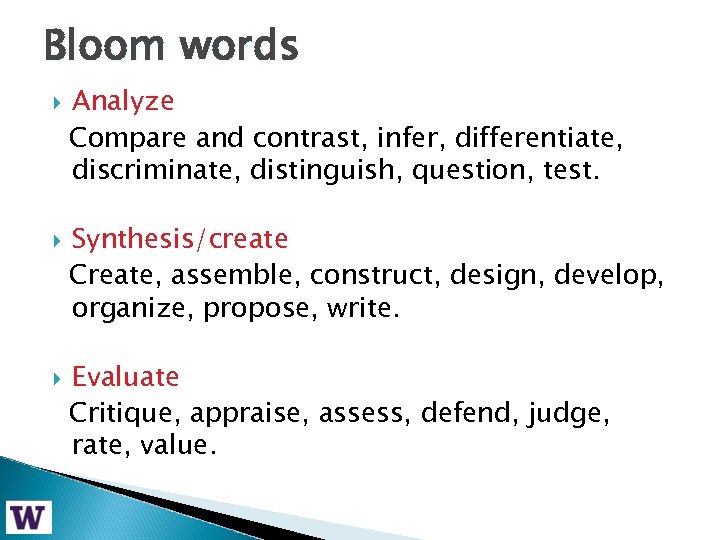 Bloom words Analyze Compare and contrast, infer, differentiate, discriminate, distinguish, question, test. Synthesis/create Create, assemble, construct, design, develop, organize, propose, write. Evaluate Critique, appraise, assess, defend, judge, rate, value.
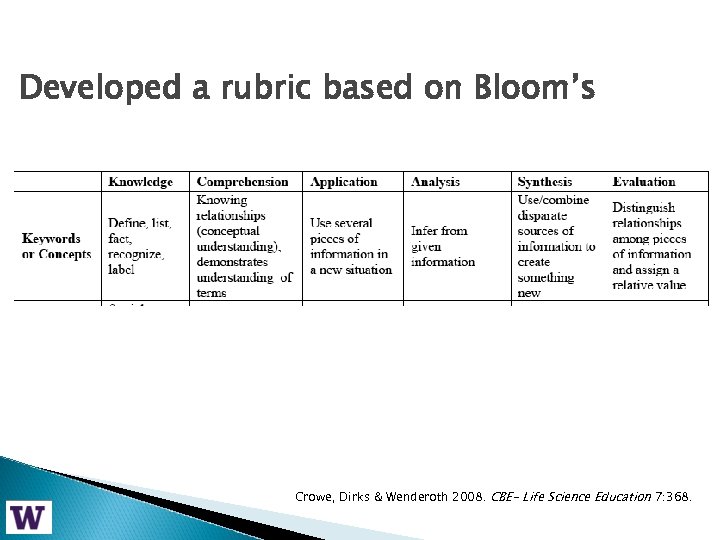 Developed a rubric based on Bloom’s Crowe, Dirks & Wenderoth 2008. CBE- Life Science Education 7: 368.
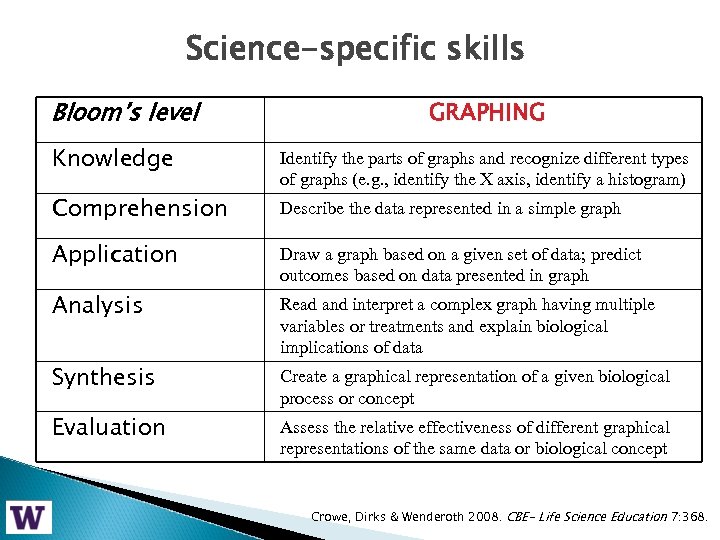 Science-specific skills Bloom’s level GRAPHING Knowledge Identify the parts of graphs and recognize different types of graphs (e. g. , identify the X axis, identify a histogram) Comprehension Describe the data represented in a simple graph Application Draw a graph based on a given set of data; predict outcomes based on data presented in graph Analysis Read and interpret a complex graph having multiple variables or treatments and explain biological implications of data Synthesis Create a graphical representation of a given biological process or concept Evaluation Assess the relative effectiveness of different graphical representations of the same data or biological concept Crowe, Dirks & Wenderoth 2008. CBE- Life Science Education 7: 368.
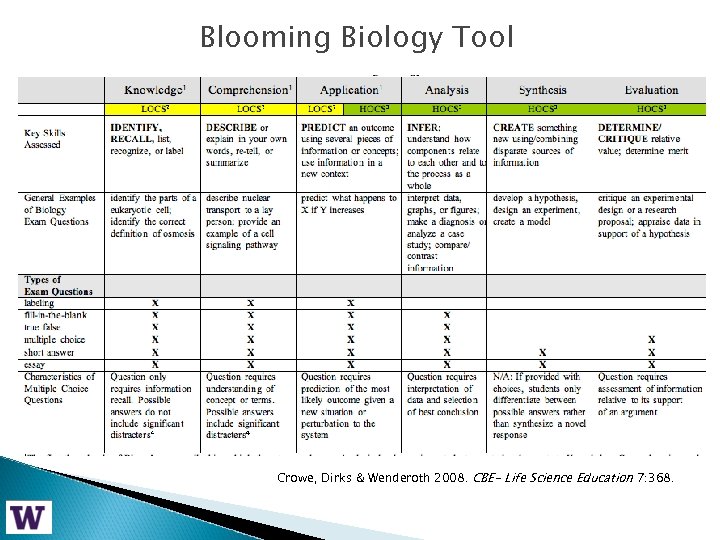 Blooming Biology Tool Crowe, Dirks & Wenderoth 2008. CBE- Life Science Education 7: 368.
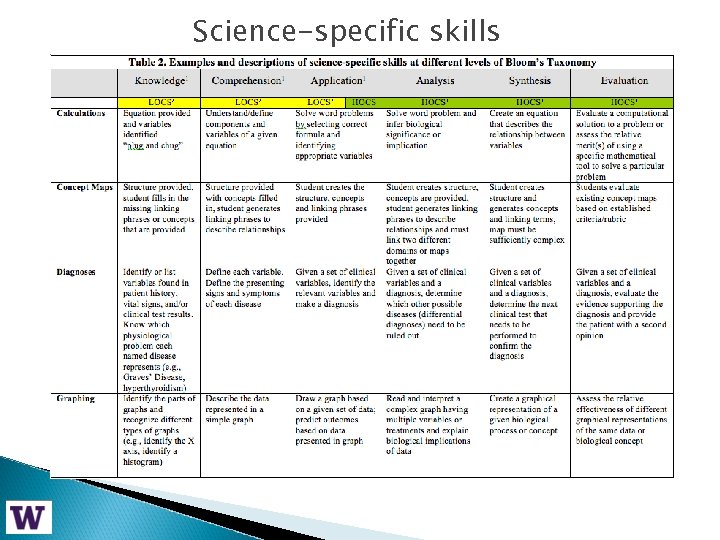 Science-specific skills
 Why Bloom a test?
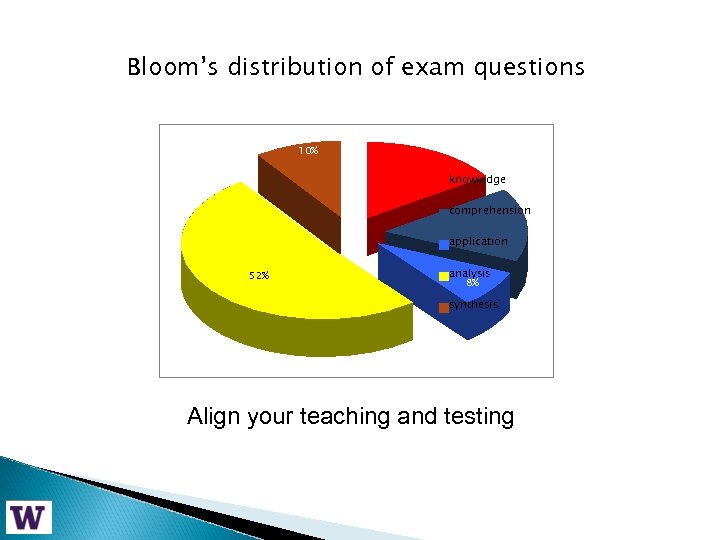 Bloom’s distribution of exam questions 10% 16% knowledge comprehension 16% application 52% analysis 8% synthesis Align your teaching and testing
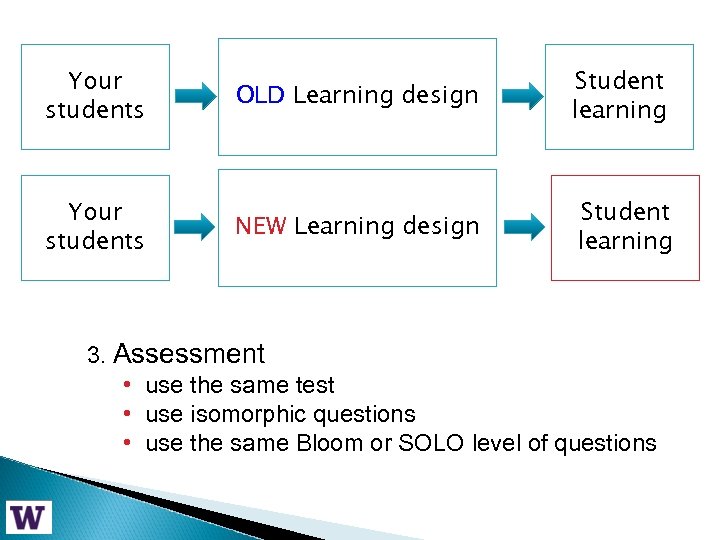 Your students OLD Learning design Student learning NEW Learning design Student learning 3. Assessment • use the same test • use isomorphic questions • use the same Bloom or SOLO level of questions
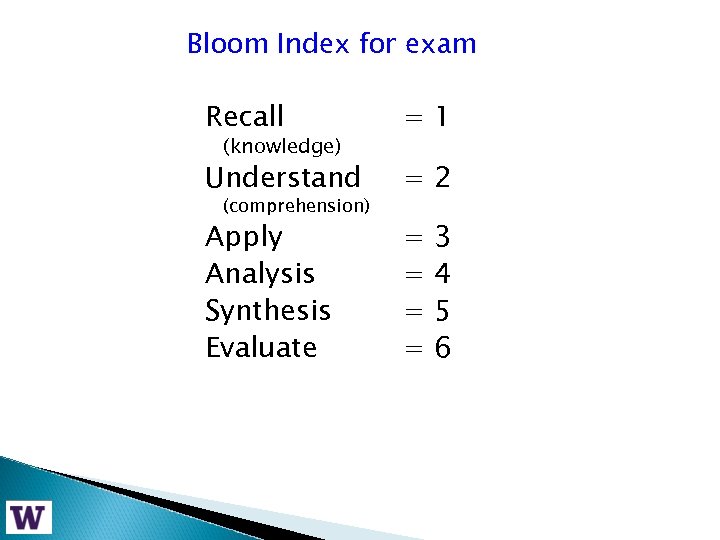 Bloom Index for exam Recall =1 Understand =2 Apply Analysis Synthesis Evaluate = = (knowledge) (comprehension) 3 4 5 6
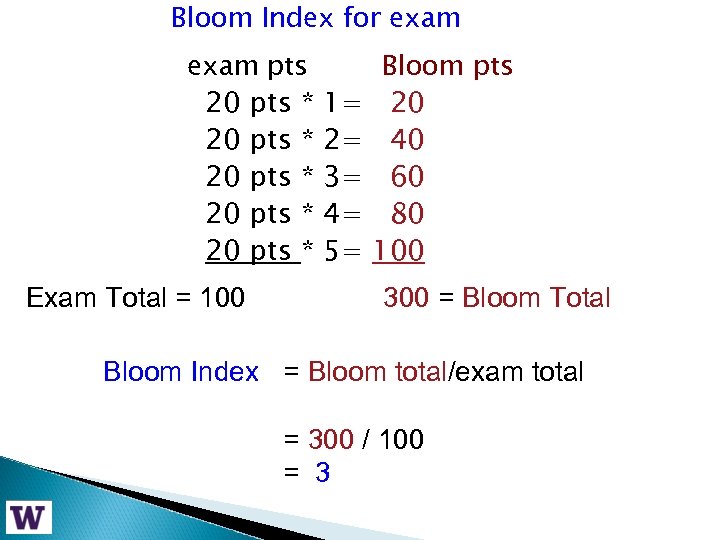 Bloom Index for exam pts 20 pts * 20 pts * Exam Total = 100 1= 2= 3= 4= 5= Bloom pts 20 40 60 80 100 300 = Bloom Total Bloom Index = Bloom total/exam total = 300 / 100 = 3
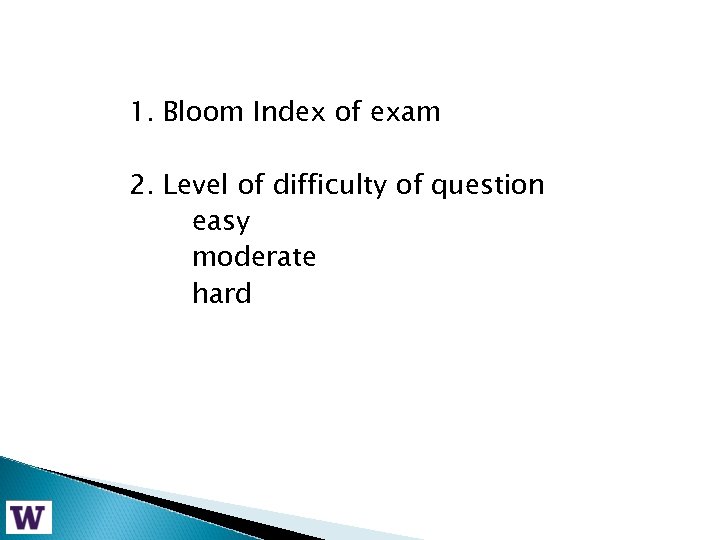 1. Bloom Index of exam 2. Level of difficulty of question easy moderate hard
 How to Bloom a test? Ask a colleague Buy them coffee Have them “Bloom” your exam
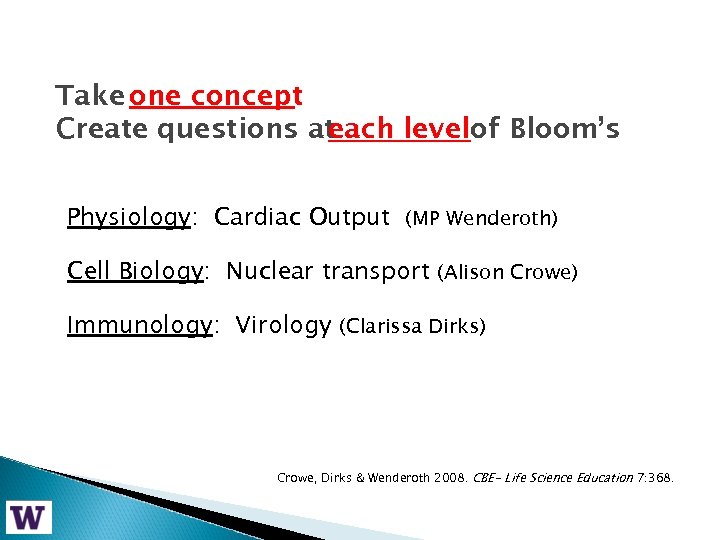 Take one concept Create questions at each levelof Bloom’s Physiology: Cardiac Output (MP Wenderoth) Cell Biology: Nuclear transport (Alison Crowe) Immunology: Virology (Clarissa Dirks) Crowe, Dirks & Wenderoth 2008. CBE- Life Science Education 7: 368.
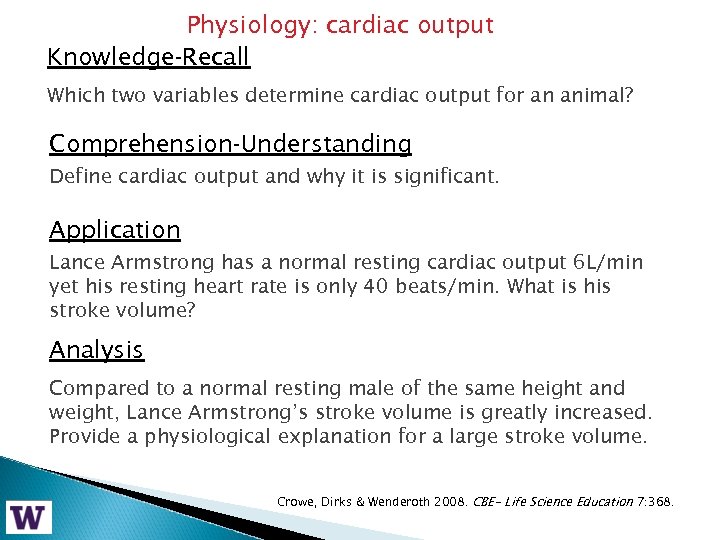 Physiology: cardiac output Knowledge-Recall Which two variables determine cardiac output for an animal? Comprehension-Understanding Define cardiac output and why it is significant. Application Lance Armstrong has a normal resting cardiac output 6 L/min yet his resting heart rate is only 40 beats/min. What is his stroke volume? Analysis Compared to a normal resting male of the same height and weight, Lance Armstrong’s stroke volume is greatly increased. Provide a physiological explanation for a large stroke volume. Crowe, Dirks & Wenderoth 2008. CBE- Life Science Education 7: 368.
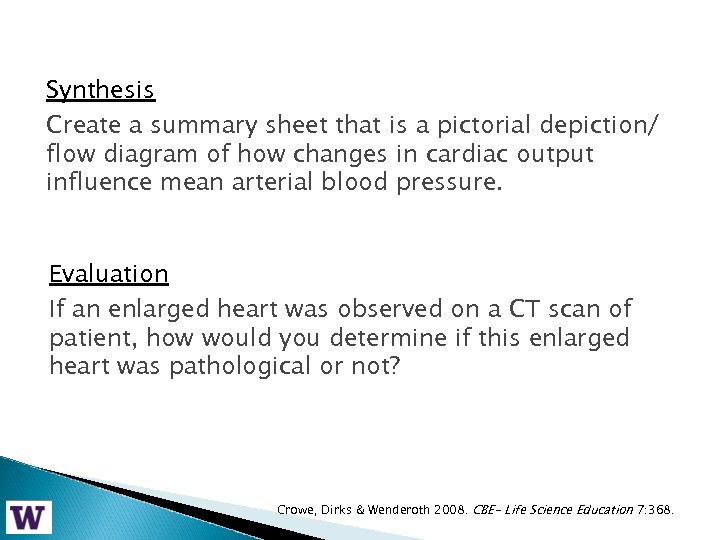 Synthesis Create a summary sheet that is a pictorial depiction/ flow diagram of how changes in cardiac output influence mean arterial blood pressure. Evaluation If an enlarged heart was observed on a CT scan of patient, how would you determine if this enlarged heart was pathological or not? Crowe, Dirks & Wenderoth 2008. CBE- Life Science Education 7: 368.
 Bloom’s Taxonomy of Cognitive Domains Higher Order Analysis Synthesis Evaluation Application Comprehension Knowledge Lower Order Bloom, B. S. , Krathwohl, D. R. , and Masia, B. B. (1956)
 SOLO Bloom Lower Order • Prestructural Knowledge/Recall • Unistructural Comprehension • Multistructural Application • Relational Analysis • Extended abstract Synthesis/Evaluation Higher Order
 References- Bloom’s Anderson, L. W. , & Krathwohl, D. R. (Eds. ). (2001). A taxonomy for learning, teaching and assessing: A revision of Bloom's Taxonomy of educational objectives: Complete edition, New York : Longman. Anderson , L. W. , & Sosniak, L. A. (Eds. ). (1994). Bloom's taxonomy: a fortyyear retrospective. Ninety-third yearbook of the National Society for the Study of Education, Pt. 2. , Chicago , IL. , University of Chicago Press. Bloom, Benjamin S. & David R. Krathwohl. (1956). Taxonomy of educational objectives: The classification of educational goals, by a committee of college and university examiners. Handbook 1: Cognitive domain. New York , Longmans. Crowe, A. , Dirks, C, & Wenderoth, M. P. (2008) Bloomin’ Biology CBE- Life Science Education 7: 368 http: //www. coun. uvic. ca/learning/exams/blooms-taxonomy. html http: //www. polyu. edu. hk/assessment/arc/links/reference_g_blooms. htm http: //www. kurwongbss. eq. edu. au/thinking/Bloom/blooms. htm
 References- SOLO http: //www. learningandteaching. info/learning/solo. htm http: //www. slideshare. net/jocelynam/solo-taxonomy http: //en. wikipedia. org/wiki/Structure_of_Observed_Learning_Outcome Biggs FILM http: //www. daimi. au. dk/~brabrand/short-film/
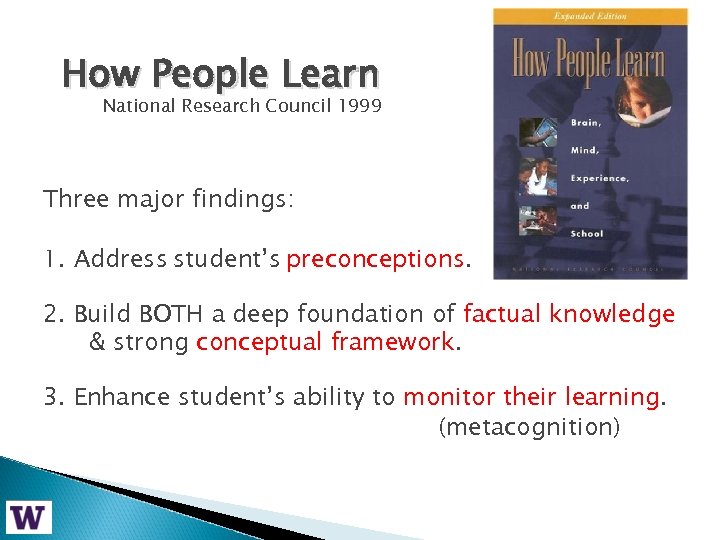 How People Learn National Research Council 1999 Three major findings: 1. Address student’s preconceptions. 2. Build BOTH a deep foundation of factual knowledge & strong conceptual framework. 3. Enhance student’s ability to monitor their learning. (metacognition)
 “To achieve these ambitious goals, we will need much more emphasis on both science education and the “science of education”. Science Jan 2, 2009