 Скачать презентацию Learning Objectives l l l 1 Trace the
5043a089c7aa26e9f0a43985a6c03ce6.ppt
- Количество слайдов: 51



Learning Objectives l l l 1 Trace the history of the electoral college. Describe the role of the electoral college in the presidential election process. Evaluate the electoral college, assessing the validity of arguments offered by its critics and its defenders. Describe and assess proposals for reforming the electoral college. Assess the likelihood of electoral college reform. Political Science Module Developed by PQE 3/19/2018
Key Terms l l l 2 Electoral College Electors Political Legitimacy Winner-Take-All Election System Small State Bias Direct Popular Election Political Science Module Developed by PQE 3/19/2018
LAST TOPIC… The Electoral College Article II, Section 1 Clause 3 th Amendment 12 3 3/19/2018 Political Science Module Developed by PQE
True or False? The candidate with the most votes is elected president. Answer: Depends. Ask Al Gore. 4 Political Science Module Developed by PQE 3/19/2018
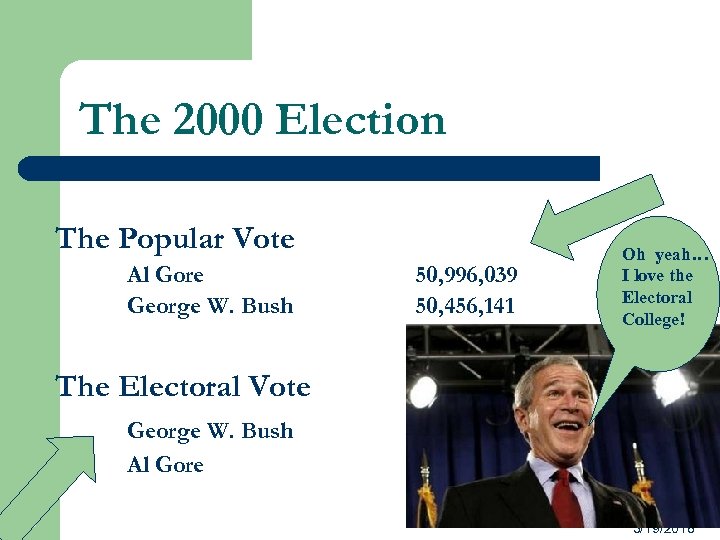
The 2000 Election The Popular Vote Al Gore George W. Bush 50, 996, 039 50, 456, 141 Oh yeah… I love the Electoral College! The Electoral Vote George W. Bush Al Gore 5 271 267 3/19/2018
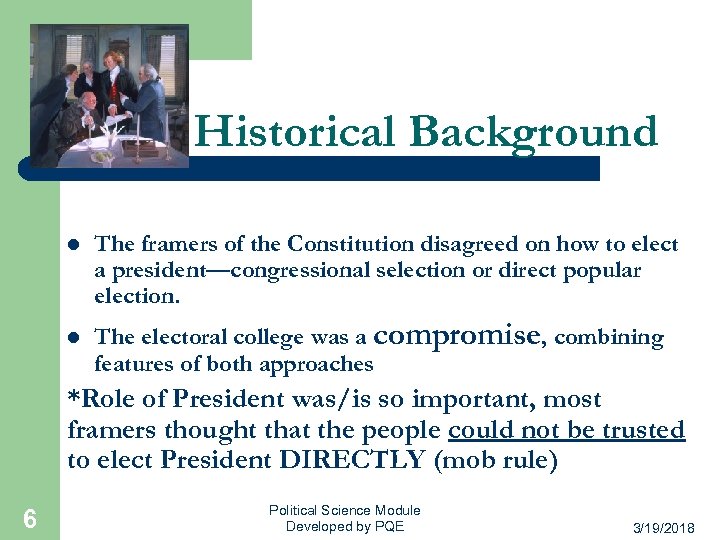
Historical Background l l The framers of the Constitution disagreed on how to elect a president—congressional selection or direct popular election. The electoral college was a compromise, combining features of both approaches *Role of President was/is so important, most framers thought that the people could not be trusted to elect President DIRECTLY (mob rule) 6 Political Science Module Developed by PQE 3/19/2018
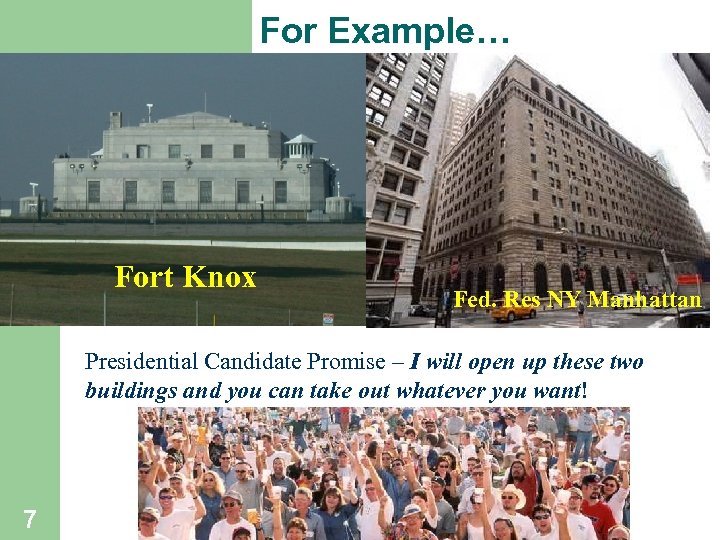
For Example… Fort Knox Fed. Res NY Manhattan Presidential Candidate Promise – I will open up these two buildings and you can take out whatever you want! 7
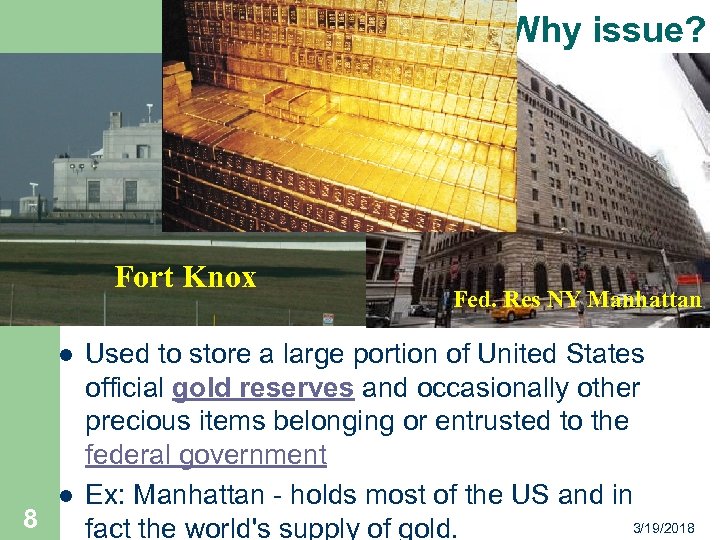
Why issue? Fort Knox l 8 l Fed. Res NY Manhattan Used to store a large portion of United States official gold reserves and occasionally other precious items belonging or entrusted to the federal government Ex: Manhattan - holds most of the US and in 3/19/2018 fact the world's supply of gold.
The Electoral College and Federalism The electoral college also reflects the federal nature of the Constitution 9 Def: a system of government in which sovereignty is constitutionally divided between a central governing authority and constituent political units (such as states or provinces). because it ensures that the States have a role in selecting the president.
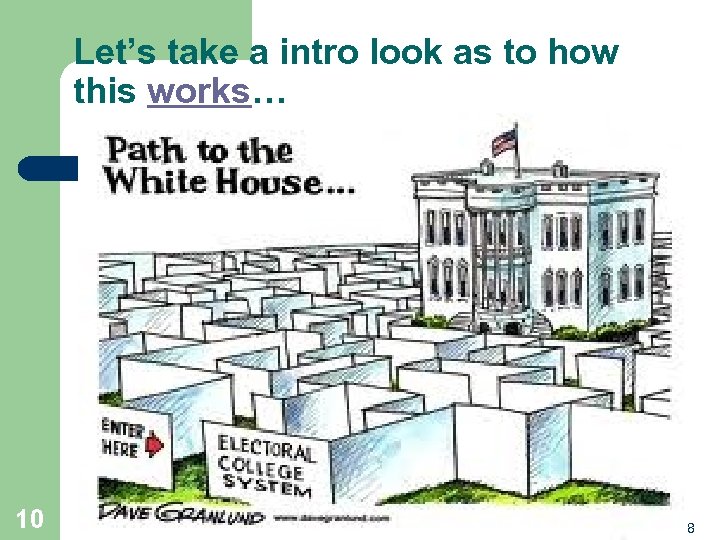
Let’s take a intro look as to how this works… 10 Political Science Module Developed by PQE 3/19/2018
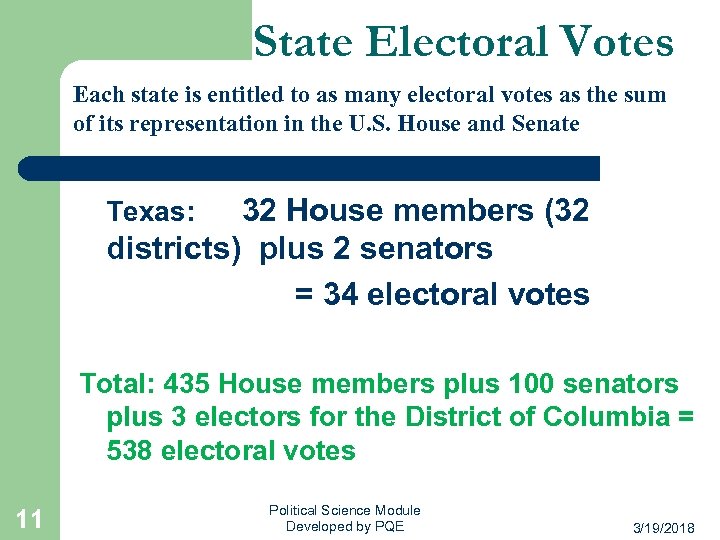
State Electoral Votes Each state is entitled to as many electoral votes as the sum of its representation in the U. S. House and Senate 32 House members (32 districts) plus 2 senators = 34 electoral votes Texas: Total: 435 House members plus 100 senators plus 3 electors for the District of Columbia = 538 electoral votes 11 Political Science Module Developed by PQE 3/19/2018
Review Question North Carolina has 13 U. S. representatives. How many electoral votes does the state have? 12 Political Science Module Developed by PQE 3/19/2018
Answer North Carolina has 15 electoral votes. The formula is the number of U. S. senators, which is two for each state, plus the number of U. S. representatives. 2 + 13 = 15. 13 Political Science Module Developed by PQE 3/19/2018
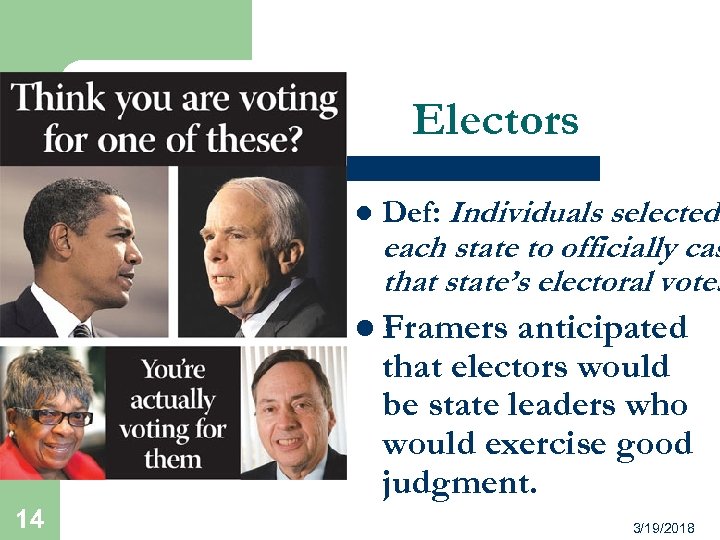
Electors l Def: Individuals selected each state to officially cas that state’s electoral votes l Framers anticipated that electors would be state leaders who would exercise good judgment. 14 3/19/2018
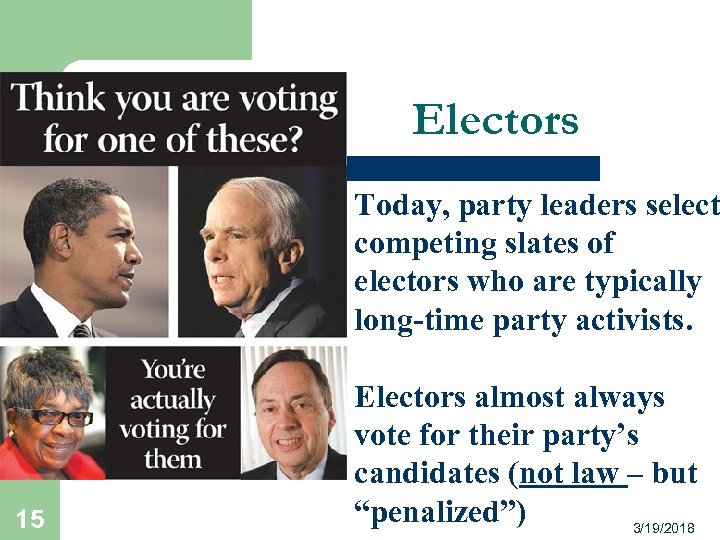
Electors Today, party leaders select competing slates of electors who are typically long-time party activists. 15 Electors almost always vote for their party’s candidates (not law – but “penalized”) 3/19/2018
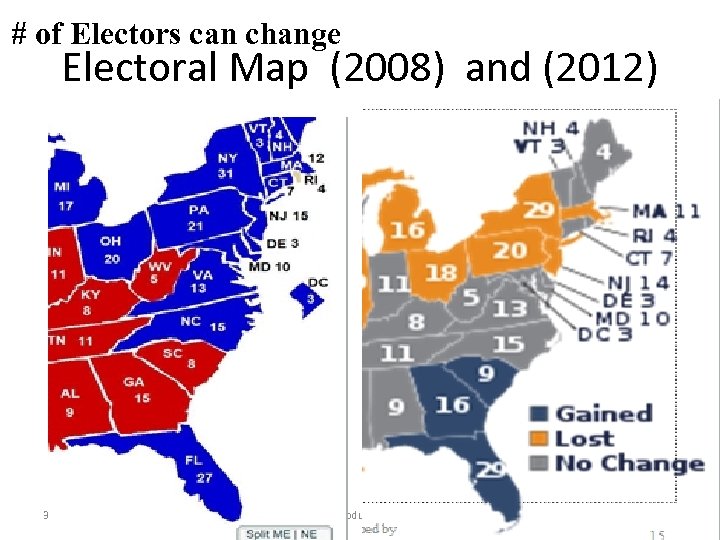
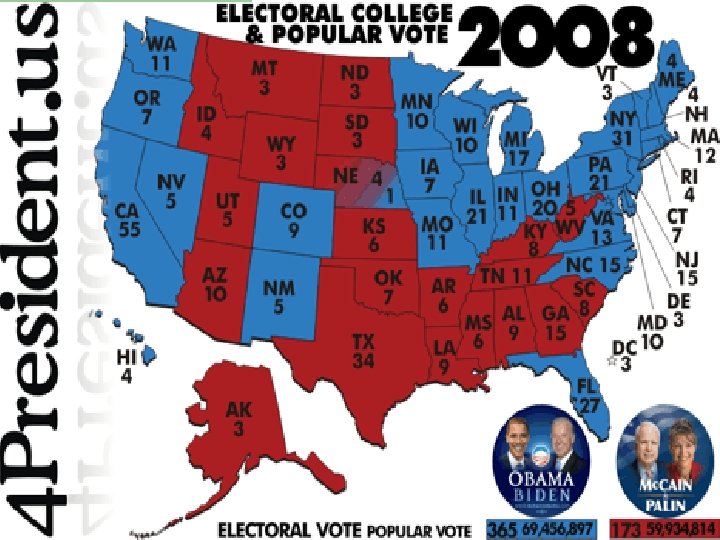
# of Electors can change Electoral Map (2008) and (2012) OBAMA Mc. CAIN 3/19/2018 Political Science Module Developed by PQE 16
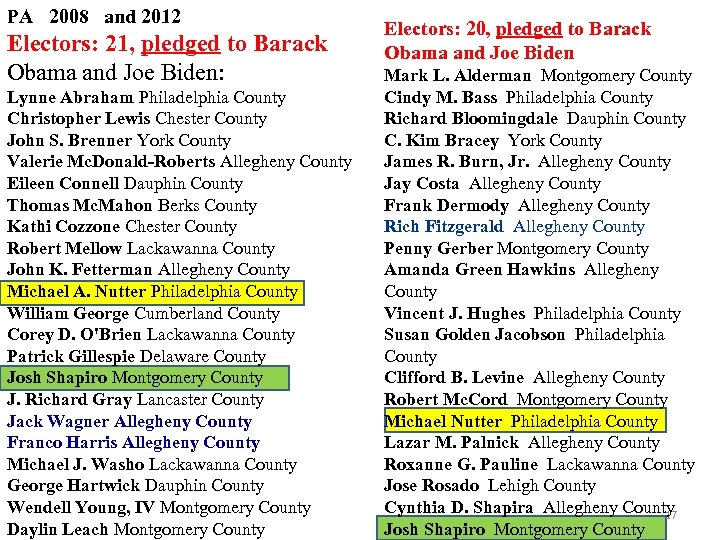
PA 2008 and 2012 Electors: 21, pledged to Barack Obama and Joe Biden: Lynne Abraham Philadelphia County Christopher Lewis Chester County John S. Brenner York County Valerie Mc. Donald-Roberts Allegheny County Eileen Connell Dauphin County Thomas Mc. Mahon Berks County Kathi Cozzone Chester County Robert Mellow Lackawanna County John K. Fetterman Allegheny County Michael A. Nutter Philadelphia County William George Cumberland County Corey D. O'Brien Lackawanna County Patrick Gillespie Delaware County Josh Shapiro Montgomery County J. Richard Gray Lancaster County Jack Wagner Allegheny County Franco Harris Allegheny County Michael J. Washo Lackawanna County George Hartwick Dauphin County Wendell Young, IV Montgomery County Daylin Leach Montgomery County Electors: 20, pledged to Barack Obama and Joe Biden Mark L. Alderman Montgomery County Cindy M. Bass Philadelphia County Richard Bloomingdale Dauphin County C. Kim Bracey York County James R. Burn, Jr. Allegheny County Jay Costa Allegheny County Frank Dermody Allegheny County Rich Fitzgerald Allegheny County Penny Gerber Montgomery County Amanda Green Hawkins Allegheny County Vincent J. Hughes Philadelphia County Susan Golden Jacobson Philadelphia County Clifford B. Levine Allegheny County Robert Mc. Cord Montgomery County Michael Nutter Philadelphia County Lazar M. Palnick Allegheny County Roxanne G. Pauline Lackawanna County Jose Rosado Lehigh County Cynthia D. Shapira Allegheny County 17 Josh Shapiro Montgomery County
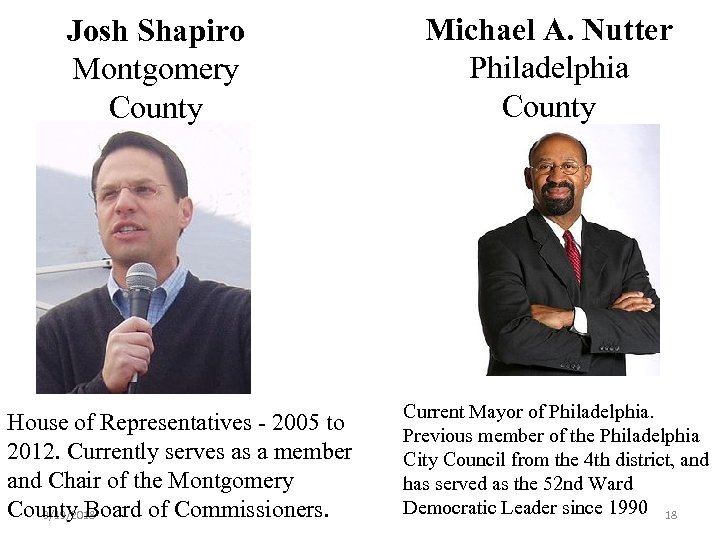
Josh Shapiro Montgomery County House of Representatives - 2005 to 2012. Currently serves as a member and Chair of the Montgomery County Board of Commissioners. 3/19/2018 Michael A. Nutter Philadelphia County Current Mayor of Philadelphia. Previous member of the Philadelphia City Council from the 4 th district, and has served as the 52 nd Ward Democratic Leader since 1990 18
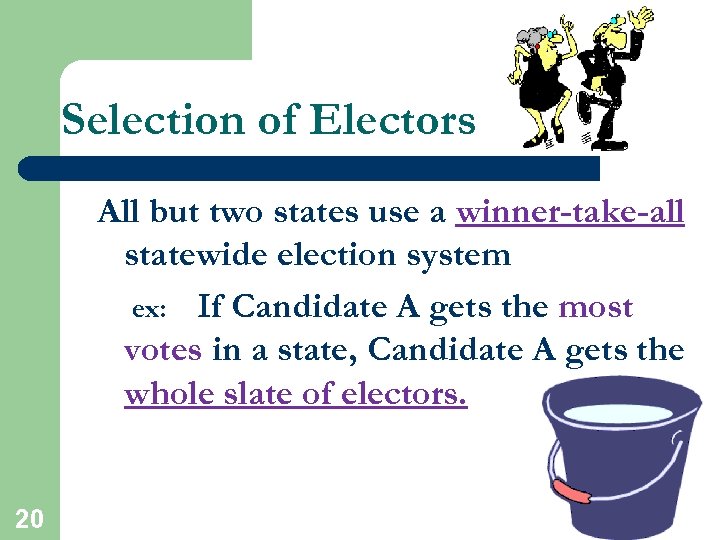
Selection of Electors All but two states use a winner-take-all statewide election system ex: If Candidate A gets the most votes in a state, Candidate A gets the whole slate of electors. 20 3/19/2018
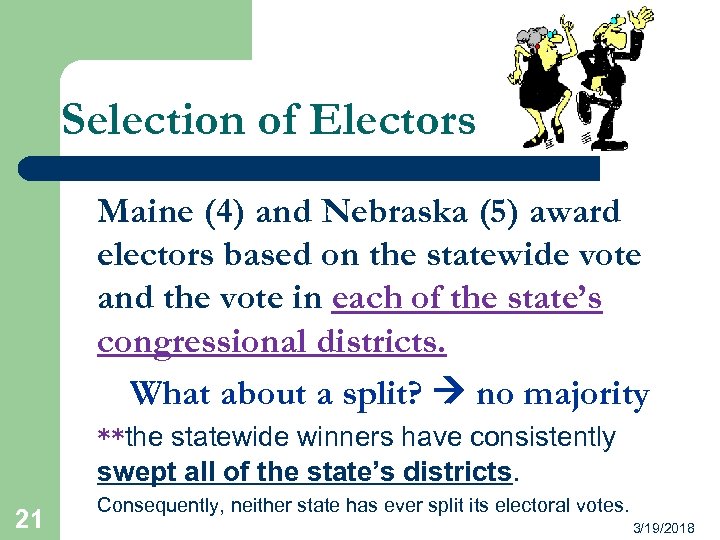
Selection of Electors Maine (4) and Nebraska (5) award electors based on the statewide vote and the vote in each of the state’s congressional districts. What about a split? no majority **the statewide winners have consistently swept all of the state’s districts. 21 Consequently, neither state has ever split its electoral votes. 3/19/2018
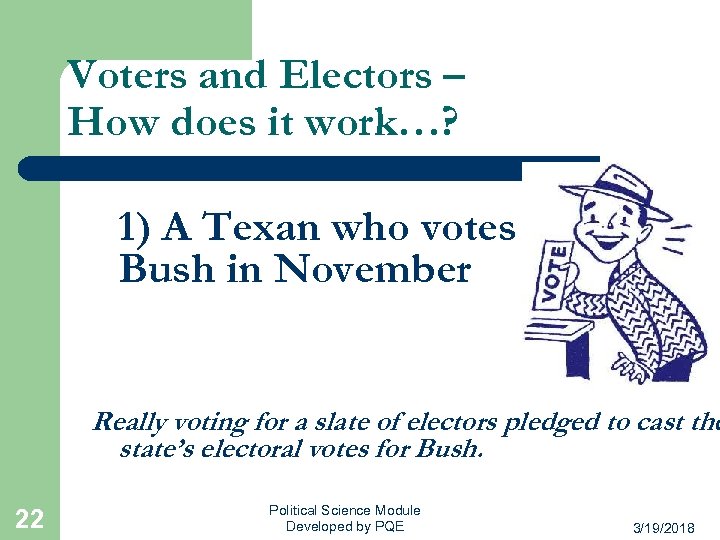
Voters and Electors – How does it work…? 1) A Texan who votes for Bush in November Really voting for a slate of electors pledged to cast the state’s electoral votes for Bush. 22 Political Science Module Developed by PQE 3/19/2018
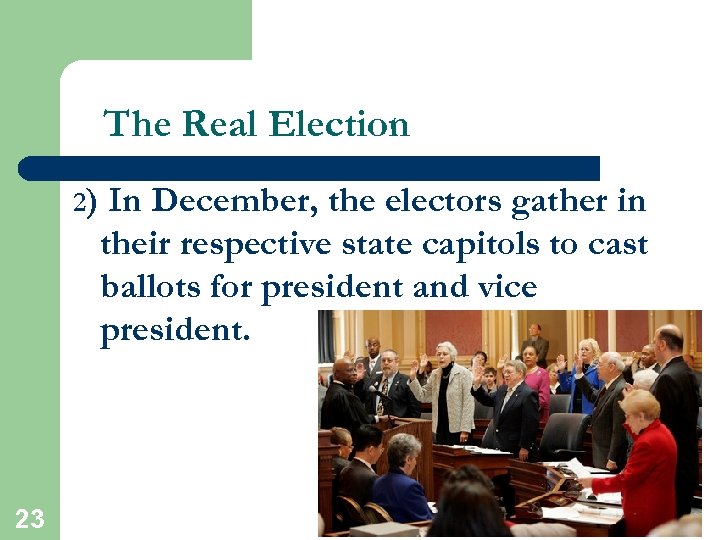
The Real Election 2) 23 In December, the electors gather in their respective state capitols to cast ballots for president and vice president. 3/19/2018
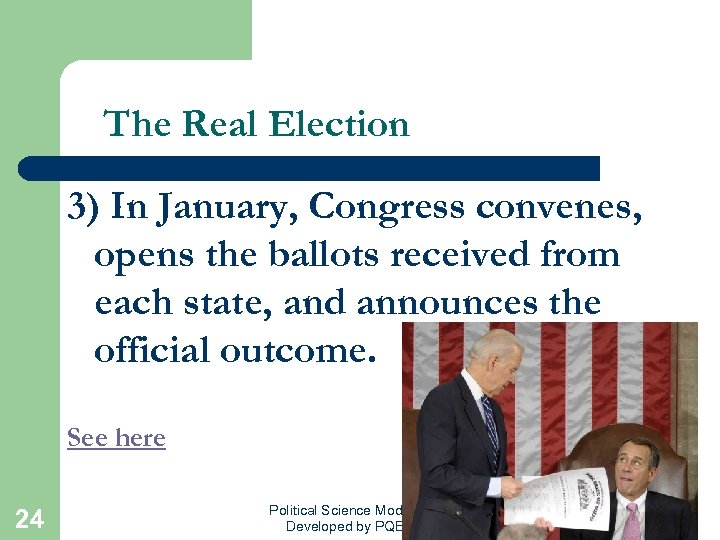
The Real Election 3) In January, Congress convenes, opens the ballots received from each state, and announces the official outcome. See here 24 Political Science Module Developed by PQE 3/19/2018
So, why do I even vote (does my vote count? ) l Let’s take a look at three states… North Carolina Alaska 25 California 3/19/2018
What does these numbers mean for the candidates? l As a matter of campaign strategy spend more time and money campaigning in the BIG states rather than SMALL states. l l 26 As a result – residents of big states tend to get more attention in presidential elections (so small states may feel left out and unimportant). YET IN REALITY, EACH INDIVIDUAL VOTER HAS LESS INFLUENCE IN A BIG STATE THAN IN A SMALL STATE 3/19/2018
What if no one receives a majority? l To win, a candidate needs a majority, that is, 270 (1/2 of 538 +1 ) electoral votes. l l 27 If no candidate has a majority, the House selects the president from among the three presidential candidates with the most electoral votes. Each state delegation has one vote. The Senate selects the vice president from the top two vice-presidential candidates. 3/19/2018
Criticisms of the Electoral College The popular vote winner may lose the presidency (Bush and Gore - 2000) l Electors may vote for persons other than their party’s presidential and vice presidential candidates (not legally bound but…) l If no candidate receives a majority, Congress will pick the president and vice president. l 28 3/19/2018
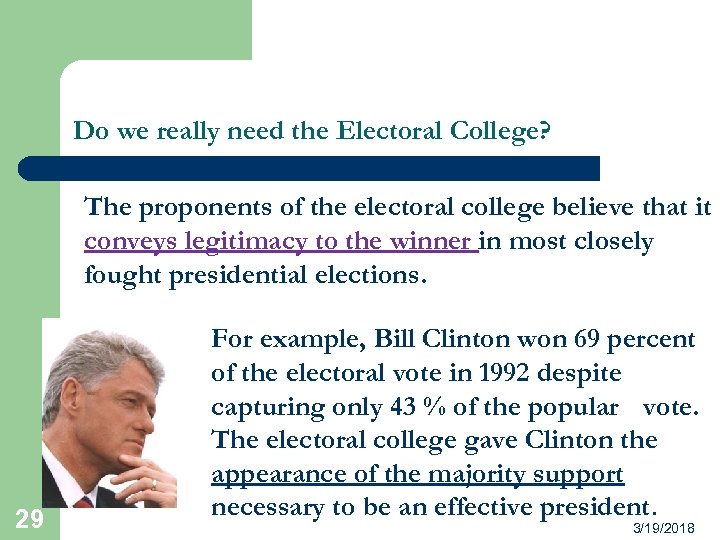
Do we really need the Electoral College? The proponents of the electoral college believe that it conveys legitimacy to the winner in most closely fought presidential elections. 29 For example, Bill Clinton won 69 percent of the electoral vote in 1992 despite capturing only 43 % of the popular vote. The electoral college gave Clinton the appearance of the majority support necessary to be an effective president. 3/19/2018
But don’t forget Florida The 2000 election demonstrated that the electoral college can sometimes undermine a president’s legitimacy. Because of the electoral college, the outcome of the national presidential election was in doubt for more than a month even though one candidate enjoyed a clear popular vote plurality nationwide. The U. S. Supreme Court eventually determined the outcome of the election by halting the vote count in Florida. 30 Political Science Module Developed by PQE
Proposals for Reform Eliminate electors but still count electoral votes. l Ex: If President Obama wins PA by the popular vote, then he would AUTOMATICALLY receive PA’s 20 electoral votes l 31 Advantage – Know right away & No human electoral vote (which could change from people’s vote) 3/19/2018
Proposals for Reform Selectors based on the proportion of the vote each candidate gets in each state. This way, a candidate who come in second place in a state with 45% of the popular vote would receive 45% of the electoral votes from that state, instead of 0%. Advantage - would greatly increase voter turnout and the representation of all parties in a state. It would also encourage candidates to campaign in all states rather than just those that are competitive. l 32 Political Science Module Developed by PQE 3/19/2018
Proposals for Reform l Selectors by congressional districts with two electors chosen at large in each state. – l Disadvantage - would actually make candidates attention even more tunneled. There are normally anywhere from 10 -20 competitive swing states in any given election. – 33 This method divides electoral votes by district, allocating one vote to each district and using the remaining two as a bonus for the statewide popular vote winner However, with this method, candidates would rather shift their focuses to competitive districts, the number of which would be small enough to further reduce the reach of presidential campaigns, promises and attention. Political Science Module Developed by PQE 3/19/2018
Proposals for Reform l Choose the president by direct popular election (Eliminate Electoral College). – – 34 This method would abolish the Electoral College and require each person to cast one vote for the candidate of their choice. The candidate who receives the most votes nationwide would win the election, with or without a majority of the votes PROBLEM - Well over half of the population lives east of the Mississippi river so in a popular vote they would overwhelm the rest of the country and there would be no reason for Californians to even go to the polls.
Critique of the Reforms l l Critics attack some reforms for not going far enough. Critics attack other reforms because of the danger that they would produce unintended bad consequences. l Too many elections decided by Congress. 35 Political Science Module Developed by PQE 3/19/2018
Will Reform Happen? l Amending the Constitution is not easy. – – l 36 The bill must pass both houses of the legislature, by a two-thirds majority in each. Once the bill has passed both houses, it goes on to the states. This is the route taken by all current amendments Small states would be opposed to reform because they benefit from the current system. Political Science Module Developed by PQE 3/19/2018

Wednesday Test Format – 60 points Matching, Multiple Choice, and Completion *Review Sheet 37 3/19/2018
Review Question If Michigan has 8 House of Representative members, how many Electoral Votes do they have total? 38 Political Science Module Developed by PQE 3/19/2018
Answer If Michigan has 8 House of Representative members, how many Electoral Votes do they have total? 10 Electoral Votes = (8 H of R + 2 Senators) 39 Political Science Module Developed by PQE 3/19/2018
Review Question Who are electors? 40 Political Science Module Developed by PQE 3/19/2018
Answer They are individuals selected in each state to officially cast that state’s electoral votes. Electors are typically long-time party activists who are selected by their state party organization as a reward for their loyalty to the party. In most states, electors are officially pledged to support their party’s presidential and vice presidential candidates. 41 Political Science Module Developed by PQE 3/19/2018
Review Question In all but 2 states, does it matter whether a candidate carries a state by a few votes or a lot of votes? 42 Political Science Module Developed by PQE 3/19/2018
Answer No. A candidate receives all of a state’s electoral votes whether the candidate carries the state by one vote or a million votes. In every state except Nebraska and Maine, the race is winner take all. 43 Political Science Module Developed by PQE 3/19/2018
Think About it… Pretend you are explaining to your grandparents or little 8 year old sibling about the Electoral College. How would you explain it to them (in terms they can understand) or make an illustration? 2) Do you favor or oppose replacing the electoral college with a different system for selecting a president? Why or Why not? 1) 44 Political Science Module Developed by PQE 3/19/2018
Review Question What is the small state bias? 45 Political Science Module Developed by PQE 3/19/2018
Answer The electoral college has a small state bias because every state gets at least three electoral votes regardless of its population. As a result, small states such as Alaska, Wyoming, and South Dakota enjoy a greater percentage of electoral votes than they would merit based strictly on population. 46 Political Science Module Developed by PQE 3/19/2018
Review Question Why would most Cuban American political leaders likely oppose replacing the electoral college with direct popular election? 47 Political Science Module Developed by PQE 3/19/2018
Answer The electoral college gives Cuban Americans a disproportionate influence in national politics because of their concentration in the state of Florida, a state with a sizable number of electoral votes that is closely divided politically. Candidates for president cannot afford to ignore the political concerns of Cuban Americans because of their role in Florida elections. 48 Political Science Module Developed by PQE 3/19/2018
Discussion Question Why didn’t the 2000 election trigger a major effort to reform the electoral college? 49 Political Science Module Developed by PQE 3/19/2018
Discussion Question How does the electoral college impact candidate strategy in presidential election campaigns? 50 Political Science Module Developed by PQE 3/19/2018
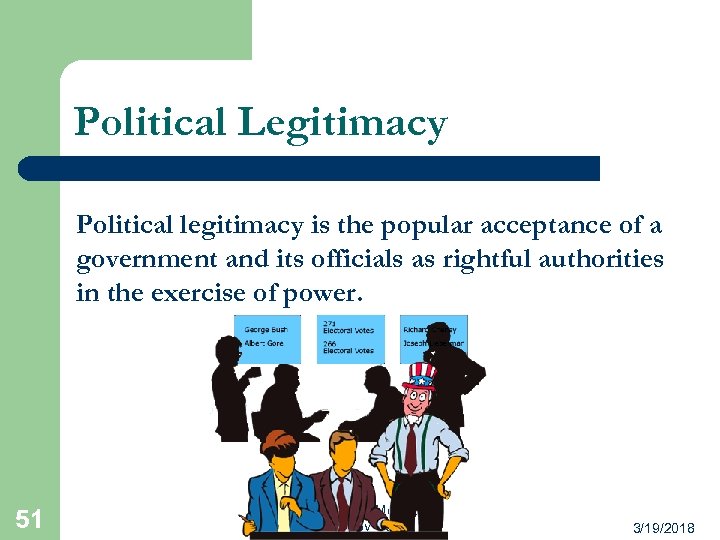
Political Legitimacy Political legitimacy is the popular acceptance of a government and its officials as rightful authorities in the exercise of power. 51 Political Science Module Developed by PQE 3/19/2018
52 Political Science Module Developed by PQE 3/19/2018
Скачать презентацию Learning Objectives l l l 1 Trace the
5043a089c7aa26e9f0a43985a6c03ce6.ppt