 Скачать презентацию Learning Objective Name _____________ Today we will contrast
fc6b295bdb2f10698c14ee5cf275a869.ppt
- Количество слайдов: 11



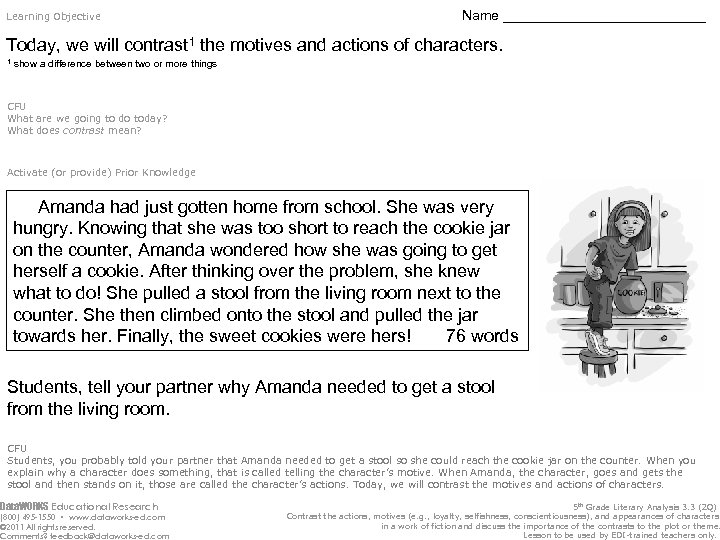
Learning Objective Name _____________ Today, we will contrast 1 the motives and actions of characters. 1 show a difference between two or more things CFU What are we going to do today? What does contrast mean? Activate (or provide) Prior Knowledge Amanda had just gotten home from school. She was very hungry. Knowing that she was too short to reach the cookie jar on the counter, Amanda wondered how she was going to get herself a cookie. After thinking over the problem, she knew what to do! She pulled a stool from the living room next to the counter. She then climbed onto the stool and pulled the jar towards her. Finally, the sweet cookies were hers! 76 words Students, tell your partner why Amanda needed to get a stool from the living room. CFU Students, you probably told your partner that Amanda needed to get a stool so she could reach the cookie jar on the counter. When you explain why a character does something, that is called telling the character’s motive. When Amanda, the character, goes and gets the stool and then stands on it, those are called the character’s actions. Today, we will contrast the motives and actions of characters. Data. WORKS Educational Research (800) 495 -1550 • www. dataworks-ed. com © 2011 All rights reserved. Comments? feedback@dataworks-ed. com 5 th Grade Literary Analysis 3. 3 (2 Q) Contrast the actions, motives (e. g. , loyalty, selfishness, conscientiousness), and appearances of characters in a work of fiction and discuss the importance of the contrasts to the plot or theme. Lesson to be used by EDI-trained teachers only.
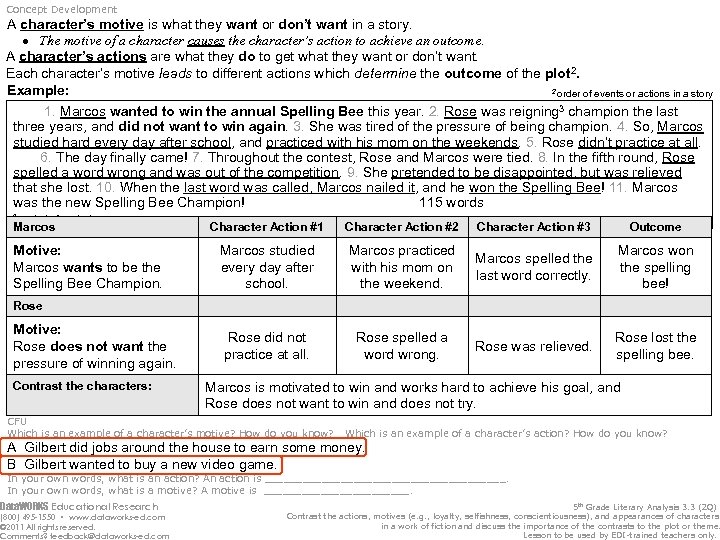
Concept Development A character’s motive is what they want or don’t want in a story. The motive of a character causes the character’s action to achieve an outcome. A character’s actions are what they do to get what they want or don’t want. Each character’s motive leads to different actions which determine the outcome of the plot 2. 2 order of events or actions in a story Example: 1. Marcos wanted to win the annual Spelling Bee this year. 2. Rose was reigning 3 champion the last three years, and did not want to win again. 3. She was tired of the pressure of being champion. 4. So, Marcos studied hard every day after school, and practiced with his mom on the weekends. 5. Rose didn’t practice at all. 6. The day finally came! 7. Throughout the contest, Rose and Marcos were tied. 8. In the fifth round, Rose spelled a word wrong and was out of the competition. 9. She pretended to be disappointed, but was relieved that she lost. 10. When the last word was called, Marcos nailed it, and he won the Spelling Bee! 11. Marcos was the new Spelling Bee Champion! 115 words 3 period of control Marcos Motive: Marcos wants to be the Spelling Bee Champion. Character Action #1 Character Action #2 Character Action #3 Outcome Marcos studied every day after school. Marcos practiced with his mom on the weekend. Marcos spelled the last word correctly. Marcos won the spelling bee! Rose did not practice at all. Rose spelled a word wrong. Rose was relieved. Rose lost the spelling bee. Rose Motive: Rose does not want the pressure of winning again. Contrast the characters: Marcos is motivated to win and works hard to achieve his goal, and Rose does not want to win and does not try. CFU Which is an example of a character’s motive? How do you know? Which is an example of a character’s action? How do you know? A Gilbert did jobs around the house to earn some money. B Gilbert wanted to buy a new video game. In your own words, what is an action? An action is ___________________. In your own words, what is a motive? A motive is ____________. Data. WORKS Educational Research (800) 495 -1550 • www. dataworks-ed. com © 2011 All rights reserved. Comments? feedback@dataworks-ed. com 5 th Grade Literary Analysis 3. 3 (2 Q) Contrast the actions, motives (e. g. , loyalty, selfishness, conscientiousness), and appearances of characters in a work of fiction and discuss the importance of the contrasts to the plot or theme. Lesson to be used by EDI-trained teachers only.
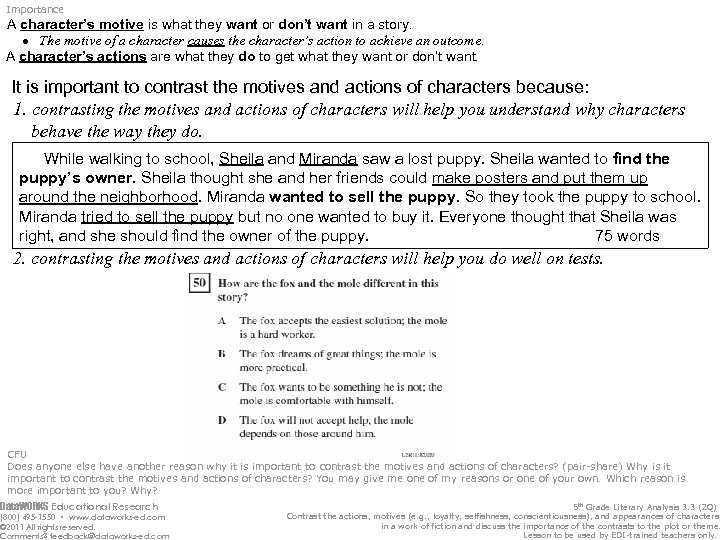
Importance A character’s motive is what they want or don’t want in a story. The motive of a character causes the character’s action to achieve an outcome. A character’s actions are what they do to get what they want or don’t want. It is important to contrast the motives and actions of characters because: 1. contrasting the motives and actions of characters will help you understand why characters behave the way they do. While walking to school, Sheila and Miranda saw a lost puppy. Sheila wanted to find the puppy’s owner. Sheila thought she and her friends could make posters and put them up around the neighborhood. Miranda wanted to sell the puppy. So they took the puppy to school. Miranda tried to sell the puppy but no one wanted to buy it. Everyone thought that Sheila was right, and she should find the owner of the puppy. 75 words 2. contrasting the motives and actions of characters will help you do well on tests. CFU Does anyone else have another reason why it is important to contrast the motives and actions of characters? (pair-share) Why is it important to contrast the motives and actions of characters? You may give me one of my reasons or one of your own. Which reason is more important to you? Why? Data. WORKS Educational Research (800) 495 -1550 • www. dataworks-ed. com © 2011 All rights reserved. Comments? feedback@dataworks-ed. com 5 th Grade Literary Analysis 3. 3 (2 Q) Contrast the actions, motives (e. g. , loyalty, selfishness, conscientiousness), and appearances of characters in a work of fiction and discuss the importance of the contrasts to the plot or theme. Lesson to be used by EDI-trained teachers only.
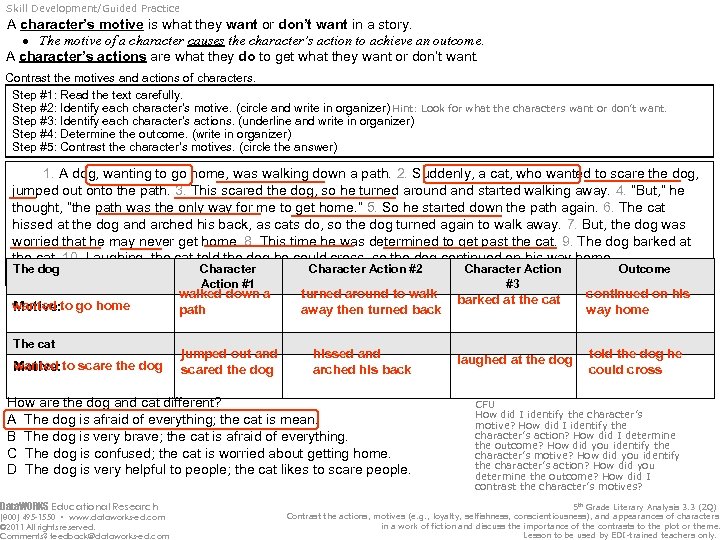
Skill Development/Guided Practice A character’s motive is what they want or don’t want in a story. The motive of a character causes the character’s action to achieve an outcome. A character’s actions are what they do to get what they want or don’t want. Contrast the motives and actions of characters. Step #1: Read the text carefully. Step #2: Identify each character’s motive. (circle and write in organizer) Hint: Look for what the characters want or don’t want. Step #3: Identify each character’s actions. (underline and write in organizer) Step #4: Determine the outcome. (write in organizer) Step #5: Contrast the character’s motives. (circle the answer) 1. A dog, wanting to go home, was walking down a path. 2. Suddenly, a cat, who wanted to scare the dog, jumped out onto the path. 3. This scared the dog, so he turned around and started walking away. 4. “But, ” he thought, “the path was the only way for me to get home. ” 5. So he started down the path again. 6. The cat hissed at the dog and arched his back, as cats do, so the dog turned again to walk away. 7. But, the dog was worried that he may never get home. 8. This time he was determined to get past the cat. 9. The dog barked at the cat. 10. Laughing, the cat told the dog he could cross, so the dog continued on his way home. The words Character Action #2 Character Action Outcome 123 dog Action #1 wanted to go home Motive: The cat wanted Motive: to scare the dog walked down a path jumped out and scared the dog turned around to walk away then turned back hissed and arched his back How are the dog and cat different? A The dog is afraid of everything; the cat is mean. B The dog is very brave; the cat is afraid of everything. C The dog is confused; the cat is worried about getting home. D The dog is very helpful to people; the cat likes to scare people. Data. WORKS Educational Research (800) 495 -1550 • www. dataworks-ed. com © 2011 All rights reserved. Comments? feedback@dataworks-ed. com #3 barked at the cat continued on his way home laughed at the dog told the dog he could cross CFU How did I identify the character’s motive? How did I identify the character’s action? How did I determine the outcome? How did you identify the character’s motive? How did you identify the character’s action? How did you determine the outcome? How did I contrast the character’s motives? 5 th Grade Literary Analysis 3. 3 (2 Q) Contrast the actions, motives (e. g. , loyalty, selfishness, conscientiousness), and appearances of characters in a work of fiction and discuss the importance of the contrasts to the plot or theme. Lesson to be used by EDI-trained teachers only.
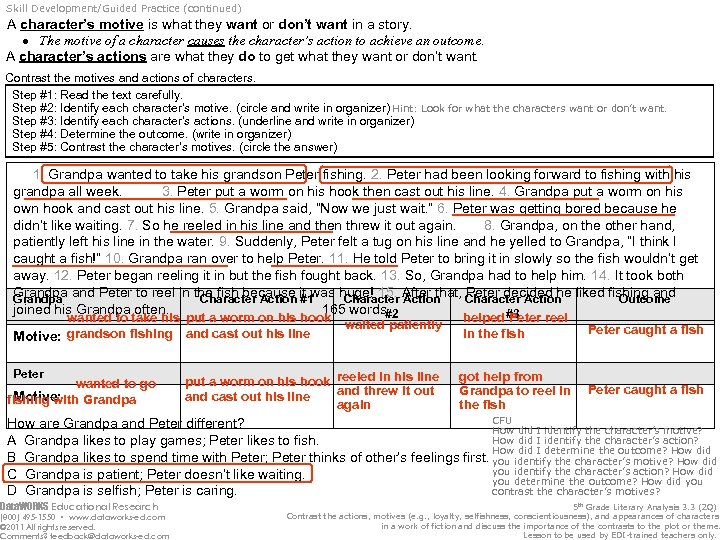
Skill Development/Guided Practice (continued) A character’s motive is what they want or don’t want in a story. The motive of a character causes the character’s action to achieve an outcome. A character’s actions are what they do to get what they want or don’t want. Contrast the motives and actions of characters. Step #1: Read the text carefully. Step #2: Identify each character’s motive. (circle and write in organizer) Hint: Look for what the characters want or don’t want. Step #3: Identify each character’s actions. (underline and write in organizer) Step #4: Determine the outcome. (write in organizer) Step #5: Contrast the character’s motives. (circle the answer) 1. Grandpa wanted to take his grandson Peter fishing. 2. Peter had been looking forward to fishing with his grandpa all week. 3. Peter put a worm on his hook then cast out his line. 4. Grandpa put a worm on his own hook and cast out his line. 5. Grandpa said, “Now we just wait. ” 6. Peter was getting bored because he didn’t like waiting. 7. So he reeled in his line and then threw it out again. 8. Grandpa, on the other hand, patiently left his line in the water. 9. Suddenly, Peter felt a tug on his line and he yelled to Grandpa, “I think I caught a fish!” 10. Grandpa ran over to help Peter. 11. He told Peter to bring it in slowly so the fish wouldn’t get away. 12. Peter began reeling it in but the fish fought back. 13. So, Grandpa had to help him. 14. It took both Grandpa and Peter to reel in the fish because it was huge! 15. After that, Character Action liked fishing and Peter decided he Grandpa Character Action #1 Character Action Outcome joined his Grandpa often. 165 words#2 #3 wanted to take his put a worm on his hook Motive: grandson fishing and cast out his line Peter wanted to go Motive: fishing with Grandpa waited patiently helped Peter reel in the fish Peter caught a fish put a worm on his hook reeled in his line and threw it out and cast out his line again got help from Grandpa to reel in the fish Peter caught a fish CFU How are Grandpa and Peter different? How did I identify the character’s motive? How did I identify the character’s action? A Grandpa likes to play games; Peter likes to fish. How did I determine the outcome? How did B Grandpa likes to spend time with Peter; Peter thinks of other’s feelings first. you identify the character’s motive? How did you identify the character’s action? How did C Grandpa is patient; Peter doesn’t like waiting. you determine the outcome? How did you contrast the character’s motives? D Grandpa is selfish; Peter is caring. Data. WORKS Educational Research (800) 495 -1550 • www. dataworks-ed. com © 2011 All rights reserved. Comments? feedback@dataworks-ed. com 5 th Grade Literary Analysis 3. 3 (2 Q) Contrast the actions, motives (e. g. , loyalty, selfishness, conscientiousness), and appearances of characters in a work of fiction and discuss the importance of the contrasts to the plot or theme. Lesson to be used by EDI-trained teachers only.
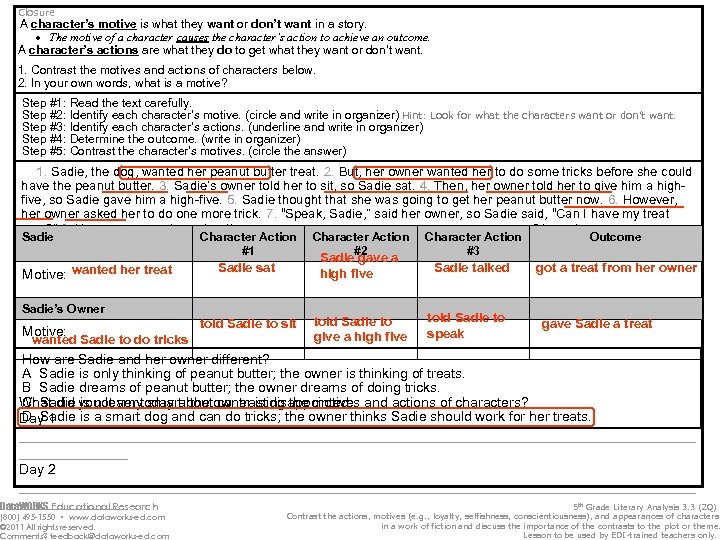
Closure A character’s motive is what they want or don’t want in a story. The motive of a character causes the character’s action to achieve an outcome. A character’s actions are what they do to get what they want or don’t want. 1. Contrast the motives and actions of characters below. 2. In your own words, what is a motive? Step #1: Read the text carefully. Step #2: Identify each character’s motive. (circle and write in organizer) Hint: Look for what the characters want or don’t want. Step #3: Identify each character’s actions. (underline and write in organizer) Step #4: Determine the outcome. (write in organizer) Step #5: Contrast the character’s motives. (circle the answer) 1. Sadie, the dog, wanted her peanut butter treat. 2. But, her owner wanted her to do some tricks before she could have the peanut butter. 3. Sadie’s owner told her to sit, so Sadie sat. 4. Then, her owner told her to give him a highfive, so Sadie gave him a high-five. 5. Sadie thought that she was going to get her peanut butter now. 6. However, her owner asked her to do one more trick. 7. “Speak, Sadie, ” said her owner, so Sadie said, “Can I have my treat now? ” 8. Her owner gave her a treat! 91 words Sadie Motive: wanted her treat Character Action #1 Sadie sat Sadie gave a high five told Sadie to sit told Sadie to give a high five Sadie’s Owner Motive: wanted Sadie to do tricks Character Action #2 Character Action #3 Outcome Sadie talked got a treat from her owner told Sadie to speak gave Sadie a treat How are Sadie and her owner different? A Sadie is only thinking of peanut butter; the owner is thinking of treats. B Sadie dreams of peanut butter; the owner dreams of doing tricks. What did you learn today about owner is disappointed. and actions of characters? C Sadie is not very smart; the contrasting the motives D Sadie is a smart dog and can do tricks; the owner thinks Sadie should work for her treats. Day 1 ____________________________________________ Day 2 ____________________________________________ 5 Grade Literary Analysis 3. 3 (2 Q) Data. WORKS Educational Research th (800) 495 -1550 • www. dataworks-ed. com © 2011 All rights reserved. Comments? feedback@dataworks-ed. com Contrast the actions, motives (e. g. , loyalty, selfishness, conscientiousness), and appearances of characters in a work of fiction and discuss the importance of the contrasts to the plot or theme. Lesson to be used by EDI-trained teachers only.
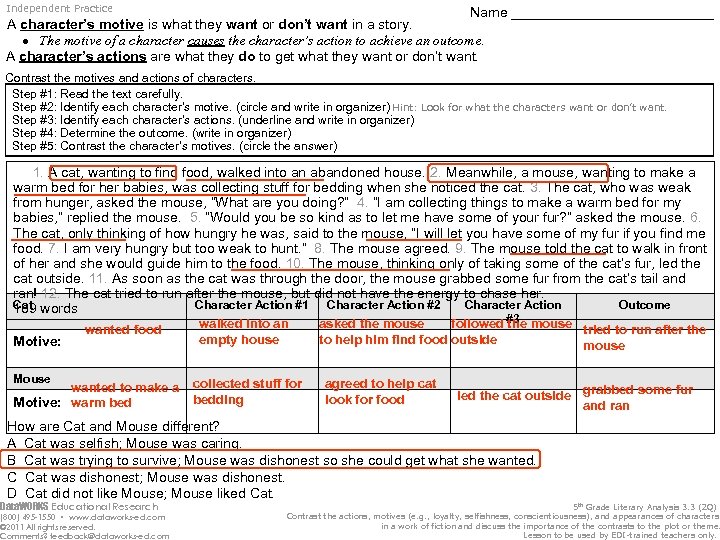
Independent Practice Name _____________ A character’s motive is what they want or don’t want in a story. The motive of a character causes the character’s action to achieve an outcome. A character’s actions are what they do to get what they want or don’t want. Contrast the motives and actions of characters. Step #1: Read the text carefully. Step #2: Identify each character’s motive. (circle and write in organizer) Hint: Look for what the characters want or don’t want. Step #3: Identify each character’s actions. (underline and write in organizer) Step #4: Determine the outcome. (write in organizer) Step #5: Contrast the character’s motives. (circle the answer) 1. A cat, wanting to find food, walked into an abandoned house. 2. Meanwhile, a mouse, wanting to make a warm bed for her babies, was collecting stuff for bedding when she noticed the cat. 3. The cat, who was weak from hunger, asked the mouse, “What are you doing? ” 4. “I am collecting things to make a warm bed for my babies, ” replied the mouse. 5. “Would you be so kind as to let me have some of your fur? ” asked the mouse. 6. The cat, only thinking of how hungry he was, said to the mouse, “I will let you have some of my fur if you find me food. 7. I am very hungry but too weak to hunt. ” 8. The mouse agreed. 9. The mouse told the cat to walk in front of her and she would guide him to the food. 10. The mouse, thinking only of taking some of the cat’s fur, led the cat outside. 11. As soon as the cat was through the door, the mouse grabbed some fur from the cat’s tail and ran! 12. The cat tried to run after the mouse, but did not have the energy to chase her. Cat words Character Action #1 Character Action #2 Character Action Outcome 189 Motive: wanted food Mouse wanted to make a Motive: warm bed walked into an empty house collected stuff for bedding asked the mouse followed #3 mouse tried to run after the to help him find food outside mouse agreed to help cat look for food led the cat outside grabbed some fur and ran How are Cat and Mouse different? A Cat was selfish; Mouse was caring. B Cat was trying to survive; Mouse was dishonest so she could get what she wanted. C Cat was dishonest; Mouse was dishonest. D Cat did not like Mouse; Mouse liked Cat. Data. WORKS Educational Research (800) 495 -1550 • www. dataworks-ed. com © 2011 All rights reserved. Comments? feedback@dataworks-ed. com 5 th Grade Literary Analysis 3. 3 (2 Q) Contrast the actions, motives (e. g. , loyalty, selfishness, conscientiousness), and appearances of characters in a work of fiction and discuss the importance of the contrasts to the plot or theme. Lesson to be used by EDI-trained teachers only.
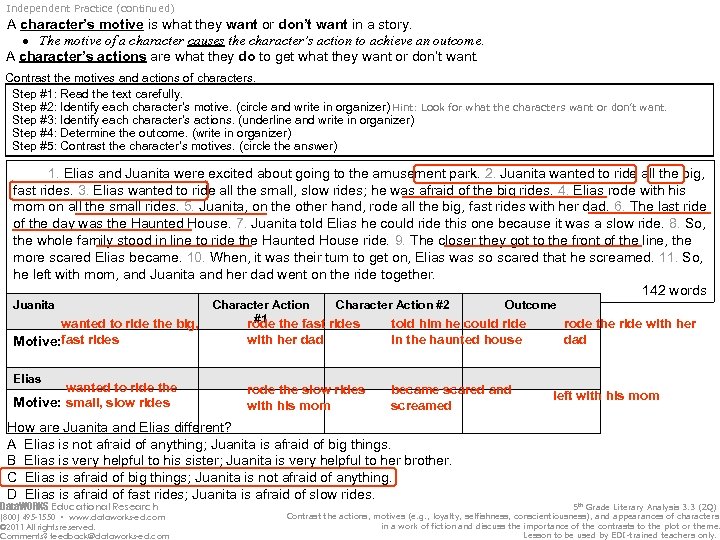
Independent Practice (continued) A character’s motive is what they want or don’t want in a story. The motive of a character causes the character’s action to achieve an outcome. A character’s actions are what they do to get what they want or don’t want. Contrast the motives and actions of characters. Step #1: Read the text carefully. Step #2: Identify each character’s motive. (circle and write in organizer) Hint: Look for what the characters want or don’t want. Step #3: Identify each character’s actions. (underline and write in organizer) Step #4: Determine the outcome. (write in organizer) Step #5: Contrast the character’s motives. (circle the answer) 1. Elias and Juanita were excited about going to the amusement park. 2. Juanita wanted to ride all the big, fast rides. 3. Elias wanted to ride all the small, slow rides; he was afraid of the big rides. 4. Elias rode with his mom on all the small rides. 5. Juanita, on the other hand, rode all the big, fast rides with her dad. 6. The last ride of the day was the Haunted House. 7. Juanita told Elias he could ride this one because it was a slow ride. 8. So, the whole family stood in line to ride the Haunted House ride. 9. The closer they got to the front of the line, the more scared Elias became. 10. When, it was their turn to get on, Elias was so scared that he screamed. 11. So, he left with mom, and Juanita and her dad went on the ride together. 142 words Juanita wanted to ride the big, Motive: fast rides Elias wanted to ride the Motive: small, slow rides Character Action #2 Outcome #1 the fast rides rode told him he could ride rode the ride with her dad in the haunted house rode the slow rides with his mom became scared and screamed How are Juanita and Elias different? A Elias is not afraid of anything; Juanita is afraid of big things. B Elias is very helpful to his sister; Juanita is very helpful to her brother. C Elias is afraid of big things; Juanita is not afraid of anything. D Elias is afraid of fast rides; Juanita is afraid of slow rides. Data. WORKS Educational Research (800) 495 -1550 • www. dataworks-ed. com © 2011 All rights reserved. Comments? feedback@dataworks-ed. com dad left with his mom 5 th Grade Literary Analysis 3. 3 (2 Q) Contrast the actions, motives (e. g. , loyalty, selfishness, conscientiousness), and appearances of characters in a work of fiction and discuss the importance of the contrasts to the plot or theme. Lesson to be used by EDI-trained teachers only.
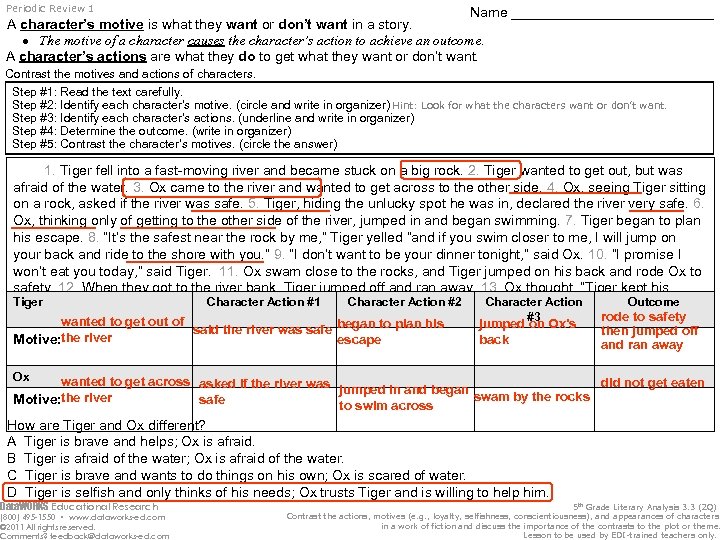
Periodic Review 1 Name _____________ A character’s motive is what they want or don’t want in a story. The motive of a character causes the character’s action to achieve an outcome. A character’s actions are what they do to get what they want or don’t want. Contrast the motives and actions of characters. Step #1: Read the text carefully. Step #2: Identify each character’s motive. (circle and write in organizer) Hint: Look for what the characters want or don’t want. Step #3: Identify each character’s actions. (underline and write in organizer) Step #4: Determine the outcome. (write in organizer) Step #5: Contrast the character’s motives. (circle the answer) 1. Tiger fell into a fast-moving river and became stuck on a big rock. 2. Tiger wanted to get out, but was afraid of the water. 3. Ox came to the river and wanted to get across to the other side. 4. Ox, seeing Tiger sitting on a rock, asked if the river was safe. 5. Tiger, hiding the unlucky spot he was in, declared the river very safe. 6. Ox, thinking only of getting to the other side of the river, jumped in and began swimming. 7. Tiger began to plan his escape. 8. “It’s the safest near the rock by me, ” Tiger yelled “and if you swim closer to me, I will jump on your back and ride to the shore with you. ” 9. “I don’t want to be your dinner tonight, ” said Ox. 10. “I promise I won’t eat you today, ” said Tiger. 11. Ox swam close to the rocks, and Tiger jumped on his back and rode Ox to safety. 12. When they got to the river bank, Tiger jumped off and ran away. 13. Ox thought, “Tiger kept his Tiger Character Action Outcome promise; he did not eat me. ” Character Action #1 178 words Action #2 wanted to get out of said the river was safe began to plan his the river escape Motive: #3 jumped on Ox’s back rode to safety then jumped off and ran away Ox wanted to get across asked if the river was did not get eaten jumped in and began swam by the rocks safe Motive: the river to swim across How are Tiger and Ox different? A Tiger is brave and helps; Ox is afraid. B Tiger is afraid of the water; Ox is afraid of the water. C Tiger is brave and wants to do things on his own; Ox is scared of water. D Tiger is selfish and only thinks of his needs; Ox trusts Tiger and is willing to help him. Data. WORKS Educational Research (800) 495 -1550 • www. dataworks-ed. com © 2011 All rights reserved. Comments? feedback@dataworks-ed. com 5 th Grade Literary Analysis 3. 3 (2 Q) Contrast the actions, motives (e. g. , loyalty, selfishness, conscientiousness), and appearances of characters in a work of fiction and discuss the importance of the contrasts to the plot or theme. Lesson to be used by EDI-trained teachers only.
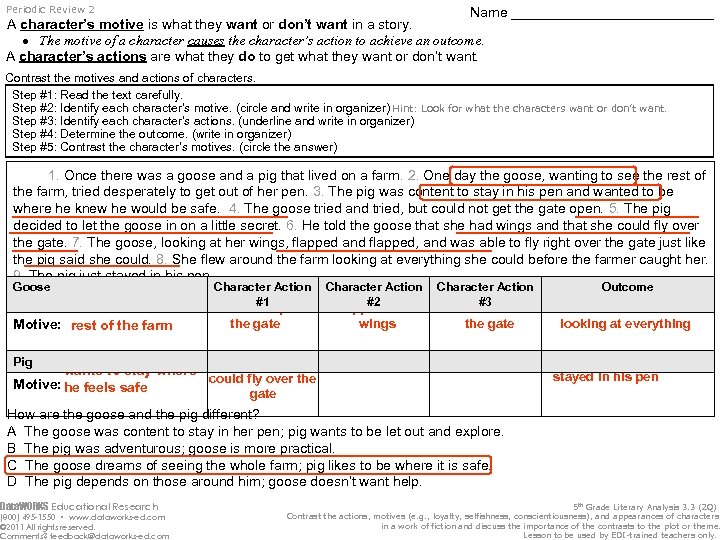
Periodic Review 2 Name _____________ A character’s motive is what they want or don’t want in a story. The motive of a character causes the character’s action to achieve an outcome. A character’s actions are what they do to get what they want or don’t want. Contrast the motives and actions of characters. Step #1: Read the text carefully. Step #2: Identify each character’s motive. (circle and write in organizer) Hint: Look for what the characters want or don’t want. Step #3: Identify each character’s actions. (underline and write in organizer) Step #4: Determine the outcome. (write in organizer) Step #5: Contrast the character’s motives. (circle the answer) 1. Once there was a goose and a pig that lived on a farm. 2. One day the goose, wanting to see the rest of the farm, tried desperately to get out of her pen. 3. The pig was content to stay in his pen and wanted to be where he knew he would be safe. 4. The goose tried and tried, but could not get the gate open. 5. The pig decided to let the goose in on a little secret. 6. He told the goose that she had wings and that she could fly over the gate. 7. The goose, looking at her wings, flapped and flapped, and was able to fly right over the gate just like the pig said she could. 8. She flew around the farm looking at everything she could before the farmer caught her. 9. The pig just stayed in his pen. Goose Character Action Outcome 148 words #1 #2 #3 tried to open flapped her flew over flew around the farm wants to see the gate wings the gate looking at everything Motive: rest of the farm Pig told goose she wants to stay where could fly over the Motive: he feels safe gate How are the goose and the pig different? A The goose was content to stay in her pen; pig wants to be let out and explore. B The pig was adventurous; goose is more practical. C The goose dreams of seeing the whole farm; pig likes to be where it is safe. D The pig depends on those around him; goose doesn’t want help. Data. WORKS Educational Research (800) 495 -1550 • www. dataworks-ed. com © 2011 All rights reserved. Comments? feedback@dataworks-ed. com stayed in his pen 5 th Grade Literary Analysis 3. 3 (2 Q) Contrast the actions, motives (e. g. , loyalty, selfishness, conscientiousness), and appearances of characters in a work of fiction and discuss the importance of the contrasts to the plot or theme. Lesson to be used by EDI-trained teachers only.
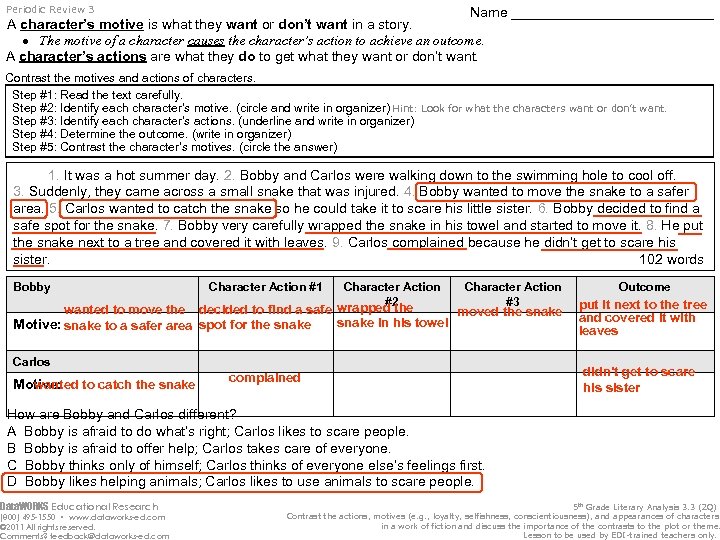
Periodic Review 3 Name _____________ A character’s motive is what they want or don’t want in a story. The motive of a character causes the character’s action to achieve an outcome. A character’s actions are what they do to get what they want or don’t want. Contrast the motives and actions of characters. Step #1: Read the text carefully. Step #2: Identify each character’s motive. (circle and write in organizer) Hint: Look for what the characters want or don’t want. Step #3: Identify each character’s actions. (underline and write in organizer) Step #4: Determine the outcome. (write in organizer) Step #5: Contrast the character’s motives. (circle the answer) 1. It was a hot summer day. 2. Bobby and Carlos were walking down to the swimming hole to cool off. 3. Suddenly, they came across a small snake that was injured. 4. Bobby wanted to move the snake to a safer area. 5. Carlos wanted to catch the snake so he could take it to scare his little sister. 6. Bobby decided to find a safe spot for the snake. 7. Bobby very carefully wrapped the snake in his towel and started to move it. 8. He put the snake next to a tree and covered it with leaves. 9. Carlos complained because he didn’t get to scare his sister. 102 words Bobby Character Action #1 Character Action #2 Character Action #3 wanted to move the decided to find a safe wrapped the moved the snake in his towel Motive: snake to a safer area spot for the snake Carlos Motive: to catch the snake wanted complained Outcome put it next to the tree and covered it with leaves didn’t get to scare his sister How are Bobby and Carlos different? A Bobby is afraid to do what’s right; Carlos likes to scare people. B Bobby is afraid to offer help; Carlos takes care of everyone. C Bobby thinks only of himself; Carlos thinks of everyone else’s feelings first. D Bobby likes helping animals; Carlos likes to use animals to scare people. Data. WORKS Educational Research (800) 495 -1550 • www. dataworks-ed. com © 2011 All rights reserved. Comments? feedback@dataworks-ed. com 5 th Grade Literary Analysis 3. 3 (2 Q) Contrast the actions, motives (e. g. , loyalty, selfishness, conscientiousness), and appearances of characters in a work of fiction and discuss the importance of the contrasts to the plot or theme. Lesson to be used by EDI-trained teachers only.
Скачать презентацию Learning Objective Name _____________ Today we will contrast
fc6b295bdb2f10698c14ee5cf275a869.ppt