


 Скачать презентацию Learning from the Cleaners Migrant Organizing at the
f056027619af2486d016a1e7117b1d6c.ppt
- Количество слайдов: 24
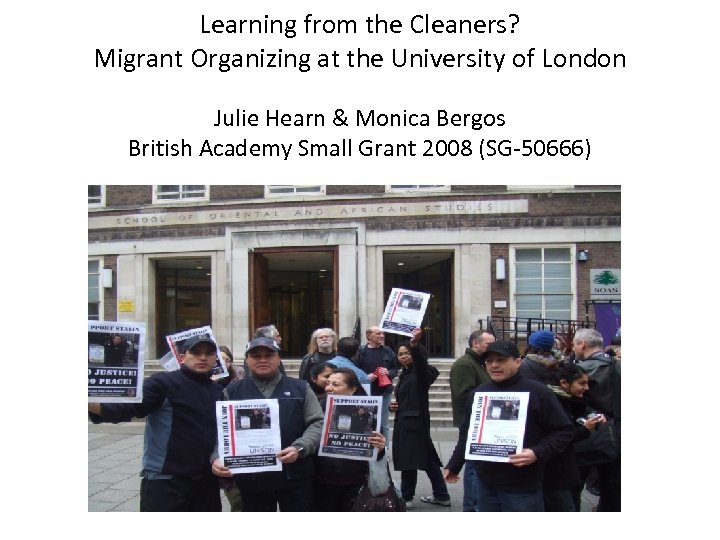 Learning from the Cleaners? Migrant Organizing at the University of London Julie Hearn & Monica Bergos British Academy Small Grant 2008 (SG-50666)
 University of London Cleaners • Federation of nineteen self-governing colleges and institutes with over 120, 000 students • Most of its cleaners are sub-contracted migrant workers on minimum wages • 2005 -2010 nine out of the nineteen colleges & institutes pay or have agreed to pay the London Living Wage of £ 8. 30 (minimum wage £ 5. 93)
 Living Wage at University of London • 2006 Queen Mary & LSE • 2008 School of Oriental & African Studies (SOAS) • Birkbeck; LSHTM; Institute of Education; Goldsmith’s; London Business School; UCL • (King’s working towards implementation) • 2010 University of East London (UEL) • March 2011 London Met • Current campaign at South Bank
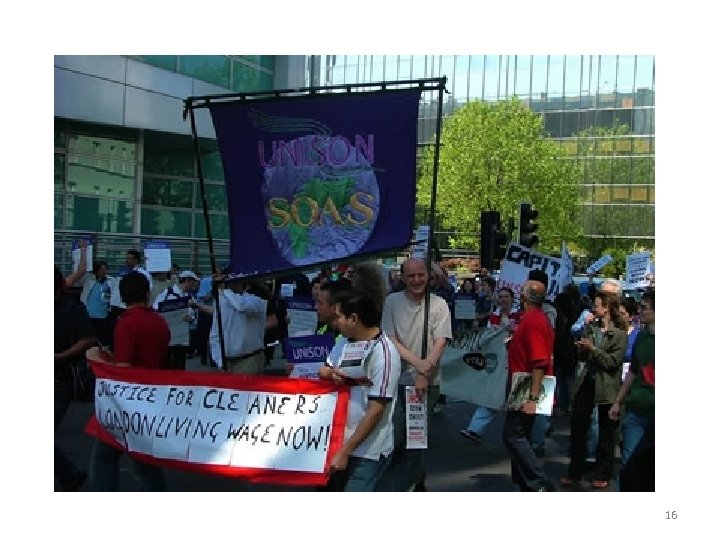
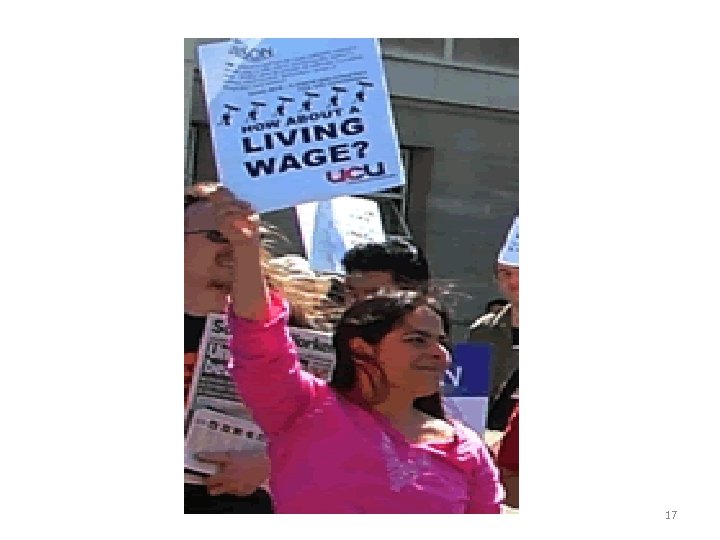
 Living Wage Campaign at SOAS • 18 month long struggle (2006 -2008) • Low paid, migrant, non-unionised Spanishspeaking workers (Colombian & Ecuadorian), who won: • Union recognition • 34% increase in wages • Visibility, solidarity, empowerment
 Research Methodology • Ten semi-structured interviews in Spanish with campaign activists • Participant observation (meetings, campaign ballot) and discussion with branch officials • Interviews with national officials of UNISON, Unite, RMT & Latin American Workers Association (LAWAS)
 Research Publications • Hearn, J. & Bergos, M. (2010) ‘Learning from the Cleaners? Trade Union Activism among Low Paid Latin American Migrant Workers at the University of London’, Working Paper No. 7 Identity, Citizenship & Migration Centre, University of Nottingham. • Hearn, J. & Bergos, M. (2011) ‘Latin American Cleaners Fight for Survival: Lessons for Migrant Activism’, Race and Class 53(1): 65 -82
 Presentation Structure • Context: Pay & working conditions • Challenges of organising in this context • Against the Odds: The story of building a migrant-friendly, effective union • Achievements • Underpinnings of success • Reprisals: Dismissals & deportations • Conclusion: Strategy & tactics
 Context: Deteriorating Poverty Pay • London’s labour market has become increasingly polarised with jobs at the bottom end experiencing real and relative deterioration. ‘While working Londoners gained an average of 71 p per hour in their real earnings between 2001 and 2005. . . cleaners lost 44 p per hour’ Wills, J. et al (2009: 445)
 Context: Minimum vs Living Wage • The minimum wage ‘reflects what the market will bear rather than what is actually required to live’ (Wills 2009: 38) • Single person in council housing needs £ 13, 400 per year to live (Joseph Rowntree Foundation in Wills 2009: 38). In 2009/10 minimum wage was just under £ 12, 000 p. a. • Gap between income and need
 Context: Sub-contracted Sector • ‘an immiseration of workers’ • Herod, A. & Aguiar, L. (eds) (2006) The Dirty Work of Neoliberalism: Cleaners in the Global Economy • Wills, J. (2008) ‘Making Class Politics Possible: Organizing Contract Cleaners in London’, Journal of Urban and Regional Research 32(2)
 Context: ‘Migrant consuming sector’ • Labour Force Survey of London: Percentage of Migrant Workers in the Cleaning Sector • 1993 -94 41% • 2004 -05 69% (Wills et al 2009)
 Challenges for Organizing • • • Fear (harassment, losing job, deportation) Powerlessness (change impossible) Language, culture, racism Nature of shift work (invisible, isolation) High turnover, part-time, overtime, caring • Historic hostility • Not core constituency • Resource intense (translation, legal support)
 • Cause: Non-payment by cleaning contractor • Dec 2006 protests, Jan 2007 campaign starts • Includes: Non-unionized cleaners, SOAS UNISON, SOAS SU, SOAS UCU • Demands: London Living Wage, In-house terms and conditions, union recognition 13
 • Jan 2007 Showing of ‘Bread & Roses’ • May 2007 May Day March, Bloomsbury • Nov 2007 Online Petition with 100 s of staff signatures 14
 • April 2008 ‘Teach-In’ • May 2008 Student and Staff Ballot (458 vote) • • June 2008 Governing Body voted: London Living Wage from Sept 2008 Trade Union Recognition Agreement Contracted Out (ISS Facility Services) 15
 16
16
 17
17
 Underpinning Success: Visibility • ‘Ahora ya no estamos invisibles como antes’ • ‘Now we are not invisible any more. Thanks to the campaign, people think differently about us. They say “cleaners can speak, they know how to stand up for their rights”’ • Mc. Ilwaine, C. et al (2011) No Longer Invisible: The Latin American Community in London
 Underpinning Success: Solidarity • ‘La sensacion de no estar sola, tener el apoyo de companeros, estudiantes, profesores. . . eso te da fuerza para luchar’ • ‘People started to care for others, solidarity became key. . . The feeling of not being alone and the support of your workmates helped me to keep fighting. ’
 Underpinning Success: Empowerment • ‘Me siento ahora mas seguro, mas fuerte’ • ‘Now I feel stronger and more confident’ • ‘It was a new experience that taught me many things. It’s great to learn that you have rights as a worker and to know that nobody should treat you unfairly. . . It was an amazing experience that I would recommend to everyone’
 Reprisals: Dismissals and Deportations • ‘No war is won without blood. We knew that there would casualties, many losses. ’ • Reconfiguration of power • ‘Some employers may seek to disrupt collective action by carrying out document checks on key trade union activists. . . This may be a deliberate attempt to undermine trade union negotiations’ TUC (2010) Immigration Document Checks and Workplace Raids.
 • 2009 SOAS Unison branch president dismissed (2009 Voted honorary president of SOAS SU) • 2009 UCL Unite cleaner sacked • 2009 SOAS dawn raid, 40 police in riot gear, nine cleaners arrested, the week after a recognition agreement had been signed and on day of protest against dismissal of branch president. Student occupation
 • ‘We had to make a choice: either we do nothing and our conditions stay the same or we start the campaign. . . We knew that. . . Families might lose out now, but we had to look to the future and organise better working conditions for everyone’ • ‘Thus although the living wage campaign has been able to secure greater money for contract cleaners. . . The campaign needed to secure the legal rights of many of those workers doing the work’ (Wills et al 2009: 447)
 Conclusion: Strategy & Tactics • Unions have proved that they can organise and win successful campaigns around union recognition and pay and conditions • But how do they PROTECT migrant activists? • 2009 RMT voted for the regularisation of all cleaners and proposed this to the TUC