


 Скачать презентацию Learning from projects Project working and project management
da09ae7d9f1bf80ceef75f4b4d6079bc.ppt
- Количество слайдов: 20
 Learning from projects? Project working and project management in management consultancy Andrew Sturdy andrew. sturdy@wbs. ac. uk December 12 th, 2006
 CONTEXT Management consultancy (MCY) is seen as a key, growing medium in the flow of business knowledge. Some debate, in public sector especially, over whether clients learn from consultancy (and accountability etc) The few studies of MC’s and kn. flow to clients see their role as both a strength (weak ties) and a weakness (burden of ‘otherness’). But how/if knowledge flow occurs is a black box – research neglect of MCY projects - assume simply a matter of sales rhetoric… MCY work is (mostly) project work, albeit often with more uncertainty re objectives and evaluation (neglect of consultancy in PM literature? ? ) Possible insights from project-based learning literature for understanding of knowledge flow from consultancy? How useful are these literatures in understanding learning through (consulting) projects?
 Overview Some thoughts from a ‘fly on the wall’ study of consultancy project meetings (ESRC - EBK - evolution of business knowledge programme) as well as informal meetings over meals and from policy work on public sector use of MCY……. Present an outsider’s perspective on project working and project management Draw on consultancy, learning (including PBL), inter-organisational relationship and boundary literatures Complexity and dynamism within projects suggests MCY literature under and over-states learning potentials PBL (project based learning) literature is inconclusive – learning depends on spatial configurations Both neglect those excluded (the real outsiders), the formality of informality and the power effects of the knowledge ‘gained’ (re projects and re management ideas) – knowledge for what/whom?
 Outsider Status is Significant in Studies of MCY and Knowledge Transfer Advantage - ‘strength of weak ties’ (new knowledge); seen as outside organisational politics; expert status Disadvantage - ‘burden of otherness’ (knowledge clash and de-contextualised) (re trust) ……. reflects a highly organisation-centric view
 Consultants as Outsiders – The Dominant View (& the counter) Re organisation ie not employees - conflicting goals (v ‘partnerships’; project as primary org. – liminal and shared space) Re work contexts and relations - eg projects v line (v projects not new to clients; personal relations) Re social world and background - ‘cosmopolitans’ v ‘locals (v career movement) Re knowledge bases - new tools/skills; sectors (v repeat business re organisation kn. ; MBAs etc; shared functions, sectors; other clients’ knowledge; rubber stamp/audit) So, depends on basis of boundary, but also who – client and consulting systems – and when (cf project phases? ) ie cannot assume consultants are outsiders……
 Help from (project-based) learning literature? Projects mostly seen as especially good for learning (and creativity) Working closely together; finite goals; reflective practices (eg on progress and from evaluation); less associated with functional vested interests; liminal space fosters creativity; formalisation process helps establish understanding (Vlaar et al, 2006) Occurs through learning-by-absorption & learning-by-reflection (Scarbrough et al, 2004). ……. . creativity and learning mostly assumed on the basis of, once again, the diversity (re knowledge and background etc) of team members cf functional/organisational silos But some contrasting views Even if new knowledge/learning occurs, problem becomes one of transfer beyond project (ie Kn. Mgt – Tempest and Starkey, 2005) Working together can lead to conflict and misunderstanding; task becomes primary focus over time to reflect; one off nature hinders learning by repetition Diversity of knowledge can present too much ‘cognitive distance’ (Nooteboom, 2004) and knowledge at stake ie low motivation (political will) to discard knowledge (Carlile, 2002)……. So need to consider optimal distance and power relations…. . Cannot assume projects are good for learning…………
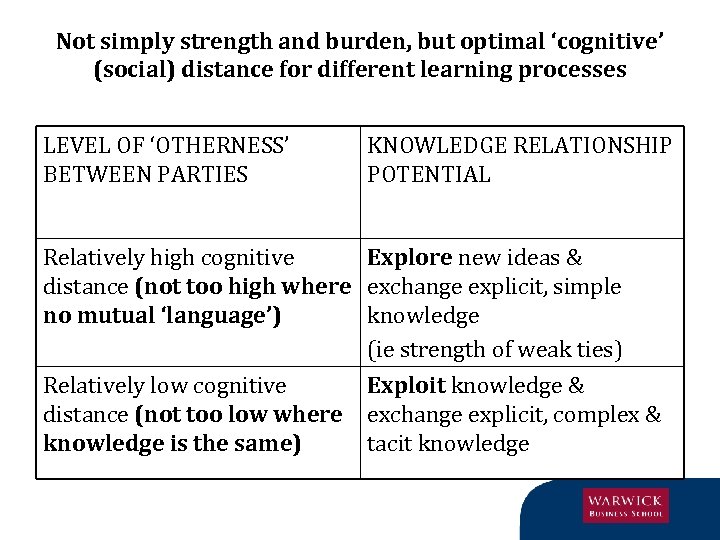 Not simply strength and burden, but optimal ‘cognitive’ (social) distance for different learning processes LEVEL OF ‘OTHERNESS’ BETWEEN PARTIES KNOWLEDGE RELATIONSHIP POTENTIAL Relatively high cognitive Explore new ideas & distance (not too high where exchange explicit, simple no mutual ‘language’) knowledge (ie strength of weak ties) Relatively low cognitive Exploit knowledge & distance (not too low where exchange explicit, complex & knowledge is the same) tacit knowledge
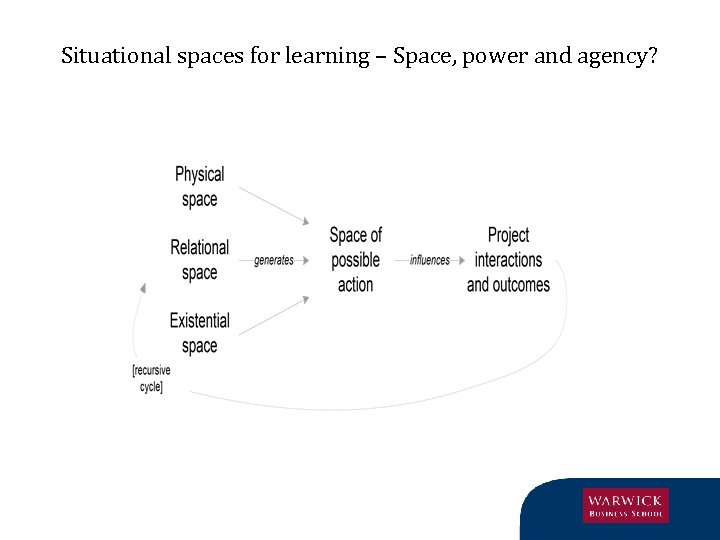 Situational spaces for learning – Space, power and agency?
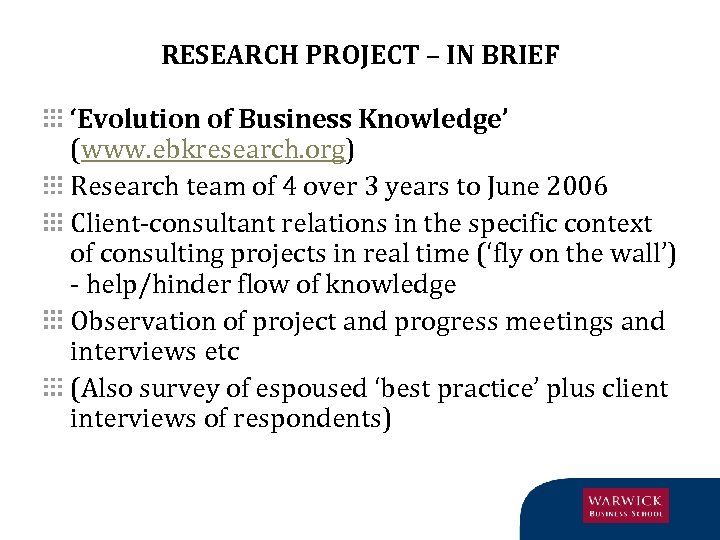 RESEARCH PROJECT – IN BRIEF ‘Evolution of Business Knowledge’ (www. ebkresearch. org) Research team of 4 over 3 years to June 2006 Client-consultant relations in the specific context of consulting projects in real time (‘fly on the wall’) - help/hinder flow of knowledge Observation of project and progress meetings and interviews etc (Also survey of espoused ‘best practice’ plus client interviews of respondents)
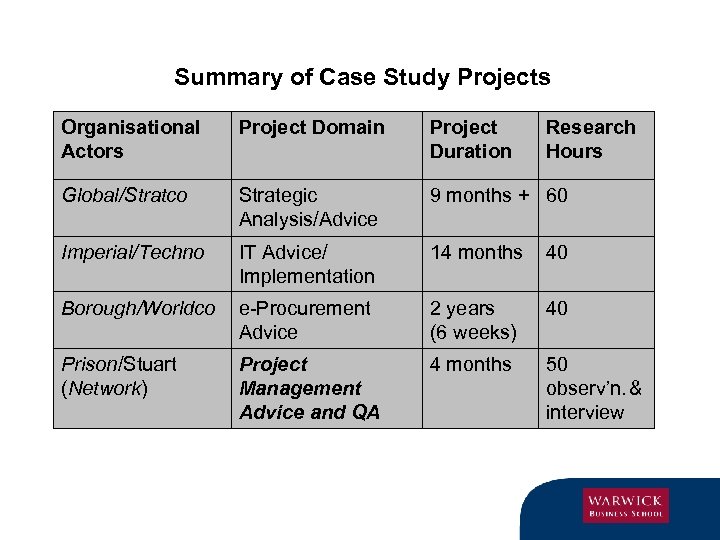 Summary of Case Study Projects Organisational Actors Project Domain Project Duration Research Hours Global/Stratco Strategic Analysis/Advice 9 months + 60 Imperial/Techno IT Advice/ Implementation 14 months 40 Borough/Worldco e-Procurement Advice 2 years (6 weeks) 40 Prison/Stuart (Network) Project Management Advice and QA 4 months 50 observ’n. & interview
 Some Snapshots From The Research
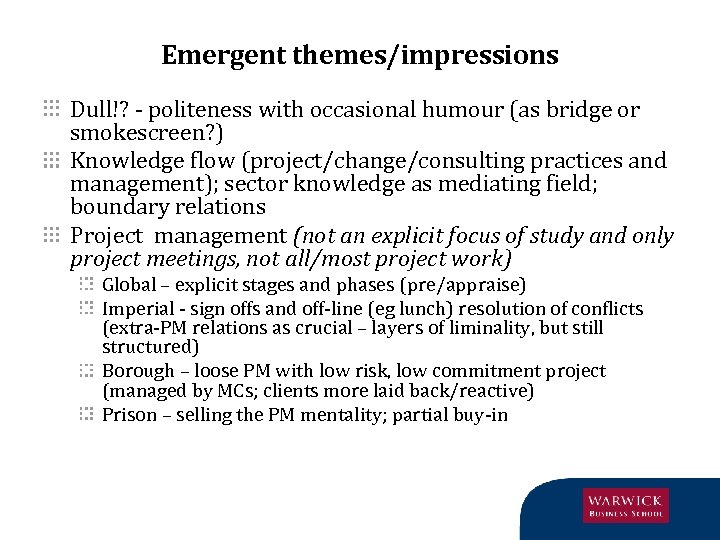 Emergent themes/impressions Dull!? - politeness with occasional humour (as bridge or smokescreen? ) Knowledge flow (project/change/consulting practices and management); sector knowledge as mediating field; boundary relations Project management (not an explicit focus of study and only project meetings, not all/most project work) Global – explicit stages and phases (pre/appraise) Imperial - sign offs and off-line (eg lunch) resolution of conflicts (extra-PM relations as crucial – layers of liminality, but still structured) Borough – loose PM with low risk, low commitment project (managed by MCs; clients more laid back/reactive) Prison – selling the PM mentality; partial buy-in
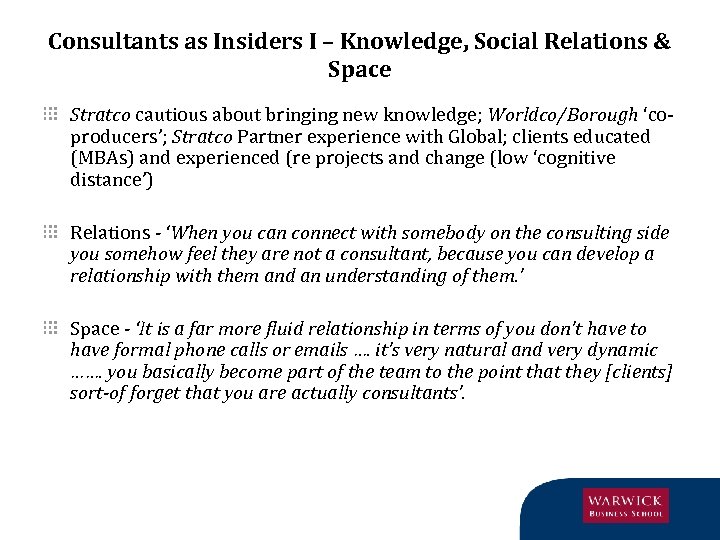 Consultants as Insiders I – Knowledge, Social Relations & Space Stratco cautious about bringing new knowledge; Worldco/Borough ‘coproducers’; Stratco Partner experience with Global; clients educated (MBAs) and experienced (re projects and change (low ‘cognitive distance’) Relations - ‘When you can connect with somebody on the consulting side you somehow feel they are not a consultant, because you can develop a relationship with them and an understanding of them. ’ Space - ‘It is a far more fluid relationship in terms of you don’t have to have formal phone calls or emails …. it’s very natural and very dynamic ……. you basically become part of the team to the point that they [clients] sort-of forget that you are actually consultants’.
 Consultants as Insiders II - Complexity and Dynamism PM consultant at Prison can be seen as a relative insider with the main client socially/spatially compared to his peer at Network and in terms of management knowledge compared to other client team members, but was very much an outsider in relation to organisational and sector knowledge From static and etic to and dynamic and emic… Stratco strategic analyst would have been a knowledge insider at the start of the project, but much less so when operational knowledge began to hold more sway. Insider-outsider status and roles are negotiated and constructed in interaction through various relationship practices ‘us and them’ humour insider as MC tactic (and resistance) inter-personal style……
 Gently selling the PM message, Consultant: ‘Just an observation - we’re not being terribly focussed this morning? [clients respond: No, No]. And I’m conscious I’m being a bit of a bully, but what does that all mean? Practical action? …. You need to delegate responsibility. …. . We seem to have got into the comfort zone of talking about nitty-gritty detail, because planning’s too hard! [laughter] So …’
 What are the implications of insider status for consultants & clients re learning in projects? Cannot assume the outsider relationship in consultancy or diversity in project work as basis of learning Need to specify insider/outsider with respect to what, whom, how and when? If more insiders, then lose ‘burden of otherness’ towards value of knowledge exploitation and learning complex and tacit knowledge But also lose the strength of weak ties ie exploration and new/explicit knowledge (ie MCY is conservative at project level) In other words, the conventional view may both under and overstate the potential for learning through consultancy projects…. Most claimed learning occurs in, and of, project practices (eg project, change and consultancy management) rather than the ‘big’ ideas (already familiar to team)
 Who then, are the ‘real’ outsiders? I/O in consultancy and diversity in PBL neglects patterns of exclusion In cases, other employees were excluded (to varying degrees) by default and by design (ie ‘proscribed’/excluded clients) Imperial staff and IT mgt kept out Prison junior project team members only allowed partial access to PM training/concepts Absence does not always mean exclusion – eg evoking (absent) presence of other (eg regulator)
 Closing thoughts and questions…. All ignores who benefits from the knowledge/s in question, if anyone…. . (incl PM) What happens at margins of PM and what does this say about PM – eg necessity of off line interactions; humorous asides; status of non-PMsavvy managers? ‘Optimum slack’ re learning and innovation and re acknowledging uncertainty – PM notions? CPM – critical of management and/or project (management v organisation)? . . . alternatives to PM? Project managers as agents or cyphers? (architect or worker bee? ) Related discourses (eg re public sector consultancy) – faith in evaluation and procurement/purchasing, yet not practiced widely; no interest in admitting failure – role of CPM re policy debate in public sector (cf CIPS)
 Questions/Comments?
 Learning from projects? Project working and project management in management consultancy Andrew Sturdy andrew. sturdy@wbs. ac. uk