


 Скачать презентацию Learning From Mistakes Error Reporting and Analysis and
0f66e9bded1abc50bfd67839d572a9da.ppt
- Количество слайдов: 29
 Learning From Mistakes: Error Reporting and Analysis and HIT Unit 12 c: Quality Improvement Tools This material was developed by Johns Hopkins University, funded by the Department of Health and Human Services, Office of the National Coordinator for Health Information Technology under Award Number IU 24 OC 000013.
 Objective At the end of this segment, the student will be able to: • Apply QI tools to analyze HIT errors Component 12/Unit 12 Health IT Workforce Curriculum 2. 0/Spring 2011 Version 2
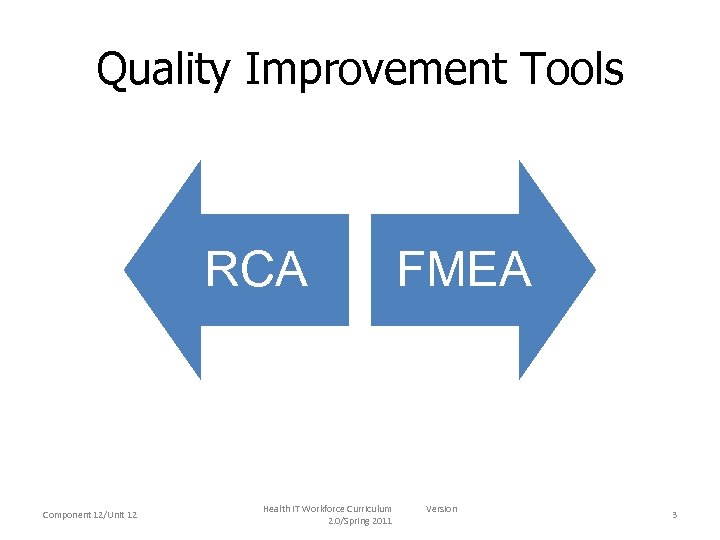 Quality Improvement Tools RCA Component 12/Unit 12 Health IT Workforce Curriculum 2. 0/Spring 2011 FMEA Version 3
 Flow Diagrams or Charts QI tool that helps to analyze processes Picture of steps of a process in sequential order May include: • sequence of actions • materials or services entering or leaving the process (inputs and outputs) • decisions that must be made • people who become involved • time involved at each step • process measurements Component 12/Unit 12 Health IT Workforce Curriculum 2. 0/Spring 2011 Version 4
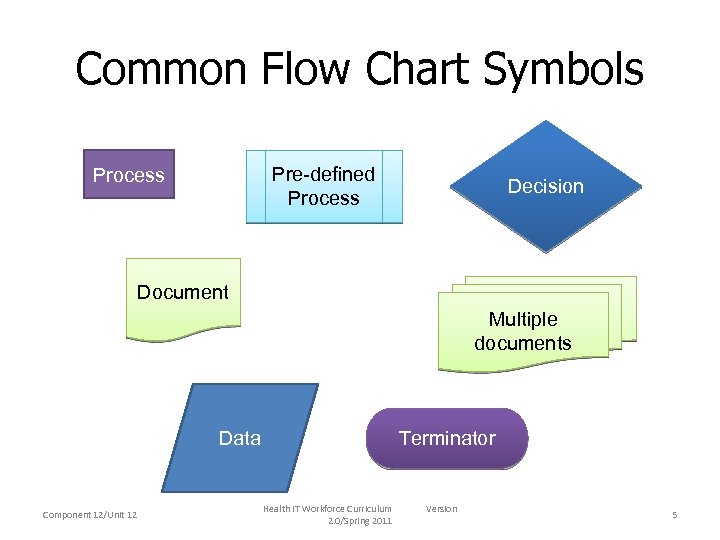 Common Flow Chart Symbols Pre-defined Process Decision Document Multiple documents Terminator Data Component 12/Unit 12 Health IT Workforce Curriculum 2. 0/Spring 2011 Version 5
 Quality Improvement Tools Root Cause Analysis • Structured problem-solving process • Considers all potential causal or contributing factors • Human factors • System factors • Detailed chronological list of events surrounding incident • Premise: one can learn from one’s mistakes Component 12/Unit 12 Health IT Workforce Curriculum 2. 0/Spring 2011 Version 6
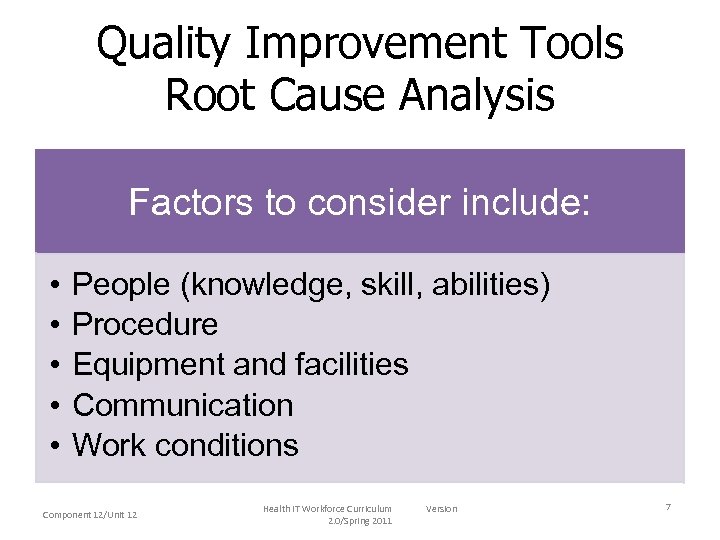 Quality Improvement Tools Root Cause Analysis Factors to consider include: • • • People (knowledge, skill, abilities) Procedure Equipment and facilities Communication Work conditions Component 12/Unit 12 Health IT Workforce Curriculum 2. 0/Spring 2011 Version 7
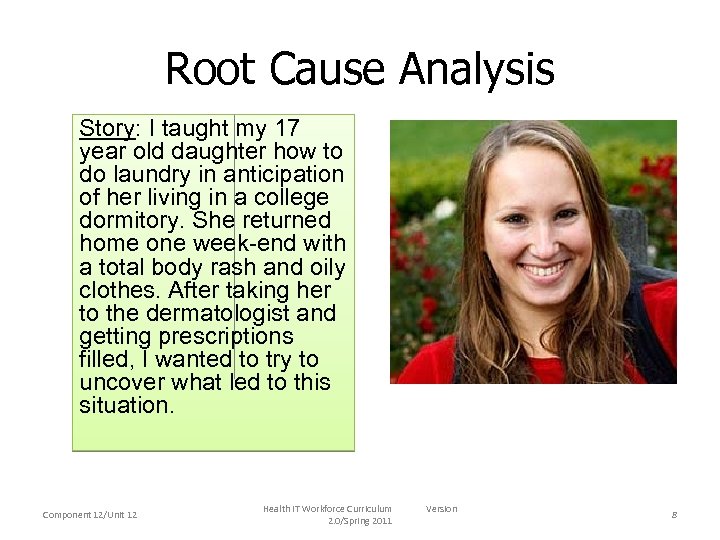 Root Cause Analysis Story: I taught my 17 year old daughter how to do laundry in anticipation of her living in a college dormitory. She returned home one week-end with a total body rash and oily clothes. After taking her to the dermatologist and getting prescriptions filled, I wanted to try to uncover what led to this situation. Component 12/Unit 12 Health IT Workforce Curriculum 2. 0/Spring 2011 Version 8
 RCA: Steps • Briefly describe event – My daughter arrived home with a total body rash and oily jeans. • Identify affected areas/services – Dorm laundry facilities – Our laundry facility – Use of laundry facilities • Assemble a team – My daughter – Me – My daughter’s dermatologist Component 12/Unit 12 Health IT Workforce Curriculum 2. 0/Spring 2011 Version 9
 RCA: Steps • Diagram the process (flow chart) – As it was designed – As it is usually done – As it was done when event occurred • Identify potential root causes, e. g. – Size of washing machine (diminutive versus full-sized) – Type of washing machine (front loader versus top loader) – Type/amount of detergent (too much? ) – Length of rinse cycle (single versus double rinse) – Following instructions given at home in the dorm environment Component 12/Unit 12 Health IT Workforce Curriculum 2. 0/Spring 2011 Version 10
 RCA: Steps • Develop action plan, e. g. – Use less soap and double rinse clothes after washing – Responsibility: My daughter – Implementation date: As soon as she returns to school – Measurement strategy: Skin assessment when she returns home and assessment of clothes for soap residue. Component 12/Unit 12 Health IT Workforce Curriculum 2. 0/Spring 2011 Version 11
 Root Cause Analysis (RCA) Health Care Example: Mrs. A. received blood in the Emergency Department. Within 15 minutes, she experienced a bad reaction. Her nurse realized that she had received blood intended for another patient. She was transferred to the intensive care unit to be stabilized. The ED staff wanted to know how this could have happened so they assembled a team to identify possible causes. Component 12/Unit 12 Health IT Workforce Curriculum 2. 0/Spring 2011 Version 12
 RCA: Steps • Briefly describe event – Mrs. A received blood intended for someone else • Identify affected areas/services – Blood Transfusion Service – Medical/Nursing Staff – Risk Manager/Quality Improvement Staff • Assemble a team – – – Manager, Transfusion Services Physician Chair of QI Committee Nurse managers, staff nurses QI, RM, patient safety representatives HIT representative Component 12/Unit 12 Health IT Workforce Curriculum 2. 0/Spring 2011 Version 13
 RCA: Steps • Diagram the process (flow chart) – As it was designed – As it is usually done – As it was done when event occurred • Identify potential root causes, e. g. – Flawed patient identification process – Faulty patient-blood product verification process – Inadequate staffing levels – Inadequate orientation, training or competence assessment Component 12/Unit 12 Health IT Workforce Curriculum 2. 0/Spring 2011 Version 14
 RCA: Steps • Prioritize root causes – Evaluate whether these factors will cause harm in the future – Design interventions that reduce this probability of harm and that have a high probability of being implemented as intended given available resources (Pham et. al, 2010) • Develop action plan, e. g. – Implement bar-code blood product verification system – Responsibility: HIT Project Manager – Implementation date: November 2011 – Measurement strategy: Collect data on patient misidentification errors related to blood product transfusion and compare to implementation rates. • Evaluate results! Component 12/Unit 12 Health IT Workforce Curriculum 2. 0/Spring 2011 Version 15
 Quality Improvement Tools Failure Mode Effects Analysis (FMEA) • Prospective attempt to predict error modes • Combines the likelihood of a particular process failure with an estimate of the relative impact of that error • Produces a criticality index that allows for the prioritization of specific processes as QI targets Component 12/Unit 12 Health IT Workforce Curriculum 2. 0/Spring 2011 Version 16
 Quality Improvement Tools Failure Mode Effects Analysis (FMEA) FMEA is a technique by which we analyze: • Ways in which a process/design can fail • Why it might fail • How it can be made safer/better Component 12/Unit 12 Health IT Workforce Curriculum 2. 0/Spring 2011 Premises on which it is based: • Don’t have to wait for errors to happen • Can anticipate errors/adverse events • Can do things to reduce risk of harm Version 17
 Failure Mode Effects Analysis Story: Before I had children, I invited one of my high school friends and her family, including a toddler, to dinner. I was worried that her toddler would somehow manage to hurt himself in my house, which was designed for a childless couple. Component 12/Unit 12 Health IT Workforce Curriculum 2. 0/Spring 2011 Version 18
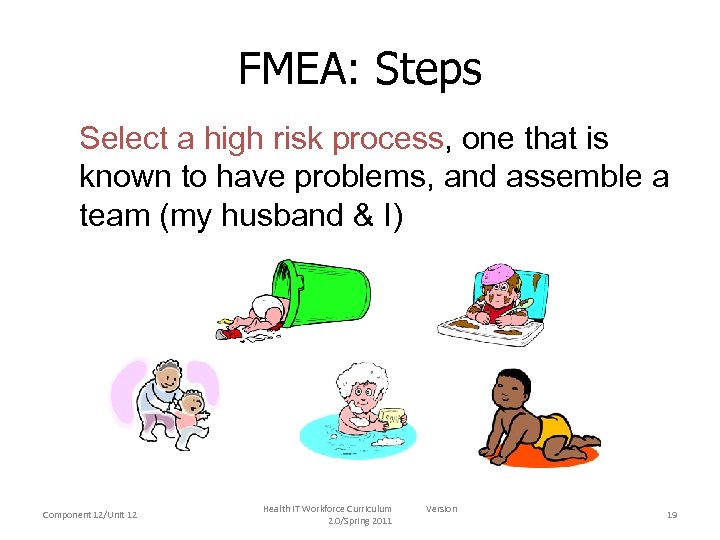 FMEA: Steps Select a high risk process, one that is known to have problems, and assemble a team (my husband & I) Component 12/Unit 12 Health IT Workforce Curriculum 2. 0/Spring 2011 Version 19
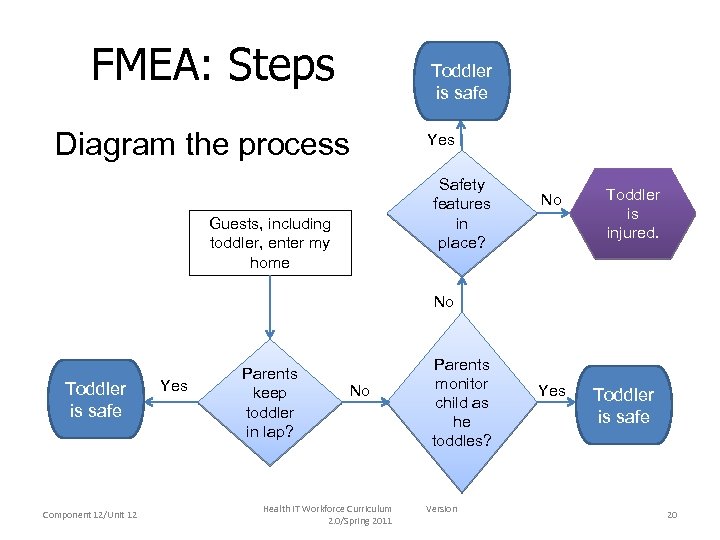 FMEA: Steps Toddler is safe Diagram the process Yes Safety features in place? Guests, including toddler, enter my home No Toddler is injured. No Toddler is safe Component 12/Unit 12 Yes Parents keep toddler in lap? No Health IT Workforce Curriculum 2. 0/Spring 2011 Parents monitor child as he toddles? Version Yes Toddler is safe 20
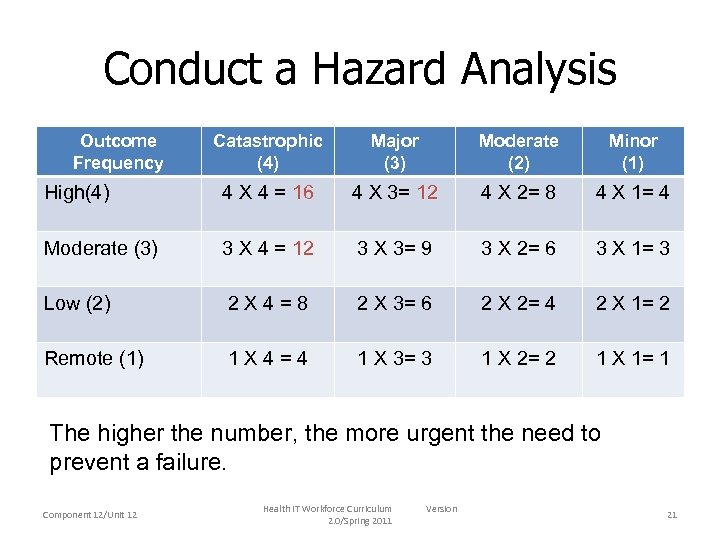 Conduct a Hazard Analysis Outcome Frequency Catastrophic (4) Major (3) Moderate (2) Minor (1) High(4) 4 X 4 = 16 4 X 3= 12 4 X 2= 8 4 X 1= 4 Moderate (3) 3 X 4 = 12 3 X 3= 9 3 X 2= 6 3 X 1= 3 Low (2) 2 X 4=8 2 X 3= 6 2 X 2= 4 2 X 1= 2 Remote (1) 1 X 4=4 1 X 3= 3 1 X 2= 2 1 X 1= 1 The higher the number, the more urgent the need to prevent a failure. Component 12/Unit 12 Health IT Workforce Curriculum 2. 0/Spring 2011 Version 21
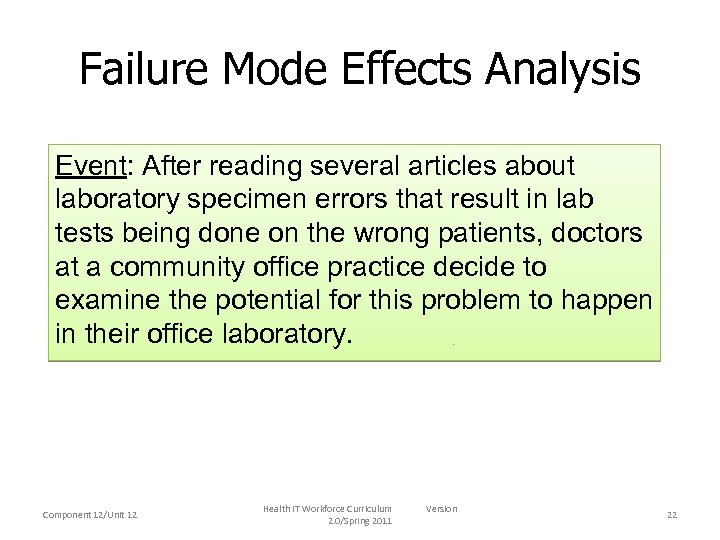 Failure Mode Effects Analysis Event: After reading several articles about laboratory specimen errors that result in lab tests being done on the wrong patients, doctors at a community office practice decide to examine the potential for this problem to happen in their office laboratory. Component 12/Unit 12 Health IT Workforce Curriculum 2. 0/Spring 2011 Version 22
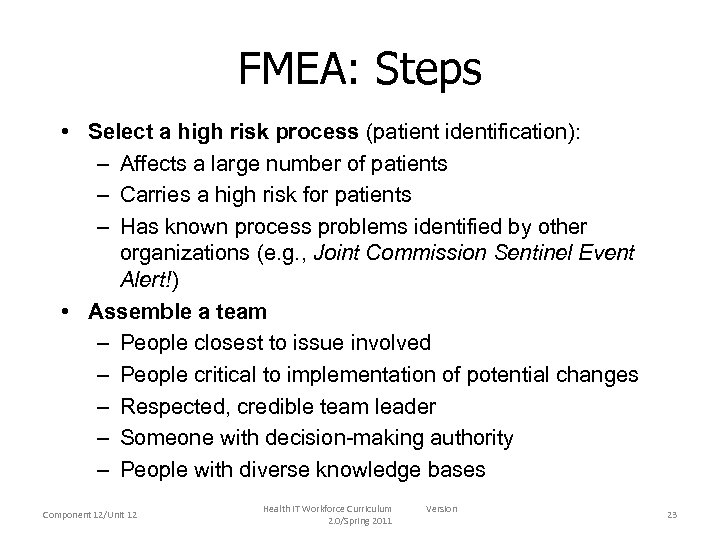 FMEA: Steps • Select a high risk process (patient identification): – Affects a large number of patients – Carries a high risk for patients – Has known process problems identified by other organizations (e. g. , Joint Commission Sentinel Event Alert!) • Assemble a team – People closest to issue involved – People critical to implementation of potential changes – Respected, credible team leader – Someone with decision-making authority – People with diverse knowledge bases Component 12/Unit 12 Health IT Workforce Curriculum 2. 0/Spring 2011 Version 23
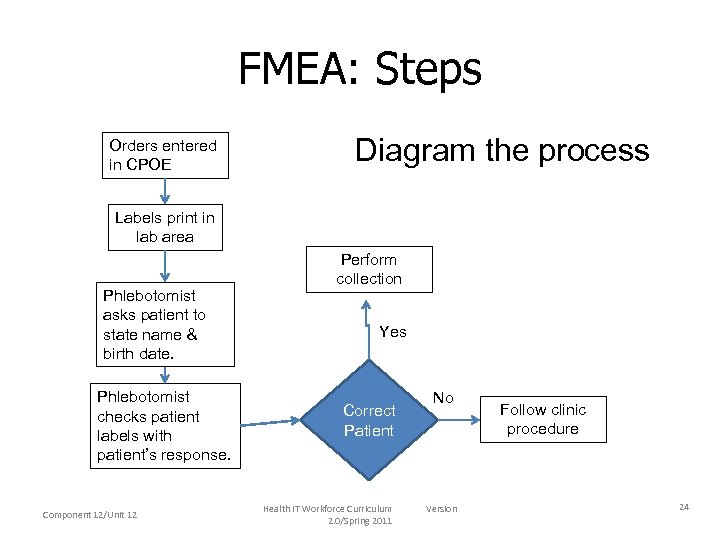 FMEA: Steps Orders entered in CPOE Diagram the process Labels print in lab area Phlebotomist asks patient to state name & birth date. Phlebotomist checks patient labels with patient’s response. Component 12/Unit 12 Perform collection Yes Correct Patient Health IT Workforce Curriculum 2. 0/Spring 2011 No Version Follow clinic procedure 24
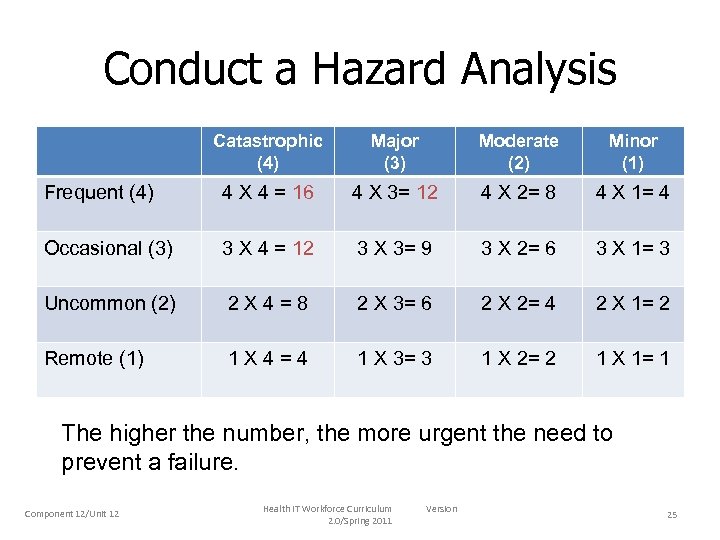 Conduct a Hazard Analysis Catastrophic (4) Major (3) Moderate (2) Minor (1) Frequent (4) 4 X 4 = 16 4 X 3= 12 4 X 2= 8 4 X 1= 4 Occasional (3) 3 X 4 = 12 3 X 3= 9 3 X 2= 6 3 X 1= 3 Uncommon (2) 2 X 4=8 2 X 3= 6 2 X 2= 4 2 X 1= 2 Remote (1) 1 X 4=4 1 X 3= 3 1 X 2= 2 1 X 1= 1 The higher the number, the more urgent the need to prevent a failure. Component 12/Unit 12 Health IT Workforce Curriculum 2. 0/Spring 2011 Version 25
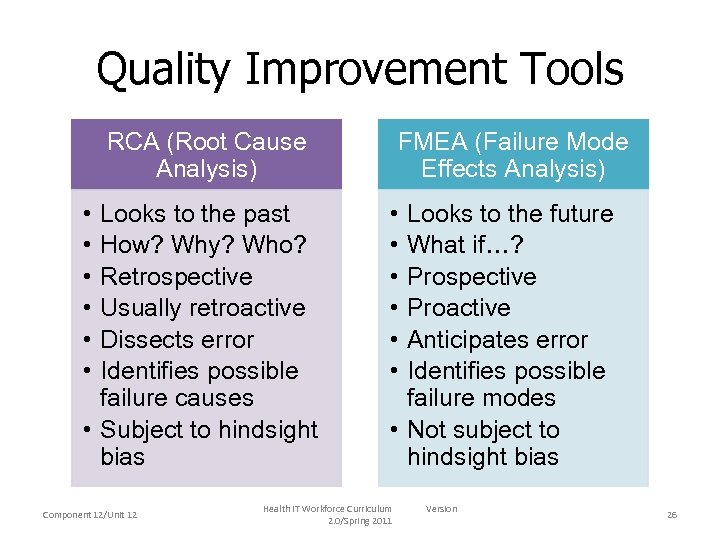 Quality Improvement Tools RCA (Root Cause Analysis) • • • Looks to the past How? Why? Who? Retrospective Usually retroactive Dissects error Identifies possible failure causes • Subject to hindsight bias Component 12/Unit 12 FMEA (Failure Mode Effects Analysis) • • • Looks to the future What if…? Prospective Proactive Anticipates error Identifies possible failure modes • Not subject to hindsight bias Health IT Workforce Curriculum 2. 0/Spring 2011 Version 26
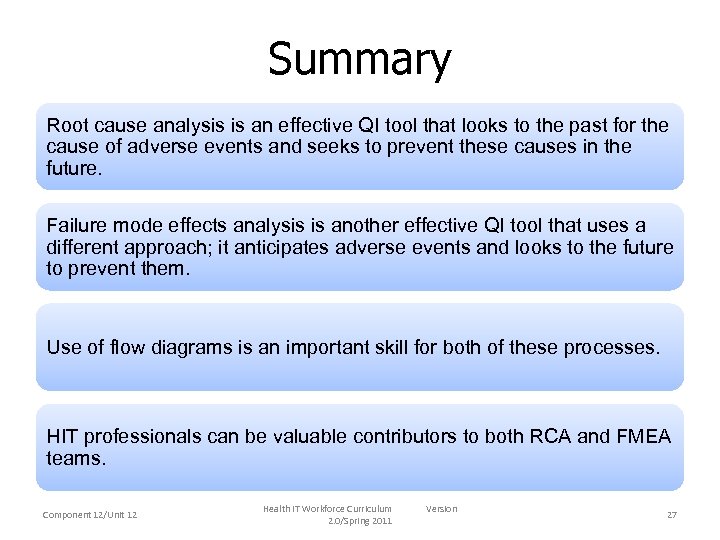 Summary Root cause analysis is an effective QI tool that looks to the past for the cause of adverse events and seeks to prevent these causes in the future. Failure mode effects analysis is another effective QI tool that uses a different approach; it anticipates adverse events and looks to the future to prevent them. Use of flow diagrams is an important skill for both of these processes. HIT professionals can be valuable contributors to both RCA and FMEA teams. Component 12/Unit 12 Health IT Workforce Curriculum 2. 0/Spring 2011 Version 27
 Learning From Mistakes Component 12/Unit 12 Health IT Workforce Curriculum 2. 0/Spring 2011 Version 28
 References • • • AHRQ Patient Safety Network. Glossary. Available from: http: //psnet. ahrq. gov/glossary. aspx Ash JS, Sittig DF, Poon EG, Guappone K, Campbell E, Dykstra RH. The extent and importance of unintended consequences related to computerized provider order entry. J Am Med Inform Assoc. 2007; 14(4): 415 -423. Institute of Medicine. Patient safety. Achieving a new standard of care. 2004 Washington, DC: National Academies Press Kilbridge PM, Classen DC. The informatics opportunities at the intersection of patient safety and clinical informatics. J Am Med Inform Assoc. 2008 Jul. Aug; 15(4): 397 -407. Epub 2008 Apr 24. Reason J. Human error: models and management. BMJ. 320: 768 -770. 2000. Siegler EL, Adelman R. Copy and paste. A remediable hazard of electronic health records. Am J Med. 2009 Jun; 122(6): 495 -6. Component 12/Unit 12 Health IT Workforce Curriculum 2. 0/Spring 2011 Version 29