


 Скачать презентацию Learning from experience to inform the future Findings
72521ea8efc309b5d714d1fd755b7851.ppt
- Количество слайдов: 17
 Learning from experience to inform the future Findings emerging from the initial phase of the Children’s Services Committees Presentation to CSC Induction and Networking Seminar Katie Burke & Stella Owens 12 th May 2010 S: CLIENT SERVICES FILESOMCYAP 002 Children's Services Committees8. Project Outputs & PublicationsCSC induction and networking seminar 12 th May 2009Learning report presentation for CSC Farmleigh Seminar v 1 KB 07 05 10
 Introduction - Setting the scene l Centre for Effective Services (CES) is an independent, not-for-profit organisation working across the island of Ireland, funded jointly by philanthropy and government. Our aims are: o To promote and support the application of an evidence-informed approach to policy and practice in child, family and community services o To promote the development of collaborative, joined up working that is outcomes-focused across research, policy and service providing organisations o To build capacity within Ireland Northern Ireland to take this work forward in the longer term by developing knowledge, skills and competencies. l CES was asked by the OMYCA to assist with, and advise on, the strategic development of CSCs. One of the first pieces of work we were asked to do: o Distil learning from the initial implementation stage of the Children’s Services Committees, with a view to informing the future development of CSCs, both existing and new 2 © Centre for Effective Services 2010
 General observations l CSCs are at an early stage in their development, and much of the early work has centred around developing structures and processes. This is consistent with: o Similar large scale initiatives being developed internationally, where the indications are that measurable impact at the level of specific outcomes for children and young people takes time to emerge o Large scale change management initiatives, where time and effort are required at the early stages both to develop ‘fit for purpose’ processes and structures and to build relationships l Widespread acceptance, among those we consulted, that the CSCs are a long term initiative 3 © Centre for Effective Services 2010
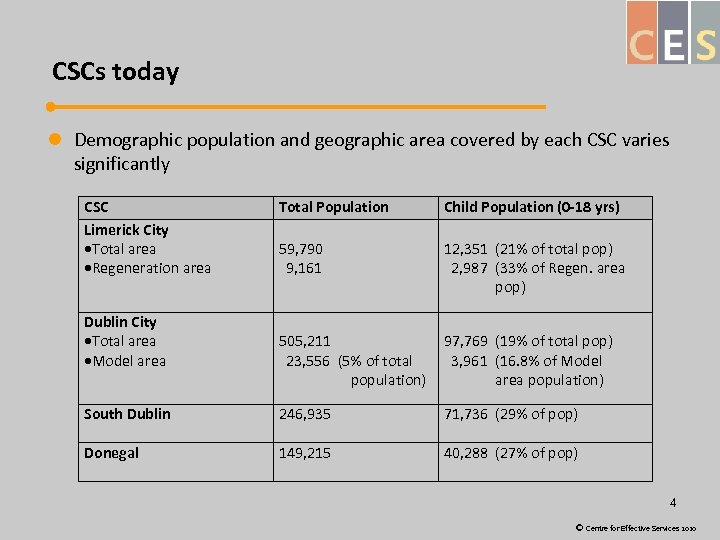 CSCs today l Demographic population and geographic area covered by each CSC varies significantly CSC Limerick City Total area Regeneration area Total Population Child Population (0 -18 yrs) 59, 790 9, 161 12, 351 (21% of total pop) 2, 987 (33% of Regen. area pop) 505, 211 23, 556 (5% of total population) 97, 769 (19% of total pop) 3, 961 (16. 8% of Model area population) South Dublin 246, 935 71, 736 (29% of pop) Donegal 149, 215 40, 288 (27% of pop) Dublin City Total area Model area 4 © Centre for Effective Services 2010
 Achievements to date l Overwhelming commitment to, and engagement with, the CSC initiative, at local CSC and national level o Many CSC members differentiated the CSCs from other multi-agency groups or committees with which they are involved o CSCs seen as “the only way forward to structurally address complex needs across all sectors, in an integrated way. ” o ‘Parent’ government departments supportive of OMCYA’s effort to develop a coherent framework for the delivery of services to children, in the context of very significant financial investment by the state in services to children and families l Building relationships and understanding of the role of different agencies, at CSC, CSC subgroup and NCSIG level - the major area where the CSC initiative is seen to have had an early impact o Relationships between the HSE and local authorities are working well o Interagency working within the education sector at CSC level has been very powerful o Need for interagency work to become embedded in the system, rather than dependent on individuals 5 © Centre for Effective Services 2010
 Achievements to date l Successfully establishing local champions and local ownership of the initiative o Leadership at CSC level provided by the HSE and the local authority o Strong sense of local ownership has developed among CSC and subgroup members, in relation to the work being conducted by each CSC l Developing structures are in place, with the aim of enabling the CSCs to operate, including particularly: o The CSCs themselves and CSC subgroups o CSC co-ordinator – viewed as essential by all CSCs l Emerging CSC activities, around local needs analysis, identifying outcomes and prioritising actions and implementing initiatives to meet needs of the local area 6 © Centre for Effective Services 2010
 Challenges and obstacles l Acknowledgement of strategic importance but disappointment at absence of ‘measureable impact’. Four areas: o o Governance Sustainability Developing a national framework Communication and support to CSCs l Governance o Leadership – HSE have provided leadership, chaired the CSCs and driven the initiative forward but, for some, HSE engagement is regarded as “patchy” o Mandate and remit – Lack of clarity about CSC’s mandate and remit, and ambiguity about where the authority to implement CSCs originates and to whom CSCs should be answerable o Universal v targeted remit – CSCs to benefit all children or focus primarily on disadvantaged children o Funding – opposing views and current dilemmas presented by CSCs o Funding to come through CSC itself versus ‘keep money off the table’ 7 © Centre for Effective Services 2010
 Challenges and obstacles l Governance (cont’d) o Accountability – different responses to question posed, ‘who CSCs are accountable to’ o Membership – two quarters the subject of debate o Department of Education & Skills o Department of Social and Family Affairs o Effectiveness of NCSIG – largely seen by members as a communication and information sharing forum rather than a decision making body with a strategic focus l Sustainability o ‘Buy in’ and taking ownership of CSC initiative – level of support and participation varies greatly 8 © Centre for Effective Services 2010
 Challenges and obstacles l Developing a national framework o Outcomes – consensus that outcomes and outcomes focussed practice not well understood and lack of clarity about origins o Indicators and needs analysis – difficulties with needs analysis and associated data collection methods o 7 national outcomes do not easily map onto national child well being indicators o Data required to populate data set not easily accessible o Lack of coherence of data systems across sectors o Evidence-based practice o Models approaches and interventions – not being replicated as designed by developers but ‘best bits’ taken from a number of programmes. Creates difficulties in terms of diluting ’active ingredients’ and ‘tweaking’ to create programme whose effectiveness is unknown o Terminology/language/constructs/concepts/definitions*? ? !*! o Participation of children and families – identified as ‘point of weakness’ o National framework with local autonomy – need for overarching framework 9 with flexibility to allow CSC to identify their own needs within this and to © Centre for Effective Services 2010 decide their own priorities for action
 Challenges and obstacles l Communication and support to CSCs o Communication, information sharing and networking o o Largely operating independently No formal communication between CSCs Level of awareness amongst professionals, services and public Support from parent department to individual agencies sitting on CSC and information sharing amongst this group o Reporting and resolution of issues o Reporting from CSC to NCSIG described as a one way process and response to issues and initiatives being developed is slow o Technical assistance and support o Assistance accessed by individual CSCs around specific projects or pieces of work e. g. needs analysis, data collection and evaluation, but no comprehensive effort to identify technical needs of each CSC and determine how these could be addressed 10 © Centre for Effective Services 2010
 Recommendations Developing a national framework To increase the credibility and accountability of the initiative at government level, a national framework for the CSC initiative should be developed to: o Guide the successful development of CSCs and facilitate a more coherent approach to the seven national outcomes for children, and associated indicators, across the CSCs o Allow for interpretation of policy at local level to meet local needs, and facilitate evaluation of the CSC initiative at a national level o Provide a platform upon which local creativity and innovation could flourish l Rec. 1 The framework could outline, for example: o The mandate, remit and functions of CSCs o Outcomes to be achieved - the 7 national outcomes o That inputs and actions needed to achieve these outcomes should be decided at local level, based on a local needs analysis o A ‘core’ set of indicators, which can be used to measure outcomes by each CSC o A clear definition of terms, concepts and constructs, so that the terms are 11 © Centre for Effective Services 2010 consistently used and easily understood by everyone
 Recommendations Developing a national framework l Rec. 2 Matching of the 7 national outcomes to the national well being indicators needs to be re-visited o Requires a rapid development of a co-ordinated and coherent national data strategy, to identify how and where data can be sourced nationally and at local county level. This will allow measurement of child well being at county level, and facilitate cross county comparison l Rec. 3 A repository of approaches, models and interventions in use by CSCs should be developed and made available - to cover specific areas of interest e. g. needs assessment, information sharing, participation and intervention tools 12 © Centre for Effective Services 2010
 Recommendations Governance - CSC mandate, remit and functions l Rec. 4 The mandate, remit and functions of the CSCs should be agreed, documented and communicated to all those involved in CSCs a. The mandate should define what the CSCs are authorised to do and from where that authority comes b. The remit of CSCs should be captured in a ‘terms of reference’ for the CSCs c. The functions should identify proposed activity areas for CSCs. l Rec. 5 The NCSIG and relevant government departments should consider the benefits and disadvantages of putting CSCs on a statutory basis l Rec. 7 The role of CSCs in terms of influencing funding decisions about (new and existing) services in their area should be clarified by the OMCYA and relevant government departments / agencies. 13 © Centre for Effective Services 2010
 Recommendations Governance - Mandate from ‘parent’ government departments l Rec. 9 There should be a clear mandate from the very top (ideally at Cabinet / Secretary General level) which requires senior management in the relevant government departments and agencies to participate actively in the CSCs and the NCSIG Governance - NCSIG l Rec. 11 The role and functions of the NCSIG should be clarified and communicated. NCSIG should be split into two discrete but closely linked steering groups at national level: o A National Children’s Strategy Steering Group: to oversee the development and implementation of the National Children’s Strategy o A Children’s Services Committee Steering Group: to oversee the implementation of CSCs throughout Ireland, including discussing and agreeing technical issues requiring direction from national level to local CSCs 14 © Centre for Effective Services 2010
 Recommendations Governance – CSC accountability l Rec. 14 Greater clarity should be provided around to whom CSCs are accountable, in terms of improving outcomes for children. Given that CSCs are a national initiative, but with a local focus, consideration should be given to having the CSCs accountable at two levels: o At national level – to a National Steering Group o At local level – to a County Development Board Sustainability l Rec. 20 Each CSC should develop a strategy or plan aimed at securing better developmental outcomes for children in the CSC’s area, through more effective integration of existing services and interventions at local level l Rec. 22 Consideration should be given to defining the appropriate structures and organisation of CSCs in larger urban areas l Rec. 23 Each new CSC should appoint a co-ordinator, at the outset l Rec. 24 A plan to evaluate the effectiveness of CSCs should be developed 15 and implemented © Centre for Effective Services 2010
 Recommendations Communication and support to CSCs l Rec. 25 CSC initiative should now be publicised on a national and local level l Rec. 26 Opportunities should be provided for CSCs to meet together, l Rec. 27 Individual agencies and departments with representatives sitting on CSCs should organise meetings of their staff involved in CSCs l Rec. 28 Appropriate technical support should be provided to CSCs l Rec. 29 The support which could be provided to CSCs from a “central” function, led by the OMCYA in collaboration with relevant agencies, should be defined Many of the recommendations resonate with the outcomes and activities identified in the Strategic Plan for the Development of CSCs 16 © Centre for Effective Services 2010
 Perspectives from CSCs – Learning from experience to inform the future l In 1(-2) sentences, how would you sum up the impact and experience of the CSCs to date? o o Donegal Dublin City Limerick City South Dublin e. g. l For us, the CSC experience has shown. . l The biggest challenge, or frustration, is. . . 17 © Centre for Effective Services 2010