


 Скачать презентацию Learner varieties and language teaching curricula An intervention
5b6add90e25e5026acf06647a2bb635d.ppt
- Количество слайдов: 63
 Learner varieties and language teaching curricula An intervention study on the acquisition of German (S)OV clause structure by native Italian speakers Das Verb muss stehen am Ende Steffi Winkler Vrije Universiteit Amsterdam Project meeting The Structure of Learner Varieties, March 26, 2010, MPI Nijmegen
 Motivation of the study • wish to work in a more applied direction and to conjoin linguistic theory with praxis • How can we use the multifarious findings of language acquisition research in the didactic praxis of language teaching? • focus: verb placement and finiteness Steffi Winkler, VU Amsterdam s. winkler@let. vu. nl 2
 Outline of the talk 1 Background German clause structure, L 1 transfer 2 Textbook analysis Introduction order in instructed acquisition 3 Design of the intervention study & Data elicitation Participants, Curriculum, Testing 4 Results Sentence bracket, Root infinitives, and negation 5 Issues to be discussed (in my thesis) Acquisition vs. learning, negation strategies, acquisition orders 6 Conclusions The sentence bracket as a prerequisite for successful acquisition Steffi Winkler, VU Amsterdam s. winkler@let. vu. nl 3
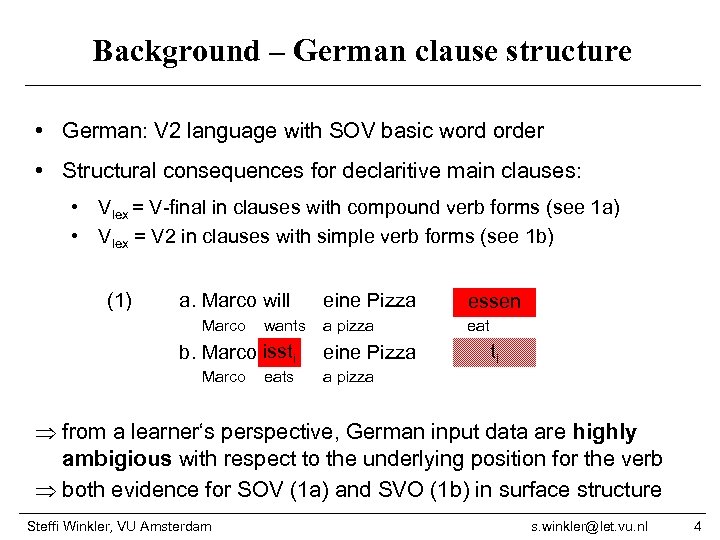 Background – German clause structure • German: V 2 language with SOV basic word order • Structural consequences for declaritive main clauses: • Vlex = V-final in clauses with compound verb forms (see 1 a) • Vlex = V 2 in clauses with simple verb forms (see 1 b) (1) a. Marco will Marco wants b. Marco issti Marco eats eine Pizza essen a pizza eat eine Pizza ti a pizza from a learner‘s perspective, German input data are highly ambigious with respect to the underlying position for the verb both evidence for SOV (1 a) and SVO (1 b) in surface structure Steffi Winkler, VU Amsterdam s. winkler@let. vu. nl 4
 Background – L 1 transfer Mechanism of L 1 transfer • consequence of surface structure alternation: learners whose L 1 is SVO overgeneralize the SVO pattern of their native language in their early German interlanguage grammar (compare Alternation Hypothesis by Jansen et al. 1981) • N. B. : no „blind“ L 1 transfer, but structural transfer due to positive evidence for the L 1 SVO structure in the L 2 input data (see Müller 1998) Steffi Winkler, VU Amsterdam s. winkler@let. vu. nl 5
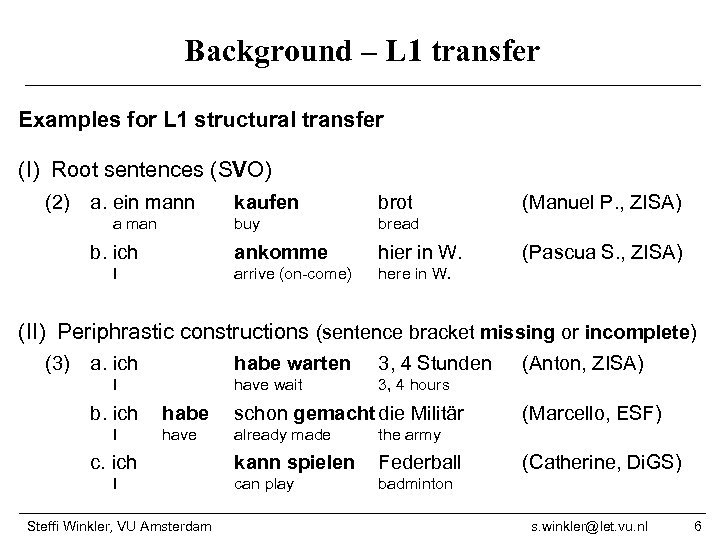 Background – L 1 transfer Examples for L 1 structural transfer (I) Root sentences (SVO) (2) a. ein mann hier in W. arrive (on-come) I bread ankomme b. ich brot buy a man kaufen (Manuel P. , ZISA) here in W. (Pascua S. , ZISA) (II) Periphrastic constructions (sentence bracket missing or incomplete) (3) a. ich habe warten have wait I b. ich I 3, 4 Stunden 3, 4 hours habe schon gemacht die Militär have already made the army kann spielen Federball can play (Anton, ZISA) badminton c. ich I Steffi Winkler, VU Amsterdam (Marcello, ESF) (Catherine, Di. GS) s. winkler@let. vu. nl 6
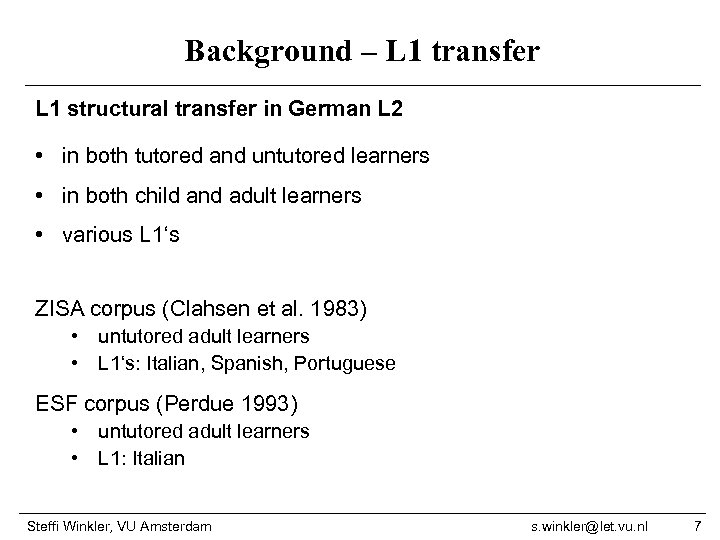 Background – L 1 transfer L 1 structural transfer in German L 2 • in both tutored and untutored learners • in both child and adult learners • various L 1‘s ZISA corpus (Clahsen et al. 1983) • untutored adult learners • L 1‘s: Italian, Spanish, Portuguese ESF corpus (Perdue 1993) • untutored adult learners • L 1: Italian Steffi Winkler, VU Amsterdam s. winkler@let. vu. nl 7
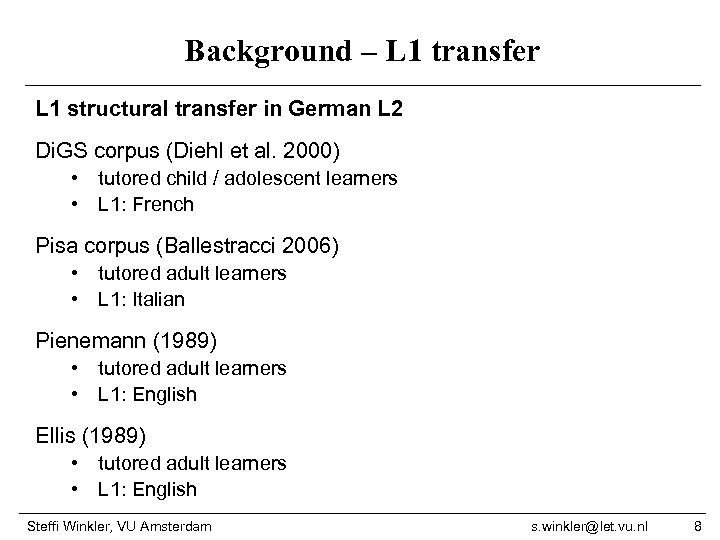 Background – L 1 transfer L 1 structural transfer in German L 2 Di. GS corpus (Diehl et al. 2000) • tutored child / adolescent learners • L 1: French Pisa corpus (Ballestracci 2006) • tutored adult learners • L 1: Italian Pienemann (1989) • tutored adult learners • L 1: English Ellis (1989) • tutored adult learners • L 1: English Steffi Winkler, VU Amsterdam s. winkler@let. vu. nl 8
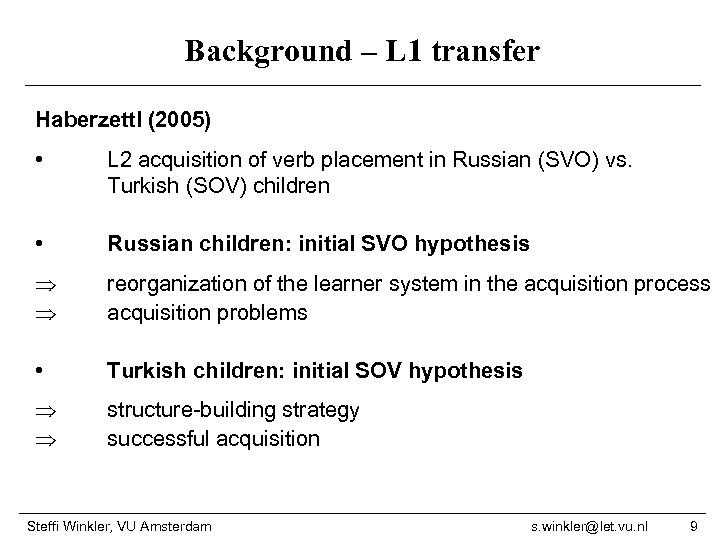 Background – L 1 transfer Haberzettl (2005) • L 2 acquisition of verb placement in Russian (SVO) vs. Turkish (SOV) children • Russian children: initial SVO hypothesis reorganization of the learner system in the acquisition process acquisition problems • Turkish children: initial SOV hypothesis structure-building strategy successful acquisition Steffi Winkler, VU Amsterdam s. winkler@let. vu. nl 9
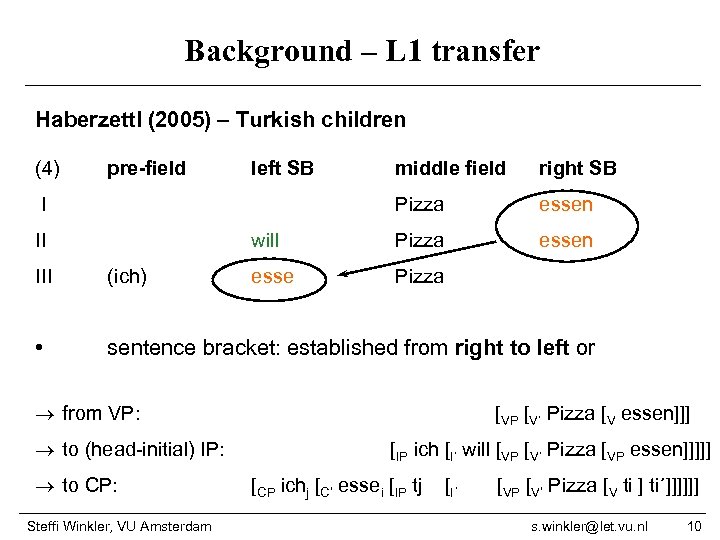 Background – L 1 transfer Haberzettl (2005) – Turkish children (4) pre-field left SB middle field right SB Pizza essen will Pizza essen esse Pizza I II III (ich) • sentence bracket: established from right to left or from VP: to (head-initial) IP: to CP: Steffi Winkler, VU Amsterdam [VP [V‘ Pizza [V essen]]] [IP ich [I‘ will [VP [V‘ Pizza [VP essen]]]]] [CP ichj [C’ essei [IP tj [I´ [VP [V’ Pizza [V ti ] ti´]]]]]] s. winkler@let. vu. nl 10
 Background – L 1 transfer Didactic implications (Haberzettl 2006) • early introduction of (S)OV patterns counterevidence to misleading SVO hypothesis • analysis of children‘s textbook „Das neue Deutschmobil“: comparatively late introduction of SOV Steffi Winkler, VU Amsterdam s. winkler@let. vu. nl 11
 Research question I How is the phenomenon of word order and verb placement dealt with in German as a foreign language textbooks for adults? Steffi Winkler, VU Amsterdam s. winkler@let. vu. nl 12
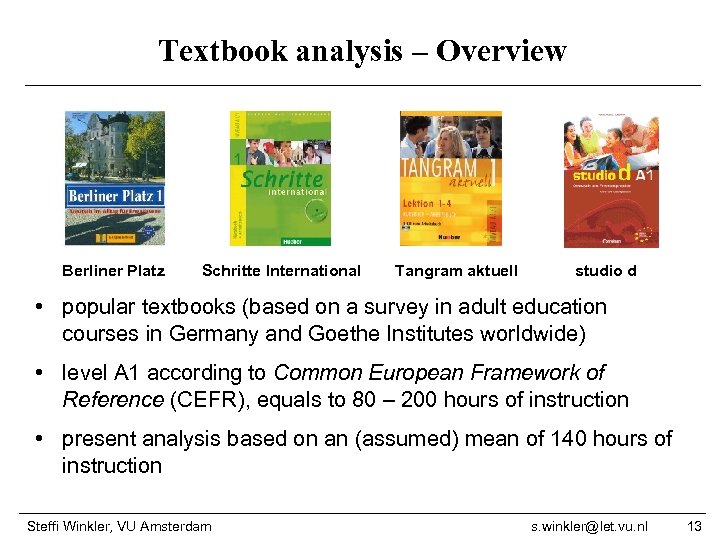 Textbook analysis – Overview Berliner Platz Schritte International Tangram aktuell studio d • popular textbooks (based on a survey in adult education courses in Germany and Goethe Institutes worldwide) • level A 1 according to Common European Framework of Reference (CEFR), equals to 80 – 200 hours of instruction • present analysis based on an (assumed) mean of 140 hours of instruction Steffi Winkler, VU Amsterdam s. winkler@let. vu. nl 13
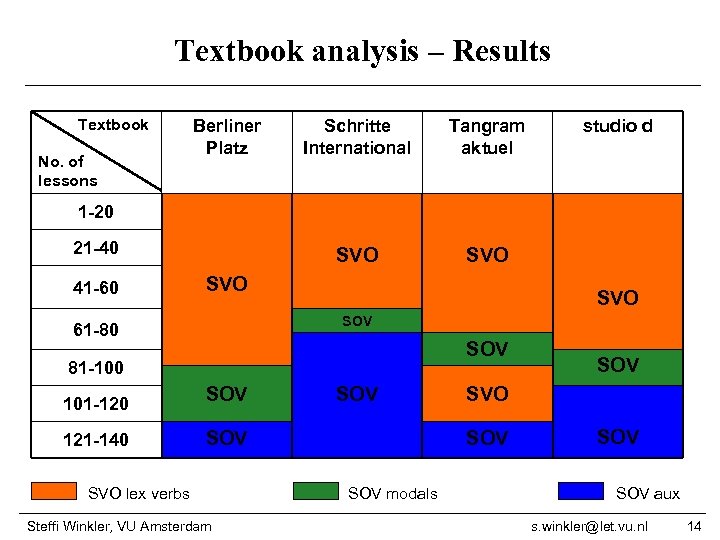 Textbook analysis – Results Textbook No. of lessons Berliner Platz Schritte International Tangram aktuel SVO studio d SVO 1 -20 21 -40 41 -60 SVO SOV 61 -80 SOV 81 -100 101 -120 SOV 121 -140 SOV SVO lex verbs Steffi Winkler, VU Amsterdam SOV SVO SOV modals SOV SOV aux s. winkler@let. vu. nl 14
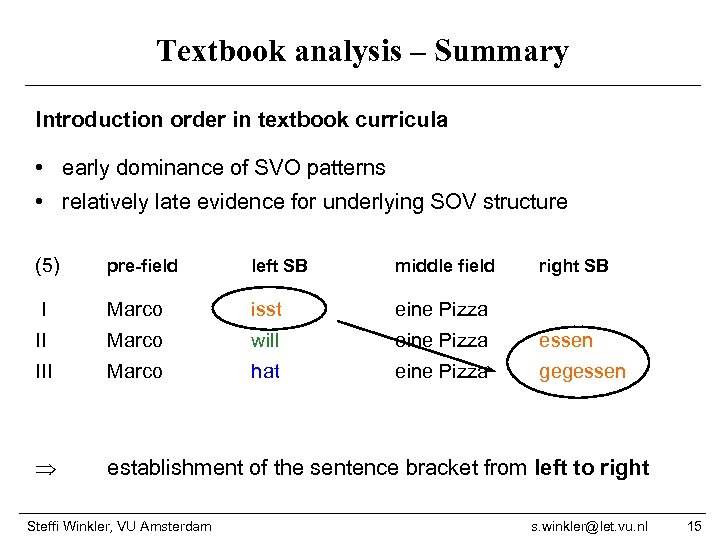 Textbook analysis – Summary Introduction order in textbook curricula • early dominance of SVO patterns • relatively late evidence for underlying SOV structure (5) pre-field left SB middle field I Marco isst eine Pizza II Marco will eine Pizza essen III Marco hat eine Pizza gegessen establishment of the sentence bracket from left to right Steffi Winkler, VU Amsterdam right SB s. winkler@let. vu. nl 15
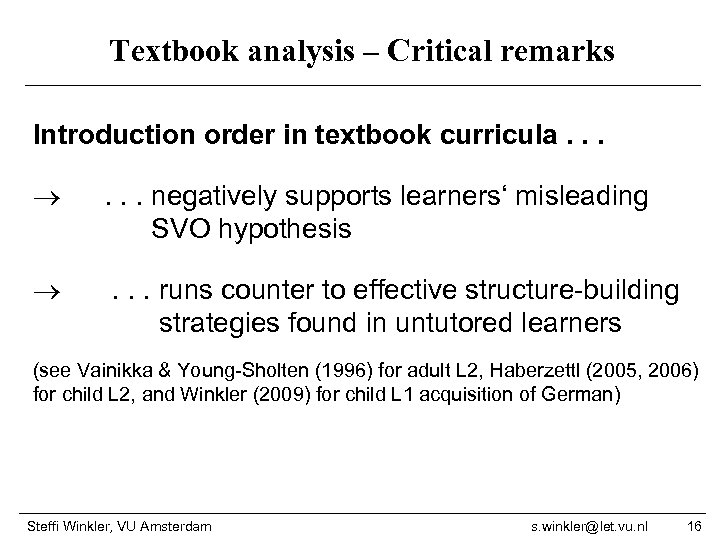 Textbook analysis – Critical remarks Introduction order in textbook curricula. . . . negatively supports learners‘ misleading SVO hypothesis . . . runs counter to effective structure-building strategies found in untutored learners (see Vainikka & Young-Sholten (1996) for adult L 2, Haberzettl (2005, 2006) for child L 2, and Winkler (2009) for child L 1 acquisition of German) Steffi Winkler, VU Amsterdam s. winkler@let. vu. nl 16
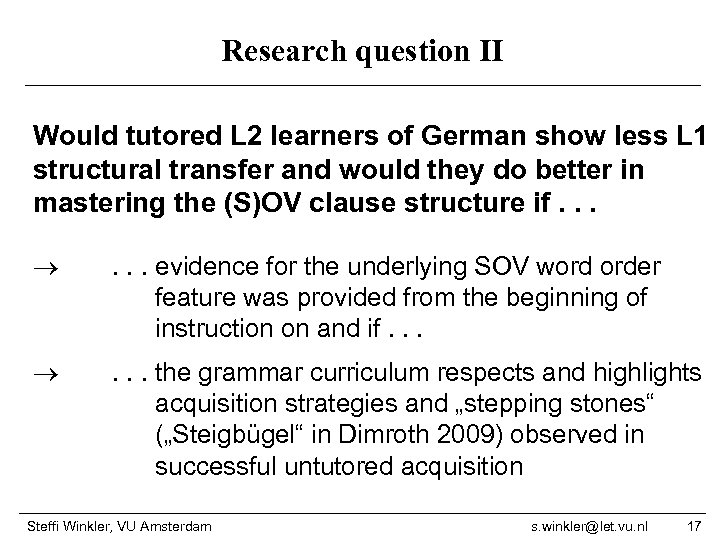 Research question II Would tutored L 2 learners of German show less L 1 structural transfer and would they do better in mastering the (S)OV clause structure if. . . . evidence for the underlying SOV word order feature was provided from the beginning of instruction on and if. . . the grammar curriculum respects and highlights acquisition strategies and „stepping stones“ („Steigbügel“ in Dimroth 2009) observed in successful untutored acquisition Steffi Winkler, VU Amsterdam s. winkler@let. vu. nl 17
 Intervention study – Participants • Italian university students, Università di Pavia • age 19 -34 • L 1: Italian (SVO), monolingual • L 2 s: English (all); French, Spanish (some); Latin classes (all) • two groups (25 students each) • „Test group“ („innovative“ curriculum) • „Control group“ („traditional“ curriculum) • same instructor for both groups (me) Steffi Winkler, VU Amsterdam s. winkler@let. vu. nl 18
 Intervention study – Instruction & Teaching method • 60 hours, 6 hours / week • communicative approach • grammar was taught inductively • relevant structures always embedded in communicative context • phenomenon first, explanations later • learners „discovered“ rules / grammar themselves • classroom language: Italian (in order to structurally control the target language input) Steffi Winkler, VU Amsterdam s. winkler@let. vu. nl 19
 Intervention study – Curriculum Guidelines for the Test group curriculum 1. Early dominance of (S)OV patterns in the input 2. Minimization of lexical verbs in V 2 Steffi Winkler, VU Amsterdam s. winkler@let. vu. nl 20
 Intervention study – Curriculum „Stepping stones“ in natural acquisition Basic Variety Approach (Klein & Perdue 1992, 1997) Functional verbs (modal verbs and auxiliaries) play a crucial – or even triggering – role in learners‘ progression from the ‚Infinite Utterance Organization‘ (IUO) to the ‚Finite Utterance Organization‘ (FUO) Post-Basic Variety I (see also Jordens 2002, Dimroth et al. 2003, Becker 2005 Jordens & Dimroth 2006, Schimke 2009, Verhagen 2009, Winkler 2009 for the crucial role of auxiliaries and modal verbs) Steffi Winkler, VU Amsterdam s. winkler@let. vu. nl 21
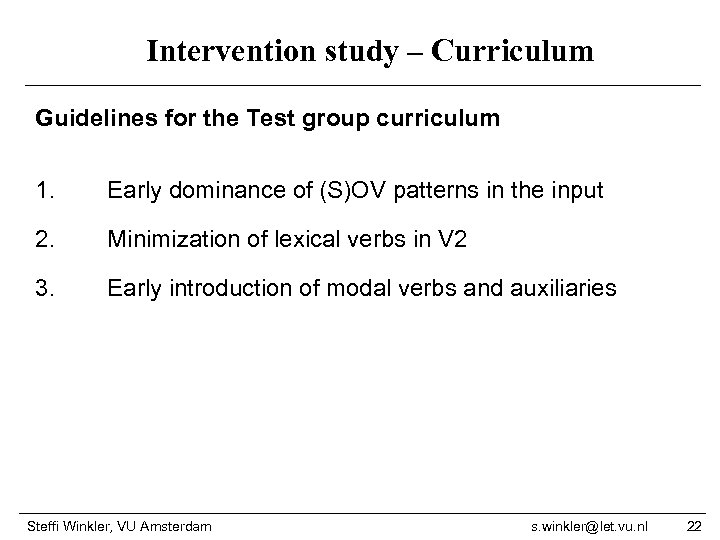 Intervention study – Curriculum Guidelines for the Test group curriculum 1. Early dominance of (S)OV patterns in the input 2. Minimization of lexical verbs in V 2 3. Early introduction of modal verbs and auxiliaries Steffi Winkler, VU Amsterdam s. winkler@let. vu. nl 22
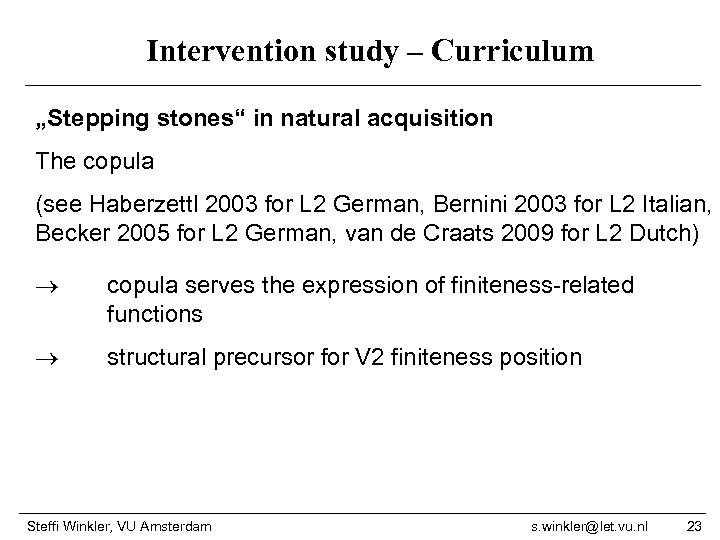 Intervention study – Curriculum „Stepping stones“ in natural acquisition The copula (see Haberzettl 2003 for L 2 German, Bernini 2003 for L 2 Italian, Becker 2005 for L 2 German, van de Craats 2009 for L 2 Dutch) copula serves the expression of finiteness-related functions structural precursor for V 2 finiteness position Steffi Winkler, VU Amsterdam s. winkler@let. vu. nl 23
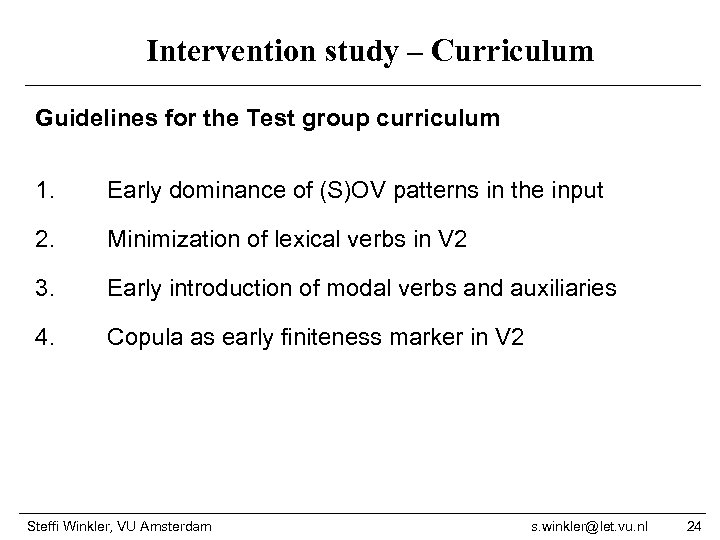 Intervention study – Curriculum Guidelines for the Test group curriculum 1. Early dominance of (S)OV patterns in the input 2. Minimization of lexical verbs in V 2 3. Early introduction of modal verbs and auxiliaries 4. Copula as early finiteness marker in V 2 Steffi Winkler, VU Amsterdam s. winkler@let. vu. nl 24
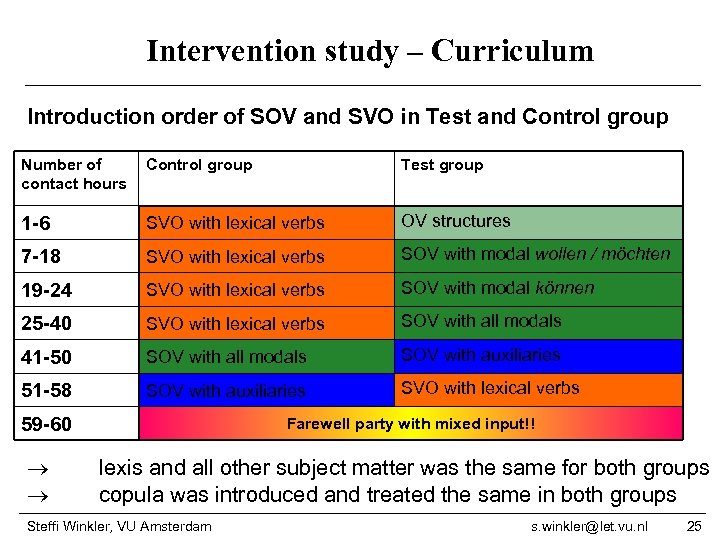 Intervention study – Curriculum Introduction order of SOV and SVO in Test and Control group Number of contact hours Control group Test group 1 -6 SVO with lexical verbs OV structures 7 -18 SVO with lexical verbs SOV with modal wollen / möchten 19 -24 SVO with lexical verbs SOV with modal können 25 -40 SVO with lexical verbs SOV with all modals 41 -50 SOV with all modals SOV with auxiliaries 51 -58 SOV with auxiliaries SVO with lexical verbs 59 -60 Farewell party with mixed input!! lexis and all other subject matter was the same for both groups copula was introduced and treated the same in both groups Steffi Winkler, VU Amsterdam s. winkler@let. vu. nl 25
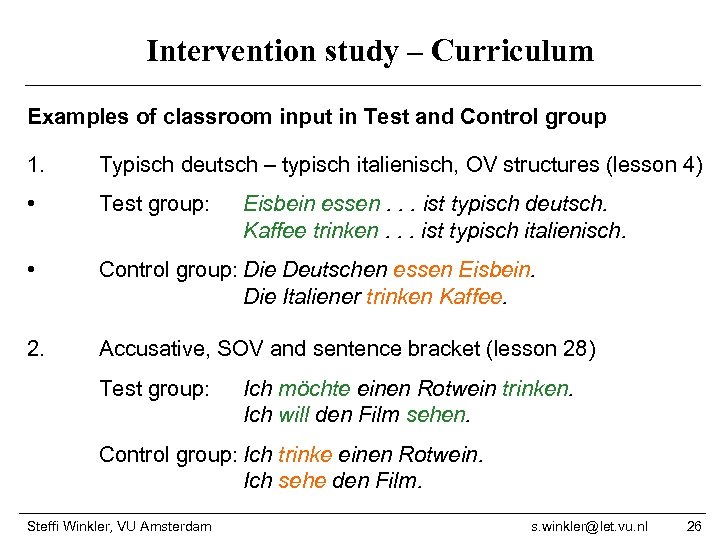 Intervention study – Curriculum Examples of classroom input in Test and Control group 1. Typisch deutsch – typisch italienisch, OV structures (lesson 4) • Test group: • Control group: Die Deutschen essen Eisbein. Die Italiener trinken Kaffee. 2. Accusative, SOV and sentence bracket (lesson 28) Test group: Eisbein essen. . . ist typisch deutsch. Kaffee trinken. . . ist typisch italienisch. Ich möchte einen Rotwein trinken. Ich will den Film sehen. Control group: Ich trinke einen Rotwein. Ich sehe den Film. Steffi Winkler, VU Amsterdam s. winkler@let. vu. nl 26
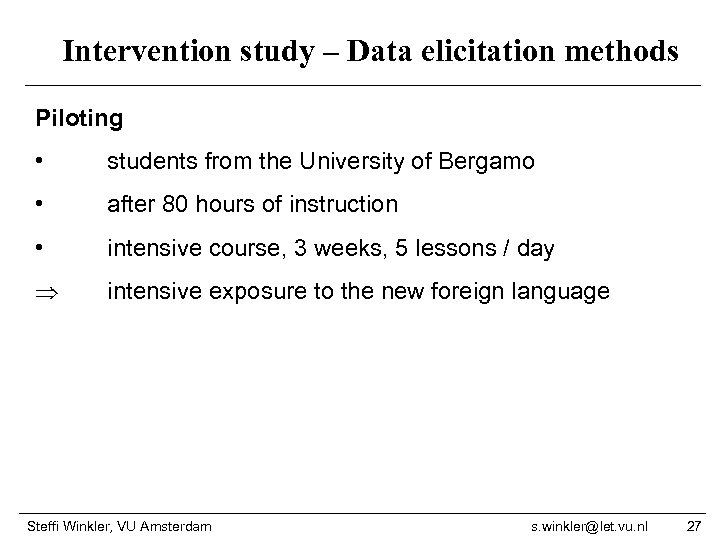 Intervention study – Data elicitation methods Piloting • students from the University of Bergamo • after 80 hours of instruction • intensive course, 3 weeks, 5 lessons / day intensive exposure to the new foreign language Steffi Winkler, VU Amsterdam s. winkler@let. vu. nl 27
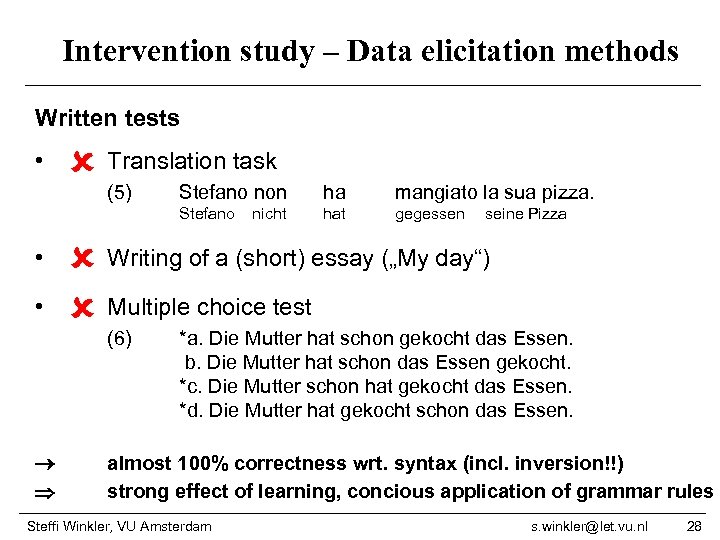 Intervention study – Data elicitation methods Written tests • Translation task (5) Stefano non Stefano • • nicht ha mangiato la sua pizza. hat gegessen seine Pizza Writing of a (short) essay („My day“) Multiple choice testhat schon gekocht das Essen. (6) *a. Die Mutter b. Die Mutter hat schon das Essen gekocht. *c. Die Mutter schon hat gekocht das Essen. *d. Die Mutter hat gekocht schon das Essen. almost 100% correctness wrt. syntax (incl. inversion!!) strong effect of learning, concious application of grammar rules Steffi Winkler, VU Amsterdam s. winkler@let. vu. nl 28
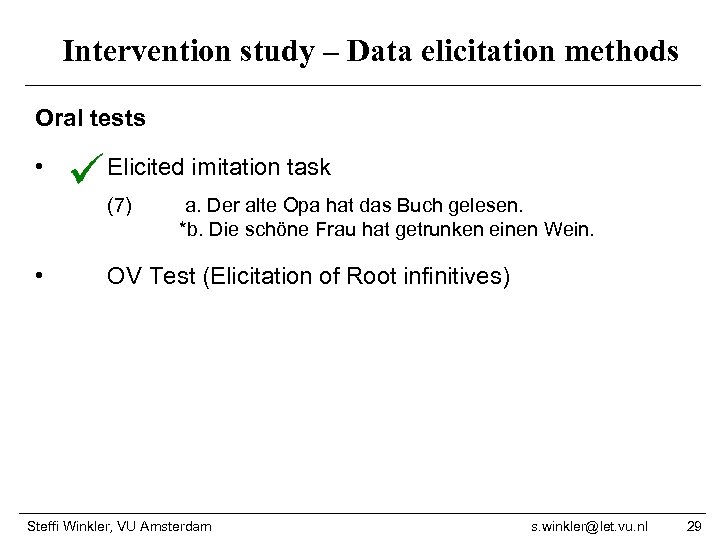 Intervention study – Data elicitation methods Oral tests • • (7) Elicited imitation task a. Der alte Opa hat das Buch gelesen. *b. Die schöne Frau hat getrunken einen Wein. OV Test (Elicitation of Root infinitives) Steffi Winkler, VU Amsterdam s. winkler@let. vu. nl 29


 46
46

 17
17

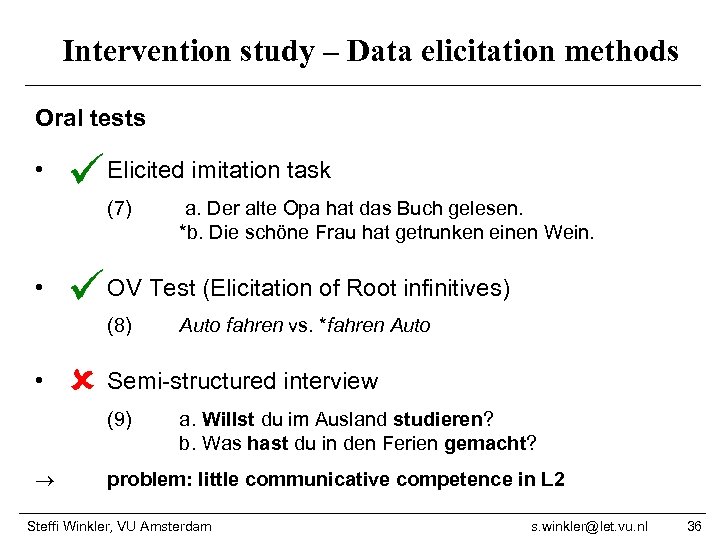 Intervention study – Data elicitation methods Oral tests • Elicited imitation task (7) • OV Test (Elicitation of Root infinitives) (8) • Auto fahren vs. *fahren Auto Semi-structured interview (9) a. Der alte Opa hat das Buch gelesen. *b. Die schöne Frau hat getrunken einen Wein. a. Willst du im Ausland studieren? b. Was hast du in den Ferien gemacht? problem: little communicative competence in L 2 Steffi Winkler, VU Amsterdam s. winkler@let. vu. nl 36
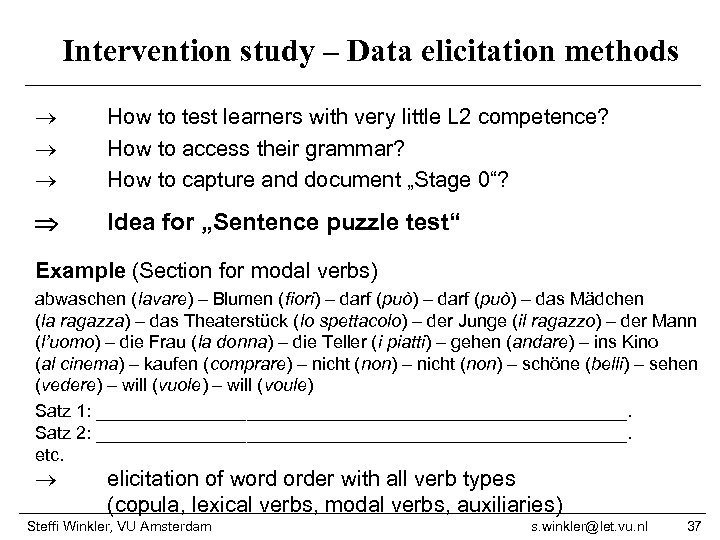 Intervention study – Data elicitation methods How to test learners with very little L 2 competence? How to access their grammar? How to capture and document „Stage 0“? Idea for „Sentence puzzle test“ Example (Section for modal verbs) abwaschen (lavare) – Blumen (fiori) – darf (può) – das Mädchen (la ragazza) – das Theaterstück (lo spettacolo) – der Junge (il ragazzo) – der Mann (l’uomo) – die Frau (la donna) – die Teller (i piatti) – gehen (andare) – ins Kino (al cinema) – kaufen (comprare) – nicht (non) – schöne (belli) – sehen (vedere) – will (vuole) – will (voule) Satz 1: ___________________________. Satz 2: ___________________________. etc. elicitation of word order with all verb types (copula, lexical verbs, modal verbs, auxiliaries) Steffi Winkler, VU Amsterdam s. winkler@let. vu. nl 37
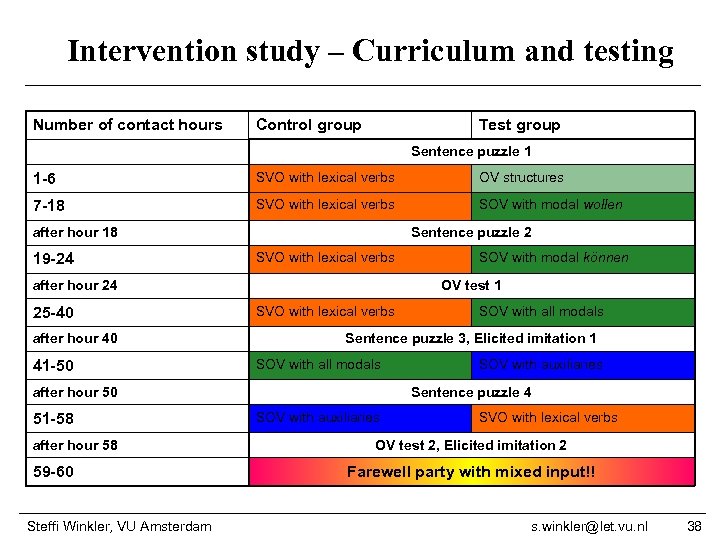 Intervention study – Curriculum and testing Number of contact hours Control group Test group Sentence puzzle 1 1 -6 SVO with lexical verbs OV structures 7 -18 SVO with lexical verbs SOV with modal wollen after hour 18 19 -24 Sentence puzzle 2 SVO with lexical verbs after hour 24 25 -40 after hour 40 41 -50 OV test 1 SVO with lexical verbs after hour 58 59 -60 Steffi Winkler, VU Amsterdam SOV with all modals Sentence puzzle 3, Elicited imitation 1 SOV with all modals after hour 50 51 -58 SOV with modal können SOV with auxiliaries Sentence puzzle 4 SOV with auxiliaries SVO with lexical verbs OV test 2, Elicited imitation 2 Farewell party with mixed input!! s. winkler@let. vu. nl 38
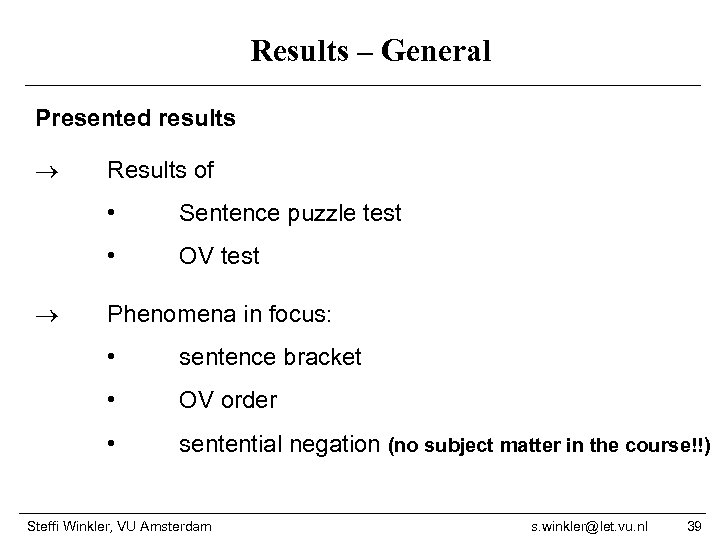 Results – General Presented results Results of • • Sentence puzzle test OV test Phenomena in focus: • sentence bracket • OV order • sentential negation (no subject matter in the course!!) Steffi Winkler, VU Amsterdam s. winkler@let. vu. nl 39
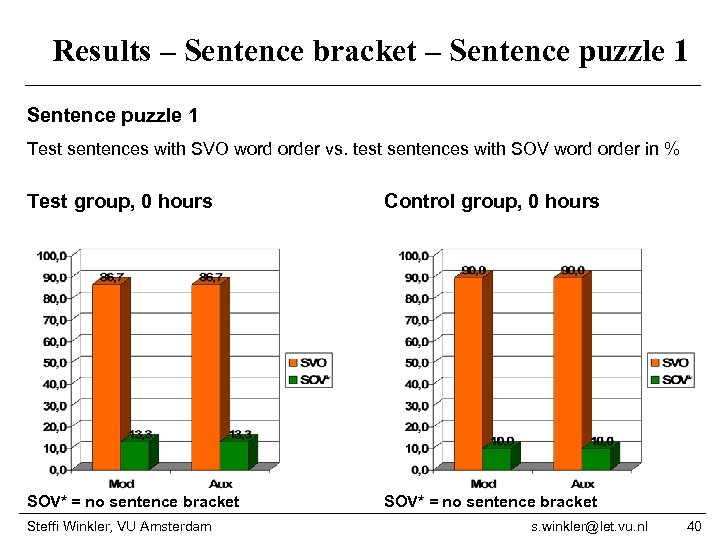 Results – Sentence bracket – Sentence puzzle 1 Test sentences with SVO word order vs. test sentences with SOV word order in % Test group, 0 hours Control group, 0 hours SOV* = no sentence bracket Steffi Winkler, VU Amsterdam s. winkler@let. vu. nl 40
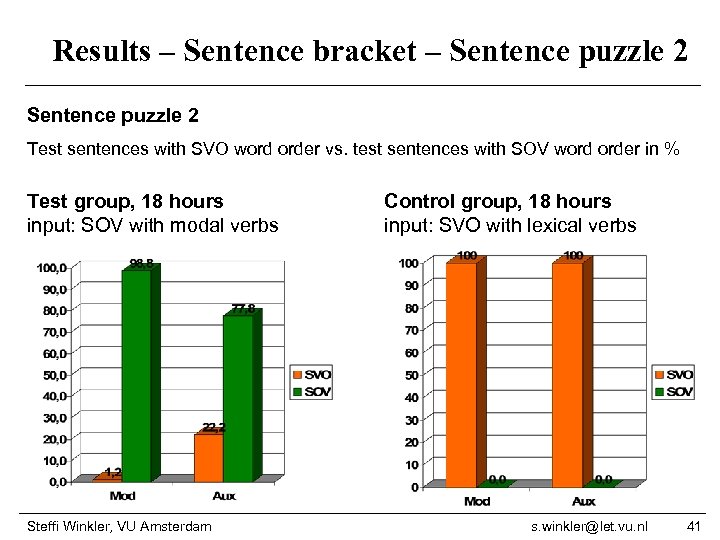 Results – Sentence bracket – Sentence puzzle 2 Test sentences with SVO word order vs. test sentences with SOV word order in % Test group, 18 hours input: SOV with modal verbs Steffi Winkler, VU Amsterdam Control group, 18 hours input: SVO with lexical verbs s. winkler@let. vu. nl 41
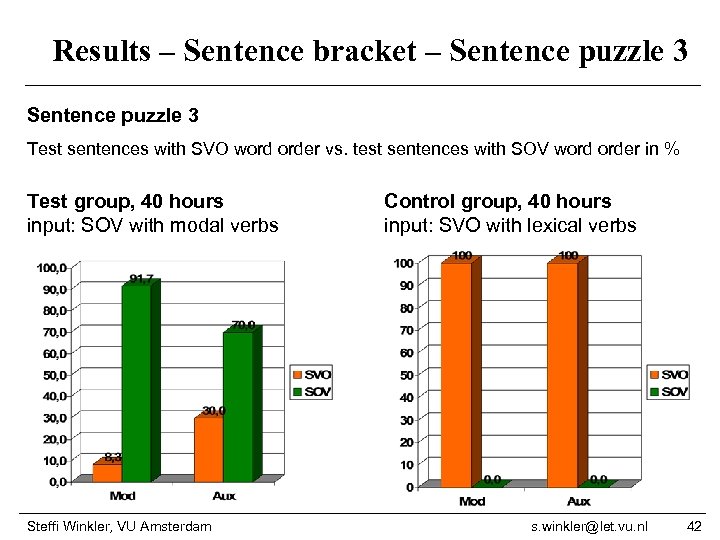 Results – Sentence bracket – Sentence puzzle 3 Test sentences with SVO word order vs. test sentences with SOV word order in % Test group, 40 hours input: SOV with modal verbs Steffi Winkler, VU Amsterdam Control group, 40 hours input: SVO with lexical verbs s. winkler@let. vu. nl 42
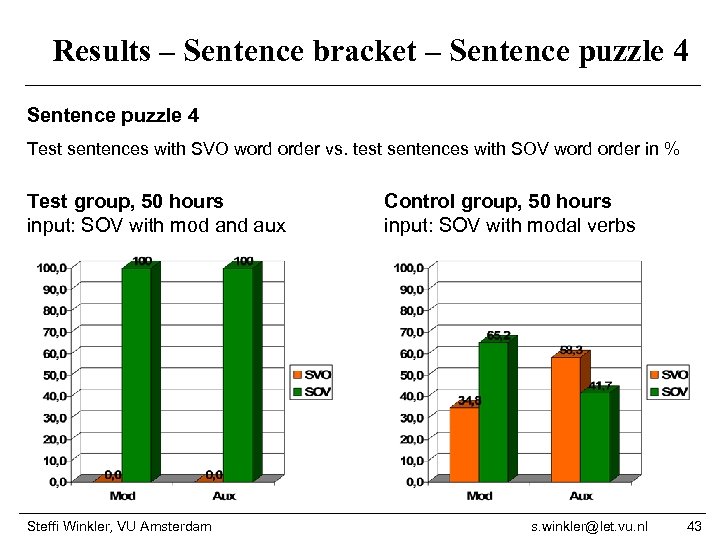 Results – Sentence bracket – Sentence puzzle 4 Test sentences with SVO word order vs. test sentences with SOV word order in % Test group, 50 hours input: SOV with mod and aux Steffi Winkler, VU Amsterdam Control group, 50 hours input: SOV with modal verbs s. winkler@let. vu. nl 43
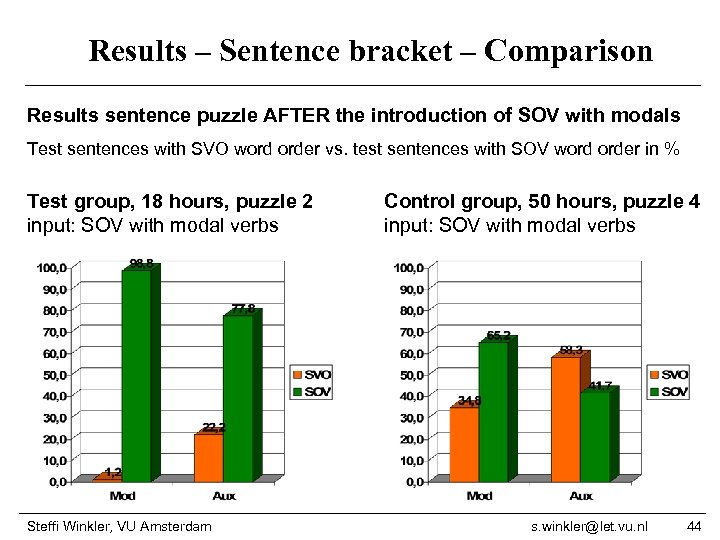 Results – Sentence bracket – Comparison Results sentence puzzle AFTER the introduction of SOV with modals Test sentences with SVO word order vs. test sentences with SOV word order in % Test group, 18 hours, puzzle 2 input: SOV with modal verbs Steffi Winkler, VU Amsterdam Control group, 50 hours, puzzle 4 input: SOV with modal verbs s. winkler@let. vu. nl 44
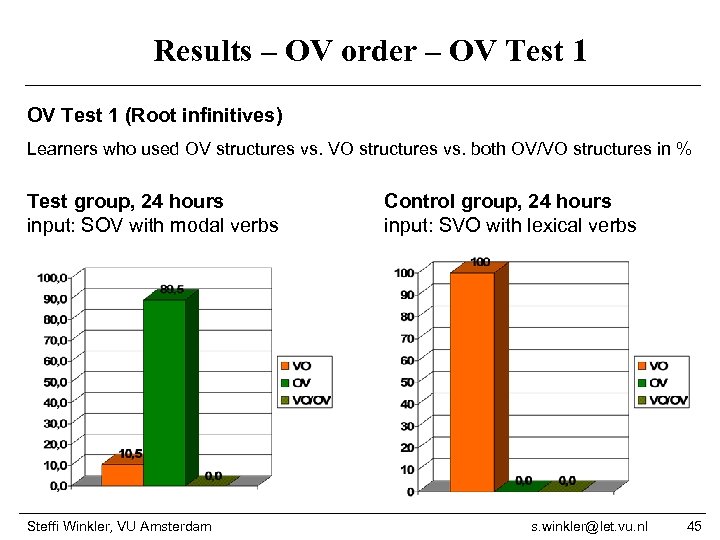 Results – OV order – OV Test 1 (Root infinitives) Learners who used OV structures vs. VO structures vs. both OV/VO structures in % Test group, 24 hours input: SOV with modal verbs Steffi Winkler, VU Amsterdam Control group, 24 hours input: SVO with lexical verbs s. winkler@let. vu. nl 45
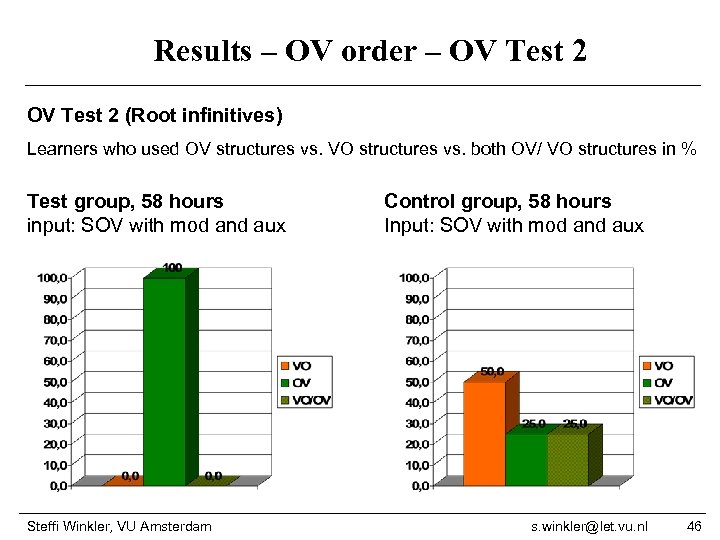 Results – OV order – OV Test 2 (Root infinitives) Learners who used OV structures vs. VO structures vs. both OV/ VO structures in % Test group, 58 hours input: SOV with mod and aux Steffi Winkler, VU Amsterdam Control group, 58 hours Input: SOV with mod and aux s. winkler@let. vu. nl 46
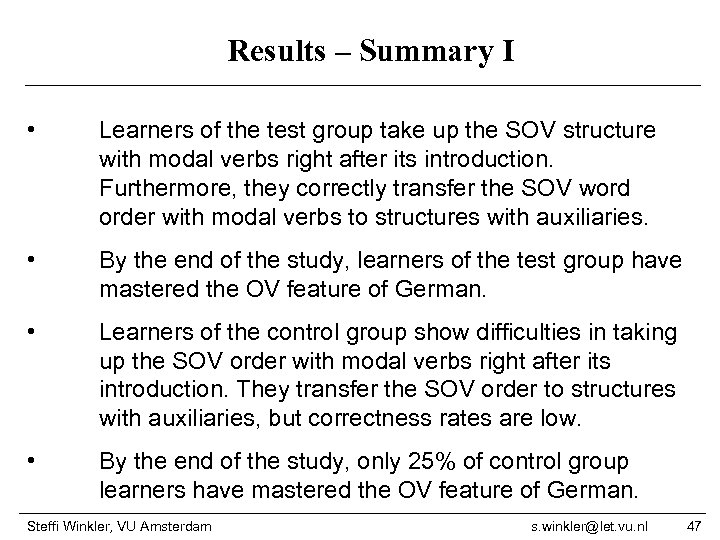 Results – Summary I • Learners of the test group take up the SOV structure with modal verbs right after its introduction. Furthermore, they correctly transfer the SOV word order with modal verbs to structures with auxiliaries. • By the end of the study, learners of the test group have mastered the OV feature of German. • Learners of the control group show difficulties in taking up the SOV order with modal verbs right after its introduction. They transfer the SOV order to structures with auxiliaries, but correctness rates are low. • By the end of the study, only 25% of control group learners have mastered the OV feature of German. Steffi Winkler, VU Amsterdam s. winkler@let. vu. nl 47
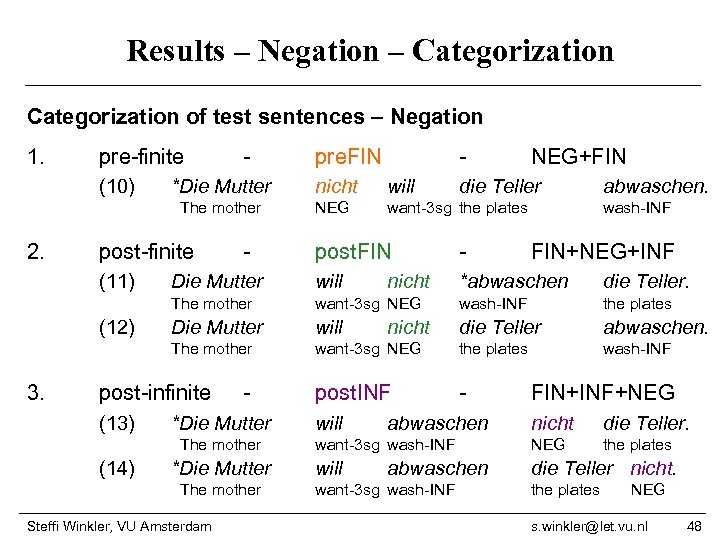 Results – Negation – Categorization of test sentences – Negation 1. pre-finite (10) - pre. FIN - nicht will The mother 2. *Die Mutter NEG+FIN want-3 sg the plates post-finite abwaschen. wash-INF 3. - Die Mutter will *abwaschen die Teller. want-3 sg NEG wash-INF the plates Die Mutter will die Teller abwaschen. The mother (12) post. FIN The mother (11) want-3 sg NEG the plates wash-INF post. INF - post-infinite (13) - die Teller - *Die Mutter The mother (14) *Die Mutter The mother Steffi Winkler, VU Amsterdam will nicht abwaschen FIN+NEG+INF FIN+INF+NEG nicht die Teller. want-3 sg wash-INF NEG the plates will die Teller nicht. abwaschen want-3 sg wash-INF the plates NEG s. winkler@let. vu. nl 48
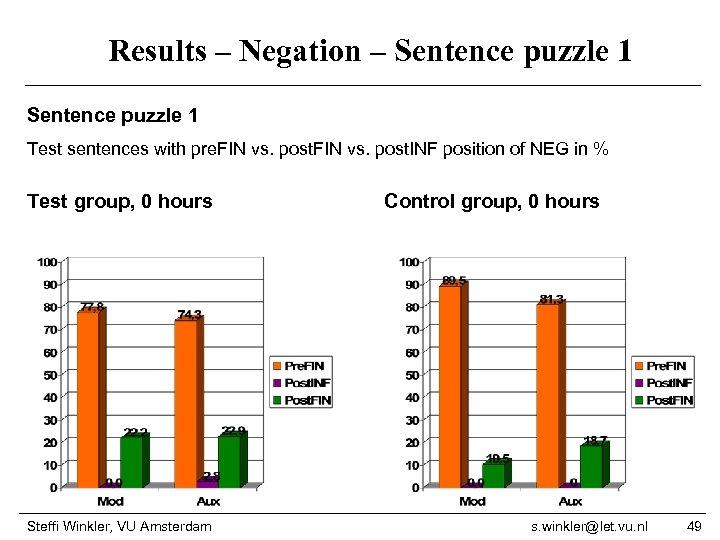 Results – Negation – Sentence puzzle 1 Test sentences with pre. FIN vs. post. INF position of NEG in % Test group, 0 hours Steffi Winkler, VU Amsterdam Control group, 0 hours s. winkler@let. vu. nl 49
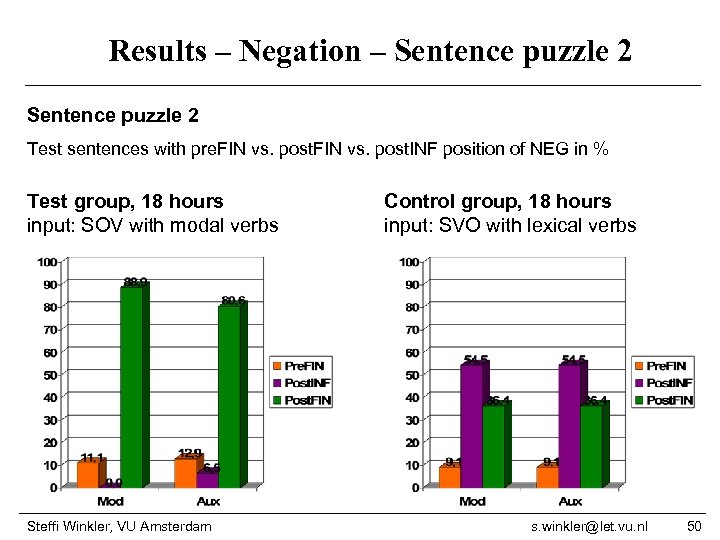 Results – Negation – Sentence puzzle 2 Test sentences with pre. FIN vs. post. INF position of NEG in % Test group, 18 hours input: SOV with modal verbs Steffi Winkler, VU Amsterdam Control group, 18 hours input: SVO with lexical verbs s. winkler@let. vu. nl 50
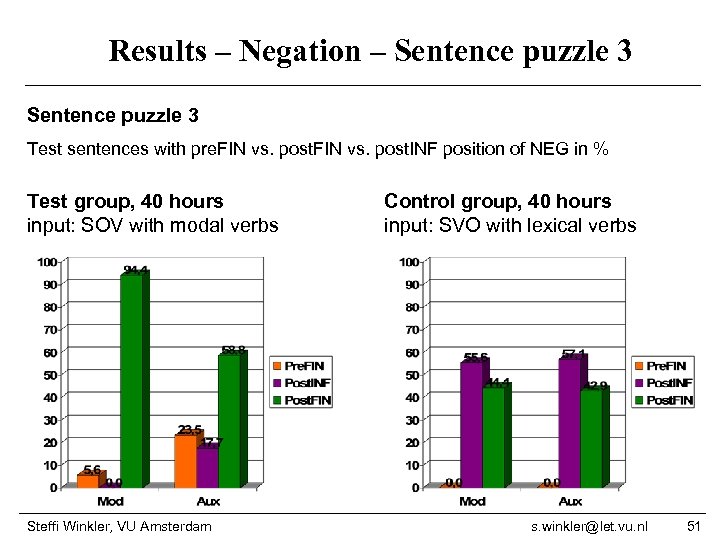 Results – Negation – Sentence puzzle 3 Test sentences with pre. FIN vs. post. INF position of NEG in % Test group, 40 hours input: SOV with modal verbs Steffi Winkler, VU Amsterdam Control group, 40 hours input: SVO with lexical verbs s. winkler@let. vu. nl 51
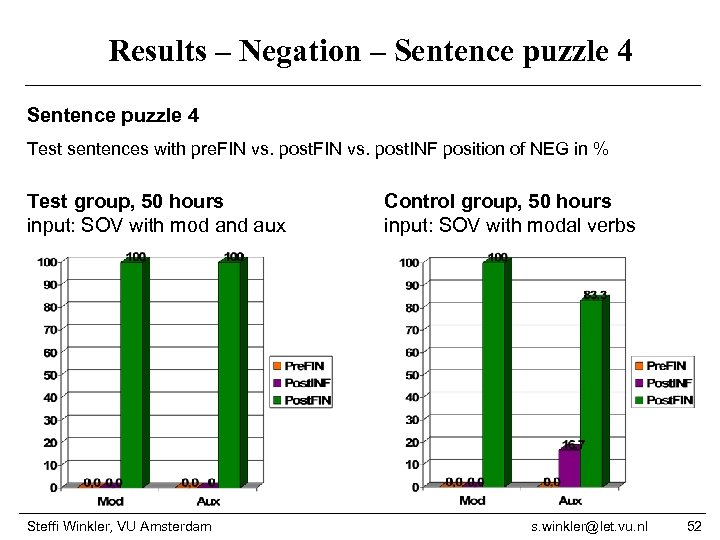 Results – Negation – Sentence puzzle 4 Test sentences with pre. FIN vs. post. INF position of NEG in % Test group, 50 hours input: SOV with mod and aux Steffi Winkler, VU Amsterdam Control group, 50 hours input: SOV with modal verbs s. winkler@let. vu. nl 52
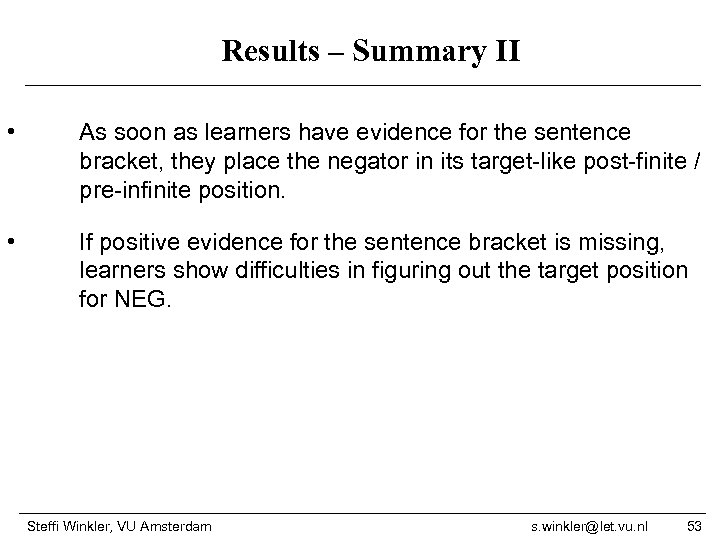 Results – Summary II • As soon as learners have evidence for the sentence bracket, they place the negator in its target-like post-finite / pre-infinite position. • If positive evidence for the sentence bracket is missing, learners show difficulties in figuring out the target position for NEG. Steffi Winkler, VU Amsterdam s. winkler@let. vu. nl 53
 Issues to be discussed 1. Dichotomy of Acquisition vs. Learning (Krashen 1981) relation of acquisition vs. learning • wrt instructed acquisition in general • wrt the present study Are the relevant structures „learned“ or are they „acquired“? Did I test / measure „acquisition“ or did I test / measure „learning“? Steffi Winkler, VU Amsterdam s. winkler@let. vu. nl 54
 Issues to be discussed 2. Negation strategies in tutored and untutored acquisition • certain stage in untutored acquisition • post-verbal, i. e. postfinite negation with functional verbs, but • pre-verbal negation with lexical verbs • Bardel (1999), Bernini (2000): utterances with post-finite negation with the copula in L 2 Italian assumption: learners intend to move the finiteness marker out of the scope of NEG Can we observe similar strategies in instructed acquisition? Steffi Winkler, VU Amsterdam s. winkler@let. vu. nl 55
 Issues to be discussed 3. Acquisition orders in tutored vs. untutored acquisition • reference study: ZISA project (Clahsen et al. 1983) • Pienemann (1989), Ellis (1989), Ballestracci (2006) confirm the ZISA order (wrt the acquisition of the sentence bracket!) for tutored acquisition • acquisition of the sentence bracket: • • • Ballestracci (2006): after 80 hours Pienemann (1989): after 90 / 102 hours Ellis (1989): after 113 hours These data might be an artifact of the introduction order employed in instruction (as regards SVO vs. SOV) Steffi Winkler, VU Amsterdam s. winkler@let. vu. nl 56
 Conclusions • Early evidence for the underlying (S)OV structure of German in the classroom input data leads to successful mastering of both the sentence bracket and the OV word order. • Regardless of the question whether the SOV order is „learned“ or „acquired“, the availability of the sentence bracket in the learners‘ (idea of) L 2 grammar seems to be a fundamental prerequisite for the acquisition of other syntactic phenomena in the target language, e. g. sentential negation. • Thus – in contrast to the current praxis – (S)OV patterns should be introduced early in instructed acquisition. Steffi Winkler, VU Amsterdam s. winkler@let. vu. nl 57
 Thanks Thank you Steffi Winkler, VU Amsterdam s. winkler@let. vu. nl 58
 References Ballestracci, S. (2006): Zum Da. F-Erwerb ausgewählter grammatischer Strukturen der deutschen Sprache bei italophonen Studierenden der Pisaner Fakultät der Lingue e Letterature Straniere. Doctoral Dissertation. Università di Pisa, Department for Linguistics. (http: //www. humnet. unipi. it/dott_linggensac/Tesi%20 discusse. php) Bardel, C. (1999): Negation and information structure in the Italian L 2 of a Swedish learner. In: Acquisition et Interaction en Langue Etrangère. Proceedings of 8 th EUROSLA Conference, Paris. Volume 2. 173 -188. Becker, A. (2005): The semantic knowledge base for the acquisition of negation and the acquisition of finiteness. In: H. Hendriks (ed. ): The Structure of Learner Varieties. Berlin / New York: de Gruyter. 263– 314. Bernini, G. (2000): Negative items and negation strategies in nonnative Italian. In: Studies in Second Language Acquisition 22. 399 -440. Bernini, G. (2003): The copula in learner Italian: Finiteness and verbal inflection. In: C. Dimroth & M. Starren (eds. ): Information structure and the dynamics of language acquisition. Amsterdam: Benjamins, 159 -186. Steffi Winkler, VU Amsterdam s. winkler@let. vu. nl 59
 References Clahsen, H. , J. Meisel & M. Pienemann (1983): Deutsch als Zweitsprache: Der Spracherwerb ausländischer Arbeiter. Tübingen: Narr. Diehl, E. , H. Christen, S. Leuenberger, I. Pelvat & T. Studer (2000): Grammatikunterricht: Alles für der Katz? Untersuchungen zum Zweitspracherwerb Deutsch. Tübingen: Niemeyer. Dimroth, C. (2009): Lernervarietäten im Sprachunterricht. In: Zeitschrift für Literaturwissenschaft und Linguistik 39 (153). 60 -80. Dimroth, C. , P. Gretsch, P. Jordens, C. Perdue, and M. Starren (2003): Finiteness in Germanic languages: A stage-model for first and second language development. In: C. Dimroth and M. Starren (eds. ): Information Structure and the Dynamics of Language Acquisition. 65 -93. Amsterdam: Benjamins. Ellis, R. (1989): Are classroom and naturalistic acquisition the same? A study of the classroom acquisition of German word order rules. In: Studies in Second Language Acquisition 11. 305 -328. Steffi Winkler, VU Amsterdam s. winkler@let. vu. nl 60
 References Haberzettl, S. (2005): Der Erwerb der Verbstellungsregeln in der Zweitsprache Deutsch durch Kinder mit russischer und türkischer Muttersprache. Tübingen: Niemeyer. Haberzettl, S. (2006): Progression im ungesteuerten Erwerb und im gesteuerten Erwerb. In: B. Ahrenholz (ed. ): Kinder mit Migrationshintergrund. Spracherwerb und Fördermöglichkeiten. Fillibach. 203 -220. Jansen, B. , J. Lalleman & P. Muysken (1981): The alternation hypothesis: the acquisition of Dutch word order by Turkish and Moroccan foreign workers. In: Language Learning 31. 315 -336. Jordens, P. (1990): The Acquisition of Verb Placement in Dutch and German. In: Linguistics 28. 1407 -1448. Jordens, Peter (2002): Finiteness in early child Dutch. Linguistics 40. 687 -765. Jordens, P. & C. Dimroth (2006): Finiteness in children and adults learning Dutch. In: N. Gagarina and I. Gülzow (eds. ): The Acquisition of Verbs and their Grammar: The Effect of particular languages. Dordrecht: Springer Netherlands. 167 -195. Steffi Winkler, VU Amsterdam s. winkler@let. vu. nl 61
 References Klein, W. & C. Perdue (1992): Utterance Structure. Developing Grammars Again. Amsterdam / Philadelphia: John Benjamins. Klein, W. & C. Perdue (1997). The Basic Variety. Or: Couldn’t Natural Languages be much Simpler? In: Second Language Research 13. 301 -347. Krashen, S. (1981). Second language acquisition and second language learning. Oxford: Pergamon Press. Müller, N. (1998): Die Abfolge OV/VO und Nebensätze im Zweit- und Erstspracherwerb. In: H. Wegener (ed. ): Eine zweite Sprache lernen: empirische Untersuchungen zum Zweitspracherwerb. Tübingen: Narr. 89 -116. Pienemann, M. (1989): Is language teachable? Psycholinguistic experiments and hypotheses. In: Applied Linguistics 10. 52 -79. Perdue, Clive (1993). Adult language acquisition: cross-linguistic perspectives. Cambridge: Cambridge University Press. Schimke, S. (2009): The acquisition of finiteness in Turkish learners of German and Turkish learners of French. Doctoral Dissertation. Max Planck Institute for Psycholinguistics, Nijmegen. Steffi Winkler, VU Amsterdam s. winkler@let. vu. nl 62
 References Verhagen, J. (2008): The acquisition of finiteness in Dutch as a second language. Doctoral Dissertation. VU Free University Amsterdam, Amsterdam and Max Planck Institute for Psycholinguistics, Nijmegen. Winkler, S. (2009): The acquisition of syntactic finiteness in L 1 German. A structure-building approach. In: C. Dimroth and P. Jordens (eds. ): Functional elements learner language. Berlin / New York: Mouton de Gruyter. Steffi Winkler, VU Amsterdam s. winkler@let. vu. nl 63