


 Скачать презентацию Leading Managing The Special Needs Assistant Working
3edb38ac480faacabbda887787150aeb.ppt
- Количество слайдов: 61
 Leading & Managing The Special Needs Assistant Working in The Primary School Environment Micheál O’Sullivan IPPN Conference January 23 rd/24 th 2014 1
 Historical Background In Ireland the progression of special needs education has had three distinct phases: the era of neglect and denial the era of special school the era of integration (Swan, 2000) 2
 Historical Background In the late 1800’s, children with special needs were not considered for education as their needs were seen as medical. The growth of special schools in the mid 20 th century was very convenient for mainstream schools as they were not expected to deal with children with special needs (Griffin & Shevlin, 2007). 3
 Historical Background By the 1980’s, there was a worldwide push for integration of children with special education needs into mainstream schools (Carey, 2005). School 4
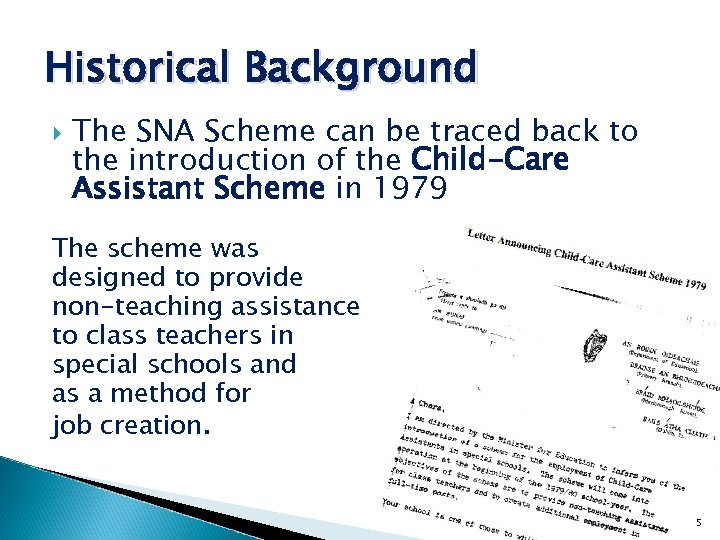 Historical Background The SNA Scheme can be traced back to the introduction of the Child-Care Assistant Scheme in 1979 The scheme was designed to provide non-teaching assistance to class teachers in special schools and as a method for job creation. 5
 Historical Background: SERC The Special Education Review Committee (SERC) Report (DES, 1993) represented a shift in mindset from the medical model to a more social model of disability. 6
 SERC 1993 Important implications arose from the report such as the expectation that primary schools cater for all children, irrespective of ability, and that the needs of the child are paramount when decisions are being made concerning their education (Mac. Giolla Phadraig, 2007). 7
 The Salamanca Statement Around the same time, Ireland became one of 92 governments to adopt The Salamanca Statement and Framework for Action on Special Educational Needs (UNESCO, 1994 a). 8
 This Salamanca Statement called on governments to adopt as a matter of law or policy the principle of inclusive education and enrol all children in regular schools unless there were compelling reasons to do otherwise (Thomas and Vaughan, 2004) 9
 The Education Act 1998 The Education Act (Govt. of Ireland, 1998) states that support services and a level of education appropriate to meeting the needs and abilities of students should be provided for. 1998 – Ministerial announcement of the provision of automatic supports for children with SEN irrespective of educational placement. 10
 The growth in applications… As the number of applications grew, the DES introduced a school certified process in February 2002 whereby the school applied directly to the DES for SNA Support 11
 The growth in applications… In 1990 there were 70 SNA’s employed in the Primary & Special School sector By 2000, this had grown to 1495 (VFM Review, June 2011) This number continued to grow…. . 12
 The National Council for Special Education (NCSE) In Sept 2004, Circular 13/04 advised schools of the Department’s intention to carry out a general review of SNA deployment This review coincided with the establishment of the NCSE under EPSEN 2004 (Govt of Ireland, 2004) 13
 The Special Education Needs Organiser (SENO) The functions of processing applications for SNA support now transferred to the NCSE supported by SENOs. Decisions by SENOs to allocate SNA support to schools is based on criteria outlined in Circular Sp. Ed. 07/02 14
 Circular Sp. Ed. 07/02 Applications for an SNA should be considered where, for example, a pupil has a significant medical need for such assistance, a significant impairment of physical or sensory function or where their behaviour is such that they are a danger to themselves or to other pupils. Pupils' needs could range from needing an assistant for a short period each week, for example to help feed or change the pupil(s) or bring them to the toilet, to requiring a full-time assistant 15
 Circular SNA 15/05 “The practice of issuing child specific contracts should cease with immediate effect” SNA 15/05 August 2005 This heralded a change in the contract of employment for Special Needs Assistants. 16
 There are currently 9 pieces of legislation covering SEN provision 1. The Education Act, 1998 2. The National Disabilities Authority Act, 1999 3. The Education Welfare Act, 2000 4. The Equal Status Act, 2000 5. The Children Act, 2001 6. Data protection Acts 1988, 1998 and 2003 7. Freedom of Information Acts 1997, 2003 8. The Teaching Council Act, 2001 9. The Education for Person’s with Special Education Needs Act, 2004 (EPSEN) 17
 A summary of Employment Protection Legislation between 1993 and 2012 includes… Parental Leave (Amendment) Act 2006 Safety, Health and Welfare at Work Act 2005 Maternity Protection (Amendment) Act 2004 Equality Act 2004 Protection of Employees (Fixed-Term Work) Act 2003 Organisation of Working Time (Records) (Prescribed Form and Exemptions) Regulations 2001 Terms of Employment (Information)Act 1994: Unfair Dismissals (Amendment)Act 1993 18
 Education for Persons with Special Needs Act (EPSEN) 2004 While not all sections of the (EPSEN) Act 2004 have commenced, S. 2 of the Act provided for inclusive education for children with special needs in July 2005. 19
 Number of pupils seeking SNA Support increase year on year……. . Number of pupils with SNA Support 2009/10… Source: NCSE Special Education Administration System (SEAS) August 2010 20
 Post Primary Total 67 351 418 567 2, 369 2, 936 86 138 224 769 2, 352 3, 121 54 232 286 Mild GLD 267 386 653 Moderate GLD 149 434 583 Multiple Disabilities 288 1, 038 1, 326 Physical Disability 523 1, 519 2, 042 Severe Emot/Behavioural 211 533 744 2 25 27 Specific Learning Disability 30 22 52 Specific Sp & Lang Disorder 13 310 323 109 172 281 3, 135 9, 881 13, 016 Assessed Syndrome Autism/ASD Borderline MGLD Emot/Behav Disturbance Hearing Impairment Severe/Profound GLD Visual Impairment Total Pupils 21
 In small groups… 1. What are your thoughts on how prepared the SNA is for the Primary school? 2. What do SNAs need to know? 3. What are the issues which arise for you when leading and managing your SNA(s)? 4. What would you like to see improved? 22
 PROCESSING OF APPLICATIONS As per Circular 0006/2011, which came into effect January 2011, a cap has been placed on the number whole time equivalent Special Needs Assistant posts in school. This number became 10, 575 whole time equivalent posts, however…… 23
 As of 2013…. In December 2013, the DES increase of 390 SNA posts announced an The cap on whole time equivalent posts will now be 10, 965 by the end of 2014 or when the recruitment process concludes According to the NCSE, the number of children “accessing” SNA support in mainstream schools is approx. 15, 000 (NCSE, 2013) 24
 Qualifications With effect from 1 st September 2011, (DES Circular 0021/2011) the minimum required standard of education for appointment to the post of Special Needs Assistant is: • A FETAC level 3 major qualification on the National Framework of Qualifications, OR • A minimum of three grade Ds in the Junior Certificate, OR • Equivalent 25
 On making an application to SENO. . Appendix 1 (Application for Access to Low Incidence Hours and SNA Support) BCN 1 form should be completed by the school where the primary reason for the SNA application relates to behavioural care needs 26
 The Backup material… Illustrate your capacity…. . 0. 17, 0. 25, 0. 83 What does the SNA do when the child attends resource? . . . every 30 mins. counts How many children can your SNA take care of on the yard? Back up all statements with documentary evidence…e. g consultants reports, specialist reports… Back up documentation from creche or otherwise Keep a diary or logbook 27
 Making applications… There is evidence that the category related to ‘behaviour is such that students are a danger to themselves or others’ is being misinterpreted and is leading to an over identification of pupils in this category. -(Value for Money Review of Expenditure on the Special Needs Assistant Scheme, 2011)(VFM, 2011) 28
 Duties The duties of SNAs are available in Appendix 1 of Circular DES Sp. Ed 07/02: Schools should note that the duties of special needs assistants sanctioned by the Department are of a nonteaching nature. Individual pupils with a general learning disability would not typically require the services of a special needs assistant. Schools with pupils who have special care needs arising from a disability and who also require additional academic input should consider applying for additional resource teaching provision. 29
 Responsibility In accordance with Circular 10/76: Duties and Responsibilities of Principal Teachers …. the duties of SNAs are assigned the Principal teacher and sanctioned by the Board of Management. Their work should be supervised either by the principal or by a class teacher. 30
 SNA Duties The duties of the Special Needs Assistant are outlined in Circular 15/05 Appendix 1 31
 Brief absences Circular 0032/2010 covers brief absences for SNA’s in recognised Primary & Post Primary Schools effective from 1 st September 2010 Can be found at: www. education. ie/home/educationpersonnel-specalneedsassistants 32
 Brief absences Substitution is allowed and leave is paid; ◦ Bereavement of a family member ◦ Special leave commences from the day directly following bereavement ◦ Jury service ◦ Court Attendance ◦ Force Majeure – under the Parental Leave Act 1998 3 days max. in 12 months or 5 days max. in 36 month 33
 Brief absences Paid leave is allowed but no substitution Marriage leave – 7 days Wedding of immediate family member – 1 day Witness in court Exam leave 34
 Brief absences For unpaid leave refer to Circular 0032/2010 Section 5 For maternity leave/paternity leave/adoptive leave refer to Circular SNA 13/05 35
 Seniority among SNAs It is important that a listing of seniority is kept under Circular 0059/2006 The sequence in which SNA’s are appointed determines their seniority. The seniority is important in determining which special need assistant(s) should be offered reduced hours or have their employment terminated when the allocation of the school is reduced. The seniority listing will be used in determining last in first out (LIFO) for the purpose of redundancy. 36
 Working Croke Park… Public Service (Croke Park) Agreement - Special Needs Assistants; Circular Number 0071/2011 “A central requirement of the re-configuration of the usage of the 12 days, is that the time be utilised and delivered outside of normal school opening hours and/or the normal school year” (DES 0071/2011) These 12 days now equate to 72 hours (pro-rata for parttime SNAs) and schools…should plan for the utilisation of the hours available and a communication strategy should also be developed to highlight the benefits to be derived from implementation of this circular. 37
 Don’t forget the Union… “…The 32 hours is used as a pay divisor only within the payroll department. However, we are aware that many Boards of Managements are attempting trying to implement a 32 hour working week, and IMPACT have been successful to date in rectifying this issue” “…The Compulsory nature of the 72 hours. It is our standard response that the 72 hours are not compulsory and (are) only to be used when the need arises” “These hours are non-contact hours and only work that is appropriate to the grade that can be undertaken. A number of BOM have issued directives to schools that these hours must be used, however, if there is no appropriate work, …then the hours do not need to be done” (Extracts from letter received from IMPACT Nov 2012) 38
 Many day to day routines are pertinent to each particular school 39
 What is an SNA? SNAs are often referred to as support staff, not ancillary staff. It is important to note that the role of the SNA in Ireland, is fundamentally different from other jurisdictions. The Learning Support Assistant (LSA) in the United Kingdom, the Teaching Assistant (TA) in Northern Ireland the paraprofessional in the United States all have a role in relation to students’ learning. 40
 The SNA is a key person in the life of a child with SEN The SNA forms part of the core team The role should not be underestimated by the SNA 41
 Key issues in research… There is a large variance between the role and the actual job description (Carrig, 2004; Lawlor & Cregan, 2003; Logan, 2006; O'Neill & Rose, 2008; Keating & O'Connor, 2012) The ‘shifting role’…(Keating & O’Connor, 2012) It was found that SNAs were increasingly acquiring an educational role in addition to a care role (Logan, 2006). 42
 The educational role was identified as; encouraging students, clarifying instructions, adapting or interpreting lessons assisting individuals and small groups of students with educational activities (Logan, 2006) The shift has occurred without sufficient training (Giangreco et al (2002) 43
 Key challenges… While support staff reduced teacher stress levels and improved classroom discipline, there was no evidence that support staff had an impact on student academic progress Blatchford et al(2009) 44
 Key challenges… SNAs report that they find it very difficult to separate care needs, social needs and teaching… 45
 Key challenges… Managing pupil behaviour… SNAs often play a preventative role in terms of management of student behaviour, but it is in knowing when and how to intervene is not easy… SNAs were more involved in “containment” of student behaviour rather than its prevention (Mowat, 2007) 46
 Key challenges… ‘The Training Trap’ when teachers allow minimally trained support staff to take on primary instruction of the students they support believing they are trained to take on this responsibility (Giangreco, 2003) 47
 Key challenges… There is a suggestion that the presence of support staff can result in the teacher adopting less responsibility for some members of the class (Booth et al, 1998) Mention of an insufficiently qualified member of staff spending the greatest amount of time with a student with SEN (Downing, Ryndak & C; ark, 2000) 48
 Key challenges… The ability of a class teacher to manage an SNA ‘Role Reversal’ – When substitute teachers or class teachers untrained in pupils’ needs looked to the SNA to fill the void (Abbott, Mc. Conkey & Dobbins, 2011) 49
 The Multiple Identities of an SNA… The role of the SNA has moved away from the described role…in the Value For Money Review (VFM, 2011) the SNA was variously ascribed as: Helper Advocate Link person Bridge Liaison Supporting professional Guard Mother figure, etc 50
 Key challenges… Proximity…hovering or helping? Awareness training is required for educators and support staff on the effects and potential harm to children caused by excessive adult proximity such as loss of personal control, interference with peer interactions, dependence on adults (Giangreco et al, 1997) 51
 Key challenges… There is a need to communicate clearly the role of support staff to parents Ensuring that parents are appropriately involved in agreeing and extent to which the SNA will provide additional care support and assistance to each child (Northern Ireland, 2006) Once an SNA is in place, parents perceive that their role is at the discretion of the principal. Principals have the ‘gift to take away from one child and give to another’(VFM, 2011) 52
 Key challenges… Therapies… In view of the particular skill set required, the VFM (2011) recommends that therapeutic role of the SNA should be discontinued as it is not envisaged by the objectives of the scheme. But then the HSE will say that their own work pressures do not afford sufficient opportunities for monitoring activities in this area 53
 Key challenges… Writing policies around SNAs It may be the case that ‘there may be some reluctance to produce written guidelines and policies …. because of awareness that the SNA role has moved away from that which was intended in the circulars (VFM, 2011, p. 76) 54
 Key challenges… Is there a Wider Pedagogical Role for SNAs? (Webster et al, 2011) The VFM (2011) suggests that the expansion of the role beyond what is envisaged by the current scheme indicates that further analysis is necessary 55
 Key challenges… Performance Review … What is the criteria / guidelines for a performance review? The The Inspectorate? SENO? Principal? Board of Management? 56
 Key challenges. . the Catch 22…. The success of SNA support can lead to the suppression of the SNA post This may also account for the lack of policies which refer to the aim of post suppression 57
 The training of an SNA…… FETAC Levels Pre-service Sector specific Is the SNA prepared for the job? To whom do we look… In-service / School specific Career pathway 58
 Types of Training… Specific disabilities Strategies Collaboration with teacher, principal, parent Team player, support player School policies Effective Communication Child protection Prevention of Bullying Behaviour Management, etc 59
 Quest ions & Comm ents 60
 And for the busy Principal… Take care… You are the only you the world has… Thanks for participating! Micheál O’Sullivan email osullivanmj@eircom. net 61