


 Скачать презентацию Leading innovation Lecture 10 Part 1 Content
Lecture 10 - recovered.pptx
- Количество слайдов: 37
 Leading innovation Lecture 10 Part 1
 Content Leading innovation programs 10 traits of innovative leaders Collective Genius: The art and practice of leading innovation – 2 chapters Case studies “Learn from successful Innovative Leaders” PIXAR Understand your own Innovative Leadership Style
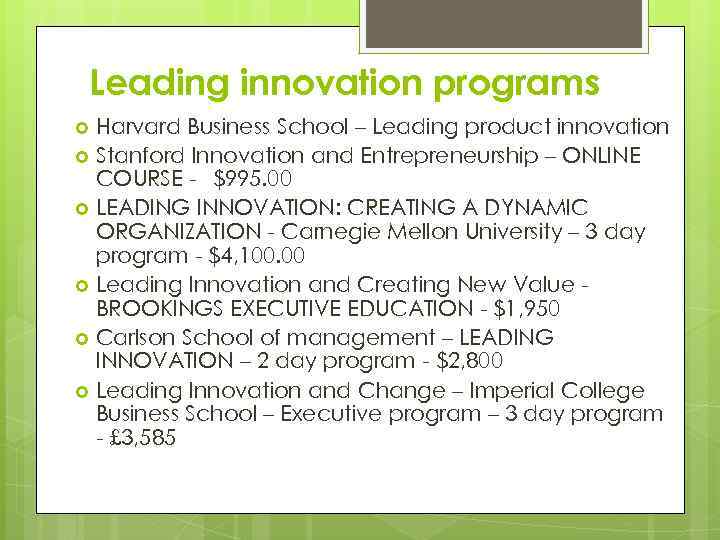 Leading innovation programs Harvard Business School – Leading product innovation Stanford Innovation and Entrepreneurship – ONLINE COURSE - $995. 00 LEADING INNOVATION: CREATING A DYNAMIC ORGANIZATION - Carnegie Mellon University – 3 day program - $4, 100. 00 Leading Innovation and Creating New Value BROOKINGS EXECUTIVE EDUCATION - $1, 950 Carlson School of management – LEADING INNOVATION – 2 day program - $2, 800 Leading Innovation and Change – Imperial College Business School – Executive program – 3 day program - £ 3, 585
 10 traits of innovative leaders (by Jack Zenger and Joseph Folkman) identified 33 individuals who scored at or above the 99 th percentile on innovation 360 degree feedback survey interviewed each leader by phone, the leader’s boss and a number of direct reports and peers asked for concrete examples of what the leader did that caused him or her to be perceived as highly innovative. The colleagues were also asked how this leader differed from other leaders they’d served.
 1. Display excellent strategic vision. The most effective innovation leaders could vividly describe their vision of the future, and as one respondent noted about his boss: “She excelled at painting a clear picture of the destination, while we worked to figure out how to get there. ”
 2. Have a strong customer focus. What was merely interesting to the customer became fascinating to these individuals. They sought to get inside the customer’s mind. They networked with clients and asked incessant questions about their needs and wants.
 3. Create a climate of reciprocal trust. Innovation often requires some level of risk. Not all innovative ideas are successful. These highly innovative leaders initiated warm, collaborative relationships with the innovators who worked for them. They made themselves highly accessible. Colleagues knew that their leader would cover their backs and not throw them under the bus if something went wrong. People were never punished for honest mistakes.
 4. Display fearless loyalty to doing what’s right for the organization and customer. Pleasing the boss or some other higher level executive always took a back seat to doing the right thing for the project or the company.
 5. Put their faith in a culture that magnifies upward communication. These leaders believed that the best and most innovative ideas bubbled up from underneath. They strived to create a culture that uncorked good ideas from the first level of the organization. They were often described as projecting optimism, full of energy, and always receptive to new ideas. Grimness was replaced with kidding and laughter.
 6. Are persuasive. These individuals were highly effective in getting others to accept good ideas. They did not push or force their ideas onto their teams. Instead, they presented ideas with enthusiasm and conviction, and the team willingly followed.
 7. Excel at setting stretch goals. These goals required people to go far beyond just working harder. These goals required that they find new ways to achieve a high goal.
 8. Emphasize speed. These leaders believed that speed scraped the barnacles off the hull of the boat. Experiments and rapid prototypes were preferred to lengthy studies by large committees.
 9. Are candid in their communication. These leaders were described as providing honest, and at times even sometimes blunt, feedback. Subordinates felt they could always count on straight answers from their leader.
 10. Inspire and motivate through action. One respondent said, “For innovation to exist you have to feel inspired. ” This comes from a clear sense of purpose and meaning in the work.
 So the question is: DO YOU WANT TO BECOME AN INNOVATIVE LEADER?
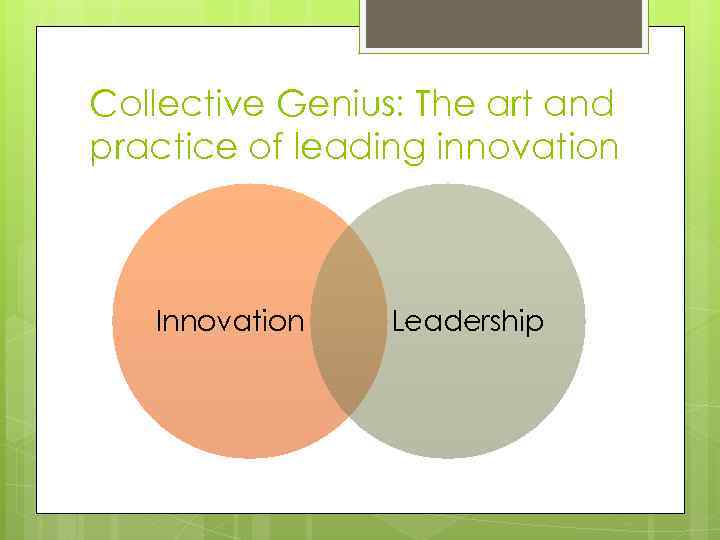 Collective Genius: The art and practice of leading innovation Innovation Leadership
 Research result Instead of trying to come up with a vision and make innovation happen themselves, a leader of innovation creates a place— a context, an environment—where people are willing and able to do the hard work that innovative problem solving requires.
 Chapter 1 -2 What Leaders Do: They Create Organizations Willing to Innovate What Leaders Do: They Create Organizations Able to Innovate
 Case study: Pixar
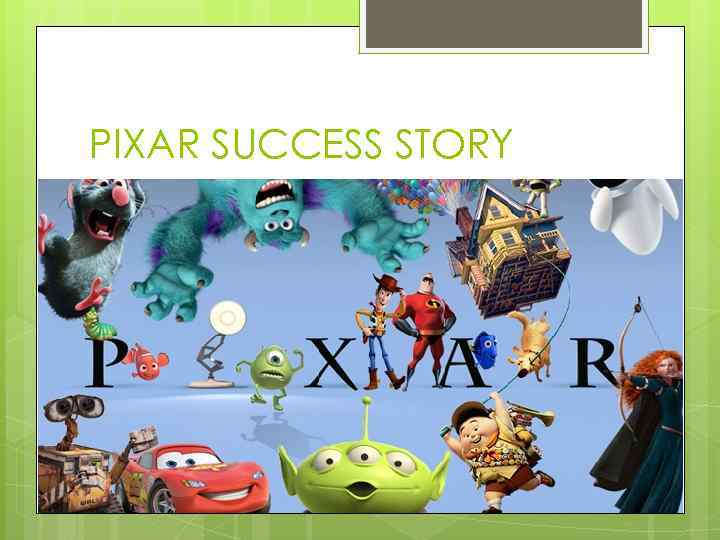 PIXAR SUCCESS STORY
 twenty-six Academy Awards Computer Graphics movies Ed Catmull and his colleagues joined Lucasfilm But the division was too expensive Steve Jobs bought it
 For 20 years, I pursued a dream of making the first computer-animated film. To be honest, after that goal was realized—when we finished Toy Story—I was a bit lost. But then I realized the most exciting thing I had ever done was to help create the unique environment that allowed that film to be made. My new goal became. . . to build a studio that had the depth, robustness, and will to keep searching for the hard truths that preserve the confluence of forces necessary to create magic. Ed Catmull
 How is film produced?
 It’s not that simple! one gifted animator took six months to get ten seconds of the film Up right CG films require so much time (years), money (hundreds of millions of dollars), and the creative exertions of so many people (200– 250) to make.

 Conventional wisdom Great people can turn a mediocre idea into a great movie, while mediocre people will ruin even a great idea.
 Innovative leadership All leaders paid particular attention to making sure their organizations were able to: Collaborate Engage in discovery-driven learning Make integrative decisions
 Innovation is a group effort Three decades of research has clearly revealed that innovation is most often a group effort. Thomas Edison the light bulb, the phonograph and a thousand other patented inventions over a sixty-year career he created that has evolved into today’s R&D laboratory with its team-based approach
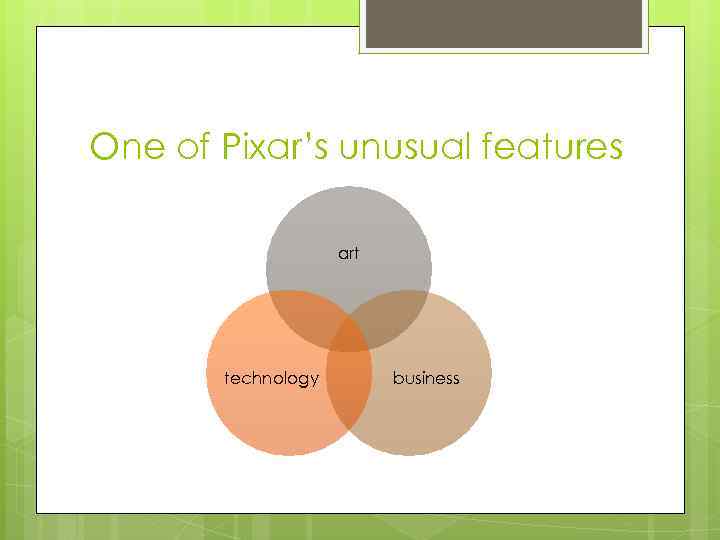 One of Pixar’s unusual features art technology business
 Collaboration “dailies” Each contributed
 Leaders foster discoverydriven learning A problem-solving process About searching for a solution by creating and testing a portfolio of ideas. Takes time A process of trial and error Thomas Edison used a cut-and-try method: “ 1 percent inspiration; 99 percent perspiration. ”
 In PIXAR: “no failures, ” defined as a “less than spectacular outcome” No difference between innovative idea generation and implementation the discovery-driven approach
 Leaders support and encourage integrative decision making How to solve problems or conflict situations? 1 approach: The leader or some dominant faction can impose a solution. 2 approach: The group can find a compromise, some way of splitting the difference between opposing options and viewpoints. 3 approach: integrating ideas—combining option A and option B to create something new, option C
 Iterations and again iterations no part of a movie is finally done until the entire movie is all done.
 Engagement As Ed Martin, Pixar vice president of human resources at the time: Pixar has always erred on the side of having people feel like they’re a part of the process. I know of very few employees who don’t immediately go to theater just to see how many people are lined up when a film first comes out. You’d be hard pressed to find that at any other business, and I would say any other studio. Imagine the receptionist going to do that. People are so engaged.
 What is your leadership style? http: //www. leadershipiq. com/blogs/lead ershipiq/36533569 -quiz-whats-yourleadership-style
 Resources to read https: //hbr. org/insight-center/leadinginnovation https: //hbr. org/2014/12/research-10 -traits-ofinnovative-leaders https: //hbr. org/2014/12/leading-your-teaminto-the-unknown Collective Genius: The art and practice of leading innovation http: //samples. sainsburysebooks. co. uk/978162 5277824_sample_666054. pdf