


 Скачать презентацию LEADERSHIP TRANSITION PLANNING James H Crumel Consulting
3313d4736fb7b90cbe031c1fe52a5000.ppt
- Количество слайдов: 15
 LEADERSHIP & TRANSITION PLANNING James H. Crumel Consulting Group 11458 30 th Cove East Parrish, FL 34219 (941) 776 -8850 Fax: (941) 776 -8993 james@crumelgroup. com
 AGENDA • Forces of Change • Transition Planning Case Study • Leadership Style Preferences • Succession Planning Case Study • Q&A
 CHANGE • Inevitable • Frequent & Accelerating • Threatens Sustainability • Requires Transition Planning
 PEOPLE DIFFER IN RESPONSE TO CHANGE • Style is about the ways people differ when they are dealing with change. • Many factors influence creative behavior, problem solving and responses to change. • Style is one important factor. © 2004, E. C. Selby, D. J. Treffinger, & S. G. Isaksen
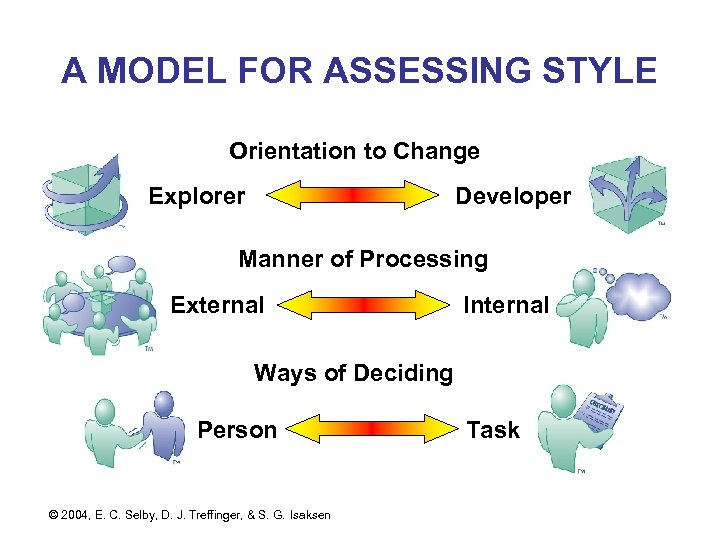 A MODEL FOR ASSESSING STYLE Orientation to Change Explorer Developer Manner of Processing External Internal Ways of Deciding Person © 2004, E. C. Selby, D. J. Treffinger, & S. G. Isaksen Task
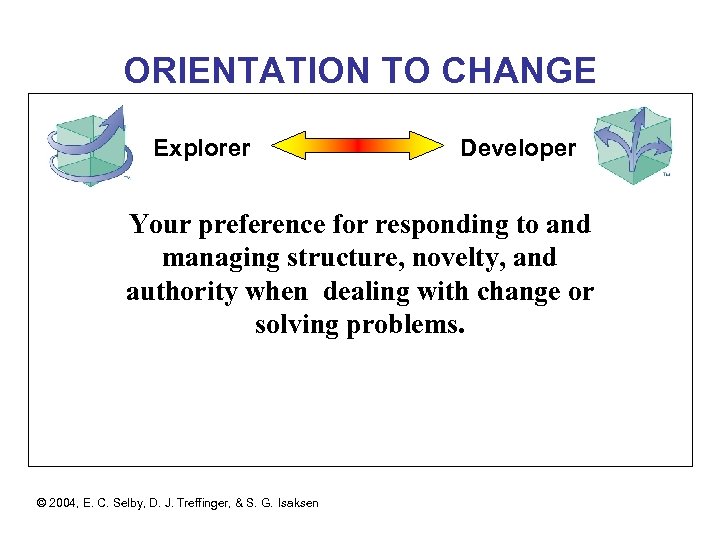 ORIENTATION TO CHANGE Explorer Developer Your preference for responding to and managing structure, novelty, and authority when dealing with change or solving problems. © 2004, E. C. Selby, D. J. Treffinger, & S. G. Isaksen
 EXPLORERS PREFER TO: • Do things differently • View structure as limiting, confining • Challenge the problem definition • Challenge authority, “bend” the rules • Be seen as ingenious and unconventional • Emphasize originality and uniqueness © 2004, E. C. Selby, D. J. Treffinger, & S. G. Isaksen
 DEVELOPERS PREFER TO: • Do things better • Find benefits and support in structure • Accept the problem definition • Work within stated rules • Emphasize improvement and usefulness • Be seen as precise, thorough, dependable © 2004, E. C. Selby, D. J. Treffinger, & S. G. Isaksen
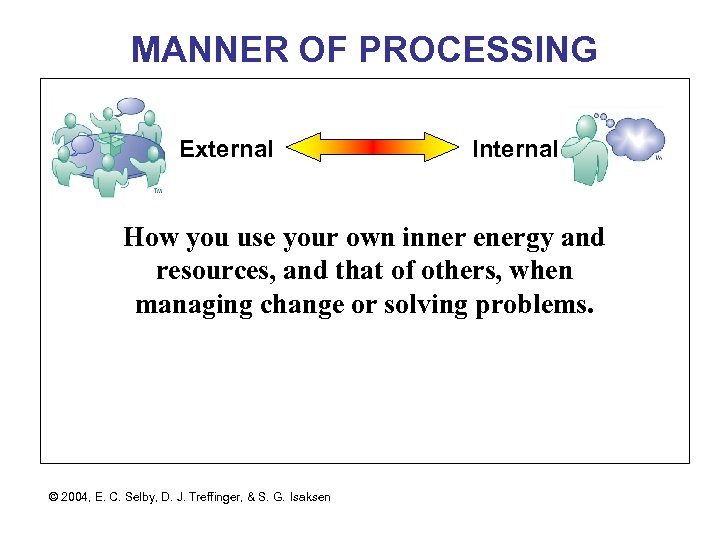 MANNER OF PROCESSING External Internal How you use your own inner energy and resources, and that of others, when managing change or solving problems. © 2004, E. C. Selby, D. J. Treffinger, & S. G. Isaksen
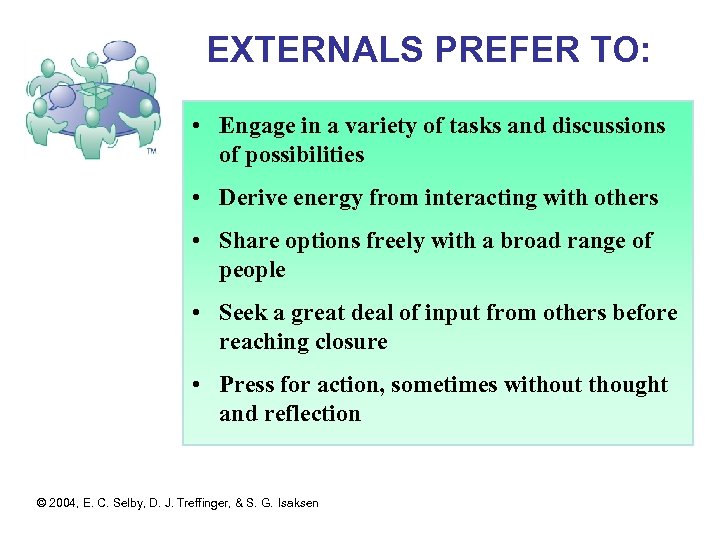 EXTERNALS PREFER TO: • Engage in a variety of tasks and discussions of possibilities • Derive energy from interacting with others • Share options freely with a broad range of people • Seek a great deal of input from others before reaching closure • Press for action, sometimes without thought and reflection © 2004, E. C. Selby, D. J. Treffinger, & S. G. Isaksen
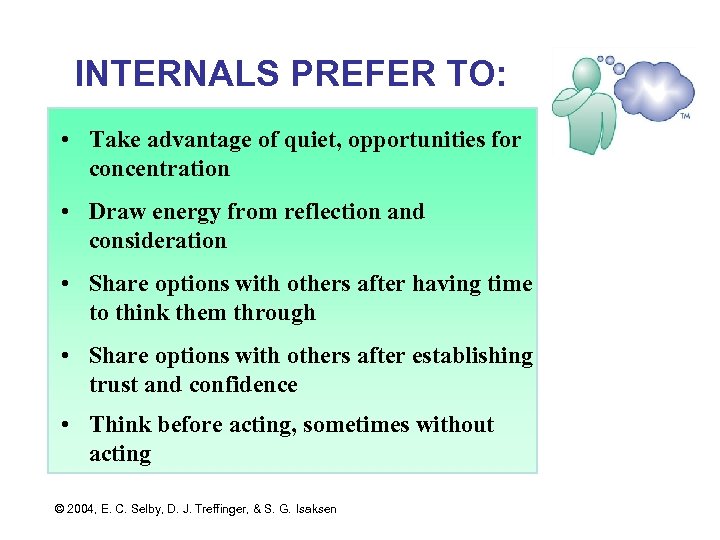 INTERNALS PREFER TO: • Take advantage of quiet, opportunities for concentration • Draw energy from reflection and consideration • Share options with others after having time to think them through • Share options with others after establishing trust and confidence • Think before acting, sometimes without acting © 2004, E. C. Selby, D. J. Treffinger, & S. G. Isaksen
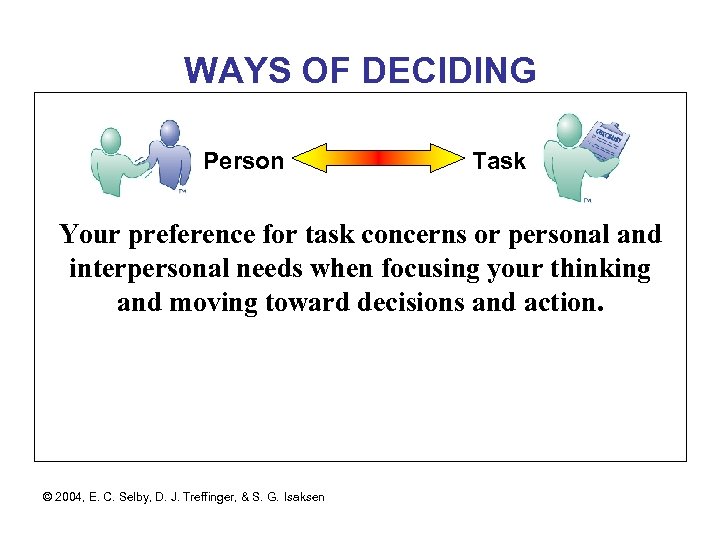 WAYS OF DECIDING Person Task Your preference for task concerns or personal and interpersonal needs when focusing your thinking and moving toward decisions and action. © 2004, E. C. Selby, D. J. Treffinger, & S. G. Isaksen
 PERSON-FOCUSED DECISION MAKERS PREFER TO: • Promote harmony and positive interpersonal relationships • Use criteria that are personal, sensitive to feelings, more subjective • Consider the personal impact or consequences of a decision • Find what’s good, attractive, or pleasing about an option • Seek options or decisions that all involved can buy into • Put people’s feelings over the quality of the outcome © 2004, E. C. Selby, D. J. Treffinger, & S. G. Isaksen
 TASK-FOCUSED DECISION MAKERS PREFER TO: • Focus on what is logical or rational • Use criteria that are authoritative, verifiable, more objective • Consider standards, rigor or quality • Find what’s wrong, what’s lacking, or what an option needs • Seek the best solution or response • Put the quality of the outcome over people’s feelings © 2004, E. C. Selby, D. J. Treffinger, & S. G. Isaksen
 Q&A
Q&A