


 Скачать презентацию Leadership Pathway Focus in Grades K 5 Winter
270254d1f7f9ddda46fda33c9425808f.ppt
- Количество слайдов: 97
 Leadership Pathway: Focus in Grades K– 5 Winter 2018
 We know from experience the hard work teachers face every day as they strive to help all of their students meet the challenges set by higher Standards. We are a diverse team of current and former classroom teachers, curriculum writers, school leaders, and education experts who have worked in the public, private, and nonprofit sectors. We are dedicated to empowering teachers by providing free, high-quality, Standards-aligned resources for the classroom, the opportunity for unbiased and immersive training through our Institutes, and the option of support through our website offerings.
 FOCUS IN GRADES K– 5 Introduction: Who I Am Name 1 • • Name 2 • • •
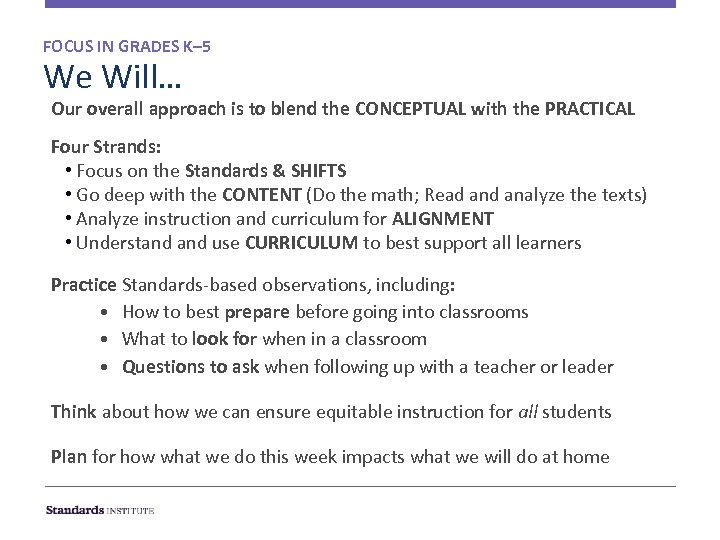 FOCUS IN GRADES K– 5 We Will… Our overall approach is to blend the CONCEPTUAL with the PRACTICAL Four Strands: • Focus on the Standards & SHIFTS • Go deep with the CONTENT (Do the math; Read analyze the texts) • Analyze instruction and curriculum for ALIGNMENT • Understand use CURRICULUM to best support all learners Practice Standards-based observations, including: • How to best prepare before going into classrooms • What to look for when in a classroom • Questions to ask when following up with a teacher or leader Think about how we can ensure equitable instruction for all students Plan for how what we do this week impacts what we will do at home
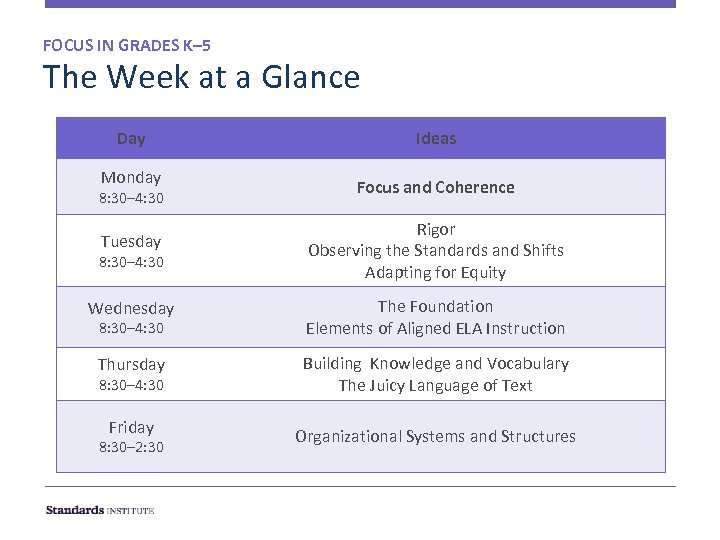 FOCUS IN GRADES K– 5 The Week at a Glance Day Monday 8: 30– 4: 30 Tuesday 8: 30– 4: 30 Ideas Focus and Coherence Rigor Observing the Standards and Shifts Adapting for Equity Wednesday The Foundation Elements of Aligned ELA Instruction Thursday Building Knowledge and Vocabulary The Juicy Language of Text 8: 30– 4: 30 Friday 8: 30– 2: 30 Organizational Systems and Structures
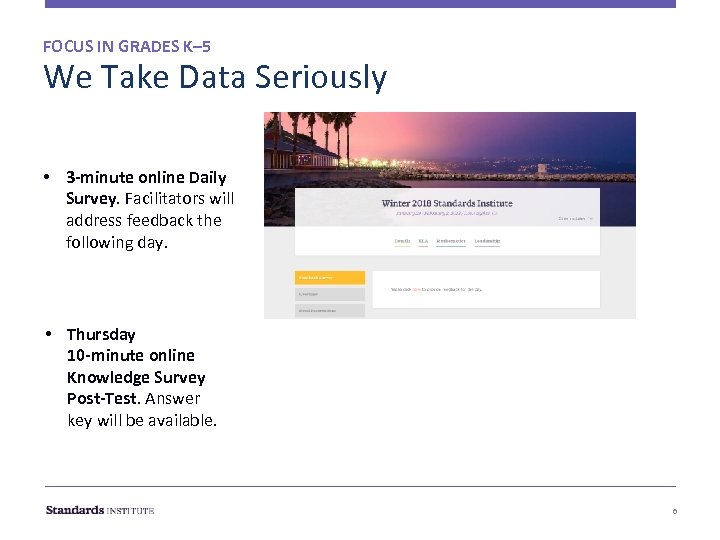 FOCUS IN GRADES K– 5 We Take Data Seriously • 3 -minute online Daily Survey. Facilitators will address feedback the following day. • Thursday 10 -minute online Knowledge Survey Post-Test. Answer key will be available. 6
 FOCUS IN GRADES K– 5 Objectives and Agenda Objectives Participants will be able to • identify the major work of the elementary grades. • evaluate tasks for alignment to Standards. • observe and coach the focus shift in teacher practice. • explain how attending to the shift of focus is an equitable practice in Standards-aligned math instruction. Agenda I. Opening and Community Builder II. Equity Discussion III. Framing the Challenge IV. Task Analysis V. Observing and Coaching for Focus (afternoon)
 FOCUS IN GRADES K– 5 Norms That Support Our Learning • Take responsibility for yourself as a learner. • Honor timeframes (start, end, activity). • Be an active and hands-on learner. • Use technology to enhance learning. • Strive for equity of voice. • Contribute to a learning environment where it is “safe to not know. ” • Identify and reframe deficit thinking and speaking.
 FOCUS IN GRADES K– 5 Where You Might Be During the Week • Moments of Validation • Moments of Reminding • Moments of New Information Notice where you are at any given time and support yourself and others by: • Offering connections • Taking notes • Asking questions
 FOCUS IN GRADES K– 5 Share Your Learning • Light bulb moments • Why I teach/lead 10
 FOCUS IN GRADES K– 5 Community Builder Introduce yourself to your table: Share your name, city, role, and organization, and one goal for the week. Raise your hand if. . . • You are a school leader. • You are a district leader. • You work for a nonprofit. • You support schools. • You coach and develop others. • You consider yourself a “math person. ” • You consider yourself a “literacy person. ” 11
 FOCUS IN GRADES K– 5 Equity • Equity is engaging in practices that meet students where they are and advances their learning by giving them what they need. It’s about fairness, not sameness. • Equity ensures that all children—regardless of circumstances—are receiving high-quality and Standards-aligned instruction with access to high-quality materials and resources. • We want to ensure that Standards-aligned instruction is a pathway to the equitable practices needed to close the gaps caused by systemic and systematic racism, bias, and poverty. • All week, we will explore our learning through an equity lens, and we will capture those moments visibly here in our room. 12
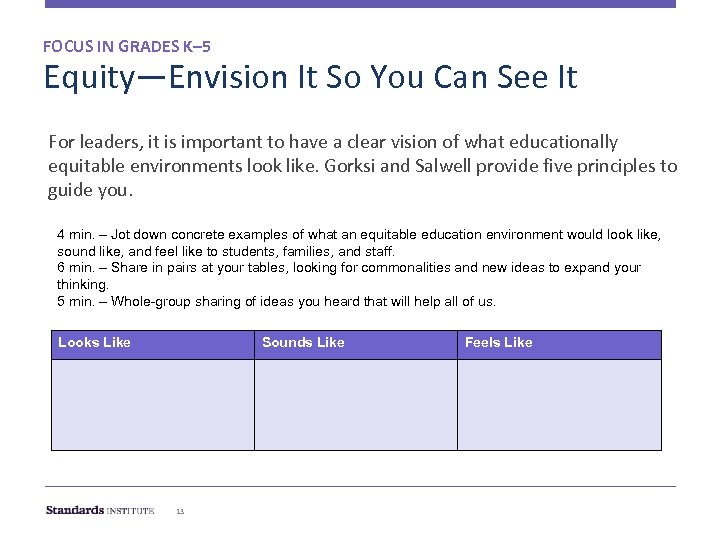 FOCUS IN GRADES K– 5 Equity—Envision It So You Can See It For leaders, it is important to have a clear vision of what educationally equitable environments look like. Gorksi and Salwell provide five principles to guide you. 4 min. – Jot down concrete examples of what an equitable education environment would look like, sound like, and feel like to students, families, and staff. 6 min. – Share in pairs at your tables, looking for commonalities and new ideas to expand your thinking. 5 min. – Whole-group sharing of ideas you heard that will help all of us. Looks Like Sounds Like 13 Feels Like
 Classroom Video Observations 14
 FOCUS IN GRADES K– 5 Time for a Classroom Visit Think about how you normally prepare. What do you check in advance? What are the “go-to” tools you use? Watch the video. Treat the video as instruction in one of your classrooms. Write the evidence that you observe so you can provide low-inference feedback later. Consider feedback. What points of feedback would help this teacher grow in terms of instruction of mathematics?
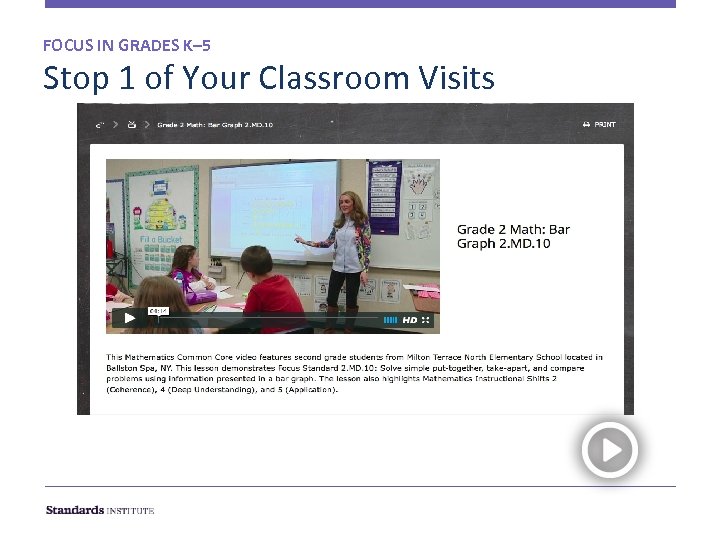 FOCUS IN GRADES K– 5 Stop 1 of Your Classroom Visits
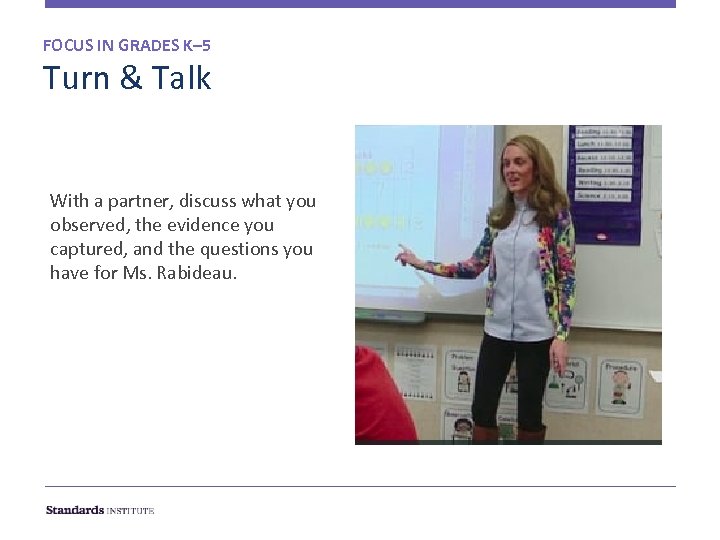 FOCUS IN GRADES K– 5 Turn & Talk With a partner, discuss what you observed, the evidence you captured, and the questions you have for Ms. Rabideau.
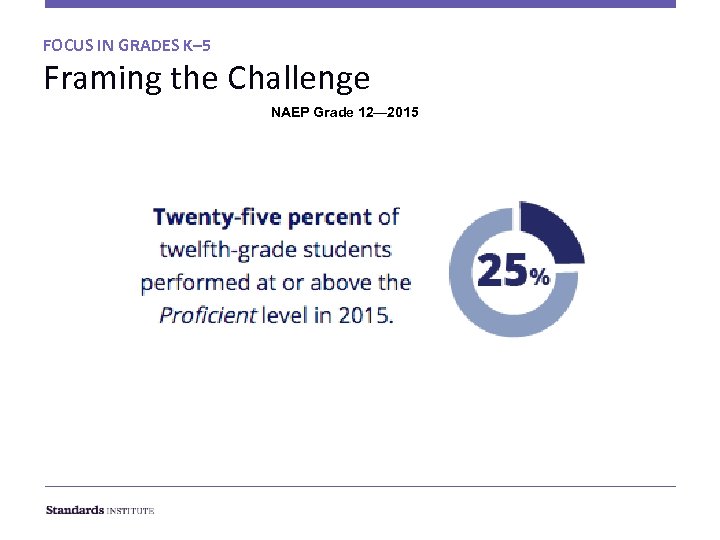 FOCUS IN GRADES K– 5 Framing the Challenge NAEP Grade 12— 2015
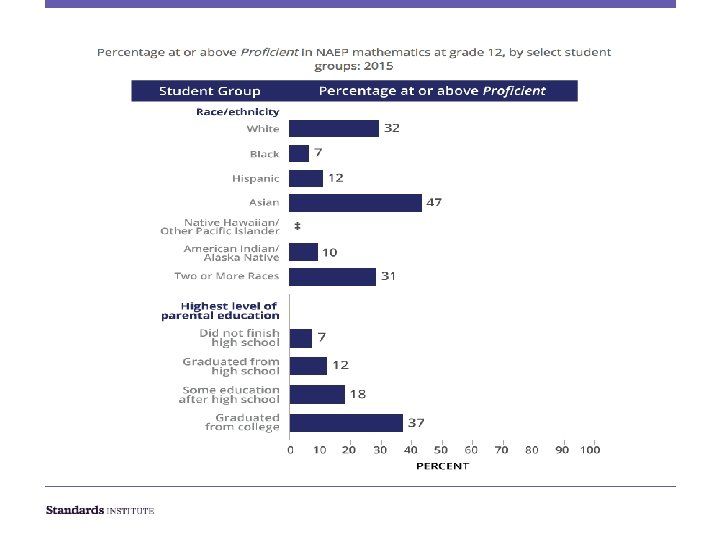
 FOCUS IN GRADES K– 5 National Mathematics Advisory Panel “A focused, coherent progression of mathematics learning, with an emphasis on proficiency with key topics, should become the norm in elementary and middle school mathematics curricula. Any approach that continually revisits topics year after year without closure is to be avoided. By the term focused, the Panel means that curriculum must include (and engage with adequate depth) the most important topics underlying success in school algebra…Improvements like those suggested in this report promise immediate positive results with minimal additional cost. ”
 FOCUS IN GRADES K– 5 Look at the Standards for Your Grade What do you notice about the major content for your table’s grade level? How do the Standards at your grade level lead to student success in algebra later? What does the trajectory of the Standards offer students when we apply an educational equity lens?
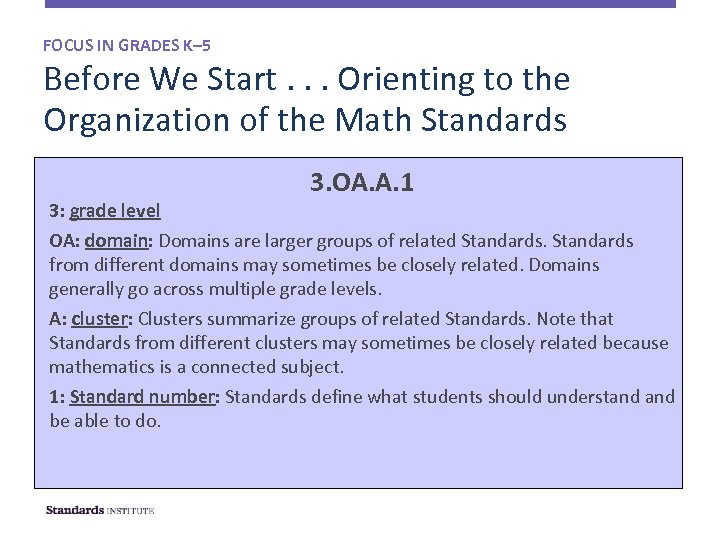 FOCUS IN GRADES K– 5 Before We Start. . . Orienting to the Organization of the Math Standards 3. OA. A. 1 3: grade level OA: domain: Domains are larger groups of related Standards from different domains may sometimes be closely related. Domains generally go across multiple grade levels. A: cluster: Clusters summarize groups of related Standards. Note that Standards from different clusters may sometimes be closely related because mathematics is a connected subject. 1: Standard number: Standards define what students should understand be able to do.
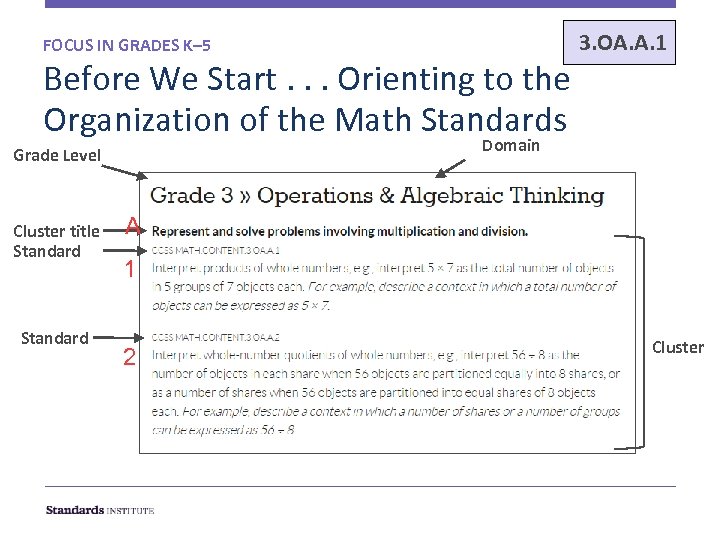 3. OA. A. 1 FOCUS IN GRADES K– 5 Before We Start. . . Orienting to the Organization of the Math Standards Domain Grade Level Cluster title Standard A 1 2 Cluster
 FOCUS IN GRADES K– 5 Before We Start. . . Using the App in Math
 FOCUS IN GRADES K– 5 Before We Start. . . Using the App in Math
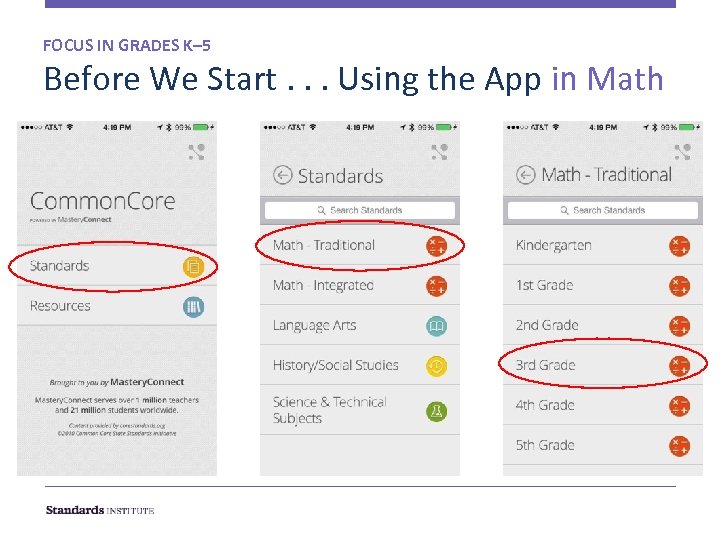
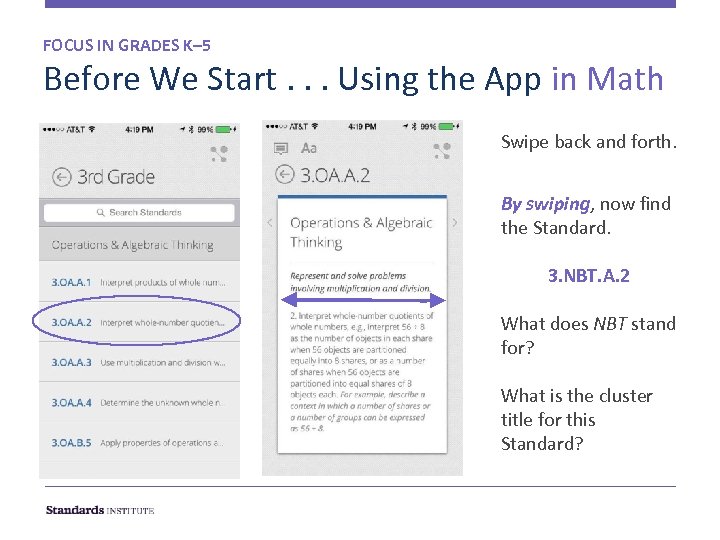 FOCUS IN GRADES K– 5 Before We Start. . . Using the App in Math Swipe back and forth. By swiping, now find the Standard. 3. NBT. A. 2 What does NBT stand for? What is the cluster title for this Standard?
 FOCUS IN GRADES K– 5 Quick Task: Using the App You are in a fourth-grade classroom and students are adding fractions. Navigate the app to find the standard students are likely addressing.
 Shift #1: “The Common Core calls for greater focus in mathematics. Rather than racing to cover many topics in a mile-wide, inch-deep curriculum, the Standards ask math teachers to significantly narrow and deepen the way time and energy are spent in the classroom. ”
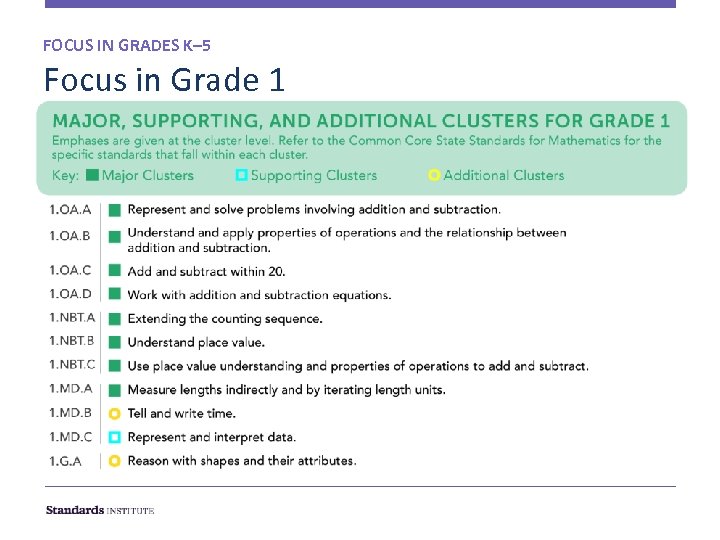
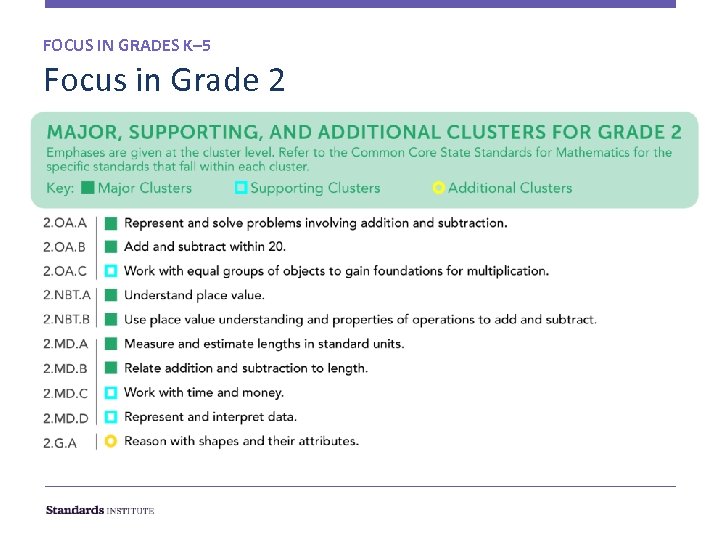
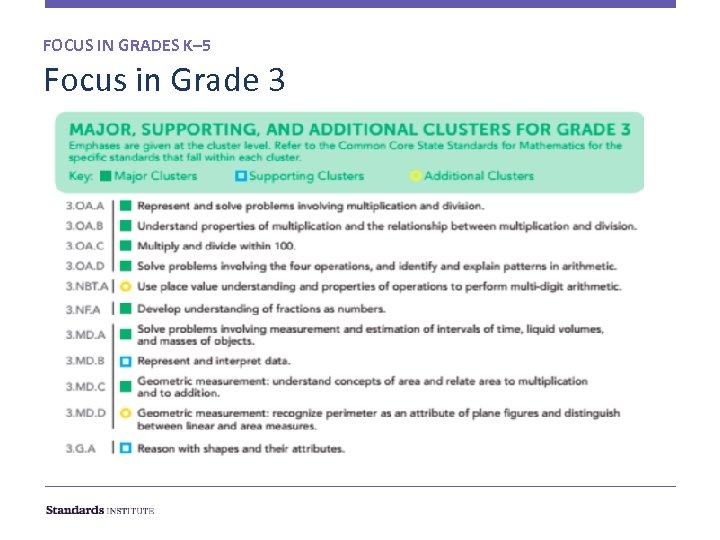
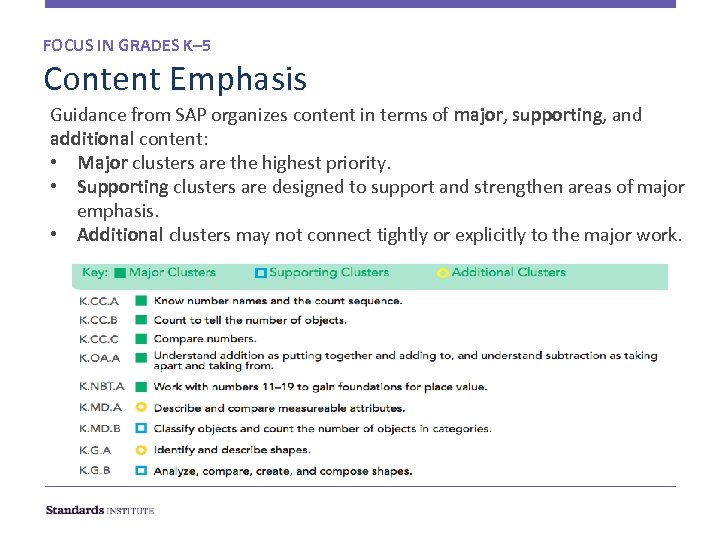 FOCUS IN GRADES K– 5 Content Emphasis Guidance from SAP organizes content in terms of major, supporting, and additional content: • Major clusters are the highest priority. • Supporting clusters are designed to support and strengthen areas of major emphasis. • Additional clusters may not connect tightly or explicitly to the major work.
 FOCUS IN GRADES K– 5 Your Turn— 5 minutes In table groups, look at your assigned grade level. Identify the major work of the grade. Be prepared to report out your decisions.
 FOCUS IN GRADES K– 5 Focus in Grade 1
 FOCUS IN GRADES K– 5 Focus in Grade 2
 FOCUS IN GRADES K– 5 Focus in Grade 3
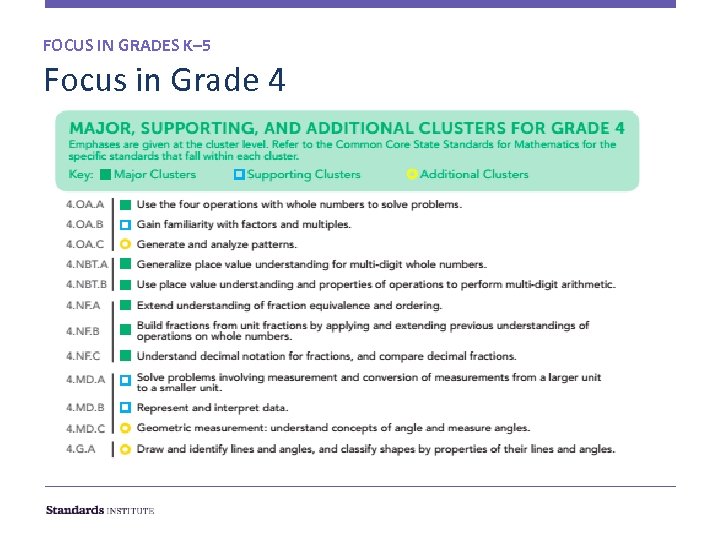 FOCUS IN GRADES K– 5 Focus in Grade 4
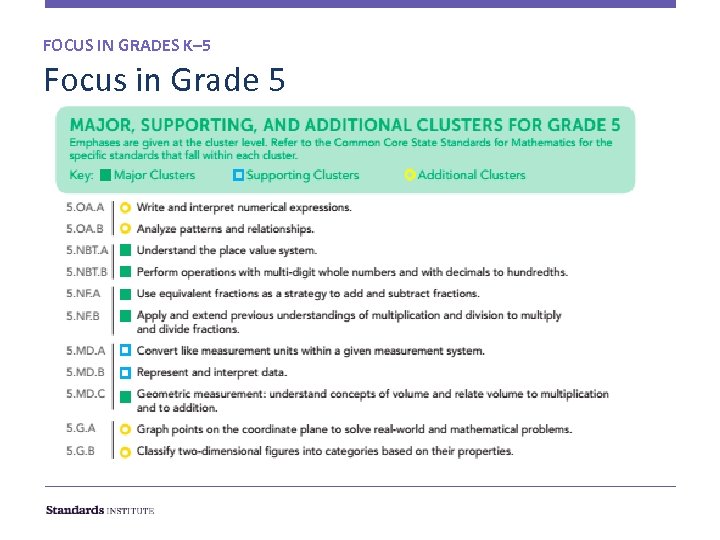 FOCUS IN GRADES K– 5 Focus in Grade 5
 FOCUS IN GRADES K– 5 Summary What are the common threads in the major work content for Grades K– 2 or 3– 5? In an elementary school, on what content topics would you anticipate to observe teachers spending the most time? How do you ensure EVERY student works on the major work content for Grades K-2 or 3 -5? What are the common threads in the Major Work content for grades K– 5? In an elementary school, what content topics would you anticipate to observe teachers spending the most time on? How does the shift of Focus ensure equitable instruction for all students?
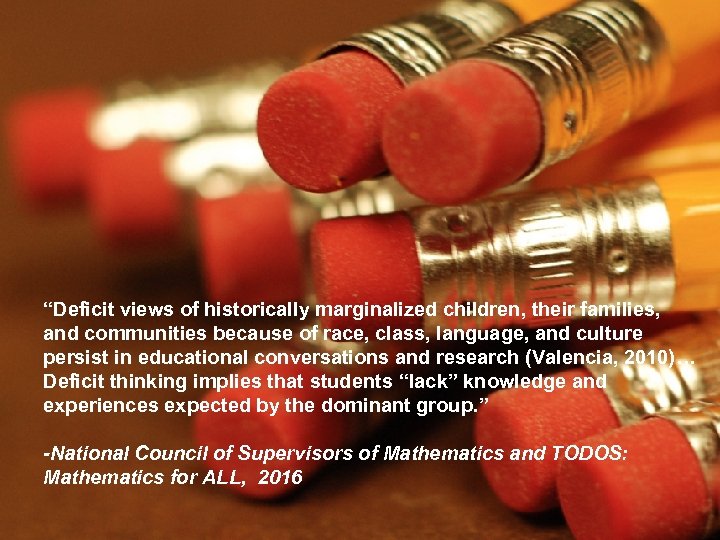 “Deficit views of historically marginalized children, their families, and communities because of race, class, language, and culture persist in educational conversations and research (Valencia, 2010)… Deficit thinking implies that students “lack” knowledge and experiences expected by the dominant group. ” -National Council of Supervisors of Mathematics and TODOS: Mathematics for ALL, 2016 37
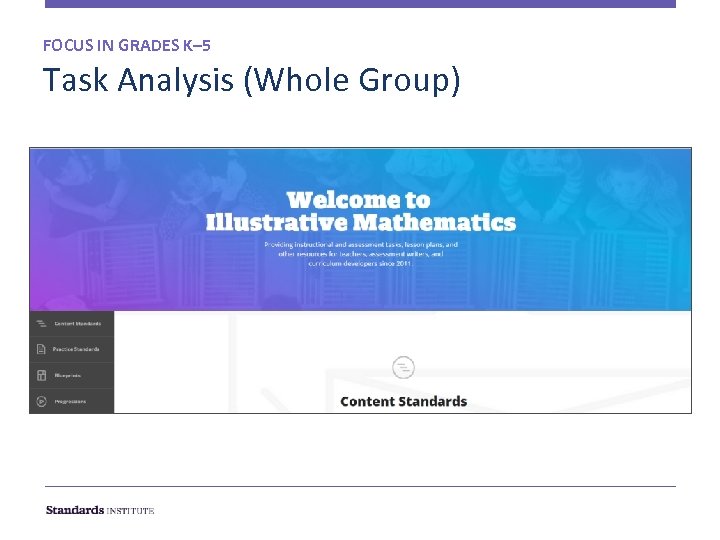 FOCUS IN GRADES K– 5 Task Analysis (Whole Group)
 FOCUS IN GRADES K– 5 Protocol 1. 2. Do the math. Discussion Questions • To what grade and standard is the task aligned? • Is this part of the major work of that grade? • What are the knowledge and skills required to be successful on this task? • How does this task connect to the major work in the grades above and below?
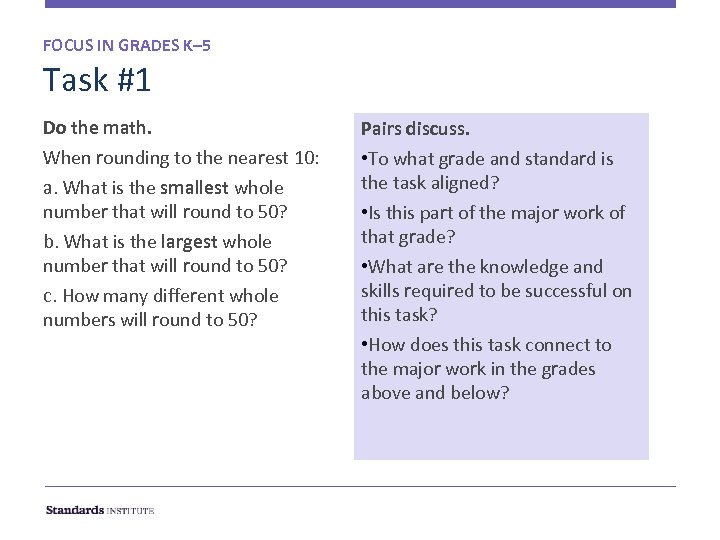 FOCUS IN GRADES K– 5 Task #1 Do the math. Pairs discuss. When rounding to the nearest 10: a. What is the smallest whole number that will round to 50? b. What is the largest whole number that will round to 50? c. How many different whole numbers will round to 50? • To what grade and standard is the task aligned? • Is this part of the major work of that grade? • What are the knowledge and skills required to be successful on this task? • How does this task connect to the major work in the grades above and below?
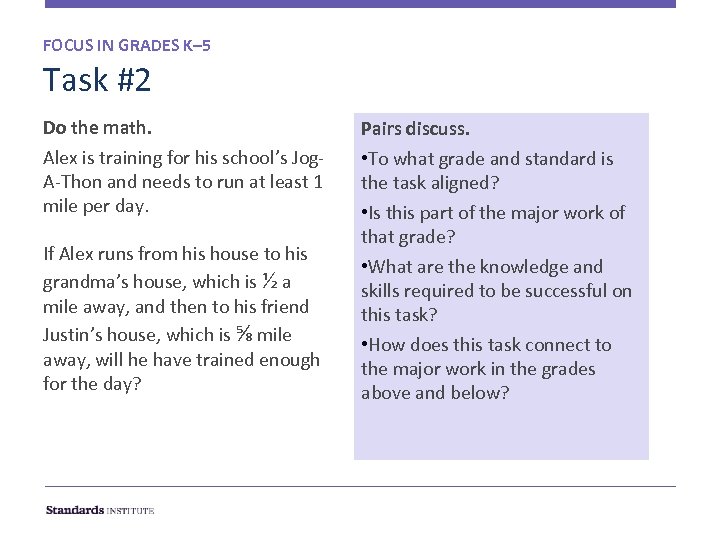 FOCUS IN GRADES K– 5 Task #2 Do the math. Pairs discuss. Alex is training for his school’s Jog. A-Thon and needs to run at least 1 mile per day. • To what grade and standard is the task aligned? • Is this part of the major work of that grade? • What are the knowledge and skills required to be successful on this task? • How does this task connect to the major work in the grades above and below? If Alex runs from his house to his grandma’s house, which is ½ a mile away, and then to his friend Justin’s house, which is ⅝ mile away, will he have trained enough for the day?
 FOCUS IN GRADES K– 5 Equity Analysis Think about these tasks with an equity lens. • Are these tasks equitable? How do you know? • What teacher practices would ensure equitable instruction using this task?
 Lunch 43
 Observing and Coaching for Focus 44
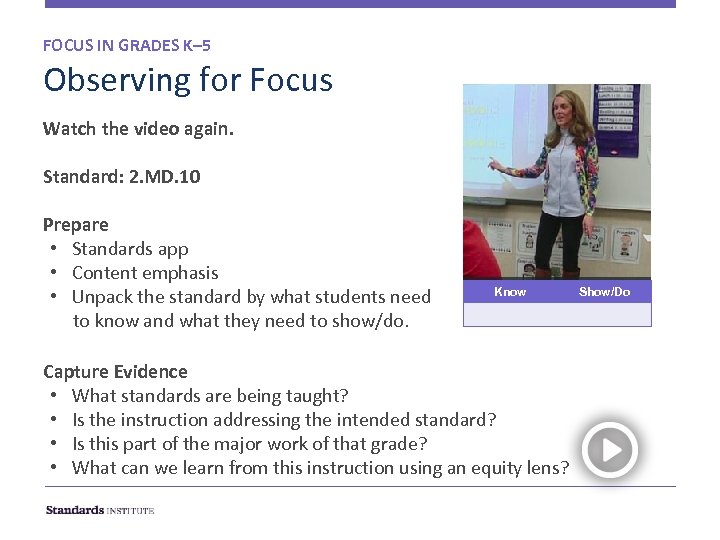 FOCUS IN GRADES K– 5 Observing for Focus Watch the video again. Standard: 2. MD. 10 Prepare • Standards app • Content emphasis • Unpack the standard by what students need to know and what they need to show/do. Know Capture Evidence • What standards are being taught? • Is the instruction addressing the intended standard? • Is this part of the major work of that grade? • What can we learn from this instruction using an equity lens? Show/Do
 FOCUS IN GRADES K– 5 Observing for Focus Standard: 2. MD. D. 10 Represent and interpret data. Draw a picture graph and a bar graph (with single-unit scale) to represent a data set with up to four categories. Solve simple put-together, take-apart, and compare problems using information presented in a bar graph. Know Show/Do
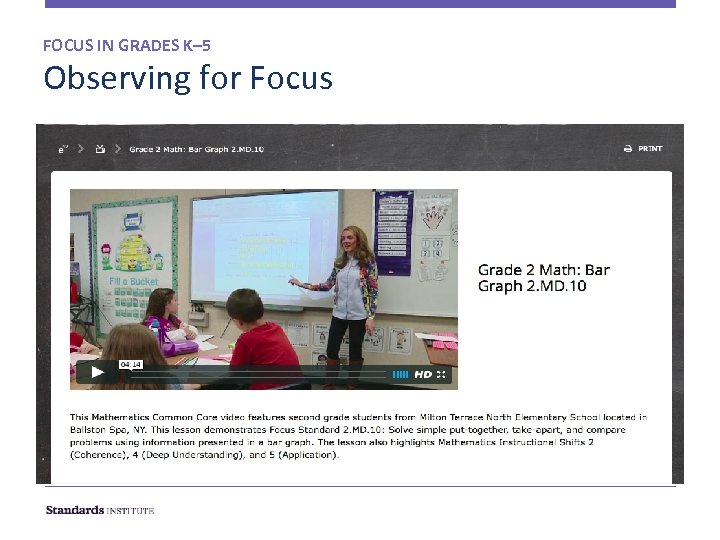 FOCUS IN GRADES K– 5 Observing for Focus
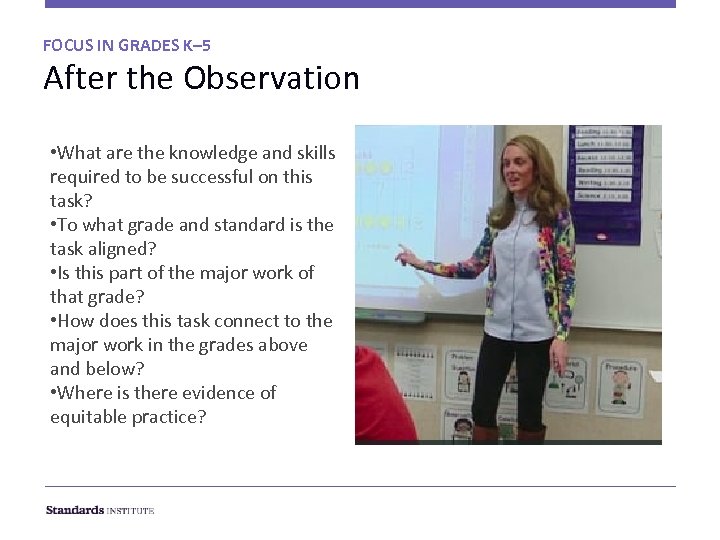 FOCUS IN GRADES K– 5 After the Observation • What are the knowledge and skills required to be successful on this task? • To what grade and standard is the task aligned? • Is this part of the major work of that grade? • How does this task connect to the major work in the grades above and below? • Where is there evidence of equitable practice?
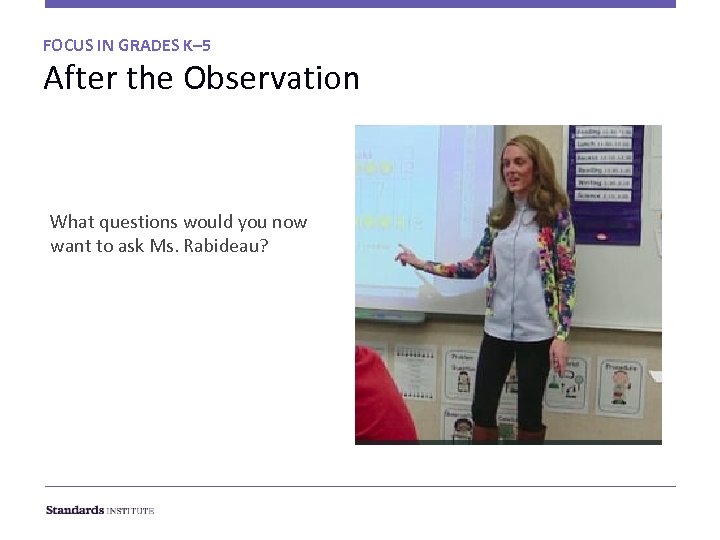 FOCUS IN GRADES K– 5 After the Observation What questions would you now want to ask Ms. Rabideau?
 FOCUS IN GRADES K– 5 Questions That Develop Leading the Conversation • What are the knowledge and skills required to be successful on this task? • To what grade and standard is the task aligned? • Is this part of the major work of that grade? • How does this task connect to the major work in the grades above and below? If not grade-level standards • Why was instruction not addressing grade-level standards? • What data or other work supports the decision to teach non–grade-level standards? If not major work of the grade • How will this chosen standard authentically lead students back to working with math content that is emphasized in this grade?
 Coaching Role Play 51
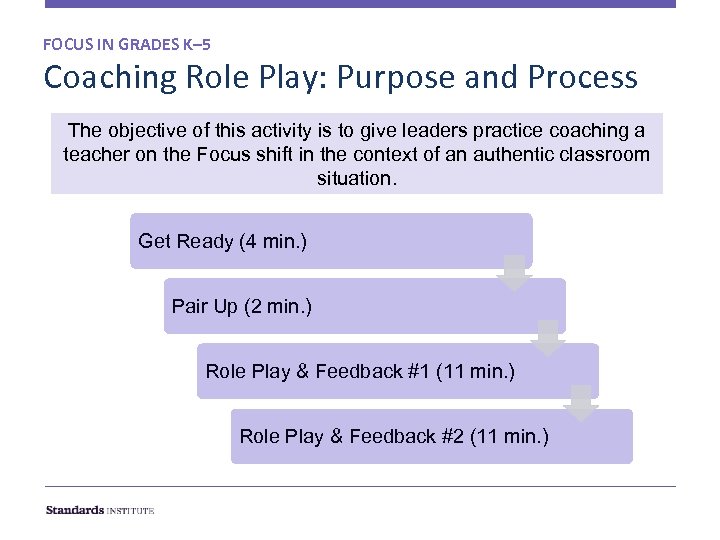 FOCUS IN GRADES K– 5 Coaching Role Play: Purpose and Process The objective of this activity is to give leaders practice coaching a teacher on the Focus shift in the context of an authentic classroom situation. Get Ready (4 min. ) Pair Up (2 min. ) Role Play & Feedback #1 (11 min. ) Role Play & Feedback #2 (11 min. )
 FOCUS IN GRADES K– 5 Coaching Role Play The objective of this activity is to give leaders a chance to practice coaching a teacher about the Focus shift in the context of an authentic classroom situation. 4 minutes – Everybody gets ready. ➢ Identify your goals for this coaching session. ➢ What do you want the teacher to know and be able to try as a result of this interaction? ➢ Draft entry question(s), clarifying questions, and probing questions. ➢ Draft key learning and next steps you want the teacher to walk away ready to try. 2 minutes – Pair up. ➢ Choose a partner. ➢ Identify who will go first. ➢ Role Play #1 shares goals and the level of “heat” you’d like to practice coaching.
 FOCUS IN GRADES K– 5 Role Play #1: 5 Minutes
 FOCUS IN GRADES K– 5 Role Play #1: Reflect and Feedback 1 minute – Each role writes reflections of effectiveness of coaching conversation from his or her point of view 2 minutes – Identify what worked. Coach first ➢ Start with stating your goal(s) for the discussion and one or two moves you made that supported that goal. ➢ Share one or two other pluses that you can identify. Teacher ➢ Share one or two moves that the coach made that deepened your understanding of Focus. 2 minutes – Identify suggestions for improvement. Coach first ➢ Share one or two things you’d like to do differently or improve. Teacher ➢ Share one or two things the coach should consider to strengthen practice.
 FOCUS IN GRADES K– 5 Transition to Role Play #2 Review preparation notes. Share coaching goals and the level of “heat” you’d like to practice coaching.
 FOCUS IN GRADES K– 5 Role Play #2: 5 Minutes
 FOCUS IN GRADES K– 5 Role Play #2: Reflection and Feedback 1 minute – Each role writes reflections of effectiveness of coaching conversation from their point of view. 2 minutes – Identify what worked. Coach first ➢ Start with stating your goal(s) for the discussion and one or two moves you made that supported that goal. ➢ Share one or two other pluses that you can identify. Teacher ➢ Share one or two moves the coach made that deepened your understanding of Focus. 2 minutes – Identify suggestions for improvement. Coach first ➢ Share one or two things you’d like to do differently or improve. Teacher ➢ Share one or two things the coach should consider to strengthen practice.
 FOCUS IN GRADES K– 5 Thumb Rating: Did we meet our objectives? Objectives: • Participants will be able to identify the major work of the elementary grades. • Participants will be able to evaluate tasks for alignment to Standards. • Participants will be able to observe and coach the focus shift in teacher practice. • Apply an equity lens as we think about the major work of the elementary grades.
 FOCUS IN GRADES K– 5 Processing & Application STOP AND JOT • What important understanding do you want to take away from our discussion about Shift 1 and equity? • What implications does the importance of focus have for your work? Consider Professional development Planning Curriculum Systems/structures Policy & programming
 Take a break. . .
 Leadership Pathway: Coherence in Grades K– 5 Winter 2018
 COHERENCE IN GRADES K– 5 Objectives and Agenda Objectives Participants will be able to: • describe the Coherence shift both as a logical sequencing of content across grades and as important connections among Standards, clusters, and domains within the grade. • identify prerequisite Standards for grade-level Standards. • observe and coach the Coherence shift in teacher practice. Agenda I. Opening and Activator II. Coherence: What and Why? III. Across Grade Coherence IV. Within Grade Coherence V. Observing for Coherence VI. Role Teams VII. Apply an Equity Lens to Coherence
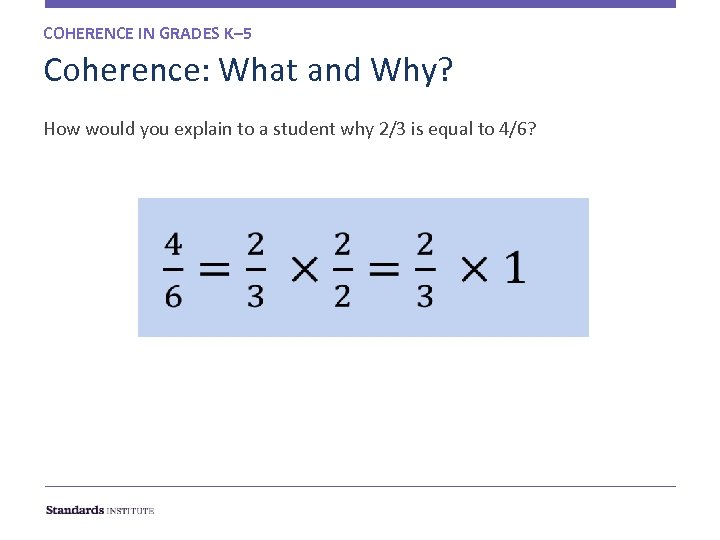 COHERENCE IN GRADES K– 5 Coherence: What and Why? How would you explain to a student why 2/3 is equal to 4/6?
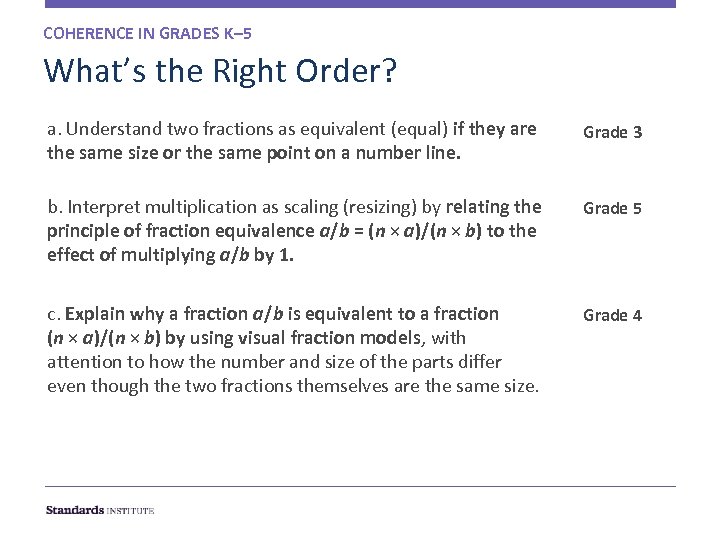 COHERENCE IN GRADES K– 5 What’s the Right Order? a. Understand two fractions as equivalent (equal) if they are the same size or the same point on a number line. Grade 3 b. Interpret multiplication as scaling (resizing) by relating the principle of fraction equivalence a/b = (n × a)/(n × b) to the effect of multiplying a/b by 1. Grade 5 c. Explain why a fraction a/b is equivalent to a fraction (n × a)/(n × b) by using visual fraction models, with attention to how the number and size of the parts differ even though the two fractions themselves are the same size. Grade 4
 Coherence is Key “A focused, coherent progression of mathematics learning, with an emphasis on proficiency with key topics, should become the norm in elementary and middle school mathematics curricula. Any approach that continually revisits topics year after year without closure is to be avoided. By the term focused, the Panel means that curriculum must include (and engage with adequate depth) the most important topics underlying success in school algebra. By the term coherent, the Panel means that the curriculum is marked by effective, logical progressions from earlier, less sophisticated topics into later, more sophisticated ones. Improvements like those suggested in this report promise immediate positive results with minimal additional cost. ”
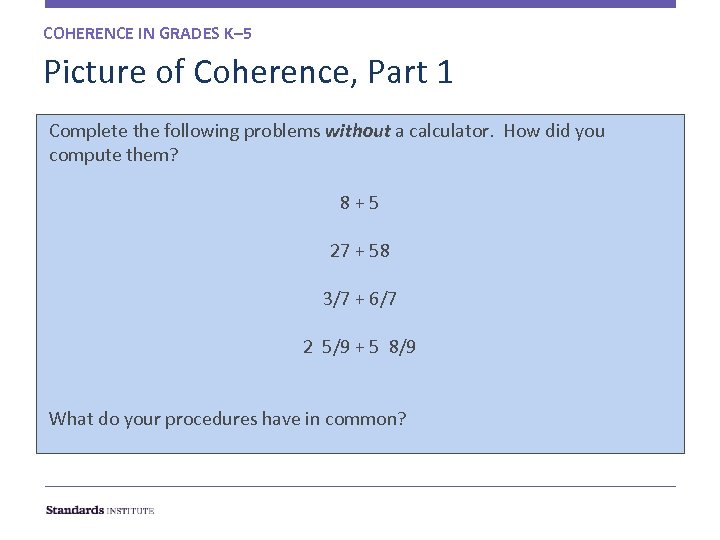 COHERENCE IN GRADES K– 5 Picture of Coherence, Part 1 Complete the following problems without a calculator. How did you compute them? 8 + 5 27 + 58 3/7 + 6/7 2 5/9 + 5 8/9 What do your procedures have in common?
 LEADERSHIP PATHWAY: COHERENCE IN HIGH SCHOOL Coherence ACROSS Grades Learning is carefully connected across grades so that students can build new understanding onto foundations built in previous years. Across Grade Coherence Learning is carefully connected across grades so students can build new understanding onto foundations built in previous years.
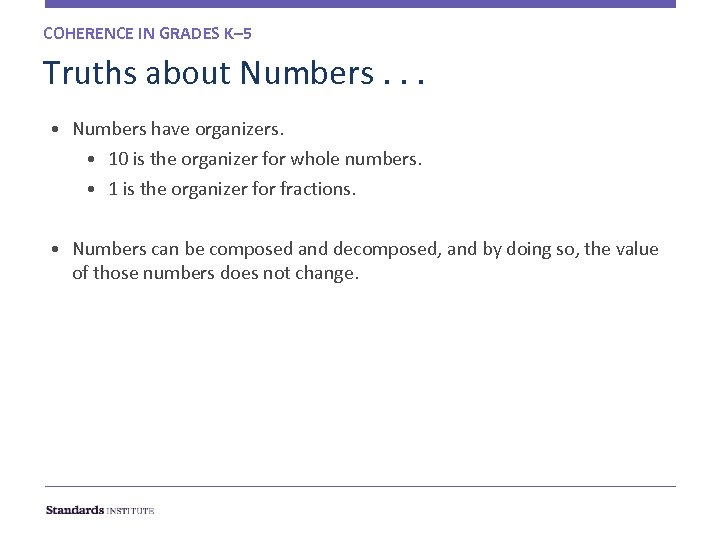 COHERENCE IN GRADES K– 5 Truths about Numbers. . . • Numbers have organizers. • 10 is the organizer for whole numbers. • 1 is the organizer for fractions. • Numbers can be composed and decomposed, and by doing so, the value of those numbers does not change.
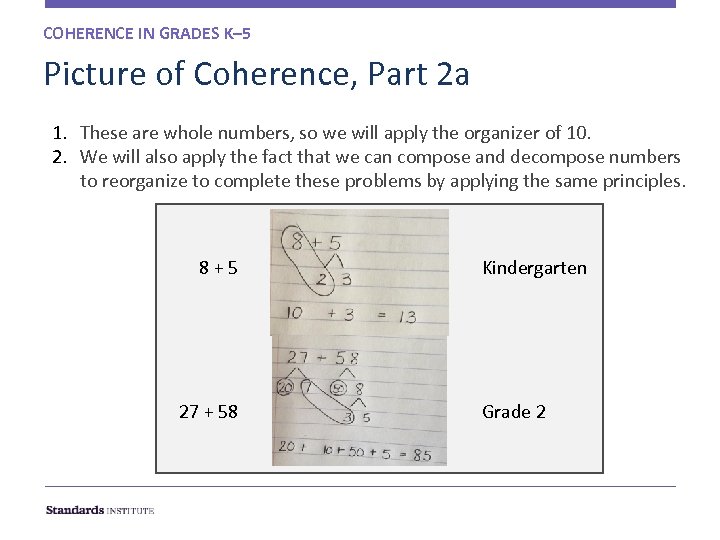 COHERENCE IN GRADES K– 5 Picture of Coherence, Part 2 a 1. These are whole numbers, so we will apply the organizer of 10. 2. We will also apply the fact that we can compose and decompose numbers to reorganize to complete these problems by applying the same principles. 8 + 5 27 + 58 Kindergarten Grade 2
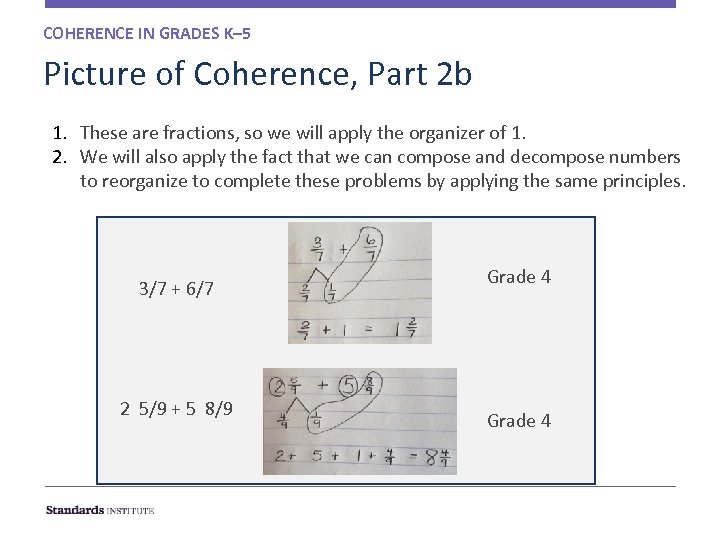 COHERENCE IN GRADES K– 5 Picture of Coherence, Part 2 b 1. These are fractions, so we will apply the organizer of 1. 2. We will also apply the fact that we can compose and decompose numbers to reorganize to complete these problems by applying the same principles. 3/7 + 6/7 2 5/9 + 5 8/9 Grade 4
 COHERENCE IN GRADES K– 5 Vertical Coherence Challenge • In your groups, you have eleven Standards on pieces of paper. Most Standards come from the Number and Operations–Fractions domains in Grades 3– 5. • The Standards are not labeled! • Determine which Standards are prerequisites for other Standards. • Note: There is more than one vertical strand. • Bonus: Can you determine which Standards belong in which grade?
 COHERENCE IN GRADES K– 5
 COHERENCE IN GRADES K– 5 Coherence Map 1. Go to http: //achievethecore. org/coherencemap/ 1. Click on 1. Choose a grade level to map out the Operations and Algebraic Thinking (OA) Domain. Use the map to check the accuracy of your Vertical Progression Challenge. 1. Revise as needed. Note which Standards belong in which grade.
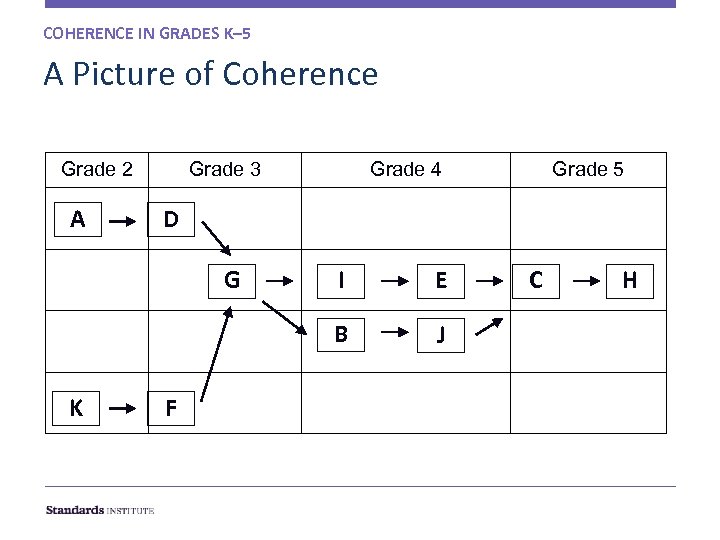 COHERENCE IN GRADES K– 5 A Picture of Coherence Grade 2 A Grade 3 Grade 4 D G F I E B K Grade 5 J C H
 COHERENCE IN GRADES K– 5 Implications What are the implications of coherence for students who are working harder mathematically in your schools? In what ways could you apply the principle of across grade coherence, or use the Coherence Map, in your role?
 Within Grade Coherence is also built into the Standards in how they reinforce a major topic in a grade by utilizing supporting, complementary topics.
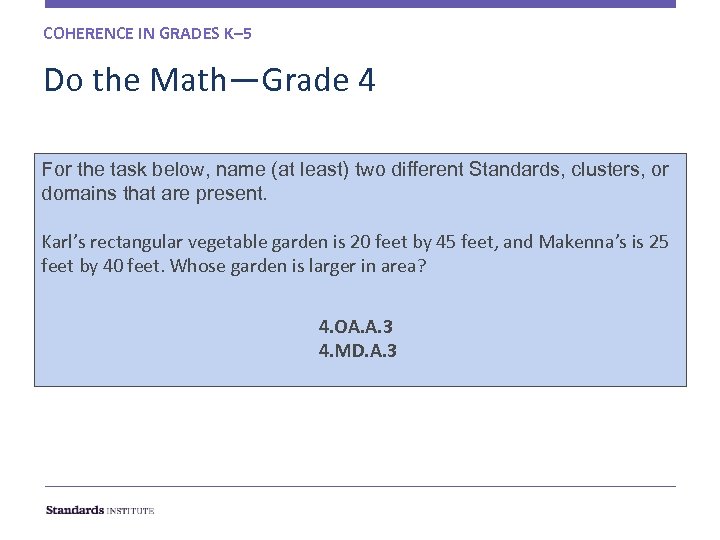 COHERENCE IN GRADES K– 5 Do the Math—Grade 4 For the task below, name (at least) two different Standards, clusters, or domains that are present. Karl’s rectangular vegetable garden is 20 feet by 45 feet, and Makenna’s is 25 feet by 40 feet. Whose garden is larger in area? 4. OA. A. 3 4. MD. A. 3
 Observing for Coherence 79
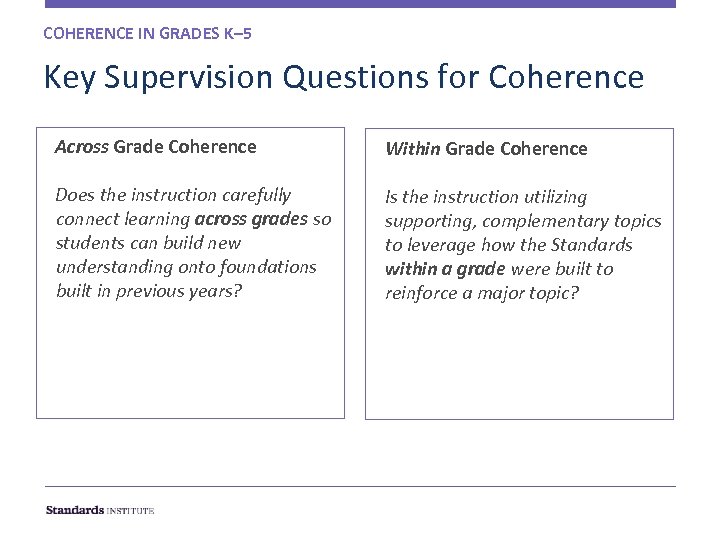 COHERENCE IN GRADES K– 5 Key Supervision Questions for Coherence Across Grade Coherence Within Grade Coherence Does the instruction carefully connect learning across grades so students can build new understanding onto foundations built in previous years? Is the instruction utilizing supporting, complementary topics to leverage how the Standards within a grade were built to reinforce a major topic?
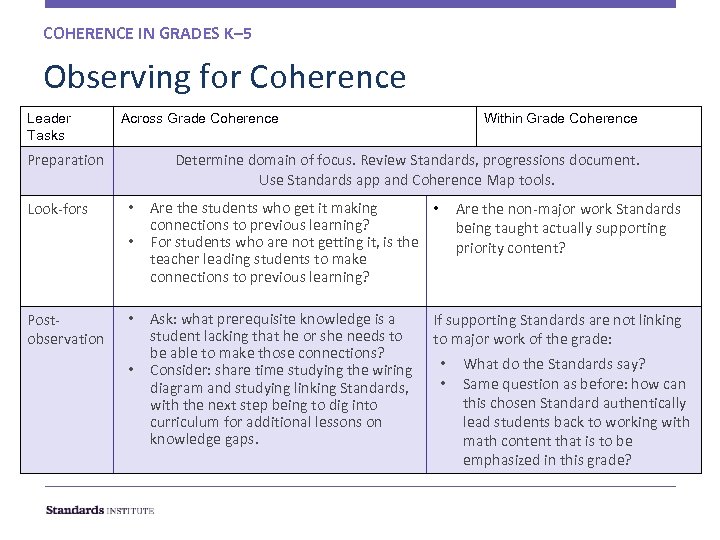 COHERENCE IN GRADES K– 5 Observing for Coherence Leader Tasks Across Grade Coherence Preparation Look-fors Determine domain of focus. Review Standards, progressions document. Use Standards app and Coherence Map tools. • • Postobservation Within Grade Coherence • • Are the students who get it making • connections to previous learning? For students who are not getting it, is the teacher leading students to make connections to previous learning? Ask: what prerequisite knowledge is a student lacking that he or she needs to be able to make those connections? Consider: share time studying the wiring diagram and studying linking Standards, with the next step being to dig into curriculum for additional lessons on knowledge gaps. Are the non-major work Standards being taught actually supporting priority content? If supporting Standards are not linking to major work of the grade: • • What do the Standards say? Same question as before: how can this chosen Standard authentically lead students back to working with math content that is to be emphasized in this grade?
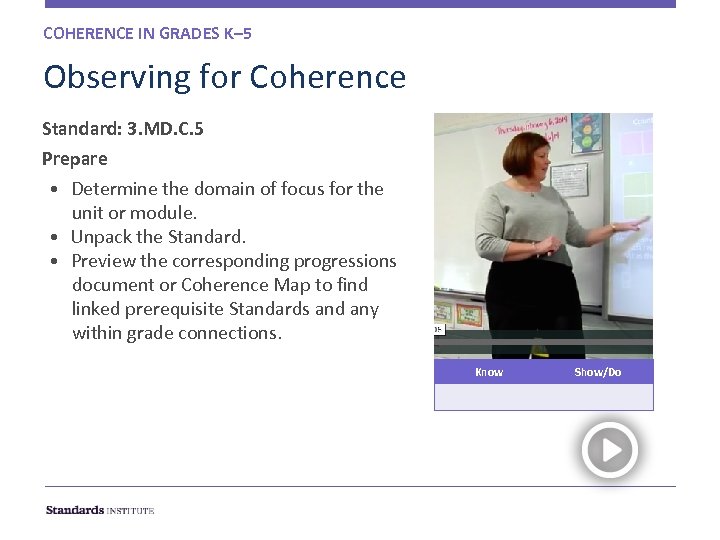 COHERENCE IN GRADES K– 5 Observing for Coherence Standard: 3. MD. C. 5 Prepare • Determine the domain of focus for the unit or module. • Unpack the Standard. • Preview the corresponding progressions document or Coherence Map to find linked prerequisite Standards and any within grade connections. Know Show/Do
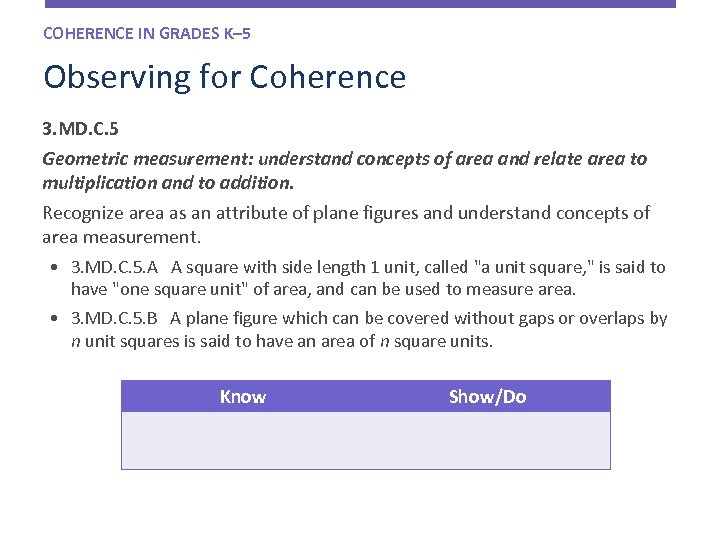 COHERENCE IN GRADES K– 5 Observing for Coherence 3. MD. C. 5 Geometric measurement: understand concepts of area and relate area to multiplication and to addition. Recognize area as an attribute of plane figures and understand concepts of area measurement. • 3. MD. C. 5. A A square with side length 1 unit, called "a unit square, " is said to have "one square unit" of area, and can be used to measure area. • 3. MD. C. 5. B A plane figure which can be covered without gaps or overlaps by n unit squares is said to have an area of n square units. Know Show/Do
 COHERENCE IN GRADES K– 5 Observing for Coherence Linked Prerequisite Standards • 2. MD. A. 1 Measure the length of an object by selecting and using appropriate tools such as rulers, yardsticks, meter sticks, and measuring tapes. • 1. G. A. 2 Compose two-dimensional shapes (rectangles, squares, trapezoids, triangles, half-circles, and quarter-circles) or three-dimensional shapes (cubes, right rectangular prisms, right circular cones, and right circular cylinders) to create a composite shape, and compose new shapes from the composite shape.
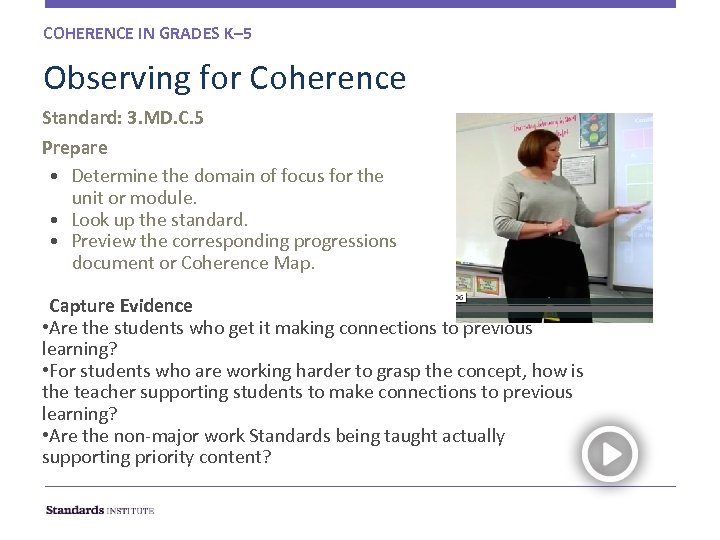 COHERENCE IN GRADES K– 5 Observing for Coherence Standard: 3. MD. C. 5 Prepare • Determine the domain of focus for the unit or module. • Look up the standard. • Preview the corresponding progressions document or Coherence Map. Capture Evidence • Are the students who get it making connections to previous learning? • For students who are working harder to grasp the concept, how is the teacher supporting students to make connections to previous learning? • Are the non-major work Standards being taught actually supporting priority content?
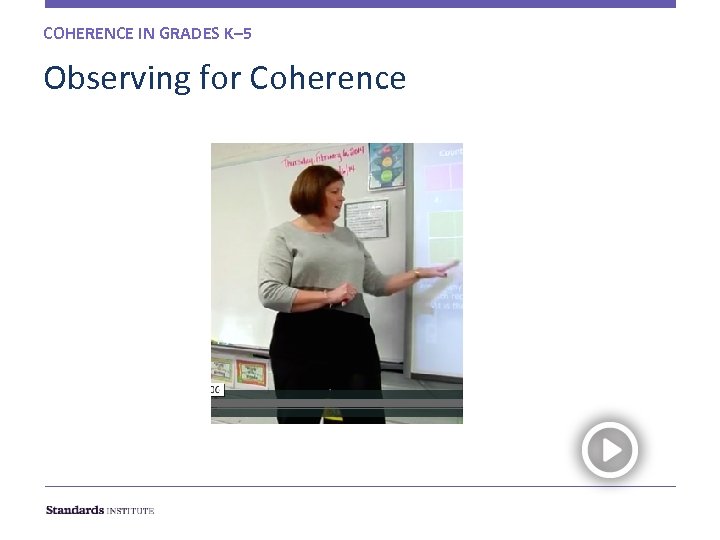 COHERENCE IN GRADES K– 5 Observing for Coherence
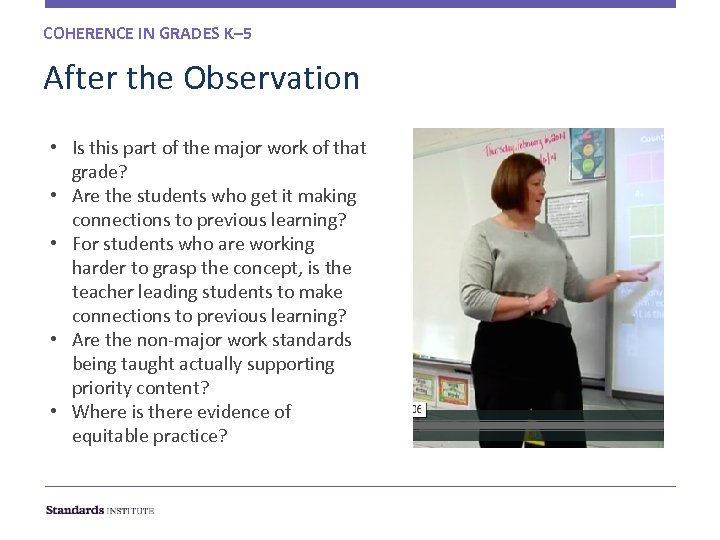 COHERENCE IN GRADES K– 5 After the Observation • Is this part of the major work of that grade? • Are the students who get it making connections to previous learning? • For students who are working harder to grasp the concept, is the teacher leading students to make connections to previous learning? • Are the non-major work standards being taught actually supporting priority content? • Where is there evidence of equitable practice?
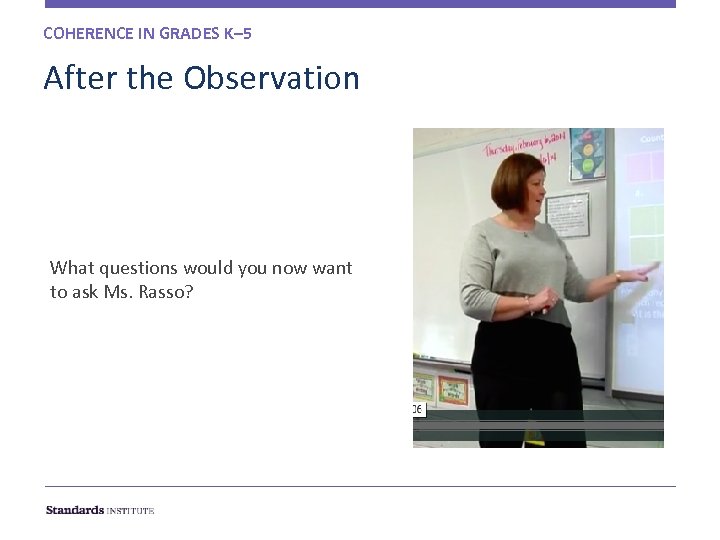 COHERENCE IN GRADES K– 5 After the Observation What questions would you now want to ask Ms. Rasso?
 COHERENCE IN GRADES K– 5 Questions that Develop Leading the Conversation • Are the students who “get it” making connections to previous learning? • For students who are working harder to “get it”, how is the teacher supporting students to make connections to previous learning? • Are the non-major work standards being taught actually supporting priority content? If students are still not making connections • Ask: what prerequisite knowledge is a student lacking that he or she needs to be able to make those connections? • Consider: share time studying the wiring diagram and the linking Standards, with the next step being to dig into curriculum for additional lessons on knowledge gaps. If supporting standards are not linking to major work of the grade • What do the standards say? • Same question as before: how can this chosen standard authentically lead students back to working with math content that will be emphasized in this grade?
 COHERENCE IN GRADES K– 5 Reflection: Coherence What is the state of Coherence in curriculum, planning, and professional development in your school or context? Curriculum • Does your curriculum identify the prerequisite skills needed for a unit or lesson? • Is across grade Coherence evident, helping students deepen understanding by making links between domains and clusters? Planning • Is Coherence a regular consideration in teacher and team lesson planning? How and when are prerequisite skills addressed when students are below grade level? Professional Development • What professional development has occurred for teachers? Do they know Coherence well enough to effectively include it in planning and instruction?
 COHERENCE IN GRADES K– 5 Role Team Time Meet your role team! 1. Download your key learning with one another and share how it is relevant to your role. 2. Share how coherence is going in your context and one step for improvement you are planning to take.
 COHERENCE IN GRADES K– 5 Thumb Rating: Did we meet our objectives? Objectives • Participants will be able to describe the coherence shift both as a logical sequencing of content across grades and as important connections between Standards, clusters, and domains within the grade. • Participants will be able to identify prerequisite Standards for grade-level Standards. • Participants will be able to observe and coach the coherence shift in teacher practice. • Apply an equity lens to consider and coach the coherence shift in teacher practice.
 COHERENCE IN GRADES K– 5 Processing & Application STOP AND JOT • What important understanding do you want to take away from our discussion about Shift 2 and equity? • How should Coherence be used to ensure equitable instruction is taking place for all students? • What implications does the importance of focus have for your work? Consider Professional development Planning Curriculum Systems/structures Policy & programming
 94
94
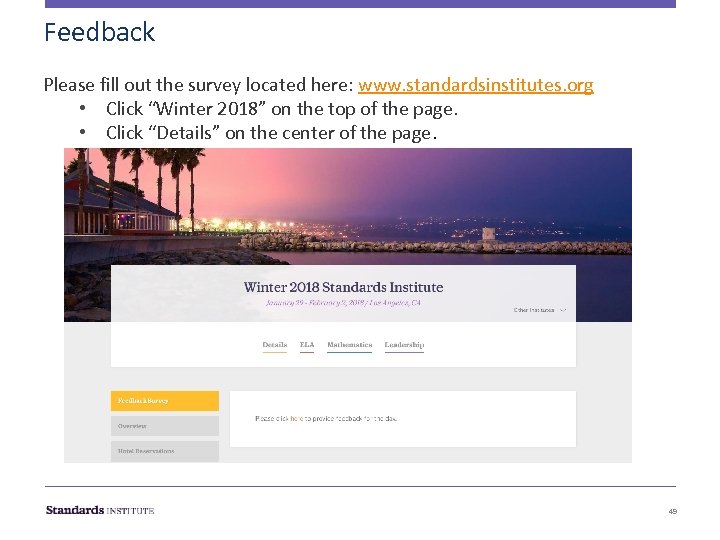 Feedback Please fill out the survey located here: www. standardsinstitutes. org • Click “Winter 2018” on the top of the page. • Click “Details” on the center of the page. 49
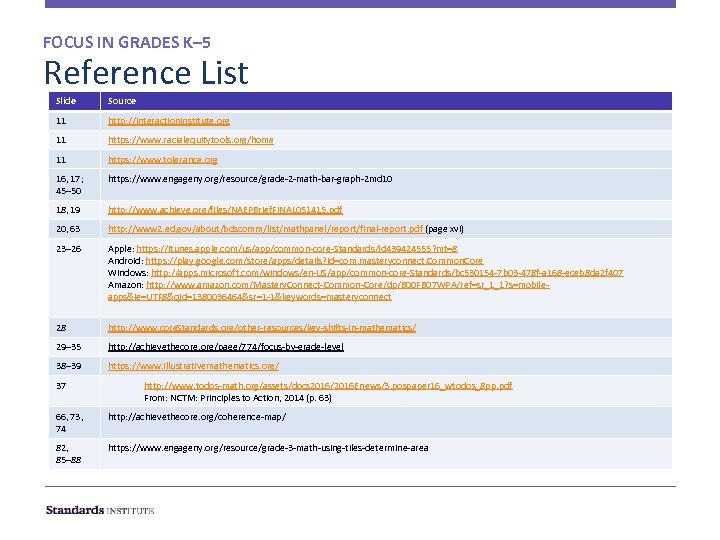 FOCUS IN GRADES K– 5 Reference List Slide Source 11 http: //interactioninstitute. org 11 https: //www. racialequitytools. org/home 11 https: //www. tolerance. org 16, 17; 45– 50 https: //www. engageny. org/resource/grade-2 -math-bar-graph-2 md 10 18, 19 http: //www. achieve. org/files/NAEPBrief. FINAL 051415. pdf 20, 63 http: //www 2. ed. gov/about/bdscomm/list/mathpanel/report/final-report. pdf (page xvi) 23– 26 Apple: https: //itunes. apple. com/us/app/common-core-Standards/id 439424555? mt=8 Android: https: //play. google. com/store/apps/details? id=com. masteryconnect. Common. Core Windows: http: //apps. microsoft. com/windows/en-US/app/common-core-Standards/bc 530154 -7 b 03 -478 f-a 168 -eceb 8 da 2 f 407 Amazon: http: //www. amazon. com/Mastery. Connect-Common-Core/dp/B 00 FB 07 WPA/ref=sr_1_1? s=mobileapps&ie=UTF 8&qid=1380036464&sr=1 -1&keywords=masteryconnect 28 http: //www. core. Standards. org/other-resources/key-shifts-in-mathematics/ 29– 35 http: //achievethecore. org/page/774/focus-by-grade-level 38– 39 https: //www. illustrativemathematics. org/ 37 http: //www. todos-math. org/assets/docs 2016/2016 Enews/3. pospaper 16_wtodos_8 pp. pdf From: NCTM: Principles to Action, 2014 (p. 63) 66, 73, 74 http: //achievethecore. org/coherence-map/ 82, 85– 88 https: //www. engageny. org/resource/grade-3 -math-using-tiles-determine-area
 FOCUS IN GRADES K– 5 Image Credits Slide 11: https: //pixabay. com/en/hands-hand-raised-hands-raised-220163/ Slides 28, 36: https: //www. flickr. com/photos/lel 4 nd/9641281573 Slide 37: https: //www. flickr. com/photos/23119666@N 03/4928502174/in/photolist-8 vv. RZq-aa. GUNr-s 5 exif-7 hc. XHvd. JFJn-6 X 2 Ww 8 -b. W 7 b. Fu-Aze. AP-f. Kbt. Ky-b. W 7 bob-6 c. XHE-QVV 29 Z-58 d. Mc 8 -9 p. JUsx-9 iwoik-8 M 9 in 5 -ir. Ju. Jg-8 nrwe. X 9 AZcpo-96 Kcjh-b. Dxn. GX-V 5 wpm. G-auyy. Bg-6 Sj. Px. D-7 Pu 8 N 5 -6 mq. LEQ-6 v. C 9 q 1 -4 H 8 ZLb-Vte. X 4 B-GJo. FNL-dim. Fznycz. EM-7 QWW 98 -c. Dci 9 -DVPM-b 5 Uxy. B-9 u 5 Neg-7 Cz 52 Z-dp. TDKj-qns. NH-b. W 7 bq. Q-7 TXTy. V-p. Sgy. WL-6 Nj 8 uk-a. E 6 CHE -m. UYwd-7 Cz 2 q. K-aq. BCmx-9 o 9 mw. J-ky. Suc Slides 54, 56, 57: https: //pixabay. com/en/personal-silhouettes-human-1264695/ Slide 61: https: //c 2. staticflickr. com/2/1055/3169282245_26 e 38493 db_z. jpg? zz=1 Slide 66: https: //pixabay. com/en/book-open-book-lamp-light-707387/ Slide 68, 76: https: //pixabay. com/en/torre-cajasol-spain-seville-786180/ Slide 77: https: //farm 7. staticflickr. com/6075/6117433883_de 7 d 1 b 919 d_b. jpg Slide 91: https: //pixabay. com/en/team-unity-celebration-dance-150149/ Slide 94: https: //pixabay. com/en/be-behold-being-hands-holding-1362324/