 Скачать презентацию Leadership Pathway Building Knowledge and Vocabulary in Grades
b9cfb7b6084f7d1bdb9a0d2ffdad5516.ppt
- Количество слайдов: 69



Leadership Pathway Building Knowledge and Vocabulary in Grades K– 5 Summer 2017
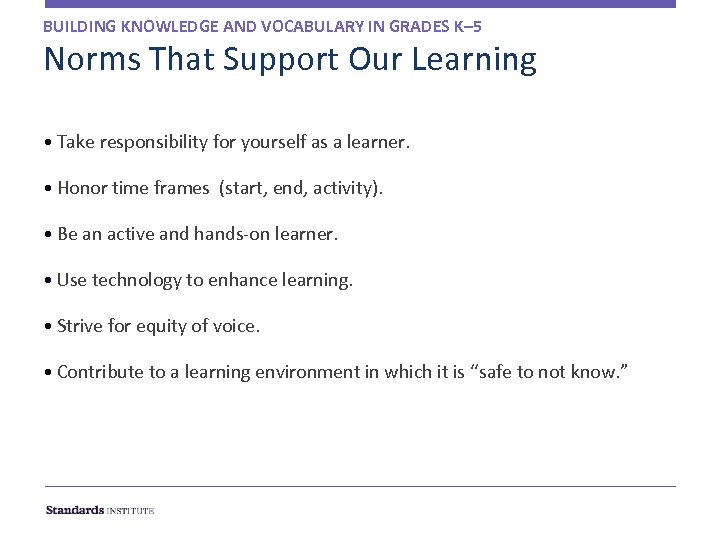
BUILDING KNOWLEDGE AND VOCABULARY IN GRADES K– 5 Norms That Support Our Learning • Take responsibility for yourself as a learner. • Honor time frames (start, end, activity). • Be an active and hands-on learner. • Use technology to enhance learning. • Strive for equity of voice. • Contribute to a learning environment in which it is “safe to not know. ”
BUILDING KNOWLEDGE AND VOCABULARY IN GRADES K– 5 Feedback on Feedback Plus Delta
BUILDING KNOWLEDGE AND VOCABULARY IN GRADES K– 5 Parking Lot Let’s go back and see if questions were addressed…
BUILDING KNOWLEDGE AND VOCABULARY IN GRADES K– 5 Equity isn’t giving every student the same thing; it’s giving every student what they need. It is about fairness. Ensuring all children – regardless of circumstance – are receiving highquality and standards-aligned instruction is an equitable practice. We want to ensure standards-aligned instruction is causing the equitable practices needed to close the gaps caused by racism, bias, and poverty. All week, we will explore our learning through this lens, and we will capture those moments visibly here in our room.
BUILDING KNOWLEDGE AND VOCABULARY IN GRADES K– 5 Share Your Learning Don’t forget to jot down ideas for • Light bulb moments • Why I teach/lead 6
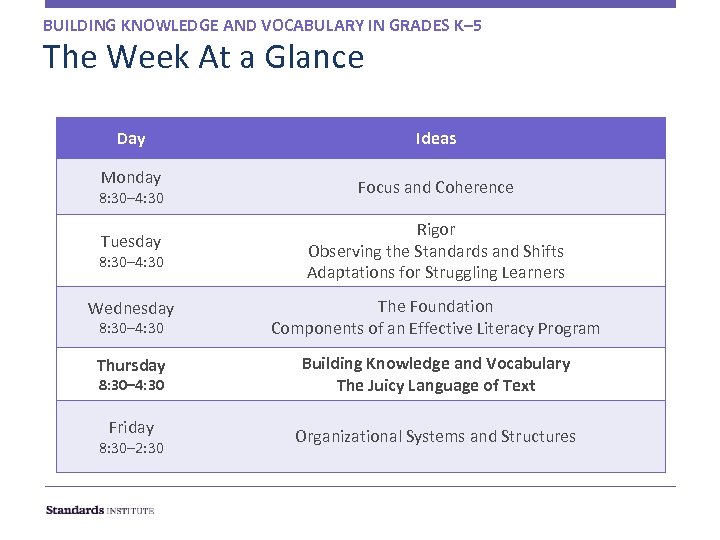
BUILDING KNOWLEDGE AND VOCABULARY IN GRADES K– 5 The Week At a Glance Day Monday 8: 30– 4: 30 Tuesday 8: 30– 4: 30 Ideas Focus and Coherence Rigor Observing the Standards and Shifts Adaptations for Struggling Learners Wednesday The Foundation Components of an Effective Literacy Program Thursday Building Knowledge and Vocabulary The Juicy Language of Text 8: 30– 4: 30 Friday 8: 30– 2: 30 Organizational Systems and Structures
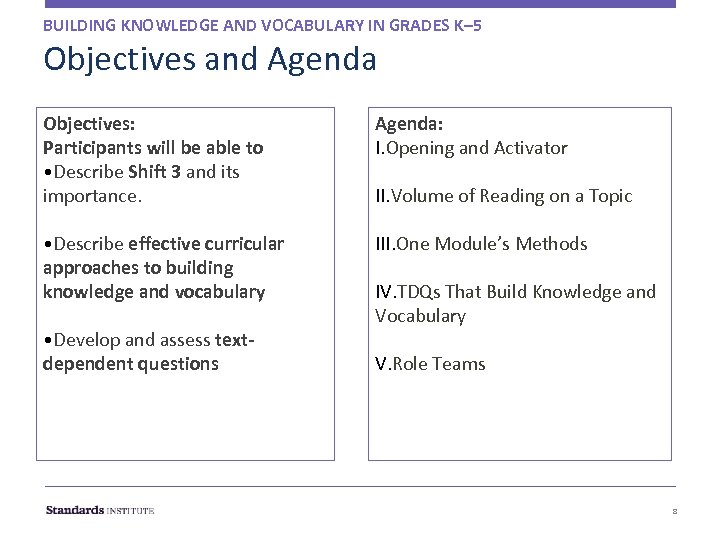
BUILDING KNOWLEDGE AND VOCABULARY IN GRADES K– 5 Objectives and Agenda Objectives: Participants will be able to • Describe Shift 3 and its importance. Agenda: I. Opening and Activator • Describe effective curricular approaches to building knowledge and vocabulary III. One Module’s Methods • Develop and assess textdependent questions II. Volume of Reading on a Topic IV. TDQs That Build Knowledge and Vocabulary V. Role Teams 8
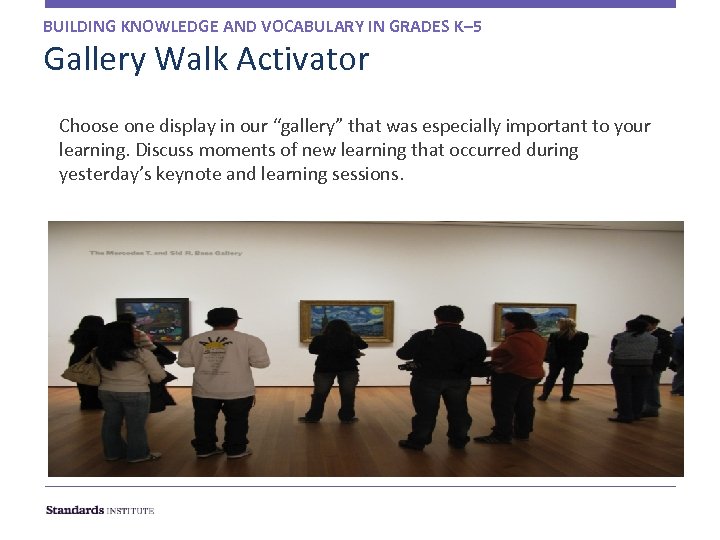
BUILDING KNOWLEDGE AND VOCABULARY IN GRADES K– 5 Gallery Walk Activator Choose one display in our “gallery” that was especially important to your learning. Discuss moments of new learning that occurred during yesterday’s keynote and learning sessions. 9
Shift 3: Intentionally Building Knowledge Through Content-rich Nonfiction
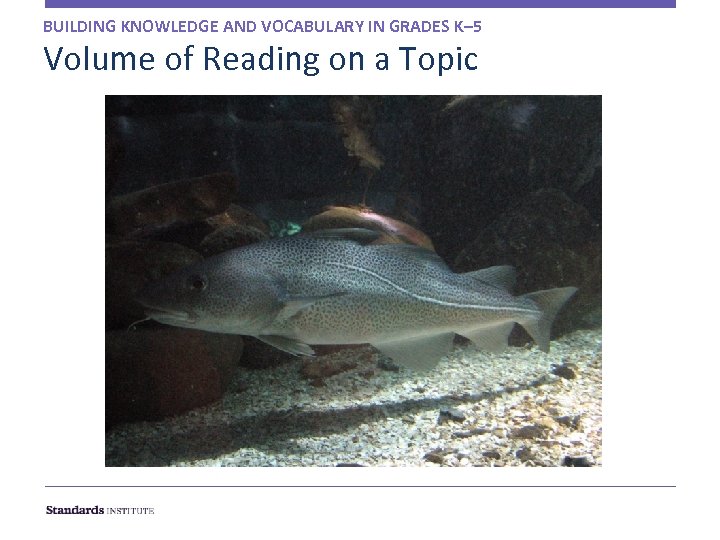
BUILDING KNOWLEDGE AND VOCABULARY IN GRADES K– 5 Volume of Reading on a Topic
BUILDING KNOWLEDGE AND VOCABULARY IN GRADES K– 5 Setting the Stage • Imagine you are 11 th-grade students studying the sustainability of seafood. • You are working to determine which species are sustainable sources of food. • The most complex texts you will tackle in this study are authentic reports, written by scientists, that explain whether a certain species of fish: – should not be fished, – should be fished “with caution, ” – or can be widely harvested. 12
BUILDING KNOWLEDGE AND VOCABULARY IN GRADES K– 5 Initial Read • Locate the article “Pacific Cod Species Report. ” • Read the article, and self-assess at the top of the page using a rating between 1 and 5: o 1= I don’t understand a single word of this. o 3= I understand some or even many of the words, but I really don’t understand what it means. o 5= I understand this information completely and can use it to make a decision about whether or not it’s a good idea to fish for Pacific cod.
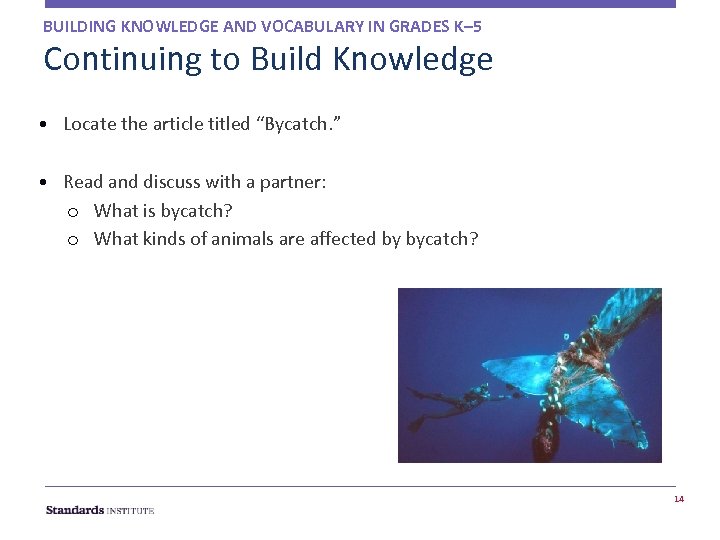
BUILDING KNOWLEDGE AND VOCABULARY IN GRADES K– 5 Continuing to Build Knowledge • Locate the article titled “Bycatch. ” • Read and discuss with a partner: o What is bycatch? o What kinds of animals are affected by bycatch? 14
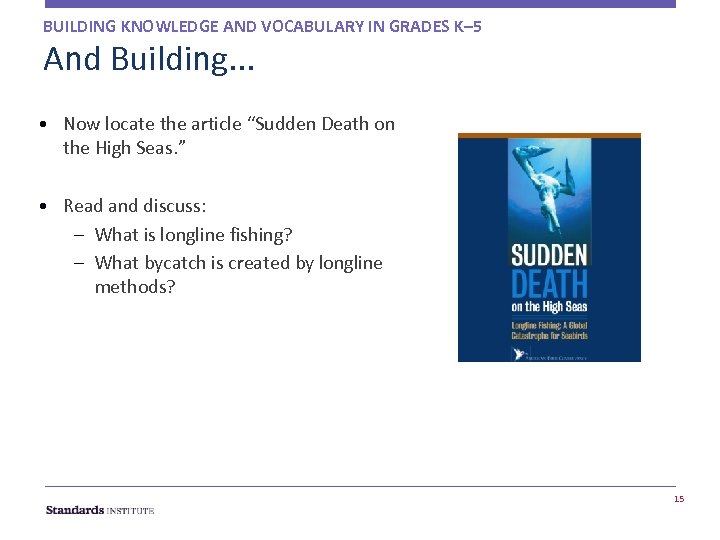
BUILDING KNOWLEDGE AND VOCABULARY IN GRADES K– 5 And Building. . . • Now locate the article “Sudden Death on the High Seas. ” • Read and discuss: – What is longline fishing? – What bycatch is created by longline methods? 15
BUILDING KNOWLEDGE AND VOCABULARY IN GRADES K– 5 What does it mean? Return to the first text, “Pacific Cod Species Report. ” Some support with structure: o Throughout the report, what are the words in all capital letters? Headings for each section of the report o In the table on the first page, what do the numbers represent? Scores for each criterion o In the table on the first page, what are the lowest and highest scores possible? What are the score ranges for each color? 0 and 4 0 to 1. 59 for Red, 1. 6 to 2. 39 for Yellow, 2. 4 to 4 for Green o How does the table in the summary correlate to the other sections? 16
BUILDING KNOWLEDGE AND VOCABULARY IN GRADES K– 5 What does it mean? How would you explain the structure? • 6 main sections: o Section 1: Summary with final score and subscores for 5 criteria o Sections 2 -6: Detailed scoring information for each criterion • The 5 criteria categories are: o (1) Life History, (2) Abundance, (3) Habitat Quality & Fishing Gear Impacts, (4) Management, (5) Bycatch • Each criterion has 2 sub-sections: Core points, Adjustment points o Core points are a base score of 1, 2 or 3 o Adjustment points are added to or subtracted from the base score for each item, worth 0. 25 points o The last line shows the total assigned points for that category 17
BUILDING KNOWLEDGE AND VOCABULARY IN GRADES K– 5 What does it mean? Some support with structure: o How do you know how many core points a criterion received? The score and definition are in bold. A paragraph explaining the score is directly below the selected score (1. 0, 2. 0 or 3. 0). o How do you understand the adjusted point score for a category? A statement is placed directly under each item for which points were adjusted. Add or subtract 0. 25 points for each statement. Some statements are in bold but not the score. This is when no points were subtracted. o Explain how the core points and adjusted points come out to 1. 75 for Life History. 18
BUILDING KNOWLEDGE AND VOCABULARY IN GRADES K– 5 Reread 1. Reread “Pacific Cod Species Report” p. 3 (Summary) , then 9 -12 (Management, Bycatch) • Think about what youve learned about bycatch and longline fishing. • Apply any gained understanding of the structure. 2. Self-assess again: 1 = I don’t understand much of this at all. 3 = I understand some or even many of the words, but I really don’t understand what it means. 5 = I completely understand this information and can use it to make a decision about whether or not it’s a good idea to fish for Pacific cod. 19
BUILDING KNOWLEDGE AND VOCABULARY IN GRADES K– 5 Discuss with a partner: • What methods are used in Pacific cod fishing? • Is bycatch a problem in Pacific cod fisheries? Why or why not? • Is it a good idea to fish for Pacific cod? Why or why not? 20
BUILDING KNOWLEDGE AND VOCABULARY IN GRADES K– 5 One More • Find the report “Monterey Bay Aquarium: Seafood Watch. ” • Locate “Cod: Pacific” in each column. – Why might this pamphlet report that it’s best to avoid Pacific cod caught by Japanese and Russian fishermen? 21
BUILDING KNOWLEDGE AND VOCABULARY IN GRADES K– 5 Debrief • What did you notice about the way you read the “Pacific Cod Species Report” article the second time versus the first time? • What enabled you to make a (likely) accurate inference about the way Pacific cod are fished in Japan and Russia? • What do you think about the amount of knowledge you gained about fish and fishing during this session? • Based on your experience in this activity, what are some curricular implications for building knowledge and vocabulary using text sets? • What are the equity implications for this activity? 22
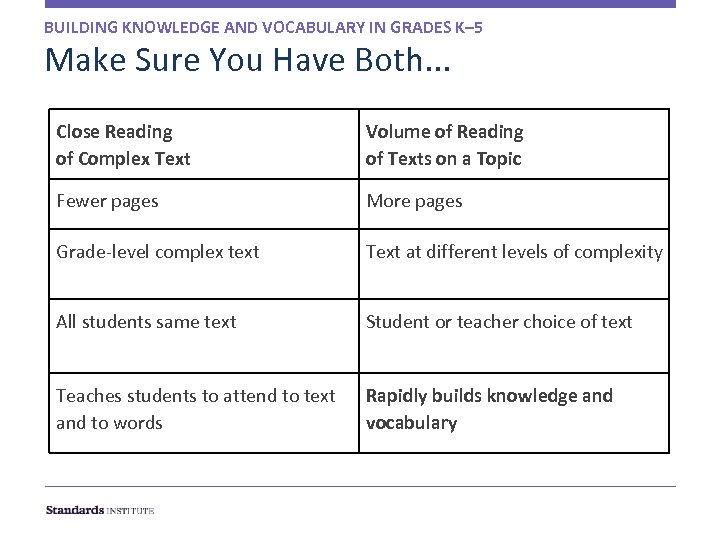
BUILDING KNOWLEDGE AND VOCABULARY IN GRADES K– 5 Make Sure You Have Both. . . Close Reading of Complex Text Volume of Reading of Texts on a Topic Fewer pages More pages Grade-level complex text Text at different levels of complexity All students same text Student or teacher choice of text Teaches students to attend to text and to words Rapidly builds knowledge and vocabulary
BUILDING KNOWLEDGE AND VOCABULARY IN GRADES K– 5 Processing & Application STOP AND JOT • What important understanding do you want to take away from our discussion about Shift 3? • What implications does the importance of Shift 3 have for your work? Consider: Professional development Planning Curriculum Systems/Structures Equity Policy & Programming
BUILDING KNOWLEDGE AND VOCABULARY IN GRADES K– 5 Objectives and Agenda Objectives: Participants will be able to • Describe an effective curricular approach to building knowledge and vocabulary, by examining one module’s methods of teaching texts and evidence-based claims • Develop and assess textdependent questions Agenda: I. Opening and Activator II. Volume of Reading on a Topic III. One Module’s Methods IV. TDQs that Build Knowledge and Vocabulary V. Role Teams 25
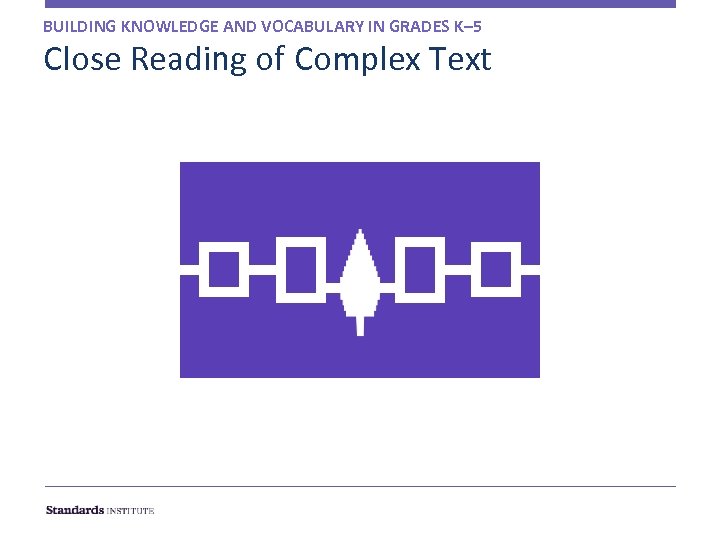
BUILDING KNOWLEDGE AND VOCABULARY IN GRADES K– 5 Close Reading of Complex Text
BUILDING KNOWLEDGE AND VOCABULARY IN GRADES K– 5 Module 1 A Unit 1 Lesson 3: Birth of the Haudenosaunee Students begin this lesson with an overview of the objectives. CCSS. ELA-LITERACY. RI. 4. 1 Refer to details and examples in a text when explaining what the text says explicitly and when drawing inferences from the text. I can explain what a text says using specific details from the text. CCSS. ELA-LITERACY. SL. 4. 4 Report on a topic or text, tell a story, or recount an experience in an organized manner, using appropriate facts and relevant, descriptive details to support main ideas or themes; speak clearly at an understandable pace. I can engage effectively in a collaborative discussion.
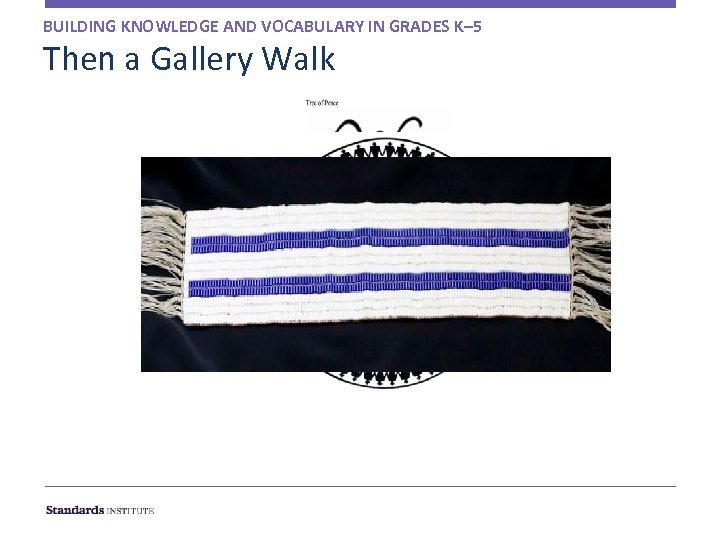
BUILDING KNOWLEDGE AND VOCABULARY IN GRADES K– 5 Then a Gallery Walk p
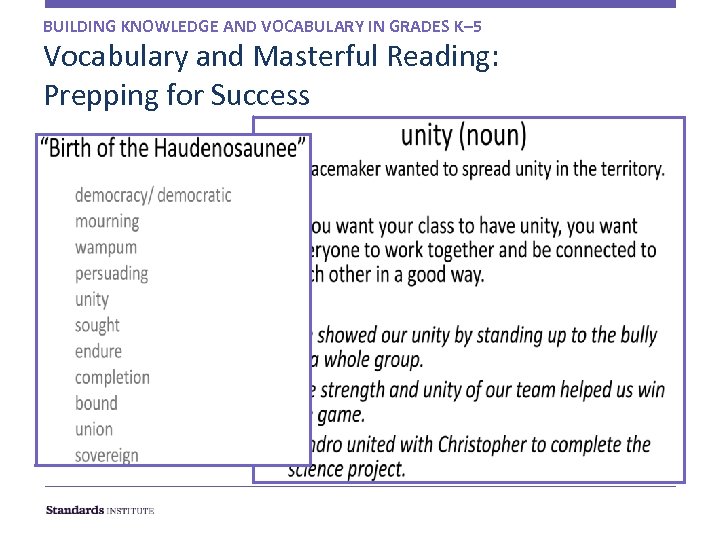
BUILDING KNOWLEDGE AND VOCABULARY IN GRADES K– 5 Vocabulary and Masterful Reading: Prepping for Success
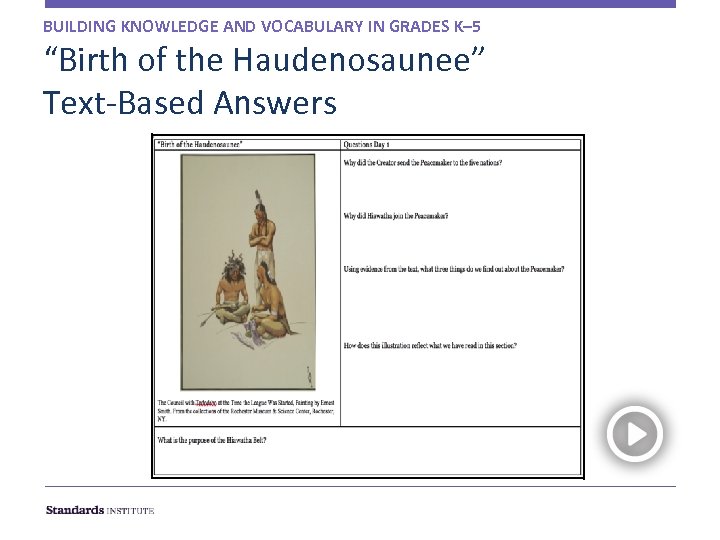
BUILDING KNOWLEDGE AND VOCABULARY IN GRADES K– 5 “Birth of the Haudenosaunee” Text-Based Answers

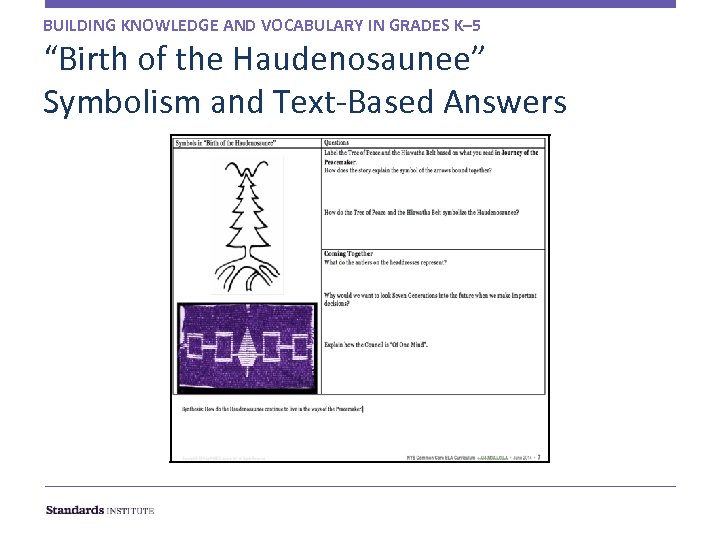
BUILDING KNOWLEDGE AND VOCABULARY IN GRADES K– 5 “Birth of the Haudenosaunee” Symbolism and Text-Based Answers
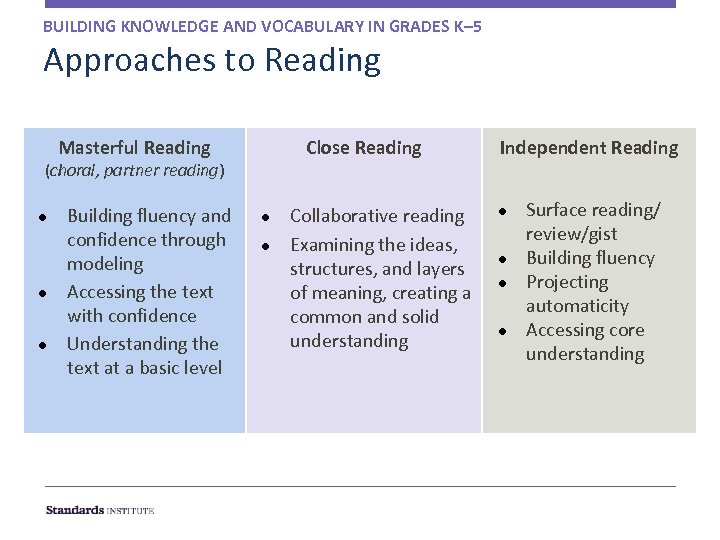
BUILDING KNOWLEDGE AND VOCABULARY IN GRADES K– 5 Approaches to Reading Masterful Reading Close Reading (choral, partner reading) ● ● ● Building fluency and confidence through modeling Accessing the text with confidence Understanding the text at a basic level ● ● Collaborative reading Examining the ideas, structures, and layers of meaning, creating a common and solid understanding Independent Reading ● ● Surface reading/ review/gist Building fluency Projecting automaticity Accessing core understanding
BUILDING KNOWLEDGE AND VOCABULARY IN GRADES K– 5 Debrief 1. As a learner, what activities were most impactful to you, why? 2. Revisit the standards. To what extent were they addressed through the series of activities? 3. How does this instruction speak to Shifts 1, 2, & 3? 4. How does the connection between standards and the Shifts build an equitable educational environment?
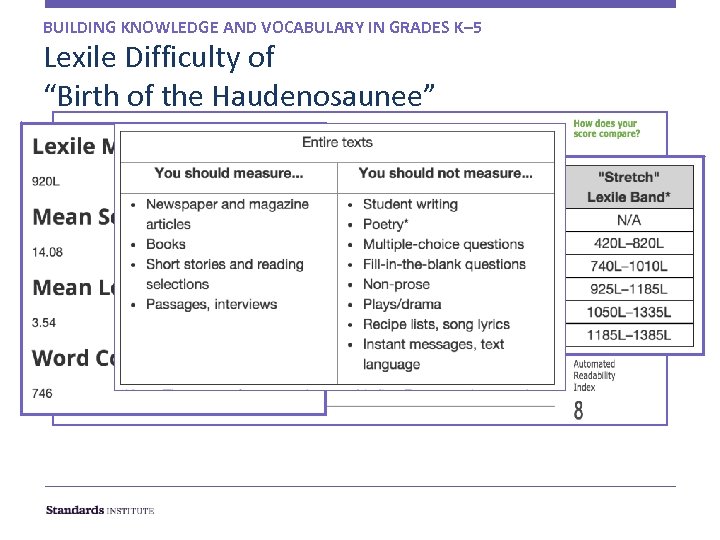
BUILDING KNOWLEDGE AND VOCABULARY IN GRADES K– 5 Lexile Difficulty of “Birth of the Haudenosaunee”
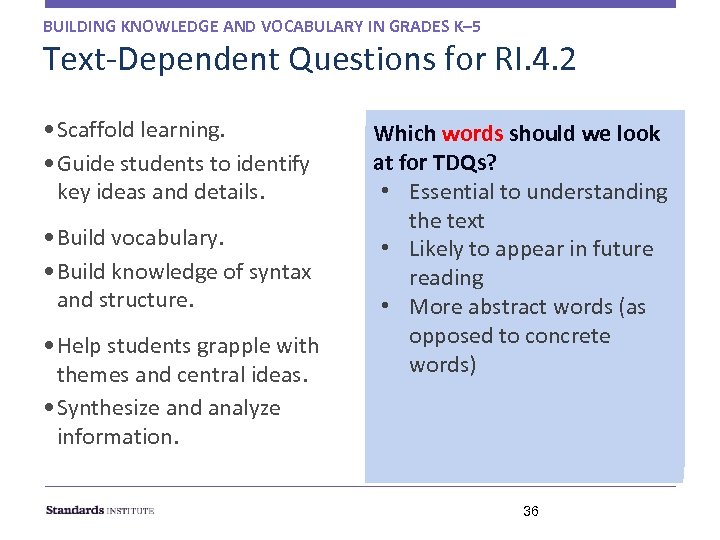
BUILDING KNOWLEDGE AND VOCABULARY IN GRADES K– 5 Text-Dependent Questions for RI. 4. 2 • Scaffold learning. • Guide students to identify key ideas and details. • Build vocabulary. • Build knowledge of syntax and structure. • Help students grapple with themes and central ideas. • Synthesize and analyze information. Why words should we Whichshould we ask central What are the key details look and idea/theme-based TDQs? at for ideas? TDQs? Guide students toward the Essential to understanding • • How can I support students theme. the text to get them to see and • understand these details Encourage students to look Likely to appear in future to the text to support their reading and ideas? • answers. More abstract words (as • Encourage students to opposed to concrete examine the complex words) layers of a rigorous text. • Support comprehension. 36
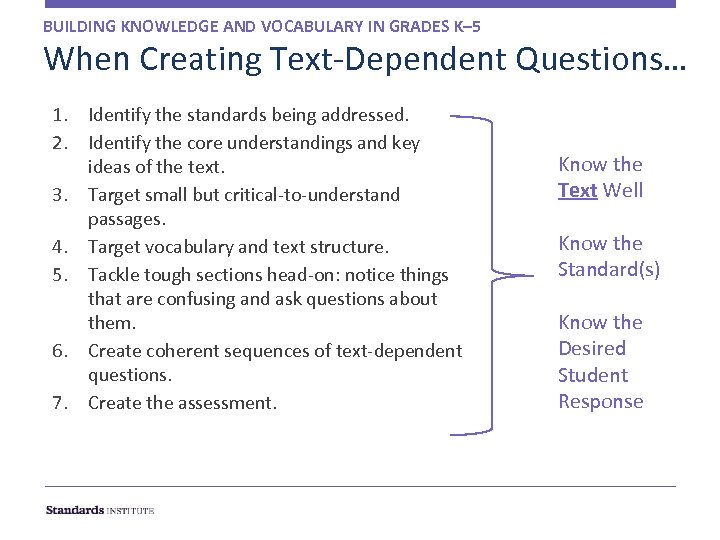
BUILDING KNOWLEDGE AND VOCABULARY IN GRADES K– 5 When Creating Text-Dependent Questions… 1. Identify the standards being addressed. 2. Identify the core understandings and key ideas of the text. 3. Target small but critical-to-understand passages. 4. Target vocabulary and text structure. 5. Tackle tough sections head-on: notice things that are confusing and ask questions about them. 6. Create coherent sequences of text-dependent questions. 7. Create the assessment. Know the Text Well Know the Standard(s) Know the Desired Student Response
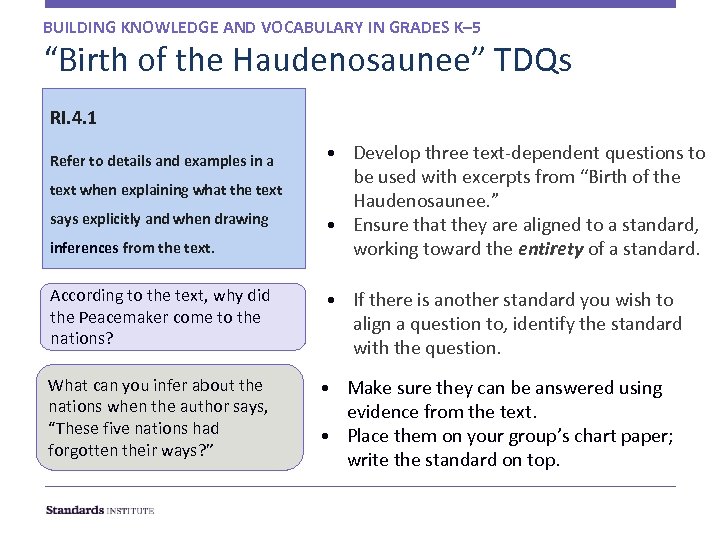
BUILDING KNOWLEDGE AND VOCABULARY IN GRADES K– 5 “Birth of the Haudenosaunee” TDQs RI. 4. 1 Refer to details and examples in a text when explaining what the text says explicitly and when drawing inferences from the text. According to the text, why did the Peacemaker come to the nations? What can you infer about the nations when the author says, “These five nations had forgotten their ways? ” • Develop three text-dependent questions to be used with excerpts from “Birth of the Haudenosaunee. ” • Ensure that they are aligned to a standard, working toward the entirety of a standard. • If there is another standard you wish to align a question to, identify the standard with the question. • Make sure they can be answered using evidence from the text. • Place them on your group’s chart paper; write the standard on top.
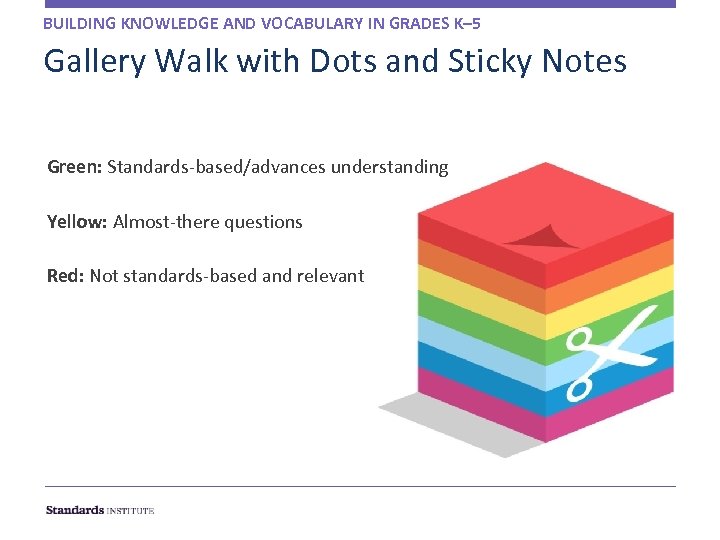
BUILDING KNOWLEDGE AND VOCABULARY IN GRADES K– 5 Gallery Walk with Dots and Sticky Notes Green: Standards-based/advances understanding Yellow: Almost-there questions Red: Not standards-based and relevant
BUILDING KNOWLEDGE AND VOCABULARY IN GRADES K– 5 Let’s Zoom Out What knowledge does a student need to access and examine “Birth of the Haudenosaunee”? What knowledge bridges can be built between what students may know and what they need to know to access and examine “Birth of the Haudenosaunee”?
BUILDING KNOWLEDGE AND VOCABULARY IN GRADES K– 5 Role Team Time Meet with your role team 1. Download your key learning with one another. 2. Discuss how this session is relevant to your role and what you can put into practice.
BUILDING KNOWLEDGE AND VOCABULARY IN GRADES K– 5 Thumb Rating: Objectives ● Describe Shift 3 and its importance. ● Describe effective curricular approaches to building knowledge and vocabulary. ● Develop and evaluate text-dependent questions. 42

Welcome Back to The Juicy Language of Text!

Leadership Pathway The Juicy Language of Text Grades K– 5 Summer 2017
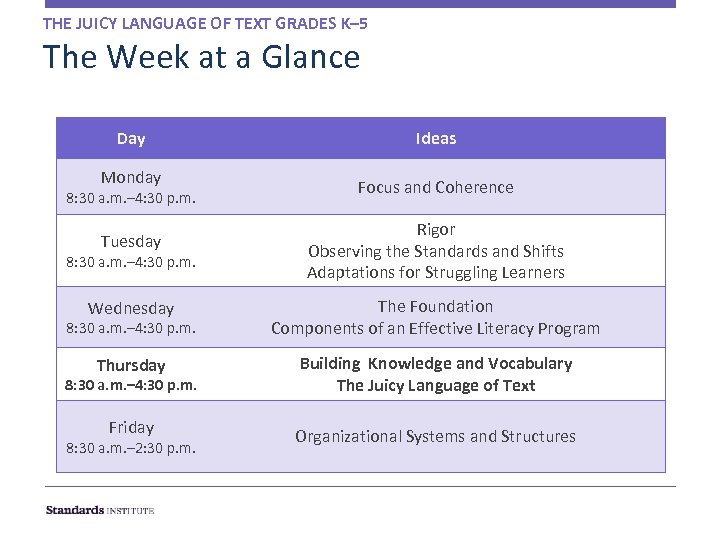
THE JUICY LANGUAGE OF TEXT GRADES K– 5 The Week at a Glance Day Monday 8: 30 a. m. – 4: 30 p. m. Tuesday 8: 30 a. m. – 4: 30 p. m. Ideas Focus and Coherence Rigor Observing the Standards and Shifts Adaptations for Struggling Learners Wednesday The Foundation Components of an Effective Literacy Program Thursday Building Knowledge and Vocabulary The Juicy Language of Text 8: 30 a. m. – 4: 30 p. m. Friday 8: 30 a. m. – 2: 30 p. m. Organizational Systems and Structures
THE JUICY LANGUAGE OF TEXT GRADES K– 5 Objectives and Agenda Objectives: Participants will be able to • Determine the role of syntax in complex text • Closely read and dissect text at the sentence level with Juicy Sentences • Observe and analyze instruction for evidence of standards and shifts • Describe the ideal literacy program Agenda: I. Opening II. Naming the Challenge III. Deconstructing Juicy Sentences IV. Instructional Video Observation I. Mini-Team Time 47
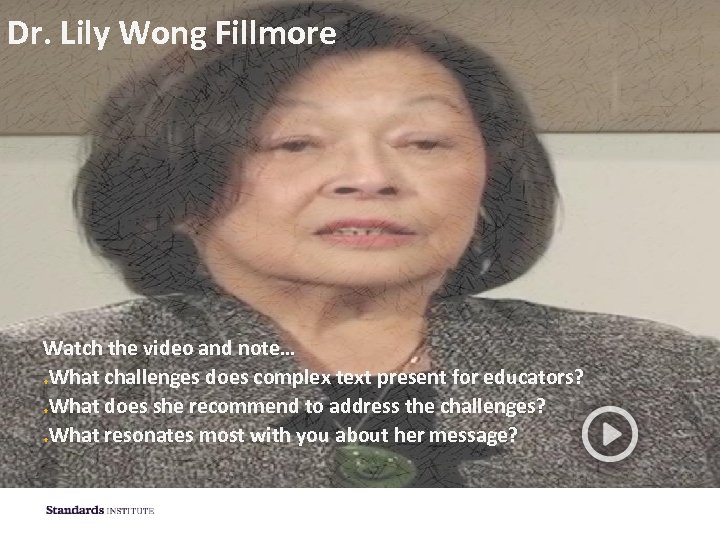
Dr. Lily Wong Fillmore Watch the video and note… What challenges does complex text present for educators? What does she recommend to address the challenges? What resonates most with you about her message? ✧ ✧ ✧
THE JUICY LANGUAGE OF TEXT GRADES K– 5 Language Standards Knowledge of Language: 4. 3 Use knowledge of language and its conventions when writing, speaking, reading, or listening. Vocabulary Acquisition and Use: 4. 4 Determine or clarify the meaning of unknown and multiple-meaning words and phrases based on Grade 4 reading and content, choosing flexibly from a variety of strategies. 4. 5 Demonstrate understanding of figurative language, word relationships, and nuances in word meanings. 4. 6 Acquire and use accurately grade-appropriate general academic and domain -specific words and phrases, including those that signal precise actions, emotions, or states of being (e. g. , quizzed, whined, stammered) and that are basic to a particular topic (e. g. , wildlife, conservation, and endangered, when discussing animal preservation).
THE JUICY LANGUAGE OF TEXT GRADES K– 5 Putting It Together Syntax Juicy Sentence Read the text. Read annotate the article. Craft your own definition of What makes a sentence juicy? syntax based on what you read. What instructional opportunities does the juicy sentence provide?
Let’s Practice… Over a thousand years ago on the shores of Onondaga Lake, in present-day central New York, democracy was born. 1. Copy the sentence. 2. Write, “I think this sentence means __________. ” 3. Write other things that you notice. 4. Write a new sentence mimicking the author’s structure.
Over aa thousand years ago on the shores of Over thousand years ago on the shores of Onondaga. Democracy was born. New Lake, in present-day central New Onondaga Lake, in present-day central New Lake in present-day central York, democracy was born.
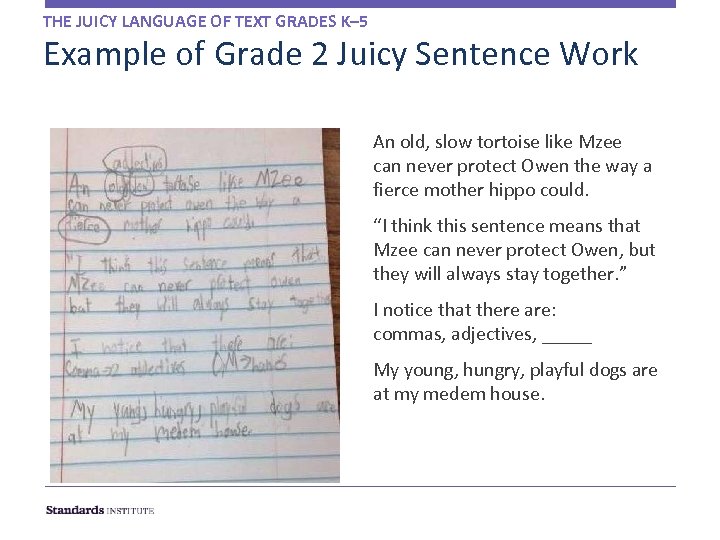
THE JUICY LANGUAGE OF TEXT GRADES K– 5 Example of Grade 2 Juicy Sentence Work An old, slow tortoise like Mzee can never protect Owen the way a fierce mother hippo could. “I think this sentence means that Mzee can never protect Owen, but they will always stay together. ” I notice that there are: commas, adjectives, _____ My young, hungry, playful dogs are at my medem house.

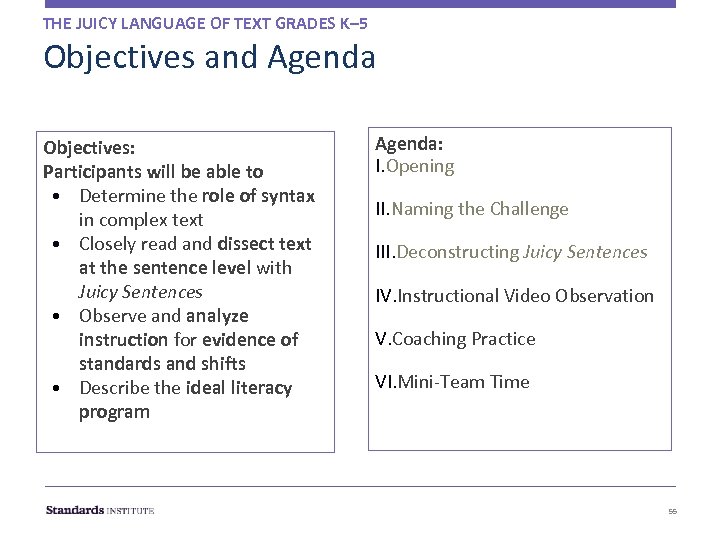
THE JUICY LANGUAGE OF TEXT GRADES K– 5 Objectives and Agenda Objectives: Participants will be able to • Determine the role of syntax in complex text • Closely read and dissect text at the sentence level with Juicy Sentences • Observe and analyze instruction for evidence of standards and shifts • Describe the ideal literacy program Agenda: I. Opening II. Naming the Challenge III. Deconstructing Juicy Sentences IV. Instructional Video Observation V. Coaching Practice VI. Mini-Team Time 55

Observing for Standards and Shifts 56
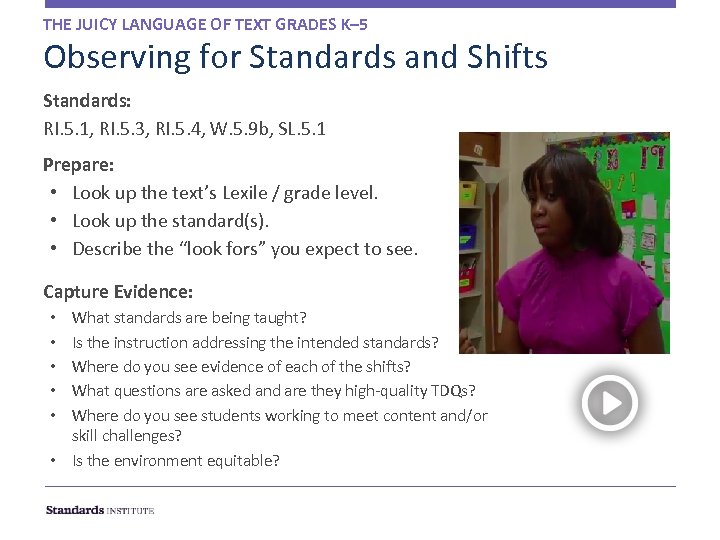
THE JUICY LANGUAGE OF TEXT GRADES K– 5 Observing for Standards and Shifts Standards: RI. 5. 1, RI. 5. 3, RI. 5. 4, W. 5. 9 b, SL. 5. 1 Prepare: • Look up the text’s Lexile / grade level. • Look up the standard(s). • Describe the “look fors” you expect to see. Capture Evidence: What standards are being taught? Is the instruction addressing the intended standards? Where do you see evidence of each of the shifts? What questions are asked and are they high-quality TDQs? Where do you see students working to meet content and/or skill challenges? • Is the environment equitable? • • •
THE JUICY LANGUAGE OF TEXT GRADES K– 5 Observing for Standards and Shifts
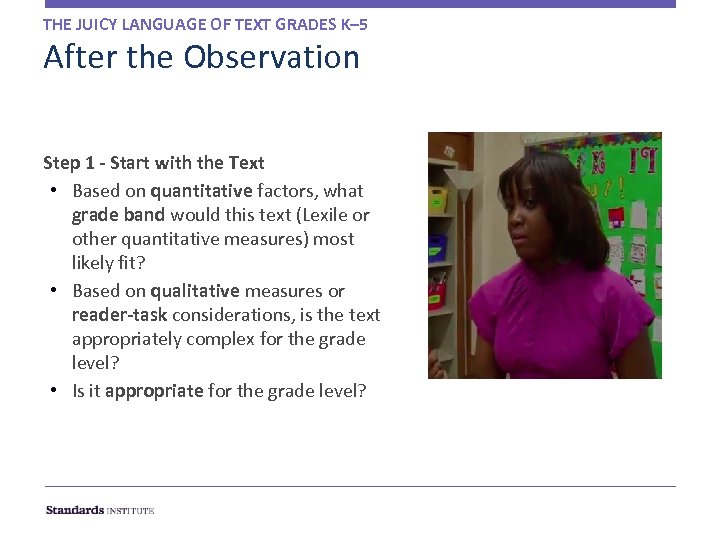
THE JUICY LANGUAGE OF TEXT GRADES K– 5 After the Observation Step 1 - Start with the Text • Based on quantitative factors, what grade band would this text (Lexile or other quantitative measures) most likely fit? • Based on qualitative measures or reader-task considerations, is the text appropriately complex for the grade level? • Is it appropriate for the grade level?
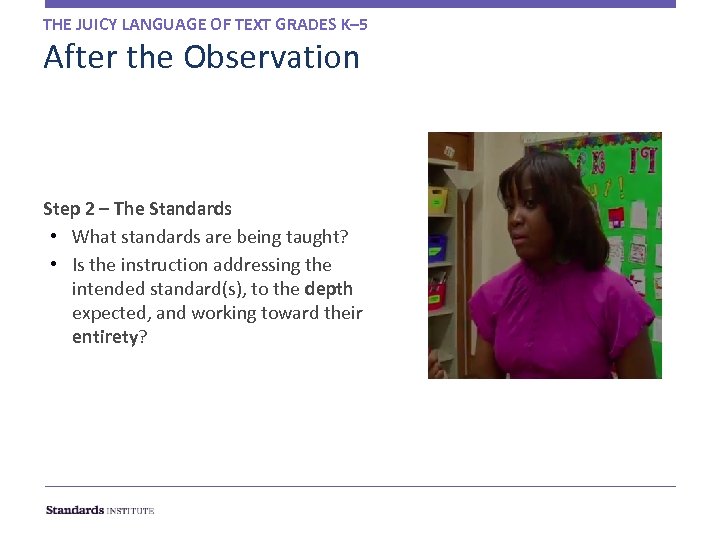
THE JUICY LANGUAGE OF TEXT GRADES K– 5 After the Observation Step 2 – The Standards • What standards are being taught? • Is the instruction addressing the intended standard(s), to the depth expected, and working toward their entirety?
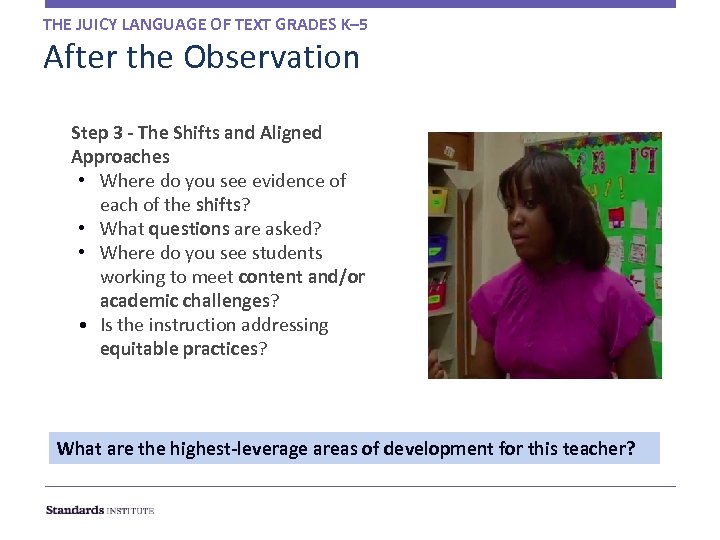
THE JUICY LANGUAGE OF TEXT GRADES K– 5 After the Observation Step 3 - The Shifts and Aligned Approaches • Where do you see evidence of each of the shifts? • What questions are asked? • Where do you see students working to meet content and/or academic challenges? • Is the instruction addressing equitable practices? What are the highest-leverage areas of development for this teacher?
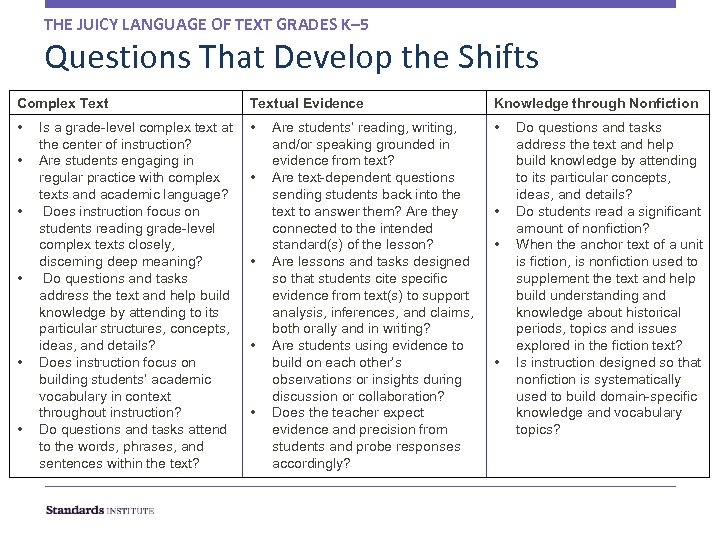
THE JUICY LANGUAGE OF TEXT GRADES K– 5 Questions That Develop the Shifts Complex Textual Evidence Knowledge through Nonfiction • • Is a grade-level complex text at the center of instruction? Are students engaging in regular practice with complex texts and academic language? Does instruction focus on students reading grade-level complex texts closely, discerning deep meaning? Do questions and tasks address the text and help build knowledge by attending to its particular structures, concepts, ideas, and details? Does instruction focus on building students’ academic vocabulary in context throughout instruction? Do questions and tasks attend to the words, phrases, and sentences within the text? • • Are students’ reading, writing, and/or speaking grounded in evidence from text? Are text-dependent questions sending students back into the text to answer them? Are they connected to the intended standard(s) of the lesson? Are lessons and tasks designed so that students cite specific evidence from text(s) to support analysis, inferences, and claims, both orally and in writing? Are students using evidence to build on each other’s observations or insights during discussion or collaboration? Does the teacher expect evidence and precision from students and probe responses accordingly? • • • Do questions and tasks address the text and help build knowledge by attending to its particular concepts, ideas, and details? Do students read a significant amount of nonfiction? When the anchor text of a unit is fiction, is nonfiction used to supplement the text and help build understanding and knowledge about historical periods, topics and issues explored in the fiction text? Is instruction designed so that nonfiction is systematically used to build domain-specific knowledge and vocabulary topics?
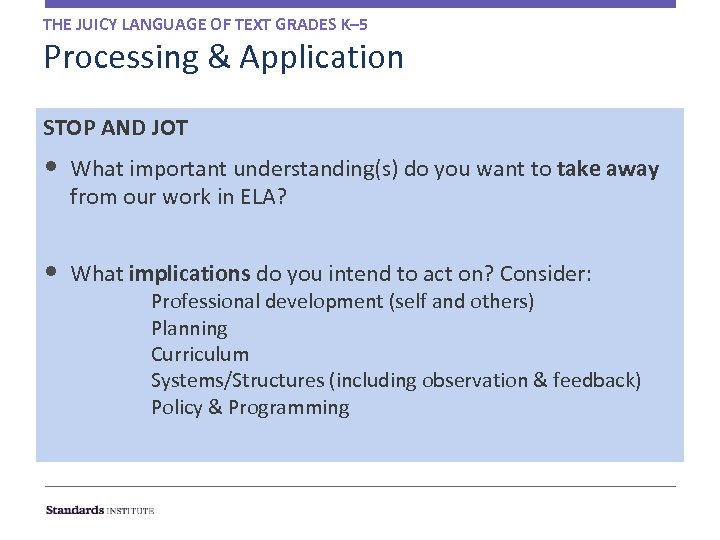
THE JUICY LANGUAGE OF TEXT GRADES K– 5 Processing & Application STOP AND JOT • What important understanding(s) do you want to take away from our work in ELA? • What implications do you intend to act on? Consider: Professional development (self and others) Planning Curriculum Systems/Structures (including observation & feedback) Policy & Programming
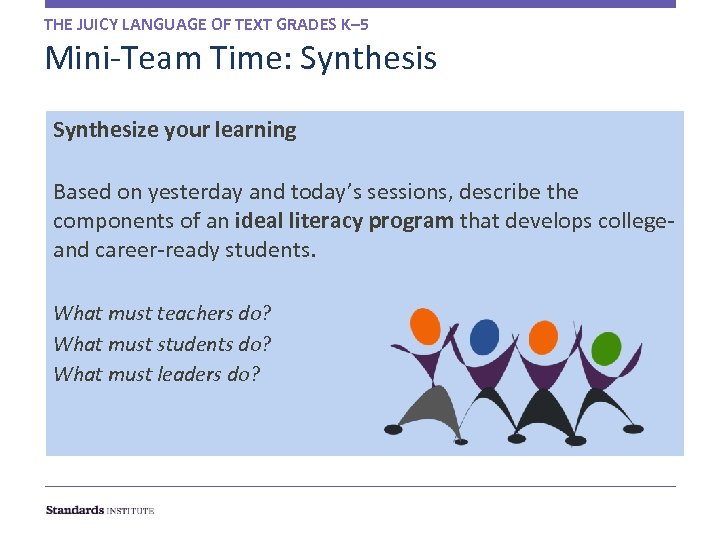
THE JUICY LANGUAGE OF TEXT GRADES K– 5 Mini-Team Time: Synthesis Synthesize your learning Based on yesterday and today’s sessions, describe the components of an ideal literacy program that develops college- and career-ready students. What must teachers do? What must students do? What must leaders do?
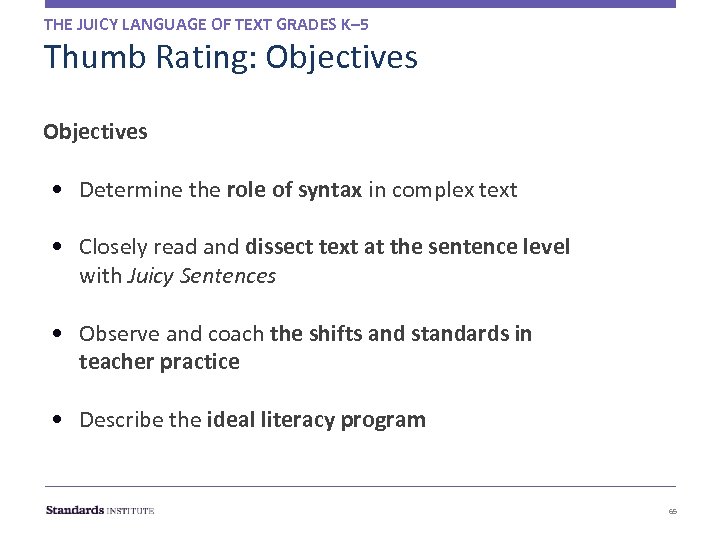
THE JUICY LANGUAGE OF TEXT GRADES K– 5 Thumb Rating: Objectives • Determine the role of syntax in complex text • Closely read and dissect text at the sentence level with Juicy Sentences • Observe and coach the shifts and standards in teacher practice • Describe the ideal literacy program 65

66
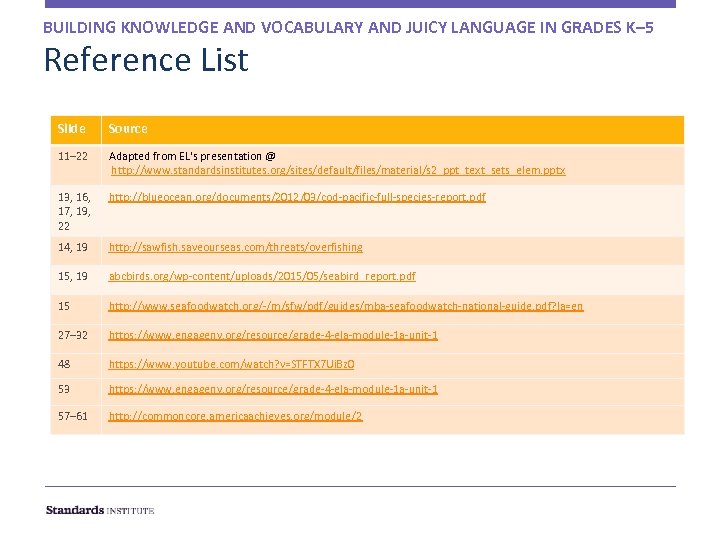
BUILDING KNOWLEDGE AND VOCABULARY AND JUICY LANGUAGE IN GRADES K– 5 Reference List Slide Source 11– 22 Adapted from EL's presentation @ http: //www. standardsinstitutes. org/sites/default/files/material/s 2_ppt_text_sets_elem. pptx 13, 16, 17, 19, 22 http: //blueocean. org/documents/2012/03/cod-pacific-full-species-report. pdf 14, 19 http: //sawfish. saveourseas. com/threats/overfishing 15, 19 abcbirds. org/wp-content/uploads/2015/05/seabird_report. pdf 15 http: //www. seafoodwatch. org/-/m/sfw/pdf/guides/mba-seafoodwatch-national-guide. pdf? la=en 27– 32 https: //www. engageny. org/resource/grade-4 -ela-module-1 a-unit-1 48 https: //www. youtube. com/watch? v=STFTX 7 Ui. Bz 0 53 https: //www. engageny. org/resource/grade-4 -ela-module-1 a-unit-1 57– 61 http: //commoncore. americaachieves. org/module/2
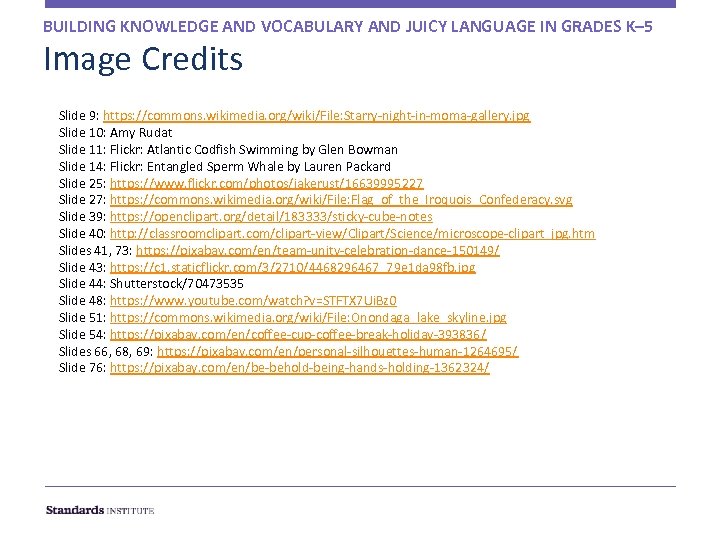
BUILDING KNOWLEDGE AND VOCABULARY AND JUICY LANGUAGE IN GRADES K– 5 Image Credits Slide 9: https: //commons. wikimedia. org/wiki/File: Starry-night-in-moma-gallery. jpg Slide 10: Amy Rudat Slide 11: Flickr: Atlantic Codfish Swimming by Glen Bowman Slide 14: Flickr: Entangled Sperm Whale by Lauren Packard Slide 25: https: //www. flickr. com/photos/jakerust/16639995227 Slide 27: https: //commons. wikimedia. org/wiki/File: Flag_of_the_Iroquois_Confederacy. svg Slide 39: https: //openclipart. org/detail/183333/sticky-cube-notes Slide 40: http: //classroomclipart. com/clipart-view/Clipart/Science/microscope-clipart_jpg. htm Slides 41, 73: https: //pixabay. com/en/team-unity-celebration-dance-150149/ Slide 43: https: //c 1. staticflickr. com/3/2710/4468296467_79 e 1 da 98 fb. jpg Slide 44: Shutterstock/70473535 Slide 48: https: //www. youtube. com/watch? v=STFTX 7 Ui. Bz 0 Slide 51: https: //commons. wikimedia. org/wiki/File: Onondaga_lake_skyline. jpg Slide 54: https: //pixabay. com/en/coffee-cup-coffee-break-holiday-393836/ Slides 66, 68, 69: https: //pixabay. com/en/personal-silhouettes-human-1264695/ Slide 76: https: //pixabay. com/en/be-behold-being-hands-holding-1362324/
Скачать презентацию Leadership Pathway Building Knowledge and Vocabulary in Grades
b9cfb7b6084f7d1bdb9a0d2ffdad5516.ppt