


 Скачать презентацию Leaderism in Academia Desiring Dismissing or Disqualifying Women
6293813d36b45eade2e0d371a9fe0b89.ppt
- Количество слайдов: 19
 Leaderism in Academia: Desiring, Dismissing or Disqualifying Women? Professor Louise Morley Centre for Higher Education and Equity Research (CHEER) University of Sussex, UK http: //www. sussex. ac. uk/education/cheer 3/19/2018
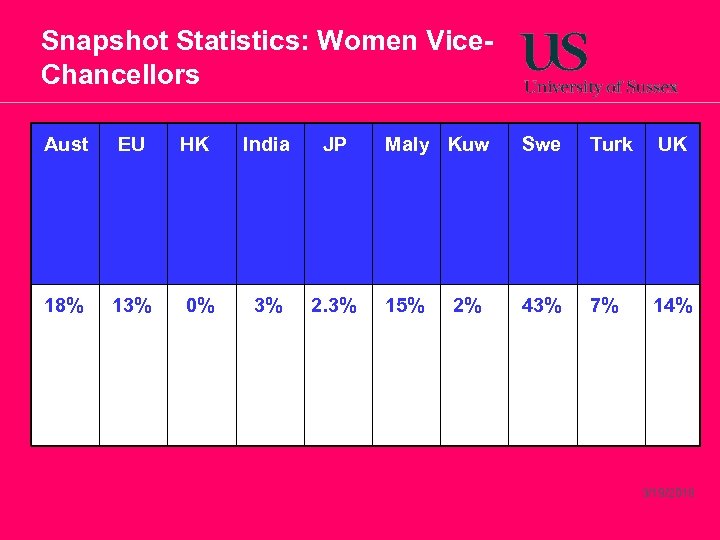 Snapshot Statistics: Women Vice. Chancellors Aust EU HK India JP 18% 13% 0% 3% 2. 3% Maly Kuw Swe Turk UK 15% 43% 7% 14% 2% 3/19/2018
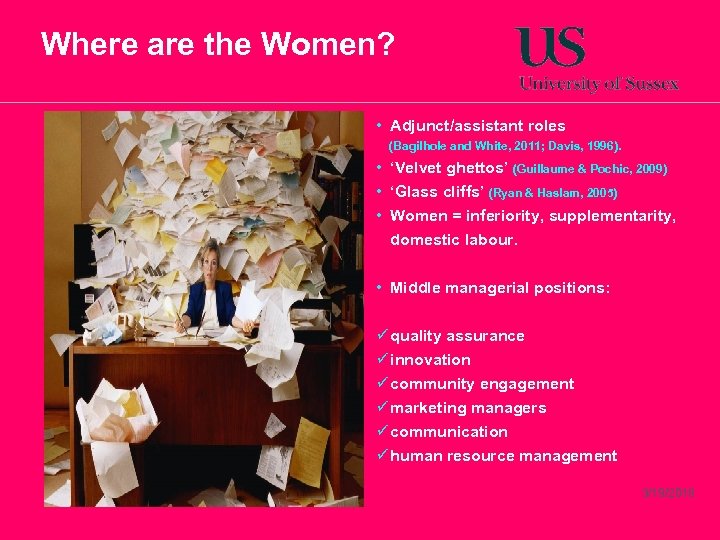 Where are the Women? • Adjunct/assistant roles (Bagilhole and White, 2011; Davis, 1996). • ‘Velvet ghettos’ (Guillaume & Pochic, 2009) • ‘Glass cliffs’ (Ryan & Haslam, 2005) • Women = inferiority, supplementarity, domestic labour. • Middle managerial positions: ü quality assurance ü innovation ü community engagement ü marketing managers ü communication ü human resource management 3/19/2018
 The Gendered Research Economy Women less likely to be: üJournal editors/cited in toprated journals (Tight, 2008). üPrincipal investigators (EC, 2011) üOn research boards üAwarded large grants üAwarded research prizes (Nikiforova, 2011)
 Desiring, Dismissing or Disqualified? • Who self-identifies/ is identified by existing power elites, as having leadership legitimacy? • Do cultural scripts for leaders coalesce/collide with normative gender performances? • Why is women’s capital devalued and misrecognised? • How does gender continue to escape organisational logic/rationalities? • Is leadership a sign of upward mobility/normative fantasy and/or a bad object of desire (Berlant, 2011).
 Consequences of Absence of Leadership Diversity Employment/ Opportunity Structures ü Democratic Deficit ü Distributive injustice/ Structural Prejudice. ü Depressed career opportunities. ü Misrecognition of leadership potential/ wasted talent. Service Delivery ü Reproduction of Institutional Norms and Practices. ü Margins/ Mainstream hegemonies, with women, BME staff seen as Organisational ‘Other’. ü Knowledge Distortions, Cognitive/ Epistemic injustice (Fricker, 2007)
 Absences and Aspirations in the Global Academy • • • • • • Australia (Fitzgerald, 2011) Canada (Acker, 2012) China (Chen, 2012) Finland (Husu, 2000) Ghana (Ohene, 2010) Guyana (Austin, 2002) Hong Kong (Cheung, 2012) Ireland (Lynch, 2010) Japan (Shirahase, 2013) Kenya (Onsongo, 2004) Nigeria (Odejide, 2007) Norway (Benediktsdottir, 2008) Pakistan (Rab, 2010) Papua New Guinea (Sar & Wilkins, 2001) South Africa (Shackleton et al. , 2006) South Korea (Kim et al. , 2010) Sri Lanka (Gunawardena et al. , 2006) Sweden (Peterson, 2011) Tanzania (Bhalalusesa, 1998) Turkey (Özkanli, 2009) Uganda (Kwesiga & Ssendiwala, 2006) UK (Deem, 2003) 3/19/2018 USA (Bonner, 2006)
 Accounting for Absences/ Expanding the Theoretical Lexicon • Gendered Division of Labour • Gender Bias/ Misrecognition • Management & Masculinity • Greedy Organisations • Women’s Missing Agency/ Deficit Internal Conversations (Morley, 2012, 2013) 3/19/2018
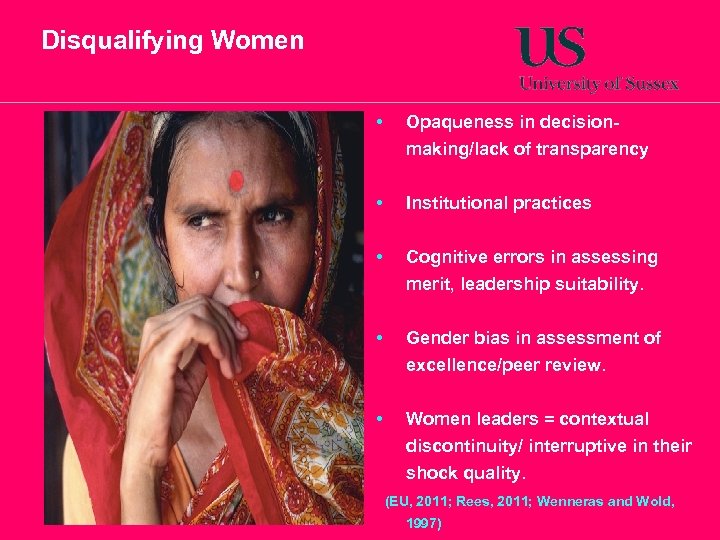 Disqualifying Women • Opaqueness in decisionmaking/lack of transparency • Institutional practices • Cognitive errors in assessing merit, leadership suitability. • Gender bias in assessment of excellence/peer review. • Women leaders = contextual discontinuity/ interruptive in their shock quality. (EU, 2011; Rees, 2011; Wenneras and Wold, 1997)
 Epistemic (In)Justice (Fricker, 2007) Testimonial Injustice Hermeneutical Injustice • When prejudice causes a hearer to • Gap in collective interpretative give a deflated level of credibility to resources/ structural identity a speaker’s world. prejudice put someone at an unfair disadvantage when it comes to • e. g. women rape victims not being making sense of their social believed. experiences. • Sharia Law (Mahmood, 2005; Salime, 2011). • e. g. suffering sexual harassment in a culture that still lacks that critical concept. 3/19/2018
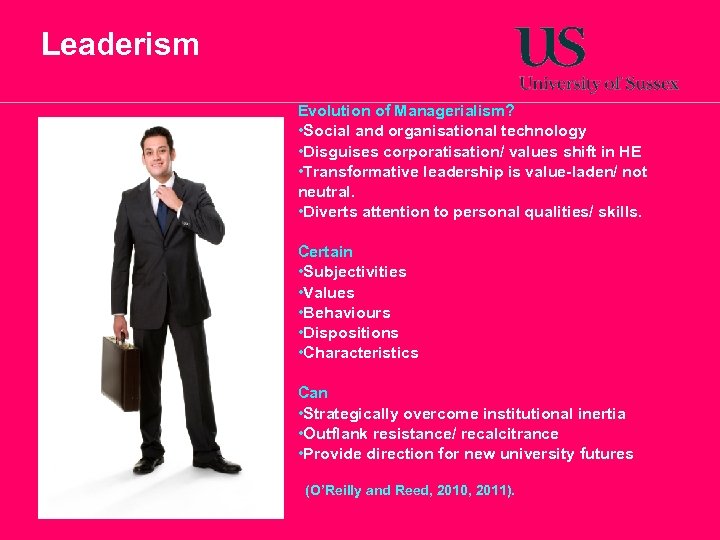 Leaderism Evolution of Managerialism? • Social and organisational technology • Disguises corporatisation/ values shift in HE • Transformative leadership is value-laden/ not neutral. • Diverts attention to personal qualities/ skills. Certain • Subjectivities • Values • Behaviours • Dispositions • Characteristics Can • Strategically overcome institutional inertia • Outflank resistance/ recalcitrance • Provide direction for new university futures (O’Reilly and Reed, 2010, 2011).
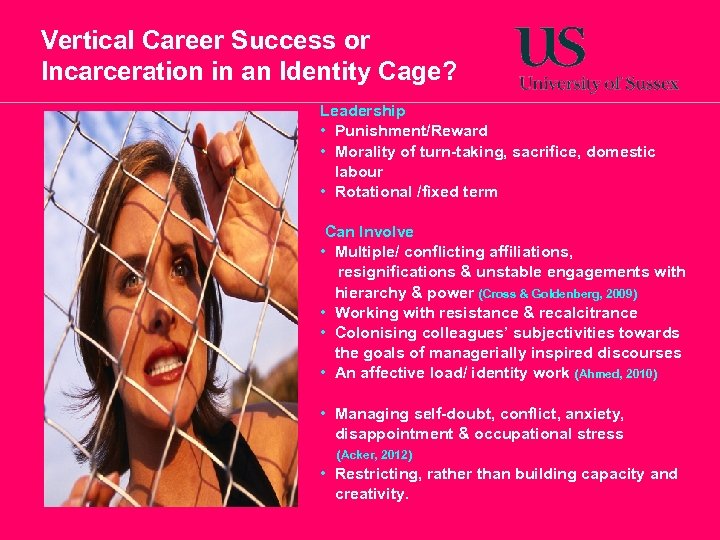 Vertical Career Success or Incarceration in an Identity Cage? Leadership • Punishment/Reward • Morality of turn-taking, sacrifice, domestic labour • Rotational /fixed term Can Involve • Multiple/ conflicting affiliations, resignifications & unstable engagements with hierarchy & power (Cross & Goldenberg, 2009) • Working with resistance & recalcitrance • Colonising colleagues’ subjectivities towards the goals of managerially inspired discourses • An affective load/ identity work (Ahmed, 2010) • Managing self-doubt, conflict, anxiety, disappointment & occupational stress (Acker, 2012) • Restricting, rather than building capacity and creativity.
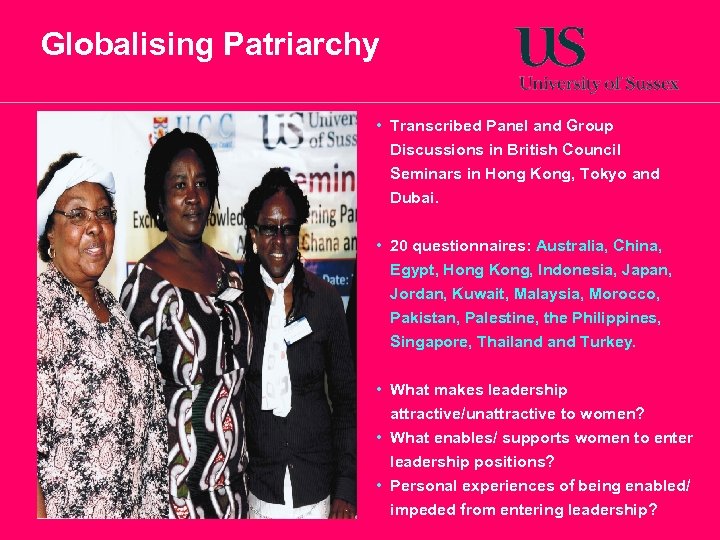 Globalising Patriarchy • Transcribed Panel and Group Discussions in British Council Seminars in Hong Kong, Tokyo and Dubai. • 20 questionnaires: Australia, China, Egypt, Hong Kong, Indonesia, Japan, Jordan, Kuwait, Malaysia, Morocco, Pakistan, Palestine, the Philippines, Singapore, Thailand Turkey. • What makes leadership attractive/unattractive to women? • What enables/ supports women to enter leadership positions? • Personal experiences of being enabled/ impeded from entering leadership?
 Women’s Internal Conversations (Archer, 2003) Women Are Not/ Rarely • Identified, supported and developed for leadership. • Achieving the most senior leadership positions in prestigious, national coeducational universities. • Personally/ collectively desiring senior leadership. Women Are • Constrained by socio-cultural messages e. g. the highly educated woman as the ‘third sex’. • Entering middle management. • Entering some senior leadership positions in non -elite universities. • Often located on career pathways that do not lead to senior positions. • Attracted to influence, rewards and recognition. • • Attracted to labour intensity of competitive, Burdened with affective load: audit cultures in the managerialised global ü being ‘other’ in masculinist cultures ü navigating between professional and domestic academy. responsibilities.
 Leadership Performances = Unliveable Lives? (Butler, 2004) Dismissing • Extreme profession/ virility test. • Affective capital deployed to direct? (‘soft’ skills/ ‘hard’ messages) • Reinforces organisational identity categories? Desiring • Berlant’s concept of ‘cruel optimism’ maintaining an attachment to a problematic object in advance of its loss? (2011) 3/19/2018
 Manifesto for Change: Accountability, Transparency, Development and Data Equality as Quality - equality should be made a Key Performance Indicator (KPI) in quality audits, with data to be returned on percentage and location of women professors and leaders, percentage and location of undergraduate and postgraduate students and gender pay equality. Gender equity achievements should be included in international recognition and reputation for universities in league tables. Research Grants - funders should monitor the percentage of applications and awards made to women and to actively promote more women as principal investigators. The applications procedures should be reviewed to incorporate a more inclusive and diverse philosophy of achievement. Gender implications and impact should also be included in assessment criteria. Journals - Editorial Boards, and the appointment of editors, need more transparent selection processes, and policies on gender equality e. g. to keep the gender balance in contributions under review. Data - a global database on women and leadership in higher education should be established. Development - more investment needs to be made in mentorship and leadership development programmes for women and gender needs to be included in existing leadership development programmes. Mainstreaming - work cultures should be reviewed to ensure that diversity is 3/19/2018 mainstreamed into all organisational practices and procedures.
 Summary: Determinism or Voluntarism? • Global academy = hypermodernisation. • Male leadership = archaism (Morley, 2011) • Accounts for women’s absences = often socially deterministic/essentialised. • Leadership perceived as structurally and culturally restorative of the status quo. • Representation is NOT transformational. • Women/minorities = access to some leadership positions. • Lack capital (economic, political, social and symbolic) to redefine the requirements of the field (Corsun & Costen, 2001). • Women exercising their personal powers to reject the situational logic of career progression? • Women making affective bargains re. costliness of attachment to leadership aspirations?
 Making Alternativity Imaginable? How can • leadership narratives • technologies & practices be more: üthan discursive performances involving repetitions of the values/ beliefs/ regulative norms of new public governance/austerity üthan legitimating HE reform narratives ümore generative, generous and gender-free? 3/19/2018
 Follow Up? • Morley, L. (2013) "The Rules of the Game: Women and the Leaderist Turn in Higher Education " Gender and Education. 25(1): 116 -131. CHEER http: //www. sussex. ac. uk/education/cheer/ • Morley, L. (2013) Women and Higher Education Leadership: Absences and Aspirations. Stimulus Paper for the Leadership Foundation for Higher Education. • Morley, L. (2013) International Trends in Women’s Leadership in Higher Education In, T. Gore, and Stiasny, M (eds) Going Global. London, Emerald Press. 3/19/2018