


 Скачать презентацию Le programme de la Division de la Recherche
85cbdb45bcb71eb6b581846ba70a1a44.ppt
- Количество слайдов: 44
 Le programme de la Division de la Recherche en Météorologie (DRM): les enjeux de la prévision météorologique et environnementale numérique. WWRP Gilbert Brunet CMC, 3 mars 2011
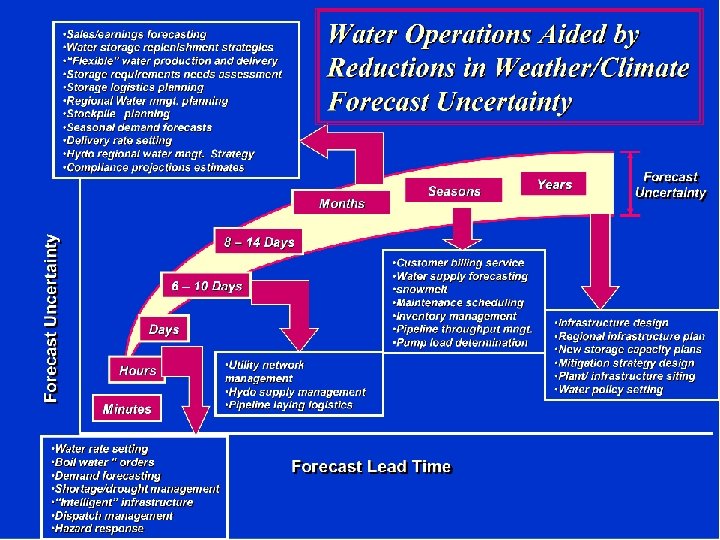
 Des besoins croissants dans les domaines de la météorologie, de l'eau et de prévision environnementale pour gérer l'évolution de la population, de la démographie, de l’économie, de l’utilisation des ressources, la santé et l'environnement Au cours de 1992 -2001, les catastrophes naturelles dans le monde ont tué 622 000 personnes et touché plus de 2 milliards de personnes; § Pour la décennie 1992 -2001, les pertes dues aux catastrophes naturelles d'origine hydrométéorologique ont été estimées à 446 milliards $US , ce qui représente environ 65% des dommages dûs à toutes les catastrophes naturelles; § Des études récentes en France, Royaume-Uni, Canada, Etats-Unis et l'ONU ont montré qu'environ 30 -40% du PNB des pays développés sont sensibles aux conditions météorologiques pour l'échelle de temps de quelques minutes à plusieurs saisons. WWRP §
 Programme de la Division de la recherche en météorologie § Service scientifique d’Environnement Canada qui a pour objectif de : Ø Fournir une base scientifique pour l’amélioration des services essentiels en matière de prévisions météorologiques et en rapport à l’environnement offerts par le SMC à tous les Canadiens et Canadiennes (incluant la Garde côtière canadienne, au Ministère de la Défense nationale et Nav Canada et à d’autres clients); WWRP Ø Réduire au minimum les risques liés aux conditions climatiques et météorologiques pour les principaux secteurs économiques (p. ex. le secteur forestier, l’agriculture, l’énergie) et maximiser les nouvelles possibilités économiques en vue d’améliorer l’efficacité et la compétitivité; Ø Miser sur les données, les renseignements et les innovations en matière environnementale et climatique en participant aux partenariats nationaux et internationaux (p. ex. Services Météorologiques et Hydrologiques Nationaux, OMM, THORPEX) et en contribuant aux initiatives (p. ex. API, MERCATOR)
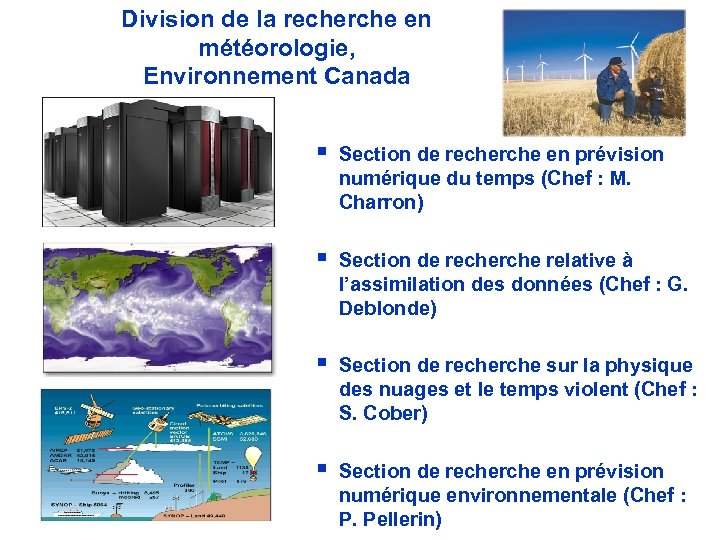 Division de la recherche en météorologie, Environnement Canada Section de recherche en prévision numérique du temps (Chef : M. Charron) § Section de recherche relative à l’assimilation des données (Chef : G. Deblonde) § WWRP § Section de recherche sur la physique des nuages et le temps violent (Chef : S. Cober) § Section de recherche en prévision numérique environnementale (Chef : P. Pellerin)
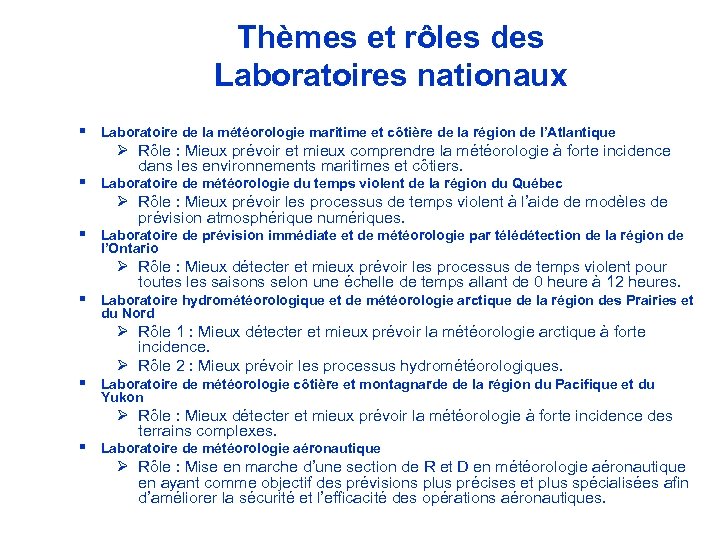 Thèmes et rôles des Laboratoires nationaux § § WWRP § § Laboratoire de la météorologie maritime et côtière de la région de l’Atlantique Ø Rôle : Mieux prévoir et mieux comprendre la météorologie à forte incidence dans les environnements maritimes et côtiers. Laboratoire de météorologie du temps violent de la région du Québec Ø Rôle : Mieux prévoir les processus de temps violent à l’aide de modèles de prévision atmosphérique numériques. Laboratoire de prévision immédiate et de météorologie par télédétection de la région de l’Ontario Ø Rôle : Mieux détecter et mieux prévoir les processus de temps violent pour toutes les saisons selon une échelle de temps allant de 0 heure à 12 heures. Laboratoire hydrométéorologique et de météorologie arctique de la région des Prairies et du Nord Ø Rôle 1 : Mieux détecter et mieux prévoir la météorologie arctique à forte incidence. Ø Rôle 2 : Mieux prévoir les processus hydrométéorologiques. Laboratoire de météorologie côtière et montagnarde de la région du Pacifique et du Yukon Ø Rôle : Mieux détecter et mieux prévoir la météorologie à forte incidence des terrains complexes. Laboratoire de météorologie aéronautique Ø Rôle : Mise en marche d’une section de R et D en météorologie aéronautique en ayant comme objectif des prévisions plus précises et plus spécialisées afin d’améliorer la sécurité et l’efficacité des opérations aéronautiques.
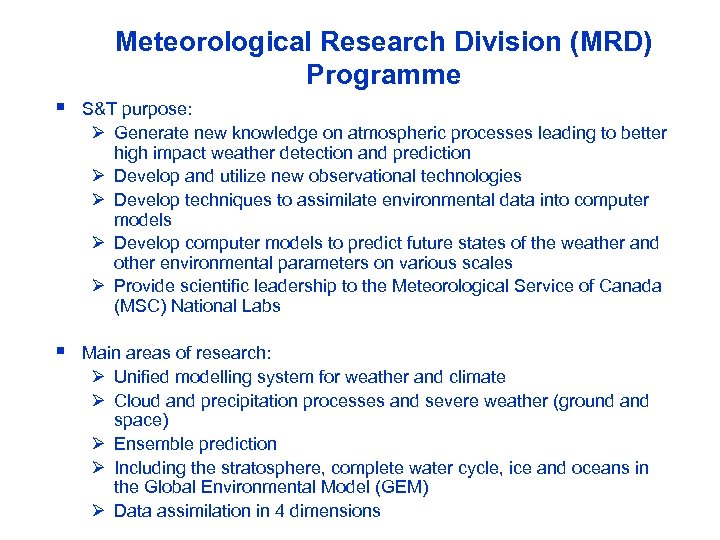 Meteorological Research Division (MRD) Programme S&T purpose: Ø Generate new knowledge on atmospheric processes leading to better high impact weather detection and prediction Ø Develop and utilize new observational technologies Ø Develop techniques to assimilate environmental data into computer models Ø Develop computer models to predict future states of the weather and other environmental parameters on various scales Ø Provide scientific leadership to the Meteorological Service of Canada (MSC) National Labs § WWRP § Main areas of research: Ø Unified modelling system for weather and climate Ø Cloud and precipitation processes and severe weather (ground and space) Ø Ensemble prediction Ø Including the stratosphere, complete water cycle, ice and oceans in the Global Environmental Model (GEM) Ø Data assimilation in 4 dimensions
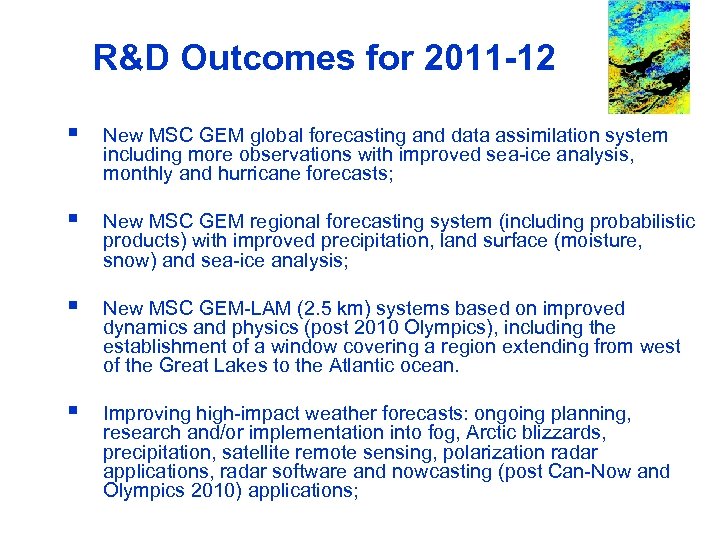 R&D Outcomes for 2011 -12 New MSC GEM global forecasting and data assimilation system including more observations with improved sea-ice analysis, monthly and hurricane forecasts; § New MSC GEM regional forecasting system (including probabilistic products) with improved precipitation, land surface (moisture, snow) and sea-ice analysis; § WWRP § New MSC GEM-LAM (2. 5 km) systems based on improved dynamics and physics (post 2010 Olympics), including the establishment of a window covering a region extending from west of the Great Lakes to the Atlantic ocean. § Improving high-impact weather forecasts: ongoing planning, research and/or implementation into fog, Arctic blizzards, precipitation, satellite remote sensing, polarization radar applications, radar software and nowcasting (post Can-Now and Olympics 2010) applications;
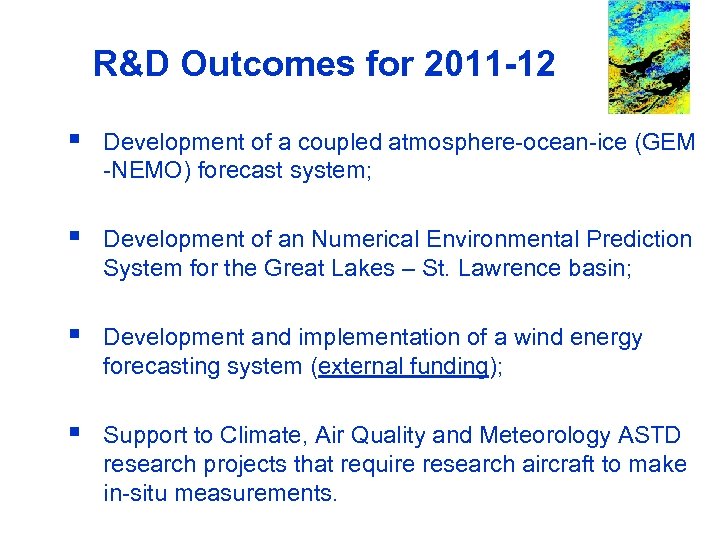 R&D Outcomes for 2011 -12 Development of a coupled atmosphere-ocean-ice (GEM -NEMO) forecast system; § Development of an Numerical Environmental Prediction System for the Great Lakes – St. Lawrence basin; § WWRP § Development and implementation of a wind energy forecasting system (external funding); § Support to Climate, Air Quality and Meteorology ASTD research projects that require research aircraft to make in-situ measurements.
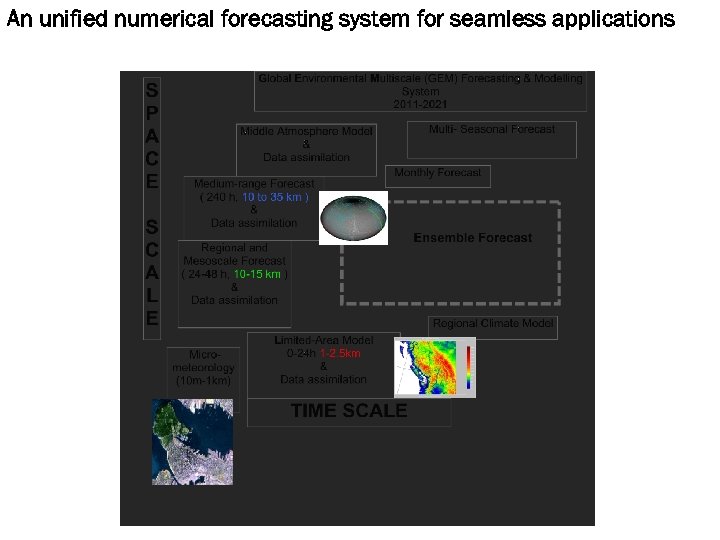 An unified numerical forecasting system for seamless applications WWRP
 An Earth-System Prediction Initiative: An Interdisciplinary Approach WWRP Gilbert Brunet World Weather Research Programme (WWRP) Chair of the Joint Scientific Committee Chair Acknowledgements: M. Shapiro, P. Bechtold, J. -F. Cantin, M. Desgagné, R. Dole, H. Lin, M. Miller, J. Morin, C. Nobre, P. Pellerin and J. Shukla
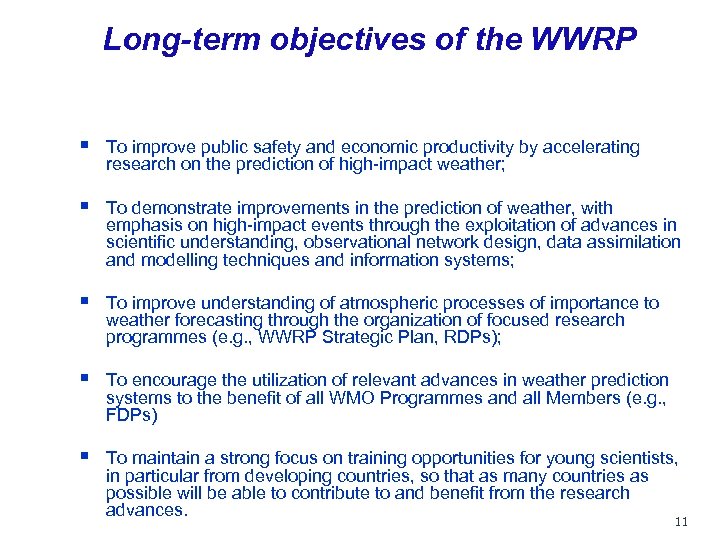 Long-term objectives of the WWRP To improve public safety and economic productivity by accelerating research on the prediction of high-impact weather; § To demonstrate improvements in the prediction of weather, with emphasis on high-impact events through the exploitation of advances in scientific understanding, observational network design, data assimilation and modelling techniques and information systems; § To improve understanding of atmospheric processes of importance to weather forecasting through the organization of focused research programmes (e. g. , WWRP Strategic Plan, RDPs); § WWRP § To encourage the utilization of relevant advances in weather prediction systems to the benefit of all WMO Programmes and all Members (e. g. , FDPs) § To maintain a strong focus on training opportunities for young scientists, in particular from developing countries, so that as many countries as possible will be able to contribute to and benefit from the research advances. 11
 WWRP
WWRP
 WWRP An Earth system Prediction Initiative
 Putting it All Together World Meteorological Organization (WMO), World Weather Research Programme (WWRP), World Climate Research Programme (WCRP), International Geosphere. Biosphere Programme (IGBP), Global Climate Observing System (GCOS), and natural-hazards and socioeconomic communities. An Earth-System Prediction Initiative for the Twenty-First Century (Shapiro et al. ) § Addressing the Complexity of the Earth System (Nobre et al. ) § WWRP § Collaboration of the Weather and Climate Communities to Advance Subseasonal-to-Seasonal Prediction (Brunet et al. ) § Toward a New Generation of World Climate Research and Computing Facilities (Shukla et al. )
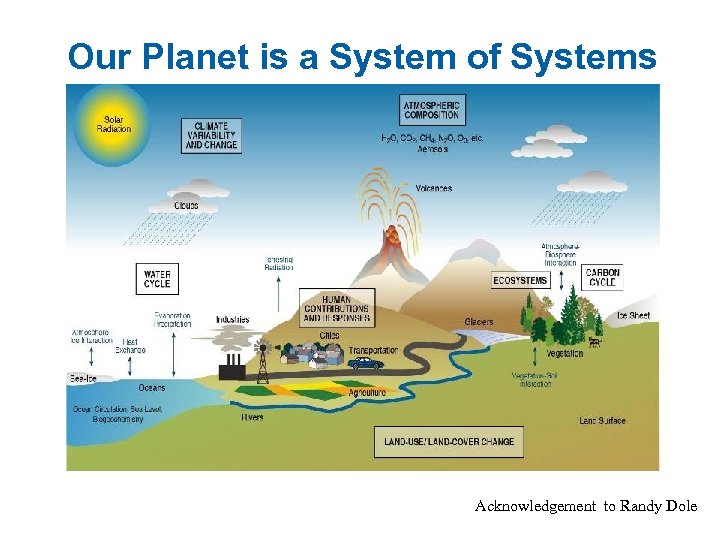 WWRP Our Planet is a System of Systems Acknowledgement to Randy Dole
 Overview of the Initiative An international-to-regional framework that links observed and predicted climate and weather to seamless interactions and feedbacks with biogeochemistry, biology, and socioeconomic impacts and drivers, e. g. , demography; global policy constraints; technology innovations; § WWRP § Global Earth-system analysis and prediction models that account for physical, chemical, biological and societal processes through coupled atmosphere– ocean–land–ice systems.
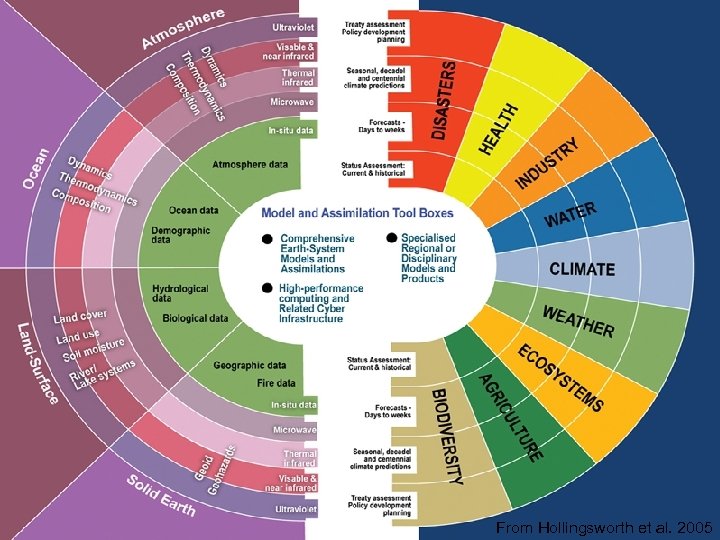 WWRP From Hollingsworth et al. 2005
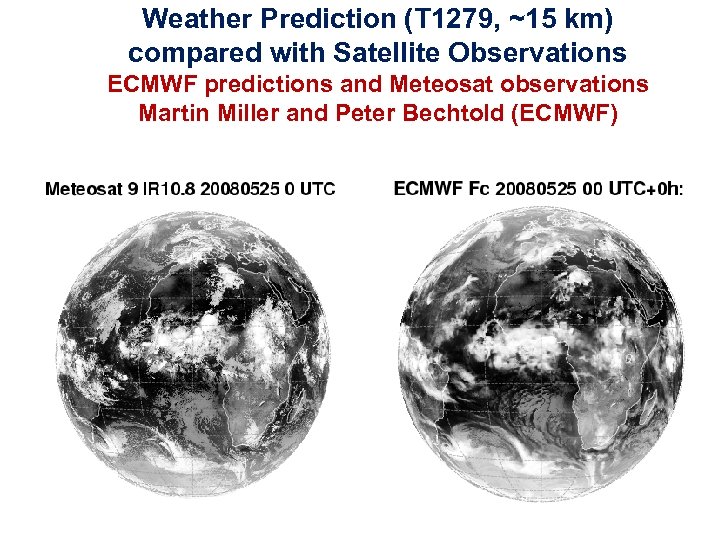 Weather Prediction (T 1279, ~15 km) compared with Satellite Observations WWRP ECMWF predictions and Meteosat observations Martin Miller and Peter Bechtold (ECMWF)
 An Earth-system Prediction Initiative for the 21 st Century An international interdisciplinary initiative to accelerate advances in knowledge, prediction, use and value of weather, climate and Earth-system information. § WWRP § Representatives from the weather, climate, geo-chemicalbiological, observational, operational and service communities. Ø M. A. Shapiro, Jagadish Shukla, Gilbert Brunet, Carlos Nobre, Michel Béland, Randall Dole, Kevin Trenberth, Richard Anthes, Ghassem Asrar, Leonard Barrie, Philippe Bougeault, Guy Brasseur, David Burridge, Antonio Busalacchi, Jim Caughey, Delaing Chen, John Church, Takeshi Enomoto, Brian Hoskins, Øystein Hov, Arlene Laing , Hervé Le Treut, Jochem Marotzke, Gordon Mc. Bean, Gerald Meehl, Martin Miller, Brian Mills, John Mitchell, Mitchell Moncrieff, Tetsuo Nakazawa, Haraldur Olafsson, Tim Palmer, David Parsons, David Rogers, Adrian Simmons, Alberto Troccoli, Zoltan Toth, Louis Uccellini, Christopher Velden and John M. Wallace.
 Requirements Science, technology and education projects to enhance knowledge, awareness and utilization of weather, climate and environmental and socio-economic information; • advanced high-performance computing facilities, supporting a worldwide network of research and operational modeling centers, and early-warning systems; • investments in maintaining existing and developing new observational capabilities; and • WWRP • infrastructure to transition achievements into operational products and services.
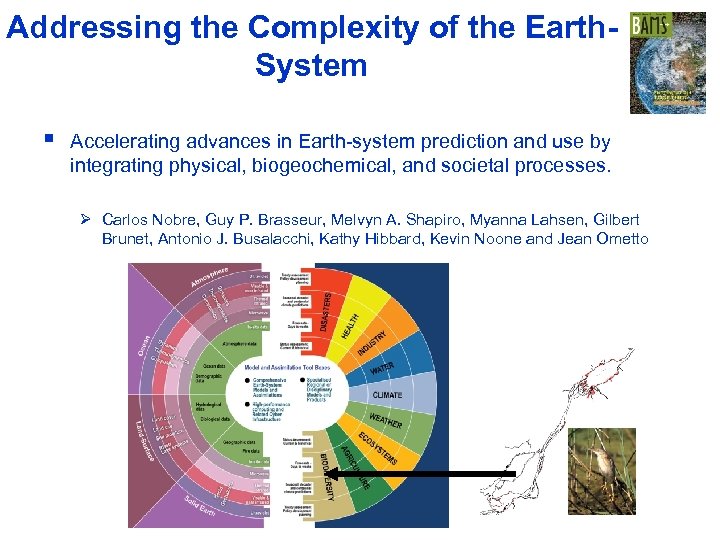 Addressing the Complexity of the Earth- System § Accelerating advances in Earth-system prediction and use by integrating physical, biogeochemical, and societal processes. WWRP Ø Carlos Nobre, Guy P. Brasseur, Melvyn A. Shapiro, Myanna Lahsen, Gilbert Brunet, Antonio J. Busalacchi, Kathy Hibbard, Kevin Noone and Jean Ometto
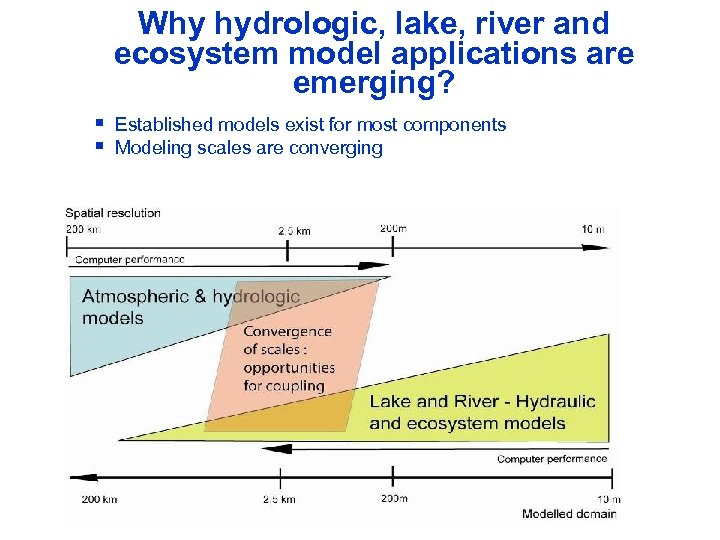 Why hydrologic, lake, river and ecosystem model applications are emerging? WWRP § § Established models exist for most components Modeling scales are converging
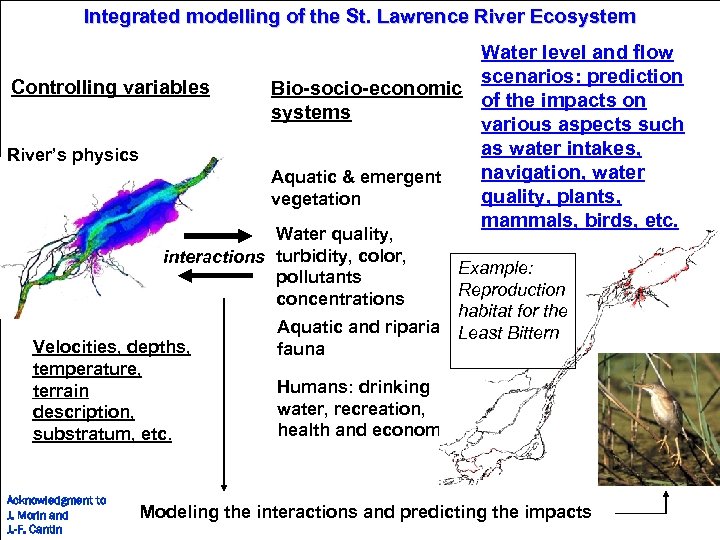 Integrated modelling of the St. Lawrence River Ecosystem Controlling variables River’s physics Water level and flow scenarios: prediction Bio-socio-economic of the impacts on systems various aspects such as water intakes, navigation, water Aquatic & emergent quality, plants, vegetation mammals, birds, etc. Water quality, interactions turbidity, color, pollutants concentrations WWRP Velocities, depths, temperature, terrain description, substratum, etc. Acknowledgment to J. Morin and J. -F. Cantin Example: Reproduction habitat for the Aquatic and riparian Least Bittern fauna Humans: drinking water, recreation, health and economy Modeling the interactions and predicting the impacts
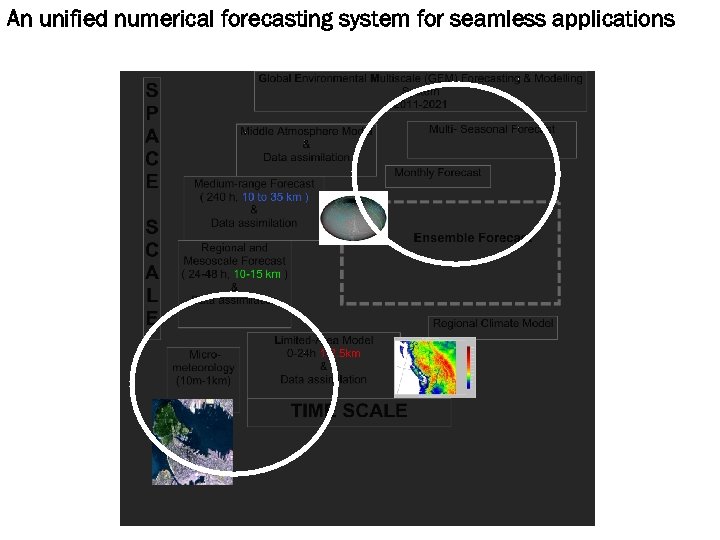 An unified numerical forecasting system for seamless applications WWRP
 Collaboration between the Weather and Climate Communities to Advance Sub-Seasonal to Seasonal Prediction § To achieve progress in long-range prediction, the coordination of research is needed in: multi-model ensemble prediction system, tropical convection, and its two-way interaction with the global circulation, data assimilation and its socioeconomic applications. WWRP Ø Gilbert Brunet, Melvyn Shapiro, Brian Hoskins, Mitch Moncrieff, Randal Dole, George N. Kiladis, Ben Kirtman, Andrew Lorenc, Brian Mills, Rebecca Morss, Saroja Polavarapu, David Rogers, John Schaake and Jagadish Shukla.
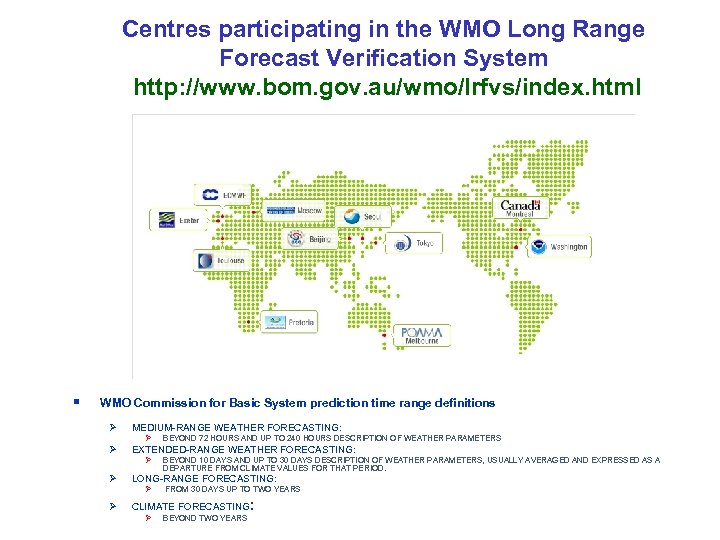 WWRP Centres participating in the WMO Long Range Forecast Verification System http: //www. bom. gov. au/wmo/lrfvs/index. html § WMO Commission for Basic System prediction time range definitions Ø MEDIUM-RANGE WEATHER FORECASTING: Ø EXTENDED-RANGE WEATHER FORECASTING: Ø Ø Ø BEYOND 10 DAYS AND UP TO 30 DAYS DESCRIPTION OF WEATHER PARAMETERS, USUALLY AVERAGED AND EXPRESSED AS A DEPARTURE FROM CLIMATE VALUES FOR THAT PERIOD. LONG-RANGE FORECASTING: Ø Ø BEYOND 72 HOURS AND UP TO 240 HOURS DESCRIPTION OF WEATHER PARAMETERS FROM 30 DAYS UP TO TWO YEARS : CLIMATE FORECASTING Ø BEYOND TWO YEARS
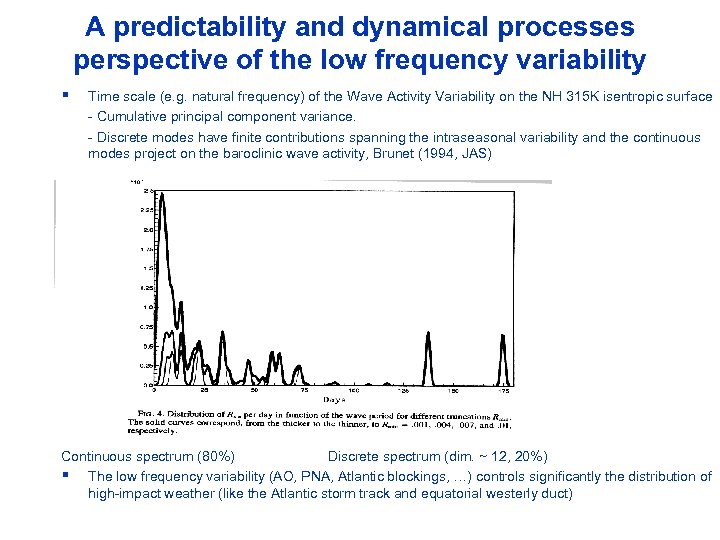 A predictability and dynamical processes perspective of the low frequency variability WWRP § Time scale (e. g. natural frequency) of the Wave Activity Variability on the NH 315 K isentropic surface - Cumulative principal component variance. - Discrete modes have finite contributions spanning the intraseasonal variability and the continuous modes project on the baroclinic wave activity, Brunet (1994, JAS) Continuous spectrum (80%) Discrete spectrum (dim. ~ 12, 20%) § The low frequency variability (AO, PNA, Atlantic blockings, …) controls significantly the distribution of high-impact weather (like the Atlantic storm track and equatorial westerly duct)
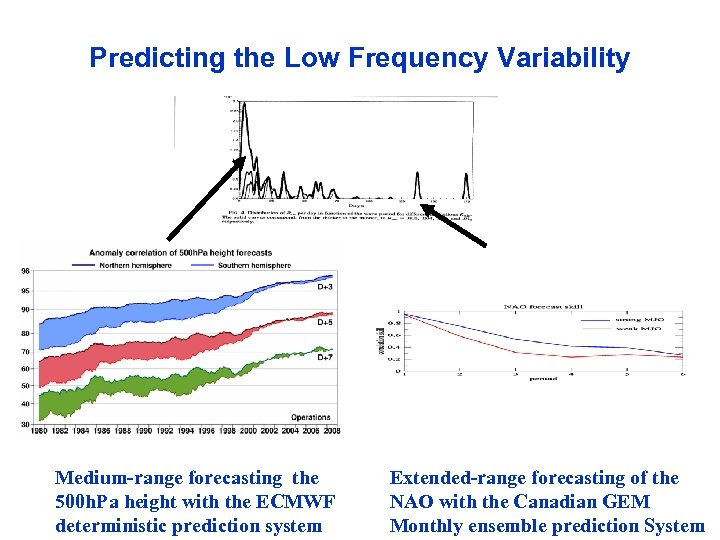 WWRP Predicting the Low Frequency Variability Medium-range forecasting the 500 h. Pa height with the ECMWF deterministic prediction system Extended-range forecasting of the NAO with the Canadian GEM Monthly ensemble prediction System
 Collaboration between the Weather and Climate Communities to Advance Sub-seasonal-to-Seasonal Prediction: Research Issues Significant progress: The multi-scale organisation of tropical convection and its two-way interaction with the global circulation § Seamless weather/climate prediction with Multi-model Ensemble Prediction Systems (MEPSs) § WWRP § Data assimilation for coupled models as a prediction and validation tool for weather and climate research § Utilization of sub-seasonal predictions for social and economic benefits
 The multi-scale organisation of tropical convection and its twoway interaction with the global circulation Collaborative effort through YOTC; § Capability acceleration of the High-Performance Computing (HPC) centers for high-resolution regional and global numerical weather, climate and environmental science activities; § WWRP § Maintaining existing and implementing planned satellite missions that measure tropical cloud and precipitation systems in order to provide a long-term capability for process studies, data assimilation and prediction in collaboration with GCOS.
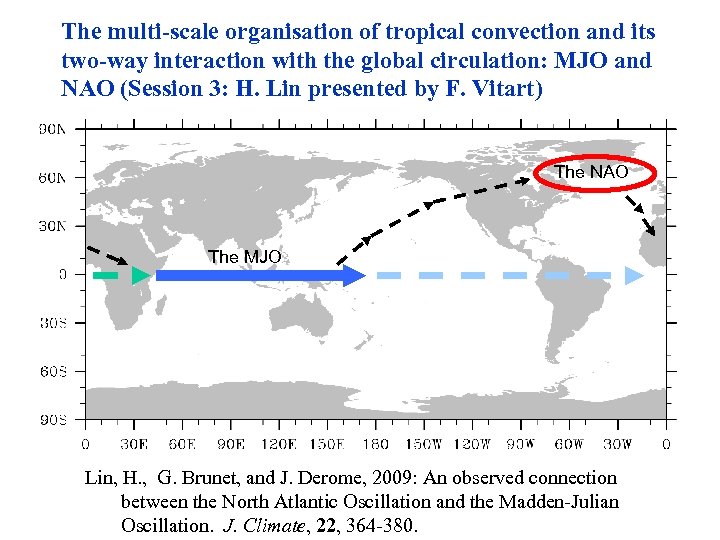 The multi-scale organisation of tropical convection and its two-way interaction with the global circulation: MJO and NAO (Session 3: H. Lin presented by F. Vitart) The NAO WWRP The MJO Lin, H. , G. Brunet, and J. Derome, 2009: An observed connection between the North Atlantic Oscillation and the Madden-Julian Oscillation. J. Climate, 22, 364 -380.
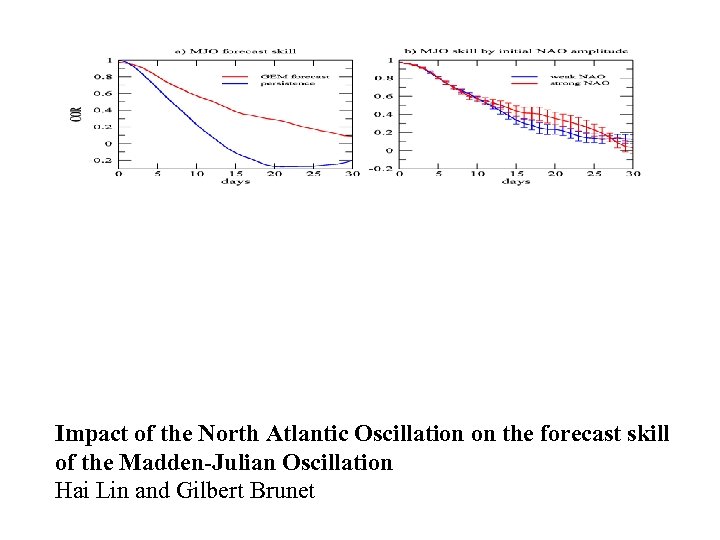 WWRP Impact of the North Atlantic Oscillation on the forecast skill of the Madden-Julian Oscillation Hai Lin and Gilbert Brunet
 Seamless weather/climate prediction with Ensemble Prediction Systems(EPSs) § WWRP § § Terms of reference for collaboration between WCRP CLIVAR Climate-system Historical Forecast Project (CHFP) and the THORPEX Interactive Grand Global Ensemble (TIGGE) must be establish for experimentation and data sharing for sub-seasonal to seasonal historical forecasts ( weeks to season) including the required infrastructure. The requirements for both ensemble prediction methods and greatly increased spatial resolution imply substantial future requirements for computational power and for data storage and delivery capacity. Development and use of ensemble based modeling methods in order to improve probabilistic estimates of the likelihood of high-impact events.
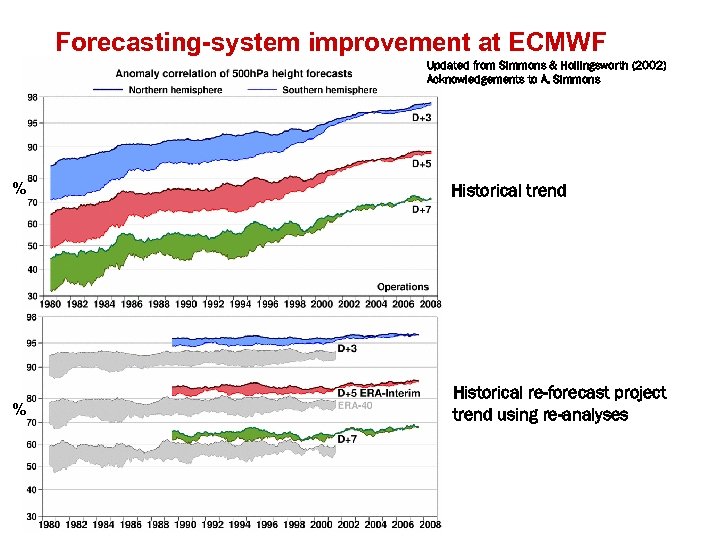 Forecasting-system improvement at ECMWF Updated from Simmons & Hollingsworth (2002) Acknowledgements to A. Simmons Historical trend % Historical re-forecast project trend using re-analyses WWRP %
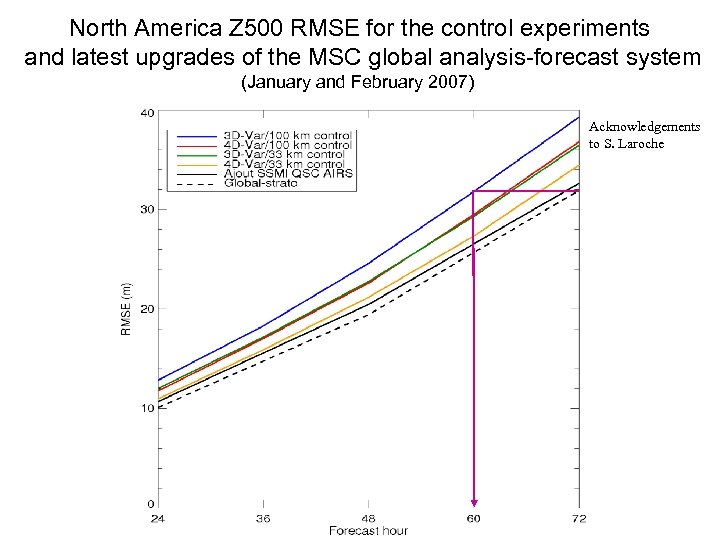 North America Z 500 RMSE for the control experiments and latest upgrades of the MSC global analysis-forecast system (January and February 2007) WWRP Acknowledgements to S. Laroche
 Data assimilation for coupled models as a prediction and validation tool for weather and climate research Promote research towards the development of a composite data assimilation system, applying different assimilation steps to different scales (weather to climate time-scales) and components (atmosphere, land, ocean, atmospheric composition) of the total Earth system model; § Promote the need to test climate models in a deterministic prediction mode, as started within the WCRP SPARC Programme. The seasonal prediction time frame provides a valuable opportunity to do this; § WWRP § Promote the use of advanced data assimilation methodologies for parameter estimation, both in weather and climate models, through close collaboration with model developers to interpret assimilation results; § Promote interdisciplinary research on data assimilation methods appropriate for the next generation of re-analysis projects aimed at developing historical records for climate studies.
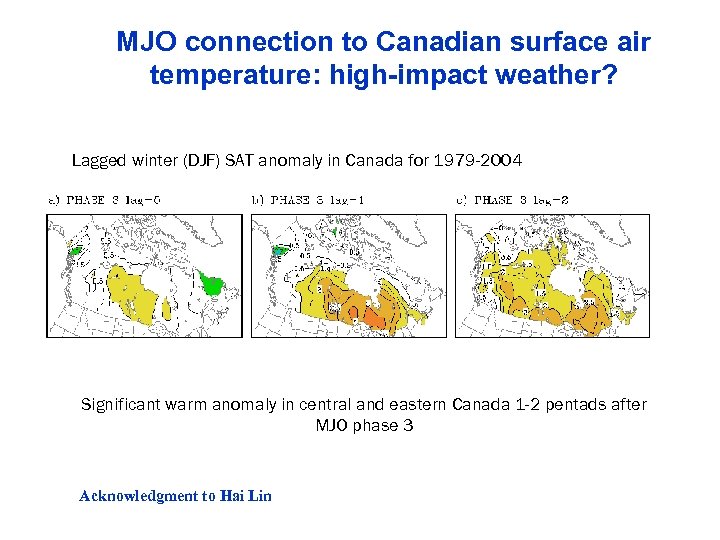 MJO connection to Canadian surface air temperature: high-impact weather? WWRP Lagged winter (DJF) SAT anomaly in Canada for 1979 -2004 Significant warm anomaly in central and eastern Canada 1 -2 pentads after MJO phase 3 Acknowledgment to Hai Lin
 Social and Economic Utilization of Sub-Seasonal and Seasonal Predictions § A need for closer ties between weather and climate research: Ø Understanding how information at the weather/climate interface, including uncertainty, connects with decision-making There is also a great need for much easier access to forecast data by the user community. These need to be available in special user-oriented products. How could we achieve this service? § WWRP § The post-processing techniques that are needed by many users may require an archive of past forecasts (e. g. for water cycle applications). Some user applications require an archive of re-forecasts from fixed models for periods as long as 20 years or more.
 WWRP
WWRP
 Toward Next Generation Computing Facilities for Weather, Climate and Earth-system Research and Services Advancing the skill and use of Earth-system science and its applications is critically dependent on accelerated investments in national-to-global HPC to enable the implementation of next-generation weather, climate and Earth-system monitoring, assessment, data-assimilation, and prediction systems. § This requires dedicated facilities with sustained speeds well beyond that of the most advanced computers of today, but which are thought to be achievable within 10 -20 years. § These facilities would be situated at research centers staffed with a critical mass of scientists and technicians. § WWRP § Each center could be supported by a cluster of countries with common interest in high-resolution prediction of weather, and climate variations and change and their interaction with biogeochemical cycles. Ø Toward a New Generation of World Climate Research and Computing Facilities Jagadish Shukla, Tim N. Palmer, Renate Hagedorn, Brian Hoskins, Jim Kinter, Jochem Marotzke, Martin Miller and Julia Slingo
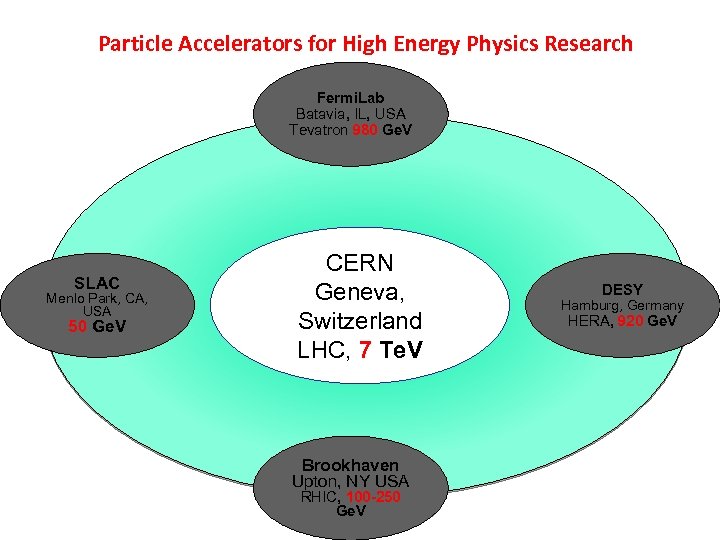 Particle Accelerators for High Energy Physics Research Fermi. Lab Batavia, IL, USA Tevatron 980 Ge. V SLAC Menlo Park, CA, USA WWRP 50 Ge. V CERN Geneva, Switzerland LHC, 7 Te. V Brookhaven Upton, NY USA RHIC, 100 -250 Ge. V DESY Hamburg, Germany HERA, 920 Ge. V
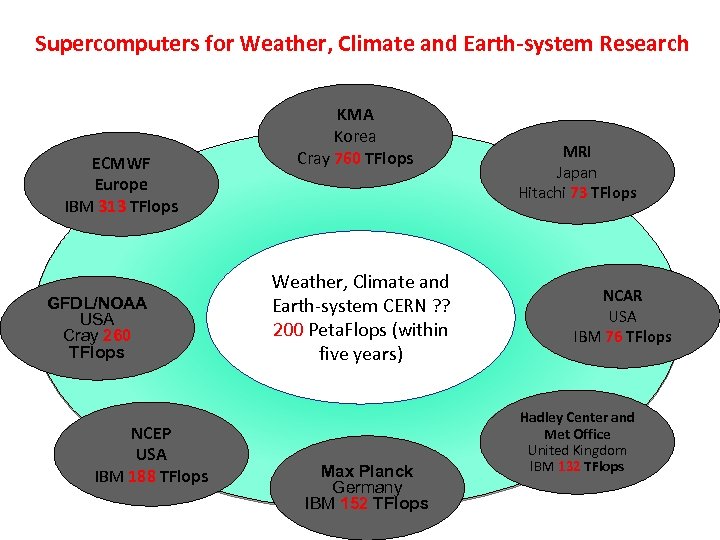 Supercomputers for Weather, Climate and Earth-system Research ECMWF Europe IBM 313 TFlops WWRP GFDL/NOAA USA Cray 260 TFlops NCEP USA IBM 188 TFlops KMA Korea Cray 760 TFlops Weather, Climate and Earth-system CERN ? ? 200 Peta. Flops (within five years) Max Planck Germany IBM 152 TFlops MRI Japan Hitachi 73 TFlops NCAR USA IBM 76 TFlops Hadley Center and Met Office United Kingdom IBM 132 TFlops
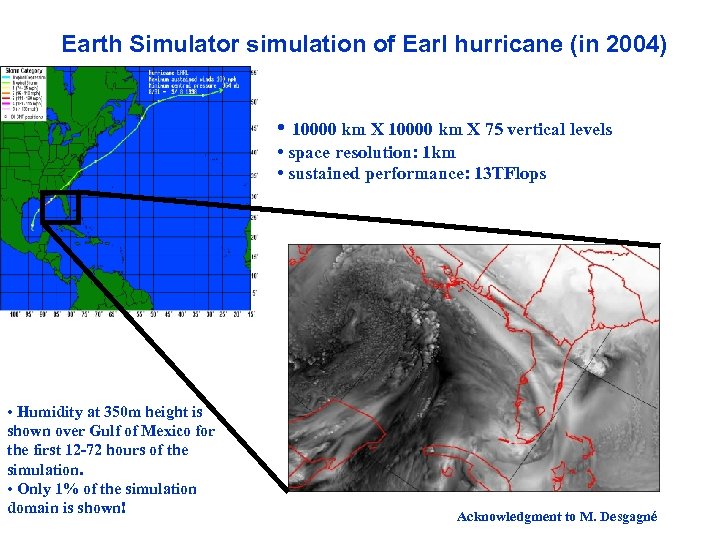 Earth Simulator simulation of Earl hurricane (in 2004) • 10000 km X 75 vertical levels • space resolution: 1 km • sustained performance: 13 TFlops WWRP • Humidity at 350 m height is shown over Gulf of Mexico for the first 12 -72 hours of the simulation. • Only 1% of the simulation domain is shown! Acknowledgment to M. Desgagné
 WWRP An Earth-system Prediction Initiative for the 21 st Century “ As nations, we have collaborated to advance global observing systems, weather forecasting, climate prediction, communication networks, and emergency preparedness and response. We must now extend this collaboration to embrace the full Earth-system and the next frontier of socioeconomic and environmental applications of our science. Our community and supporting organizations are poised for the discoveries ahead and the opportunity to make our information available to users and decision makers to meet the needs of society. “ Shapiro, Shukla, Brunet, Nobre, and others. 2010 October BAMS