


 Скачать презентацию Le faire causatif faire infinitive Reprise Chapitre
df14ecb4ddaca940e70c1e96d128193f.ppt
- Количество слайдов: 8
 Le faire causatif (faire + infinitive) Reprise, Chapitre 10
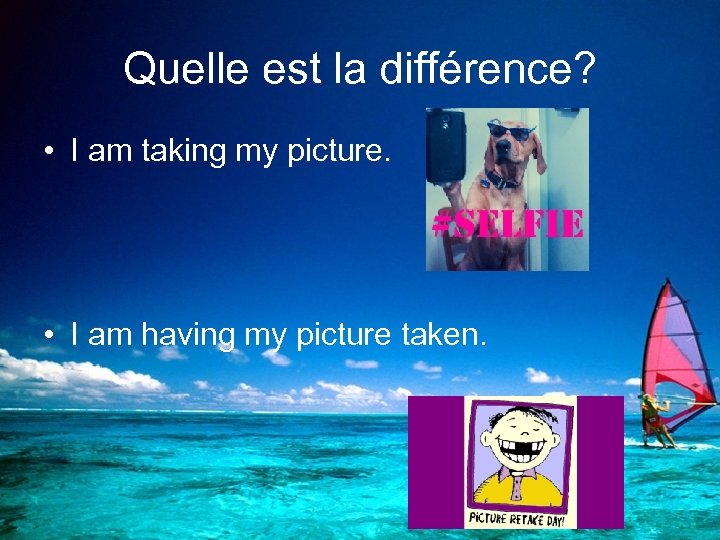 Quelle est la différence? • I am taking my picture. • I am having my picture taken.
 Faire + infinitive someone has something done by someone. Par or à can be used to indicate the person doing the action. • Il a fait réparer sa voiture (par le méchanicien). Faire can be in any tense – He had his car repaired by the mechanic. • Elles vont faire construire une maison par un nouvel architecte. – They are going to have a house built by a new architect.
 Faire + an infinitive can also indicate someone is making someone do something. • L’institutrice fait travailler les élèves. – The teacher makes the children work. • Elle les fait lire et écrire. – She makes them read and write.
 Faire + infinitive can also show something is (or is not) causing something to happen. • La guerre fait souffrir tant de gens. – War makes so many people suffer. • Le soleil fait fondre la glace. – The sun is melting the ice. • Le film n’a pas fait rire ces enfants. – The film didn’t make these children laugh.
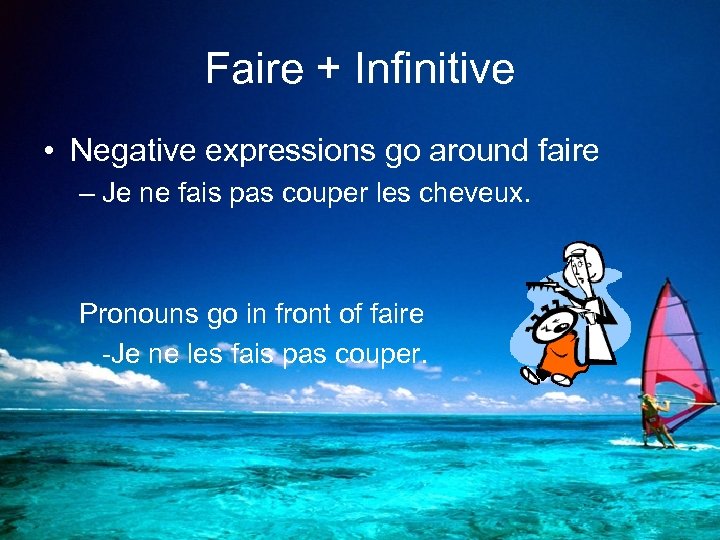 Faire + Infinitive • Negative expressions go around faire – Je ne fais pas couper les cheveux. Pronouns go in front of faire -Je ne les fais pas couper.
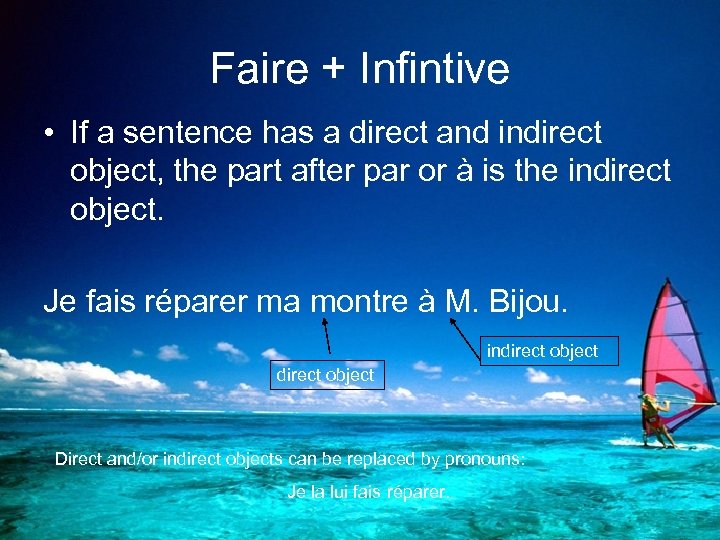 Faire + Infintive • If a sentence has a direct and indirect object, the part after par or à is the indirect object. Je fais réparer ma montre à M. Bijou. indirect object Direct and/or indirect objects can be replaced by pronouns: Je la lui fais réparer.
 NOTE: There is never agreement with a preceding direct object in the passé composé with causative faire. • Ce film? Il ne les a pas fait rire. – This film? It didn’t make them laugh. • As-tu vu Amélie? Qui l’a fait pleurer? – Did you see Amelie? Who made her cry?