 Скачать презентацию LDB-centrum Östen Jonsson Verksamhetsledare Liten insats stor
8b025e42d18ce509402d76f936b0e607.ppt
- Количество слайдов: 132



LDB-centrum Östen Jonsson Verksamhetsledare Liten insats – stor nytta 1
PReservation Organizations using Tools in AGent Environments PROTAGE Nov. 2007 – Okt 2010 20/01/2009 2
Historik - Ansökan 8 maj 2007 - Besked 17 Juli 2007 - Förhandling 30 augusti 2007 20/01/2009 3
Värdering av projektet - 14 av 15 möjliga poäng - 3 av ca 190 till förhandling - Troligen värderades vi högst 20/01/2009 4
Varför gick det så bra? - Idé - Positionering - Förhandsinformaiton - Konsortium - Ansökan 20/01/2009 5
Reflexioner - EU ville att vi skulle börja tidigare - Håll hårt i starten 20/01/2009 6
Frågor? 20/01/2009 7
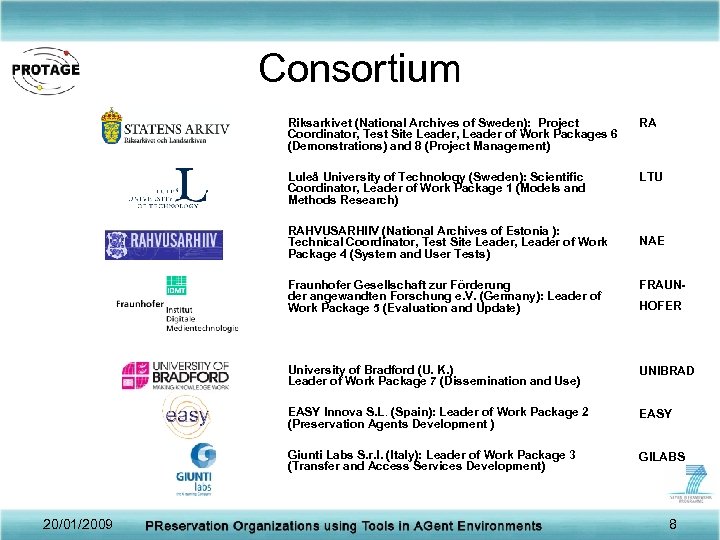
Consortium Riksarkivet (National Archives of Sweden): Project Coordinator, Test Site Leader, Leader of Work Packages 6 (Demonstrations) and 8 (Project Management) RA LTU Luleå University of Technology (Sweden): Scientific Coordinator, Leader of Work Package 1 (Models and Methods Research) RAHVUSARHIIV (National Archives of Estonia ): Technical Coordinator, Test Site Leader, Leader of Work Package 4 (System and User Tests) NAE Fraunhofer Gesellschaft zur Förderung der angewandten Forschung e. V. (Germany): Leader of Work Package 5 (Evaluation and Update) University of Bradford (U. K. ) Leader of Work Package 7 (Dissemination and Use) UNIBRAD EASY Innova S. L. (Spain): Leader of Work Package 2 (Preservation Agents Development ) EASY Giunti Labs S. r. l. (Italy): Leader of Work Package 3 (Transfer and Access Services Development) 20/01/2009 FRAUN- GILABS HOFER 8
Aim and Approach The aim: … to investigate and initiate complementary new approaches to digital preservation – that make long-term digital preservation easy enough for users to be able to help preserving their own content, – while reducing the cost and increasing the capacity of memory institutions to preserve digital information. 20/01/2009 9
Aim and Approach The idea: …to link digital objects to long-term digital preservation processes by using agentbased software technology. 20/01/2009 10
Aim and Approach The approach: …based on the latest research on digital preservation strategies and on autonomous systems, the PROTAGE project will build and validate flexible and extensible software agents for long-term digital preservation that (1) are independent of hardware and software technologies; (2) can cooperate with and be integrated in existing and new preservation systems. 20/01/2009 11
Aim and Approach Targeted end users: curators and digital content creators, including individuals managing their own digital collections. 20/01/2009 12
Overall Objectives • Research the potential of software agent ecosystems to support the automation of digital preservation tasks; • demonstrate the technical feasibility of such a system; • analyse implementation in different organisational environments; • explore possible integration with other digital preservation environments; • explore synergies with other RTD activities in digital preservation. 20/01/2009 13
Intended Application Areas • Submission and ingest of digital material • Monitoring preservation • Transfer between repositories 20/01/2009 14
Expected Results • Allow content producers to create and publish content in a preservation-compatible manner • Provide digital repositories with tools for further automation of the preservation processes • Facilitate seamless interoperation between content providers, repositories and end-users • Introduces a shift of focus in digital preservation from repository and preservation management systems to preservation-friendly digital objects 20/01/2009 15
The European Dimension • Consolidates European research and competence • Interoperability with other EU digital preservation projects • Enables integrated operation of archives and libraries – format and functionality repositories – strategies for migration and redundancy • Wide dissemination to European users – models, methods and tools – commercial solutions 20/01/2009 16
What Do We Mean With Agents? 20/01/2009 17
Needs of the preservation user communities 1. There are many different commercial and non-commercial tools and technologies for users of digital information. Many of these tools requires a certain level of expertise • • • Identification and Data Description Tools Management Software Data Storage Tools Digital Repository and Library Models Web Archiving Tools 20/01/2009 18
Needs of the preservation user communities 2. Automating preservation tasks such as: • • 20/01/2009 What to select? What needs to be transferred to an archive? Defining the appropriate SIP for a digital object type (the archive does not know what I have, what I can give to it) Approaching technical difficulties with preparing the SIP that meets all the criteria (conversion of file formats, extraction of metadata, organising the files into a structure, adding checksums) Working with metadata – creation, extraction, standardisation, negotiating the transfer schedule and details How to verify the submission (is the transfer complete? ), checking the quality of the SIP How to request extension to the storage system? How to extract of metadata from SIP and matching it with my finding aids and metadata management? How to make things self-archiving? How to convert a SIP into an AIP (conversion to a “safe” archival file format in the archive)? How to convert a SIP into a DIP (conversion to a number of file formats that users currently like)? 19
How to address their immediate needs? • • Systems and tools supporting key digital preservation functions Systems that are autonomous, that can learn – leading to greater efficiency and making decision proactively. Agent is a tool to achieve autonomy to interact in a real world (Wooldridge 1999, Hess 2000) An agent is a computer system that is capable of flexible autonomous action in dynamic and open domains (Jennings 1998). 20/01/2009 20
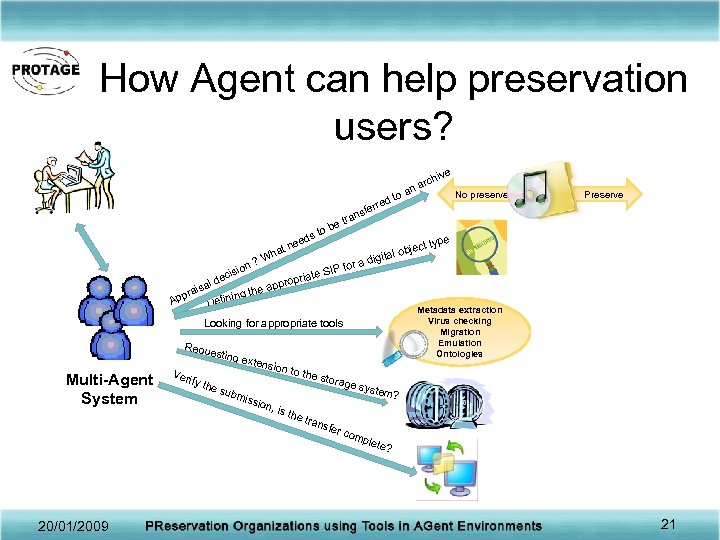
How Agent can help preservation users? ve i rch n a to a e to b ds ? n isio P Metadata extraction Virus checking Migration Emulation Ontologies Looking for appropriate tools esting Multi-Agent System 20/01/2009 Ver ify exten the sub Preserve t type objec al digit for a SI c riate l de prop a p ais the a ppr Defining A Requ No preserve s tran e ne hat W ed ferr sion t o the storag e sys te mis sio n, is the tran m? sfer com plet e? 21
Agents for Digital Preservation • Autonomy: makes decisions about what to do without the direct intervention of humans • Pro-activeness: agents do not simply act in response to their environment, they are able to exhibit goal-directed behavior by taking the initiative • Social ability: agents interact with other agents (and possibly humans) via some kind of agent-communication language , and typically have the ability to engage in social activities (such as cooperative problem solving or negotiation) in order to achieve their goals. 20/01/2009 22
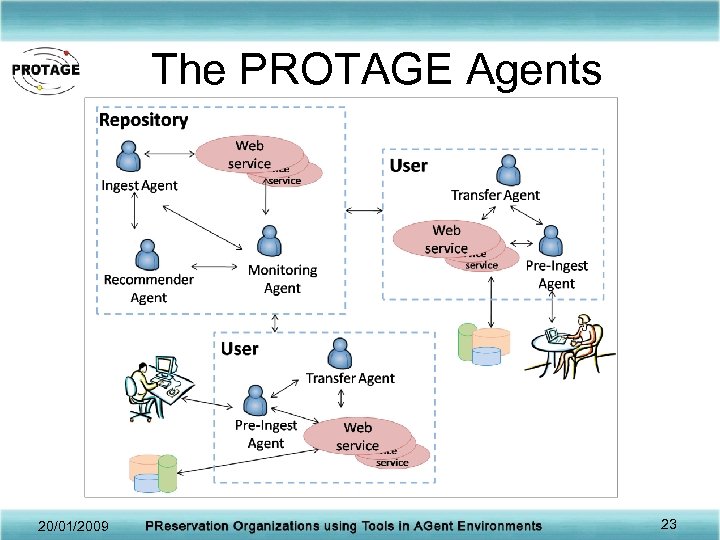
The PROTAGE Agents 20/01/2009 23
The PROTAGE Agents • Agents can display an intelligent behaviour. For example, using techniques from artificial intelligence, agents can maintain a representation of what is happening and offer spontaneous help (proactive behaviour). • Agents are developed independently, a multi-agent system can be easily modified by simple addition or removal of agents like in a team where members enter and quit the group at any time. • An agent may have mechanisms for learning the user’s preferences and the context of the work allowing it to suggest (recommend) some action. • Automatically perform digital preservation task, monitoring the evolution of file formats and usage to ensure availability and future access of their content. • Support and aid users in preserving, retrieving and sharing content. • Support the collaborative work by managing, allowing for communication among the different software components such as web services and user interfaces. 20/01/2009 24
Overview of Work Completed so Far 20/01/2009 25
Project Objectives for the Reporting Period (WP 1) Conduct cross-disciplinary research on models and methods for long-term digital preservation, agent technology and new media with the purpose to – – 20/01/2009 identify (1) agent based technology suitable for application in the preservation field, (2) preservation models suitable for agent technology adaptation, and (3) stakeholder needs and requirements that can be transformed into specified functional requirements; develop PROTAGE models and methods. 26
Deliverables (WP 1) D 1. 1 State of the Art, Stakeholder Needs and Application Scenarios D 1. 2 Functional Requirements Specification D 1. 3 Methodology Handbook (proposed new dates for delivery to the Commission) 20/01/2009 27
Project Objectives for the Reporting Period (WP 2 and 3) Based on the outcomes from research in models and methods, start the development of preservation agents by – identifying key characteristics and requirements for preservation software agents; – defining (1) detailed service models (white-box view) for transfer, ingest and monitoring services in digital repositories, and (2) technical requirements for modular and extensible multi-agent based transfer and access services. 20/01/2009 28
Deliverables (WP 2 and WP 3) D 2. 1 and D 3. 1 Initial Technical Specifications 20/01/2009 29
Project Objectives for the Reporting Period (WP 2, 3, 4, 5) Start preparing for testing the tools, models and systems that PROTAGE will develop by - defining (1) series of user tests that take into account a representative sample of designated communities and (2) an evaluation strategy; - specifying in an operation test plan the focus of testing; - starting to set up testing environments. 20/01/2009 30
Deliverable (WP 5) D 5. 1 Evaluation Strategy and Operational Test Plan 20/01/2009 31
Project Objectives for the Reporting Period (WP 7) Perform timely dissemination of project results, while preserving possibilities to seek IPR protection for commercialization by - providing publicity for the results of PROTAGE to the widest possible audience; - opening up channels for dissemination; - exchanging technical information and results; - producing publicity materials; - generating awareness of the outputs from PROTAGE; - actively (1) participate in conferences, workshops and courses related to digital libraries, archives and museums, (2) promote the results from PROTAGE to the European Commission, and (3) foster relationships with other framework projects. 20/01/2009 32
Deliverables (WP 7) D 7. 1 Public Web (including update) D 7. 2 Dissemination Master Plan and Publicity Material 20/01/2009 33
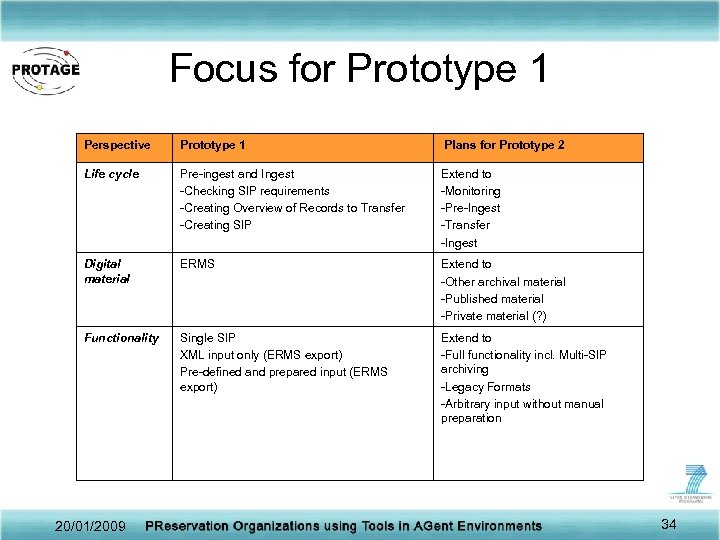
Focus for Prototype 1 Perspective Prototype 1 Plans for Prototype 2 Life cycle Pre-ingest and Ingest -Checking SIP requirements -Creating Overview of Records to Transfer -Creating SIP Extend to -Monitoring -Pre-Ingest -Transfer -Ingest Digital material ERMS Extend to -Other archival material -Published material -Private material (? ) Functionality Single SIP XML input only (ERMS export) Pre-defined and prepared input (ERMS export) Extend to -Full functionality incl. Multi-SIP archiving -Legacy Formats -Arbitrary input without manual preparation 20/01/2009 34
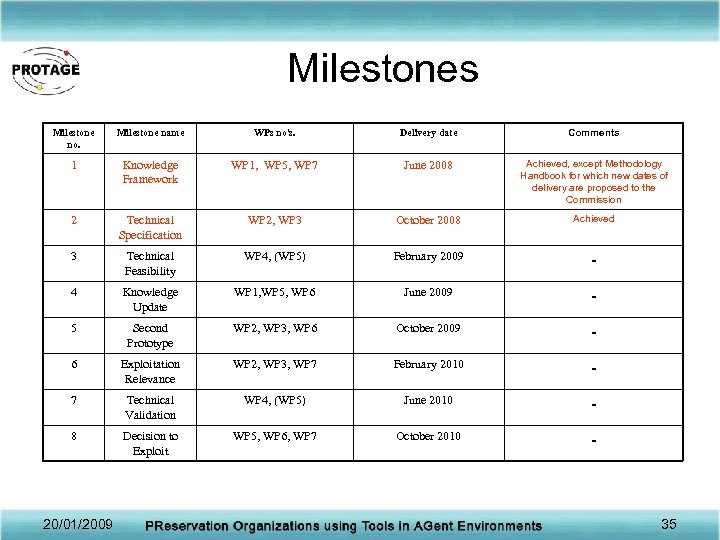
Milestones Milestone no. Milestone name WPs no's. Delivery date Comments 1 Knowledge Framework WP 1, WP 5, WP 7 June 2008 Achieved, except Methodology Handbook for which new dates of delivery are proposed to the Commission 2 Technical Specification WP 2, WP 3 October 2008 Achieved 3 Technical Feasibility WP 4, (WP 5) February 2009 - 4 Knowledge Update WP 1, WP 5, WP 6 June 2009 - 5 Second Prototype WP 2, WP 3, WP 6 October 2009 - 6 Exploitation Relevance WP 2, WP 3, WP 7 February 2010 - 7 Technical Validation WP 4, (WP 5) June 2010 - 8 Decision to Exploit WP 5, WP 6, WP 7 October 2010 - 20/01/2009 35
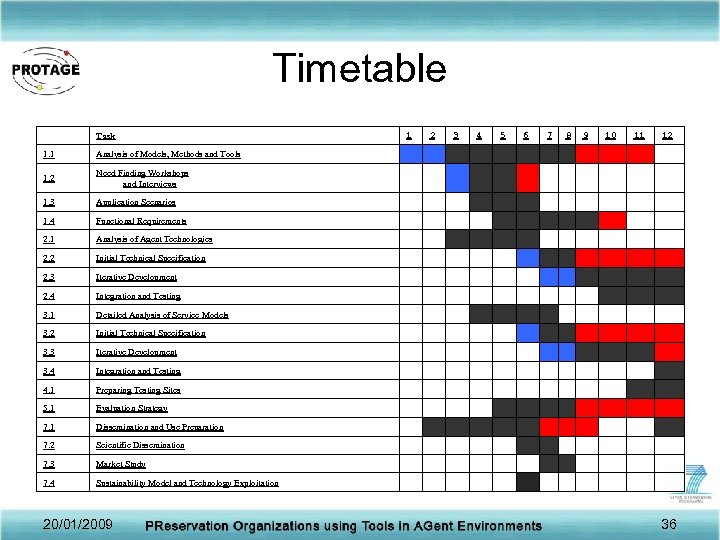
Timetable Task 1. 1 Integration and Testing 4. 1 Preparing Testing Sites 5. 1 Evaluation Strategy 7. 1 Dissemination and Use Preparation 7. 2 Scientific Dissemination 7. 3 Market Study 7. 4 12 Iterative Development 3. 4 11 Initial Technical Specification 3. 3 10 Detailed Analysis of Service Models 3. 2 9 Integration and Testing 3. 1 8 Iterative Development 2. 4 7 Initial Technical Specification 2. 3 6 Analysis of Agent Technologies 2. 2 5 Functional Requirements 2. 1 4 Application Scenarios 1. 4 3 Need Finding Workshops and Interviews 1. 3 2 Analysis of Models, Methods and Tools 1. 2 1 Sustainability Model and Technology Exploitation 20/01/2009 36
A Short Summary of Progress to Date • Initial project concept • User needs identification and analysis • 13 application scenarios • Functional requirements • Technical specifications • An on-going prototype development • The first iteration of system tests under preparation • Communication strategy 20/01/2009 37
Questions and Answers 38 20/01/2009
Technical Session 1 Representatives for Work Packages 1 – 5 and 7 Raivo Ruusalepp, NAE Technical Coordinator Prof. Ann Hägerfors, LTU Scientific Coordinator 20/01/2009 39
Presentation Outline • Work developed in the work packages 1 -5 and 7 • The projects own assessment of the work accomplished • Questions and answers 20/01/2009 40
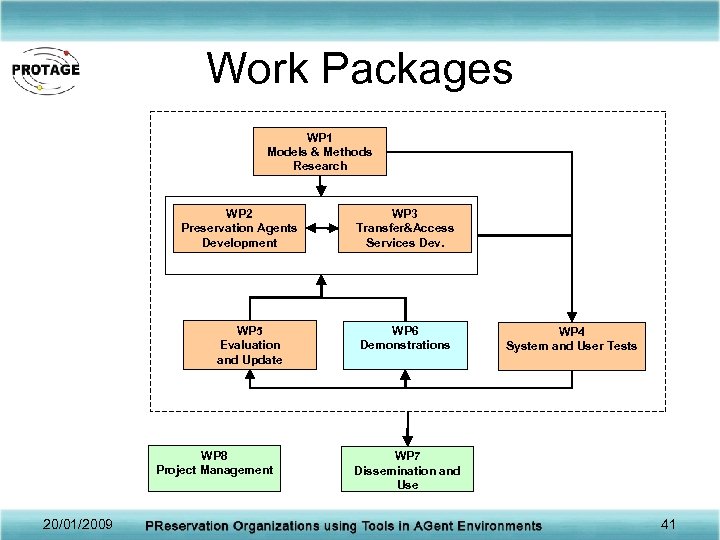
Work Packages WP 1 Models & Methods Research WP 2 Preservation Agents Development WP 5 Evaluation and Update WP 8 Project Management 20/01/2009 WP 3 Transfer&Access Services Dev. WP 6 Demonstrations WP 4 System and User Tests WP 7 Dissemination and Use 41
WP 1: Models and Methods Research Hamid Rofoogaran, LTU 42 20/01/2009
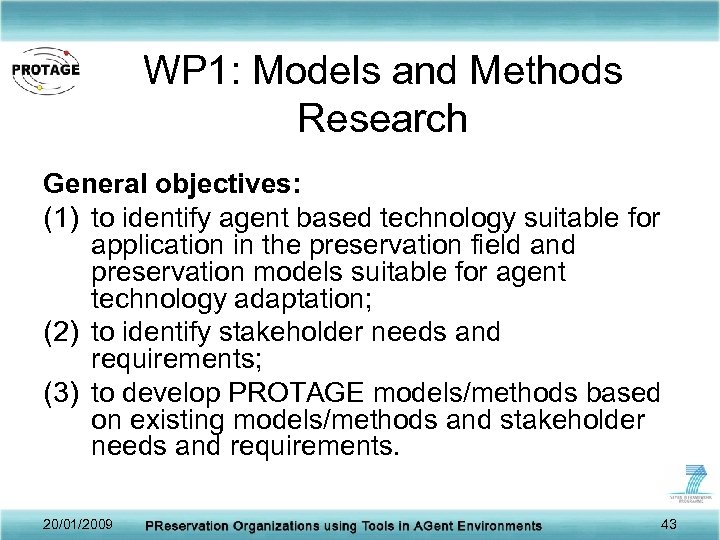
WP 1: Models and Methods Research General objectives: (1) to identify agent based technology suitable for application in the preservation field and preservation models suitable for agent technology adaptation; (2) to identify stakeholder needs and requirements; (3) to develop PROTAGE models/methods based on existing models/methods and stakeholder needs and requirements. 20/01/2009 43
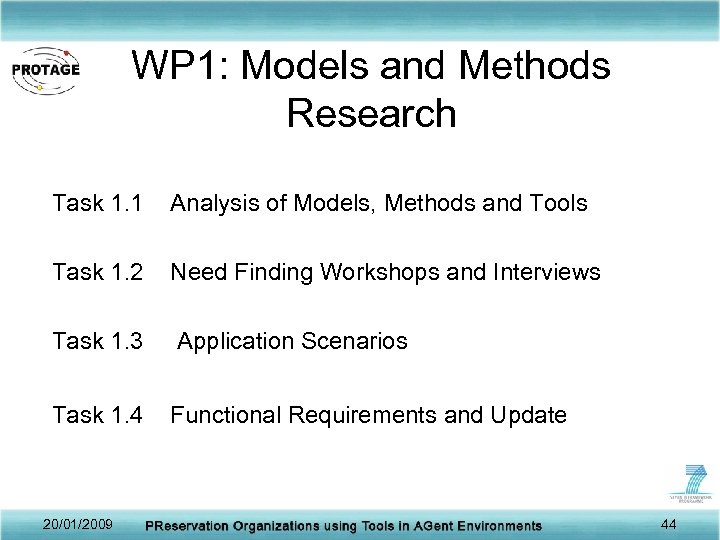
WP 1: Models and Methods Research Task 1. 1 Analysis of Models, Methods and Tools Task 1. 2 Need Finding Workshops and Interviews Task 1. 3 Application Scenarios Task 1. 4 Functional Requirements and Update 20/01/2009 44
T 1. 1: Analysis of Models, Methods and Tools • Agents : A quick State of the art • Models and Methods for Digital preservation • Organizational Issues for Digital Preservation • Literature Survey on Decision Modelling and processing • Analysis of the Literature Review in Relation to Agent Technology 20/01/2009 45
T 1. 2: Need Finding Workshops and Interviews • The needs and requirements raised by the partners and stakeholders • Tools with capabilities exceeding the normal IT-tools of today. • Two separate workshops in Estonia with -Archivists -Record managers • One mixed workshop in Sweden 20/01/2009 46
T 1. 2: Need Finding Workshops and Interviews Finding out problems and bottlenecks, ideas for solutions Among our questions - Which tasks in the pre-ingest phase currently contain the most time consuming work for a records manager or an archivist? - Which tasks in the transfer phase currently contain too technical tasks for a records manager or an archivist? - What processes would you most like to be automated – in which parts of the process is the records manager or the archivist willing to give up manual control? 20/01/2009 47
T 1. 2: Need Finding Workshops and Interviews Some examples of needs where agents could be used : • To help agencies to understand the requirements from the archival institutions • To be aware about and inform you when there is changes in requirements from the archival institutions • Track how long time the information is needed in organisation, when it could be disposed (transferred or destroyed) • How to transfer and how to create a correct SIP • To check that transferred formats and checksums are correct • To check that the specific metadata is correct • To check the general documentation, textual metadata in system description and manuals 20/01/2009 48
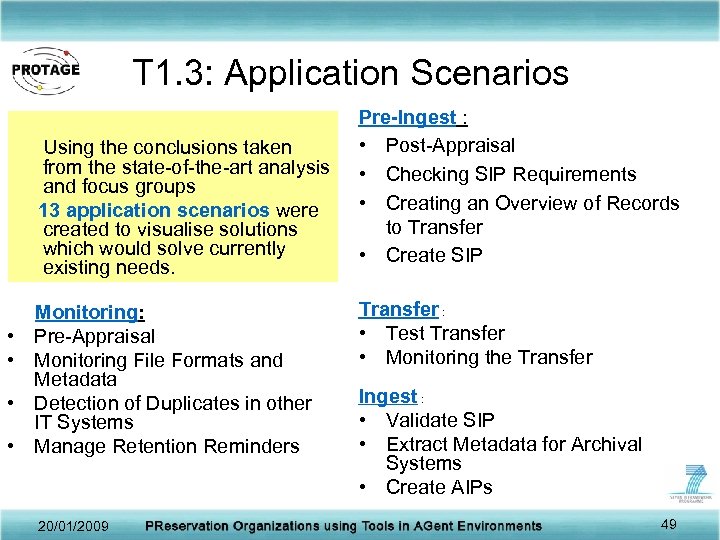
T 1. 3: Application Scenarios Using the conclusions taken from the state-of-the-art analysis and focus groups 13 application scenarios were created to visualise solutions which would solve currently existing needs. Monitoring: • Pre-Appraisal • Monitoring File Formats and Metadata • Detection of Duplicates in other IT Systems • Manage Retention Reminders 20/01/2009 Pre-Ingest : • Post-Appraisal • Checking SIP Requirements • Creating an Overview of Records to Transfer • Create SIP Transfer : • Test Transfer • Monitoring the Transfer Ingest : • Validate SIP • Extract Metadata for Archival Systems • Create AIPs 49
T 1. 1 + T 1. 2 + T 1. 3 = D 1. 1 20/01/2009 50
T 1. 4: Functional Requirements • D 1. 2 is totally based on the outcomes from T 1. 4 • The objective of D 1. 2 is to specify how the PROTAGE system should implement the demands of stakeholders and end-users. Therefore, D 1. 2 is fully based on the deliverable D 1. 1 State-of-the-art, Stakeholder Needs, Application Scenarios, particularly on its application scenarios part. • Starting point for technology development and implementation in the PROTAGE project • On-going improvement and iterative updating 20/01/2009 51
WP 2: Preservation Agents Development WP Leader: Prof. Josep Lluis de la Rosa, EASY Presenter: Silvana Aciar, EASY 52 20/01/2009
WP 2: Preservation Agents Development General objectives: (1) to identify key characteristics and requirements for preservation software agents; (2) to prototype and implement a set of generic preservation software agents. 20/01/2009 53
WP 2: Preservation Agents Development Official deliverable: • D 2. 1 Initial Technical Specifications • Publications: Josep Lluís de la Rosa, Johan E. Bengtsson, Raivo Ruusalepp, Ann Hägerfors, Hugo Quisbert: Using Agents for Long-Term Digital Preservation the PROTAGE Project. DCAI 2008: 118 -122 20/01/2009 54
WP 2: Preservation Agents Development Task 2. 1 Analysis of Agent Technologies Task 2. 2 Initial Technical Specification Task 2. 3 Iterative Development Task 2. 4 Integration and Testing 20/01/2009 55
WP 2: Preservation Agents Development Task 2. 1 Analysis of Agent (EASY, RA, LTU) • Definition of a preservation software agent • Reviewed the literature about agent technology and recent developments in agent oriented research • A workshop has also been carried out focusing on the issue of a platform to develop multi-agent systems and how this platform can be used to develop agents with the potential to provide solutions for digital preservation challenges 20/01/2009 56
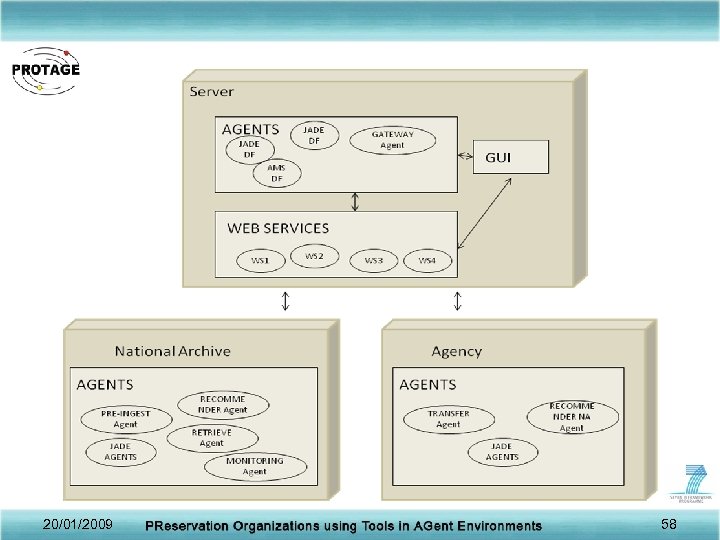
WP 2: Preservation Agents Development Task 2. 2 Initial Technical Specification (LTU , NAE, EASY) • Analysis of user needs and functional requirements specified in deliverables D 1. 1 and D 1. 2 • Definition of a first PROTAGE system architecture • Parallel analysis of Web Services and User Interface, developed by Task T 3. 1 in WP 3, resulted as 'WP 3 technical specification' and used as input 20/01/2009 57
20/01/2009 58
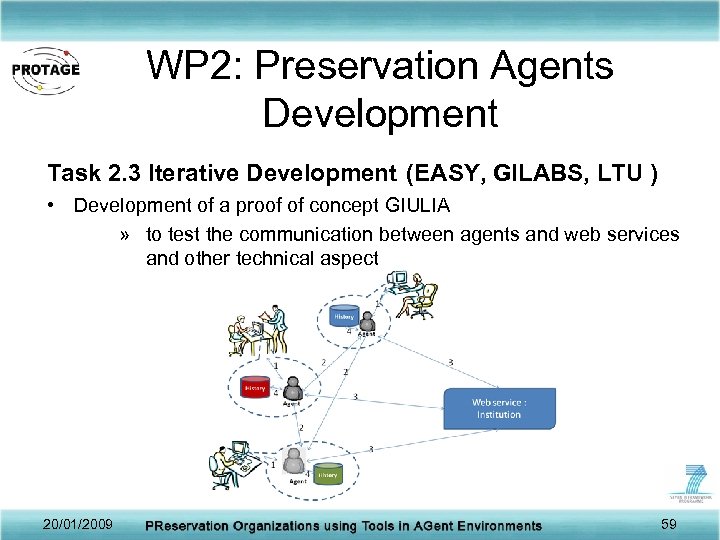
WP 2: Preservation Agents Development Task 2. 3 Iterative Development (EASY, GILABS, LTU ) • Development of a proof of concept GIULIA » to test the communication between agents and web services and other technical aspect 20/01/2009 59
WP 2: Preservation Agents Development • Development of the first prototype. » PRE-INGEST - Checking SIP Requirements » PRE-INGEST - Creating an overview of the SIP Transfer » PRE-INGEST - Create SIP 20/01/2009 60
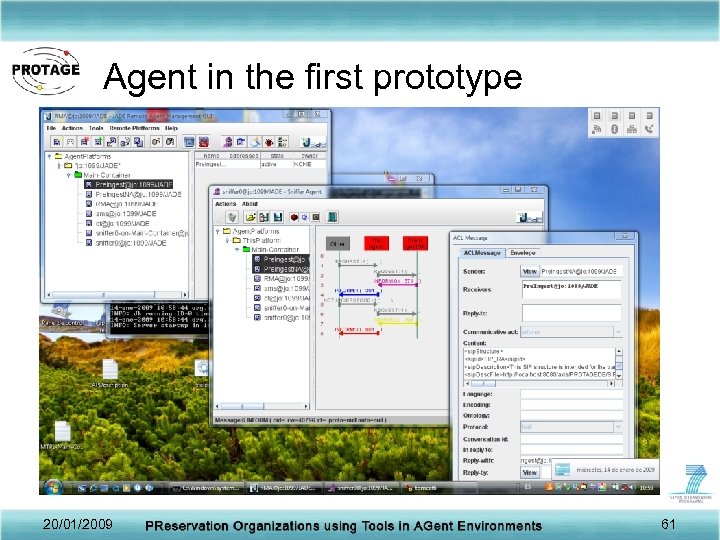
Agent in the first prototype 20/01/2009 61
WP 2: Preservation Agents Development Task 2. 4 Integration and Testing • Analysis and selection of a test platform to test the multiagent system and the web services developed in the first prototype. » The choice will probably be the JADE test suit which also can be used for testing the integration of all components, data base, web services, agents, etc. Deviations between actual and planned person-months: none so far. 20/01/2009 62
WP 3: Transfer and Access Services Development Lucia Oneto, GILABS 63 20/01/2009
WP 3: Transfer and Access Services Development General objectives: (1) to define detailed service models (white-box view) for transfer, ingest and monitoring services in digital repositories; (2) to define technical requirements for modular and extensible multi-agents based transfer and access services; (3) to implement prototype services for long-term digital preservation based on software agents. 20/01/2009 64
WP 3: Transfer and Access Services Development Official deliverable: • D 3. 1 Initial Technical Specifications 20/01/2009 65
WP 3: Transfer and Access Services Development Task 3. 1 Detailed analysis of Service Models Task 3. 2 Initial Technical Specification Task 3. 3 Iterative Development Task 3. 4 Integration and Testing 20/01/2009 66
WP 3: Transfer and Access Services Development Task 3. 1 Detailed analysis of Service Models (NAE, GILABS, FRAUNHOF) • Identification of detailed services and additional components that need a specific implementation/adaptation effort (gap analysis) • Activities are still open and concern mainly service mockups planned for coming stakeholder workshops 20/01/2009 67
WP 3: Transfer and Access Services Development Task 3. 2 Initial Technical Specification (GILABS , NAE, LTU) • Analysis of user needs and functional requirements specified in deliverables D 1. 1 and D 1. 2 • Definition of a first PROTAGE system architecture in collaboration with WP 2 members • Initial Technical Specification writing has requested a close involvement of all the technical partners 20/01/2009 68
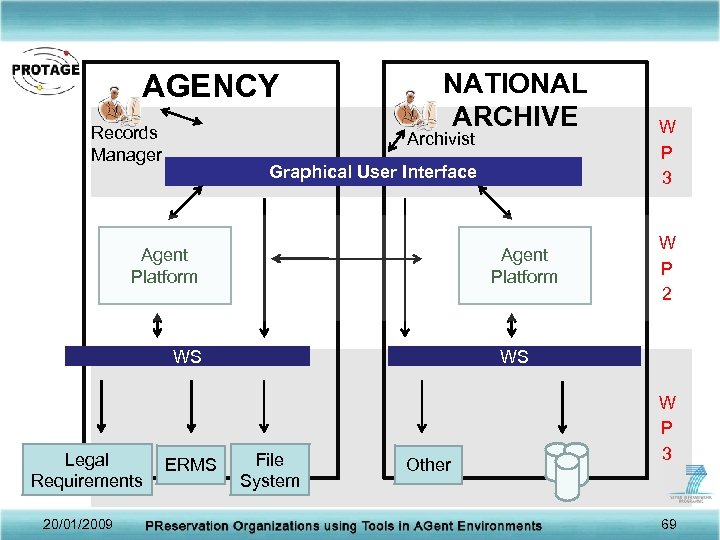
AGENCY Records Manager NATIONAL ARCHIVE Archivist Graphical User Interface Agent Platform WS Legal Requirements 20/01/2009 ERMS W P 3 W P 2 WS File System Other W P 3 69
WP 3: Transfer and Access Services Development Task 3. 3 Iterative Development (UNIBRAD, GILABS, EASY) • Development of a proof of concept GIULIA to test the communication between agents and web services • Development of three scenarios for the first prototype » PRE-INGEST - Checking SIP Requirements » PRE-INGEST - Creating an overview of the SIP Transfer » PRE-INGEST - Create SIP. 20/01/2009 70
WP 3: Transfer and Access Services Development Task 3. 4 Integration and Testing (GILABS, UNIBRAD, EASY) • Set up of a configuration system able to support any integration procedure • Ensure robust interoperability between the developed services and the Intelligent Agent Framework built in WP 2 • Make available the first prototype to WP 4 for on-site installation and testing. 20/01/2009 71
WP 5: Evaluation and Update Dr. Fanny Klett, FRAUNHOFER 72 20/01/2009
WP 5: Evaluation and Update General objectives: (1) to evaluate and improve the documentation of models, methods and tools 7 systems developed by WP 1, WP 2, and WP 3 and tested in WP 4; (2) to ensure that the developed technologies, models and methods: (a) meet the defined requirements and specifications; (b) achieve the best possible quality; © forward the existing state of the art. 20/01/2009 73
WP 5: Evaluation and Update Task 5. 1 Evaluation Strategy and Operational Test Plan Tasks to be carried out during the 2 nd or 3 rd year of the project: Task 5. 2 Evaluation of Test # 1 Task 5. 3 Evaluation of Test # 2 Task 5. 4 Overall Evaluation Report 20/01/2009 74
Outline • Objectives of task 5. 1 • Evaluation process and evaluation environment • Quality evaluation characteristics • Functional and non-functional quality • Evaluation plan for system and user tests • Evaluation plan for demonstration • Dependencies and timeframe • Summary 20/01/2009 75
Task 5. 1 Objectives • Technical evaluation (input from WP 4, in close collaboration with WP 2 and WP 3) • Evaluation of effectiveness of models and methods (input mainly from WP 1) • Evaluations of prototypes, functional requirements, models and methods focusing on interoperability, scalability, performance, customization possibilities, usability, and management model • Update of functional requirements (D 1. 2) and the Methodology Handbook (D 1. 3) • Support of project’s further development, verification, validation and improvement 20/01/2009 76
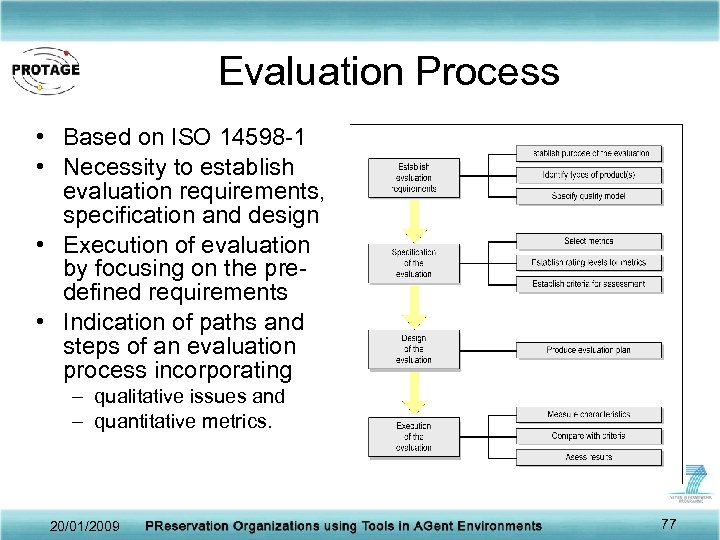
Evaluation Process • Based on ISO 14598 -1 • Necessity to establish evaluation requirements, specification and design • Execution of evaluation by focusing on the predefined requirements • Indication of paths and steps of an evaluation process incorporating – qualitative issues and – quantitative metrics. 20/01/2009 77
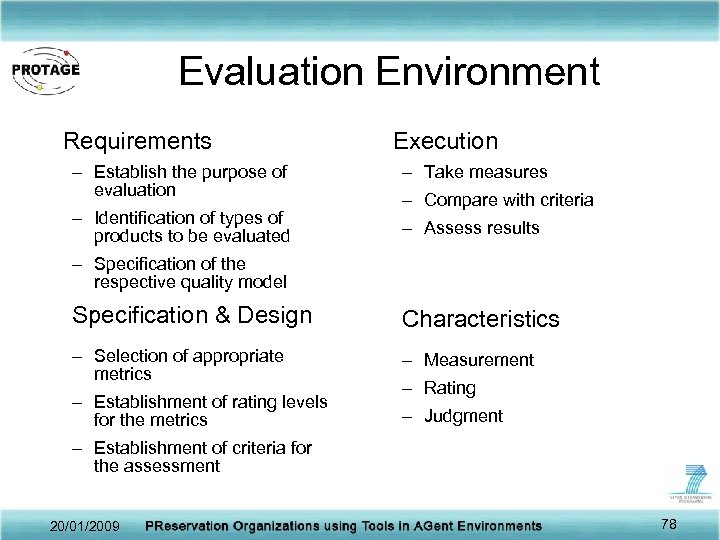
Evaluation Environment Requirements Execution – Establish the purpose of evaluation – Take measures – Identification of types of products to be evaluated – Assess results – Compare with criteria – Specification of the respective quality model Specification & Design Characteristics – Selection of appropriate metrics – Measurement – Establishment of rating levels for the metrics – Judgment – Rating – Establishment of criteria for the assessment 20/01/2009 78
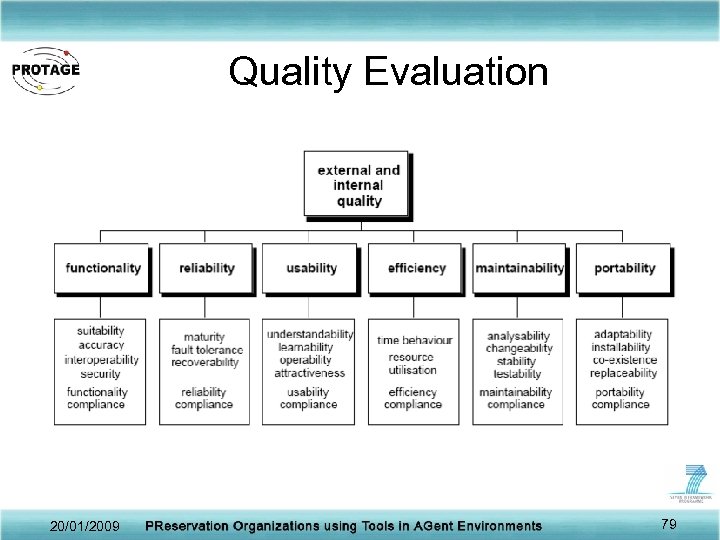
Quality Evaluation 20/01/2009 79
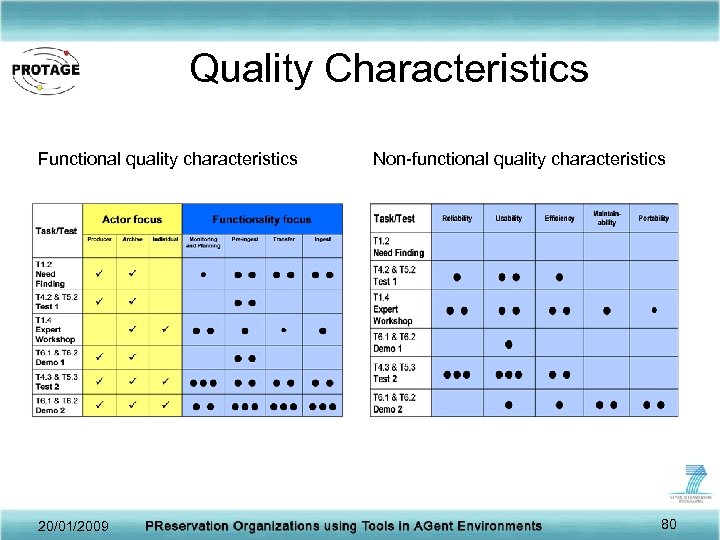
Quality Characteristics Functional quality characteristics 20/01/2009 Non-functional quality characteristics 80
System and User Tests • • Comprehensive test of the PROTAGE system using prototypes Analysis of findings from the tests Comparison with state-of-the-art products in relevant areas Overall recommendations on updates to – Functional requirements – Technical specifications – Methodology handbook • Summary of critical design issues from – User perspective – Technical perspective – Business perspective • Evaluation results utilized to update WP 1 models and methods providing updated requirements to WP 2 and WP 3 for developing the next PROTAGE prototype. 20/01/2009 81
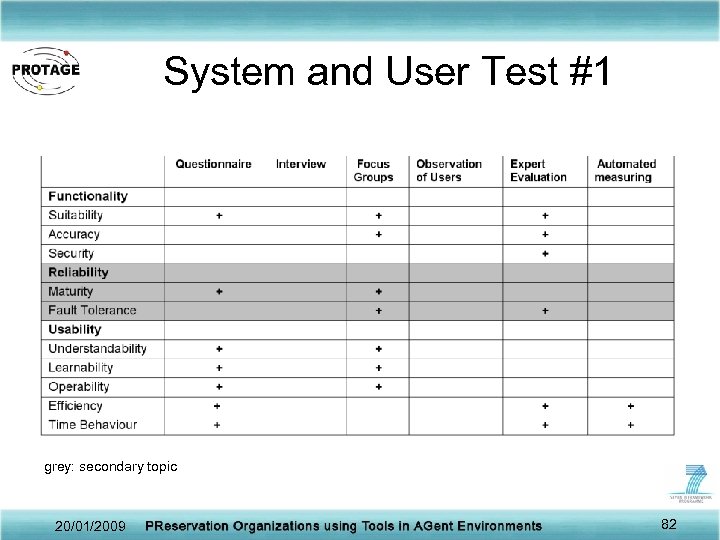
System and User Test #1 grey: secondary topic 20/01/2009 82
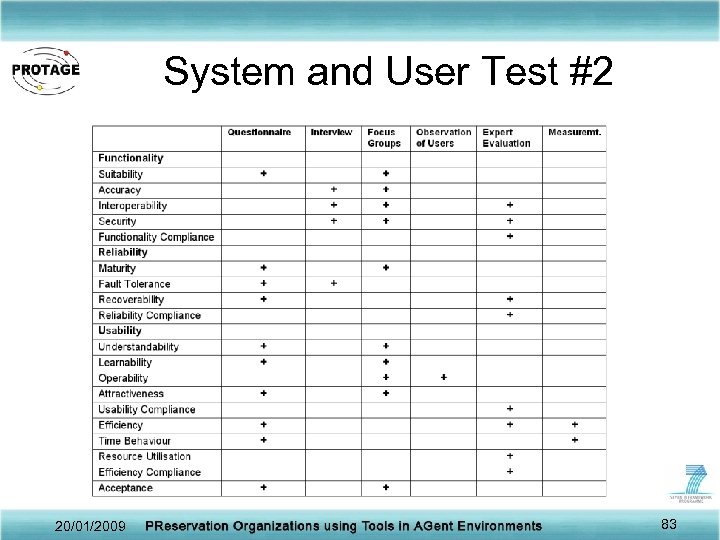
System and User Test #2 20/01/2009 83
Demonstrations • • After each System and User Test Extended tests and workshops (short term) Comprehensive demonstration of the entire system Involvement of external stakeholders – Associated memory institutions – End-users – Other EU projects • • Determination of critical success factors for PROTAGE Evaluation of the current status of the system Identification of possible weaknesses of the product Investigation of relevance of, and compatibility with other developments within digital preservation domain 20/01/2009 84
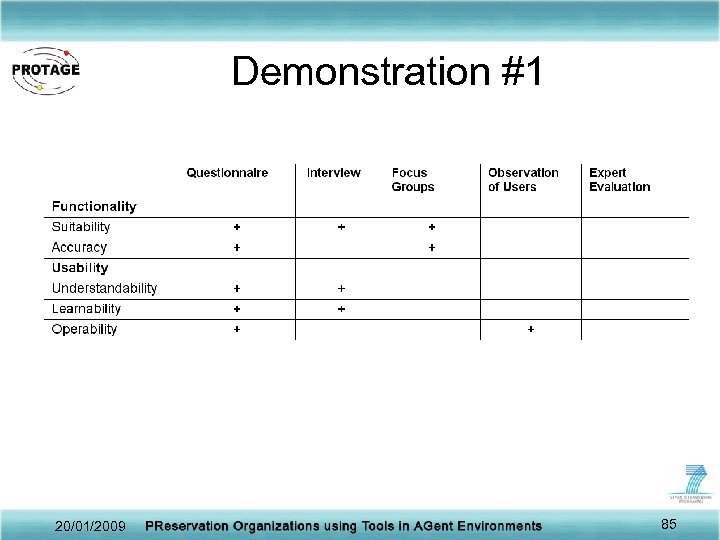
Demonstration #1 20/01/2009 85
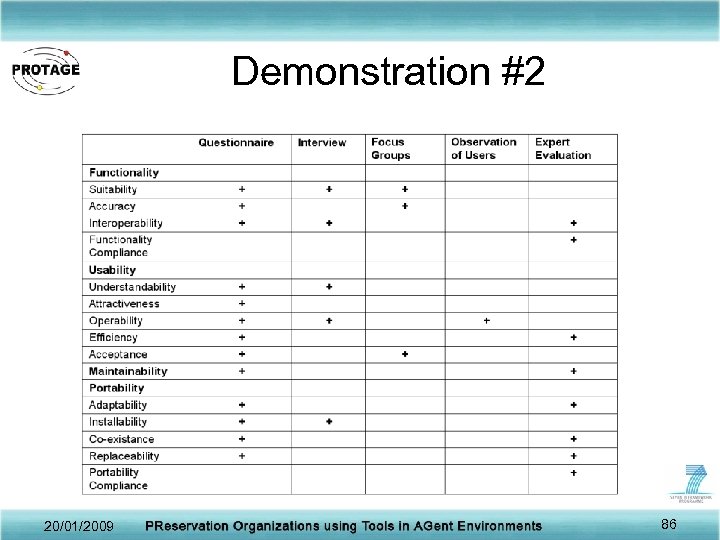
Demonstration #2 20/01/2009 86
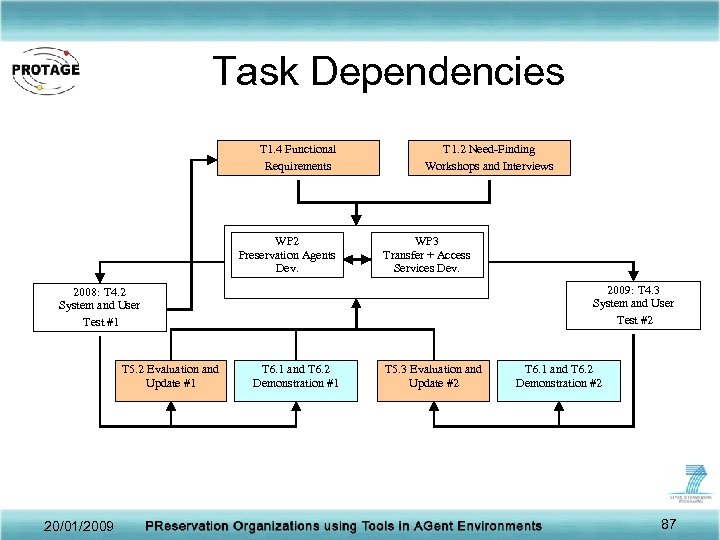
Task Dependencies T 1. 4 Functional Requirements WP 2 Preservation Agents Dev. T 1. 2 Need-Finding Workshops and Interviews WP 3 Transfer + Access Services Dev. 2009: T 4. 3 System and User Test #2 2008: T 4. 2 System and User Test #1 T 5. 2 Evaluation and Update #1 20/01/2009 T 6. 1 and T 6. 2 Demonstration #1 T 5. 3 Evaluation and Update #2 T 6. 1 and T 6. 2 Demonstration #2 87
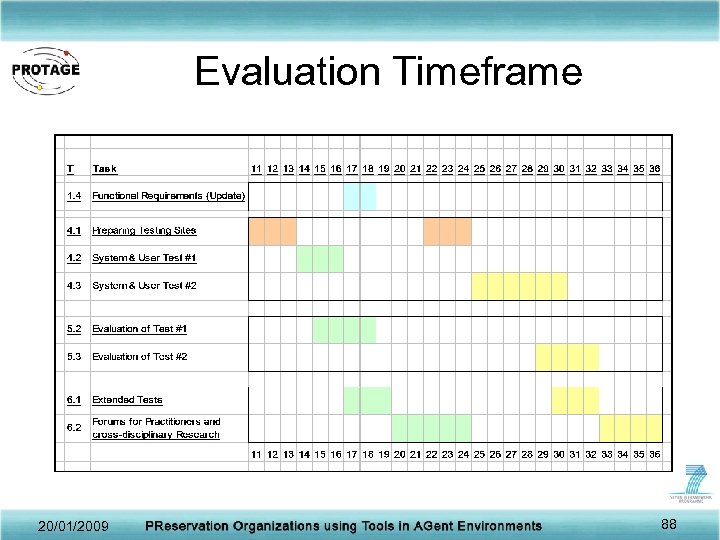
Evaluation Timeframe 20/01/2009 88
Summary • Need-finding workshops provide requirements for selecting appropriate evaluation characteristics • Different methods of data gathering according to evaluation characteristics and test environment • Results of each evaluation phase provide input for refinement of prototype / product • Results of each evaluation phase allow refinement of evaluation characteristics, sub-characteristics, and methods for following tests / demonstrations 20/01/2009 89
WP 4: System and User Tests Kuldar Aas, NAE 20/01/2009 90
WP 4: System and User Tests General objectives: (1) to define a series of user tests that take into account a representative sample of designed communities, incl. Memory institutions, content creators, end users; (2) to set up a testing environment for testing the PROTAGE toolkit in two iterations from the following criteria: a. user-friendliness: b. technology robustness; c. system reliability. 20/01/2009 91
WP 4: System and User Tests Task 4. 1 Preparing Test Sites Tasks to be carried out during the 2 nd or 3 rd year of the project: Task 4. 2 First System and User Test Task 4. 3 Second System and user Test 20/01/2009 92
WP 4: System and User Tests • Task 4. 1: Preparing test sites – Executed twice (M 10 – M 12; M 22 – M 24) – Contributing partners: NAE, RA, LTU, FRAUNHOF – No official deliverables but an unofficial “test site configuration” document is prepared 20/01/2009 93
Test site configuration • Users taking part in first system and user test (based on Need Finding Workshops, D 1. 1) • Test methodology and data gathering (based on D 5. 1) • Test data (extracted from EDRM systems) • Test scenarios (based on selected application scenarios in D 1. 1 and development done in WP 2 and WP 3) • Test site hardware and software 20/01/2009 94
WP 4: System and User Tests • About 20 -30 people testing both in Sweden and Estonia • Aim at open-source test platform • Dissemination aspect in testing – workshop to both introduce the projects development and also gather feedback according to D 5. 1 20/01/2009 95
WP 7: Dissemination and Use WP Leader: Prof. Jianmin Jiang, UNIBRAD Presenter: Xiaolong Jin, UNIBRAD 96 20/01/2009
WP 7 Dissemination and Use General Objectives: To perform timely dissemination of project results, while preserving possibilities to seek IPR protection for commercialisation. (1) Provide publicity for the results of PROTAGE to the widest possible audience, so that results can find their way into mainstream practice; (2) Open up channels for dissemination and exchanging technical information; (3) Produce publicity materials and generate awareness of the outputs from PROTAGE; (4) Participate actively in conferences, workshops and courses related to digital libraries, archives and museums; (5) Promote actively the results to the European Commission and foster relationships with other framework projects. 20/01/2009 97
WP 7 Tasks T 7. 1 Dissemination and Use Preparation - finished T 7. 2 Scientific Dissemination - ongoing T 7. 3 Market Study - started T 7. 4 Sustainability Model and Technology Exploitation - started 20/01/2009 98
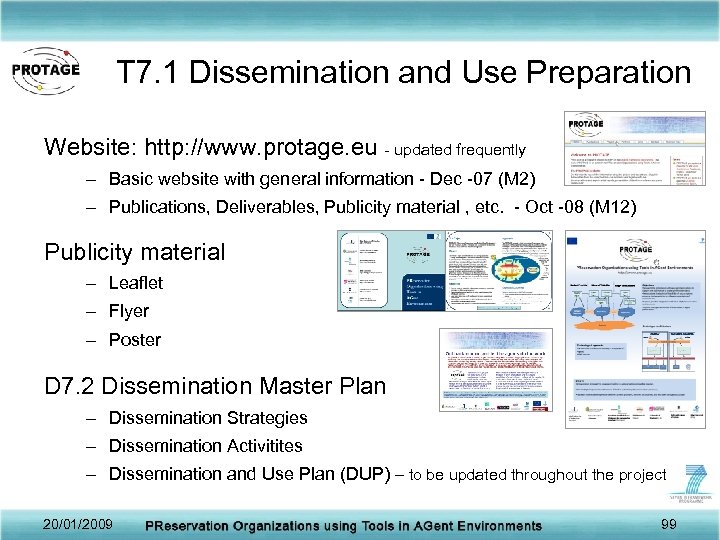
T 7. 1 Dissemination and Use Preparation Website: http: //www. protage. eu - updated frequently – Basic website with general information - Dec -07 (M 2) – Publications, Deliverables, Publicity material , etc. - Oct -08 (M 12) Publicity material – Leaflet – Flyer – Poster D 7. 2 Dissemination Master Plan – Dissemination Strategies – Dissemination Activitites – Dissemination and Use Plan (DUP) – to be updated throughout the project 20/01/2009 99
T 7. 2 - Papers 1. Using Agents for Long-Term Digital Preservation - the PROTAGE Project, in Proceedings of the International Symposium on Distributed Computing and Artificial Intelligence (DCAI 2008), Salamanca, October 2008; 2. Long-Term Digital Preservation using Agent Technology – the PROTAGE Project, DLM Forum 2008 Conference, Toulouse, December 2008; 3. Towards Automated Long-Term Digital Preservation: A Multi-Agent Based Approach, submitted to Ambient Intelligence and Smart Environments, 2008; 4. Towards Computerized Digital Preservation Based on Intelligent Agents and Web Services, Accepted to appear in the Proceedings of the 5 th International Conference on Web Information Systems and Technologies (WEBIST'09), Lisbon, March 2009; 5. A Personal Filing System using Multi-Agent Reinforcement Learning, submitted to International Journal of Digital Curation, 2008; 6. Agents: A Quick State of the Art, www. protage. eu, November 2008. 20/01/2009 100
T 7. 2 - Presentations 1. PROTAGE, Digital libraries and technology-enhanced learning, Call 3 information day, Luxembourg, December 2007; 2. ICT Call 3 – PROTAGE project, Information and Communication Technologies Presentazione 3° bando ICT Settimo Programma Quadro, Rome, January 2008; 3. PROTAGE, EPOCH Final Event, Rome, February 2008; 4. PROTAGE, Conference on Digital Storage and Archiving, Sweden, October 2008; 5. PROTAGE, 3 rd Annual We. Preserve Conference , Nice, France, October 2008. 20/01/2009 101
T 7. 2 – Channels for Dissemination • Applied to join the We. Preserve consortium (DPE, PLANETS, CASPAR). Informally accepted, waiting for official notification. • www. protage. eu • i. PRES 2008, London, September 2008 • ICT 2008, Lyon, November 2008 20/01/2009 102
T 7. 3 Market Study - Approach • Objectives – Analyse critical success factors: (a) clear target group and (b) compelling value proposition, to identify where commercial potential exists. – Identify areas where national archives could take a leading role in introducing agent-based long-term digital preservation in archives, libraries, and museums. • Methodology – Analysis of technological and commercial trends – Desk study of overall preservation market potential – Questionnaire based survey on: • Immediate and potential needs of target groups • Workflows of target groups to fit PROTAGE in their needs • Differences and barriers in legal environments of countries 20/01/2009 103
T 7. 3 Market Study – Early Results • Primary Target Group is Repository Providers: – – National archives Libraries Museums Research institutions – Corporate companies – Media organizations – Repository Hosting Providers • Overall Market Potential – Comparing with the anti-virus tool market: 5, 1 billion GBP (2013) (http: //www. computerweekly. com/Articles/2007/07/13/225550/antivirus-software-market-grows. htm) – assume 10% archival/availability value via reseller -> PROTAGE potential market for personal systems is about 600 million EUR by 2013. – The potential for non-personal systems in memory institutions will need to be analysed in a similar way. 20/01/2009 104
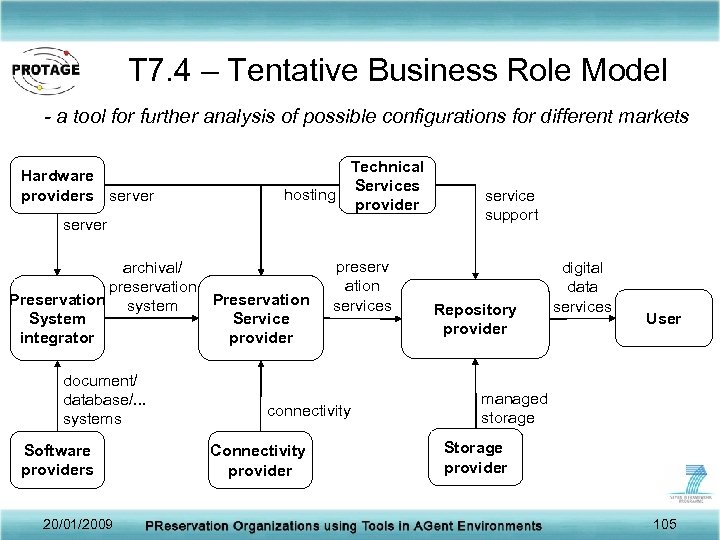
T 7. 4 – Tentative Business Role Model - a tool for further analysis of possible configurations for different markets Hardware providers server Technical Services hosting provider server archival/ preservation Preservation system Preservation System Service integrator provider document/ database/. . . systems Software providers 20/01/2009 preserv ation services connectivity Connectivity provider service support Repository provider digital data services User managed storage Storage provider 105
Exploitation Planning – Next Steps • Completing D 7. 3 Market Study (M 27) – Questionnaire based survey (M 25 -26) – Overall market segment analysis – Study of legal environments in individual countries • Further business analysis in T 7. 4 (M 26 -) – Potentially exploitable assets – IPR ownership agreements among partners – Synergies with external business parties 20/01/2009 106
The Projects Own Assessment of the Work Accomplished Prof. Ann Hägerfors, LTU Scientific Coordinator Raivo Ruusalepp, NAE Technical Coordinator 107 20/01/2009
Scientific Assessment • Combination of two bodies of knowledge: preservation and agent technology - Radically new approach - Seems feasible • Interdisciplinarity - Start of the project - Creative atmosphere - Work methods 20/01/2009 108
Scientific Assessment • Scientific publications - Conference and journal articles 2008 - Submitted articles - More to come … • Postponing Methodology Handbook (D 1. 3) - Increases quality and usability 20/01/2009 109
Technical Coordinator • Professional developers’ team • Testing partners have been trained on use of the necessary platforms and tools • Technical solution is complex by its nature, but close eye is being kept on the functionality and user requirements throughout the development cycle • Already active interest from potential end-users who consider agent technology a new and potentially valuable tool for digital preservation (cf. Discussion at the DLM-Forum conference 2008) 20/01/2009 110
Questions and Answers 111 20/01/2009
Technical Session 2 Silvana Aciar, EASY Lucia Oneto, GILABS Börje Justrell, RA 20/01/2009 112
Presentation Outline • Demonstration • Presentation of planned work coming year • Questions and Answers 20/01/2009 113
Demonstration Silvana Aciar, EASY 20/01/2009 Lucia Oneto, GILABS 114
Presentation of planned work coming year Börje Justrell, RA, and Leaders of WP active year 2 20/01/2009 115
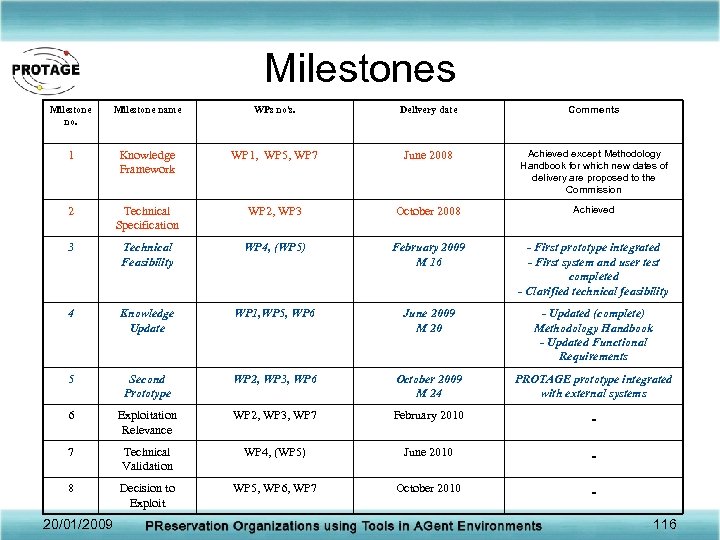
Milestones Milestone no. Milestone name WPs no's. Delivery date Comments 1 Knowledge Framework WP 1, WP 5, WP 7 June 2008 Achieved except Methodology Handbook for which new dates of delivery are proposed to the Commission 2 Technical Specification WP 2, WP 3 October 2008 Achieved 3 Technical Feasibility WP 4, (WP 5) February 2009 M 16 - First prototype integrated - First system and user test completed - Clarified technical feasibility 4 Knowledge Update WP 1, WP 5, WP 6 June 2009 M 20 - Updated (complete) Methodology Handbook - Updated Functional Requirements 5 Second Prototype WP 2, WP 3, WP 6 October 2009 M 24 PROTAGE prototype integrated with external systems 6 Exploitation Relevance WP 2, WP 3, WP 7 February 2010 - 7 Technical Validation WP 4, (WP 5) June 2010 - 8 Decision to Exploit WP 5, WP 6, WP 7 October 2010 - 20/01/2009 116
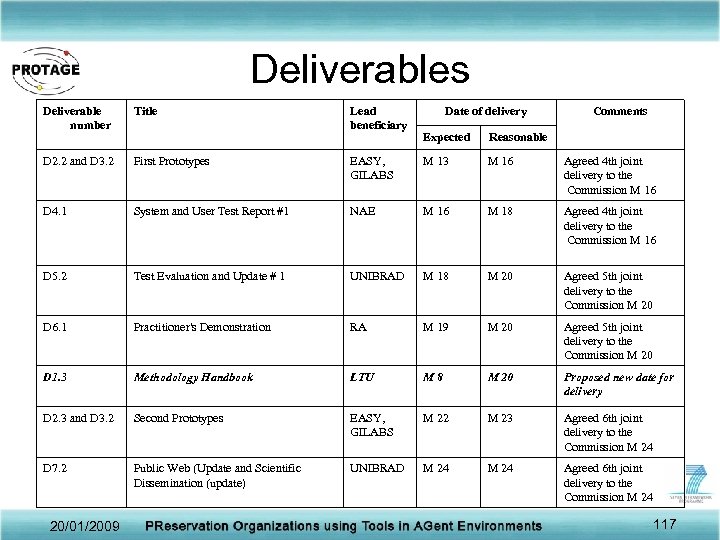
Deliverables Deliverable number Title D 2. 2 and D 3. 2 First Prototypes D 4. 1 Lead beneficiary Date of delivery Comments Expected Reasonable EASY, GILABS M 13 M 16 Agreed 4 th joint delivery to the Commission M 16 System and User Test Report #1 NAE M 16 M 18 Agreed 4 th joint delivery to the Commission M 16 D 5. 2 Test Evaluation and Update # 1 UNIBRAD M 18 M 20 Agreed 5 th joint delivery to the Commission M 20 D 6. 1 Practitioner's Demonstration RA M 19 M 20 Agreed 5 th joint delivery to the Commission M 20 D 1. 3 Methodology Handbook LTU M 8 M 20 Proposed new date for delivery D 2. 3 and D 3. 2 Second Prototypes EASY, GILABS M 22 M 23 Agreed 6 th joint delivery to the Commission M 24 D 7. 2 Public Web (Update and Scientific Dissemination (update) UNIBRAD M 24 Agreed 6 th joint delivery to the Commission M 24 20/01/2009 117
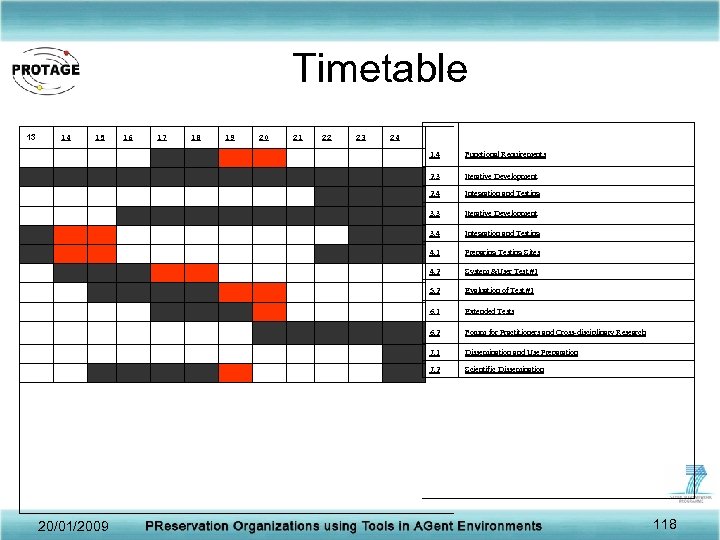
Timetable 13 14 15 16 17 18 19 20 21 22 23 24 1. 4 2. 3 Iterative Development 2. 4 Integration and Testing 3. 3 Iterative Development 3. 4 Integration and Testing 4. 1 Preparing Testing Sites 4. 2 System &User Test #1 5. 2 Evaluation of Test #1 6. 1 Extended Tests 6. 2 Forum for Practitioners and Cross-disciplinary Research 7. 1 Dissemination and Use Preparation 7. 2 20/01/2009 Functional Requirements Scientific Dissemination 118
Questions and Answers 119 20/01/2009
Management Session 2 Börje Justrell, RA Östen Jonsson, RA 20/01/2009 120
Presentation Outline • • Project management structure PROTAGE committees PROTAGE collaboration Risk management Project handbook Resource management Comments on costs and cumulative efforts Questions and Answers 20/01/2009 121
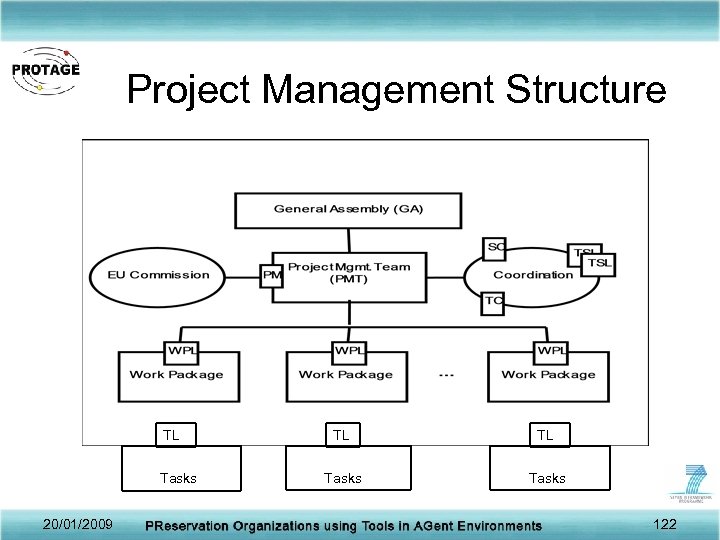
Project Management Structure TL Tasks 20/01/2009 TL Tasks 122
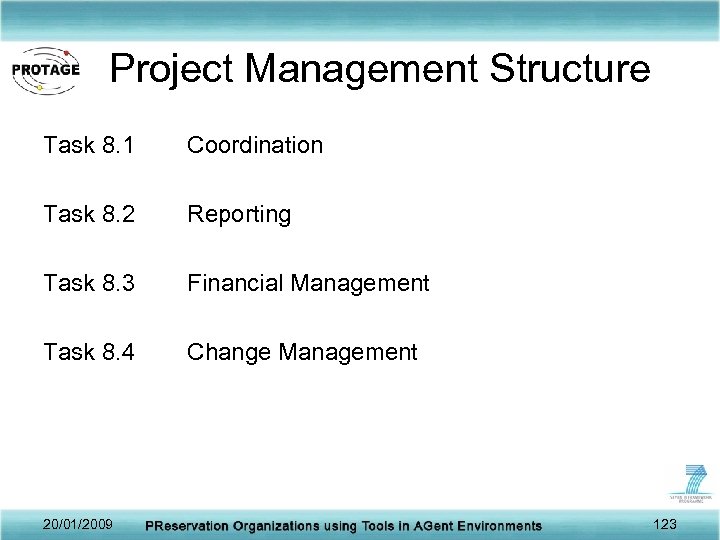
Project Management Structure Task 8. 1 Coordination Task 8. 2 Reporting Task 8. 3 Financial Management Task 8. 4 Change Management 20/01/2009 123
PROTAGE Committees • A Scientific Advisory Board has been appointed by the PMT in order to ensure high-quality publication and addressing the dissemination needs of the project. Members are professor Berndt Fredriksson at the University of Stockholm and professor Karen Anderson at Mid-Sweden University. There are plans for appointing a third scientist later on. The board is led by PROTAGE scientific coordinator. • An Ethics Advisory Board is also under process of being appointed. For the moment one member I appointed: professor Karin Axelsson, Lulea University of Technology 20/01/2009 124
PROTAGE Collaboration • Regular PMT-meetings for coordination of shared effort across work packages (standing agenda) • Physical consortium meetings and workshops – – – Kick off meeting (1) General Assembly meeting (1) Milestone meetings (2) ”Think tank” meeting (1) Technical work shops (several) • Work Package meetings and Task meetings 20/01/2009 125
PROTAGE Collaboration In order to foster good interaction among the participants in the project, the following tools are used (besides the website): - an internal portal, which was the formal deliverable D 8. 1. This portal is web based and has functions for document storage with version handling, team list with groups and e-mail support, project calendar, project news, discussions and project planning. The internal portal is available via login at the PROTAGE website (www. protage. eu); - a Wiki for co-creation of text material, available via http: //protage. ldbcentrum. se/wiki/tiki-index. php; - a mailing list that shall be used for spreading information to all participants in the project (PROTAGE@protage. eu); - an e-meeting system (Marratech) for keeping project members connected to each other and to promote on-demand meetings as well as regular meetings over the Internet. 20/01/2009 126
Risk Management Plan A Risk Management Plan has been produced, based on an initial plan integrated in the Do. W. Complementary information was added at the PROTAGE kick-off meeting in November 2007. The main purpose of the Risk Management Plan is to identify risks which might impact the project and ensure that each risk is analysed for probability and impact and handled in a proper way. 20/01/2009 127
Project Handbook An internal project handbook has been produced as deliverable D 8. 2. It focus on the work procedures in the project and provides an overview of basic planning and organisation. The aim is that it shall summarise the information the project participants need to have at hand. 20/01/2009 128
Resource Management • All partners started their work in the beginning of the project. Therefore, pre-payment has been distributed to the partners in relation to their share of the total project budget. • Follow ups of resources used and work done take place on a quarterly basis. • To secure already from the beginning of the project that resources are consumed and used in a proper way, an authorised accounting firm has been commissioned to make an audit report for the first year of the project. The report will be made available to the Commission when it is finished. 20/01/2009 129
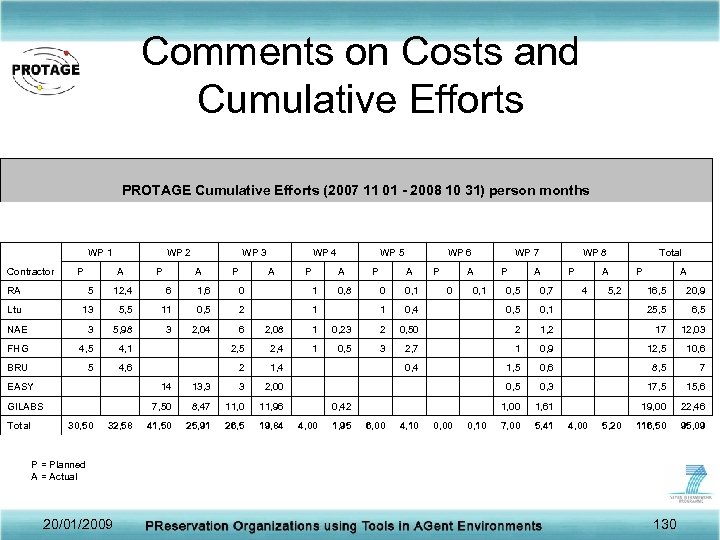
Comments on Costs and Cumulative Efforts PROTAGE Cumulative Efforts (2007 11 01 - 2008 10 31) person months WP 1 Contractor WP 2 P A P WP 3 A P WP 4 A P WP 5 A P RA 5 12, 4 6 1, 6 0 1 0, 8 Ltu 13 5, 5 11 0, 5 2 1 NAE 3 5, 98 3 2, 04 6 2, 08 FHG 4, 5 4, 1 2, 5 2, 4 BRU 5 4, 6 2 1, 4 WP 6 A P 0 0, 1 1 0, 4 0, 23 2 0, 50 1 0, 5 3 A 1 WP 7 0 0, 1 P WP 8 A P 0, 5 0, 7 0, 5 0, 1 2 1, 2 2, 7 1 0, 4 A Total 4 5, 2 P A 16, 5 20, 9 25, 5 6, 5 17 12, 03 0, 9 12, 5 10, 6 1, 5 0, 6 8, 5 7 EASY 14 13, 3 3 2, 00 0, 5 0, 3 17, 5 15, 6 GILABS 7, 50 8, 47 11, 0 11, 96 0, 42 1, 00 1, 61 19, 00 22, 46 Total 30, 50 32, 58 41, 50 25, 91 26, 5 19, 84 4, 00 1, 95 6, 00 4, 10 0, 00 0, 10 7, 00 5, 41 4, 00 5, 20 116, 50 95, 09 P = Planned A = Actual 20/01/2009 130
Comments on Costs and Cumulative Efforts • PROTAGE has used about 21 person months less than originally planned. The reasons are mainly delays in the beginning. We estimate that the cost will be as budgeted. • We plan to start a discussion with the Commission on a reallocation of resources focusing on deviations of importance between Members of the Consortium. • As a total, PROTAGE is on budget. 20/01/2009 131
Questions and Answers 132 20/01/2009
Скачать презентацию LDB-centrum Östen Jonsson Verksamhetsledare Liten insats stor
8b025e42d18ce509402d76f936b0e607.ppt