


 Скачать презентацию LCG Service Challenges Planning for Tier 2 Sites
eb6dddb0c7658b8a01647aa316f8226d.ppt
- Количество слайдов: 25
 LCG Service Challenges: Planning for Tier 2 Sites • Jamie Shiers • IT-GD, CERN
 Introduction • Roles of Tier 2 sites • Services they require (and offer) • Timescale for involving T 2 s in LCG SCs • Simplest (useful) T 2 Model • Possible procedure Jamie. Shiers@cern. ch 2
 The Problem (or at least part of it…) • SC 1 – December 2004 • SC 2 – March 2005 Neither of these involve T 2 s or even the experiments – just basic infrastructure • SC 3 – from July 2005 involves 2 Tier 2 s • + experiments’ software + catalogs + other additional stuff • SCn – completes at least 6 months prior to LHC data taking. Must involve all Tier 1 s and ~all Tier 2 s • Not clear how many T 2 s there will be MMaybe 50; maybe 100 – still a huge number to add! • ALICE: 15? , ATLAS: 30, CMS: 25, LHCb: 15; overlap? Jamie. Shiers@cern. ch 3
 Tier 2 Roles • Tier 2 roles vary by experiment, but include: • Production of simulated data; • Production of calibration constants; • Active role in [end-user] analysis Ø Must also consider services offered to T 2 s by T 1 s • e. g. safe-guarding of simulation output; • Delivery of analysis input. • No fixed dependency between a given T 2 and T 1 • But ‘infinite flexibility’ has a cost… Jamie. Shiers@cern. ch 4
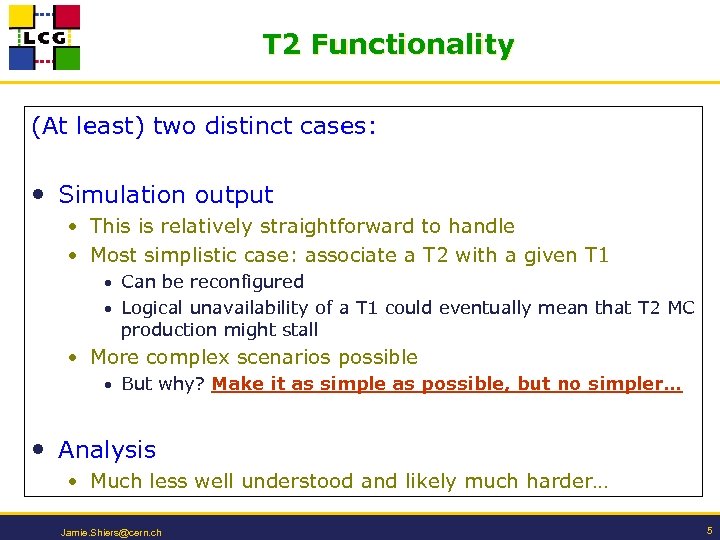 T 2 Functionality (At least) two distinct cases: • Simulation output • This is relatively straightforward to handle • Most simplistic case: associate a T 2 with a given T 1 • Can be reconfigured • Logical unavailability of a T 1 could eventually mean that T 2 MC production might stall • More complex scenarios possible • But why? Make it as simple as possible, but no simpler… • Analysis • Much less well understood and likely much harder… Jamie. Shiers@cern. ch 5
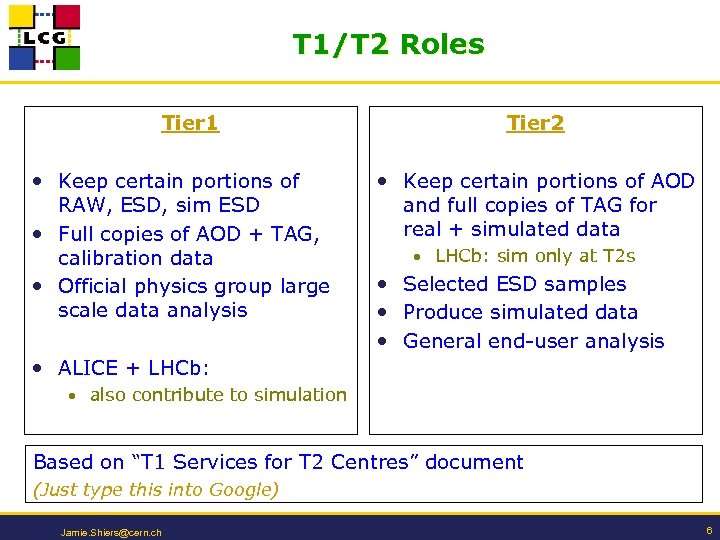 T 1/T 2 Roles Tier 1 • Keep certain portions of RAW, ESD, sim ESD • Full copies of AOD + TAG, calibration data • Official physics group large scale data analysis • ALICE + LHCb: Tier 2 • Keep certain portions of AOD and full copies of TAG for real + simulated data • LHCb: sim only at T 2 s • Selected ESD samples • Produce simulated data • General end-user analysis • also contribute to simulation Based on “T 1 Services for T 2 Centres” document (Just type this into Google) Jamie. Shiers@cern. ch 6
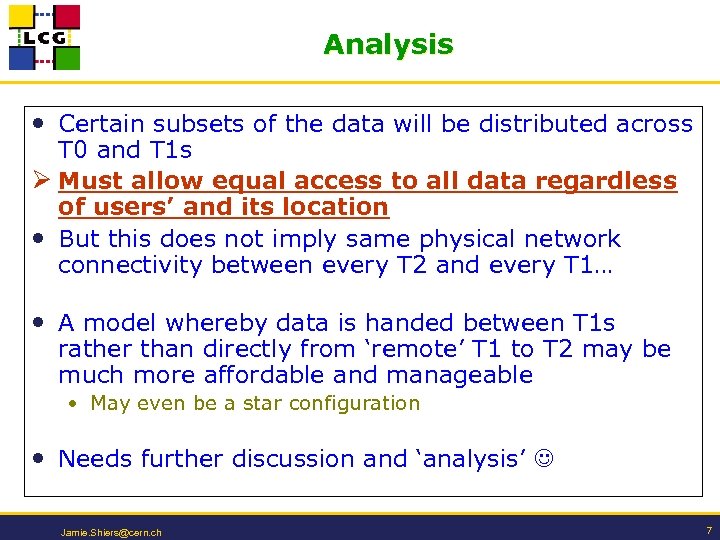 Analysis • Certain subsets of the data will be distributed across T 0 and T 1 s Ø Must allow equal access to all data regardless of users’ and its location • But this does not imply same physical network connectivity between every T 2 and every T 1… • A model whereby data is handed between T 1 s rather than directly from ‘remote’ T 1 to T 2 may be much more affordable and manageable • May even be a star configuration • Needs further discussion and ‘analysis’ Jamie. Shiers@cern. ch 7
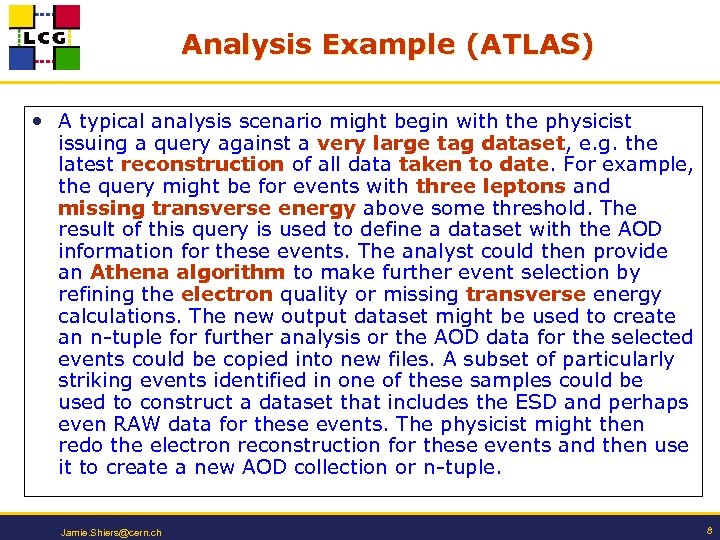 Analysis Example (ATLAS) • A typical analysis scenario might begin with the physicist issuing a query against a very large tag dataset, e. g. the latest reconstruction of all data taken to date. For example, the query might be for events with three leptons and missing transverse energy above some threshold. The result of this query is used to define a dataset with the AOD information for these events. The analyst could then provide an Athena algorithm to make further event selection by refining the electron quality or missing transverse energy calculations. The new output dataset might be used to create an n-tuple for further analysis or the AOD data for the selected events could be copied into new files. A subset of particularly striking events identified in one of these samples could be used to construct a dataset that includes the ESD and perhaps even RAW data for these events. The physicist might then redo the electron reconstruction for these events and then use it to create a new AOD collection or n-tuple. Jamie. Shiers@cern. ch 8
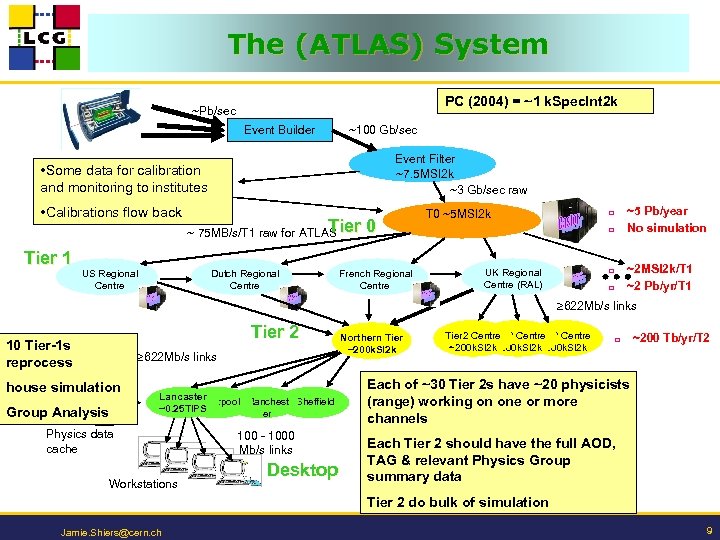 The (ATLAS) System PC (2004) = ~1 k. Spec. Int 2 k ~Pb/sec Event Builder ~100 Gb/sec Event Filter ~7. 5 MSI 2 k ~3 Gb/sec raw • Some data for calibration and monitoring to institutes • Calibrations flow back Tier 1 US Regional Centre Tier ~ 75 MB/s/T 1 raw for ATLAS Dutch Regional Centre 0 French Regional Centre T 0 ~5 MSI 2 k ~5 Pb/year No simulation ¨ ¨ UK Regional Centre (RAL) ~2 MSI 2 k/T 1 ~2 Pb/yr/T 1 ¨ ¨ 622 Mb/s links Tier 2 10 Tier-1 s reprocess 622 Mb/s links house simulation Group Analysis Lancaster Liverpool Manchest Sheffield ~0. 25 TIPS er Physics data cache Workstations 100 - 1000 Mb/s links Desktop Northern Tier ~200 k. SI 2 k Tier 2 Centre ~200 k. SI 2 k ¨ ~200 Tb/yr/T 2 Each of ~30 Tier 2 s have ~20 physicists (range) working on one or more channels Each Tier 2 should have the full AOD, TAG & relevant Physics Group summary data Tier 2 do bulk of simulation Jamie. Shiers@cern. ch 9
 Basic T 2 Services • T 2 s will need to provide services for data up- and down-load Ø Assume that this uses the same components as between T 0 and T 1 s • Assume that this also includes an SRM interface to local disk pool manager • This / these should / could also be provided through LCG • Networking requirements need to be further studied but current estimates suggest 1 Gbit connections will satisfy needs of a given experiment M Can be dramatically affected by analysis model, heavy ion data processing etc M T 3 network requirements so far ignored(? ) Jamie. Shiers@cern. ch 10
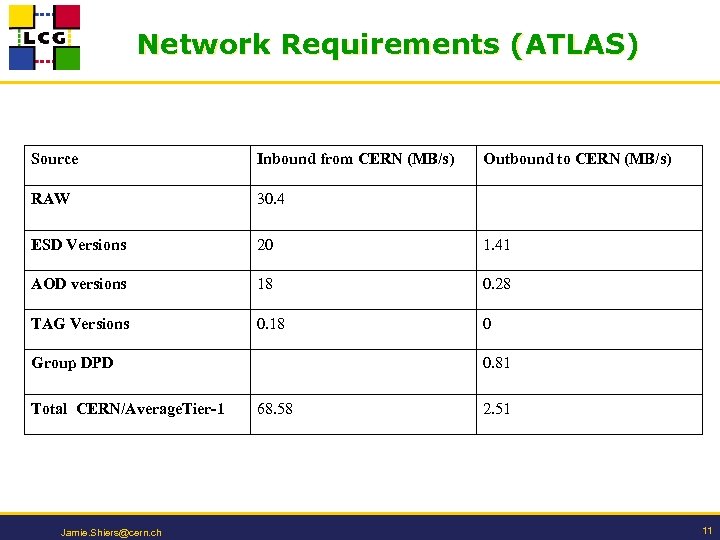 Network Requirements (ATLAS) Source Inbound from CERN (MB/s) RAW 30. 4 ESD Versions 20 1. 41 AOD versions 18 0. 28 TAG Versions 0. 18 0 Group DPD Total CERN/Average. Tier-1 Jamie. Shiers@cern. ch Outbound to CERN (MB/s) 0. 81 68. 58 2. 51 11
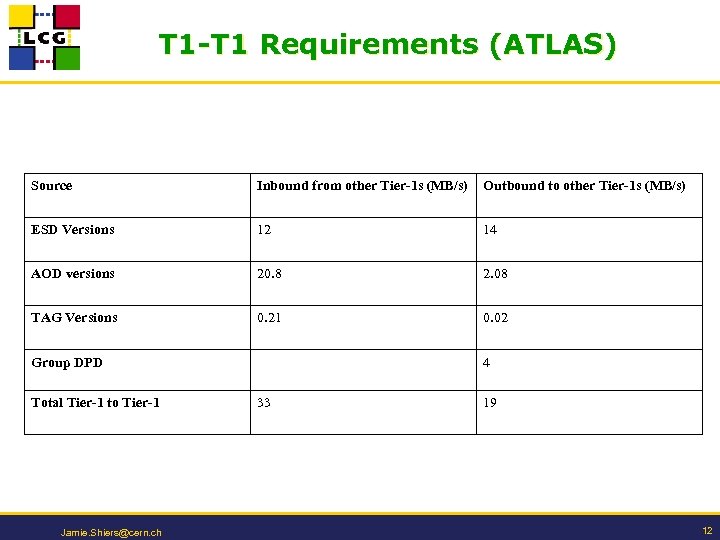 T 1 -T 1 Requirements (ATLAS) Source Inbound from other Tier-1 s (MB/s) Outbound to other Tier-1 s (MB/s) ESD Versions 12 14 AOD versions 20. 8 2. 08 TAG Versions 0. 21 0. 02 Group DPD Total Tier-1 to Tier-1 Jamie. Shiers@cern. ch 4 33 19 12
 T 2 Specifications (CMS) • T 2 centres should have WAN connectivity in the range of 1 Gb/s or more to satisfy CMS analysis requirements • T 2 centres will require relatively sophisticated disk cache management systems, or explicit and enforceable local policy, to ensure sample latency on disk is adequate and to avoid disk/WAN thrashing Jamie. Shiers@cern. ch 13
 CMS Network Requirements • We are pushing available networks to their limits in the Tier-1/Tier-2 connections • Tier-0 needs ~2 x 10 Gb/s links for CMS • Each Tier-1 needs ~10 Gb/s links • Each Tier-2 needs 1 Gb/s for its incoming traffic • There will be extreme upward pressure on these numbers as the distributed computing becomes more and more useable and effective (Presentation to LHCC review of Computing Models) Jamie. Shiers@cern. ch 14
 T 2 Timeline • Assume a small number of T 2 s fairly early in SC 3 One from INFN? § One from the UK? Ø SC 3 preparations will be complex! • Need to start identifying candidate sites and ramp up procedure now • Given the number of T 2 s, hope that this experience can be (extensively) re-used Jamie. Shiers@cern. ch 15
 Possible T 2 Procedure(? ) Ø Work through existing structures where possible • INFN in Italy, Grid. PP in the UK, HEPi. X, etc. • USATLAS, USCMS etc. • Probably need also some ‘regional’ events • e. g. fall HEPi. X for North American sites, EGEE conf. in Pisa… • Complemented with workshops at CERN and elsewhere Ø An INFN T 2 is clearly a strong option Well established INFN Grid infrastructure • Need to look beyond the basic ‘file transfer’ service and consider also good local experiment support / involvement Jamie. Shiers@cern. ch 16
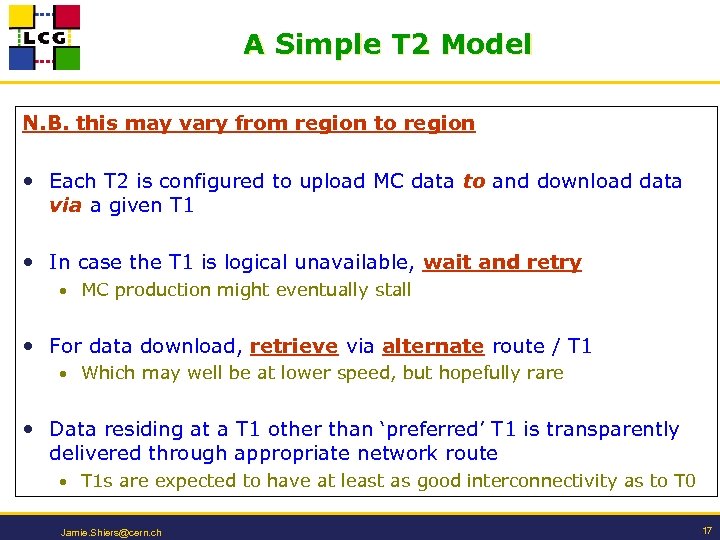 A Simple T 2 Model N. B. this may vary from region to region • Each T 2 is configured to upload MC data to and download data via a given T 1 • In case the T 1 is logical unavailable, wait and retry • MC production might eventually stall • For data download, retrieve via alternate route / T 1 • Which may well be at lower speed, but hopefully rare • Data residing at a T 1 other than ‘preferred’ T 1 is transparently delivered through appropriate network route • T 1 s are expected to have at least as good interconnectivity as to T 0 Jamie. Shiers@cern. ch 17
 Which Candidate T 2 Sites? • Would be useful to have: • Good local support from relevant experiment(s) • Some experience with disk pool mgr and file transfer s/w • ‘Sufficient’ local CPU and storage resources • Manpower available to participate in SC 3+ • And also define relevant objectives? • 1 Gbit/s network connection to T 1? • Probably a luxury at this stage… • First T 2 site(s) will no doubt be a learning process • Hope to (semi-)automate this so that adding new sites can be achieved with low overhead Jamie. Shiers@cern. ch 18
 From Grid. PP Summary… • Coordinator for T 2 work • Network expert • Understand how sites will be linked and ensure appropriate network is provisioned • Storage expert • Someone to understand how the SRM and storage should be installed and configured • Experiment experts • To drive the experiment needs • How are we going to do the transfers? • What do the experiments want to achieve out of the exercise? Jamie. Shiers@cern. ch 19
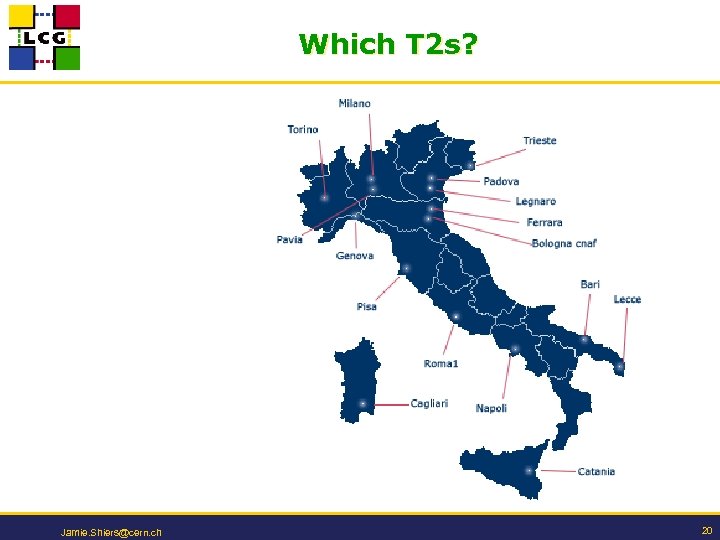 Which T 2 s? Jamie. Shiers@cern. ch 20
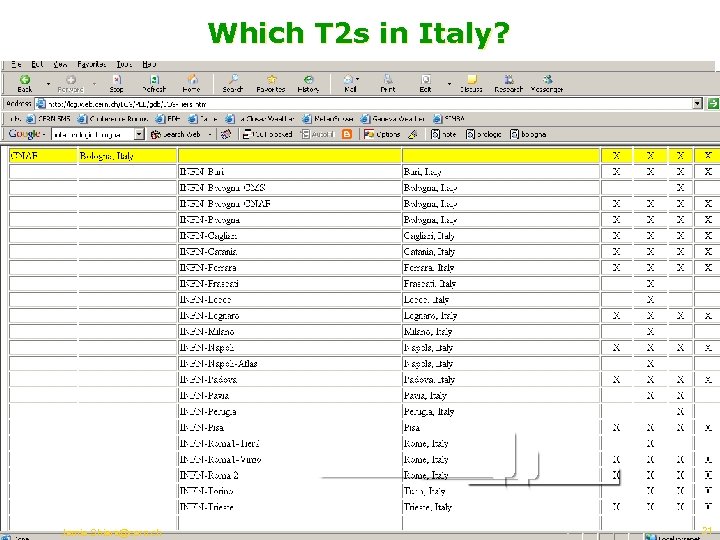 Which T 2 s in Italy? Jamie. Shiers@cern. ch 21
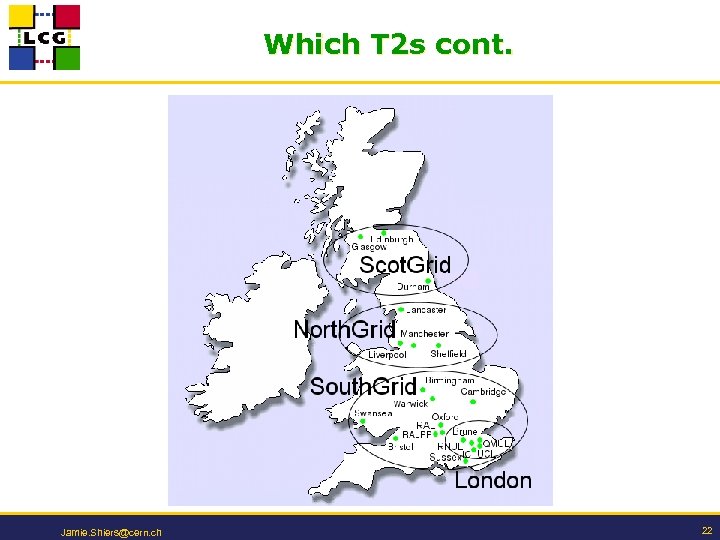 Which T 2 s cont. Jamie. Shiers@cern. ch 22
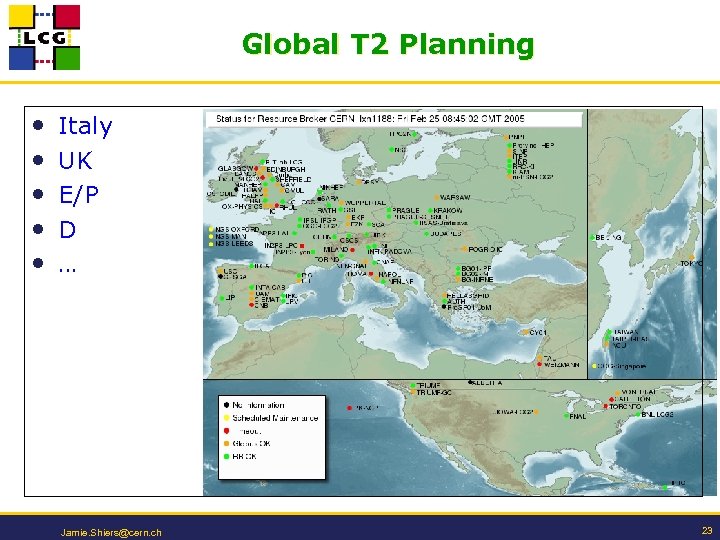 Global T 2 Planning • • • Italy UK E/P D … Jamie. Shiers@cern. ch 23
 Which Experiments? Meetings with experiments: • LHCb (4 th) ALICE (7 th) March ATLAS (10 th) • LHCb: first demonstrate infrastructure, simulate access patterns, add experiment’s s/w as last step • ALICE: • Proposal that experiments’ plans are presented at both March (Lyon) and April (Taipei) SC meetings Ø LCG Storage Management workshop 5 -7 April • Will focus on concrete needs for Service Challenges • File transfer s/w, storage management s/w, experiment- specific solutions (hopefully) built on top of standards Stephen Burke has been invited as “loose cannon” Ø SC 3 detailed planning workshop June 13 – 15 CERN • Aim is to ‘get down and dirty’ – discuss the nitty-gritty Jamie. Shiers@cern. ch 24
 Summary • The first T 2 sites need to be actively involved in Service Challenges from Summer 2005 • ~All T 2 sites need to be successfully integrated just over one year later • Adding the T 2 s and integrating the experiments’ software in the SCs will be a massive effort! Ø Due to the well-established INFN Grid infrastructure, Italy would be an excellent place to pioneer this work Jamie. Shiers@cern. ch 25