


 Скачать презентацию LCD 720 — 05 13 09 Assessment and Evaluation
d723f59f59ec05568b65f157a056c35b.ppt
- Количество слайдов: 18
 LCD 720 - 05/13/09 Assessment and Evaluation
 Announcements • Lesson plan / final paper – Due today • Evaluations: – Online at http: //www. qc. cuny. edu/courseevaluation – Until Friday, May 22
 Issues in implementation • Techniques • Curriculum • Assessment and evaluation Today
 Assessment and evaluation • Goals • Assessment techniques – Diagnostic passage – Standardized tests and rubrics • Feedback • Evaluation
 Introspection • When you were learning a foreign/second language: – Was pronunciation assessed separately? Was oral production assessed at all? – Were any self- or peer evaluation techniques used by the instructor? If so, describe them. • Are you using pronunciation assessment and evaluation in your classroom now? – What techniques do you use, and why?
 Goals of assessment • Diagnostic – Placement: Which class level should a student be assigned to? – Setting objectives: What are the students’ needs? • Evaluation – Were the lessons successful?
 Assessment techniques • Assessment techniques can be similar to instructional techniques, esp. for perception: – E. g. , listening discrimination, fill in the blanks dictation • Assessing production – Diagnostic passage • Containing common problems – Spontaneous speech sample • Topic • Role play • Picture description / illustrated stories • Oral proficiency testing instruments
 Assessment techniques: Diagnostic passage • If English is not your native language, people may have noticed that you come from another country because of your “foreign accent”. Why do people usually have an accent when they speak a second language? Several theories address this issue. Many people believe that only young children can learn a second language without an accent, but applied linguists have reported cases of older individuals who have mastered a second How would you use language without an accent. … this to analyze a See accent checklist, p. 399 student’s abilities?
 • Listen to the native speaker sample • Listen to the two non-native speakers’ samples, and diagnose their production. – Use accent checklist, p. 399 NS NNS 1 NNS 2
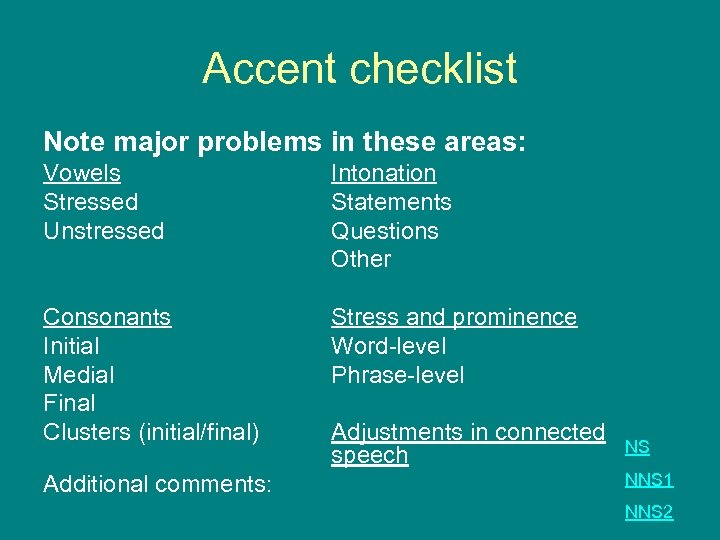 Accent checklist Note major problems in these areas: Vowels Stressed Unstressed Intonation Statements Questions Other Consonants Initial Medial Final Clusters (initial/final) Stress and prominence Word-level Phrase-level Additional comments: Adjustments in connected speech NS NNS 1 NNS 2
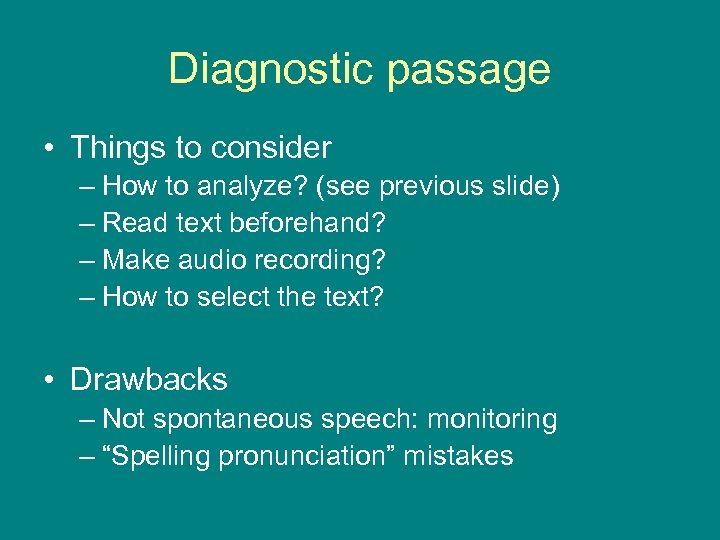 Diagnostic passage • Things to consider – How to analyze? (see previous slide) – Read text beforehand? – Make audio recording? – How to select the text? • Drawbacks – Not spontaneous speech: monitoring – “Spelling pronunciation” mistakes
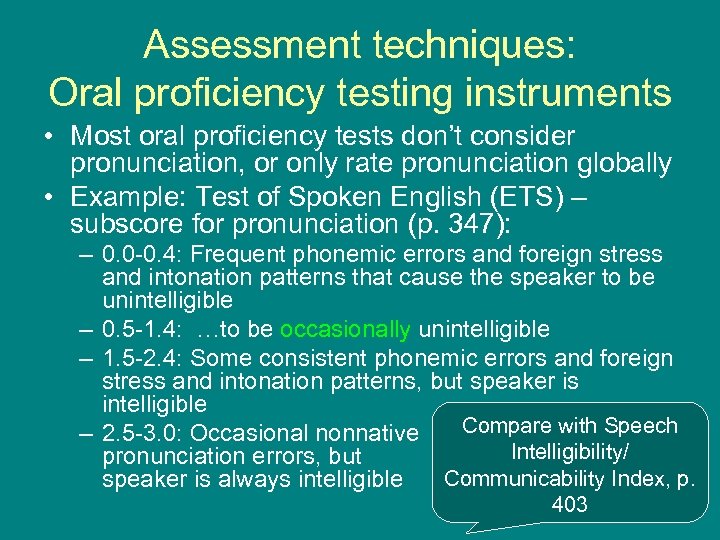 Assessment techniques: Oral proficiency testing instruments • Most oral proficiency tests don’t consider pronunciation, or only rate pronunciation globally • Example: Test of Spoken English (ETS) – subscore for pronunciation (p. 347): – 0. 0 -0. 4: Frequent phonemic errors and foreign stress and intonation patterns that cause the speaker to be unintelligible – 0. 5 -1. 4: …to be occasionally unintelligible – 1. 5 -2. 4: Some consistent phonemic errors and foreign stress and intonation patterns, but speaker is intelligible Compare with Speech – 2. 5 -3. 0: Occasional nonnative Intelligibility/ pronunciation errors, but Communicability Index, p. speaker is always intelligible 403
 • Use the Test of Spoken English subscores and the Speech Intelligibility/ Communicability Index: – Think of a student, friend, or family member: How would you rate him/her? – How would you rate yourself? (ESL or other L 2) – What difficulties did you encounter?
 Feedback Students should monitor their progress and know what to work on 1. Self-correction and monitoring – How to teach this? 2. Peer feedback 3. Teacher feedback – Dialogue journal: What do they say? Would you use this in your class?
 Evaluation • Less broad than diagnostic test – Test only those aspects that have been taught • Test them in more depth – Various times during course to track progress • Lower stakes than in placement tests – Less control required, so interviews and role plays can be used to elicit spontaneous speech – Use rubrics for evaluation and feedback
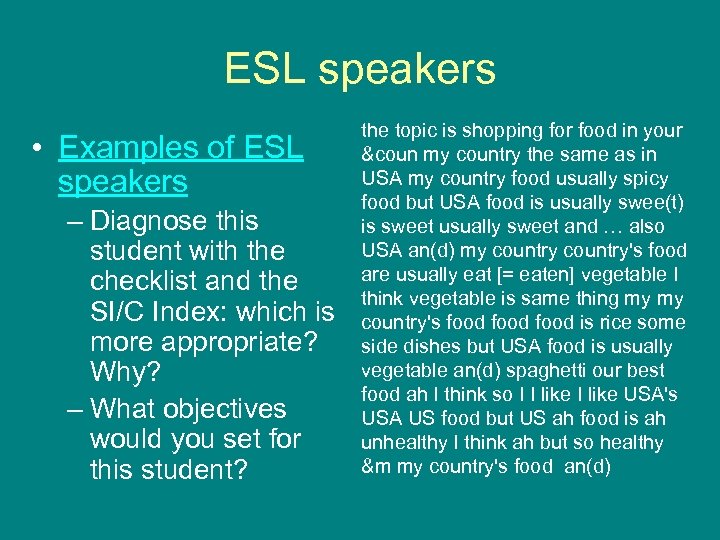 ESL speakers • Examples of ESL speakers – Diagnose this student with the checklist and the SI/C Index: which is more appropriate? Why? – What objectives would you set for this student? the topic is shopping for food in your &coun my country the same as in USA my country food usually spicy food but USA food is usually swee(t) is sweet usually sweet and … also USA an(d) my country's food are usually eat [= eaten] vegetable I think vegetable is same thing my my country's food is rice some side dishes but USA food is usually vegetable an(d) spaghetti our best food ah I think so I I like USA's USA US food but US ah food is ah unhealthy I think ah but so healthy &m my country's food an(d)
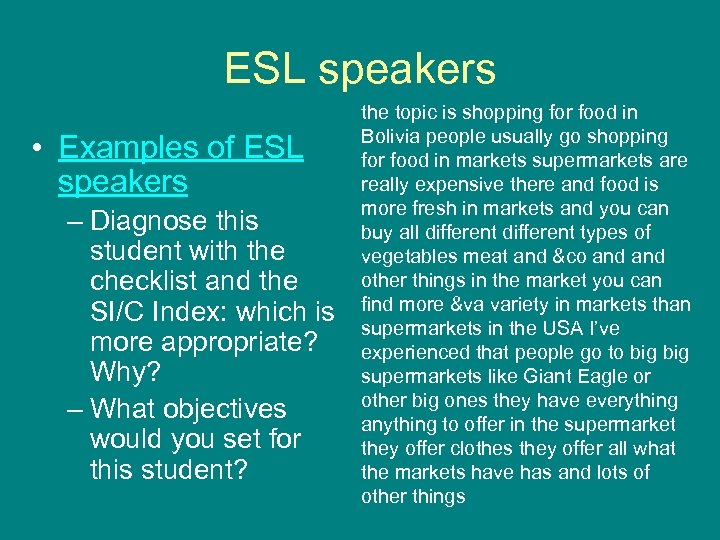 ESL speakers • Examples of ESL speakers – Diagnose this student with the checklist and the SI/C Index: which is more appropriate? Why? – What objectives would you set for this student? the topic is shopping for food in Bolivia people usually go shopping for food in markets supermarkets are really expensive there and food is more fresh in markets and you can buy all different types of vegetables meat and &co and other things in the market you can find more &va variety in markets than supermarkets in the USA I’ve experienced that people go to big supermarkets like Giant Eagle or other big ones they have everything anything to offer in the supermarket they offer clothes they offer all what the markets have has and lots of other things
 Next week • Technology and pronunciation teaching – examples