 Скачать презентацию LBWD s Prototype-Scale Testing of NF Membranes for Seawater
2b7ddf6aea6ec7414eca5f20addd3673.ppt
- Количество слайдов: 40



LBWD’s Prototype-Scale Testing of NF Membranes for Seawater Desalination Robert C. Cheng, Tai J. Tseng, Kevin L. Wattier February 17, 2011 MSSC National Salinity Summit 1
Research Partners Government SUS Bureau of Reclamation SCA Dept. of Water Resources SLA Department of Water and Power SSouthern Nevada Water Authority STampa Bay Water Authority Industry SDu. Pont SWater Research Foundation (Awwa. RF) SBlack & Veatch SCH 2 M Hill Academia SUCLA SUniversity of New Hampshire SClemson University SUniversity of Illinois SMontana State University SUniversity of Central Florida SVirginia Tech SUniversity of Nevada, Reno SUniversity of Iowa
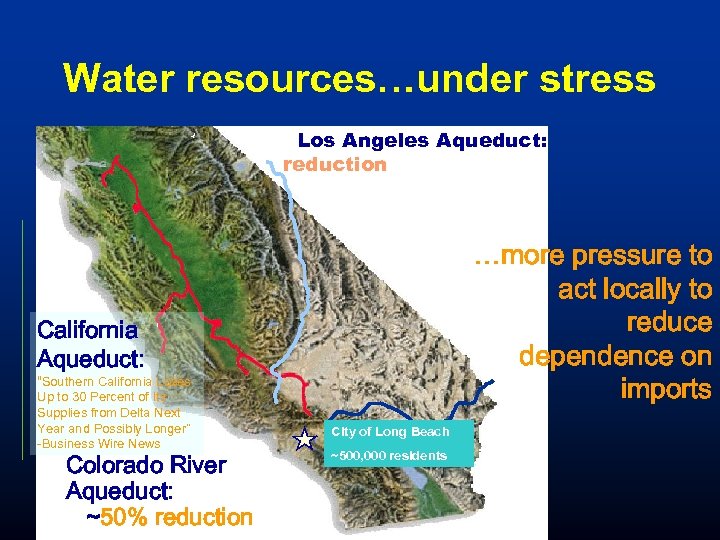
Water resources…under stress Los Angeles Aqueduct: reduction …more pressure to act locally to reduce dependence on imports California Aqueduct: “Southern California Loses Up to 30 Percent of Its Supplies from Delta Next Year and Possibly Longer” -Business Wire News Colorado River Aqueduct: ~50% reduction City of Long Beach ~500, 000 residents
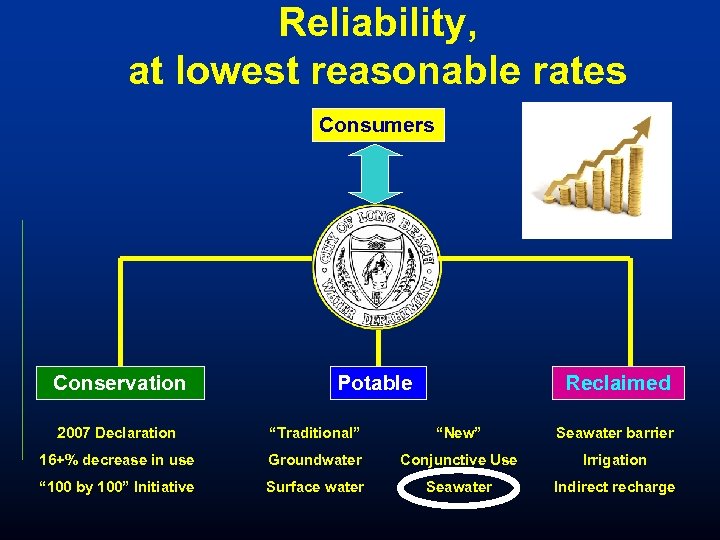
Reliability, at lowest reasonable rates Consumers Conservation Potable Reclaimed 2007 Declaration “Traditional” “New” Seawater barrier 16+% decrease in use Groundwater Conjunctive Use Irrigation “ 100 by 100” Initiative Surface water Seawater Indirect recharge
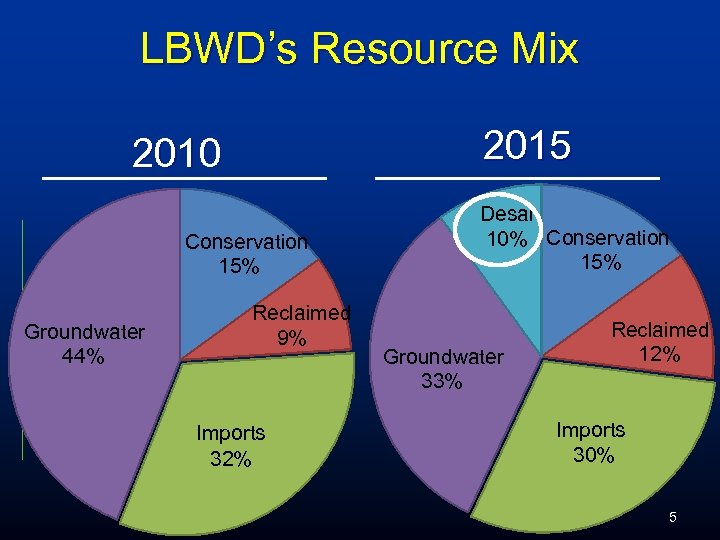
LBWD’s Resource Mix 2015 2010 Conservation 15% Groundwater 44% Reclaimed 9% Imports 32% Desal 10% Conservation 15% Groundwater 33% Reclaimed 12% Imports 30% 5
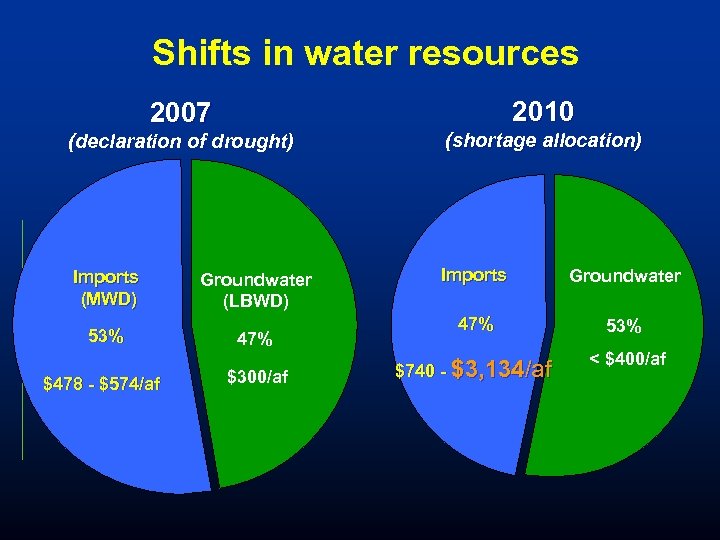
Shifts in water resources 2010 2007 (declaration of drought) (shortage allocation) Imports (MWD) Imports Groundwater 47% 53% $740 - $3, 134/af < $400/af 53% $478 - $574/af Groundwater (LBWD) 47% $300/af
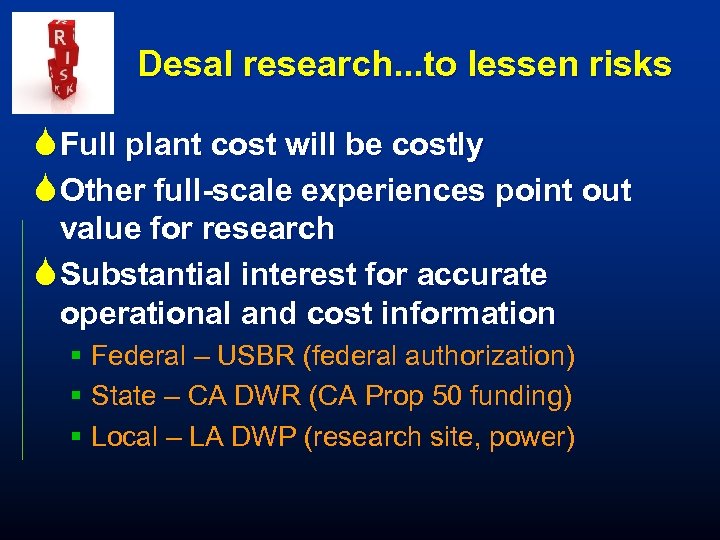
Desal research. . . to lessen risks S Full plant cost will be costly S Other full-scale experiences point out value for research S Substantial interest for accurate operational and cost information § Federal – USBR (federal authorization) § State – CA DWR (CA Prop 50 funding) § Local – LA DWP (research site, power)
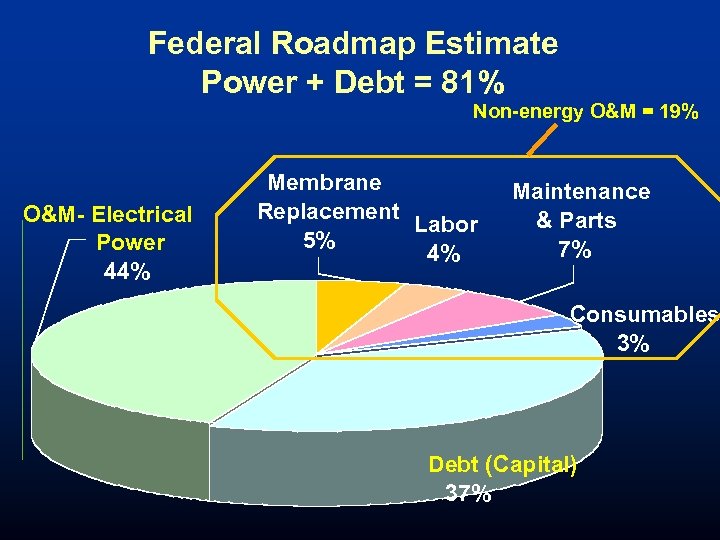
Federal Roadmap Estimate Power + Debt = 81% Non-energy O&M = 19% O&M- Electrical Power 44% Membrane Replacement Labor 5% 4% Maintenance & Parts 7% Consumables 3% Debt (Capital) 37%
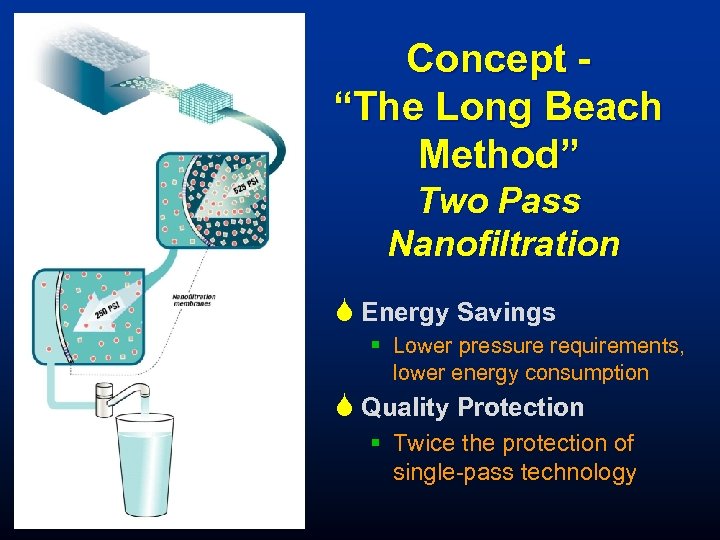
Concept - “The Long Beach Method” Two Pass Nanofiltration S Energy Savings § Lower pressure requirements, lower energy consumption S Quality Protection § Twice the protection of single-pass technology
NF membrane for seawater desal S Proof-of-concept § Initiated testing ~2001 § verified through 2 -yr Awwa. RF project, “A Novel Approach to Seawater Desalination Using Dual-Staged Nanofiltration” S Patent application § US patent 7144511, granted 12/5/06 § “Two stage nanofiltration desalination system” S Prototype plant construction/operations § 2004 - 2010
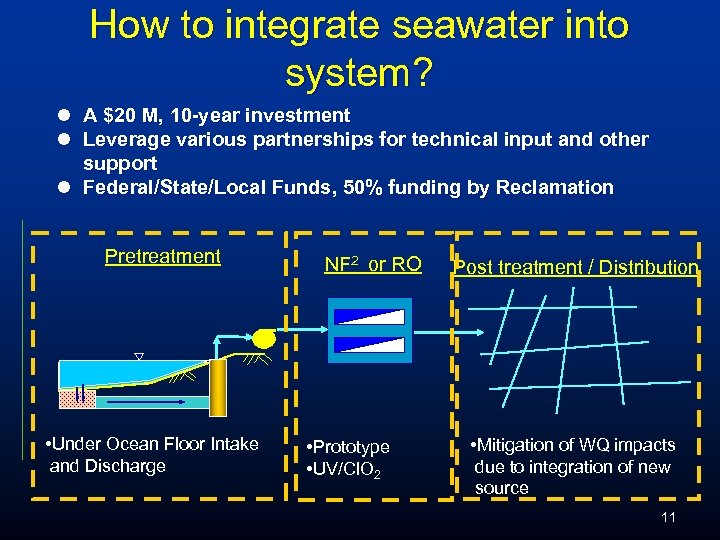
How to integrate seawater into system? l A $20 M, 10 -year investment l Leverage various partnerships for technical input and other support l Federal/State/Local Funds, 50% funding by Reclamation Pretreatment • Under Ocean Floor Intake and Discharge NF 2 or RO • Prototype • UV/Cl. O 2 Post treatment / Distribution • Mitigation of WQ impacts due to integration of new source 11
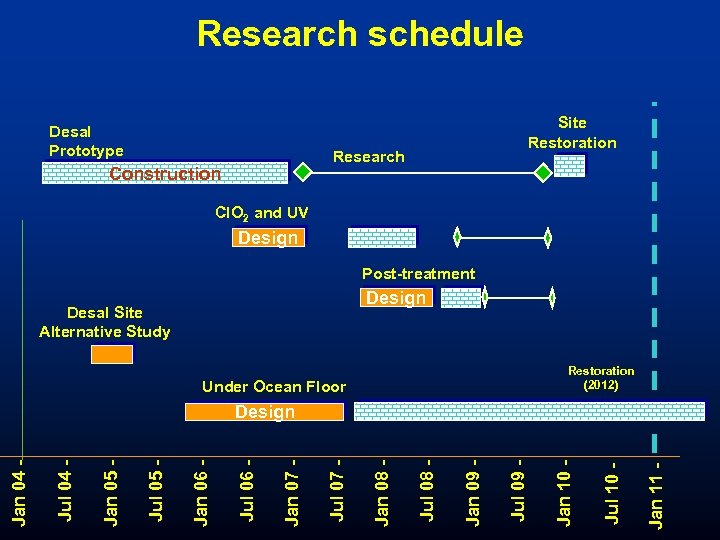
Research schedule Desal Prototype Site Restoration Research Construction Cl. O 2 and UV Design Post-treatment Design Desal Site Alternative Study Restoration (2012) Under Ocean Floor Jan 11 - Jul 10 - Jan 10 - Jul 09 - Jan 09 - Jul 08 - Jan 08 - Jul 07 - Jan 07 - Jul 06 - Jan 06 - Jul 05 - Jan 05 - Jul 04 - Jan 04 - Design
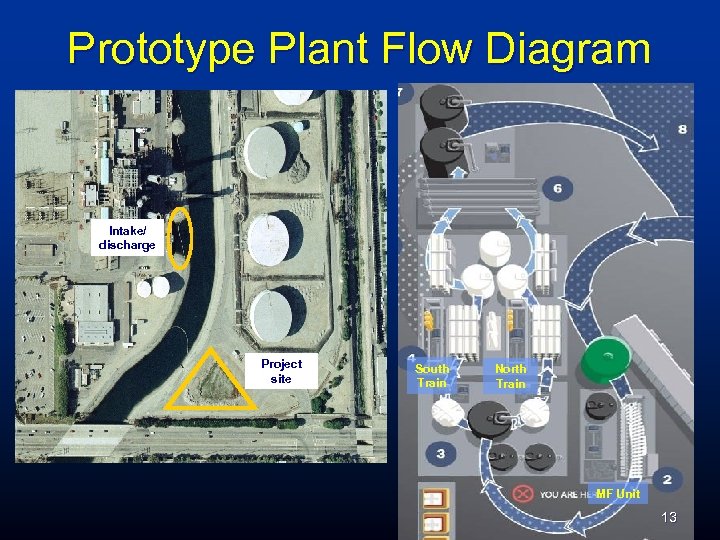
Prototype Plant Flow Diagram Intake/ discharge Project site South Train North Train MF Unit 13
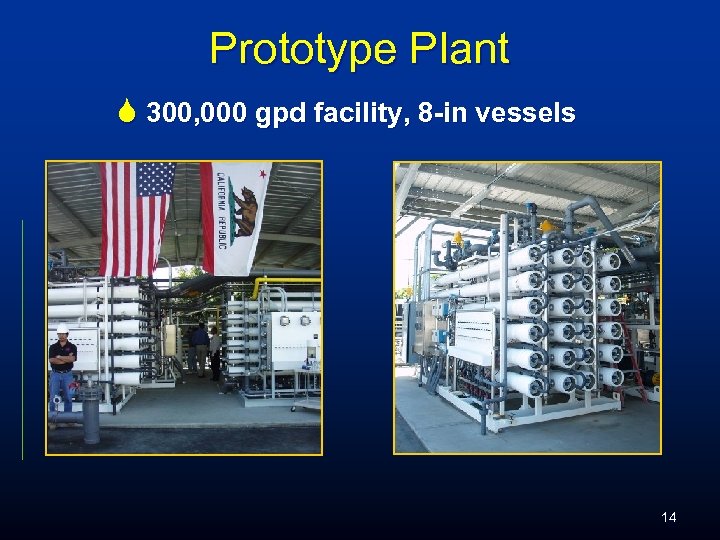
Prototype Plant S 300, 000 gpd facility, 8 -in vessels 14
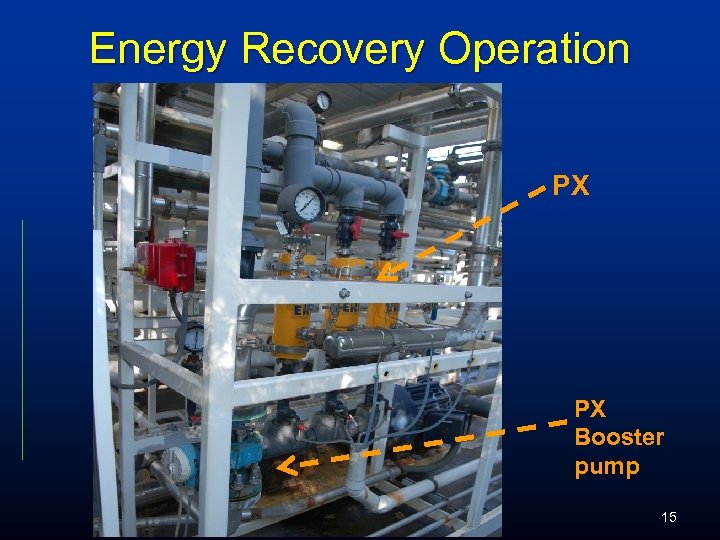
Energy Recovery Operation PX PX Booster pump 15
Other Issues S Technical § Water quality met (boron, bromide, etc. ) § Blending issues with existing water S Environmental § Impingement/entrainment § Discharge S Public Trust § Sound investment § Transparency S Permitting
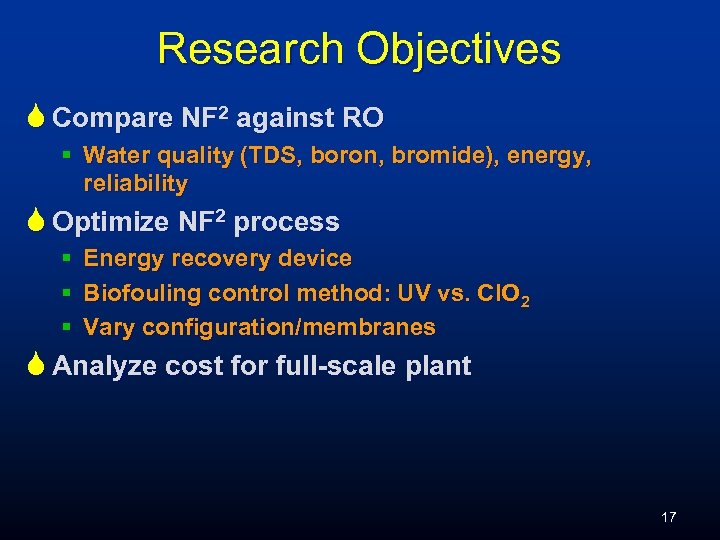
Research Objectives S Compare NF 2 against RO § Water quality (TDS, boron, bromide), energy, reliability S Optimize NF 2 process § § § Energy recovery device Biofouling control method: UV vs. Cl. O 2 Vary configuration/membranes S Analyze cost for full-scale plant 17
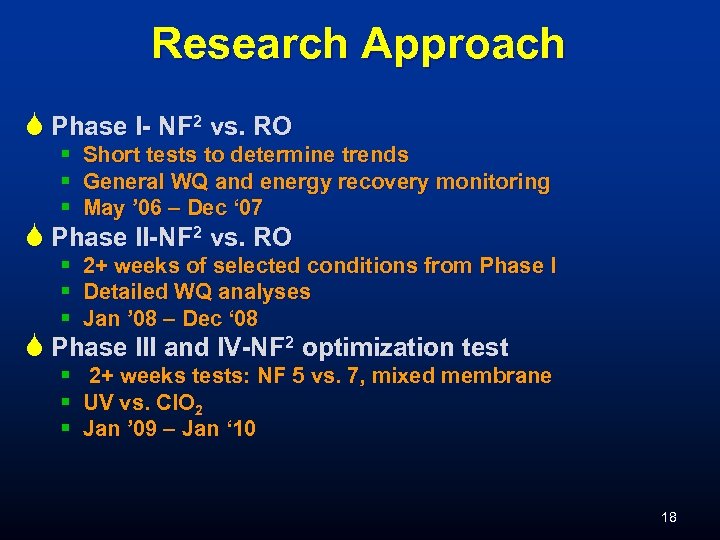
Research Approach S Phase I- NF 2 vs. RO § § § Short tests to determine trends General WQ and energy recovery monitoring May ’ 06 – Dec ‘ 07 § § § 2+ weeks of selected conditions from Phase I Detailed WQ analyses Jan ’ 08 – Dec ‘ 08 § § § 2+ weeks tests: NF 5 vs. 7, mixed membrane UV vs. Cl. O 2 Jan ’ 09 – Jan ‘ 10 S Phase II-NF 2 vs. RO S Phase III and IV-NF 2 optimization test 18
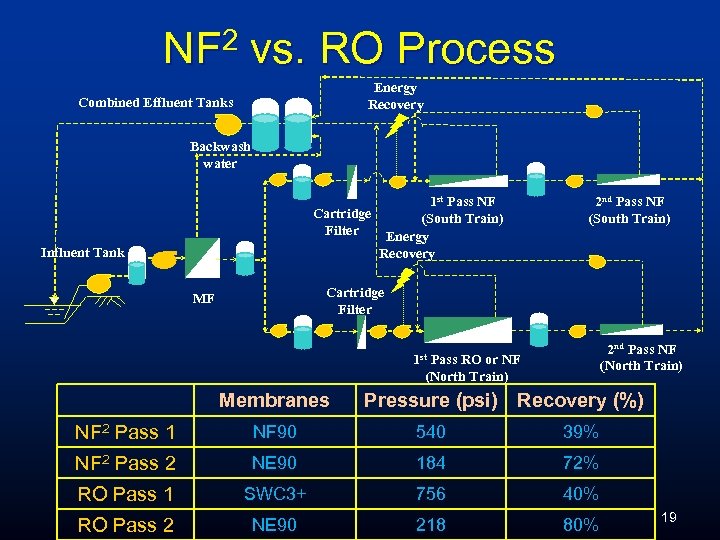
NF 2 vs. RO Process Energy Recovery Combined Effluent Tanks Backwash water 1 st Pass NF Cartridge (South Train) Filter Energy Recovery Influent Tank 2 nd Pass NF (South Train) Cartridge Filter MF 2 nd Pass NF (North Train) 1 st Pass RO or NF (North Train) Membranes Pressure (psi) Recovery (%) NF 2 Pass 1 NF 90 540 39% NF 2 Pass 2 NE 90 184 72% RO Pass 1 SWC 3+ 756 40% RO Pass 2 NE 90 218 80% 19
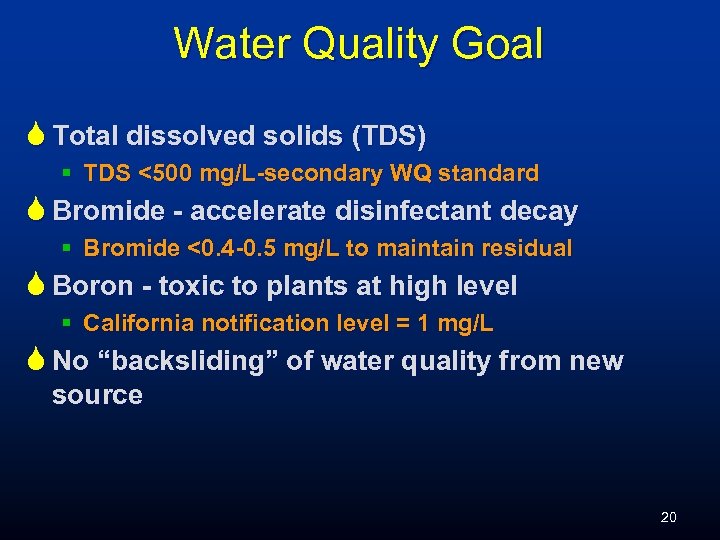
Water Quality Goal S Total dissolved solids (TDS) § TDS <500 mg/L-secondary WQ standard S Bromide - accelerate disinfectant decay § Bromide <0. 4 -0. 5 mg/L to maintain residual S Boron - toxic to plants at high level § California notification level = 1 mg/L S No “backsliding” of water quality from new source 20
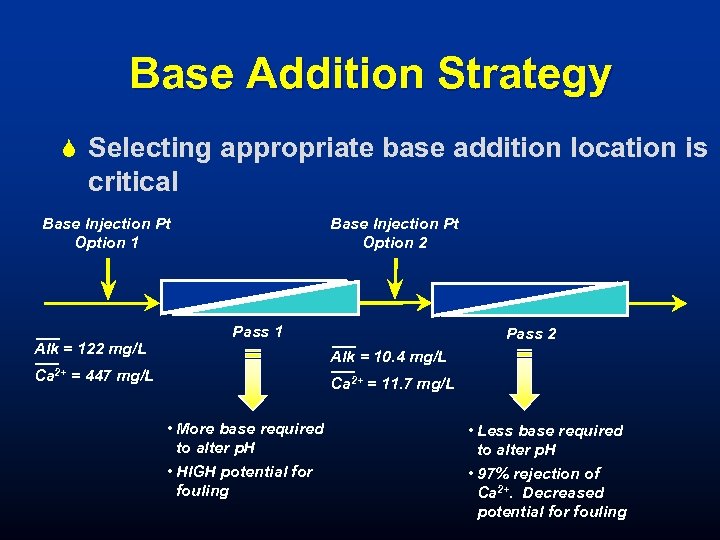
Base Addition Strategy S Selecting appropriate base addition location is critical Base Injection Pt Option 1 Alk = 122 mg/L Base Injection Pt Option 2 Pass 1 Pass 2 Alk = 10. 4 mg/L Ca 2+ = 447 mg/L Ca 2+ = 11. 7 mg/L • More base required to alter p. H • HIGH potential for fouling • Less base required to alter p. H • 97% rejection of Ca 2+. Decreased potential for fouling
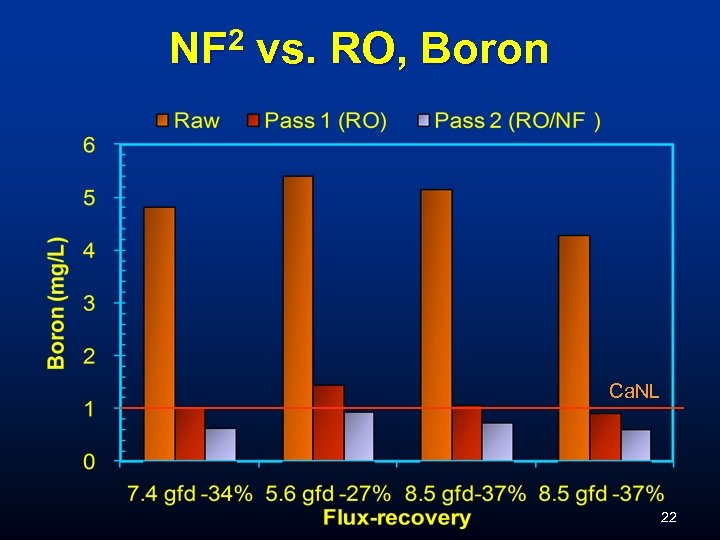
NF 2 vs. RO, Boron Ca. NL 22
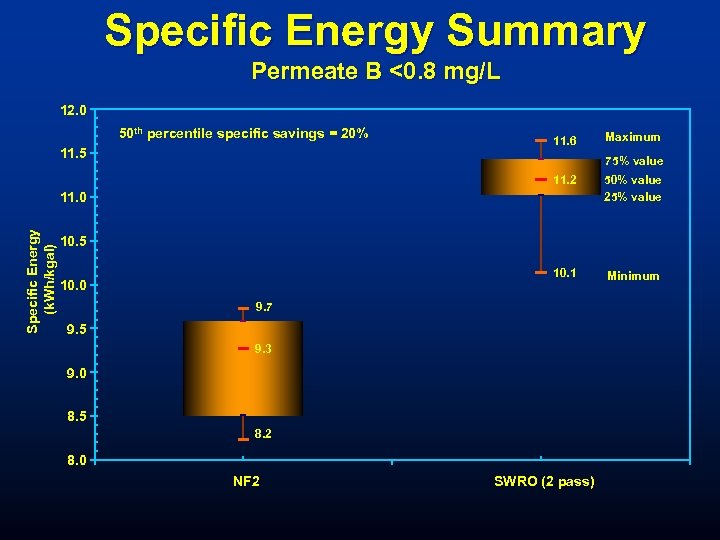
Specific Energy Summary Permeate B <0. 8 mg/L 12. 0 50 th percentile specific savings = 20% 11. 5 11. 6 Maximum 75% value 11. 2 50% value 25% value 10. 1 Minimum Specific Energy (k. Wh/kgal) 11. 0 10. 5 10. 0 9. 7 9. 5 9. 3 9. 0 8. 5 8. 2 8. 0 NF 2 SWRO (2 pass)
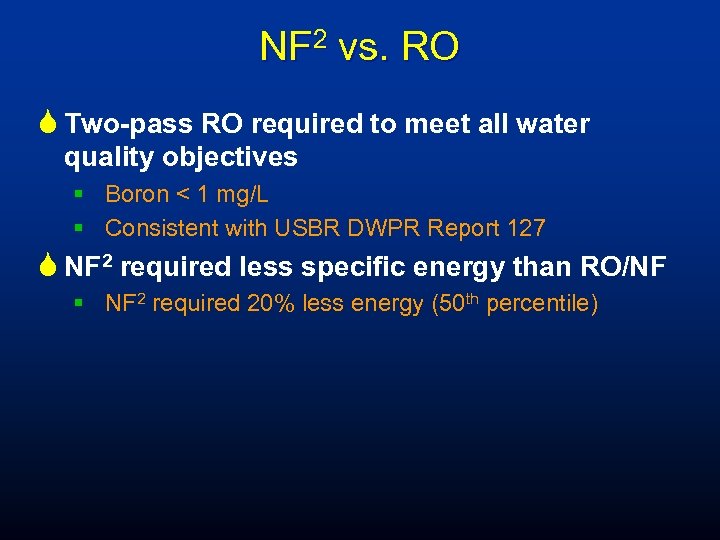
NF 2 vs. RO S Two-pass RO required to meet all water quality objectives § Boron < 1 mg/L § Consistent with USBR DWPR Report 127 S NF 2 required less specific energy than RO/NF § NF 2 required 20% less energy (50 th percentile)
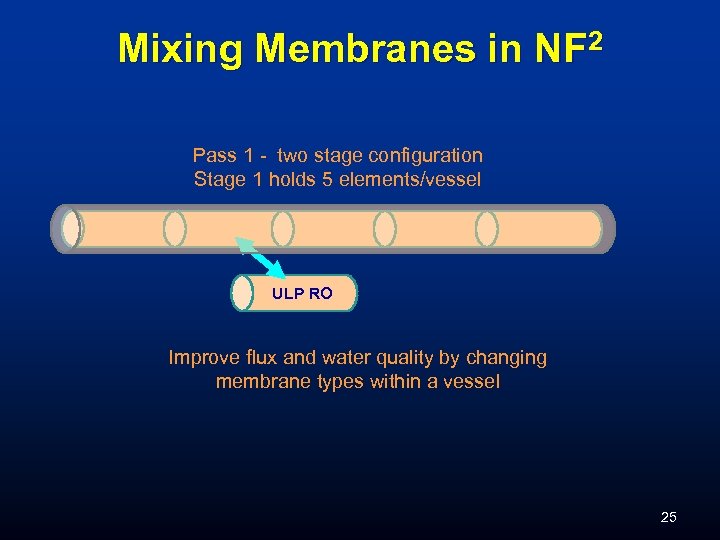
Mixing Membranes in NF 2 Pass 1 - two stage configuration Stage 1 holds 5 elements/vessel ULP RO Improve flux and water quality by changing membrane types within a vessel 25
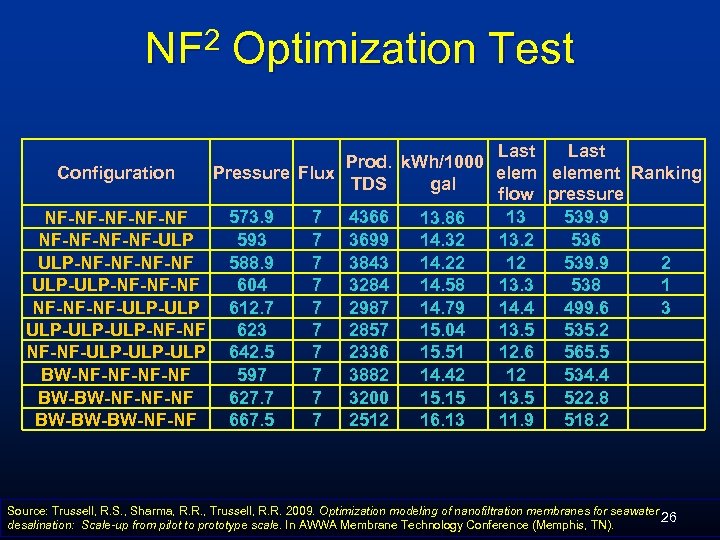
NF 2 Optimization Test Last Prod. k. Wh/1000 Configuration Pressure Flux element Ranking TDS gal flow pressure 573. 9 7 4366 13 539. 9 NF-NF-NF 13. 86 NF-NF-ULP 593 7 3699 14. 32 13. 2 536 2 ULP-NF-NF 588. 9 7 3843 14. 22 12 539. 9 ULP-NF-NF-NF 604 7 3284 14. 58 13. 3 538 1 NF-NF-NF-ULP 612. 7 7 2987 14. 79 14. 4 499. 6 3 ULP-ULP-NF-NF 623 7 2857 15. 04 13. 5 535. 2 NF-NF-ULP-ULP 642. 5 7 2336 15. 51 12. 6 565. 5 BW-NF-NF 597 7 3882 14. 42 12 534. 4 BW-BW-NF-NF-NF 627. 7 7 3200 15. 15 13. 5 522. 8 BW-BW-BW-NF-NF 667. 5 7 2512 16. 13 11. 9 518. 2 Source: Trussell, R. S. , Sharma, R. R. , Trussell, R. R. 2009. Optimization modeling of nanofiltration membranes for seawater 26 desalination: Scale-up from pilot to prototype scale. In AWWA Membrane Technology Conference (Memphis, TN).
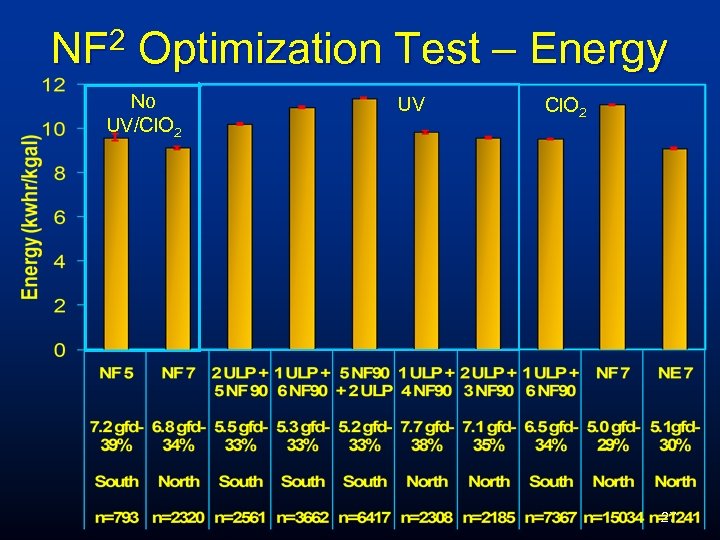
NF 2 Optimization Test – Energy No UV/Cl. O 2 UV Cl. O 2 27
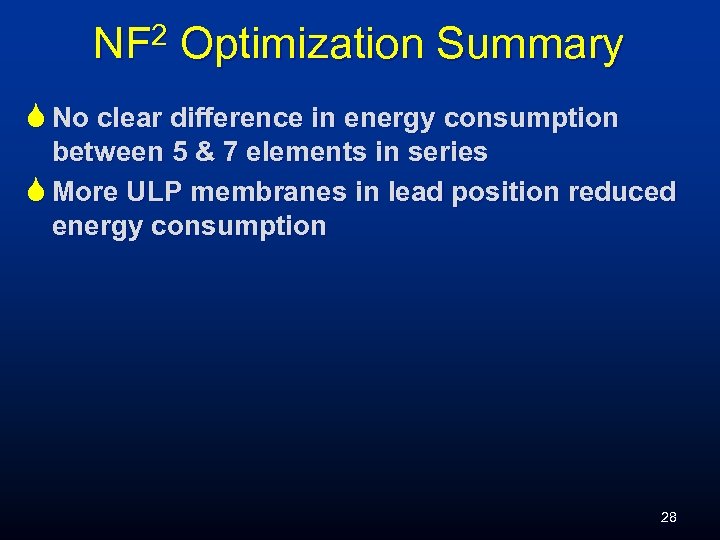
NF 2 Optimization Summary S No clear difference in energy consumption between 5 & 7 elements in series S More ULP membranes in lead position reduced energy consumption 28
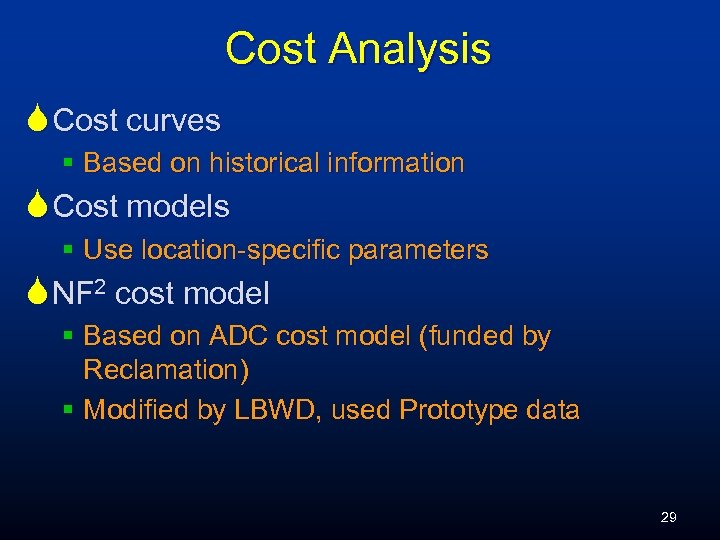
Cost Analysis S Cost curves § Based on historical information S Cost models § Use location-specific parameters S NF 2 cost model § Based on ADC cost model (funded by Reclamation) § Modified by LBWD, used Prototype data 29
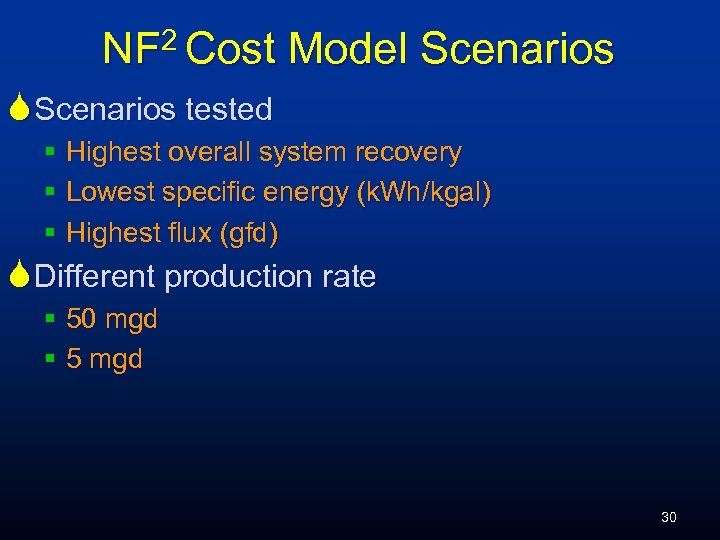
NF 2 Cost Model Scenarios S Scenarios tested § Highest overall system recovery § Lowest specific energy (k. Wh/kgal) § Highest flux (gfd) S Different production rate § 50 mgd § 5 mgd 30
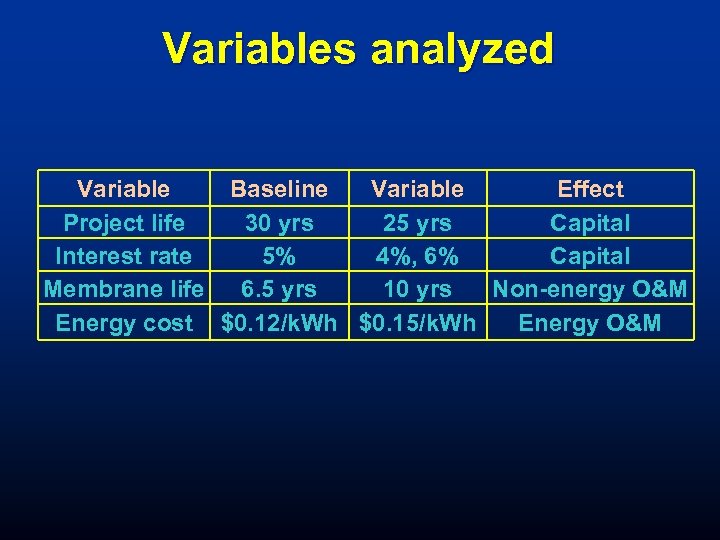
Variables analyzed Variable Baseline Variable Effect Project life 30 yrs 25 yrs Capital Interest rate 5% 4%, 6% Capital Membrane life 6. 5 yrs 10 yrs Non-energy O&M Energy cost $0. 12/k. Wh $0. 15/k. Wh Energy O&M
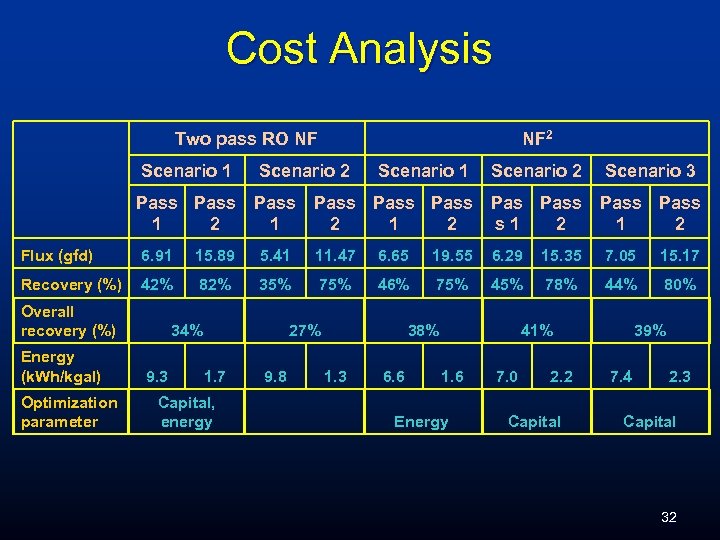
Cost Analysis Two pass RO NF Scenario 1 NF 2 Scenario 2 Scenario 1 Scenario 2 Scenario 3 Pass Pass Pass 1 2 1 2 s 1 2 Flux (gfd) 6. 91 15. 89 5. 41 11. 47 6. 65 19. 55 6. 29 15. 35 7. 05 15. 17 Recovery (%) 42% 82% 35% 75% 46% 75% 45% 78% 44% 80% Overall recovery (%) Energy (k. Wh/kgal) Optimization parameter 34% 9. 3 27% 1. 7 Capital, energy 9. 8 38% 1. 3 6. 6 41% 1. 6 Energy 7. 0 2. 2 Capital 39% 7. 4 2. 3 Capital 32
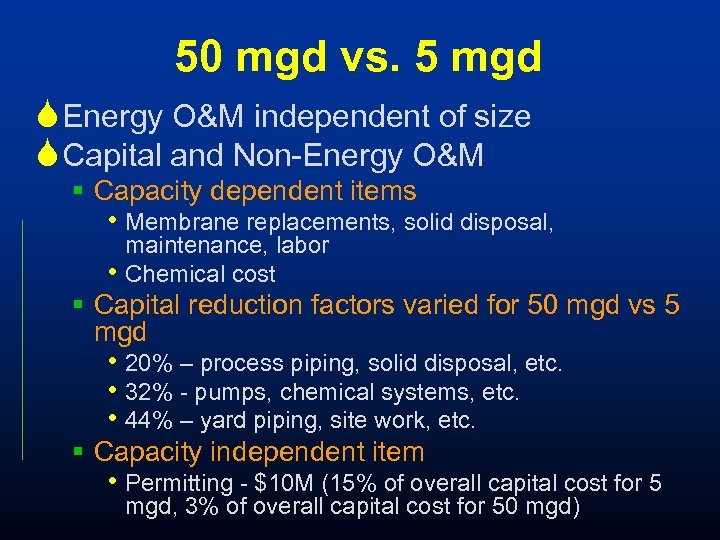
50 mgd vs. 5 mgd S Energy O&M independent of size S Capital and Non-Energy O&M § Capacity dependent items • Membrane replacements, solid disposal, maintenance, labor Chemical cost • § Capital reduction factors varied for 50 mgd vs 5 mgd • 20% – process piping, solid disposal, etc. • 32% - pumps, chemical systems, etc. • 44% – yard piping, site work, etc. § Capacity independent item • Permitting - $10 M (15% of overall capital cost for 5 mgd, 3% of overall capital cost for 50 mgd)
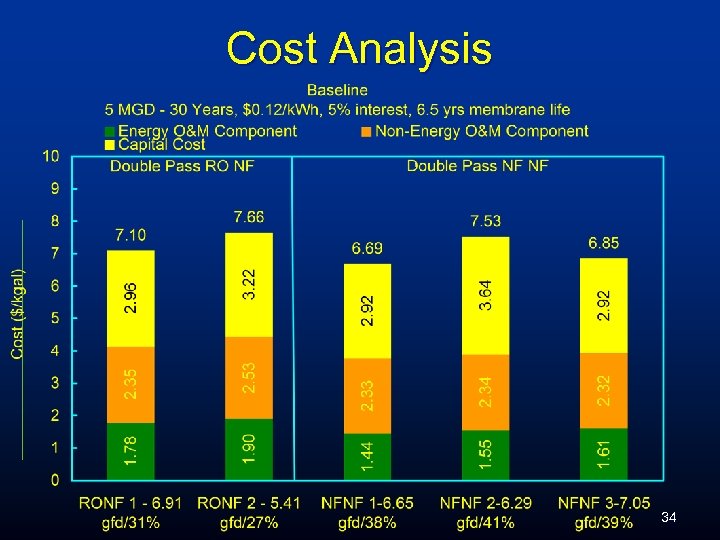
Cost Analysis 34
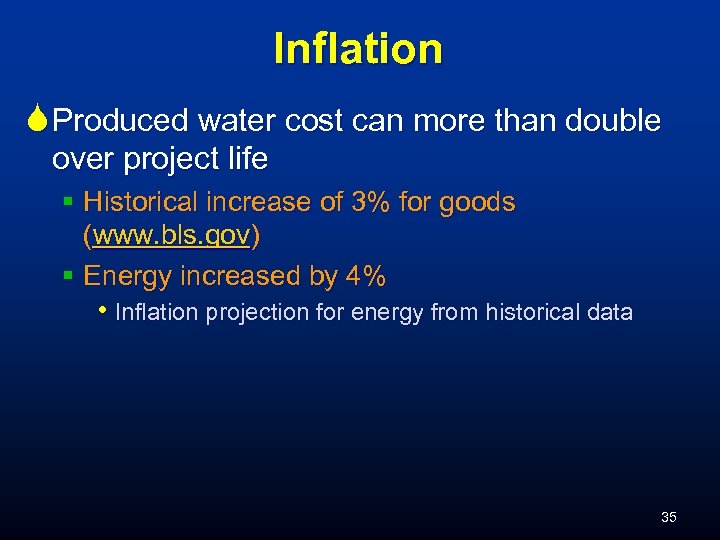
Inflation S Produced water cost can more than double over project life § Historical increase of 3% for goods (www. bls. gov) § Energy increased by 4% • Inflation projection for energy from historical data 35
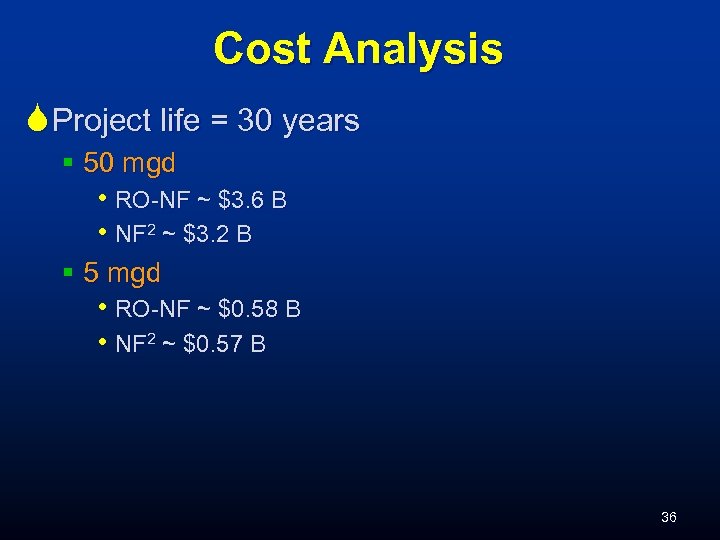
Cost Analysis S Project life = 30 years § 50 mgd • RO-NF ~ $3. 6 B • NF 2 ~ $3. 2 B § 5 mgd • RO-NF ~ $0. 58 B • NF 2 ~ $0. 57 B 36
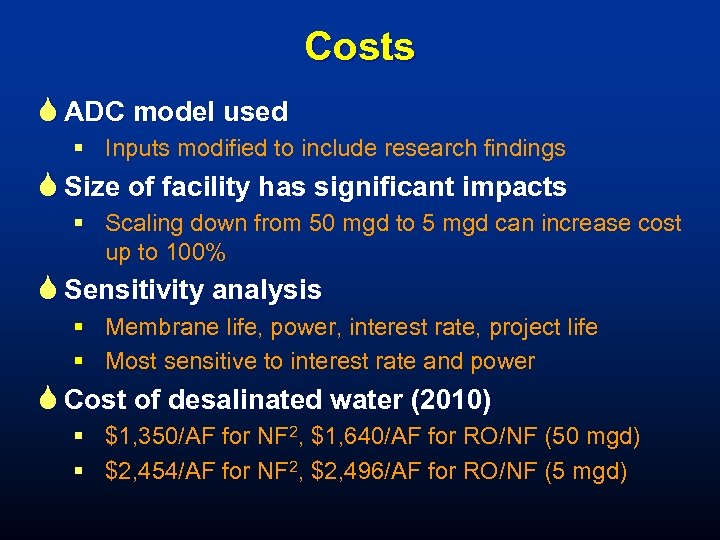
Costs S ADC model used § Inputs modified to include research findings S Size of facility has significant impacts § Scaling down from 50 mgd to 5 mgd can increase cost up to 100% S Sensitivity analysis § Membrane life, power, interest rate, project life § Most sensitive to interest rate and power S Cost of desalinated water (2010) § $1, 350/AF for NF 2, $1, 640/AF for RO/NF (50 mgd) § $2, 454/AF for NF 2, $2, 496/AF for RO/NF (5 mgd)
Next steps S Report for USBR in print ?

Research Presentations

Questions? www. lbwater. org
Скачать презентацию LBWD s Prototype-Scale Testing of NF Membranes for Seawater
2b7ddf6aea6ec7414eca5f20addd3673.ppt