


 Скачать презентацию Layer 1 Networking 5 21 2015 Link on last slide
f670e0cf7171e7d763c32cb563b4c90f.ppt
- Количество слайдов: 43
 Layer 1 Networking 5/21/2015 Link on last slide Warner
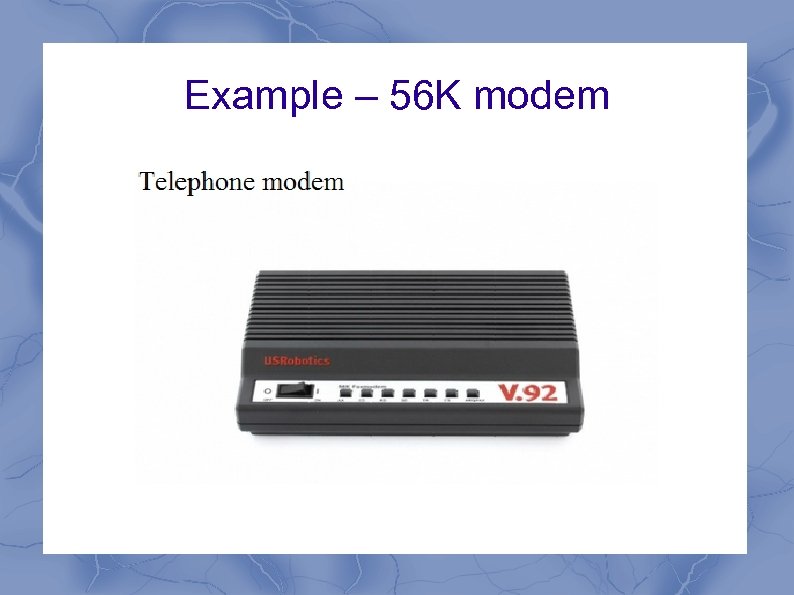 Example – 56 K modem
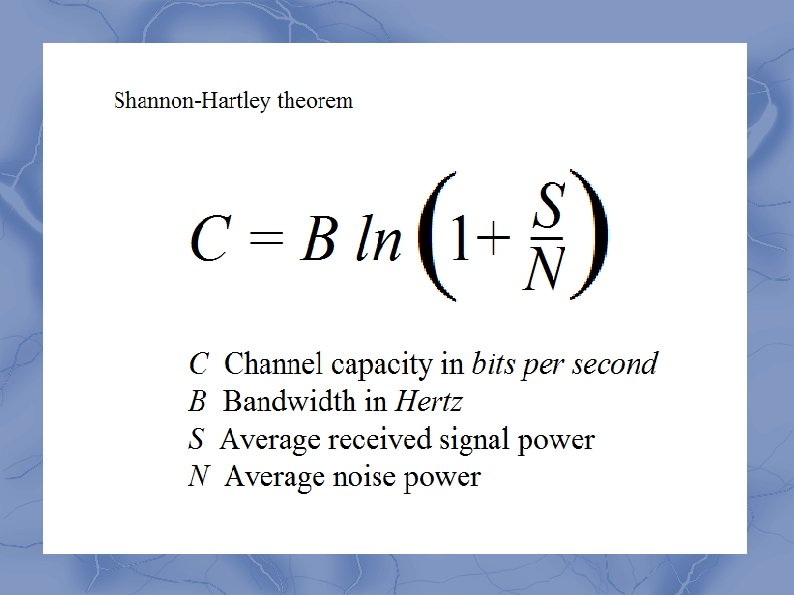
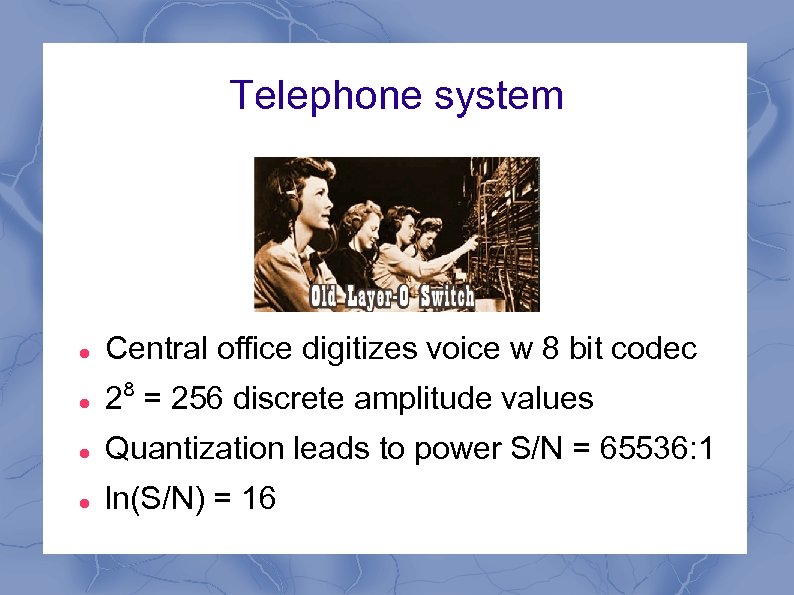 Telephone system Central office digitizes voice w 8 bit codec 2⁸ = 256 discrete amplitude values Quantization leads to power S/N = 65536: 1 ln(S/N) = 16
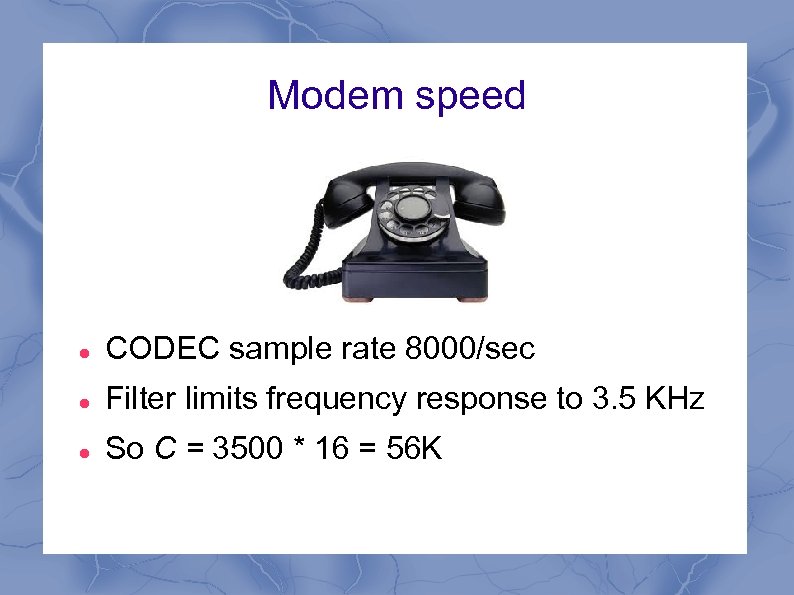 Modem speed CODEC sample rate 8000/sec Filter limits frequency response to 3. 5 KHz So C = 3500 * 16 = 56 K

 Overall theme We want to use cheap media along with fancy electronics to get the best performance possible. Communications integrated circuits are ultimately printed at low incremental cost while expensive wire has a cost per foot.
 ADSL Asymmetrical Digital Subscriber Loop Works like dial-up, except. . . BW is greater – 2 Mb/s versus 3. 5 Kb/s BW falls with CO distance Performance is noise-limited by crosstalk rather than quantization
 Crosstalk Each signal path is a pair of wires twisted together Many pairs are bundled together into a cable Individual pairs act like transformers and couple energy into each other Higher frequencies have more crosstalk
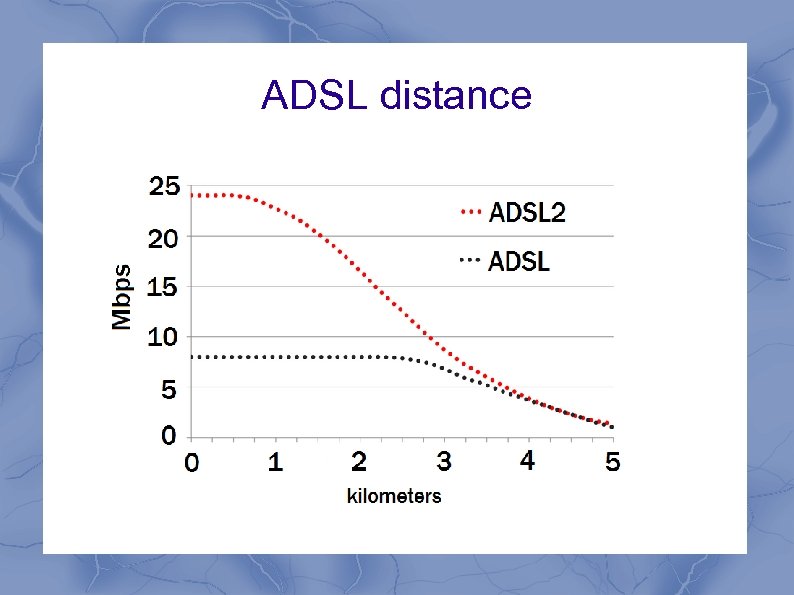 ADSL distance
 Yet higher speeds. . . ADSL 2 is not the end of the road VDSL up to 52 Mb/s but distance 300 M At that scale, useful for large buildings
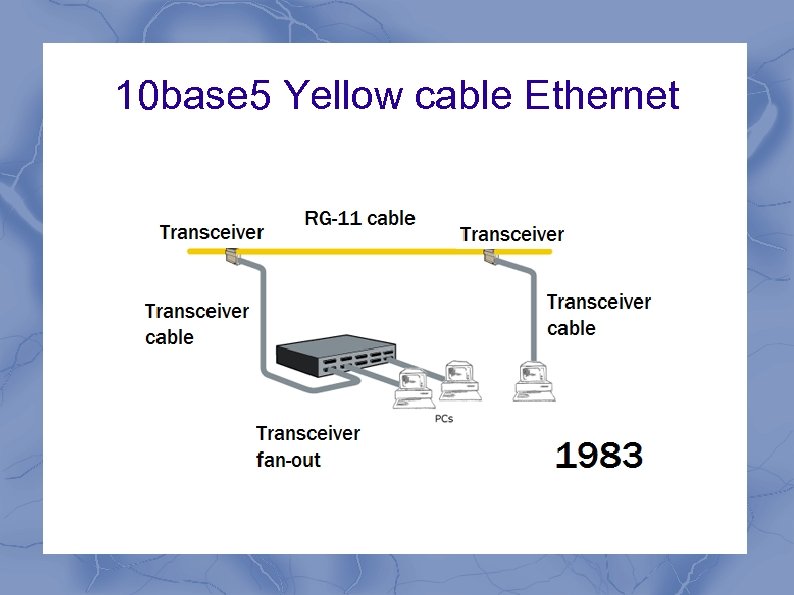 10 base 5 Yellow cable Ethernet
 Repeaters 10 and 100 Mb/s Ethernet permits repeaters subject to a rule that information about collisions needs to propagate to all stations in the time required to send a minimum length packet. This is required to guarantee that all stations will detect a collision while the sender is still transmitting. Four repeaters in the longest path across the network are permitted in 10 Mb/s systems.
 Repeaters Regenerate the amplitude of signals that may have attenuated over distance Re-time signal transitions to remove accumulated jitter Replace lost preamble bits at the front of each packet
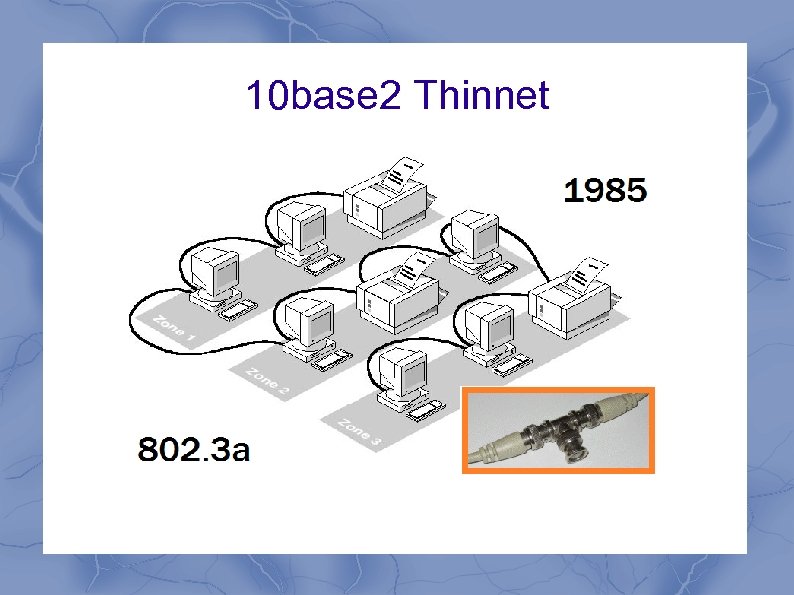 10 base 2 Thinnet
 Structured cabling 10 base 5 and 10 base 2 have a daisy chain architecture Generally, this leads to a mess To be supportable, all communications paths should connect radially to a serving cable closet. 100 meter link distance was selected as a workable but somewhat arbitrary standard.
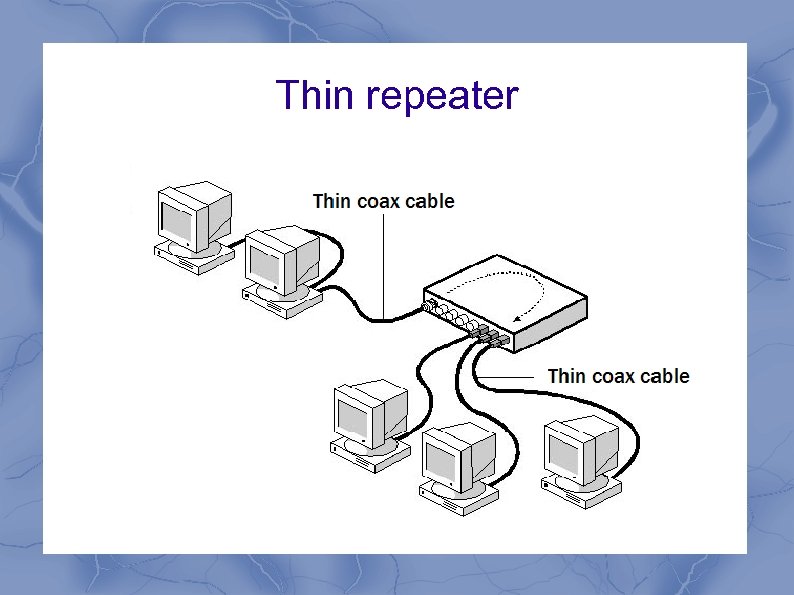 Thin repeater
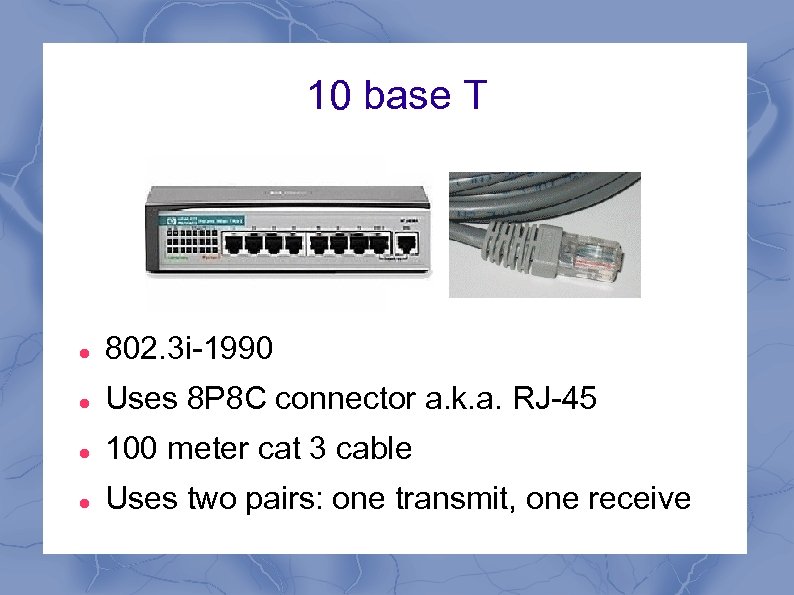 10 base T 802. 3 i-1990 Uses 8 P 8 C connector a. k. a. RJ-45 100 meter cat 3 cable Uses two pairs: one transmit, one receive
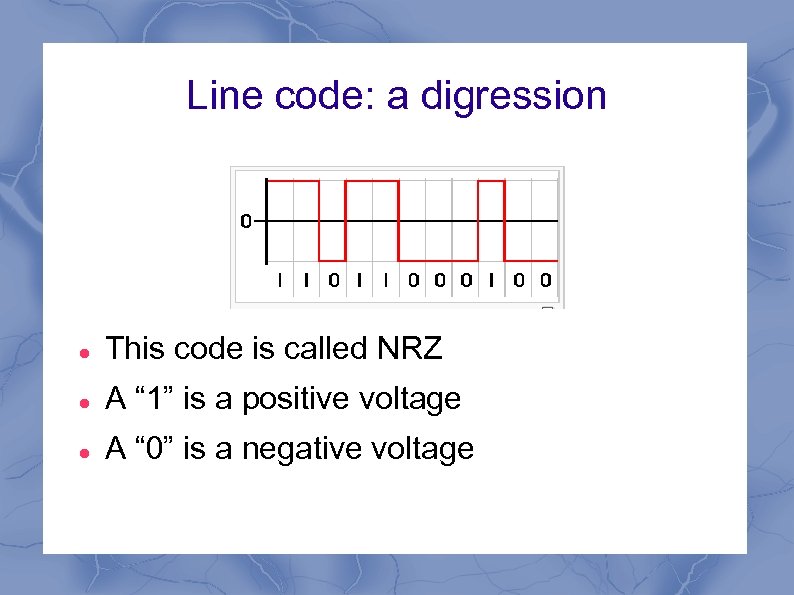 Line code: a digression This code is called NRZ A “ 1” is a positive voltage A “ 0” is a negative voltage
 NRZ = Non Return to Zero How does the receiver find the bit cell boundaries? Long runs of all 0 s or 1 s have no transitions Early answer: send bit clock on a spare wire pair Not a great answer. . .
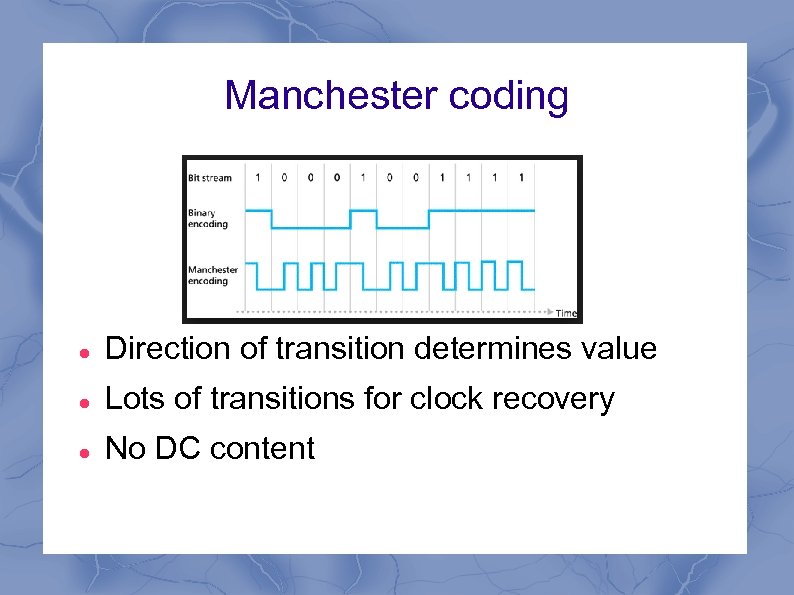 Manchester coding Direction of transition determines value Lots of transitions for clock recovery No DC content
 Twisted pair Ethernet Signals are driven differentially over their respective pairs. Because each pair is twisted together external fields excite the same noise in both of the pair conductors. Receivers reject common mode signals, providing low cost noise immunity. 10 Mb/s tw-pr uses manchester code
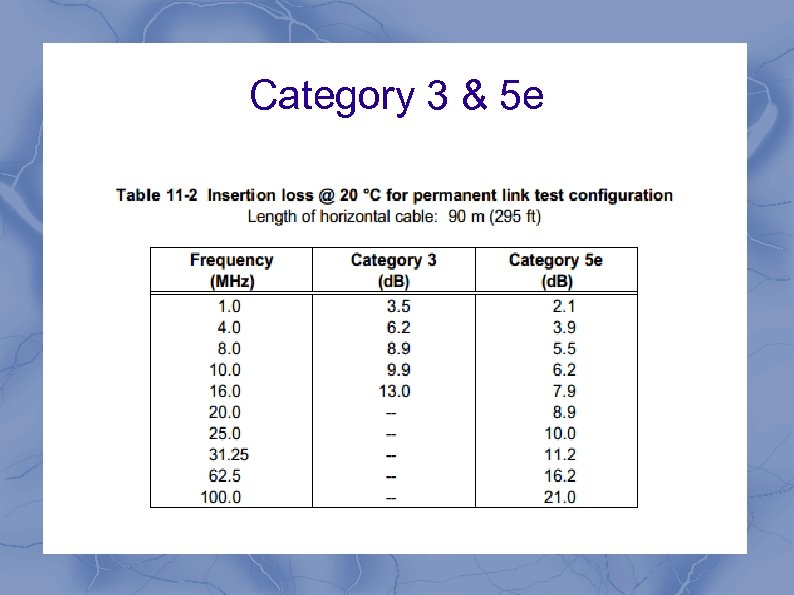 Category 3 & 5 e
 Category. . . Anixter, an electrical distributor, cooked up the category classification to solve what they saw as major marketplace confusion among customers who just wanted to know what to buy. The EIA/TIA fell into line behind Anixter and helped with the classification. The IEEE generally does not bother with things like this.
 100 Mb/s tw-pr Ethernet 802. 3 u-1995 100 meters over category 5 wire 4 B/5 B encoding MLT-3 line code results in 31. 25 Khz Max one repeater in a collision domain Uses two pairs, same as 10 base T
 4 B/5 B, what is that? ? There are 32 different codes that are five bits long. The 16 values that can be taken on by 4 -bit nibbles are selected from the 32 5 -bit possibilities so that codes are rich in 1's content. This coding guarantees a transition density sufficient for the clock to be extracted from the data stream. The cost to make the stream self-clocking is 25 percent.
 Category 3 vs 5 Category 5 wire has tighter twisting so to rejects noise to higher frequencies. Each pair has a different pitch to its twist. This reduces pair-to-pair coupling. Category 3 wire can have PVC insulation. PVC has poor frequency characteristics caused by dielectric loss. Cat 5 wire uses better insulation that gives lower loss.
 Category 5 vs 5 e ? ? The “e” stands for enhanced. Not much difference. It is the same stuff made the same way. Category 5 e has some additional tests to assure it can be used bi-directionally. Category 5 has disappeared from the market.
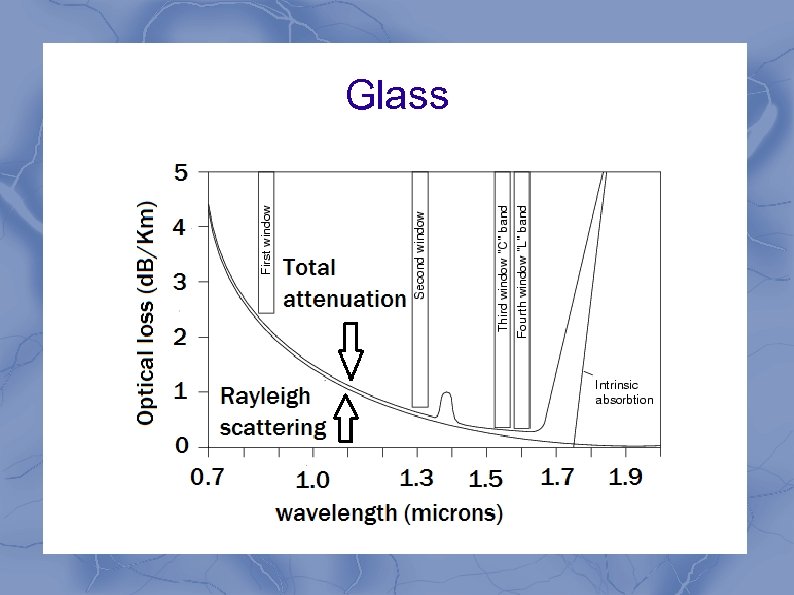
 Gigabit over fiber 802. 3 z 1998 There are no repeaters. All links are point-to-point Short range (SR) to 100 meters uses multimode fiber at 850 n. M (deep red) Long range (LR) uses single mode fiber at 1300 n. M. Distance limit is 0 -10 KM.
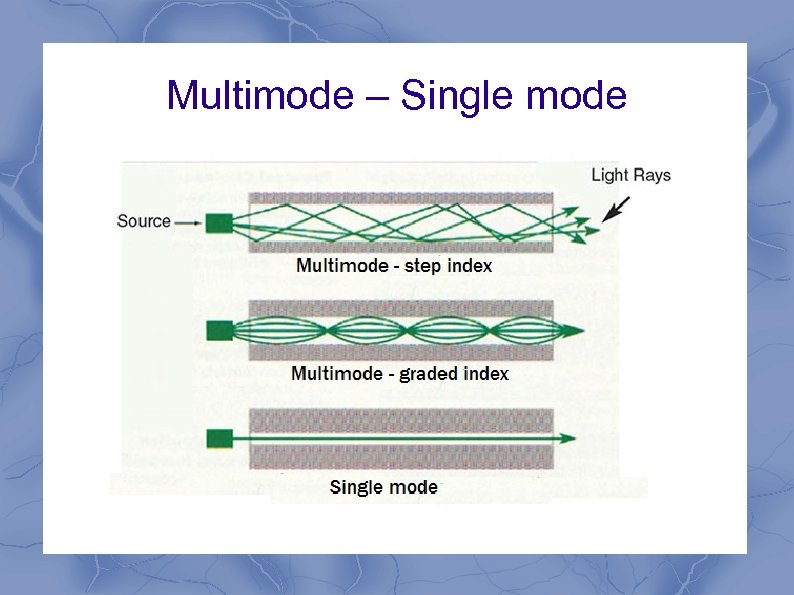 Multimode – Single mode
 Why did they do that ? The 9 micron core in SM fiber requires a very intense light source. Lasers are needed. $$$$ A larger core diameter permits a cheaper light source. $$$$ Favors multimode. Graded index MM fiber shapes the refractive index profile so that the rays that travel farther go faster. This partially compensates for the effect on speed.
 Fiber bandwidth Single mode: 10's of terabit/sec per core. Limitation is non-linear effects like heating that are hard to quantify. Multimode: OM 3 – a type of 50 micron multimode – has 2000 MHz-km At 1 KM, the BW is 2 GHz At 100 M, the BW is 20 GHz
 Gigabit over twisted pair 1000 base. T IEEE 802. 3 ab 1999 Designed for same wire as 100 Mb/s Uses all 4 pairs in both directions 4 x improvement in capacity Each byte sprays across all four pairs 5 level PAM 5 code replaces 3 level code Symbol rate is the same as 100 Mb/s, but cleaner transmission is required for PAM 5
 What happened to Cat 6 ? Category 6 tests the wire to 250 MHz and has tighter parameters than 5 e. It is not sufficient for 10 Gig-E. All dressed up with no place to go – Cat 6 wire was designed for a 2 -pair Gig-E standard that was a commercial failure. The incremental cost of Category 6 wire has earned it some popularity since it is better than 5 e and backward compatible.
 OPTICAL TRANSPORT
 Glass
Glass
 MSA Modules
 10 Gigabit/s over twisted pair 10 Gbase. T IEEE 802. 3 an 2006 Requires category 6 a cable to reach 100 m Uses PAM 16 for more bits per symbol Full duplex operation only Uses BW to 450 MHz Thruput: 4 pr x 833 Mbaud x 3 bits/symbol
 10 G Warts Alien crosstalk – signals from nearby cables induce noise too complex to be compensated electronically Aliens require shielding that makes the cable bigger and heavier Power consumption is high, making for high operating costs. This will come down. Direct connect is cheaper and faster.
 10 Gb/s applications Data center, when power consumption improves Wave 2 802. 11 ac Wi. Fi access points
 What about Wi. Fi?
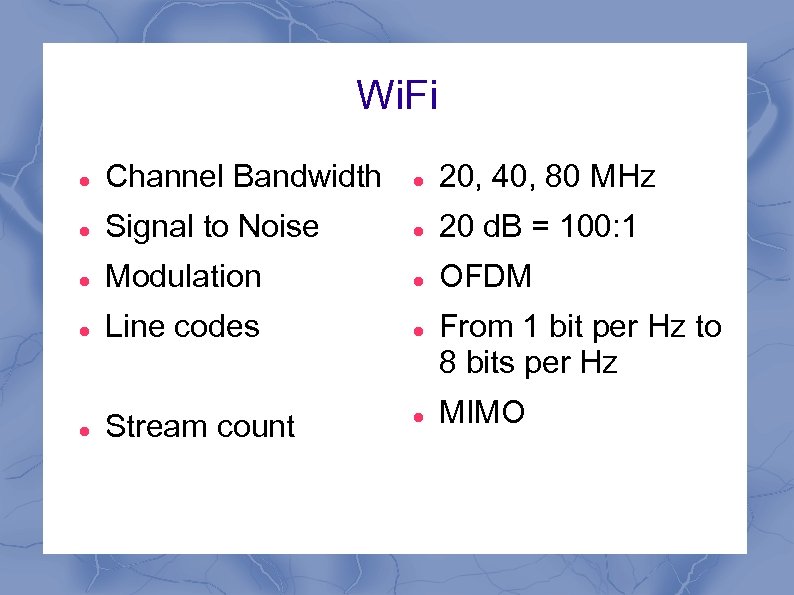 Wi. Fi Channel Bandwidth 20, 40, 80 MHz Signal to Noise 20 d. B = 100: 1 Modulation OFDM Line codes Stream count From 1 bit per Hz to 8 bits per Hz MIMO
 Http: //noc. ucsc. edu/docs/Layer-1. pdf