


 Скачать презентацию Laws and Regulations Regulatory Authority EPA
e3f6989def41d606e16b242d460e682a.ppt
- Количество слайдов: 30
 Laws and Regulations
 Regulatory Authority • EPA – Water • Safe Drinking Water Act • Clean Water Act – Air • Currently No EPA Standards Set for Mold in Indoor Air • Homeland Security; “Biowatch Program” – Biosolids • Section 405 (d) and (e) • 40 CFR 503 – Disinfectants • FIFRA • OPP
 Regulatory Authority • FDA – Food – Pharmaceutics – Title 21 of CFR • USDA – FSIS • Federal Meat, Poultry and Egg Products Inspection Acts • Title 9 of CFR – Homeland Security
 Drinking Water Regulations • National Primary Drinking Water Regulation – Legally enforceable standard – Limits levels of specific contaminants that can adversely affect public health – Maximum Contaminant Level or Treatment Technique • National Secondary Drinking Water Regulation – Nonenforceable guideline – Covers contaminants that may cause cosmetic or aesthetic effects
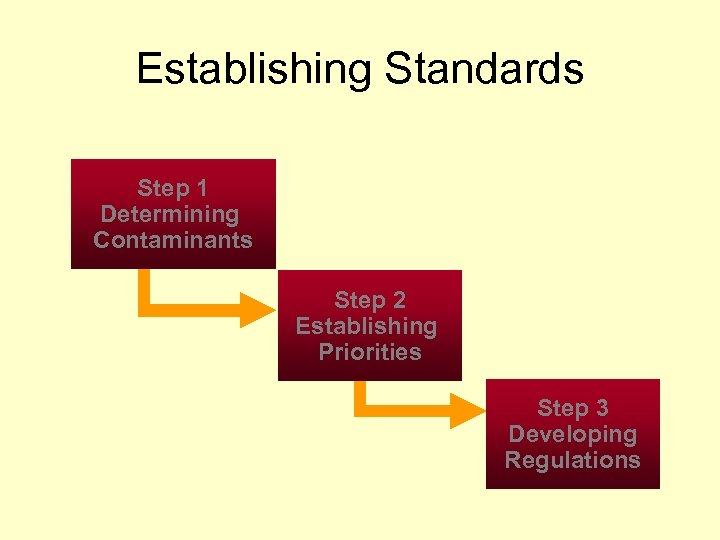 Establishing Standards Step 1 Determining Contaminants Step 2 Establishing Priorities Step 3 Developing Regulations
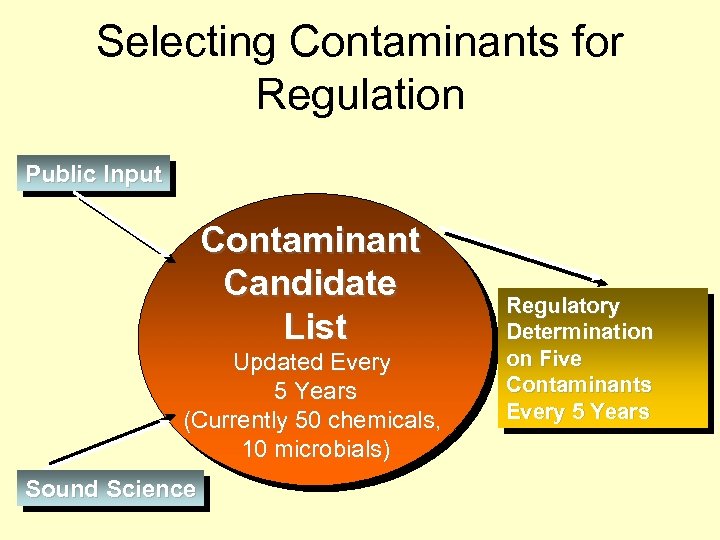 Selecting Contaminants for Regulation Public Input Contaminant Candidate List Updated Every 5 Years (Currently 50 chemicals, 10 microbials) Sound Science Regulatory Determination on Five Contaminants Every 5 Years
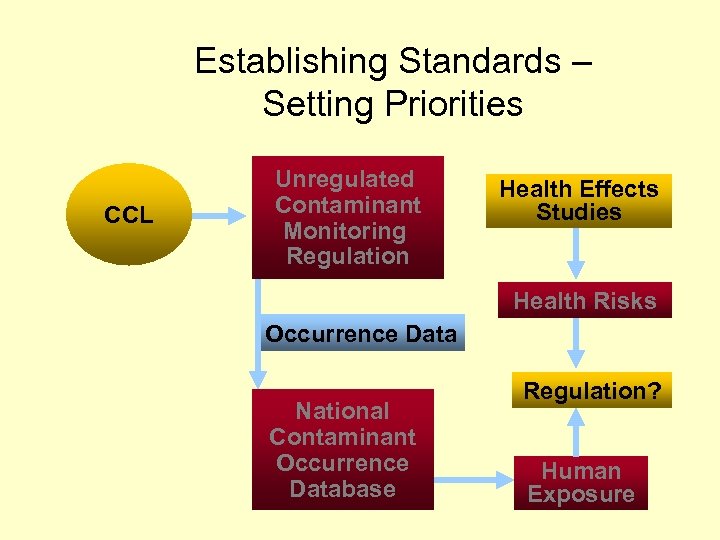 Establishing Standards – Setting Priorities CCL Unregulated Contaminant Monitoring Regulation Health Effects Studies Health Risks Occurrence Data National Contaminant Occurrence Database Regulation? Human Exposure
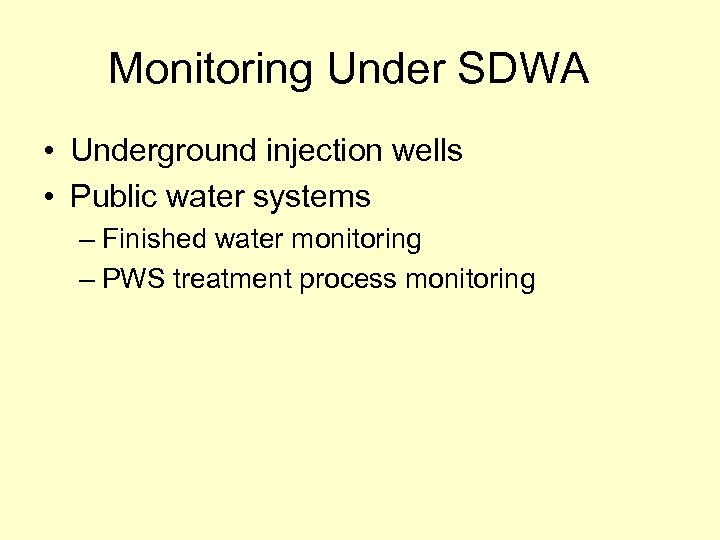 Monitoring Under SDWA • Underground injection wells • Public water systems – Finished water monitoring – PWS treatment process monitoring
 Public Water System Monitoring • Finished water monitoring – (MCLs and MRDLs) – Water receiving no treatment – Water with disinfection – Water receiving treatment and disinfection • Raw water monitoring • Water treatment process monitoring – Treatment techniques
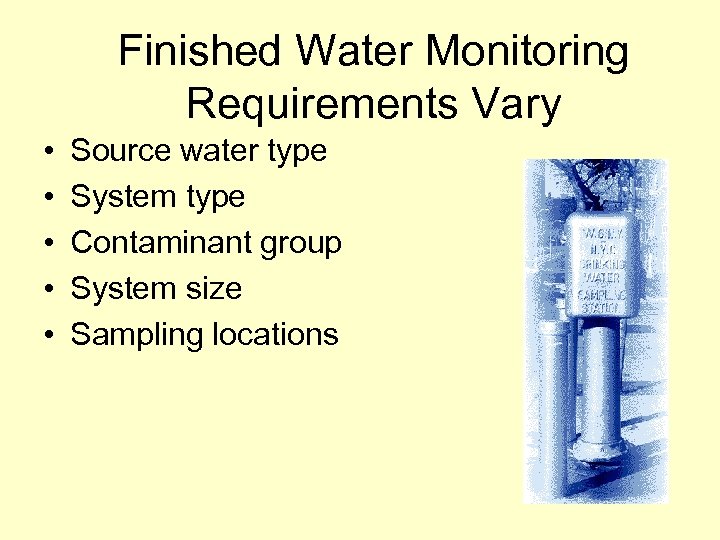 Finished Water Monitoring Requirements Vary • • • Source water type System type Contaminant group System size Sampling locations
 How Often Must a System Monitor under SDWA? • Bacteriological quality (coliform bacteria) – Ranges from daily to quarterly • Turbidity – Ranges from daily or less to continuous • Chemicals and radiologicals – Quarterly (less or more) • Disinfectant residuals – Ranges from daily to monthly • Disinfection byproducts (DBPs) – Ranges from 4 samples per quarter to 1 per quarter
 Monitoring-General • A system can remain on a monitoring schedule only if the sampling results support the schedule • MCL exceedance? – Must begin quarterly sampling – Must continue until 4 consecutive quarterly samples are below the MCL • NOTE: compliance determination based on annual average
 Unregulated Contaminant Monitoring Rule • • List of contaminants to monitor A schedule for sampling Analytical methods Reporting requirements – To regulatory agencies – To the public
 SDWA • Regulated Microbes – Cryptosporidium – Giardia – Legionella – Enteric Viruses • Indicators – Total Coliforms – HPC – Turbidity
 CCL • CCL 2 – – – – – Adenoviruses Aeromonas hydrophila Caliciviruses Coxsackieviruses Cyanobacteria (blue-green algae), other freshwater algae, and their toxins Echoviruses Helicobacter pylori Microsporidia (Enterocytozoon & Septata) Mycobacterium avium intracellulare (MAC)
 Total Coliform Rule • Standard is 0 CFU/100 ml • Must not detect Coliforms in more than 5% of samples in a month (1 sample per month in<40 samples collected) • If >5% of samples positive then must report to state and public – State within next business day – Public within 14 days (30 days)
 Total Coliform Rule • If a sample positive then system must be retested for TC within 24 hours and analyzed for fecal coliforms and E. coli • If positives in retest, then acute MCl violation and must rapidly report to state and public; issue BWA – State by end of next business day – Public within 72 hours (24 hours)
 Total Coliform Rule • Sampling is population dependent – <1000 people, once per month • Exception for GW with SS free of defects – 50, 000 people, 60 times per month – 2. 5 million people, 420 time per month
 Groundwater Rule • Periodic Sanitary Surveys • Source Water Monitoring – Triggered: TCR violation in distribution system • Within 24 of notification conduct fecal indicator test • 5 repeats if sample positive – Assessment: At any time required by state to assess high risk systems
 LT 2 ESWTR • 2 years of monthly sampling for Cryptosporidium (E. coli trigger) • Also monitor turbidity
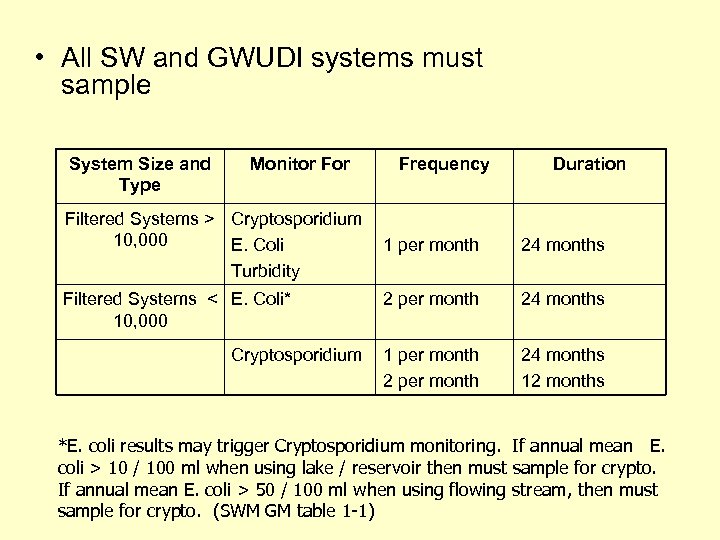 • All SW and GWUDI systems must sample System Size and Type Monitor Filtered Systems > Cryptosporidium 10, 000 E. Coli Turbidity Filtered Systems < E. Coli* 10, 000 Cryptosporidium Frequency Duration 1 per month 24 months 2 per month 24 months 12 months *E. coli results may trigger Cryptosporidium monitoring. If annual mean E. coli > 10 / 100 ml when using lake / reservoir then must sample for crypto. If annual mean E. coli > 50 / 100 ml when using flowing stream, then must sample for crypto. (SWM GM table 1 -1)
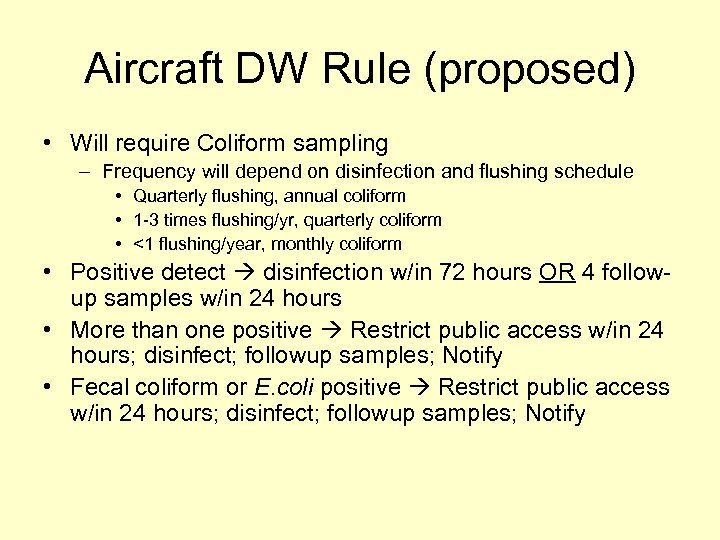 Aircraft DW Rule (proposed) • Will require Coliform sampling – Frequency will depend on disinfection and flushing schedule • Quarterly flushing, annual coliform • 1 -3 times flushing/yr, quarterly coliform • <1 flushing/year, monthly coliform • Positive detect disinfection w/in 72 hours OR 4 followup samples w/in 24 hours • More than one positive Restrict public access w/in 24 hours; disinfect; followup samples; Notify • Fecal coliform or E. coli positive Restrict public access w/in 24 hours; disinfect; followup samples; Notify
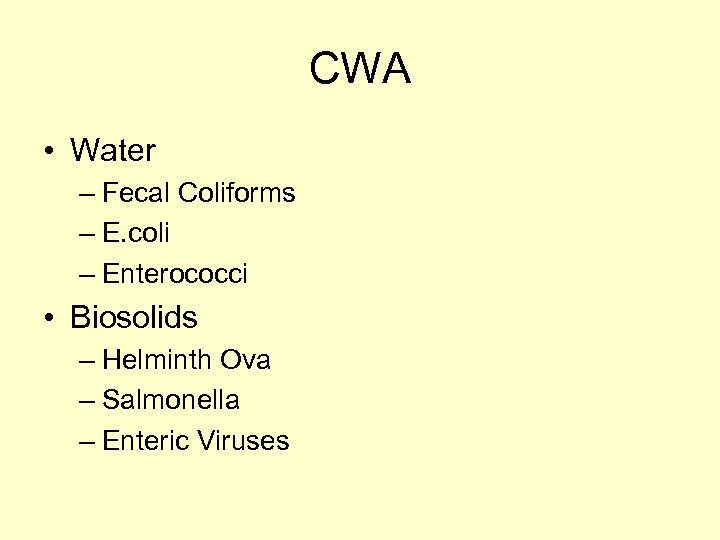 CWA • Water – Fecal Coliforms – E. coli – Enterococci • Biosolids – Helminth Ova – Salmonella – Enteric Viruses
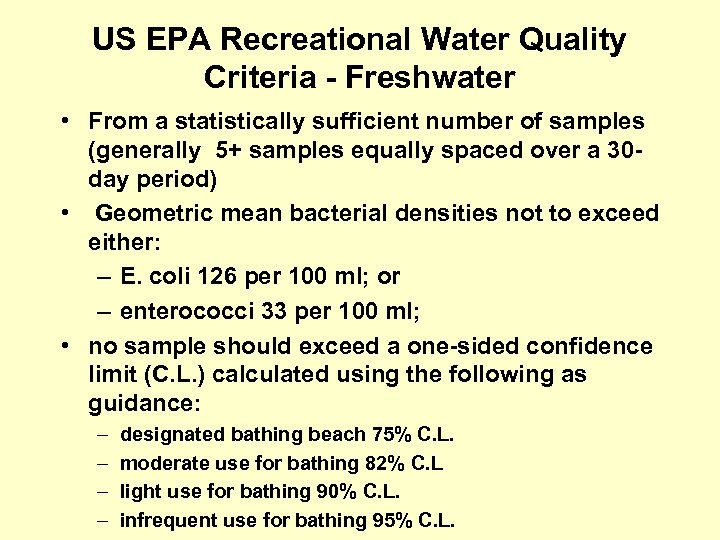 US EPA Recreational Water Quality Criteria - Freshwater • From a statistically sufficient number of samples (generally 5+ samples equally spaced over a 30 day period) • Geometric mean bacterial densities not to exceed either: – E. coli 126 per 100 ml; or – enterococci 33 per 100 ml; • no sample should exceed a one-sided confidence limit (C. L. ) calculated using the following as guidance: – – designated bathing beach 75% C. L. moderate use for bathing 82% C. L light use for bathing 90% C. L. infrequent use for bathing 95% C. L.
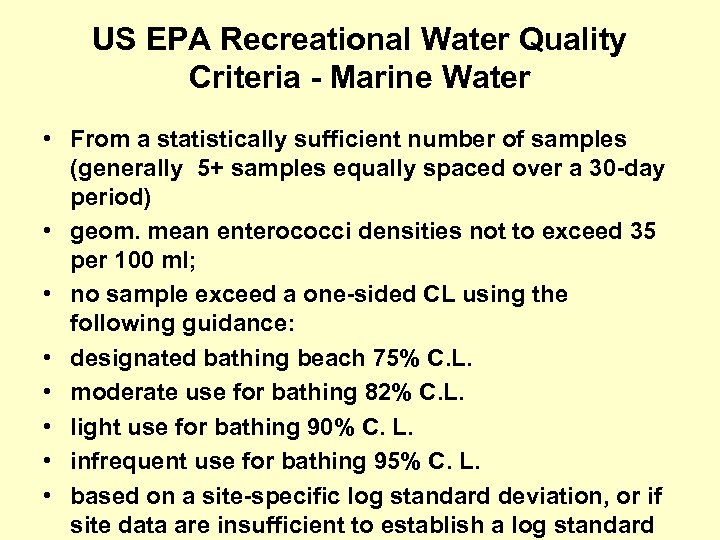 US EPA Recreational Water Quality Criteria - Marine Water • From a statistically sufficient number of samples (generally 5+ samples equally spaced over a 30 -day period) • geom. mean enterococci densities not to exceed 35 per 100 ml; • no sample exceed a one-sided CL using the following guidance: • designated bathing beach 75% C. L. • moderate use for bathing 82% C. L. • light use for bathing 90% C. L. • infrequent use for bathing 95% C. L. • based on a site-specific log standard deviation, or if site data are insufficient to establish a log standard
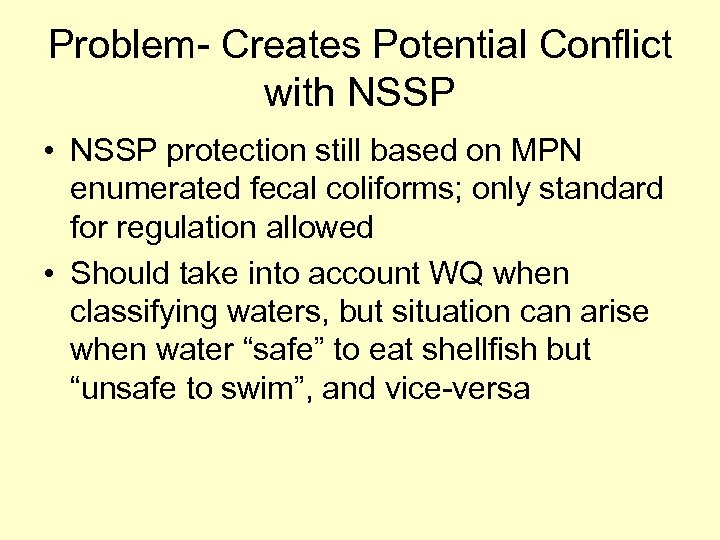 Problem- Creates Potential Conflict with NSSP • NSSP protection still based on MPN enumerated fecal coliforms; only standard for regulation allowed • Should take into account WQ when classifying waters, but situation can arise when water “safe” to eat shellfish but “unsafe to swim”, and vice-versa
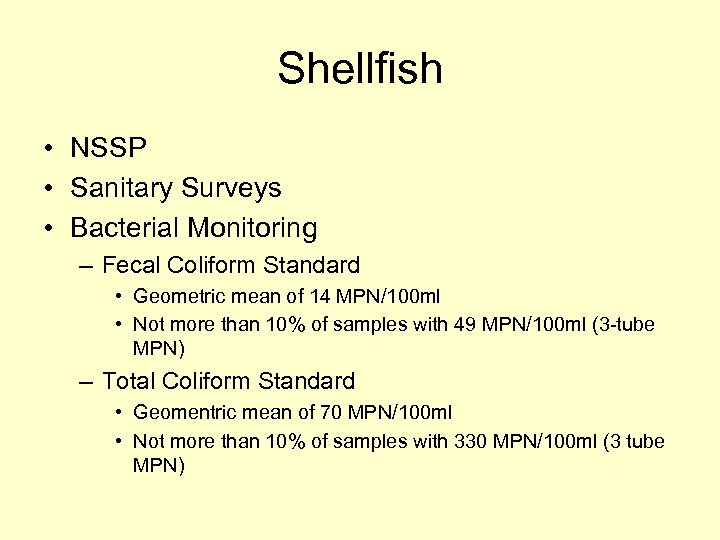 Shellfish • NSSP • Sanitary Surveys • Bacterial Monitoring – Fecal Coliform Standard • Geometric mean of 14 MPN/100 ml • Not more than 10% of samples with 49 MPN/100 ml (3 -tube MPN) – Total Coliform Standard • Geomentric mean of 70 MPN/100 ml • Not more than 10% of samples with 330 MPN/100 ml (3 tube MPN)
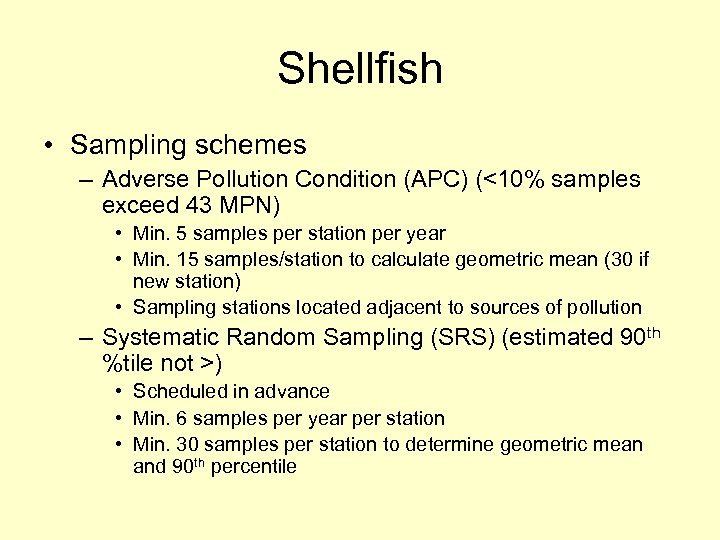 Shellfish • Sampling schemes – Adverse Pollution Condition (APC) (<10% samples exceed 43 MPN) • Min. 5 samples per station per year • Min. 15 samples/station to calculate geometric mean (30 if new station) • Sampling stations located adjacent to sources of pollution – Systematic Random Sampling (SRS) (estimated 90 th %tile not >) • Scheduled in advance • Min. 6 samples per year per station • Min. 30 samples per station to determine geometric mean and 90 th percentile
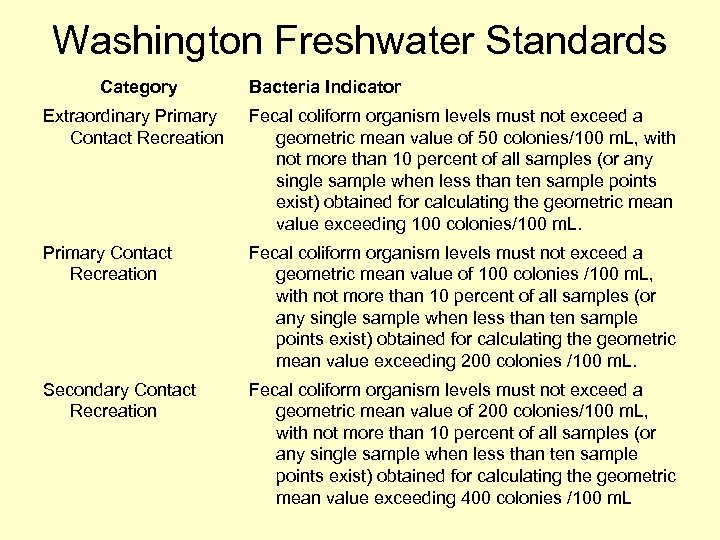 Washington Freshwater Standards Category Bacteria Indicator Extraordinary Primary Contact Recreation Fecal coliform organism levels must not exceed a geometric mean value of 50 colonies/100 m. L, with not more than 10 percent of all samples (or any single sample when less than ten sample points exist) obtained for calculating the geometric mean value exceeding 100 colonies/100 m. L. Primary Contact Recreation Fecal coliform organism levels must not exceed a geometric mean value of 100 colonies /100 m. L, with not more than 10 percent of all samples (or any single sample when less than ten sample points exist) obtained for calculating the geometric mean value exceeding 200 colonies /100 m. L. Secondary Contact Recreation Fecal coliform organism levels must not exceed a geometric mean value of 200 colonies/100 m. L, with not more than 10 percent of all samples (or any single sample when less than ten sample points exist) obtained for calculating the geometric mean value exceeding 400 colonies /100 m. L
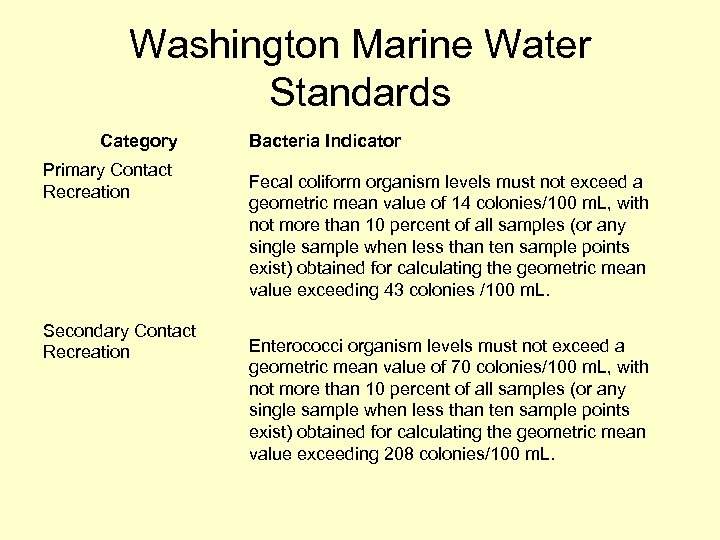 Washington Marine Water Standards Category Primary Contact Recreation Secondary Contact Recreation Bacteria Indicator Fecal coliform organism levels must not exceed a geometric mean value of 14 colonies/100 m. L, with not more than 10 percent of all samples (or any single sample when less than ten sample points exist) obtained for calculating the geometric mean value exceeding 43 colonies /100 m. L. Enterococci organism levels must not exceed a geometric mean value of 70 colonies/100 m. L, with not more than 10 percent of all samples (or any single sample when less than ten sample points exist) obtained for calculating the geometric mean value exceeding 208 colonies/100 m. L.