 Скачать презентацию Lawrence Livermore National Laboratory The Emerging Challenge of
ad7acba886235e7c0d821e0cb62afdaa.ppt
- Количество слайдов: 29



Lawrence Livermore National Laboratory The Emerging Challenge of Human Performance Improvement: Managing Complex Interdependencies Cynthia A. Wagner Manager, Office of Performance Excellence November 28, 2007
The Challenge Barriers and Practices are Dynamic Lawrence Livermore National Option: UCRL# Laboratory Option: Additional Information 2
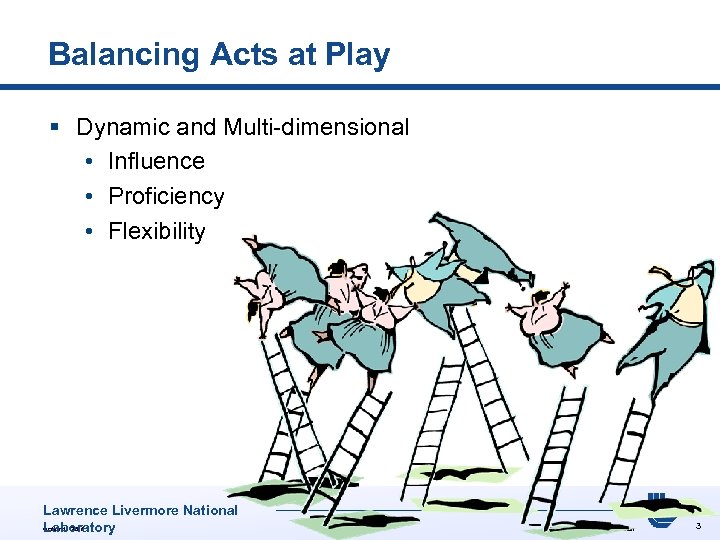
Balancing Acts at Play § Dynamic and Multi-dimensional • Influence • Proficiency • Flexibility Lawrence Livermore National Option: UCRL# Laboratory Option: Additional Information 3
Proactive Management § Human-System Interfaces • Knowledge of Current Practices Barriers Outcomes • Awareness of Emerging Changes USER NEEDS: WHAT DOES WORK, DOESN’T WORK, and IS LIKELY TO CHANGE? Lawrence Livermore National Option: UCRL# Laboratory Option: Additional Information 4
Causal Analysis § Structured, questioning process § Enables recognition of practices and beliefs in an organization, or does it? § Why don’t we do more Root Causes? USER NEEDS: DISCUSSION OF VALUES AND BELIEFS Lawrence Livermore National Option: UCRL# Laboratory Option: Additional Information 5
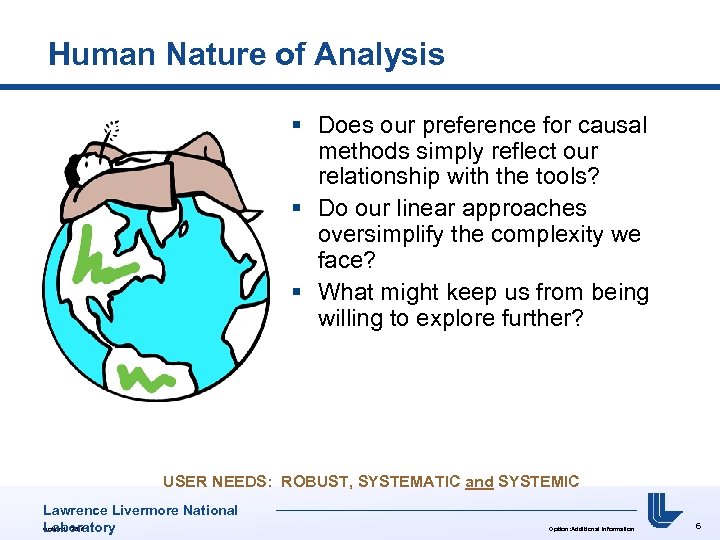
Human Nature of Analysis § Does our preference for causal methods simply reflect our relationship with the tools? § Do our linear approaches oversimplify the complexity we face? § What might keep us from being willing to explore further? USER NEEDS: ROBUST, SYSTEMATIC and SYSTEMIC Lawrence Livermore National Option: UCRL# Laboratory Option: Additional Information 6
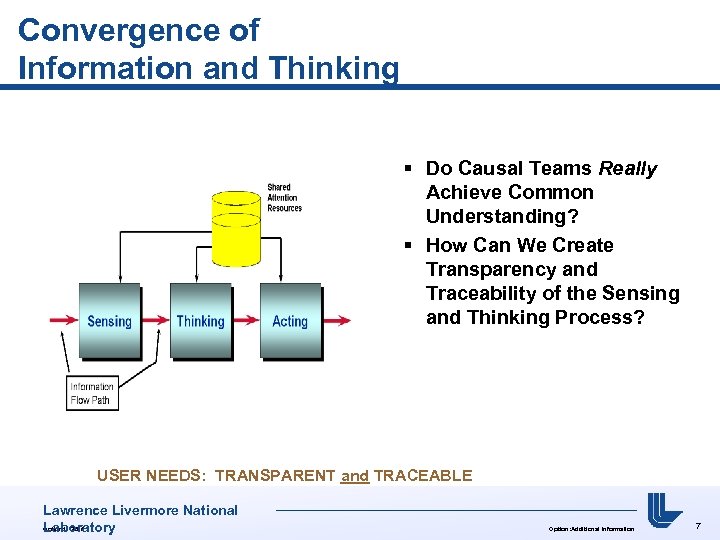
Convergence of Information and Thinking § Do Causal Teams Really Achieve Common Understanding? § How Can We Create Transparency and Traceability of the Sensing and Thinking Process? USER NEEDS: TRANSPARENT and TRACEABLE Lawrence Livermore National Option: UCRL# Laboratory Option: Additional Information 7
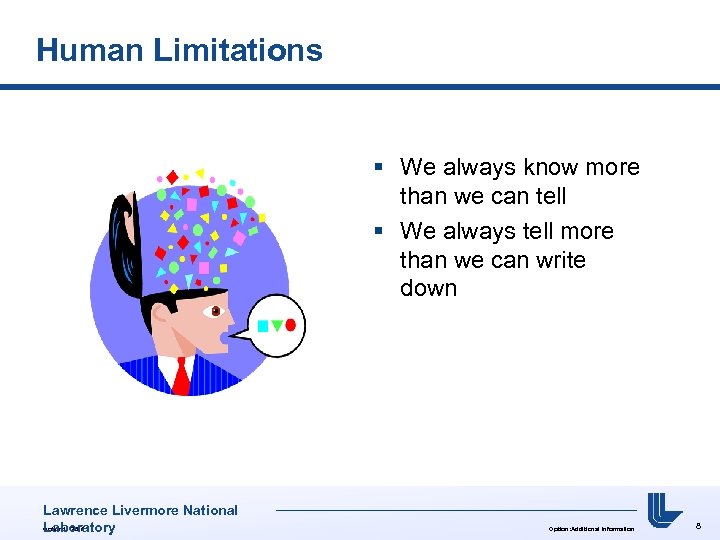
Human Limitations § We always know more than we can tell § We always tell more than we can write down Lawrence Livermore National Option: UCRL# Laboratory Option: Additional Information 8
Making Sense for Others § § Are expectations reasonable given the complexity of interdependencies? Are traditional analysis reports effective for making sense of findings and creating buy-in? USER NEEDS: EFFICIENT and EFFECTIVE COMMUNICATIONS Lawrence Livermore National Option: UCRL# Laboratory Option: Additional Information 9
Summary of User Needs § Method • Robust, Systematic and Systemic • Easy to Learn and Use § Output • Knowledge and Insight • Traceable and Transparent Discussion • Effective and Efficient Communications Lawrence Livermore National Option: UCRL# Laboratory Option: Additional Information 10
Consider Stream Analysis § Compatible with HPI • Open Systems Theory • Social Cognitive Theory § In Practice • INPO experience § Applicable across the organization at all levels • Project leaders, unit managers, organizational advisors, oversight teams, business executives “Stream Analysis - A Powerful Way to Diagnose and Manage Organizational Change” by Professor Jerry Porras, Stanford Graduate School of Business Lawrence Livermore National Option: UCRL# Laboratory Option: Additional Information 11
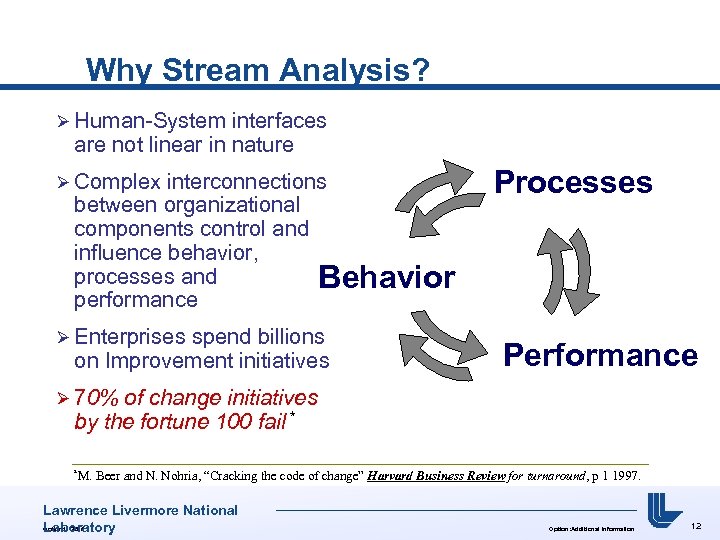
Why Stream Analysis? Ø Human-System interfaces are not linear in nature Ø Complex interconnections between organizational components control and influence behavior, processes and Behavior performance Ø Enterprises spend billions on Improvement initiatives Processes Performance Ø 70% of change initiatives by the fortune 100 fail * *M. Beer and N. Nohria, “Cracking the code of change” Harvard Business Review for turnaround, p 1 1997. Lawrence Livermore National Option: UCRL# Laboratory Option: Additional Information 12
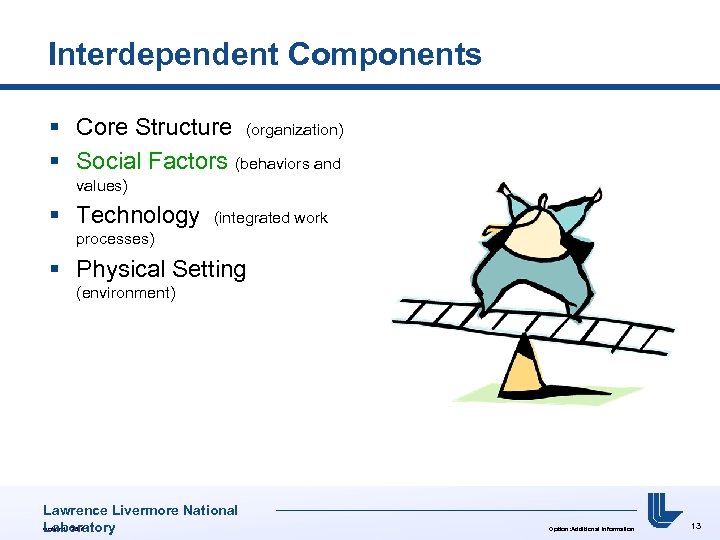
Interdependent Components § Core Structure (organization) § Social Factors (behaviors and values) § Technology (integrated work processes) § Physical Setting (environment) Lawrence Livermore National Option: UCRL# Laboratory Option: Additional Information 13
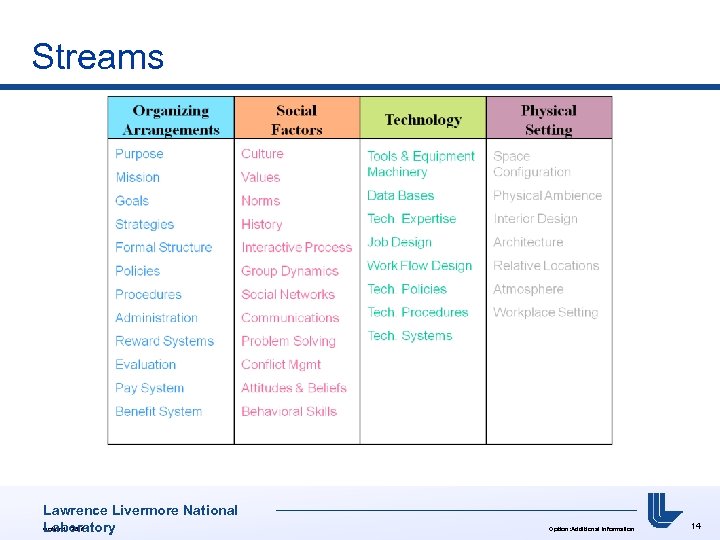
Streams Lawrence Livermore National Option: UCRL# Laboratory Option: Additional Information 14
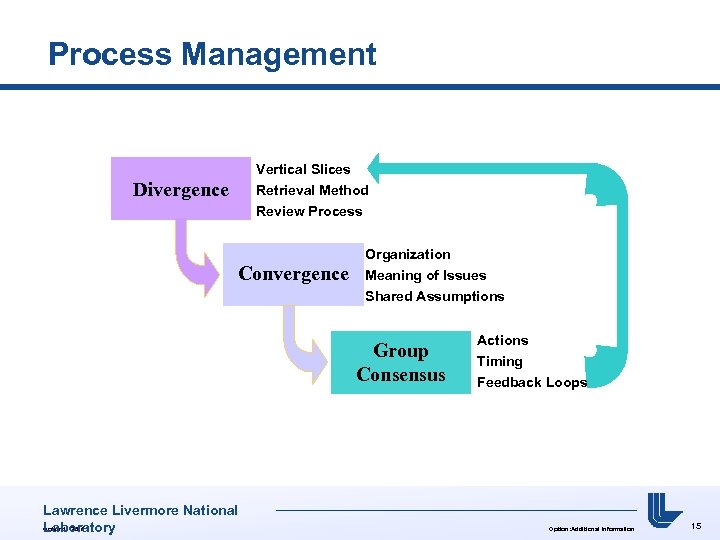
Process Management Vertical Slices Retrieval Method Review Process Divergence Convergence Organization Meaning of Issues Shared Assumptions Group Consensus Lawrence Livermore National Option: UCRL# Laboratory Actions Timing Feedback Loops Option: Additional Information 15
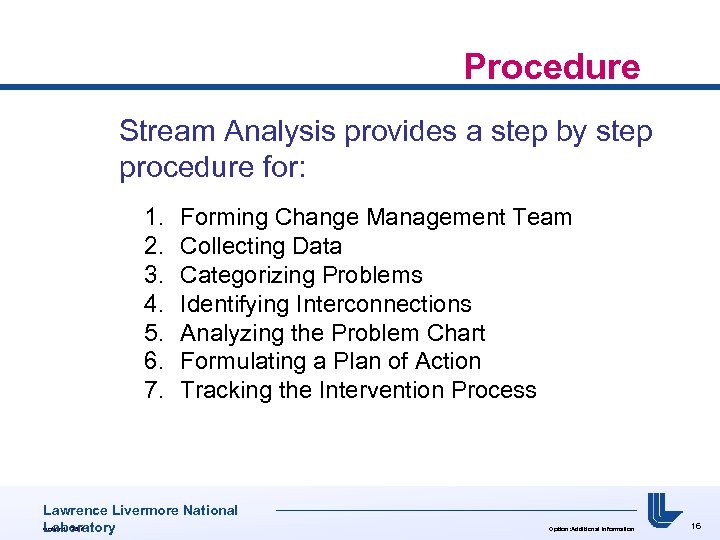
Procedure Stream Analysis provides a step by step procedure for: 1. 2. 3. 4. 5. 6. 7. Forming Change Management Team Collecting Data Categorizing Problems Identifying Interconnections Analyzing the Problem Chart Formulating a Plan of Action Tracking the Intervention Process Lawrence Livermore National Option: UCRL# Laboratory Option: Additional Information 16
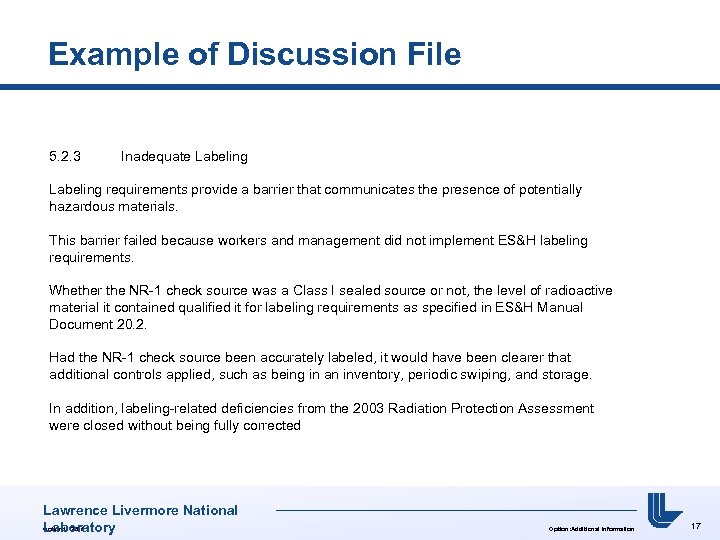
Example of Discussion File 5. 2. 3 Inadequate Labeling requirements provide a barrier that communicates the presence of potentially hazardous materials. This barrier failed because workers and management did not implement ES&H labeling requirements. Whether the NR-1 check source was a Class I sealed source or not, the level of radioactive material it contained qualified it for labeling requirements as specified in ES&H Manual Document 20. 2. Had the NR-1 check source been accurately labeled, it would have been clearer that additional controls applied, such as being in an inventory, periodic swiping, and storage. In addition, labeling-related deficiencies from the 2003 Radiation Protection Assessment were closed without being fully corrected Lawrence Livermore National Option: UCRL# Laboratory Option: Additional Information 17
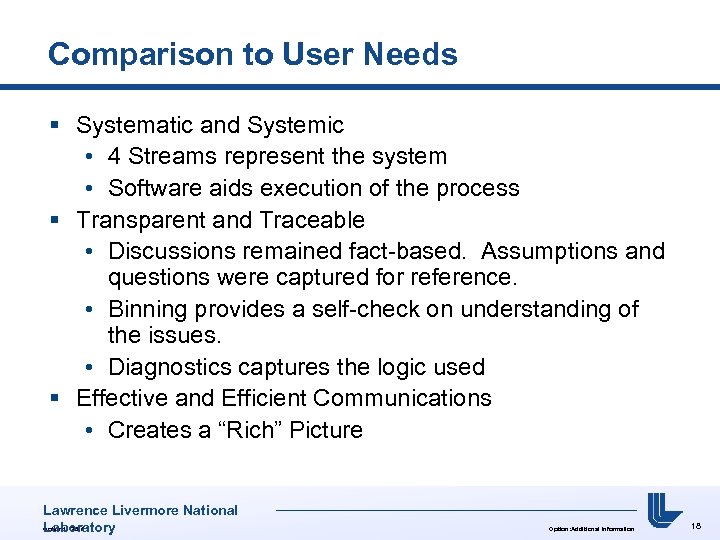
Comparison to User Needs § Systematic and Systemic • 4 Streams represent the system • Software aids execution of the process § Transparent and Traceable • Discussions remained fact-based. Assumptions and questions were captured for reference. • Binning provides a self-check on understanding of the issues. • Diagnostics captures the logic used § Effective and Efficient Communications • Creates a “Rich” Picture Lawrence Livermore National Option: UCRL# Laboratory Option: Additional Information 18
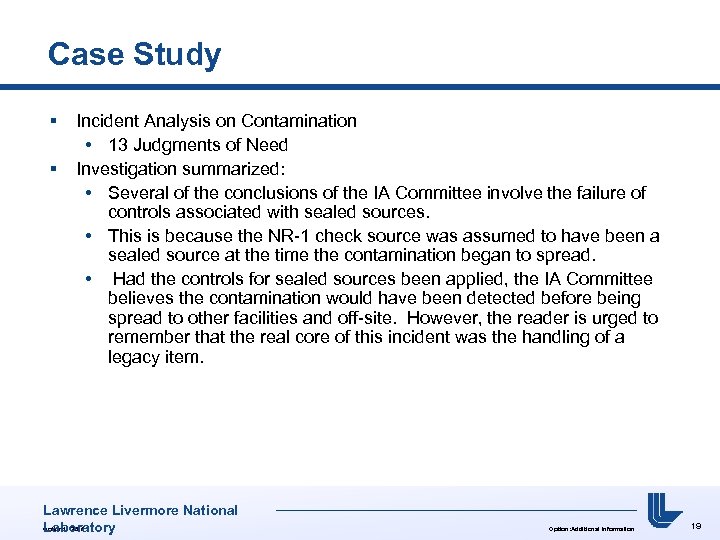
Case Study § § Incident Analysis on Contamination • 13 Judgments of Need Investigation summarized: • Several of the conclusions of the IA Committee involve the failure of controls associated with sealed sources. • This is because the NR-1 check source was assumed to have been a sealed source at the time the contamination began to spread. • Had the controls for sealed sources been applied, the IA Committee believes the contamination would have been detected before being spread to other facilities and off-site. However, the reader is urged to remember that the real core of this incident was the handling of a legacy item. Lawrence Livermore National Option: UCRL# Laboratory Option: Additional Information 19
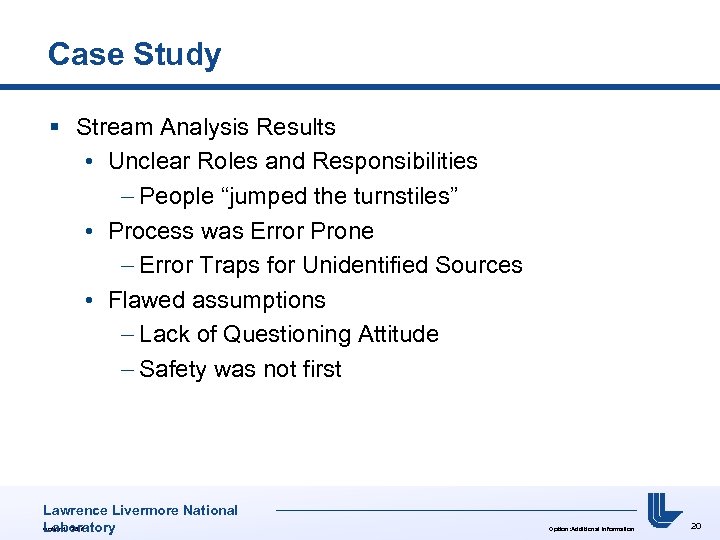
Case Study § Stream Analysis Results • Unclear Roles and Responsibilities People “jumped the turnstiles” • Process was Error Prone Error Traps for Unidentified Sources • Flawed assumptions Lack of Questioning Attitude Safety was not first Lawrence Livermore National Option: UCRL# Laboratory Option: Additional Information 20
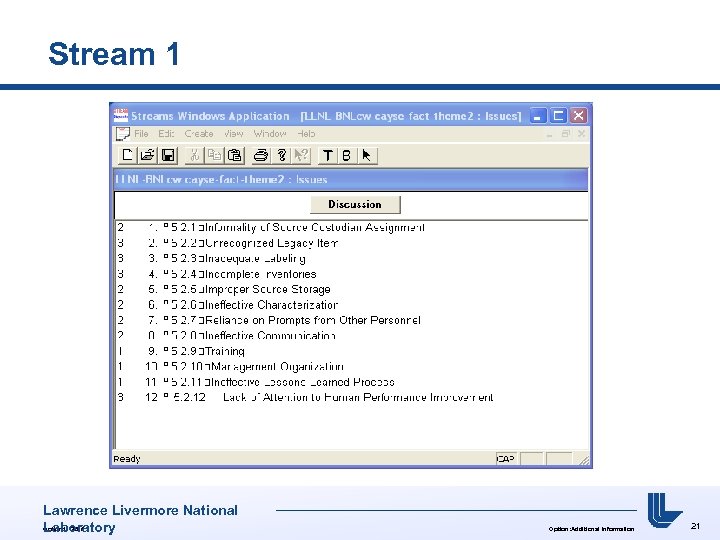
Stream 1 Lawrence Livermore National Option: UCRL# Laboratory Option: Additional Information 21
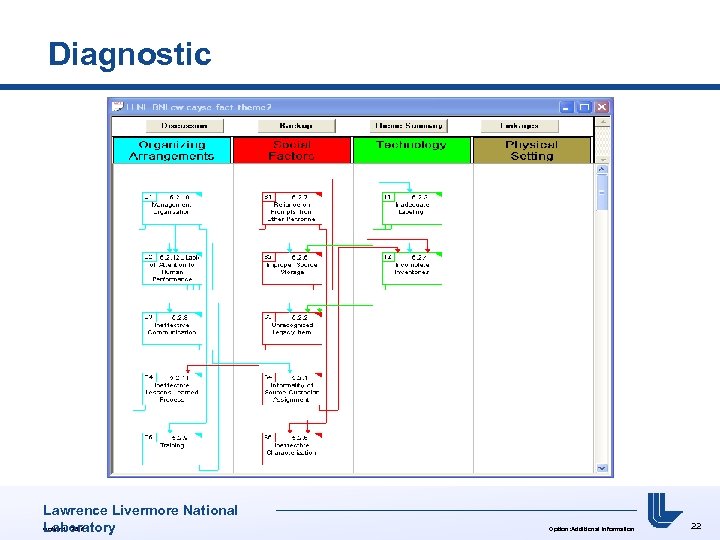
Diagnostic Lawrence Livermore National Option: UCRL# Laboratory Option: Additional Information 22
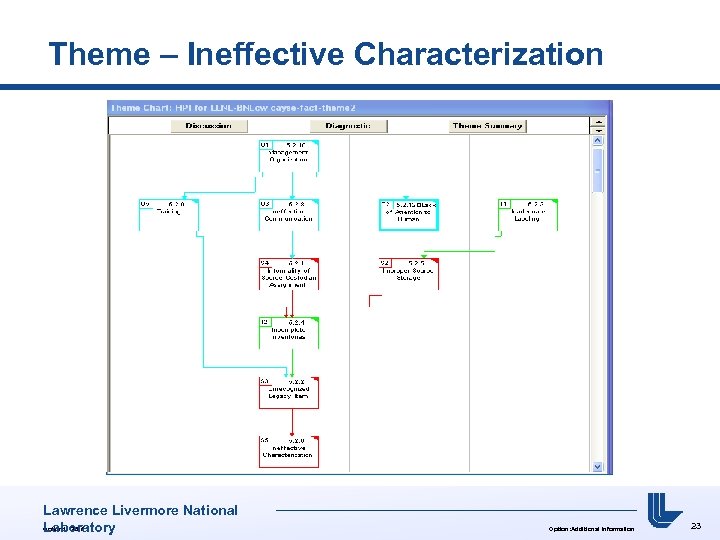
Theme – Ineffective Characterization Lawrence Livermore National Option: UCRL# Laboratory Option: Additional Information 23
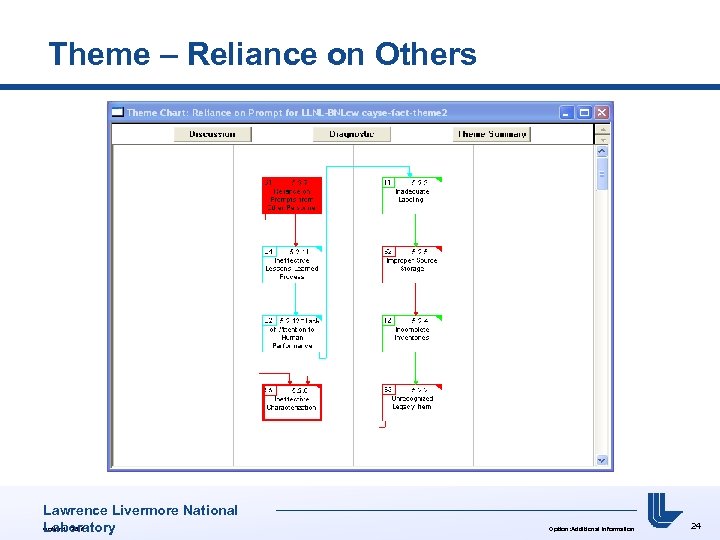
Theme – Reliance on Others Lawrence Livermore National Option: UCRL# Laboratory Option: Additional Information 24
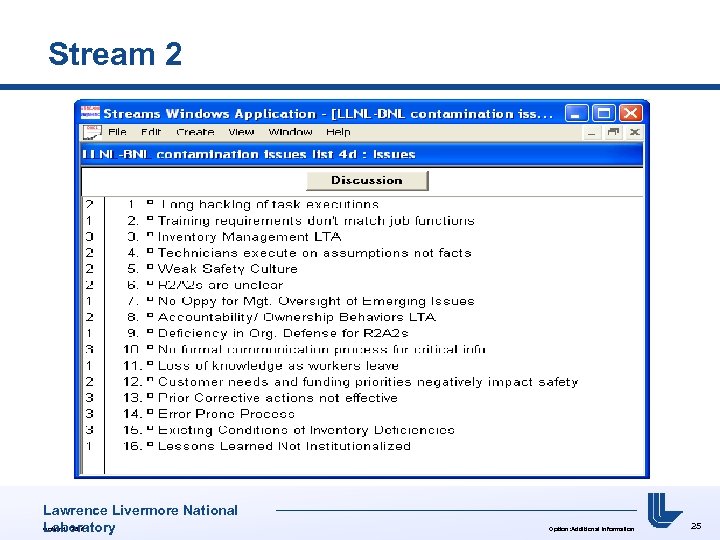
Stream 2 Lawrence Livermore National Option: UCRL# Laboratory Option: Additional Information 25
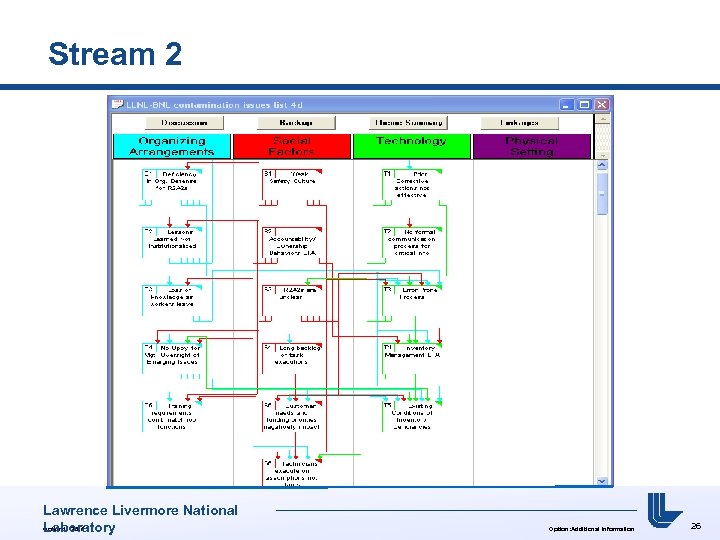
Stream 2 Lawrence Livermore National Option: UCRL# Laboratory Option: Additional Information 26
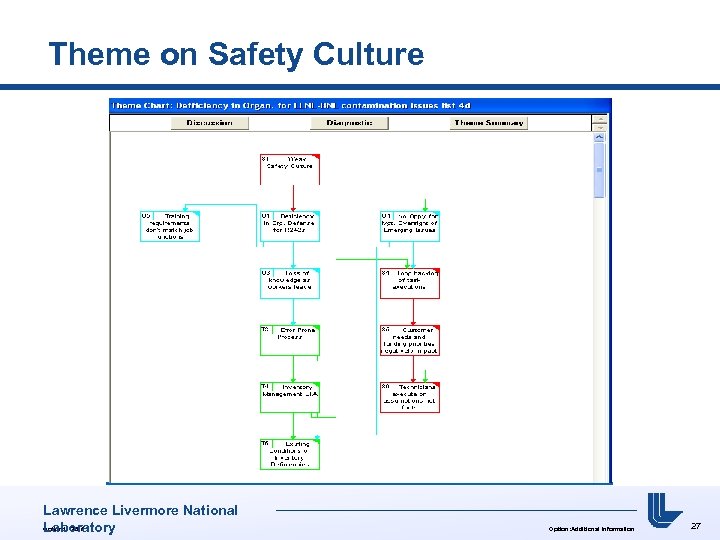
Theme on Safety Culture Lawrence Livermore National Option: UCRL# Laboratory Option: Additional Information 27
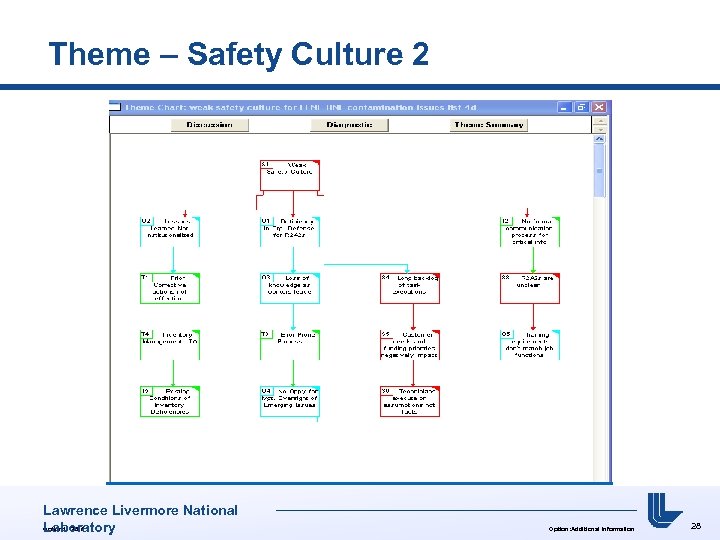
Theme – Safety Culture 2 Lawrence Livermore National Option: UCRL# Laboratory Option: Additional Information 28
Questions? Lawrence Livermore National Option: UCRL# Laboratory Option: Additional Information 29
Скачать презентацию Lawrence Livermore National Laboratory The Emerging Challenge of
ad7acba886235e7c0d821e0cb62afdaa.ppt