 Скачать презентацию Lawrence Berkeley National Laboratory Environmental Energy Technologies Division
8d6c0c81dfd1235154458683814e1949.ppt
- Количество слайдов: 21



Lawrence Berkeley National Laboratory Environmental Energy Technologies Division (EETD) Saving Energy and Improving Environmental Quality William J. Fisk Acting Division Director
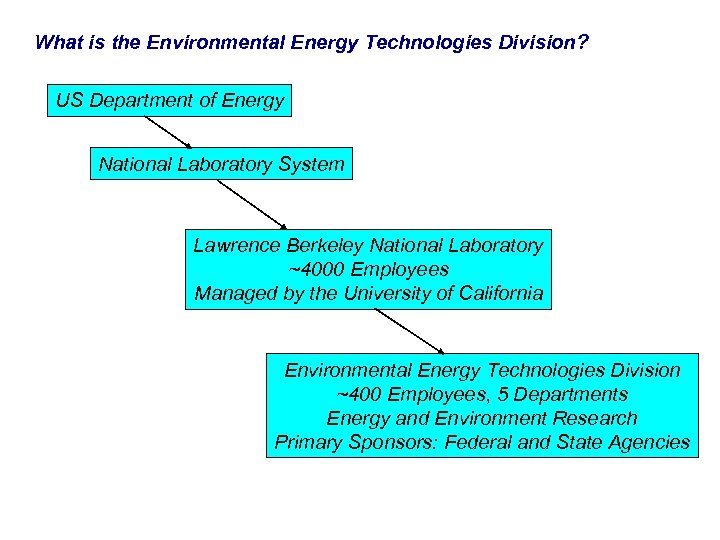
What is the Environmental Energy Technologies Division? US Department of Energy National Laboratory System Lawrence Berkeley National Laboratory ~4000 Employees Managed by the University of California Environmental Energy Technologies Division ~400 Employees, 5 Departments Energy and Environment Research Primary Sponsors: Federal and State Agencies
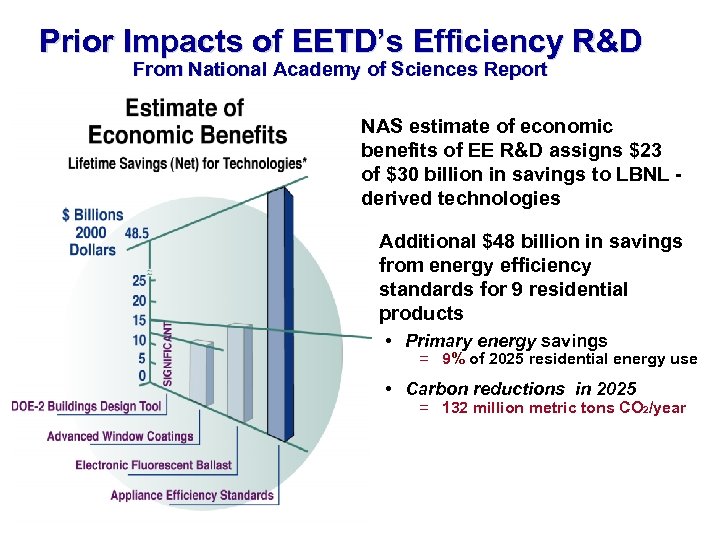
Prior Impacts of EETD’s Efficiency R&D From National Academy of Sciences Report NAS estimate of economic benefits of EE R&D assigns $23 of $30 billion in savings to LBNL derived technologies Additional $48 billion in savings from energy efficiency standards for 9 residential products • Primary energy savings = 9% of 2025 residential energy use • Carbon reductions in 2025 = 132 million metric tons CO 2/year
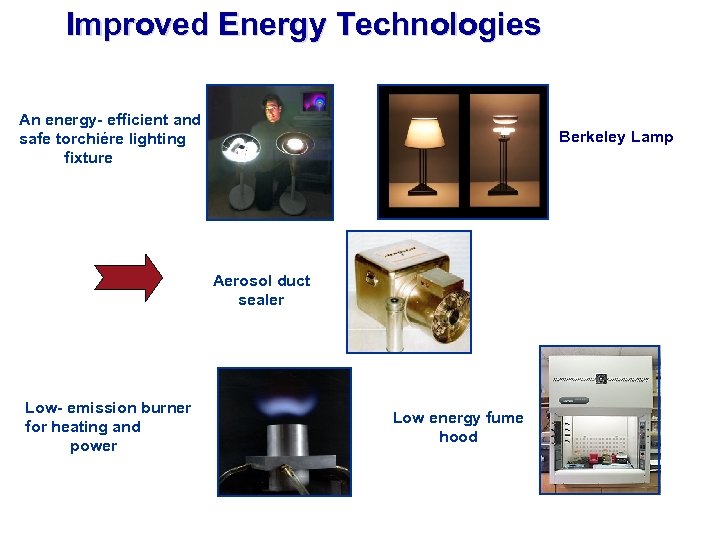
Improved Energy Technologies An energy- efficient and safe torchiére lighting fixture Berkeley Lamp Aerosol duct sealer Low- emission burner for heating and power Low energy fume hood
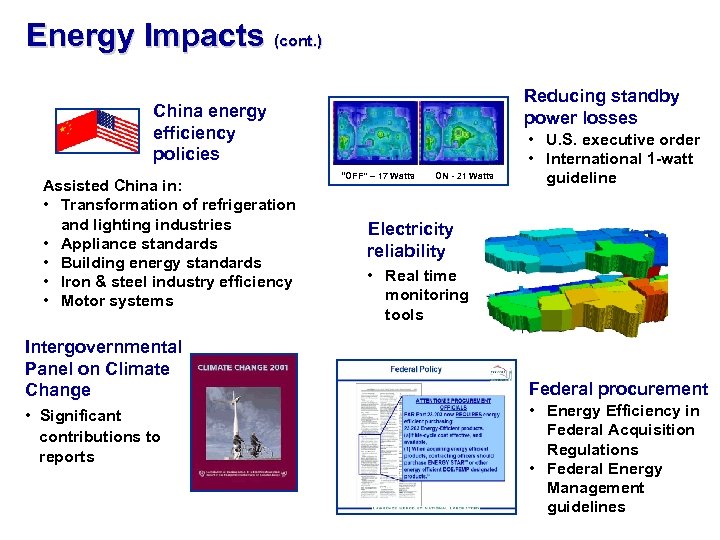
Energy Impacts (cont. ) Reducing standby power losses China energy efficiency policies Assisted China in: • Transformation of refrigeration and lighting industries • Appliance standards • Building energy standards • Iron & steel industry efficiency • Motor systems Intergovernmental Panel on Climate Change • Significant contributions to reports “OFF” – 17 Watts ON - 21 Watts • U. S. executive order • International 1 -watt guideline Electricity reliability • Real time monitoring tools Federal procurement • Energy Efficiency in Federal Acquisition Regulations • Federal Energy Management guidelines
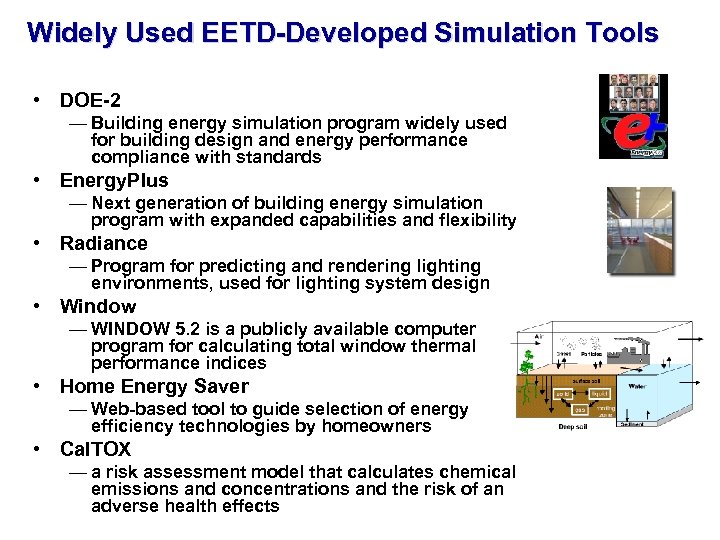
Widely Used EETD-Developed Simulation Tools • DOE-2 — Building energy simulation program widely used for building design and energy performance compliance with standards • Energy. Plus — Next generation of building energy simulation program with expanded capabilities and flexibility • Radiance — Program for predicting and rendering lighting environments, used for lighting system design • Window — WINDOW 5. 2 is a publicly available computer program for calculating total window thermal performance indices • Home Energy Saver — Web-based tool to guide selection of energy efficiency technologies by homeowners • Cal. TOX — a risk assessment model that calculates chemical emissions and concentrations and the risk of an adverse health effects
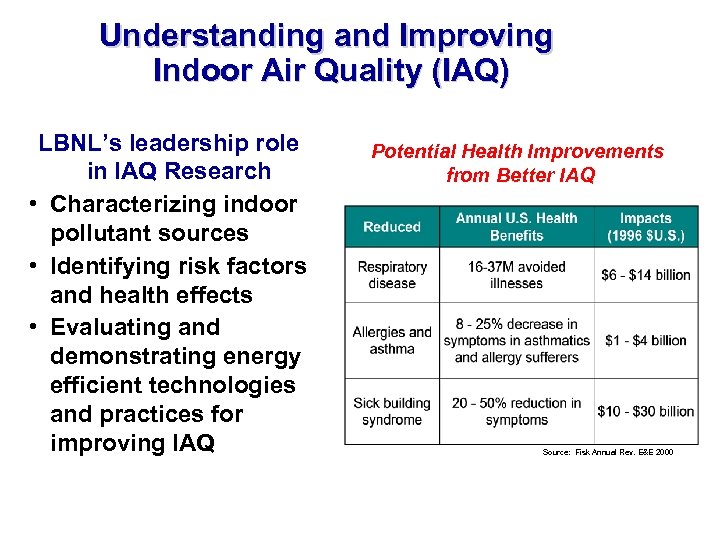
Understanding and Improving Indoor Air Quality (IAQ) LBNL’s leadership role in IAQ Research • Characterizing indoor pollutant sources • Identifying risk factors and health effects • Evaluating and demonstrating energy efficient technologies and practices for improving IAQ Potential Health Improvements from Better IAQ Source: Fisk Annual Rev. E&E 2000
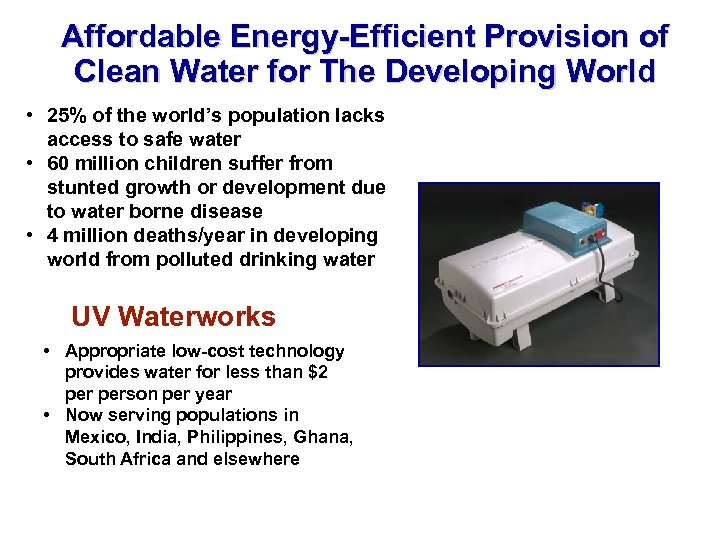
Affordable Energy-Efficient Provision of Clean Water for The Developing World • 25% of the world’s population lacks access to safe water • 60 million children suffer from stunted growth or development due to water borne disease • 4 million deaths/year in developing world from polluted drinking water UV Waterworks • Appropriate low-cost technology provides water for less than $2 person per year • Now serving populations in Mexico, India, Philippines, Ghana, South Africa and elsewhere
Examples of EETD’s Ongoing Energy Research
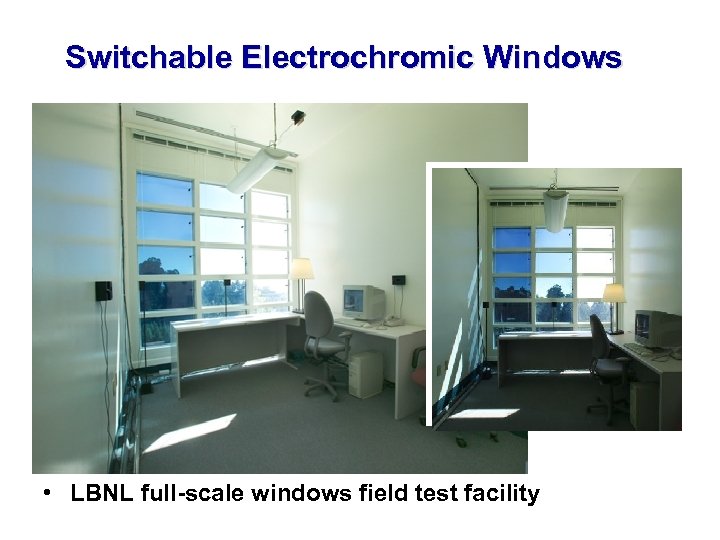
Switchable Electrochromic Windows • LBNL full-scale windows field test facility
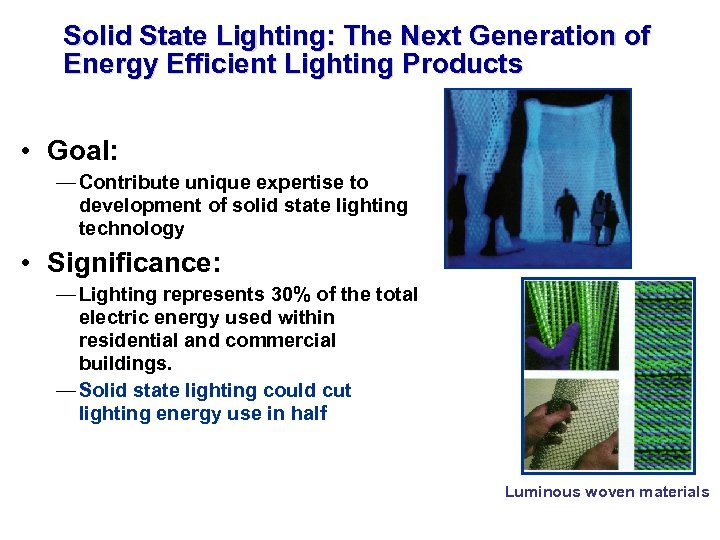
Solid State Lighting: The Next Generation of Energy Efficient Lighting Products • Goal: — Contribute unique expertise to development of solid state lighting technology • Significance: — Lighting represents 30% of the total electric energy used within residential and commercial buildings. — Solid state lighting could cut lighting energy use in half Luminous woven materials
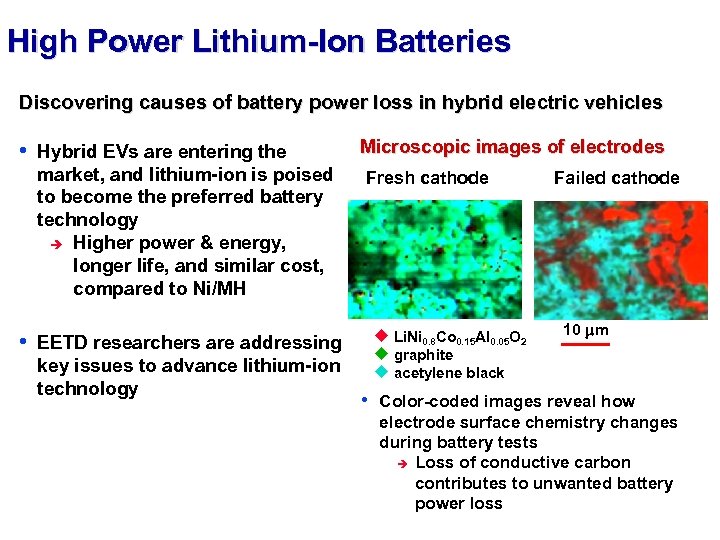
High Power Lithium-Ion Batteries Discovering causes of battery power loss in hybrid electric vehicles • Hybrid EVs are entering the market, and lithium-ion is poised to become the preferred battery technology è Higher power & energy, longer life, and similar cost, compared to Ni/MH • EETD researchers are addressing key issues to advance lithium-ion technology Microscopic images of electrodes Fresh cathode Li. Ni 0. 8 Co 0. 15 Al 0. 05 O 2 graphite acetylene black Failed cathode 10 m • Color-coded images reveal how electrode surface chemistry changes during battery tests è Loss of conductive carbon contributes to unwanted battery power loss
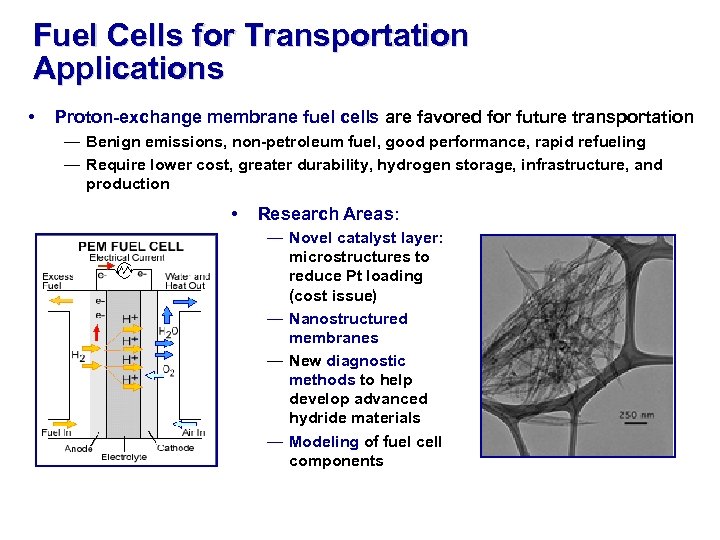
Fuel Cells for Transportation Applications • Proton-exchange membrane fuel cells are favored for future transportation — Benign emissions, non-petroleum fuel, good performance, rapid refueling — Require lower cost, greater durability, hydrogen storage, infrastructure, and production • Research Areas: — Novel catalyst layer: microstructures to reduce Pt loading (cost issue) — Nanostructured membranes — New diagnostic methods to help develop advanced hydride materials — Modeling of fuel cell components
Zero-Energy Commercial Buildings Background • The buildings sector accounts for about 40% of total U. S. energy consumption • Approximately half of that is from commercial buildings. • The commercial sector is the fastest growing energy end-use sector Goals • EETD is partnering with Alliance to Save Energy, AIA, ASHRAE, World Business Council for Sustainable Development to define and propose a major initiative to: ü Stimulate measurement and disclosure of the energy performance of buildings ü Develop and demonstrate scaleable and replicable building energy system solution packages ü Develop a strategy for sector-wide building transformation
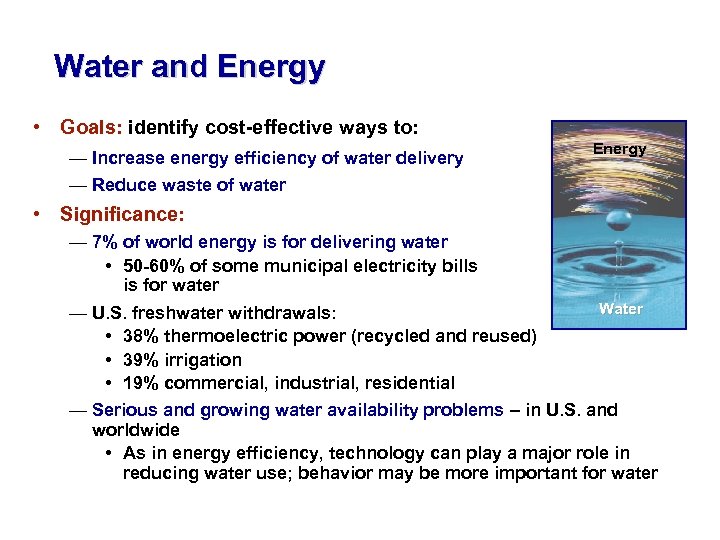
Water and Energy • Goals: identify cost-effective ways to: — Increase energy efficiency of water delivery — Reduce waste of water Energy • Significance: — 7% of world energy is for delivering water • 50 -60% of some municipal electricity bills is for water Water — U. S. freshwater withdrawals: • 38% thermoelectric power (recycled and reused) • 39% irrigation • 19% commercial, industrial, residential — Serious and growing water availability problems – in U. S. and worldwide • As in energy efficiency, technology can play a major role in reducing water use; behavior may be more important for water
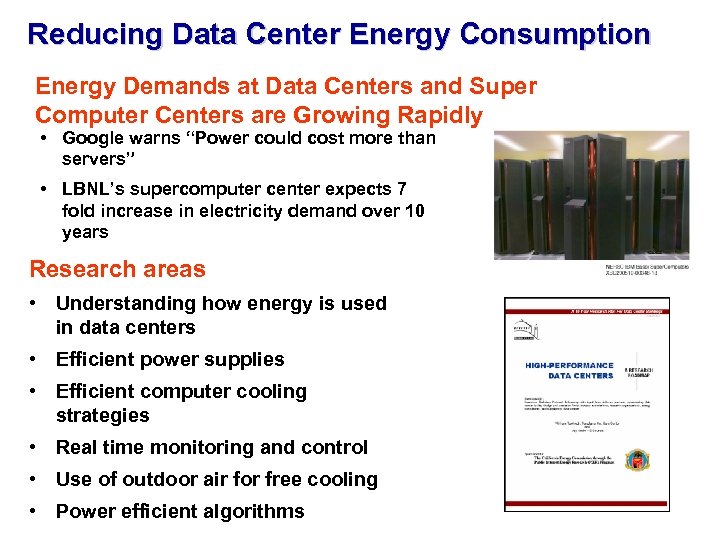
Reducing Data Center Energy Consumption Energy Demands at Data Centers and Super Computer Centers are Growing Rapidly • Google warns “Power could cost more than servers” • LBNL’s supercomputer center expects 7 fold increase in electricity demand over 10 years Research areas • Understanding how energy is used in data centers • Efficient power supplies • Efficient computer cooling strategies • Real time monitoring and control • Use of outdoor air for free cooling • Power efficient algorithms
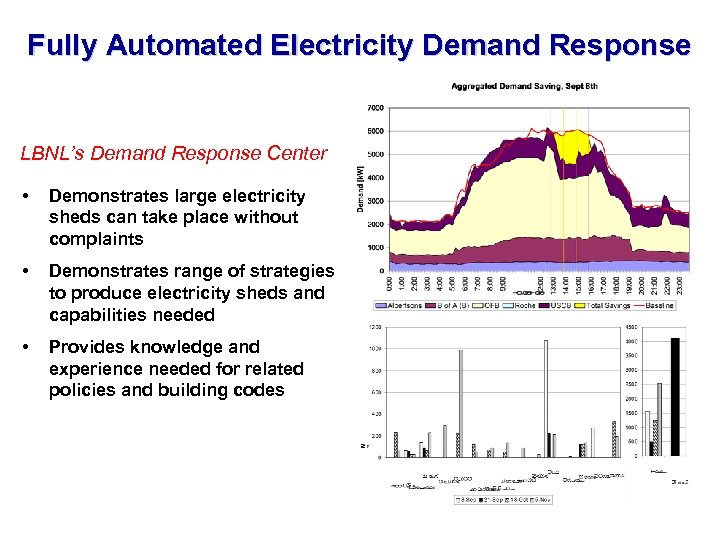
Fully Automated Electricity Demand Response LBNL’s Demand Response Center • Demonstrates large electricity sheds can take place without complaints • Demonstrates range of strategies to produce electricity sheds and capabilities needed • Provides knowledge and experience needed for related policies and building codes
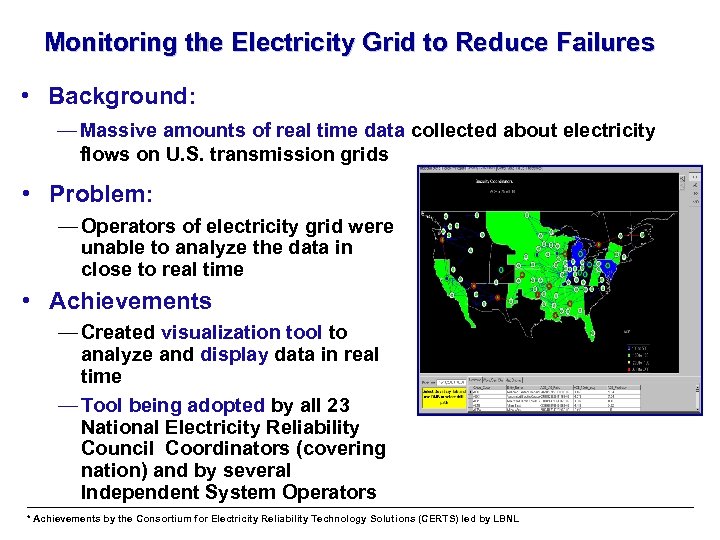
Monitoring the Electricity Grid to Reduce Failures • Background: — Massive amounts of real time data collected about electricity flows on U. S. transmission grids • Problem: — Operators of electricity grid were unable to analyze the data in close to real time • Achievements * — Created visualization tool to analyze and display data in real time * — Tool being adopted by all 23 National Electricity Reliability Council Coordinators (covering nation) and by several Independent System Operators * Achievements by the Consortium for Electricity Reliability Technology Solutions (CERTS) led by LBNL
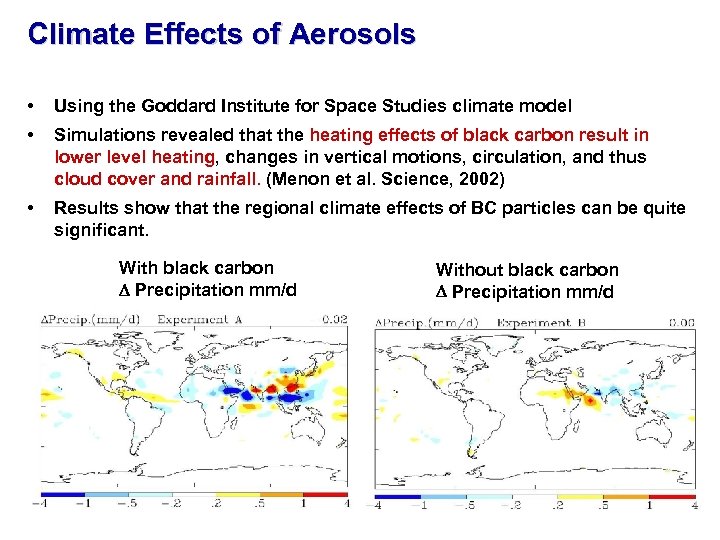
Climate Effects of Aerosols • Using the Goddard Institute for Space Studies climate model • Simulations revealed that the heating effects of black carbon result in lower level heating, changes in vertical motions, circulation, and thus cloud cover and rainfall. (Menon et al. Science, 2002) • Results show that the regional climate effects of BC particles can be quite significant. With black carbon Precipitation mm/d Without black carbon Precipitation mm/d

For More Information http: //eetd. lbl. gov/
Скачать презентацию Lawrence Berkeley National Laboratory Environmental Energy Technologies Division
8d6c0c81dfd1235154458683814e1949.ppt