


 Скачать презентацию LAW Recitation 3 Prof Agata Jurkowska-Gomułka ajurkowska wsiz rzeszow
Recitation_3.ppt
- Количество слайдов: 20
 LAW (Recitation 3) Prof. Agata Jurkowska-Gomułka ajurkowska@wsiz. rzeszow. pl Rzeszów, 2014/2015
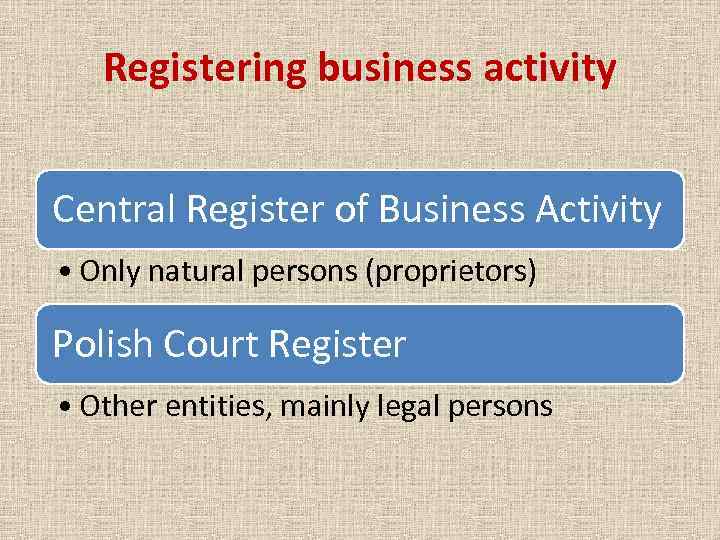 Registering business activity Central Register of Business Activity • Only natural persons (proprietors) Polish Court Register • Other entities, mainly legal persons
 Central Register of Business Activity every individual conducting business activity in a form of proprietorship obliged to register with the Central Register of Business Activity Register (CEDIG) Registration procedure starts with the filing of the application form (data of an entrepreneur, adress, objectives of the business activity, day of the commencement of the business activity
 Central Register of Business Activity • At the moment of a registration the applicant has the right to begin business activity (although once can choose another moment). • CEDIG is available to everybody. • Presumption that facts entered into register are true.
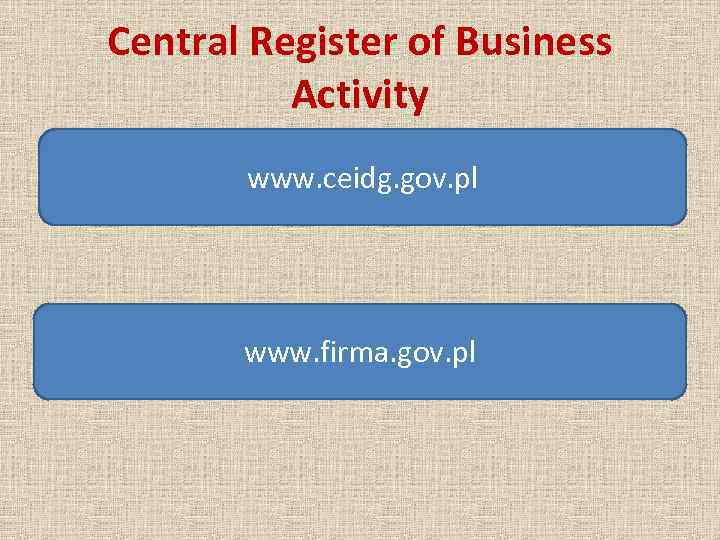 Central Register of Business Activity www. ceidg. gov. pl www. firma. gov. pl
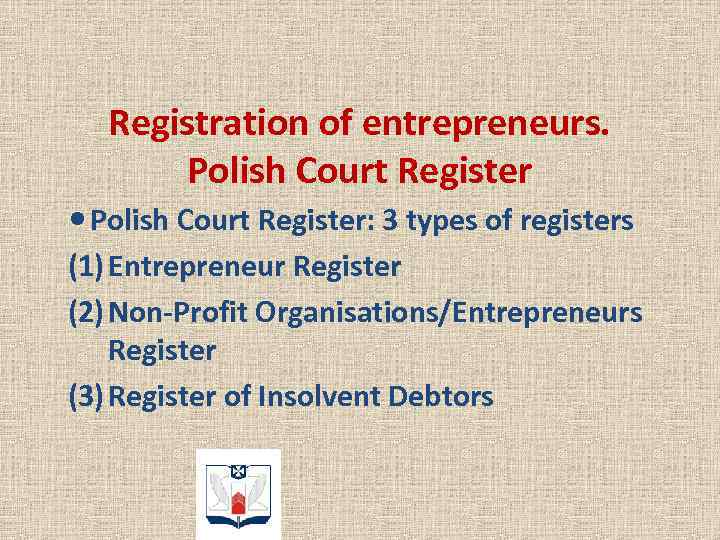 Registration of entrepreneurs. Polish Court Register: 3 types of registers (1) Entrepreneur Register (2) Non-Profit Organisations/Entrepreneurs Register (3) Register of Insolvent Debtors
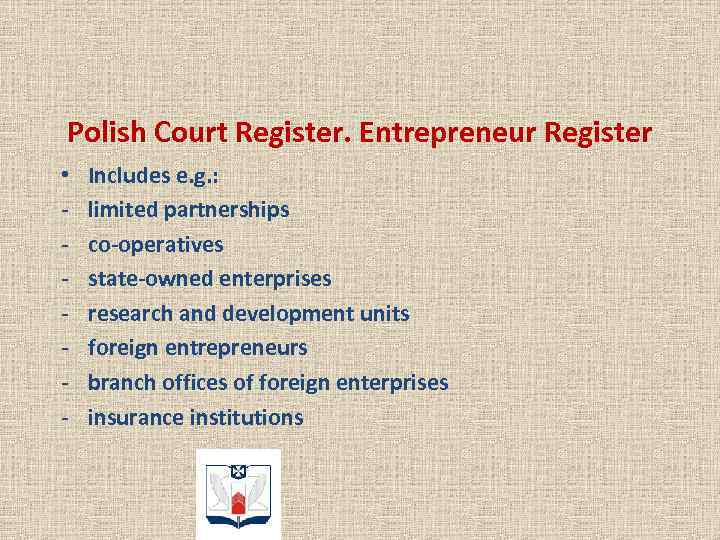 Polish Court Register. Entrepreneur Register • - Includes e. g. : limited partnerships co-operatives state-owned enterprises research and development units foreign entrepreneurs branch offices of foreign enterprises insurance institutions
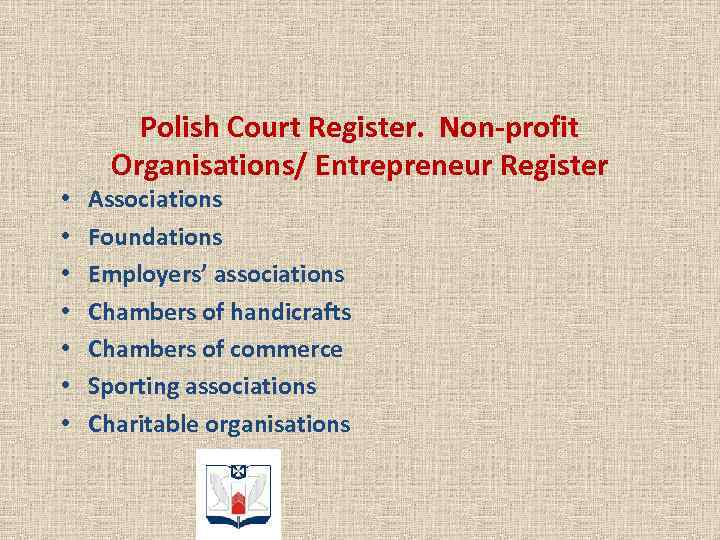 • • Polish Court Register. Non-profit Organisations/ Entrepreneur Register Associations Foundations Employers’ associations Chambers of handicrafts Chambers of commerce Sporting associations Charitable organisations
 Polish Court Register of Insolvent Debtors • Debtors unable to repay debts • Entry to the Register: ex officio by the court or at the request of the third party (creditor) • Request of a creditor justified if a creditor possesses an enforcement title against debtor who is an individual who has failed to pay their debts within 30 days of receiving a demand for repayment established by the enforcement title.
 Polish Court Register. Registration Procedure registration at the request of the applicant incorrect applications – rejected or the applicant called by the court to complete the application (7 days) application for a registration: chargeable (at avarage 1000 PLN as a court fee for registration and 500 PLN a a fee for publication (in most cases)
 Polish Court Register. Registration Procedure Once the application for registration has been filed, the registry court examines: - compliance of the application with formal requirements - consistency of the application with law When an application has some formal mistakes – the registry court calls the applicant to remove mistatkes within 7 days. If the application meets all the requirements: registration is granted by the court
 Polish Court Register. Consequences of Registration Entrepreneur is entitled to start business activity upon its registration within the Polish Court Register. Principle of positive reliance on the existance of the fact entered into the Court Register: the third party cannot claim that she/he was unaware of a fact registered
 Polish Court Register. Consequences of Registration Within 16 days of the publication of a registered fact, a third party may question this fact by providing evidence that she/he was unable previosly to acquire knowledge of such fact. Court Register establishes a presumption that all the facts entered into the Register are true.
 Auxiliary Persons of the Entrepreneur § Persons who assist entrpreneurs to run their business § dependent auxiliary persons (prokurent) § independent auxiliary persons
 Dependent auxiliary person. Prokurent (I) § A person acting on the statutory power of attorney § Only a person with a full legal capacity § Prokura (representation) can be granted only in written form and must be registered. § Scope of representation: determined directly in law
 Dependent auxiliary person. Prokurent (2) § Prokurent is entitled to carry out on the behalf of his principal all court and out-of-court activities connected with operation of the enterprise. § The principal may limit the scope of activities (for instance to transactions not exceeding a certain sum of money) § Limitations relevant only internally (do not affect relationships with third parties)
 Dependent auxiliary person. Prokurent (3) § If the prokurent ignores the agreed limitations, an agreement entered by the prokurent on behalf of the principal is valid and effective, but the prokurent must recover damages to the principal. § Prokura may be withdrawn by the principal at any time.
 Dependent auxiliary person. Agent § Agent: a person who performs services for his/her principal (entrepreneur), but who is not involved in the business organisation as an employee. § Agent has a status of entrepeneur itself (even if acting on behalf of the principal) § Agents authorized to bring about direct relations between third parties and the principal & agents authorized to conclude contracts
 Dependent auxiliary person. Authorised dealers § Dealership contract – non-standardised contract § Dealer: an entrepreneur whose enterprise is included in the sale or marketing of manufactured products (branded articles) § Dealers act on their own behalf.
 Dependent auxiliary person. Franchisee § Parties to the franchising agreements: franchise & franchisor § Non-standardised contract § Franchisor grants the franchisee right (license) to sell certain goods or to provide services on a certain market within his/her own enterprise. § Franchisee pays royalties in return for using a trademark, sales methods or franchisor’s enterprise idea.