 Скачать презентацию LAW AND CLIMATE CHANGE IN NIGERIA By Professor
2c72f6e9f81ba9419c2d189d96373c22.ppt
- Количество слайдов: 35



LAW AND CLIMATE CHANGE IN NIGERIA By Professor Olanrewaju. A. Fagbohun, Ph. D Nigerian Institute of Advanced Legal Studies University of Lagos Campus Akoka, Lagos 1 Being paper presented at the 2010 Edition of the Faculty of Law, University of Ilorin Law Workshop on the 13 th of May, 2010.
CLIMATE CHANGE - DEFINITION “…a change of climate which is attributed directly or indirectly to human activity that alters the composition of the global atmosphere and which is in addition to natural climate variability observed over comparable time periods”. - UNFCCC Definition. “Greenhouse gases are accumulating in Earth’s atmosphere as a result of human activities, causing surface air temperatures and subsurface ocean temperatures to rise. ” 2
CLIMATE CHANGE V. GLOBAL WARMING – Global warming is an overall warming of the planet, based on average temperature over the entire surface; – Climate change is changes in regional climate characteristics, including temperature, humidity, rainfall, wind and severe weather events. 3
WHICH ARE THE GREENHOUSE GASES (GHGS? ) • Global warming is thought to be linked to the emission of the following GHGs among others: – Carbon monoxide and carbon dioxide: power stations, industrial processes and transportation; – Nitrous oxides: livestock production; – Methane: decomposition of organic wastes in landfills, herds of cattles; – Chlorofluorocarbons (CFCs): aerosol sprays, solvents, refrigerants, freezers; air conditioners; – Sulphur – dioxide: burning fossil fuels that contain sulphurs. 4
CONSEQUENCES OF CLIMATE CHANGE • Climate change is predicted to lead to a variety of negative effects including: (i) Melting (and possible disappearance) of glaciers and mountain snow caps that feeds the world’s rivers and supply a large portion of the fresh water used for drinking and irrigation (water stress could affect as much as 75 – 250 million people in Africa alone by 2020); (ii) A rise in sea levels due to the melting of the ice-based land sheets in Greenland Antarctica, with many islands and coastal areas more exposed to storm damage (coastal 5
(iii) Increasingly costly “bad weather” events such as heat waves, droughts, floods and severe storms; (iv) Lowered agricultural productivity due to less favourable weather conditions, less available irrigation water, increased heat stress to plants, and an increase in pest activities due to warmer temperatures (food security – as much as 50% yield decline by 2020 in some African countries); 6 (v) Increases in vector-borne diseases like
(vi) Large numbers of extinctions of higher -level species and social dislocation due to their inability to adapt to rapidly changing climate and habitat conditions. – • the first two are mostly related to global warming while the remaining four have non-temperature factors (climate change factors) playing critical role. Developing nations are more vulnerable and at risk in meeting the challenges of climate change for reasons of “funding”, “lack of technology”, “poverty” and “population 7
ADAPTATION AND MITIGATION • There are two responses to global climate change: (i) Mitigation - intervention or policies to reduce the emissions or enhance the sinks of greenhouse gases. ; (ii) Adaptation response to the changing climate (e. g. acclimatization in humans) and policies to minimize the predicted impacts of climate change (e. g. building better coastal defences). • While mitigation primarily involve reduction in the concentration of GHGs either by reducing their sources or increasing their sinks, adaptation involves acting to minimize the effects of global warming; • Mitigation policy helps reduce future increases in climate change while adaptation policy deals with the 8
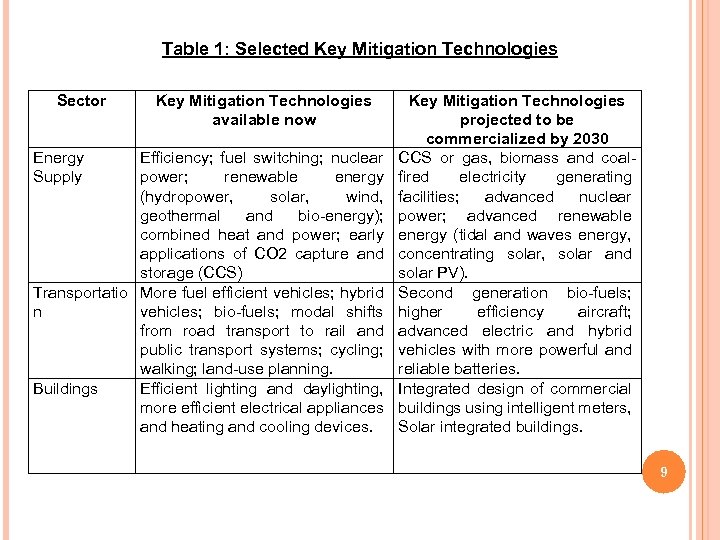
Table 1: Selected Key Mitigation Technologies Sector Energy Supply Key Mitigation Technologies available now Efficiency; fuel switching; nuclear power; renewable energy (hydropower, solar, wind, geothermal and bio-energy); combined heat and power; early applications of CO 2 capture and storage (CCS) Transportatio More fuel efficient vehicles; hybrid n vehicles; bio-fuels; modal shifts from road transport to rail and public transport systems; cycling; walking; land-use planning. Buildings Efficient lighting and daylighting, more efficient electrical appliances and heating and cooling devices. Key Mitigation Technologies projected to be commercialized by 2030 CCS or gas, biomass and coalfired electricity generating facilities; advanced nuclear power; advanced renewable energy (tidal and waves energy, concentrating solar, solar and solar PV). Second generation bio-fuels; higher efficiency aircraft; advanced electric and hybrid vehicles with more powerful and reliable batteries. Integrated design of commercial buildings using intelligent meters, Solar integrated buildings. 9
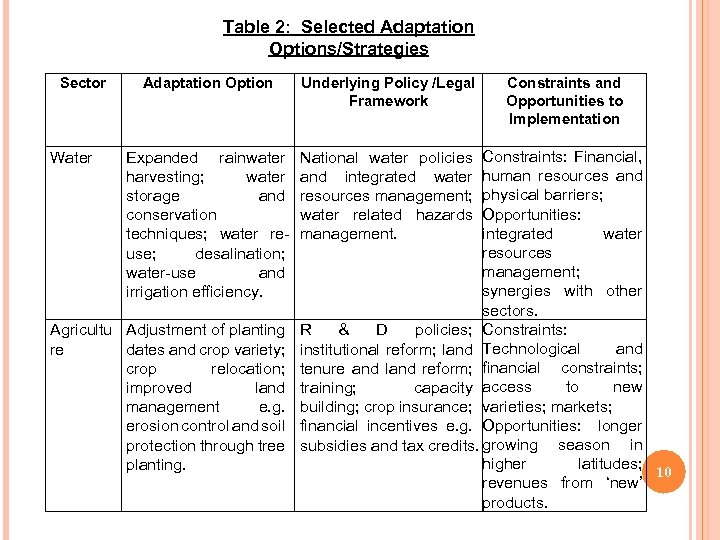
Table 2: Selected Adaptation Options/Strategies Sector Water Adaptation Option Underlying Policy /Legal Framework Expanded rainwater harvesting; water storage and conservation techniques; water reuse; desalination; water-use and irrigation efficiency. National water policies and integrated water resources management; water related hazards management. Agricultu Adjustment of planting re dates and crop variety; crop relocation; improved land management e. g. erosion control and soil protection through tree planting. Constraints and Opportunities to Implementation Constraints: Financial, human resources and physical barriers; Opportunities: integrated water resources management; synergies with other sectors. R & D policies; Constraints: and institutional reform; land Technological tenure and land reform; financial constraints; to new training; capacity access building; crop insurance; varieties; markets; financial incentives e. g. Opportunities: longer subsidies and tax credits. growing season in higher latitudes; 10 revenues from ‘new’ products.
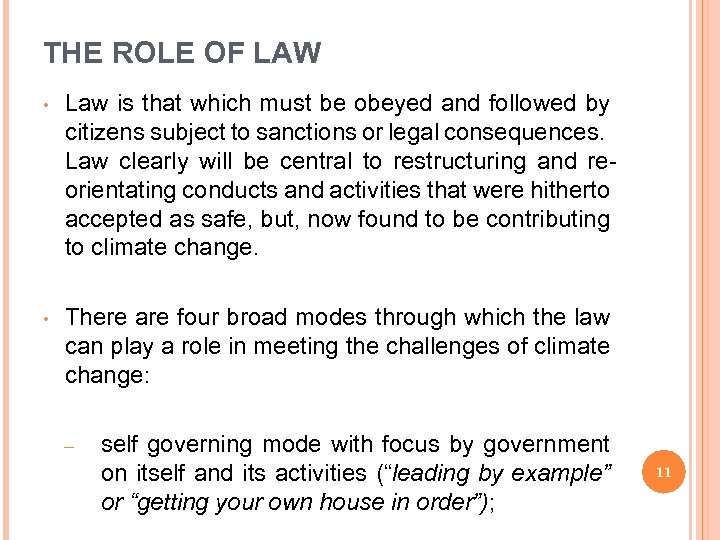
THE ROLE OF LAW • Law is that which must be obeyed and followed by citizens subject to sanctions or legal consequences. Law clearly will be central to restructuring and reorientating conducts and activities that were hitherto accepted as safe, but, now found to be contributing to climate change. • There are four broad modes through which the law can play a role in meeting the challenges of climate change: – self governing mode with focus by government on itself and its activities (“leading by example” or “getting your own house in order”); 11
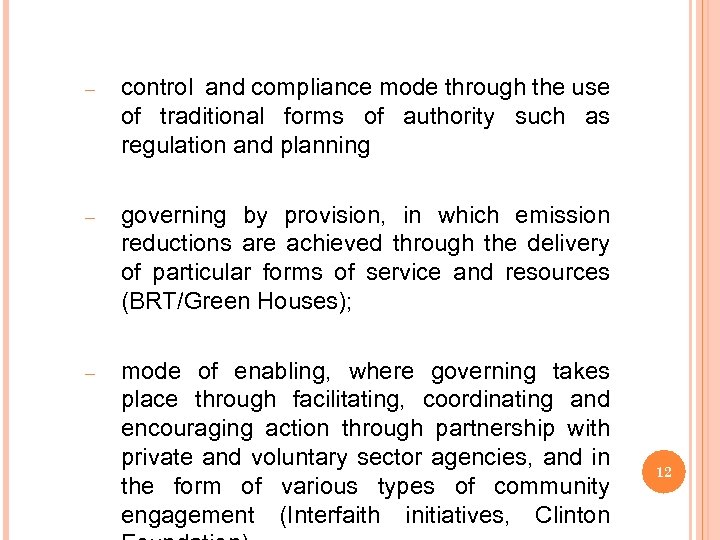
– control and compliance mode through the use of traditional forms of authority such as regulation and planning – governing by provision, in which emission reductions are achieved through the delivery of particular forms of service and resources (BRT/Green Houses); – mode of enabling, where governing takes place through facilitating, coordinating and encouraging action through partnership with private and voluntary sector agencies, and in the form of various types of community engagement (Interfaith initiatives, Clinton 12
HOW HAS THE LAW FARED? • Global challenges must be met by global measures in the sense that global problems do not respond to unilateral fixes; • The need for international action stems from two important observations arising out of the work of the Intergovernmental Panel on Climate Change (IPCC): – first, if we do not mitigate emissions of GHGs, the negative effects of climate change will be difficult to reverse; – second, the benefits of mitigating emissions of GHGs are so overwhelming that this, combined with the prospect of the harm resulting from inaction, makes it imperative for the world to devise an 13
THE CLIMATE CHANGE CONVENTION (UNFCCC) • The first report of the IPCC in 1990 was what led to the adoption of the UNFCCC at the Rio Conference in 1992. It was ratified by 50 countries and came into force in March, 1994; • It was based on the concept of “common but differentiated responsibility” recognizing the need for global actions and the differing levels of obligations placed upon industrialized and developing countries; • The main objective of the Convention was to stabilize greenhouse gas emissions at a level that would not interfere with the climate system or food production, but which would still allow sustainable economic development – (Art. 2); 14
– objectives to be met within a time frame that would allow ecosystems to adapt to any changes; – the unavoidability of some changes in climate and seeks to achieve the possible by seeking to link it to the ability of nature to adapt to whatever changes occur; – Intergenerational equity; – common but differentiated responsibility; – the precautionary principle; – the right to sustainable development; – the need to cooperate within a supportive and open international economic system. 15
• The Convention divides countries into two main groups: – Industrialized countries (41 countries) comprising of OECD countries and economies in transition; – • Developing countries (145 countries). By way of general commitments, countries (based on common but differentiated responsibilities) were to: – compile inventories of GHG emissions caused by human activities; – compile inventories of activities which remove 16
– develop regional programmes to mitigate climate change; – develop and transfer technologies, practices and processes to control GHGs in all relevant industrial sectors (including energy, transport, agriculture, forestry and waste management); – Promote mechanisms to remove GHGs from the atmosphere; – take climate change considerations into account in formulating and implementing social, economic and environmental policies; and 17
– • promote research, education and public awareness. The industrialized countries have additional commitments: – they must adopt national policies and take measures to mitigate climate change by limiting emissions of GHGs. The aim is to limit emissions to 1990 levels, but this target is not binding; – The OECD countries have a special obligation to provide finance to developing countries to enable them to comply with their obligations, and to facilitate the transfer of climate – friendly 18
THE KYOTO PROTOCOL (KP) • The KP which was adopted in 1997 and entered into force in 2005 was the subject of tough negotiations as a result of the political difficulties faced by the USA in setting significant reduction targets; • It sets binding reduction targets for Annex 1 Parties in relation to six gases – carbon dioxide, hydrofluorocarbons, methane, nitrous oxide, and ground level ozone. • KP had joint implementation mechanisms that allow the commitments to be shared: 19
– Aggregating emissions (Art. 4) – Joint implementation (Art. 6) – – • Emissions trading systems (Arts 4 and 17) The clean development mechanism (Art. 12) The lack of support for KP by the USA was a major problem. 20
THE BALI ACTION PLAN (BALI ROAD MAP) • Parties to the UNFCCC meet annually at the Conference of Parties (COP) to review implementation of the Convention; • By 2007 when COP met in Bali, (Indonesia), China, a non-Annex 1 country had become the largest annual GHG emitter. The USA had also not left off its hostility; • The Bali Action Plan, among others: – Noted that climate change is unequivocal and recognized the need for cuts in global 21
– – • • the focus was still on developed countries making emissions commitments, while developing countries take actions appropriate to their developmental needs; there was agreement that the role of forests as carbon sinks should be specifically recognized and deforestation in developing countries avoided; No timetabled target was agreed. It simply set in motion a process through which such targets might be forthcoming. Bali has been applauded as a master class in 22
THE COPENHAGEN ACCORD • Arising from the Bali Action Plan, December, 2009 was mapped out as the year in which the true negotiation for significant cuts in emission would take place at the 15 COP at Copenhagen; • The aim was that the Copenhagen deal would enter into force not later than by the end of 2012 when the first commitment period of the Kyoto Protocol expires; • Copenhagen Conference was seen as crucial to human security and survival, in the hope that it would achieve the following: 23
– a science – based agreement for ambitious emission reductions; – A robust mechanism for financing low-carbon development and technology transfer; – countries and communities hardest hit by climate change must have the resources to adopt to current and future impacts; – Forest countries especially in the tropics must get the tools and incentives to stop forest destruction 24
• There was so much hope riding “on sealing the deal” in Copenhagen. Regrettably, Copenhagen came and went - there was no deal in place to be sealed by the time the number of heads of governments (almost 120 were present) arrived at the tail of the conference; • The Copenhagen Accord which came out of the conference has been described by the Swedish EU Presidency as “a disaster”. US President Obama saw it as representing “an unprecedented breakthrough”. 25
WHY HAS THE INTERNATIONAL LEGAL FRAMEWORK FAILED SO FAR? • UNFCCC started with a view of serving as an integrated regulatory regime; • A centralized and comprehensive integrated regulatory regime is easily achieved when you have stakeholders whose “interests”, “power”, “information” and “belief” are sufficiently similar across a broad issue – area. – the same is not the case where opposing interest co -exist in the same issue area. Conflict between the individual elements are likely to arise. • In the case of climate change, achieving a comprehensive integrated regulatory regime has been politically a difficult problem for the following fundamental reasons: 26
– It is a global problem, whose solution cannot be achieved through the efforts of any single group/unit; – The negative effects are not observable now, but are expected to occur some years in the future (present generations are being expected to pay costs for the benefit of their successes two or more generations into the future); – Changing practices with respect to climate change requires changes in the habits of billions of people, as well as organizations such as firms; but practical policies to generate incentives for these behavioural changes require action by governments that, in many cases, may not have the interest or ability to exert much influence on their subject; 27
– • Specific problems inherent in the concept of “climate change” are enormously diverse. The diversity of problems is, in turn, associated with parallel diverse political patterns of interests, power, information and beliefs. The result is climate change cooperation problems. In the words of George Bush, former President of the United State: “…I oppose the Kyoto Protocol because it exempts 80 percent of the world; including major population centers such as China and India, from compliance and would cause serious harm to the US economy… Kyoto would’ve wrecked our economy. I wouldn’t in good faith have signed Kyoto”. 28
THE EXPERIENCE AT NATIONAL/STATE LEVELS • Nigeria and States like Lagos are currently working on climate change legislation; • Current state of legislation (sectoral); • What is being advocated is a legal framework that can give harmony to the collection of independent sectoral regulatory regimes; 29
• It law will lay down general broad principles that are aimed at regulating and limiting GHG emissions in various sectors and then leave the rules needed for implementation to the determined by the relevant sectors ; • It law will coordinate on cross-sectoral issues and institutionalize delivery system for attainment of related objectives; • Its essentials are: “coherence”, “accountability”, “effectiveness”, “determinacy”, “sustainability” and “epistemic quality”. 30
THE GOALS OF A LEGAL FRAMEWORK An appropriate legal framework must be able to achieve the following, among others: – Transit Nigeria to a clean energy economy (renewable energy and energy efficiency) without compromising her short-term competitiveness; – It must make more expensive low emission industries attractive to private sector investor through schemes that remove the short term technology and market risk; – It must be protective of innovations (intellectual property and patent rights) order to attract investors; 31
– Be sufficiently balanced in its approach as to receive broad support from the coalition of utility companies, oil companies, chemical companies, transportation sector, major manufacturers, environmentalists, and labor organizations; – Assure the companies operating in Nigerian of the right market incentives and rewards that will help them remain competitive such that the jobs will remain in Nigerian as the market transforms. The jobs must not “leak” to other countries; – Be able to encourage capacity programs that will train workers to succeed in the new energy economy (virtually all low emission industries contain a significant national – and often regional – 32
– Low and moderate-income families must be protected from price increases caused by inadvertent or abusive practices through rebates and market stability schemes that can limit price volatility; – Must ensure that small business and agricultural enterprises are given appropriate exceptions and support; – Must give support for strong policing measures to establish market-place accountability and ensure the new carbon marketplace is transparent, fair and accountable; 33 – Must be able to support adaptation strategies for
– Must be capable of supporting funding for the identification of at-risk populations, habitats, and ecosystems that are particularly susceptible to climate change; – Must encourage public/private partnership; – Must be able to encourage cooperative activities between Federal Government on the one hand the States on the other hand. 34
CONCLUSION • We must recognize that actions are needed to meet the challenges of climate change. We must also recognize that implementable effective actions are possible. Finally, we must recognize that the law has a major role to play. Thank you. 35
Скачать презентацию LAW AND CLIMATE CHANGE IN NIGERIA By Professor
2c72f6e9f81ba9419c2d189d96373c22.ppt