


 Скачать презентацию Laurie Mc Court MD CJCP JCR Consultant Former
af90d9ed2124a70051e8d876d53bb24f.ppt
- Количество слайдов: 111
 Laurie Mc. Court, MD, CJCP JCR Consultant Former TJC Surveyor: Hospital, Office Based Surgery, and Special Survey Unit © Joint Commission Resources The TJC Medical Staff Standards Update 2017
 Joint Commission Resources Disclaimer § These slides are current as of April 1, 2017. Joint Commission Resources reserves the right to change the content of the information, as appropriate. § These slides are copyrighted and may not be further used, shared or distributed without permission of the original presenter or Joint Commission Resources. © Joint Commission Resources § These slides are only meant to be cue points, which were expounded upon verbally by the original presenter and are not meant to be comprehensive statements of standards interpretation or represent all the content of the presentation. Thus, care should be exercised in interpreting Joint Commission requirements based solely on the content of these slides.
 § Review what’s new in 2017 for TJC § Review the top scored standards in the medical staff chapter and their related Co. Ps from 2016 § Review of processes that have been used as solutions to the top scored standards § Review standards/Co. Ps from other chapters that impact medical staff © Joint Commission Resources Objectives
 © Joint Commission Resources Project REFRESH
 Project REFRESH: What is it? © Joint Commission Resources § A series of enhancements to the entire survey process which are the result of data collected from a variety of sources, most importantly, YOU, our customers. These enhancements are to be phased in over 2016 and 2017.
 Project REFRESH: What is it? § Real-time information gathering between – surveyors and Standards Interpretation Group – during survey § Enhanced mobile technology § Fewer standards: No changes in MS Chapter as yet § Revised criticality models § Easier & less complex decision process § Higher consistency in interpretation of standards © Joint Commission Resources § Streamlined post-survey process
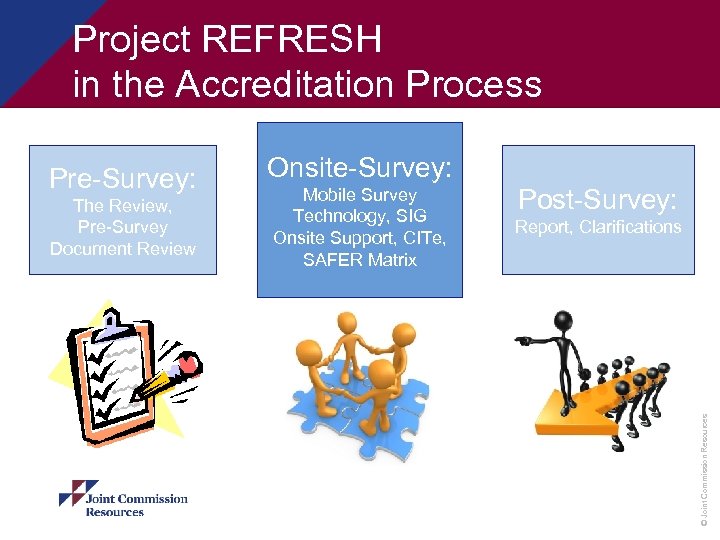 Project REFRESH in the Accreditation Process The Review, Pre-Survey Document Review Onsite-Survey: Mobile Survey Technology, SIG Onsite Support, CITe, SAFER Matrix Post-Survey: Report, Clarifications © Joint Commission Resources Pre-Survey:
 © Joint Commission Resources
 Pre-Survey Document Review § Surveyors spend hours during survey reviewing documents § Coming in 2017: Allow customers ability to upload key documents prior to survey for Joint Commission review: Could include Bylaws, Rules, Regulations © Joint Commission Resources § This cuts into valuable survey time that would be better spent doing tracers, environmental tours, etc. where surveyors could identify more relevant patient and environmental safety risks
 © Joint Commission Resources
 Changes to Surveys § “A” and “C” designations were removed: MS chapter was mostly “A”s § “Direct” vs. “Indirect” designations removed § Continued review of manual with EP revision and removal § Surveyors documenting real time on tablets § Involvement of organizations on SIG phone calls § New scoring process 11 © Joint Commission Resources January 2017 :
 © Joint Commission Resources Survey Analysis for Evaluating Risk™ (SAFER™) Matrix
 § A transformative approach for identifying and communicating risk levels associated with deficiencies cited during surveys § Helps organizations prioritize and focus corrective actions § Provides one, comprehensive visual representation of survey findings § Replaces current scoring methodology § Implementation: January 2017 – Was implemented June 6 th, 2016 for deemed Psychiatric Hospitals only © Joint Commission Resources Survey Analysis for Evaluating Risk (SAFER)
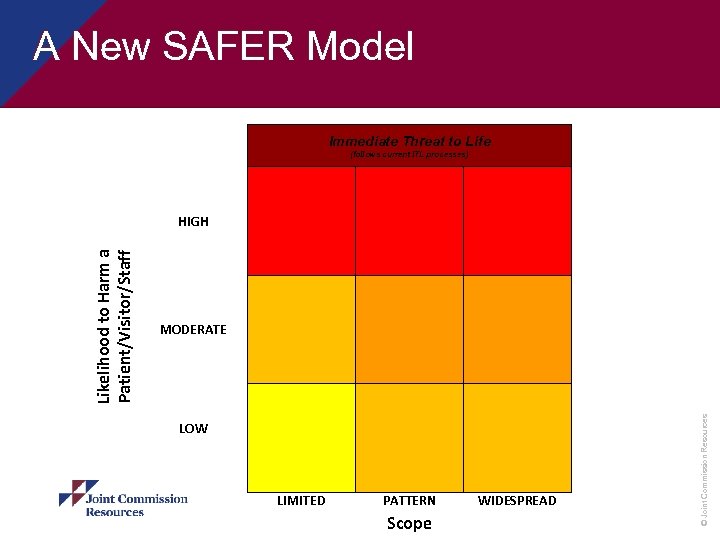 A New SAFER Model Immediate Threat to Life (follows current ITL processes) Likelihood to Harm a Patient/Visitor/Staff HIGH LOW LIMITED PATTERN Scope WIDESPREAD © Joint Commission Resources MODERATE
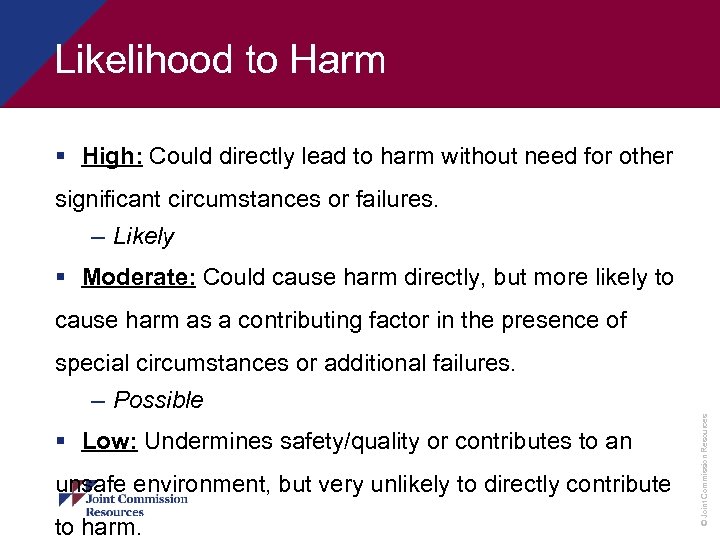 Likelihood to Harm § High: Could directly lead to harm without need for other significant circumstances or failures. – Likely § Moderate: Could cause harm directly, but more likely to cause harm as a contributing factor in the presence of special circumstances or additional failures. § Low: Undermines safety/quality or contributes to an unsafe environment, but very unlikely to directly contribute to harm. © Joint Commission Resources – Possible
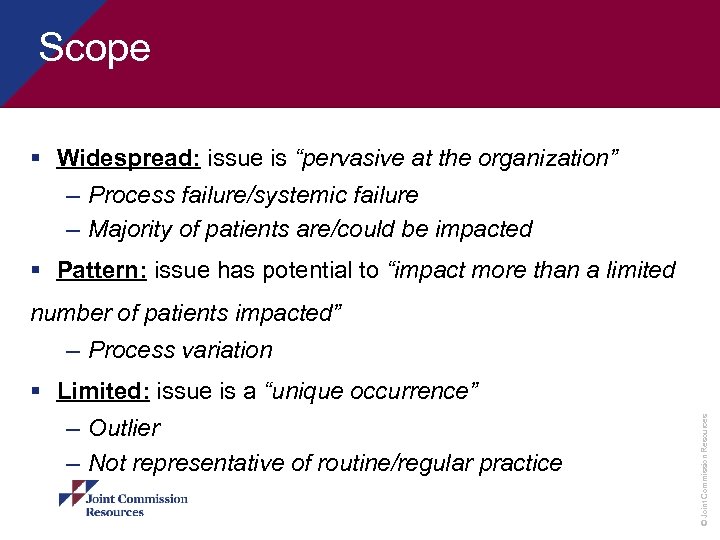 Scope § Widespread: issue is “pervasive at the organization” – Process failure/systemic failure – Majority of patients are/could be impacted § Pattern: issue has potential to “impact more than a limited number of patients impacted” – Process variation – Outlier – Not representative of routine/regular practice © Joint Commission Resources § Limited: issue is a “unique occurrence”
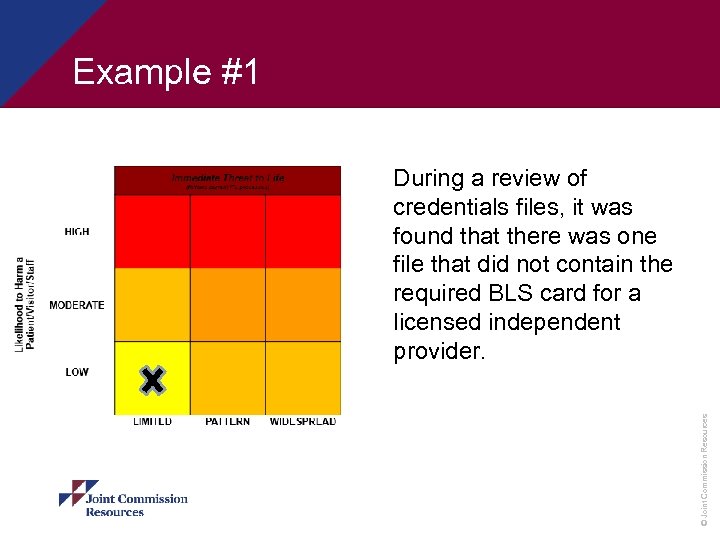 Example #1 © Joint Commission Resources During a review of credentials files, it was found that there was one file that did not contain the required BLS card for a licensed independent provider.
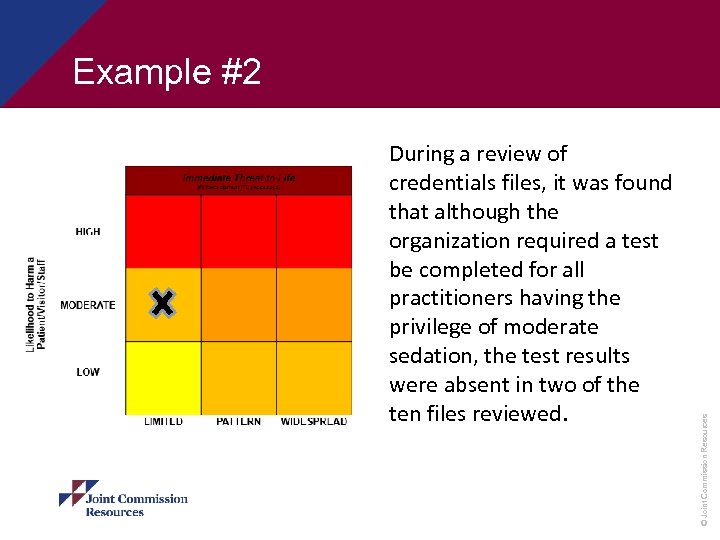 During a review of credentials files, it was found that although the organization required a test be completed for all practitioners having the privilege of moderate sedation, the test results were absent in two of the ten files reviewed. © Joint Commission Resources Example #2
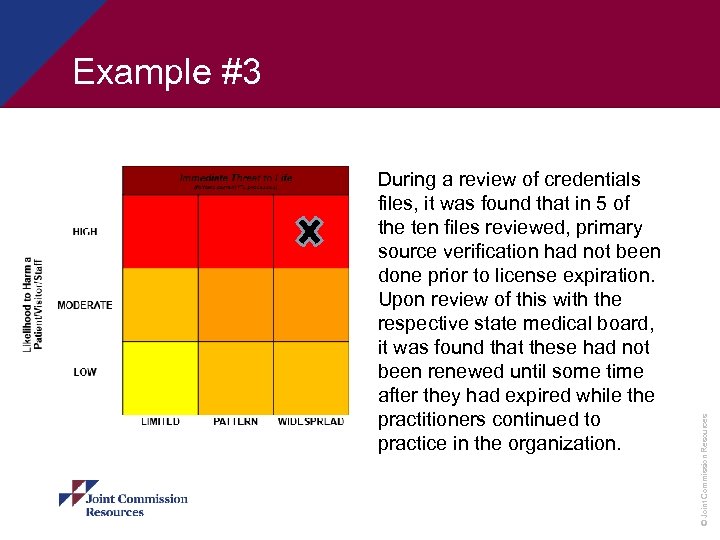 During a review of credentials files, it was found that in 5 of the ten files reviewed, primary source verification had not been done prior to license expiration. Upon review of this with the respective state medical board, it was found that these had not been renewed until some time after they had expired while the practitioners continued to practice in the organization. © Joint Commission Resources Example #3
 Post-Survey: © Joint Commission Resources Report, Clarifications
 Follow-up Actions © Joint Commission Resources § Follow-up customized and prioritized according to placement within SAFER Matrix
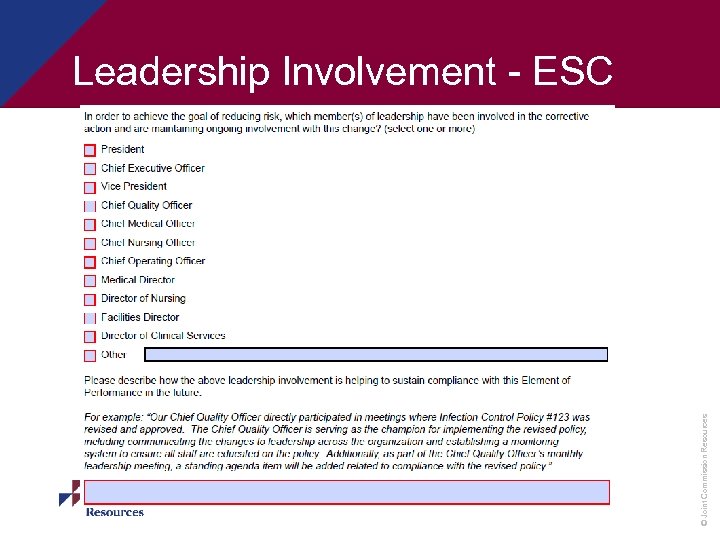
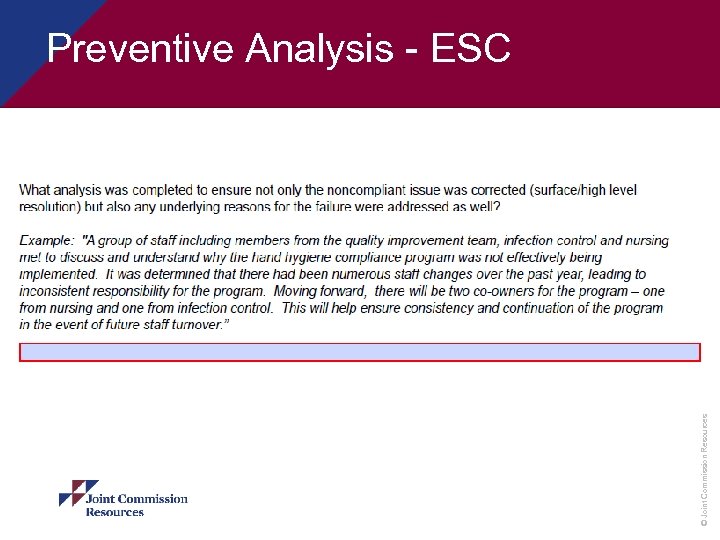
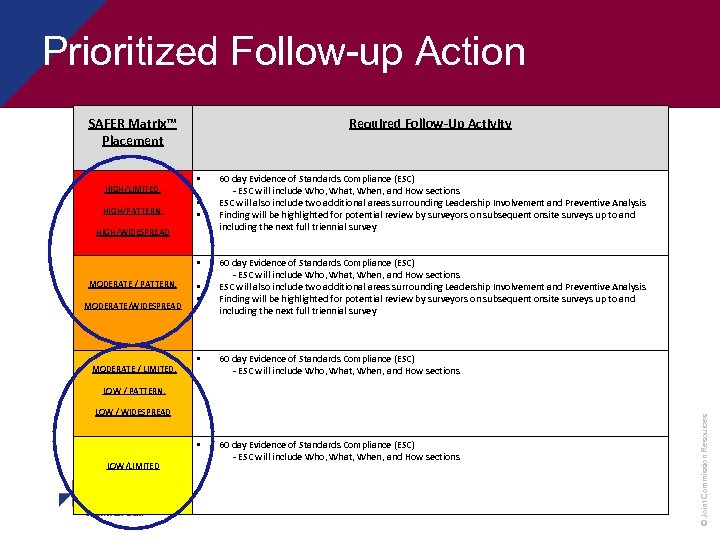 Prioritized Follow-up Action SAFER Matrix™ Placement HIGH/LIMITED, HIGH/PATTERN, HIGH/WIDESPREAD MODERATE / PATTERN, MODERATE/WIDESPREAD MODERATE / LIMITED, Required Follow-Up Activity • 60 day Evidence of Standards Compliance (ESC) - ESC will include Who, What, When, and How sections • ESC will also include two additional areas surrounding Leadership Involvement and Preventive Analysis • Finding will be highlighted for potential review by surveyors on subsequent onsite surveys up to and including the next full triennial survey • 60 day Evidence of Standards Compliance (ESC) - ESC will include Who, What, When, and How sections LOW / WIDESPREAD LOW/LIMITED • 60 day Evidence of Standards Compliance (ESC) - ESC will include Who, What, When, and How sections © Joint Commission Resources LOW / PATTERN,
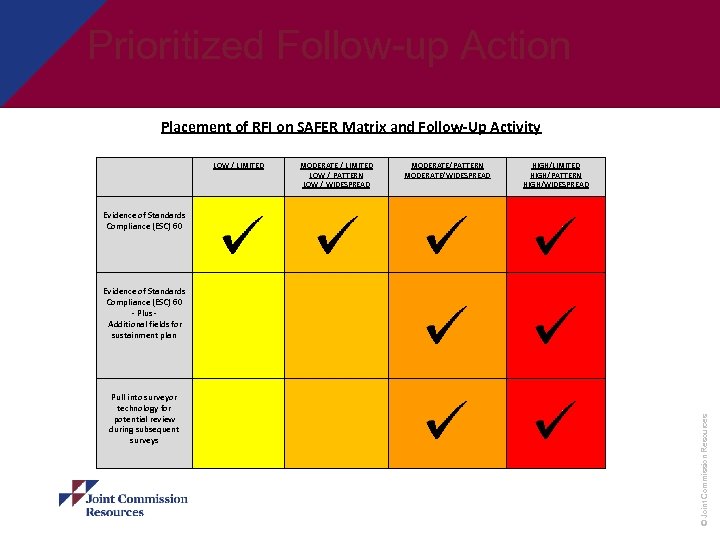 Prioritized Follow-up Action Placement of RFI on SAFER Matrix and Follow-Up Activity LOW / LIMITED MODERATE / LIMITED LOW / PATTERN LOW / WIDESPREAD MODERATE/PATTERN MODERATE/WIDESPREAD HIGH/LIMITED HIGH/PATTERN HIGH/WIDESPREAD Evidence of Standards Compliance (ESC) 60 Pull into surveyor technology for potential review during subsequent surveys © Joint Commission Resources Evidence of Standards Compliance (ESC) 60 - Plus - Additional fields for sustainment plan
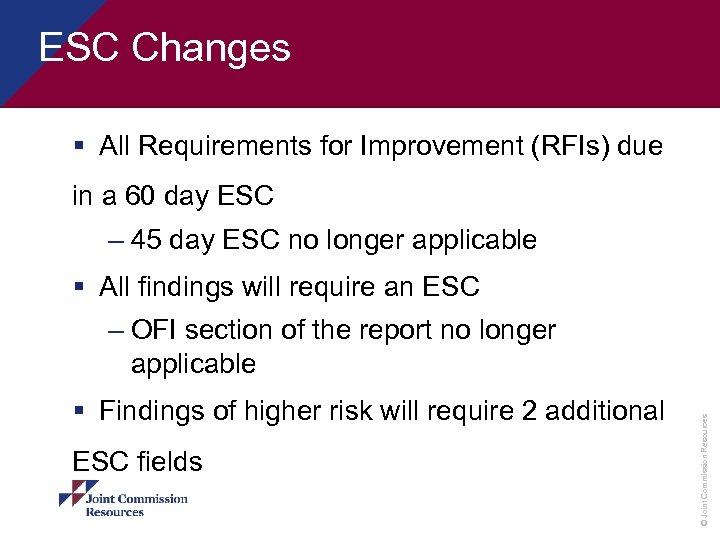 ESC Changes § All Requirements for Improvement (RFIs) due in a 60 day ESC – 45 day ESC no longer applicable § All findings will require an ESC § Findings of higher risk will require 2 additional ESC fields © Joint Commission Resources – OFI section of the report no longer applicable
 © Joint Commission Resources Leadership Involvement - ESC
 © Joint Commission Resources Preventive Analysis - ESC
 Changes to Clarification Process § Still have 10 business days after survey ends for this process. – Required Documents as listed in the “Checklist of Required Documents” on the home page of your extranet – Clerical Errors as a reason to remove a finding – Need for an audit process…No “c” elements of performance © Joint Commission Resources § NOT Accepted During Clarification Process:
 © Joint Commission Resources TJC and CMS
 TJC and CMS § Continue to become more closely aligned following most recent granting of deeming authority in 2015 § CMS Co. Ps (Conditions of Participation) and TJC Standards do not have a one to one relationship § A Co. P can have multiple standards associated with it § A Standard/EP can have more than one Co. P § Scoring depends on the context and circumstances of the finding © Joint Commission Resources associated with it
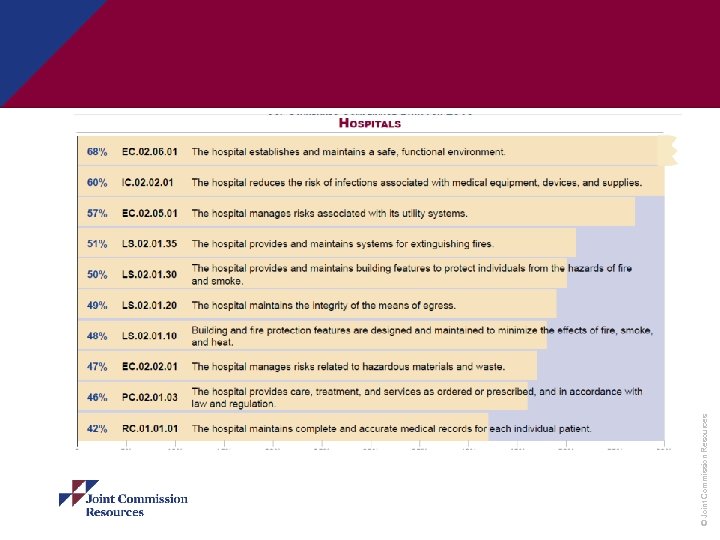
 © Joint Commission Resources Top Scored Standards
 © Joint Commission Resources
 MS. 01. 01 § “The Bylaws Standard” § EP 3: Most commonly scored EP, must be scored if one of EPs 12 -37 is scored © Joint Commission Resources
 § Every requirement set forth in MS. 01. 01, Elements of Performance (EPs) 12– 37, is in the medical staff bylaws. These requirements may have associated details, some of which may be extensive; such details may reside in the medical staff bylaws, rules and regulations, or policies. The organized medical staff adopts what constitutes the associated details, where they reside, and whether their adoption can be delegated. Adoption of associated details that reside in medical staff bylaws cannot be delegated. For those EPs 12– 37 that require a process, the medical staff bylaws include, at a minimum, the basic steps required for implementation of the requirement, as determined by the organized medical staff and approved by the governing body. © Joint Commission Resources MS. 01. 01 EP 3
 MS. 01. 01 EP 16 © Joint Commission Resources § EP 16 : The requirements for completing and documenting medical histories and physical examinations. The medical history and physical examination are completed and documented by a physician, an oralmaxillofacial surgeon, or other qualified licensed individual in accordance with state law and hospital policy.
 MS. 01. 01 EP 16 H & P (482. 22 (c)(5)(i)) Update (482. 22 (c)(5)(ii)) © Joint Commission Resources EP 16: Note 2: The requirements referred to in this element of performance are, at a minimum, those described in the element of performance and Standard PC. 01. 02. 03, EPs 4 and 5.
 MS. 01. 01 EP 5 § EP 5: The medical staff complies with the medical staff bylaws, rules, and regulations (482. 22 (a)(1) (482. 22 (c) © Joint Commission Resources § If deficiencies are present in histories, physicals or updates…it will be scored here
 © Joint Commission Resources Recent Changes to MS. 01. 01
 MS. 01. 01 EP 13 § The medical staff bylaws include the following requirements, in accordance with Element of Performance 3: Qualifications for appointment to the medical staff. Note: For hospitals that use Joint Commission accreditation for deemed status purposes: The medical staff must be composed of doctors of medicine or osteopathy. In accordance with state law, including scope of practice laws, the medical staff may also include other categories of physicians as listed at 482. 12(c)(1) and nonphysician practitioners who are determined to be eligible for appointment by the governing body. § (482. 22 (a)) © Joint Commission Resources §
 § MS. 01. 01 EP 37 § For hospitals that use Joint Commission accreditation for deemed status purposes: When a multihospital system has a unified and integrated medical staff, the bylaws describe the process by which medical staff members at each separately accredited hospital (that is, all medical staff members who hold privileges to practice at that specific hospital) are advised of their right to opt out of the unified and integrated medical staff structure after a majority vote by the members to maintain a separate and distinct medical staff for their respective hospital. (482. 22 (b)(4)) © Joint Commission Resources MS. 01. 01 EP 37
 MS. 01. 05 EP 1 -4 § MS. 01. 05 EP 1 -4 contain the details of what is required in multihospital systems and all begin § “If a multihospital system with separately accredited hospitals chooses to establish a unified and integrated medical staff, the following occurs: ” © Joint Commission Resources with the same language as a reminder:
 Tips for Success © Joint Commission Resources § Take a copy of the bylaws and the standard EPs 12 -37 and tab where each of the EP’s is located § If the details of any of EPs 12 -37 are in other areas such as the rules, regs, or policies, keep these handy and updated. § Keep these updated every time bylaws, etc. , are revised
 MS. 08. 01. 03 Ongoing Professional Practice Evaluation © Joint Commission Resources (482. 22 (a)(1))
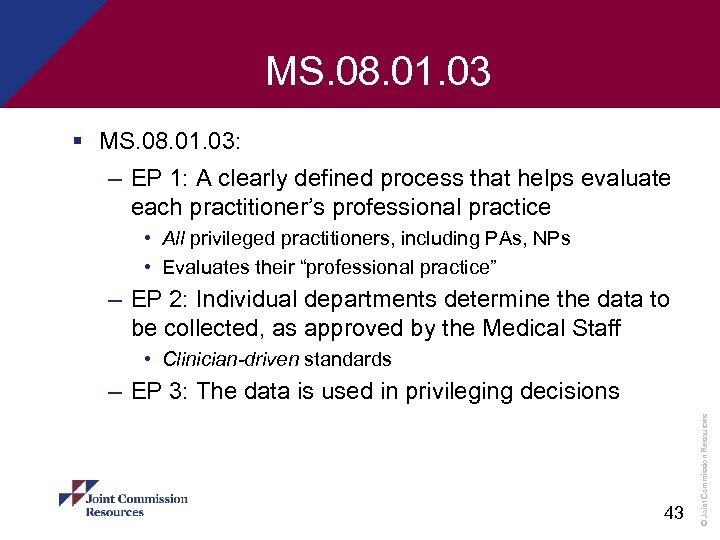 MS. 08. 01. 03 § MS. 08. 01. 03: – EP 1: A clearly defined process that helps evaluate each practitioner’s professional practice • All privileged practitioners, including PAs, NPs • Evaluates their “professional practice” – EP 2: Individual departments determine the data to be collected, as approved by the Medical Staff • Clinician-driven standards 43 © Joint Commission Resources – EP 3: The data is used in privileging decisions
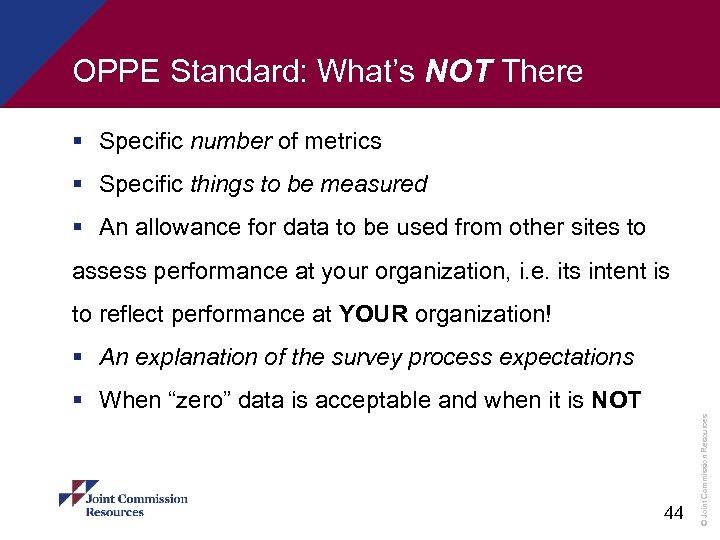 OPPE Standard: What’s NOT There § Specific number of metrics § Specific things to be measured § An allowance for data to be used from other sites to assess performance at your organization, i. e. its intent is to reflect performance at YOUR organization! § An explanation of the survey process expectations 44 © Joint Commission Resources § When “zero” data is acceptable and when it is NOT
 In other words… § Who? § When? § What? 45 © Joint Commission Resources § How?
 Who, When… § WHO • Who will be responsible for reviewing data – Department chair, credentials committee, the MEC, or a special committee – Review must be medical staff driven process; not clerical function • How often the data will be reviewed – Frequency defined by the organizations medical staff such as every three to nine months (twelve months is periodic rather than ongoing) © Joint Commission Resources • WHEN
 What… § WHAT – Defined by individual medical staff departments and approved by the organized medical staff – Departments will know best what type of data will reflect both good and problem performance for the various practitioners in their departments – Data not just negative/outlier/trending data, but also data on good performance © Joint Commission Resources • This can be as department specific as warranted by the organization’s service lines
 48 © Joint Commission Resources I must be forgetting something….
 § Oh, that’s right… 49 © Joint Commission Resources HOW?
 So, OPPE Should Be… § Ongoing (vs. “periodic”) information… § …able to help make privileging decisions… § …for all privileged providers It’s an ongoing assessment of clinical competency – similar to what most of the rest of the healthcare team 50 © Joint Commission Resources have been doing for decades
 “ Ongoing” (cont. ) § Examples of effective “ongoing” assessments: 51 © Joint Commission Resources – Promptly assessing all post-op infections against a set of indicators (rather than simply aggregating a year’s worth of post-op infections to look for trends) – Collecting data on response time for pages in ER, ICU, etc – Compliance with measures already being collected, i. e. required data sets from TJC, CMS, DOH, etc.
 “Ongoing” (con’t) HOWEVER, § Don’t make the mistake of including every piece of data that is currently being gathered in OPPE. This will dilute the value of the process to the physicians…they need to see the value. So guide department chairs to should lead to an improvement in care 52 © Joint Commission Resources guide their members to choose the data to track that
 “…able to help make privileging decisions…” § Ideally, measures will be based on “SMART” goals: Specific Measurable Attainable Relevant Turn-Around in Care 53 © Joint Commission Resources – – –
 “…for all privileged providers” § Measures will vary by specialty, clinical setting, and aspect to be assessed; must be consistent for all providers holding a privilege § So, it is important to remember…if an employed practitioner (whose practice is a part of the survey) holds the privilege for which metrics are being used in OPPE, by the same metric(s) 54 © Joint Commission Resources then an independent practitioner must also be evaluated
 “…for all privileged providers” § So, now, look at the metrics being followed for OPPE. For example, items you may be able to track for all ambulatory practitioners may be: 55 © Joint Commission Resources – Acceptance of recommendations from radiologists when test appropriateness is questioned – Response time for critical test results/values – Communication with hospitalists regarding patient care
 “…for all privileged providers” § In other words, don’t say you are tracking Hgb. A 1 C levels or performance of heart failure education if this data is not available on all LIPs with the same privileges § You may still track any and all of these items for your OPPE. 56 © Joint Commission Resources employed physicians, but they don’t have to be a part of
 “…for all privleged providers” § Remember, you are assessing the ability to perform a privilege, not their choice of employment status. § It is not OK to say to a surveyor, “We can only get the information on our employed doctors” § If this is the issue, then review the medical staff – For example: Do you have a “refer and follow” category with no clinical privileges? 57 © Joint Commission Resources categories and their associated privileges
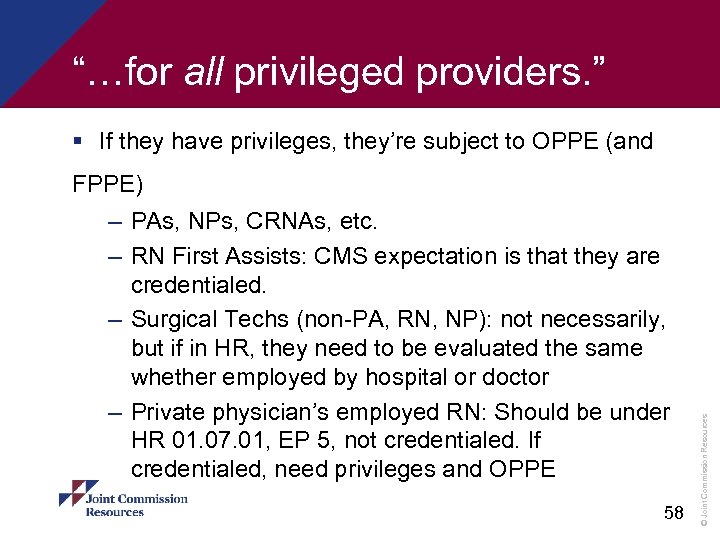 “…for all privileged providers. ” § If they have privileges, they’re subject to OPPE (and – PAs, NPs, CRNAs, etc. – RN First Assists: CMS expectation is that they are credentialed. – Surgical Techs (non-PA, RN, NP): not necessarily, but if in HR, they need to be evaluated the same whether employed by hospital or doctor – Private physician’s employed RN: Should be under HR 01. 07. 01, EP 5, not credentialed. If credentialed, need privileges and OPPE 58 © Joint Commission Resources FPPE)
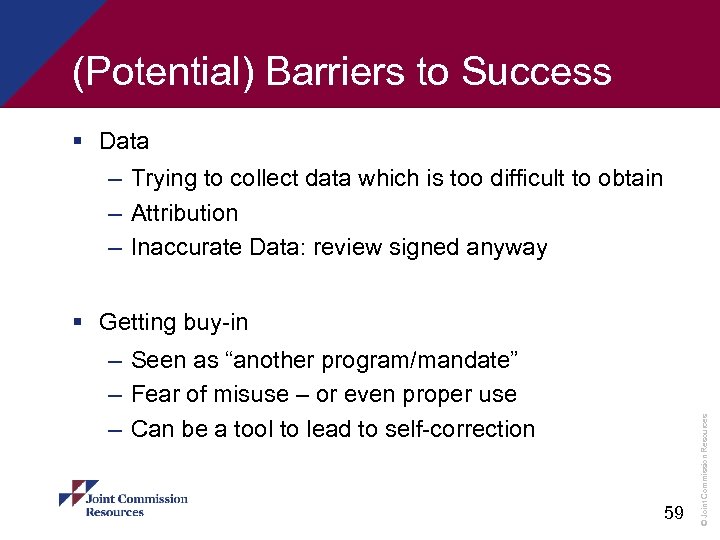 (Potential) Barriers to Success § Data – Trying to collect data which is too difficult to obtain – Attribution – Inaccurate Data: review signed anyway – Seen as “another program/mandate” – Fear of misuse – or even proper use – Can be a tool to lead to self-correction 59 © Joint Commission Resources § Getting buy-in
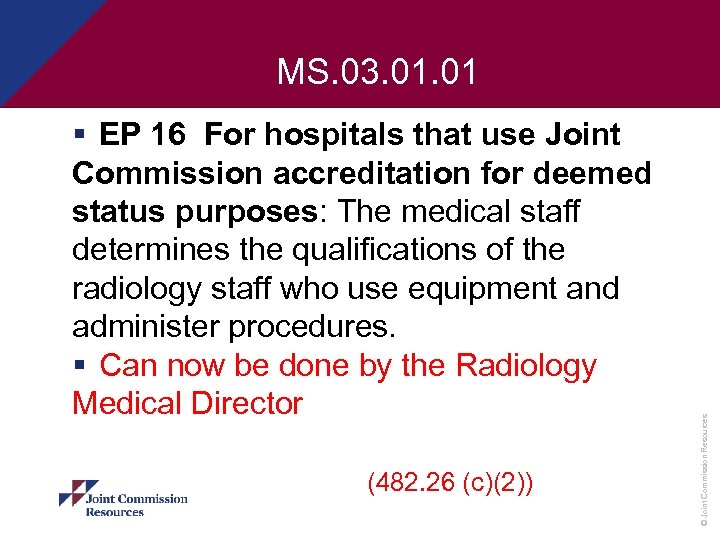 § EP 16 For hospitals that use Joint Commission accreditation for deemed status purposes: The medical staff determines the qualifications of the radiology staff who use equipment and administer procedures. § Can now be done by the Radiology Medical Director (482. 26 (c)(2)) © Joint Commission Resources MS. 03. 01
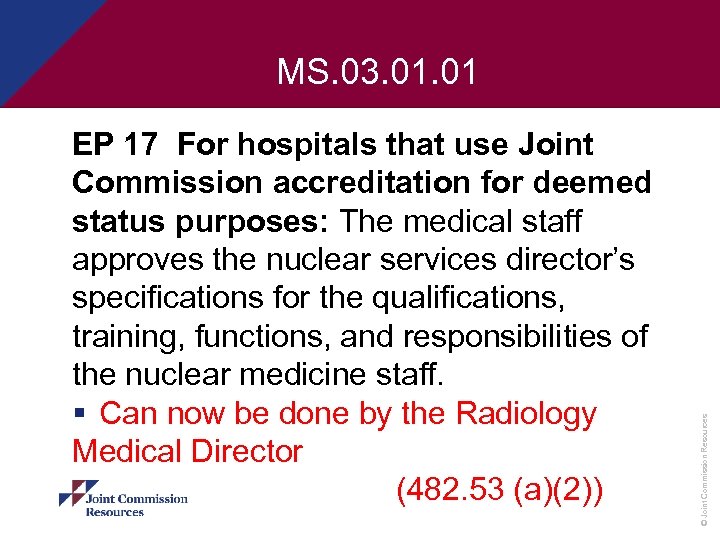 EP 17 For hospitals that use Joint Commission accreditation for deemed status purposes: The medical staff approves the nuclear services director’s specifications for the qualifications, training, functions, and responsibilities of the nuclear medicine staff. § Can now be done by the Radiology Medical Director (482. 53 (a)(2)) © Joint Commission Resources MS. 03. 01
 MS. 03. 01 § This standard often scored if deficiencies are seen in histories and physicals which are scored at MS. 01. 01, EP 5, if no process is in place to monitor © Joint Commission Resources § EP 7 The organized medical staff monitors the quality of the medical histories and physical examinations.
 MS. 03. 01 (482. 52 (a)(3)) (482. 12 (c)(2)) (482. 12 (a)(1))… © Joint Commission Resources § EP 2 Practitioners practice only within the scope of their privileges as determined through mechanisms defined by the organized medical staff.
 Tips for Success © Joint Commission Resources § Encourage medical staffs to develop audit tool for H and P’s and review these regularly and track data and actions taken § Check applications carefully for possible omissions or oversights
 MS. 08. 01 Focused Professional Practice Evaluation © Joint Commission Resources (482. 22 (a)(1))
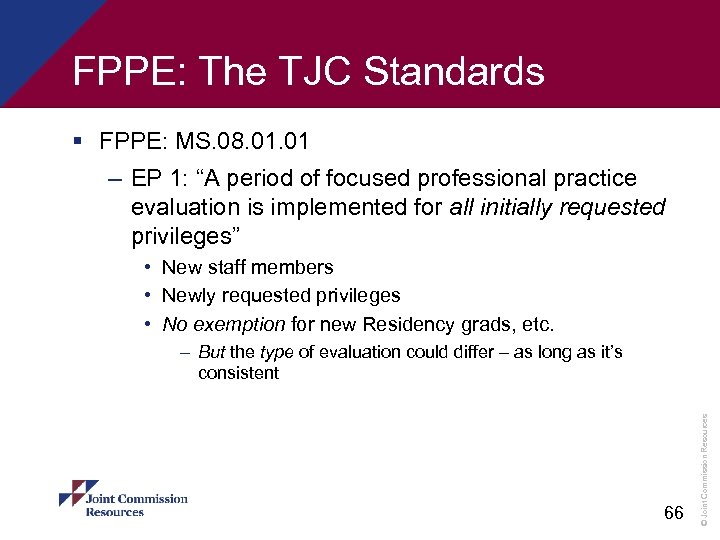 FPPE: The TJC Standards § FPPE: MS. 08. 01 – EP 1: “A period of focused professional practice evaluation is implemented for all initially requested privileges” • New staff members • Newly requested privileges • No exemption for new Residency grads, etc. 66 © Joint Commission Resources – But the type of evaluation could differ – as long as it’s consistent
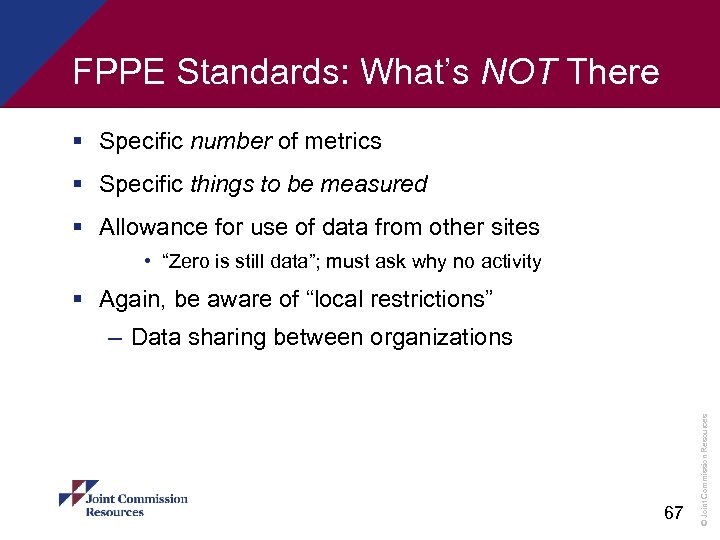 FPPE Standards: What’s NOT There § Specific number of metrics § Specific things to be measured § Allowance for use of data from other sites • “Zero is still data”; must ask why no activity § Again, be aware of “local restrictions” 67 © Joint Commission Resources – Data sharing between organizations
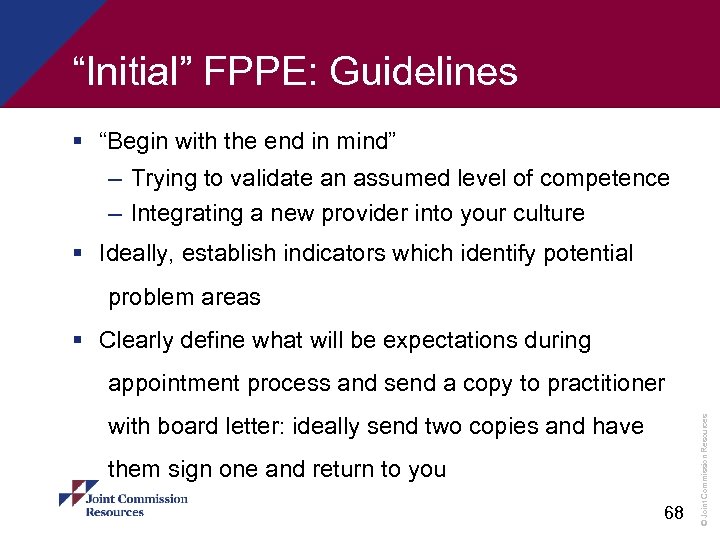 “Initial” FPPE: Guidelines § “Begin with the end in mind” – Trying to validate an assumed level of competence – Integrating a new provider into your culture § Ideally, establish indicators which identify potential problem areas § Clearly define what will be expectations during with board letter: ideally send two copies and have them sign one and return to you 68 © Joint Commission Resources appointment process and send a copy to practitioner
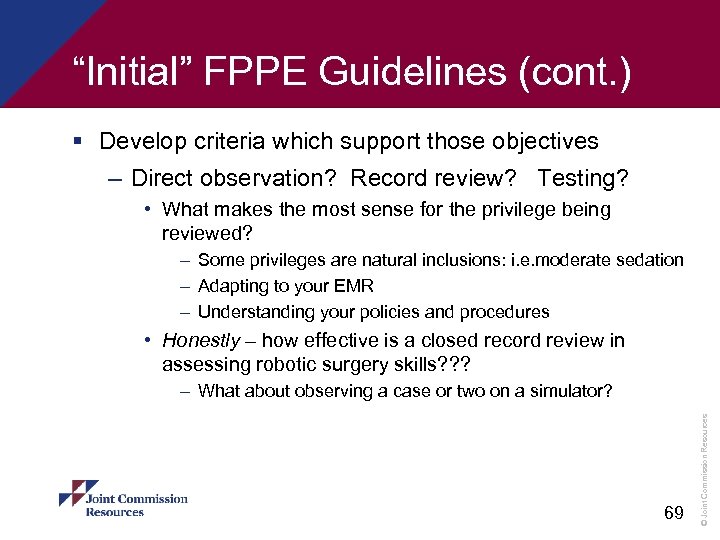 “Initial” FPPE Guidelines (cont. ) § Develop criteria which support those objectives – Direct observation? Record review? Testing? • What makes the most sense for the privilege being reviewed? – Some privileges are natural inclusions: i. e. moderate sedation – Adapting to your EMR – Understanding your policies and procedures • Honestly – how effective is a closed record review in assessing robotic surgery skills? ? ? 69 © Joint Commission Resources – What about observing a case or two on a simulator?
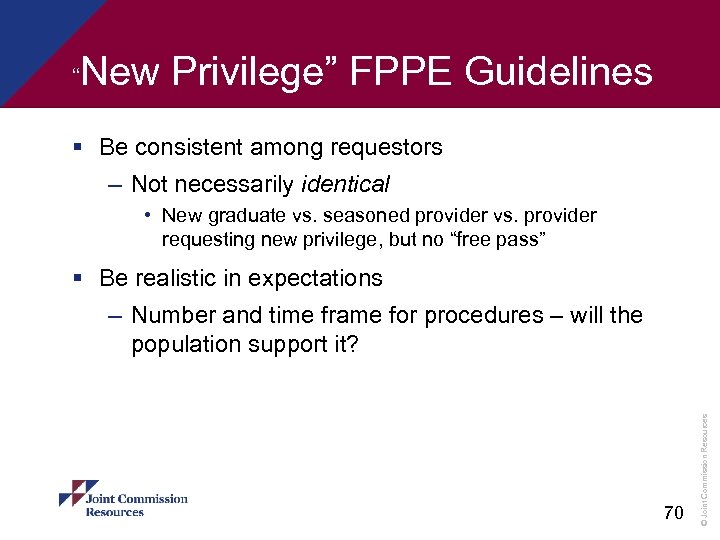 “ New Privilege” FPPE Guidelines § Be consistent among requestors – Not necessarily identical • New graduate vs. seasoned provider vs. provider requesting new privilege, but no “free pass” § Be realistic in expectations 70 © Joint Commission Resources – Number and time frame for procedures – will the population support it?
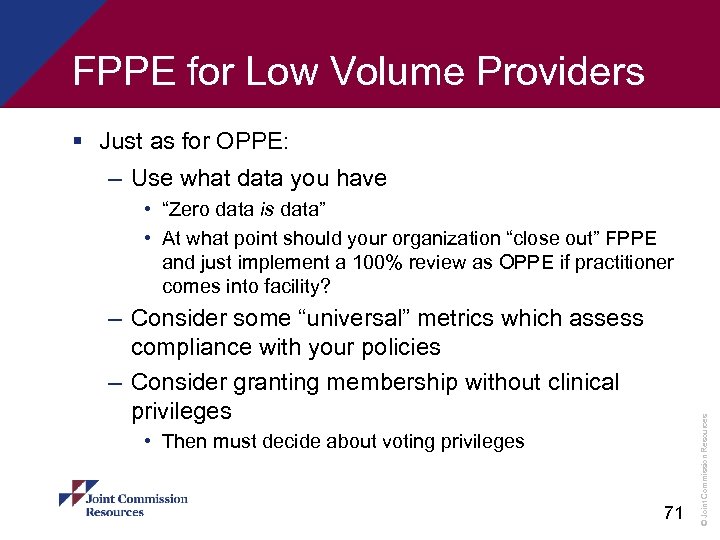 FPPE for Low Volume Providers § Just as for OPPE: – Use what data you have – Consider some “universal” metrics which assess compliance with your policies – Consider granting membership without clinical privileges • Then must decide about voting privileges 71 © Joint Commission Resources • “Zero data is data” • At what point should your organization “close out” FPPE and just implement a 100% review as OPPE if practitioner comes into facility?
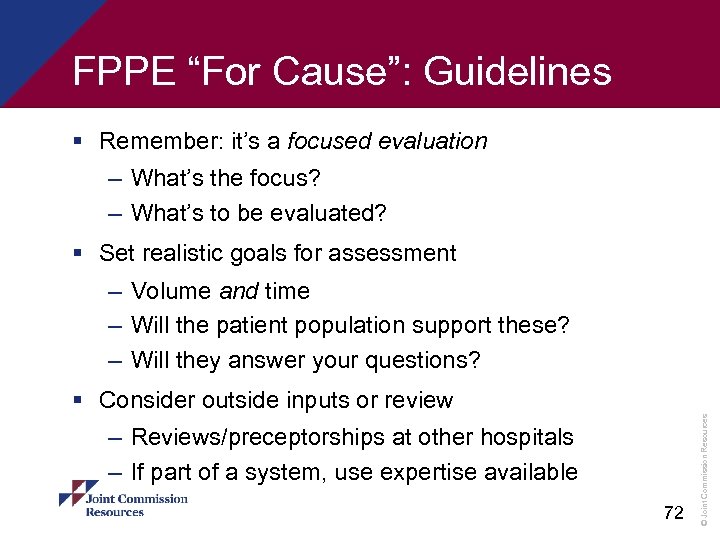 FPPE “For Cause”: Guidelines § Remember: it’s a focused evaluation – What’s the focus? – What’s to be evaluated? § Set realistic goals for assessment – Volume and time – Will the patient population support these? – Will they answer your questions? – Reviews/preceptorships at other hospitals – If part of a system, use expertise available 72 © Joint Commission Resources § Consider outside inputs or review
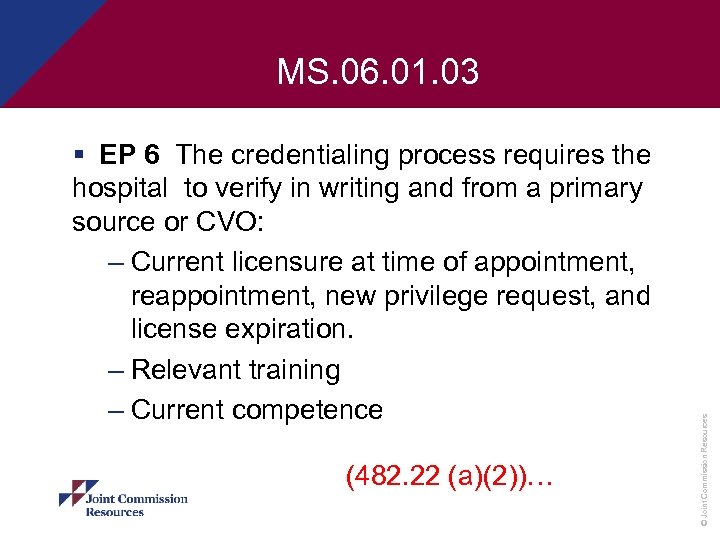 § EP 6 The credentialing process requires the hospital to verify in writing and from a primary source or CVO: – Current licensure at time of appointment, reappointment, new privilege request, and license expiration. – Relevant training – Current competence (482. 22 (a)(2))… © Joint Commission Resources MS. 06. 01. 03
 § EP 5 The hospital verifies that the practitioner requesting approval is the same practitioner identified in the credentialing documents by viewing one of the following: – Current picture hospital ID – A valid government issued photo ID © Joint Commission Resources MS. 06. 01. 03
 § Spreadsheet and reminders for license or other certification renewals § Process of going up the chain of command § Make sure there is verification of current competence in some way: provide privileges to those who are completing references © Joint Commission Resources Tips for Success
 MS. 05. 01. 03 § EP 3 The organized medical staff participates in the following activity: Accurate, timely, and legible completion of patient’s medical records. (482. 24(c)(1))… © Joint Commission Resources – How is the medical staff informed of issues, what is the process for outliers? – In EHR: may be how scribes are used or if an excessive number of telephone orders?
 § EP 2 The hospital, with the approval of the medical staff and board, develops criteria that include: – Current license and/or certification – Documented training – Physically able to perform privilege – Data from org. where currently performing privilege – Peer/faculty recommendation – When renewing, check current performance © Joint Commission Resources MS. 06. 01. 05
 MS. 06. 01. 05 (482. 22 (a)(1)) (482. 54 (c)(4)(i) © Joint Commission Resources § EP 3 All of the criteria used are consistently evaluated for all practitioners holding that privilege
 MS. 06. 01. 05 (482. 22 (a)(1)) (482. 12 (a)(6)) © Joint Commission Resources § EP 7 National Practitioner Data Bank query at appointment, reappointment, and if requesting a new privilege. § Continuous query demonstrates compliance
 MS. 06. 01. 05 § EP 10 The hospital has a process to determine whethere is sufficient clinical performance information to make a decision to grant, limit, or deny the requested privilege. © Joint Commission Resources (482. 22 (a)(1))
 § Develop solid criteria and use it as a checklist during the credentialing process. § At the time of reappointment, ensure that you have documentation of the performance of a privilege § Pre-populate the privilege forms with the number of times each privilege has been done and outcomes © Joint Commission Resources Tips for Success
 MS. 06. 01 © Joint Commission Resources § EP 1 There is a process to determine whether sufficient space, equipment, staffing, and financial resources are in place or available within a specified time frame to support each requested privilege
 Tips for Success © Joint Commission Resources § Review privilege lists regularly with medical staff § Keep open lines of communication with directors of departments to get updates if services change
 Non-MS Important Standards for © Joint Commission Resources the Medical Staff
 § EP 1… Note: Outpatient services may be ordered by a practitioner not appointed to the medical staff as long as he or she meets the following: - Responsible for the care of the patient - Licensed in the state where he or she provides care to the patient - Acting within his or her scope of practice under state law - Authorized in accordance with state law and policies adopted by the medical staff and approved by the governing body to order the applicable outpatient services © Joint Commission Resources PC. 02. 01. 03
 Emergency Management © Joint Commission Resources § EM 02. 13 EP 2 The medical staff identifies, in its bylaws, those individuals responsible for granting disaster privileges to volunteer licensed independent practitioners.
 Emergency Management © Joint Commission Resources § EM 02. 13 EP 3 The hospital determines how it will distinguish volunteer licensed independent practitioners from other licensed independent practitioners. (Usually in the Emergency Operations Plan)
 Emergency Management © Joint Commission Resources § EM 02. 13 EP 4 The medical staff describes, in writing, how it will oversee the performance of volunteer licensed independent practitioners who are granted disaster privileges (for example, by direct observation, mentoring, medical record review).
 Emergency Management © Joint Commission Resources § EM 02. 13 EP 5 Before a volunteer practitioner is considered eligible to function as a volunteer licensed independent practitioner, the hospital obtains his or her valid governmentissued photo identification (for example, a driver’s license or passport) AND at least one of the following:
 § A current picture identification card from a health care organization that clearly identifies professional designation § Primary source verification of licensure § Identification indicating that the individual is a member of a Disaster Medical Assistance Team (DMAT), the Medical Reserve Corps (MRC), the Emergency. System for Advance Registration of Volunteer Health Professionals(ESAR-VHP), or other recognized state or federal response organization or group § Identification indicating that the individual has been granted authority by a government entity to provide patient care, treatment, or services in disaster circumstances § Confirmation by a licensed independent practitioner currently privileged by the hospital or by a staff member with personal knowledge of the volunteer practitioner’s ability to act as a licensed independent practitioner during a disaster. § A current license to practice © Joint Commission Resources Emergency Management
 Record of Care (482. 24) (482. 26) © Joint Commission Resources § RC. 01. 02. 01 EP 3 If unable to tell who documented in the medical record: i. e. a history and physical completed in a physician’s office that is clearly written by someone other than the individual who signed it; basically acted as a scribe
 Record of Care (482. 24) © Joint Commission Resources § RC. 01. 01 EP 8 If there are instances of illegibility that cannot be read by staff members, then it will be scored here. This is because the information is not available to the next provider of care.
 Record of Care § RC. 01. 01 EP 11 and EP 19 (482. 24) (482. 53) © Joint Commission Resources – Dating and timing of medical records
 Other CMS Co. Ps and their © Joint Commission Resources Corresponding TJC Standards
 Rights and Ethics Medical staff support patients’ rights to: §Make informed decisions regarding care RI. 01. 02. 01 – Be informed of health status – Be able to request or refuse treatment § Formulate advance directives/have staff comply RI. 01. 05. 01 § Have a family member/representative and physician of (482. 13 (b)(1 -4)) § ( ((482. 13 (b)(1)-(4)) 95 © Joint Commission Resources choice notified promptly of hospital admission RI. 01. 02. 01
 Rights and Ethics Medical staff support patient rights to: § Informed Consent: RI. 01. 03. 01, RI. 01. 03, RI. 01. 03. 05 § Personal privacy RI. 01. 01 § Freedom from: § (482. 13 (b) (1 -4)) 96 © Joint Commission Resources – all forms of abuse/harassment/punishment RI. 01. 06. 03 – restraint or seclusion, of any form, imposed as a means of coercion, discipline, convenience, or retaliation by staff PC. 03. 05. 01
 Autopsies § The medical staff should attempt to secure autopsies in all cases of unusual deaths and of medical-legal and educational interest. MS. 05. 01 EP 17 § The mechanism for documenting permission to perform an autopsy must be defined. RI. 01. 05. 01 EP 21 § There must be a system for notifying the medical staff, autopsy is being performed. MS. 05. 01 EP 17 § 482. 22(d) 97 © Joint Commission Resources and specifically the attending practitioner, when an
 © Joint Commission Resources Anesthesia and Sedation
 Anesthesia and Sedation § PC. 03. 01 Plans sedation: who can do: whether moderate or deep (482. 52) – EP 7: Qualified doctor of medicine or osteopathy directs anesthesia, emergency services, nuclear medicine, and respiratory therapy – EP 9: For hospitals that use Joint Commission accreditation for deemed status purposes: The anesthesia service is responsible for all anesthesia administered in the hospital. • *For TJC purposes: this includes sedation © Joint Commission Resources § LD. 04. 01. 05 (482. 52, 482. 53 (a)(1), 482. 57 (a)(1))
 Moderate vs Deep Sedation § Deep sedation is administered in several areas of the hospital. CMS requires hospitals to stipulate deep sedation administration eligibility criteria for nonanesthesia providers that meet the State and Federal law allows eligible nonanesthesia MDs/DOs, dentists and podiatrists to order, administer and oversee Federal regulation to order and administer deep sedation. 482. 52 and 482. 12 (a)(5) © Joint Commission Resources deep sedation. ARNPs and PAs are not allowed by
 Anesthesia and Sedation § PC. 03. 01. 03 Performs pre-anesthesia assessments, includes immediately prior to procedure (482. 52 (b)(1)) § PC. 03. 01. 05 Monitors patient during procedure (482. 52 (b)(2)) (482. 51 (b)(4)) – Seven Required Elements (482. 52 (b)(3)) © Joint Commission Resources § PC. 03. 01. 07 Post-anesthesia assessment
 Anesthesia and Sedation A post-anesthesia evaluation includes: § Respiratory function, including respiratory rate, airway patency, and oxygen saturation Cardiovascular function, including pulse rate and blood pressure § Mental status § Temperature § Pain § Nausea and vomiting § Post-operative hydration © Joint Commission Resources §
 § Anesthesia providers and anesthesia technicians should be provided education on infection control standards and nationally recognized standards of practice. This is a “hot topic” for CMS and frequently leads to Conditionlevel deficiencies. Areas of focus: hand hygiene in procedural areas, safe injection practices, IV priming, and control of high-alert medications (paralytics), appropriate control and wasting of all medications © Joint Commission Resources Anesthesia Education and Practice
 Medical Staff and Leadership: PI and Quality Survey Expectations © Joint Commission Resources § The two should not be mutually exclusive nor functioning in silos.
 Medical Staff and Leadership: PI and Quality Survey Expectations (482. 62 (b)(2)) © Joint Commission Resources § In order to show compliance with MS 05. 01 the surveyors should be able to discern from meeting minutes and discussion with physicians that there is significant medical staff involvement in performance improvement.
 Medical Staff and Leadership: PI and Quality Survey Expectations (482. 21) © Joint Commission Resources §. From a leadership perspective, the organization’s administration, in partnership with the medical staff, should be able to show an organization-wide patient safety program has been implemented as delineated in LD. 04. 05. This will be assessed through the review of minutes and the leadership session
 PI/IC/LD Chapter The medical staff, along with CEO and DNS, must: § Ensure that the hospital-wide quality assurance program and training programs address problems identified by the infection control officer or officers; and § Be responsible for the implementation of successful (482. 42(b)) 107 © Joint Commission Resources corrective action plans in affected problem areas.
 © Joint Commission Resources
 Link to Leadership Strategies http: //www. jcrinc. com/patient-safety-initiative-hospitalexecutive-and-physician-leadership-strategies/ OR © Joint Commission Resources Available on JCR website
 © Joint Commission Resources Questions?
 Contact Information § lmccourt@jcrinc. com © Joint Commission Resources § Ph: 630 -854 -6881