 Скачать презентацию Lattices Confidentiality BLP Nicolas T Courtois — University
f9fec50e515713d69786a0a930389f2a.ppt
- Количество слайдов: 67



Lattices, Confidentiality, BLP Nicolas T. Courtois - University College London
Comp. Sec COMPGA 01 Roadmap • • Lattices What’s Wrong with DAC? Trojans MAC, Multi-level security Product lattices, Bell La. Padula = BLP model – Chapter 11 • 2 Optional: In 11. 3. - the Multics OS and BLP Nicolas T. Courtois, January 2009
Comp. Sec COMPGA 01 Lattices will be on the exam 3 Nicolas T. Courtois, January 2009
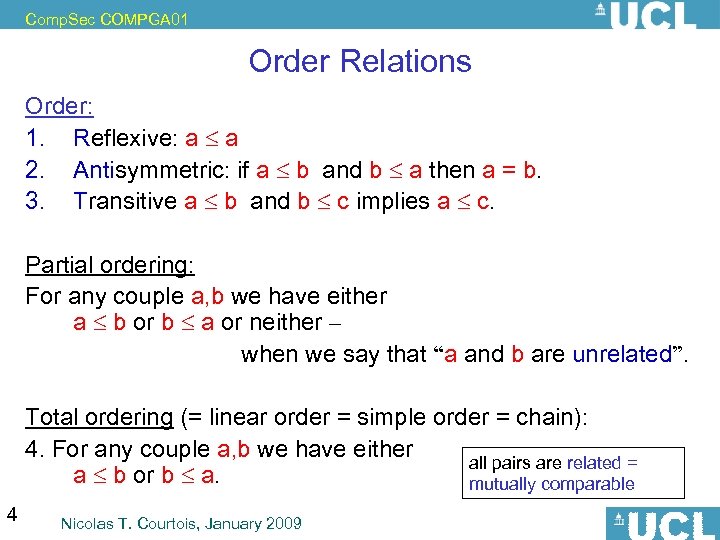
Comp. Sec COMPGA 01 Order Relations Order: 1. Reflexive: a a 2. Antisymmetric: if a b and b a then a = b. 3. Transitive a b and b c implies a c. Partial ordering: For any couple a, b we have either a b or b a or neither – when we say that “a and b are unrelated”. Total ordering (= linear order = simple order = chain): 4. For any couple a, b we have either all pairs are related = a b or b a. mutually comparable 4 Nicolas T. Courtois, January 2009
Comp. Sec COMPGA 01 POSET = Partially Ordered Set A set A and an order relation . Poset is the couple (A, ). 5 Nicolas T. Courtois, January 2009
Comp. Sec COMPGA 01 Bounds Exist for both total and partial orders. Total orders are simple in sense they are “onedimensional”. Like a straight line… Partial orders describe much more complex situations…. 6 Nicolas T. Courtois, January 2009
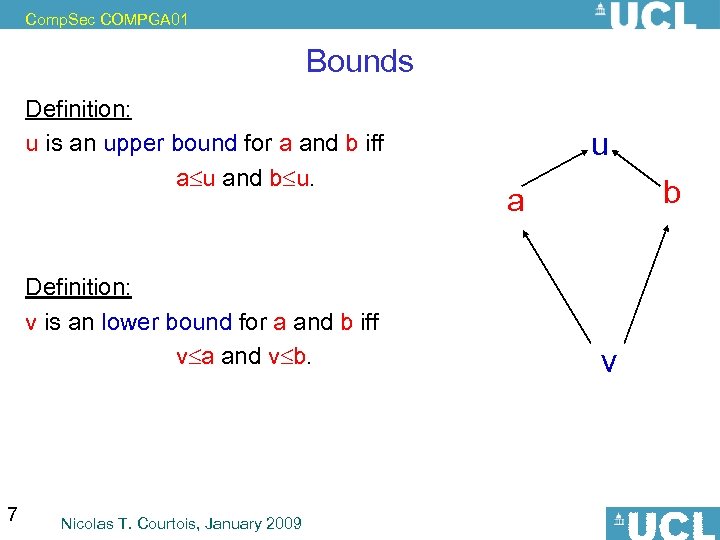
Comp. Sec COMPGA 01 Bounds Definition: u is an upper bound for a and b iff a u and b u. Definition: v is an lower bound for a and b iff v a and v b. 7 Nicolas T. Courtois, January 2009 u b a v
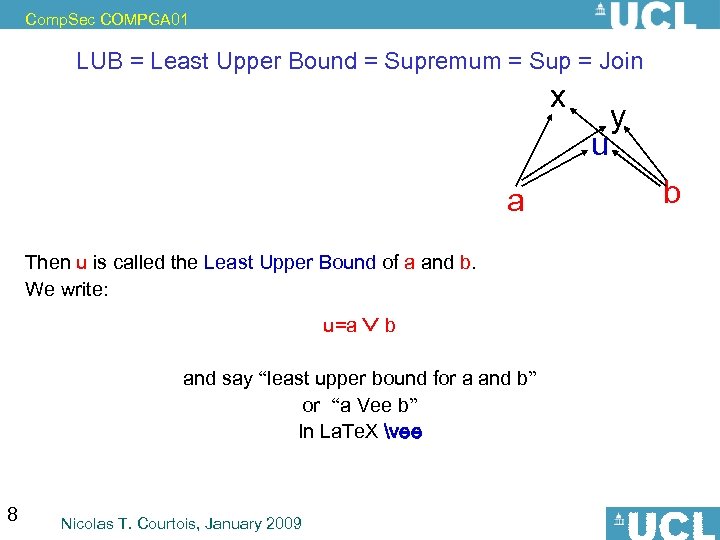
Comp. Sec COMPGA 01 LUB = Least Upper Bound = Supremum = Sup = Join x u a Then u is called the Least Upper Bound of a and b. We write: u=a b and say “least upper bound for a and b” or “a Vee b” In La. Te. X vee 8 Nicolas T. Courtois, January 2009 y b
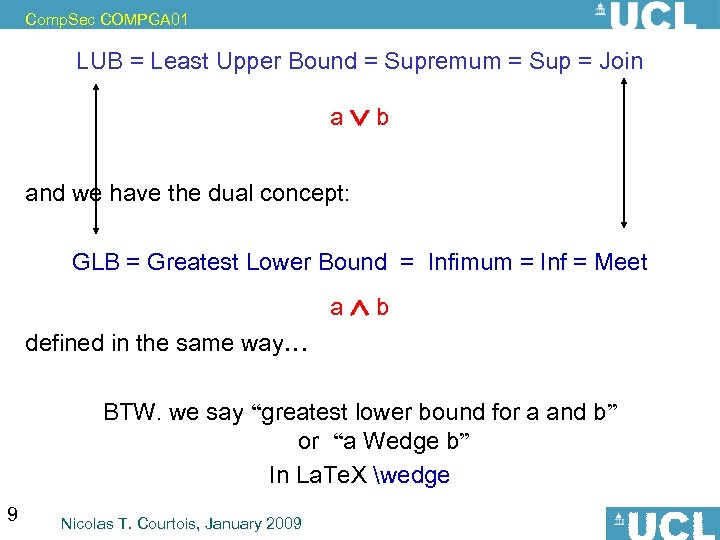
Comp. Sec COMPGA 01 LUB = Least Upper Bound = Supremum = Sup = Join a b and we have the dual concept: GLB = Greatest Lower Bound = Infimum = Inf = Meet a b defined in the same way… BTW. we say “greatest lower bound for a and b” or “a Wedge b” In La. Te. X wedge 9 Nicolas T. Courtois, January 2009
Comp. Sec COMPGA 01 Lattices Definition: An ordered set S, Is called a lattice if: • a, b the LUB a b exists. • a, b the GLB a b exists. Corollary 1: every finite subset has a SUP and an INF. Corollary 2: In every finite lattice we have two special elements called top T and bottom . 10 Nicolas T. Courtois, January 2009
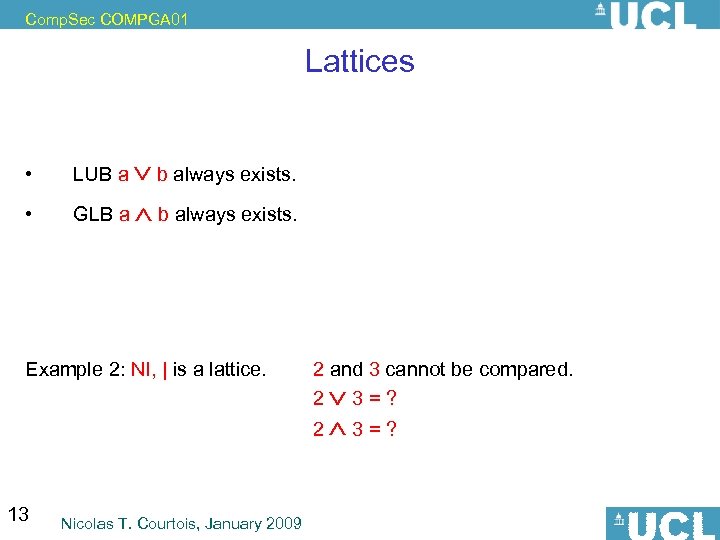
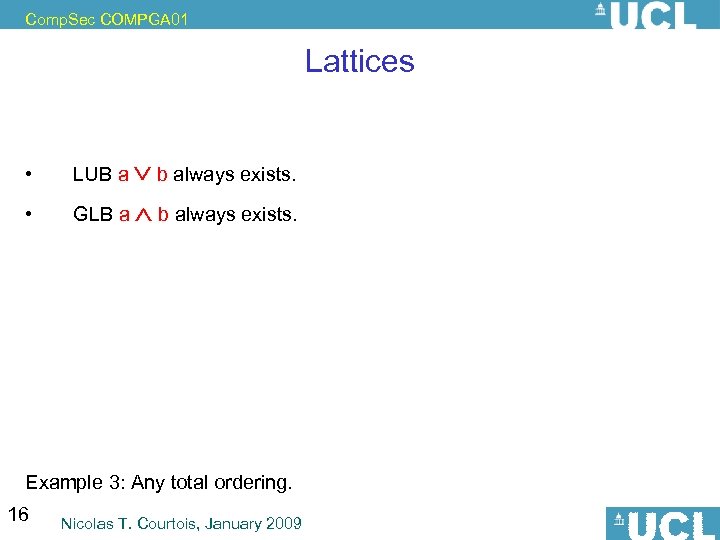
Comp. Sec COMPGA 01 Lattices • LUB a b always exists. • GLB a b always exists. Example 1: For any set P, we call the “Power of P” and denote 2 P the set of all subsets of P. Then 2 P, forms a lattice. Example 2: NI, | is a lattice. 2 and 3 cannot be compared. 2 3=? Example 3: Any total ordering. 11 Nicolas T. Courtois, January 2009
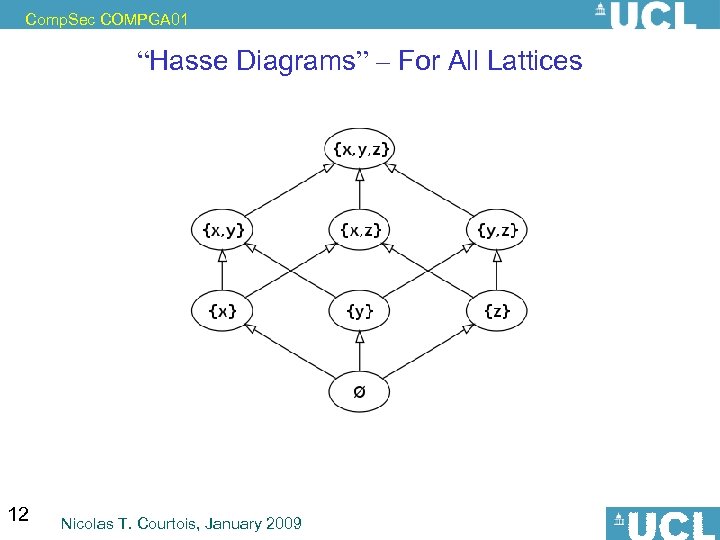
Comp. Sec COMPGA 01 “Hasse Diagrams” – For All Lattices 12 Nicolas T. Courtois, January 2009
Comp. Sec COMPGA 01 Lattices • LUB a b always exists. • GLB a b always exists. Example 1: For any set P, we call the “Power of P” and denote 2 P the set of all subsets of P. Then 2 P, forms a lattice. Example 2: NI, | is a lattice. 2 and 3 cannot be compared. 2 3=? Example 3: Any total ordering. 13 Nicolas T. Courtois, January 2009
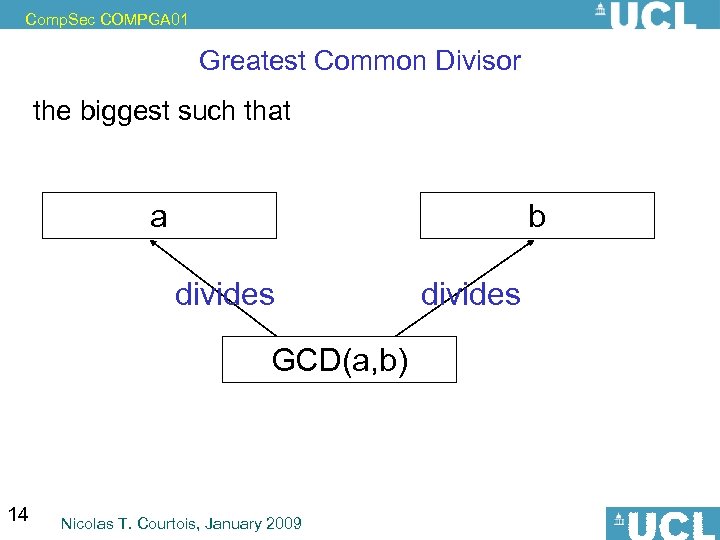
Comp. Sec COMPGA 01 Greatest Common Divisor the biggest such that a b divides GCD(a, b) 14 Nicolas T. Courtois, January 2009 divides
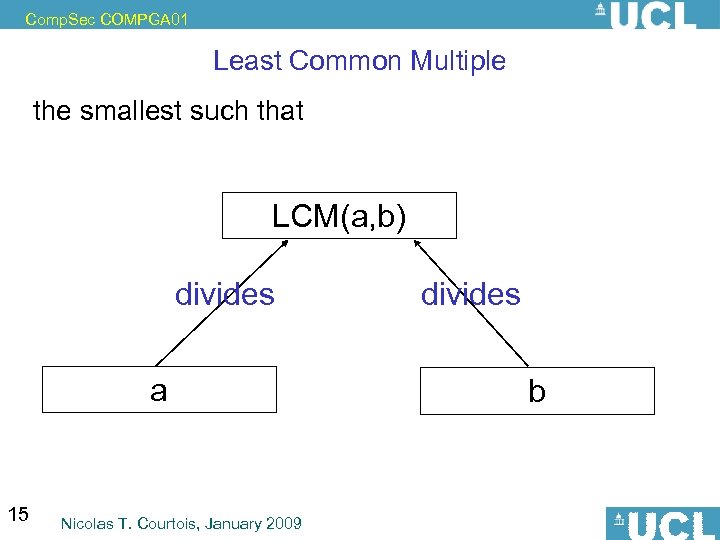
Comp. Sec COMPGA 01 Least Common Multiple the smallest such that LCM(a, b) divides a 15 Nicolas T. Courtois, January 2009 divides b
Comp. Sec COMPGA 01 Lattices • LUB a b always exists. • GLB a b always exists. Example 1: For any set P, we call the “Power of P” and denote 2 P the set of all subsets of P. Then 2 P, forms a lattice. Example 2: NI, | is a lattice. 2 and 3 cannot be compared. 2 3=? Example 3: Any total ordering. 16 Nicolas T. Courtois, January 2009
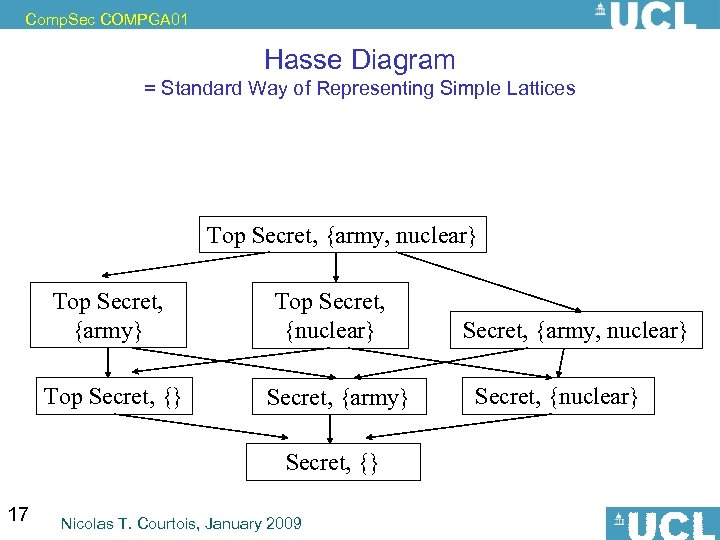
Comp. Sec COMPGA 01 Hasse Diagram = Standard Way of Representing Simple Lattices Top Secret, {army, nuclear} Top Secret, {army} Top Secret, {nuclear} Secret, {army} Secret, {} 17 Nicolas T. Courtois, January 2009 Secret, {army, nuclear} Secret, {nuclear}
Comp. Sec COMPGA 01 What’s Wrong with DAC? 18 Nicolas T. Courtois, January 2009
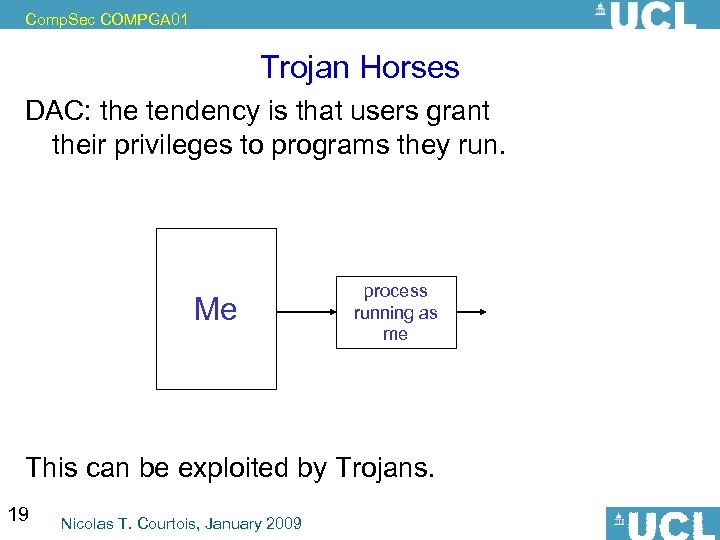
Comp. Sec COMPGA 01 Trojan Horses DAC: the tendency is that users grant their privileges to programs they run. Me process running as me This can be exploited by Trojans. 19 Nicolas T. Courtois, January 2009
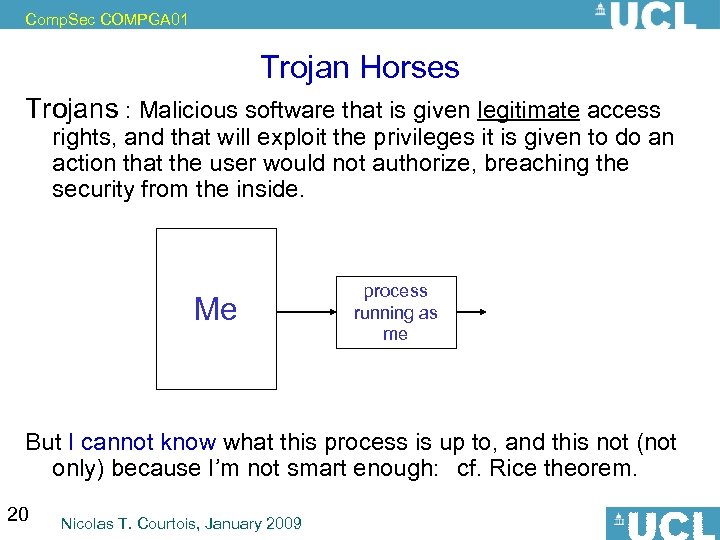
Comp. Sec COMPGA 01 Trojan Horses Trojans : Malicious software that is given legitimate access rights, and that will exploit the privileges it is given to do an action that the user would not authorize, breaching the security from the inside. Me process running as me But I cannot know what this process is up to, and this not (not only) because I’m not smart enough: cf. Rice theorem. 20 Nicolas T. Courtois, January 2009
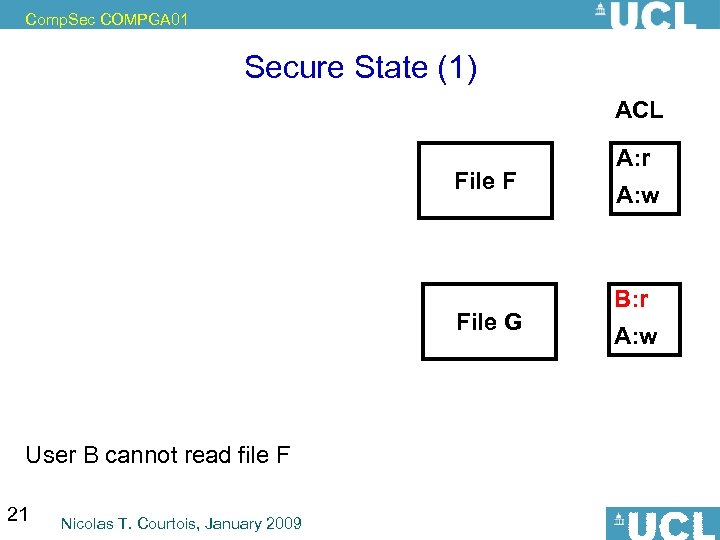
Comp. Sec COMPGA 01 Secure State (1) ACL File F File G User B cannot read file F 21 Nicolas T. Courtois, January 2009 A: r A: w B: r A: w
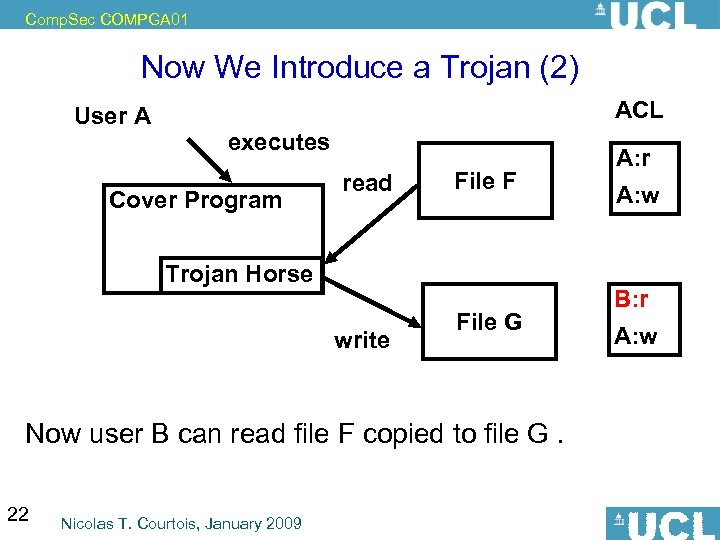
Comp. Sec COMPGA 01 Now We Introduce a Trojan (2) User A ACL executes Cover Program read File F Trojan Horse write File G Now user B can read file F copied to file G. 22 Nicolas T. Courtois, January 2009 A: r A: w B: r A: w
Comp. Sec COMPGA 01 Mandatory Access Control 23 Nicolas T. Courtois, January 2009
Comp. Sec COMPGA 01 Definition Mandatory Access Control restricts the access based on a system-wide policy – Possibly denying users full control over the resources that they created themselves. • the system policy (set by the administrator), not individual choices of participants, determines the access rights 24 Nicolas T. Courtois, January 2009
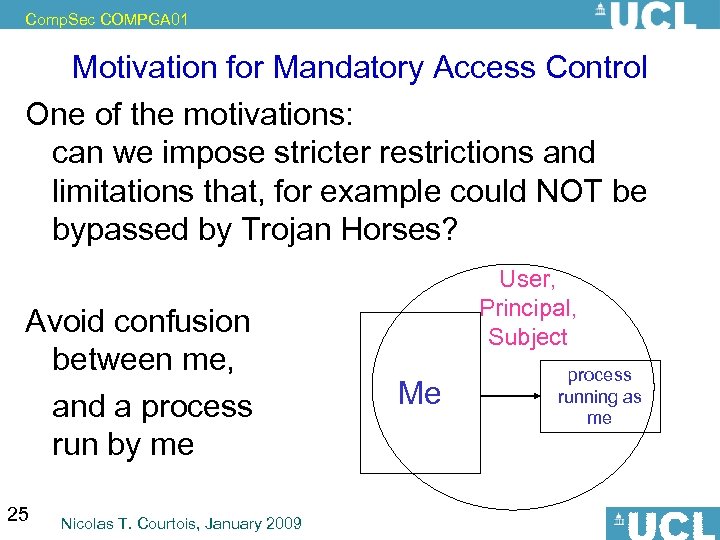
Comp. Sec COMPGA 01 Motivation for Mandatory Access Control One of the motivations: can we impose stricter restrictions and limitations that, for example could NOT be bypassed by Trojan Horses? Avoid confusion between me, and a process run by me 25 Nicolas T. Courtois, January 2009 User, Principal, Subject Me process running as me
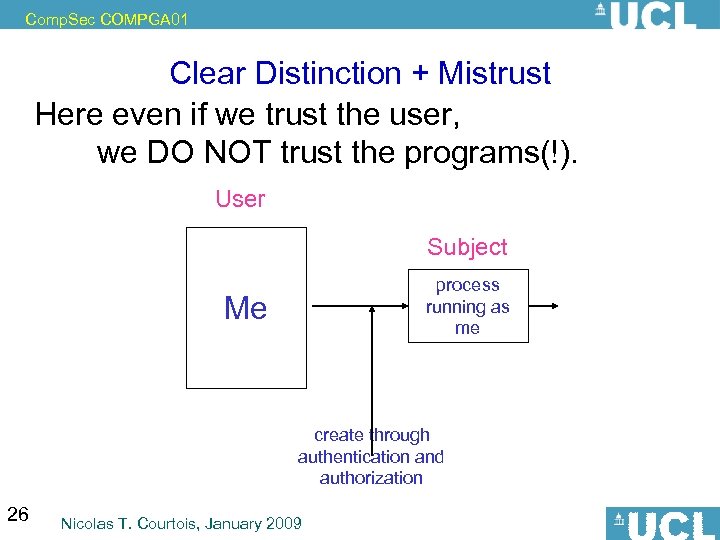
Comp. Sec COMPGA 01 Clear Distinction + Mistrust Here even if we trust the user, we DO NOT trust the programs(!). User Subject process running as me Me create through authentication and authorization 26 Nicolas T. Courtois, January 2009
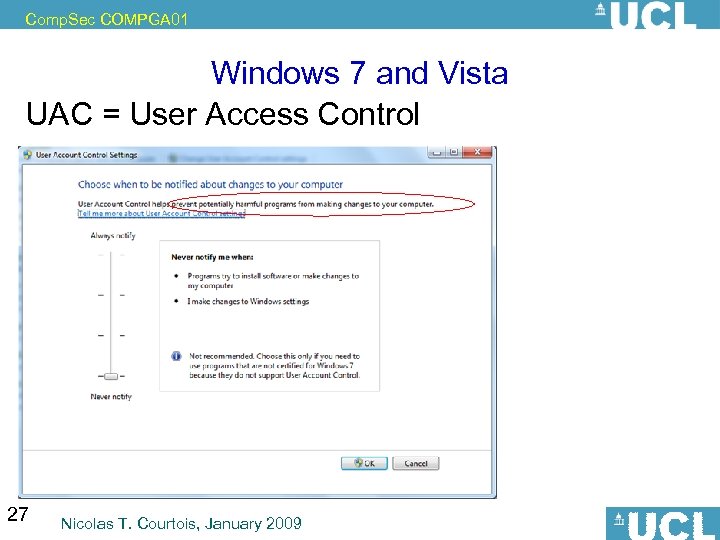
Comp. Sec COMPGA 01 Windows 7 and Vista UAC = User Access Control 27 Nicolas T. Courtois, January 2009
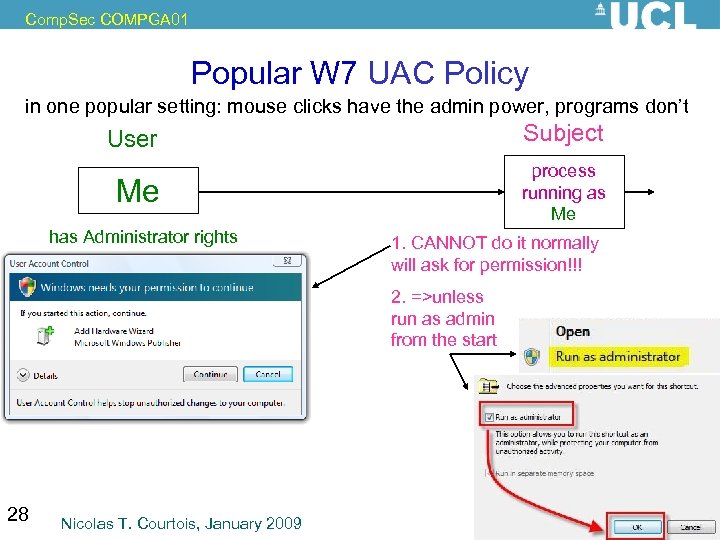
Comp. Sec COMPGA 01 Popular W 7 UAC Policy in one popular setting: mouse clicks have the admin power, programs don’t User Subject Me process running as Me has Administrator rights 1. CANNOT do it normally will ask for permission!!! 2. =>unless run as admin from the start 28 Nicolas T. Courtois, January 2009
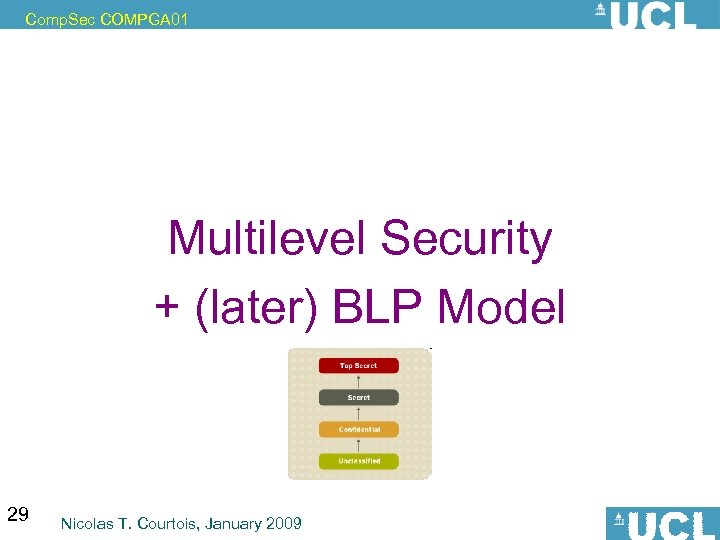
Comp. Sec COMPGA 01 Multilevel Security + (later) BLP Model 29 Nicolas T. Courtois, January 2009
Comp. Sec COMPGA 01 Multilevel Security The most common form of MAC. • Based on a classification of subjects AND objects. • Two main classes of policies: – Secrecy-oriented: Bell La. Padula (BLP) model. – Integrity-oriented: Biba model. 30 Nicolas T. Courtois, January 2009
![Comp. Sec COMPGA 01 Bell La. Padula [1973] Research was motivated by US army.](https://present5.com/presentation/f9fec50e515713d69786a0a930389f2a/image-31.jpg "Comp. Sec COMPGA 01 Bell La. Padula [1973] Research was motivated by US army.")
Comp. Sec COMPGA 01 Bell La. Padula [1973] Research was motivated by US army. Main Objective: • Be able to formally show that a given computer system can securely process classified information 31 Nicolas T. Courtois, January 2009
Comp. Sec COMPGA 01 Main Idea in Multilevel Security The idea originated in the military. Security levels, or levels of security clearance are ordered. Example: unclassified confidential secret topsecret Both subjects and objects are placed at one level… for now we have a total ordering… 32 Nicolas T. Courtois, January 2009
Comp. Sec COMPGA 01 Detailed Semantics • in-depth background checks, highly trusted individual • routine background checks, trusted individual This type classification is officially used by many countries and organisations. Originated in WW 2 and Cold War. – Top Secret • no background check, but very limited distribution • minimally trusted individuals, but in limited numbers and on the need-to-know basis • no obligation to disclose, keep confidential – Secret – Confidential / For Official Use Only / Sensitive – Unclassified • Unlimited distribution • Can be given to untrusted individuals 33 Nicolas T. Courtois, January 2009
Comp. Sec COMPGA 01 A “Commercial”-style Example: public sensitive/official use proprietary restricted Similar semantics except that proprietary is mostly about intellectual property, there are strong laws in this domain and private business will rather only create security rules that do have vital and legal importance, otherwise they maybe wouldn’t bother about secrecy that much. 34 Nicolas T. Courtois, January 2009
Comp. Sec COMPGA 01 Remark: Violations of such policies by individuals, for example in the military, are usually very SERIOUS offences 35 Nicolas T. Courtois, January 2009
Comp. Sec COMPGA 01 What’s the Point? Any ordering, immediately allows to have policies such as (part of BLP, studied later): • no read up: – cannot read a file at a higher level. • no write down: – a process with a confidential clearance cannot write a non-classified file • because it might contain confidential information… • this rule says that the “confidential clearance” is not only a right, but also an obligation. 36 Nicolas T. Courtois, January 2009
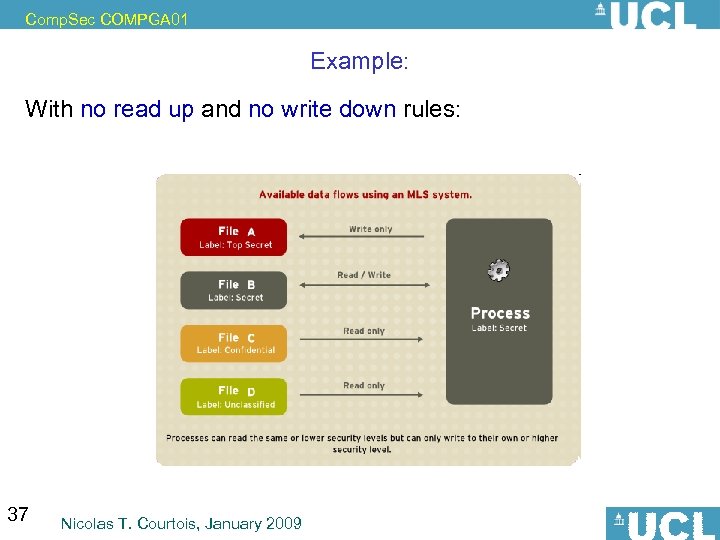
Comp. Sec COMPGA 01 Example: With no read up and no write down rules: 37 Nicolas T. Courtois, January 2009
Comp. Sec COMPGA 01 posets For now we have a total ordering… Now, we usually need more flexibility: achieved through compartmentalization. Then some levels will not be comparable and we will have posets. Here is why and how. 38 Nicolas T. Courtois, January 2009
Comp. Sec COMPGA 01 Compartmentalization We want to additional categorizations, for example describing different departments in an organisation, or different armed forces, or the authority granted in different domains… – – this will allow us to implement severe access control limitations of the type “need-toknow” this is able of managing complex situations, usually imposed by law or contractual obligations, therefore one needs to be strict. Example: The U. S. have two allies that maybe do not wish to share foreign intelligence data (say Israel and Saudi Arabia). The policy will then have three distinct levels: 1. 2. 3. Top Secret, Israel Top Secret, Saudi Arabia Top Secret, Middle East (including Israel and Saudi Arabia) And as will se later, in our model the only allowed information flows are 3 1 and 3 2. 39 Nicolas T. Courtois, January 2009
Comp. Sec COMPGA 01 Compartmentalization - Examples • army, navy, air force In civilian sector: • Sales, R&D, HR 40 Nicolas T. Courtois, January 2009
Comp. Sec COMPGA 01 Further Mistrust Multi-level security policies allow in fact to get a further degree mistrust in people, and processes they create (that could be Trojans). And this can go as far as we want: The policies of no read-up and no write-down become more and more restrictive when the ordering is partial, so that there is less objects accessible to read or write from. 41 Nicolas T. Courtois, January 2009
Comp. Sec COMPGA 01 *Lattices Definition: An poset S, is called a lattice if: • a, b the LUB a b exists. • a, b the GLB a b exists. Corollary 1: every finite subset has a SUP and an INF. Corollary 2: In every finite lattice we have two special elements called top T and bottom . 42 Nicolas T. Courtois, January 2009
Comp. Sec COMPGA 01 Multilevel Security and Lattices in security jargon, when a b we say: “b dominates a”. We call: • system low is the bottom level – dominated by all others. • system high is the top level T – which dominates all others. 43 Nicolas T. Courtois, January 2009
Comp. Sec COMPGA 01 A Small Precision Needed With a partial ordering, we have the same two definitions: • no read up, – cannot read a file with a higher level. • no write down: – cannot write a file at a lower level But, just to avoid misunderstandings, it should be clear that we allow neither write nor read for levels that are unrelated in the product lattice. 44 Nicolas T. Courtois, January 2009
Comp. Sec COMPGA 01 The Product Lattice • • Let H be a set of classifications and a total ordering H. our first lattice. = Need To Know area Let Cat be a set of categories. • We call compartments = NTK’s arbitrary subsets of Cat. our 2 nd lattice. security levels = secrecy classes = levels of clearance are pairs of (classification, compartment) where by definition (L 1, C 1) (L 2, C 2) Remark: mathematicians will explain that it is in fact iff indeed what is known as “a product lattice” of the two lattices (H, ) and the L 1 H L 2 AND C 1 C 2. lattice of subsets of C. H 45 Nicolas T. Courtois, January 2009
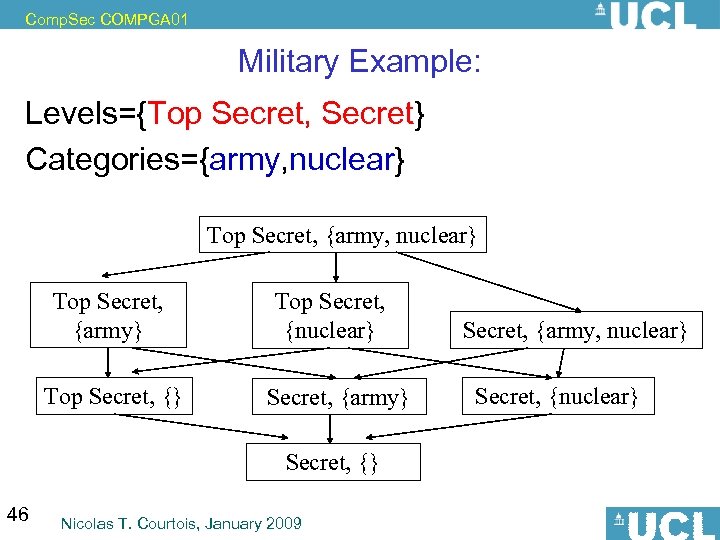
Comp. Sec COMPGA 01 Military Example: Levels={Top Secret, Secret} Categories={army, nuclear} Top Secret, {army} Top Secret, {nuclear} Secret, {army} Secret, {} 46 Nicolas T. Courtois, January 2009 Secret, {army, nuclear} Secret, {nuclear}
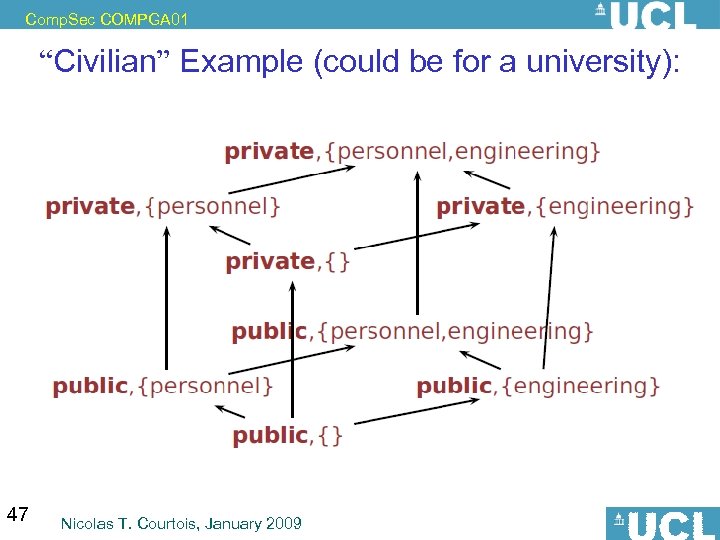
Comp. Sec COMPGA 01 “Civilian” Example (could be for a university): 47 Nicolas T. Courtois, January 2009
Comp. Sec COMPGA 01 Intended Application • • Each user is assigned a security class = clearance. A user can “connect to the system” at a lower, user specified level of security, allowed for any level that is dominated by his clearance. – • A process activated by a subject takes the level of clearance with which the user has connected (not the user’s level of clearance). Examples (cf. our 2 pictures). – (private, {personnel}) • – (Secret, {Army, Nuclear}) • 48 can access private data about UCL personnel, but not inside the faculty of Engineering. can access Secret information in both domains, but none of Top Secret information. Nicolas T. Courtois, January 2009
Comp. Sec COMPGA 01 Further Usage and Semantics • The class assigned to a user, reflects user’s trustworthiness not to disclose sensitive information to individuals who do not hold appropriate clearance. – • For an object, it reflects the sensitivity of information that this object will or may contain, – 49 should disclose any information only to people with security clearance that dominates this user should be disclosed only to people/processes with security clearance that dominates this object. Nicolas T. Courtois, January 2009
Comp. Sec COMPGA 01 Semantics of Categories/Compartments • • Each category can be viewed as the right to know (right to read) certain things (not all) in a given dimension/domain. The larger is the number of categories, the less the data is shared following the “need-to-know” principle. • But daily business may be very difficult if there are too many categories… – – 50 so we need a “sensible split” that is both secure and practical. . . Ross Anderson: “MLS systems… impair operational effectiveness”. Nicolas T. Courtois, January 2009
Comp. Sec COMPGA 01 Bell La. Padula (BLP) Multi-Level Security Model 51 Nicolas T. Courtois, January 2009
![Comp. Sec COMPGA 01 BLP Model [1973] This model is simply defence in depth:](https://present5.com/presentation/f9fec50e515713d69786a0a930389f2a/image-52.jpg "Comp. Sec COMPGA 01 BLP Model [1973] This model is simply defence in depth:")
Comp. Sec COMPGA 01 BLP Model [1973] This model is simply defence in depth: 1. Our product lattice + 2. two mandatory rules: – no write down and – no read up. 3. + extra DAC mechanism. Goal: prevent information flowing from high level to low level. 52 Nicolas T. Courtois, January 2009
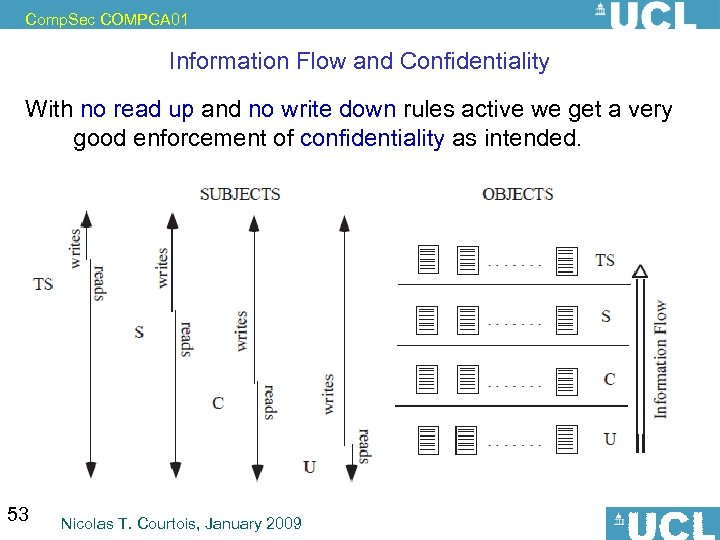
Comp. Sec COMPGA 01 Information Flow and Confidentiality With no read up and no write down rules active we get a very good enforcement of confidentiality as intended. 53 Nicolas T. Courtois, January 2009
Comp. Sec COMPGA 01 BLP Model: A Long Definition • • A set S of Subjects (e. g. processes) which can execute privileges in the system. A set O of Objects (e. g. files) on which the privileges can be executed. A set A of Operations. Example: A={exec, read, append, write}. A poset (L, ) of levels of security clearance, e. g. <un, {}> <cl, {HR, ENG}>. Let b S x O x A be a current access defined as a set of triples (s, o, a) meaning s is performing operation an object o. Defines what is happening at a time. Let B = 2 Sx. Ox. A be the set of all possible current accesses b (all possible outcomes). We will define an access control matrix as before: M=(Mso) s S o O MS, O(A) – where each entry Mso A. being the set of permissions s is given for accessing an object o: s can perform only operations a such that a Mso A. • We call a security level assignment f a triple of functions f=(f. S, f. C, f. O) where: – f. S: S L gives the maximum security level each subject can have. – f. C: S L gives the current security level each subject has at this moment, with f. C f. S. – f. O: O L is the security classification level for all objects. • • 54 We call F= LS x LO the set of all security level assignments. We call a BLP state a triple (b, M, f). Nicolas T. Courtois, January 2009
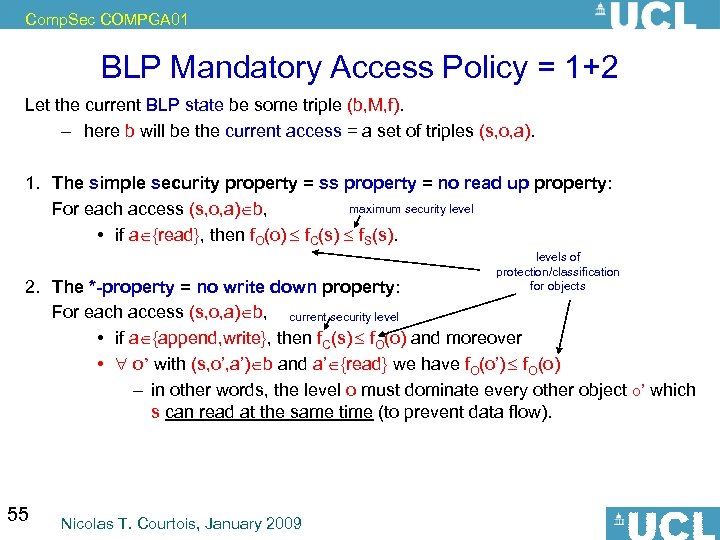
Comp. Sec COMPGA 01 BLP Mandatory Access Policy = 1+2 Let the current BLP state be some triple (b, M, f). – here b will be the current access = a set of triples (s, o, a). 1. The simple security property = ss property = no read up property: maximum security level For each access (s, o, a) b, • if a {read}, then f. O(o) f. C(s) f. S(s). levels of protection/classification for objects 2. The *-property = no write down property: For each access (s, o, a) b, current security level • if a {append, write}, then f. C(s) f. O(o) and moreover • o’ with (s, o’, a’) b and a’ {read} we have f. O(o’) f. O(o) – in other words, the level o must dominate every other object o’ which s can read at the same time (to prevent data flow). 55 Nicolas T. Courtois, January 2009
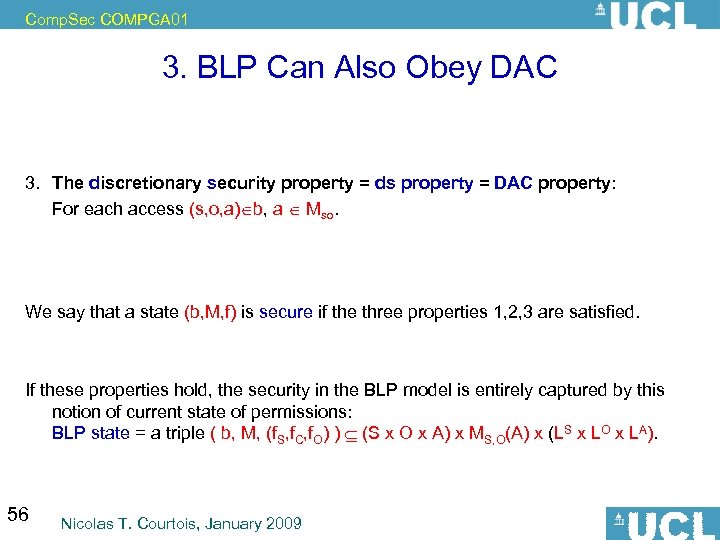
Comp. Sec COMPGA 01 3. BLP Can Also Obey DAC Let the current BLP state be some triple (b, M, f). – here b will be the current access = a set of triples (s, o, a). 3. The discretionary security property = ds property = DAC property: For each access (s, o, a) b, a Mso. We say that a state (b, M, f) is secure if the three properties 1, 2, 3 are satisfied. If these properties hold, the security in the BLP model is entirely captured by this notion of current state of permissions: BLP state = a triple ( b, M, (f. S, f. C, f. O) ) (S x O x A) x MS, O(A) x (LS x LO x LA). 56 Nicolas T. Courtois, January 2009
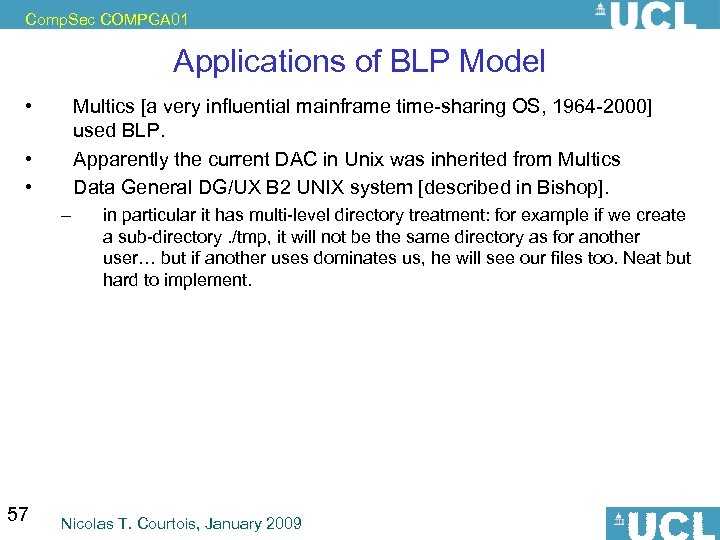
Comp. Sec COMPGA 01 Applications of BLP Model • Multics [a very influential mainframe time-sharing OS, 1964 -2000] used BLP. Apparently the current DAC in Unix was inherited from Multics Data General DG/UX B 2 UNIX system [described in Bishop]. • • – 57 in particular it has multi-level directory treatment: for example if we create a sub-directory. /tmp, it will not be the same directory as for another user… but if another uses dominates us, he will see our files too. Neat but hard to implement. Nicolas T. Courtois, January 2009
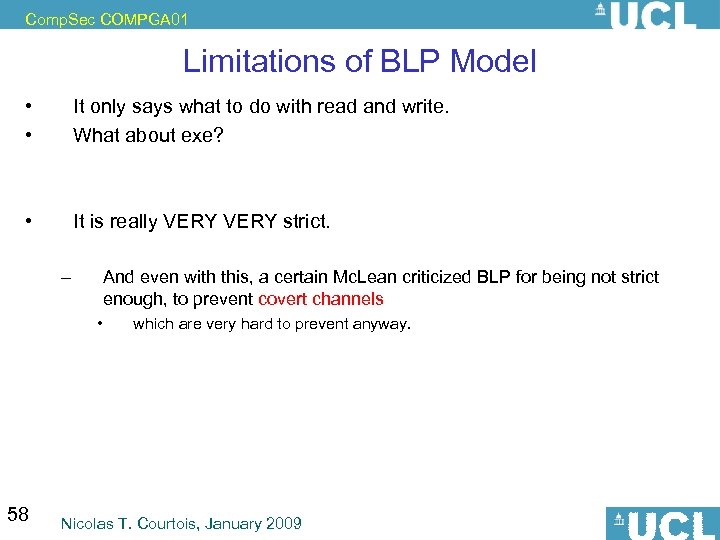
Comp. Sec COMPGA 01 Limitations of BLP Model • • It only says what to do with read and write. What about exe? • It is really VERY strict. – And even with this, a certain Mc. Lean criticized BLP for being not strict enough, to prevent covert channels • 58 which are very hard to prevent anyway. Nicolas T. Courtois, January 2009
Comp. Sec COMPGA 01 On Need to Write-Down As stated, in the BLP model, a user at a higher level, connected at higher level cannot even send commands to a lower level. Not very practical for sending orders for example(!). There are two ways out of it: 1. temporal downgrade of Subject (already built-in in our current formulation of BLP): This why we have the current security clearance level with f. C f. S. This approach works because users cannot at the same time access highly sensitive files and send messages to lower levels. It works as far as people themselves can be trusted, but it does prevent any Trojan horse attack (!) because the legitimate channels for the Trojan to use are blocked when connected at a lower level. 2. 59 identify a set of trusted subjects - a variation of BLP – that will be allowed to write-down. Example: Certain people will be allowed to publish or diffuse parts of a secret document… Nicolas T. Courtois, January 2009
Comp. Sec COMPGA 01 DAC + MAC BLP implements both. DAC provides “discretionality”, but only within the strict boundaries of Mandatory AC rules. 60 Nicolas T. Courtois, January 2009
Comp. Sec COMPGA 01 Can We Change the Levels? • Raising the classification security level of an object in the lattice: – • not a problem. Changing to an unrelated one – • a problem. Changing to a lower one – a possible security breach… Need for special procedures: declassification, sanitization etc. Def: Sanitization: editing the document so that it does not leak any extra information that the one that is intended to make public such as exact names, exact places, file meta data, etc. 61 Nicolas T. Courtois, January 2009
Comp. Sec COMPGA 01 Tranquillity The key problem in BLP is that, if we change levels in a live system then actually the BLP rules can be violated (the Trojan can accumulate some data in a file and leak information directly because levels has changed). So many implementations require either • some of form of the so called “Tranquility” • or that the subjects “forget everything” when changing levels, for example stop all tasks, log off, clear all temporary files etc. 62 Nicolas T. Courtois, January 2009
Comp. Sec COMPGA 01 Attacks on BLP Systems in Operation 63 Nicolas T. Courtois, January 2009
Comp. Sec COMPGA 01 Types of Failures – Adapted Slide • Failure in the model • Failure in the implementation • Failure in operation or a combination… 64 Nicolas T. Courtois, January 2009
Comp. Sec COMPGA 01 Covert Channels The BLP model protects very well against overt (legitimate) channels. Covert channels: “leaking the information more or less on purpose“ are hard to prevent, but it is good to know where the problems may arise. Examples: more like a side channel: low level subject requests a resource used by high-level subjects. Access is poor or refused (can be a file lock). Can be used to leak information. Remark: this kind of channel can be used to leak whole files 1 bit / second or so… 65 Nicolas T. Courtois, January 2009
Comp. Sec COMPGA 01 Quiz 66 Nicolas T. Courtois, January 2009
Comp. Sec COMPGA 01 Quiz What is a • An order relation (RAT) • Lattice? • • • 67 DAC and MAC? How exactly do we define is the BLP product lattice? BLP model? Nicolas T. Courtois, January 2009
Скачать презентацию Lattices Confidentiality BLP Nicolas T Courtois — University
f9fec50e515713d69786a0a930389f2a.ppt