


 Скачать презентацию Lattice site location of implanted Fe in Sr
3429c96faf8a624935156c20d672df53.ppt
- Количество слайдов: 12
 Lattice site location of implanted Fe in Sr. Ti. O 3 and lattice damage recovery studies A. C. Marques 1, 4 *, U. Wahl 1, 2, J. G. Correia 1, 2, 4, E. Rita 1, 2, J. P. Araújo 3, L. Pereira 3, C. Marques 2, E. Alves 2, M. A. Reis 2, P. C. Chaves 2, M. R. Silva 1, J. C. Soares 1 (1)Centro de Física Nuclear da Universidade de Lisboa, Portugal (2)Instituto Tecnológico e Nuclear, Sacavém, Portugal (3) IFIMUP, Fac. Ciências, Porto, Portugal (4)CERN, Geneva, Switzerland * ana. marques@cern. ch WORKSHOP AND USERS February 2007 1
 Outline Materials, • Undoped Sr. Ti. O 3 • Sr. Ti. O 3 pre-implanted with stable Fe emission channeling technique, studies • Fe lattice site location • lattice damage recovery • Magnetic properties • impurities search by means of PIXE and conclusions. WORKSHOP AND USERS February 2007 2
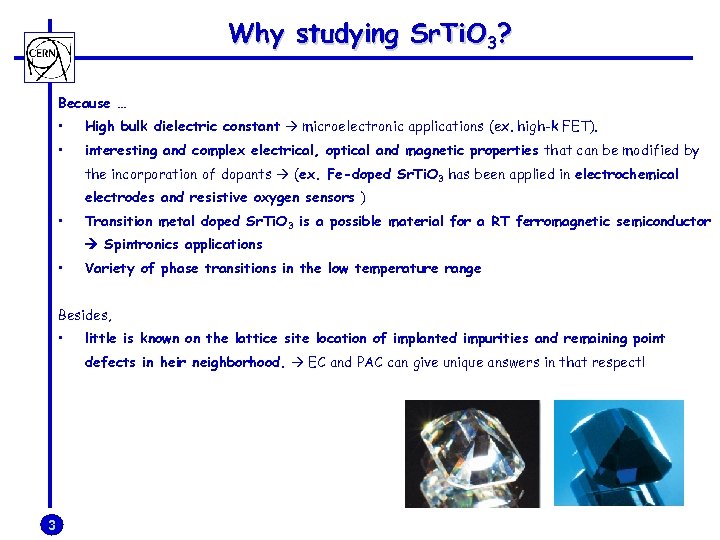 Why studying Sr. Ti. O 3? Because … • High bulk dielectric constant microelectronic applications (ex. high-k FET). • interesting and complex electrical, optical and magnetic properties that can be modified by the incorporation of dopants (ex. Fe-doped Sr. Ti. O 3 has been applied in electrochemical electrodes and resistive oxygen sensors ) • Transition metal doped Sr. Ti. O 3 is a possible material for a RT ferromagnetic semiconductor Spintronics applications • Variety of phase transitions in the low temperature range Besides, • little is known on the lattice site location of implanted impurities and remaining point defects in heir neighborhood. EC and PAC can give unique answers in that respect! WORKSHOP AND USERS February 2007 3
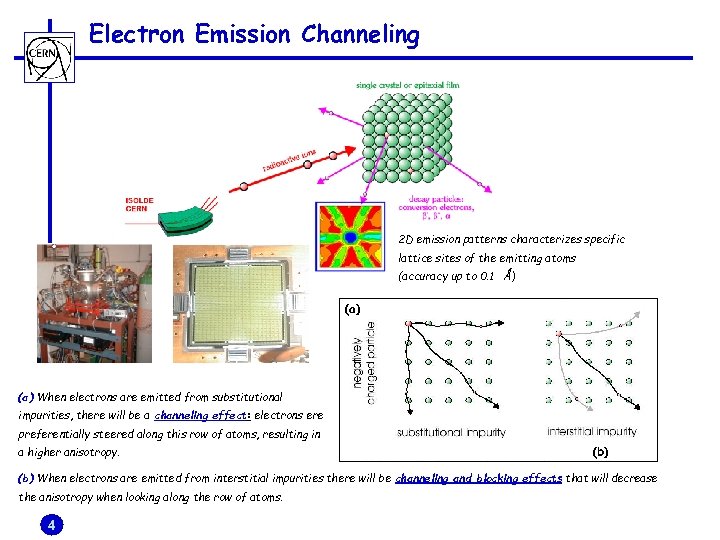 Electron Emission Channeling 2 D emission patterns characterizes specific lattice sites of the emitting atoms (accuracy up to 0. 1 Ǻ) (a) When electrons are emitted from substitutional impurities, there will be a channeling effect: electrons ere preferentially steered along this row of atoms, resulting in (b) a higher anisotropy. (b) When electrons are emitted from interstitial impurities there will be channeling and blocking effects that will decrease the anisotropy when looking along the row of atoms. 4 WORKSHOP AND USERS February 2007
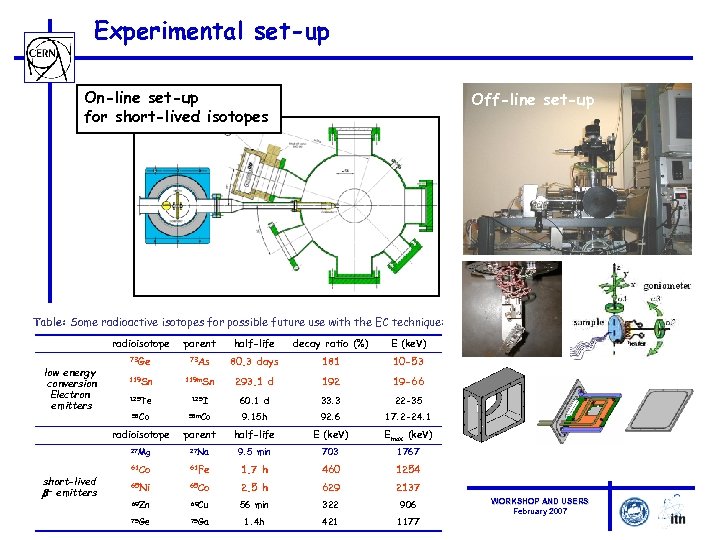 Experimental set-up On-line set-up for short-lived isotopes Off-line set-up Table: Some radioactive isotopes for possible future use with the EC technique: radioisotope 5 decay ratio (%) E (ke. V) 73 Ge 73 As 80. 3 days 181 10 -53 119 Sn 119 m. Sn 293. 1 d 192 19 -66 125 Te 125 I 60. 1 d 33. 3 22 -35 58 Co 58 m. Co 9. 15 h 92. 6 17. 2 -24. 1 parent half-life E (ke. V) Emax (ke. V) 27 Mg short-lived - emitters half-life radioisotope low energy conversion Electron emitters parent 27 Na 9. 5 min 703 1767 61 Co 61 Fe 1. 7 h 460 1254 65 Ni 65 Co 2. 5 h 629 2137 69 Zn 69 Cu 56 min 322 906 75 Ge 75 Ga 1. 4 h 421 1177 WORKSHOP AND USERS February 2007
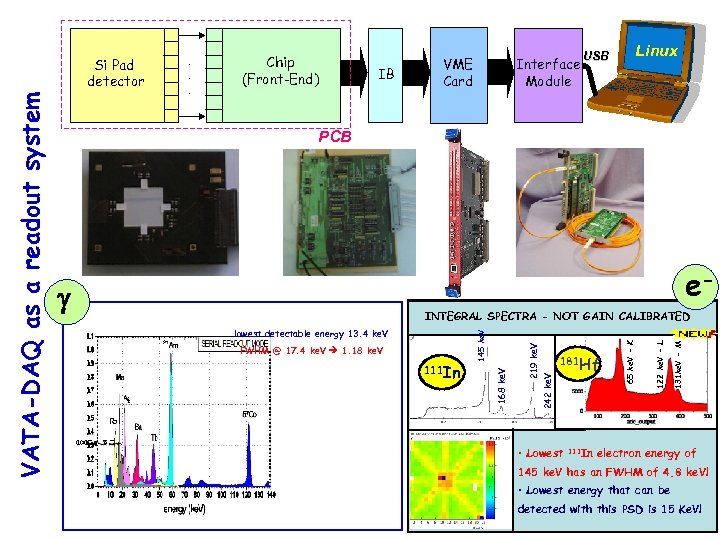 VATA-DAQ as a readout system Si Pad detector . . . Chip (Front-End) IB VME Card Interface Module USB Linux PCB e- • Lowest 111 In 131 ke. V - M 122 ke. V - L 181 Hf 65 ke. V - K 111 In 219 ke. V 242 ke. V FWHM @ 17. 4 ke. V 1. 18 ke. V 168 ke. V lowest detectable energy 13. 4 ke. V 145 ke. V INTEGRAL SPECTRA - NOT GAIN CALIBRATED electron energy of 145 ke. V has an FWHM of 4. 8 ke. V! • Lowest energy that can be WORKSHOP AND USERS detected February 2007 with 6 this PSD is 15 Ke. V!
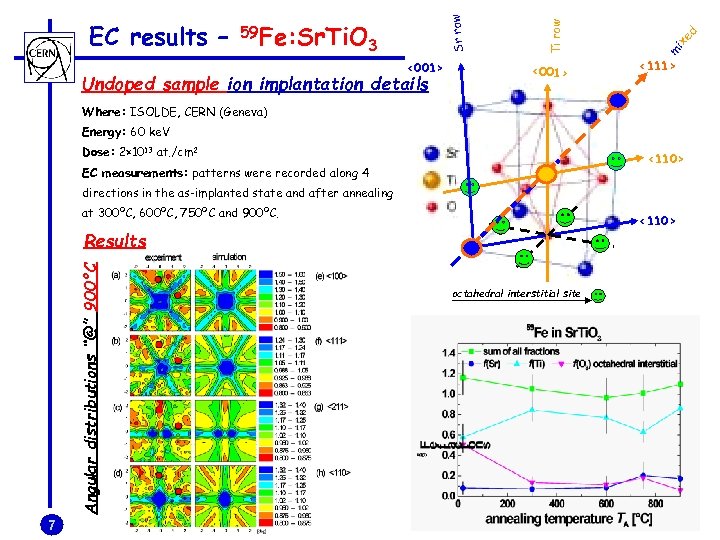 <001> Undoped sample ion implantation details <001> ed m ix 3 Ti row 59 Fe: Sr. Ti. O Sr row EC results – <111> Where: ISOLDE, CERN (Geneva) Energy: 60 ke. V Dose: 2× 10¹³ at. /cm 2 <110> EC measurements: patterns were recorded along 4 directions in the as-implanted state and after annealing at 300ºC, 600ºC, 750ºC and 900ºC. <110> Angular distributions “@” 900ºC Results 7 octahedral interstitial site WORKSHOP AND USERS February 2007
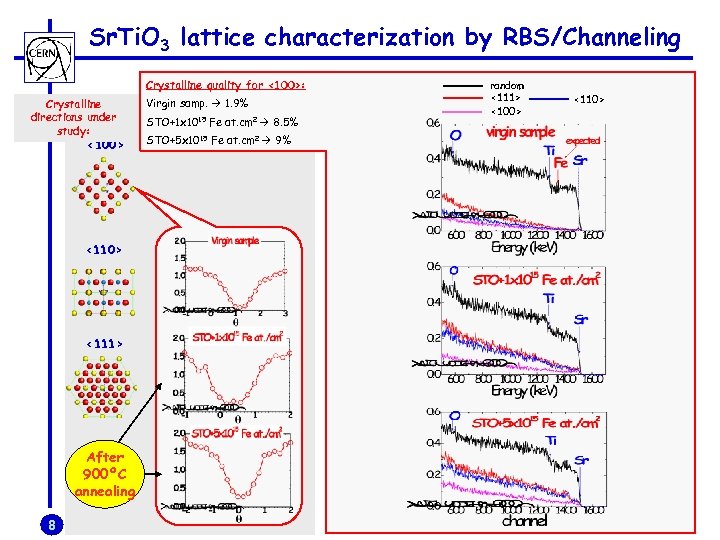 Sr. Ti. O 3 lattice characterization by RBS/Channeling Crystalline quality for <100>: Crystalline directions under study: <100> Virgin samp. 1. 9% STO+1 x 10¹⁵ Fe at. cm 2 8. 5% random <111> <100> <110> STO+5 x 10¹⁵ Fe at. cm 2 9% <110> <111> After 900ºC annealing 8 WORKSHOP AND USERS February 2007
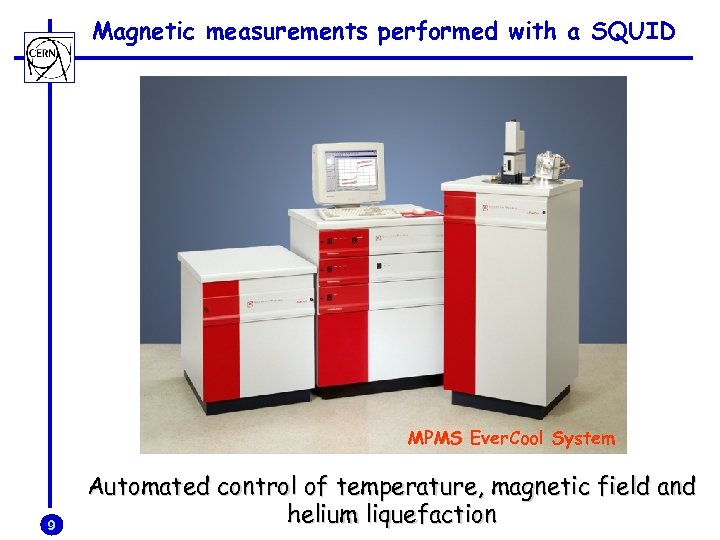 Magnetic measurements performed with a SQUID MPMS Ever. Cool System Automated control of temperature, magnetic field and helium liquefaction WORKSHOP AND USERS February 2007 9
 Magnetic measurements performed with a SQUID 5. 5 T 5. 26 x 1015 Fe at. /cm 2 Magnetic measurements were performed in two Sr. Ti. O 3 samples pre-implanted with stable Fe at ITN-Portugal and after 900ºC vacuum annealing. 1. 69 x 1015 Fe at. /cm 2 Low dose sample 1. 69 x 1015 at. /cm 2 High dose sample 5. 26 x 1015 at. /cm 2 Undoped sample as sensitized 10 K M = 8, 8 B/Fe Fe 2. 2 B Fe 2+ 6 B Fe 3+ 5 B M is considerably higher!! Why? ? … we still don’t know! 10 is normalized to the mass sample WORKSHOP AND USERS February 2007
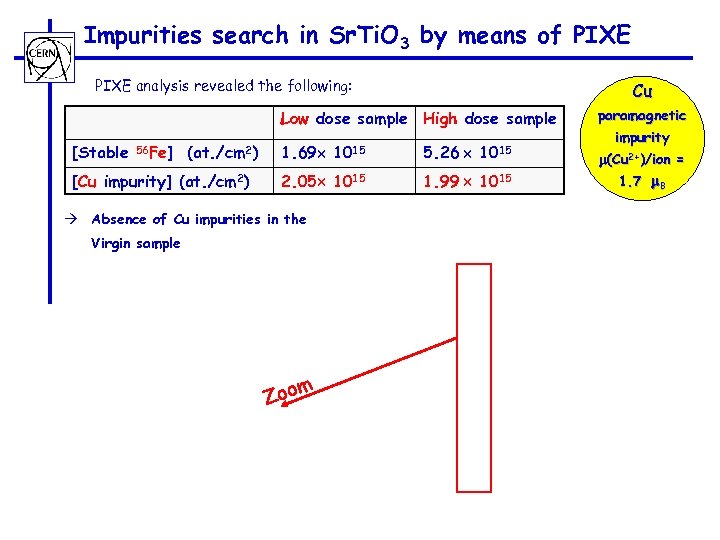 Impurities search in Sr. Ti. O 3 by means of PIXE analysis revealed the following: Cu Low dose sample High dose sample [Stable 56 Fe] (at. /cm 2) [Cu impurity] (at. /cm 2) 1. 69 1015 2. 05 1015 5. 26 1015 1. 99 1015 Absence of Cu impurities in the Virgin sample m Zoo WORKSHOP AND USERS February 2007 11 paramagnetic impurity (Cu 2+)/ion = 1. 7 B
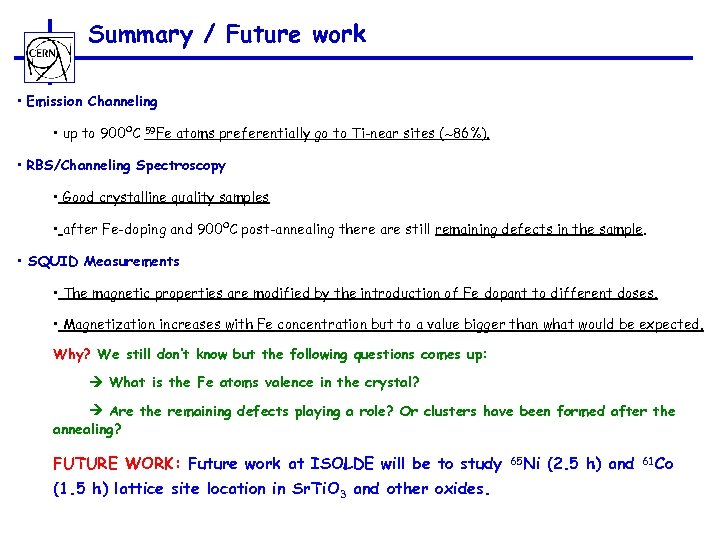 Summary / Future work • Emission Channeling • up to 900ºC 59 Fe atoms preferentially go to Ti-near sites ( 86%). • RBS/Channeling Spectroscopy • Good crystalline quality samples • after Fe-doping and 900ºC post-annealing there are still remaining defects in the sample. • SQUID Measurements • The magnetic properties are modified by the introduction of Fe dopant to different doses. • Magnetization increases with Fe concentration but to a value bigger than what would be expected. Why? We still don’t know but the following questions comes up: What is the Fe atoms valence in the crystal? Are the remaining defects playing a role? Or clusters have been formed after the annealing? FUTURE WORK: Future work at ISOLDE will be to study (1. 5 h) lattice site location in Sr. Ti. O 3 and other oxides. 12 65 Ni (2. 5 h) and WORKSHOP AND USERS February 2007 61 Co