 Скачать презентацию Latest Updates to USDA s GLAM Global Agriculture Monitoring
96d3dc647b7a511900f638e3d603a2d9.ppt
- Количество слайдов: 35



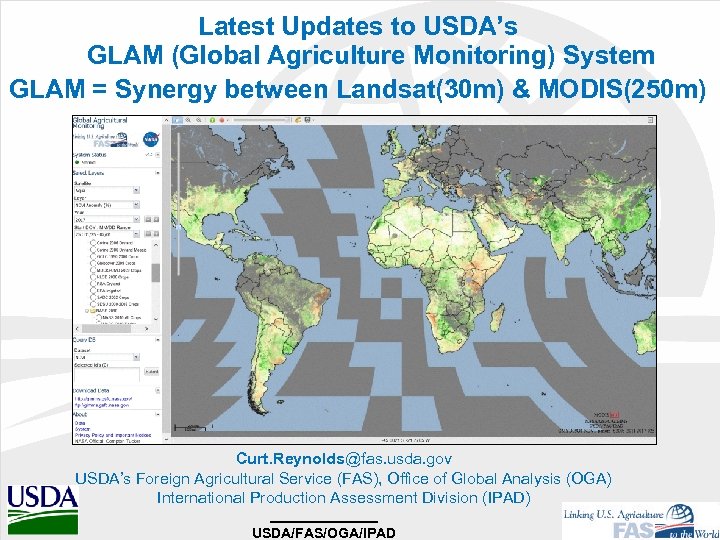
Latest Updates to USDA’s GLAM (Global Agriculture Monitoring) System GLAM = Synergy between Landsat(30 m) & MODIS(250 m) Curt. Reynolds@fas. usda. gov USDA’s Foreign Agricultural Service (FAS), Office of Global Analysis (OGA) International Production Assessment Division (IPAD) USDA/FAS/OGA/IPAD
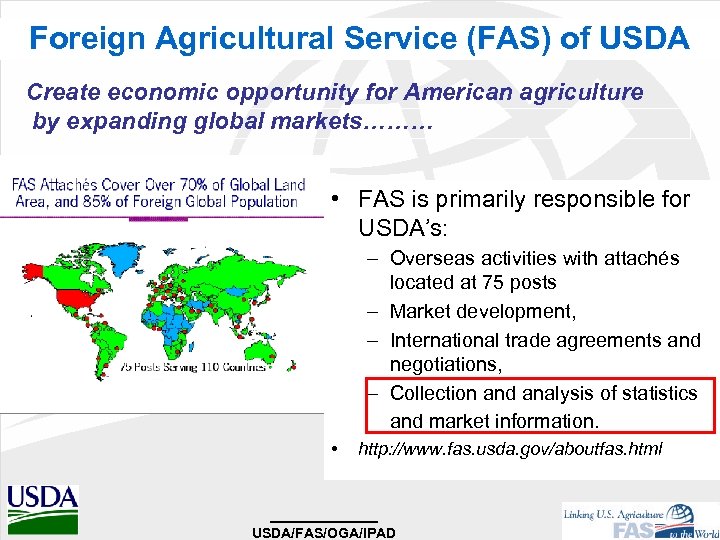
Foreign Agricultural Service (FAS) of USDA Create economic opportunity for American agriculture by expanding global markets……… • FAS is primarily responsible for USDA’s: – Overseas activities with attachés located at 75 posts – Market development, – International trade agreements and negotiations, – Collection and analysis of statistics and market information. • http: //www. fas. usda. gov/aboutfas. html USDA/FAS/OGA/IPAD
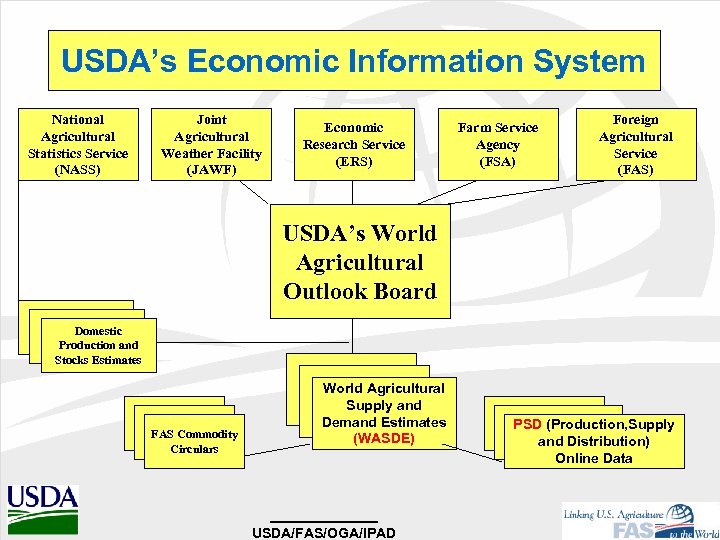
USDA’s Economic Information System National Agricultural Statistics Service (NASS) Joint Agricultural Weather Facility (JAWF) Economic Research Service (ERS) Farm Service Agency (FSA) Foreign Agricultural Service (FAS) USDA’s World Agricultural Outlook Board Domestic Production and Stocks Estimates FAS Commodity Circulars World Agricultural Supply and Demand Estimates (WASDE) USDA/FAS/OGA/IPAD PSD (Production, Supply and Distribution) Online Data
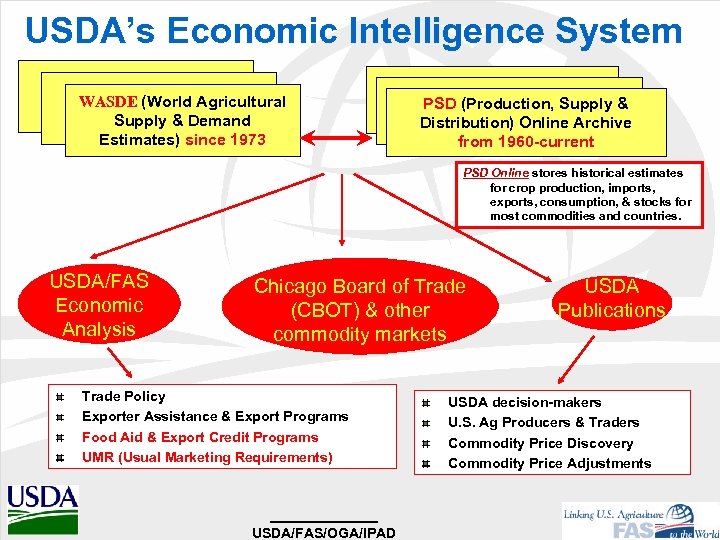
USDA’s Economic Intelligence System WASDE (World Agricultural Supply & Demand Estimates) since 1973 PSD (Production, Supply & Distribution) Online Archive from 1960 -current PSD Online stores historical estimates for crop production, imports, exports, consumption, & stocks for most commodities and countries. USDA/FAS Economic Analysis Chicago Board of Trade (CBOT) & other commodity markets Trade Policy Exporter Assistance & Export Programs Food Aid & Export Credit Programs UMR (Usual Marketing Requirements) USDA/FAS/OGA/IPAD USDA Publications USDA decision-makers U. S. Ag Producers & Traders Commodity Price Discovery Commodity Price Adjustments
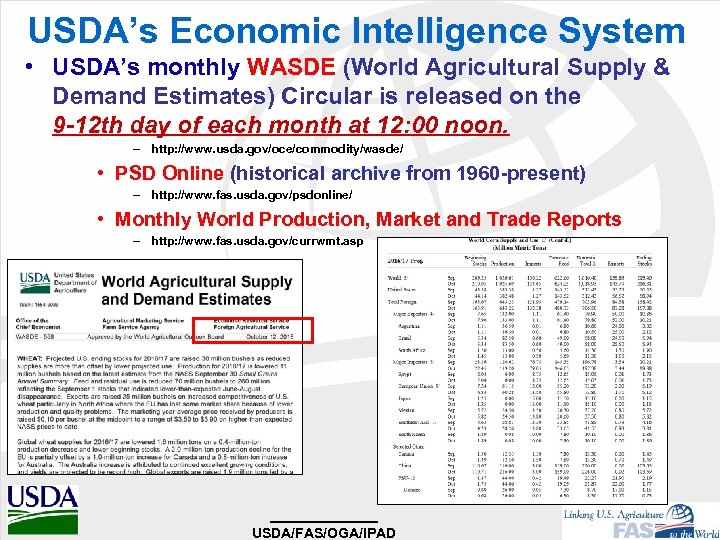
USDA’s Economic Intelligence System • USDA’s monthly WASDE (World Agricultural Supply & Demand Estimates) Circular is released on the 9 -12 th day of each month at 12: 00 noon. – http: //www. usda. gov/oce/commodity/wasde/ • PSD Online (historical archive from 1960 -present) – http: //www. fas. usda. gov/psdonline/ • Monthly World Production, Market and Trade Reports – http: //www. fas. usda. gov/currwmt. asp USDA/FAS/OGA/IPAD
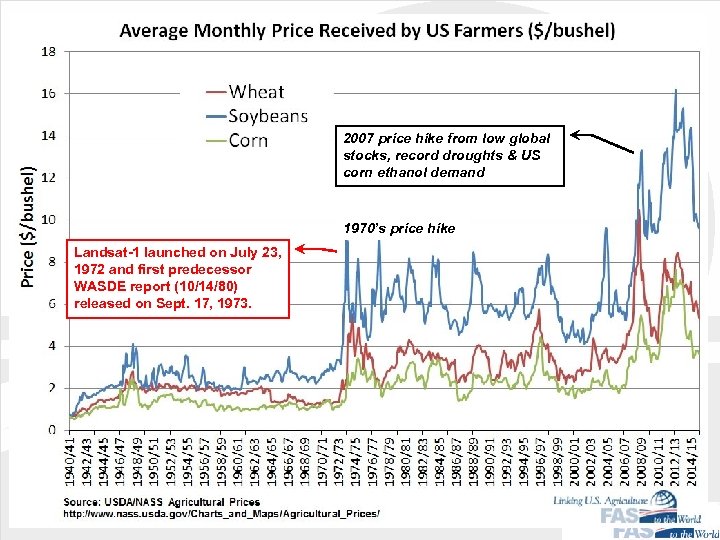
2007 price hike from low global stocks, record droughts & US corn ethanol demand 1970’s price hike Landsat-1 launched on July 23, 1972 and first predecessor WASDE report (10/14/80) released on Sept. 17, 1973.
USDA/FAS/OGA/IPAD
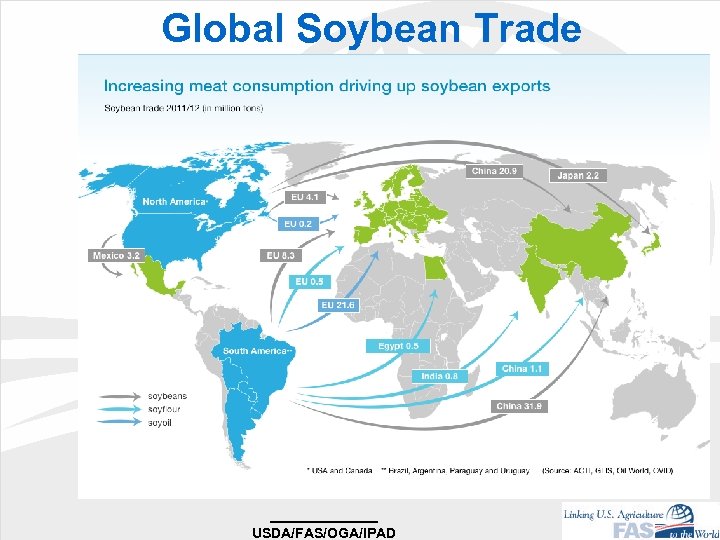
Global Soybean Trade USDA/FAS/OGA/IPAD
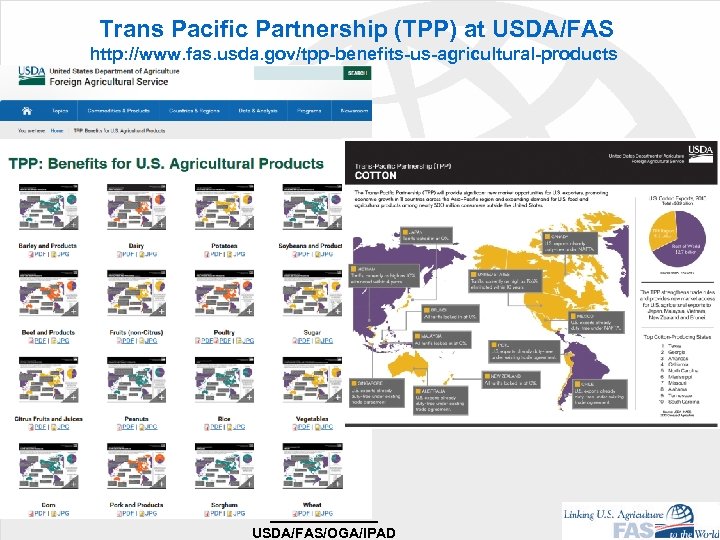
Trans Pacific Partnership (TPP) at USDA/FAS http: //www. fas. usda. gov/tpp-benefits-us-agricultural-products USDA/FAS/OGA/IPAD
Goals of USDA’s Economic Intelligence System (i. e. , monthly WASDE/PSD Online) • Objective – Provide independent and unbiased information for commodity markets. • Reliable – Best available information at current point in time. – Analysis based on sound data. • Timely – Scheduled and immediate release for public, traders and commodity markets. USDA/FAS/OGA/IPAD
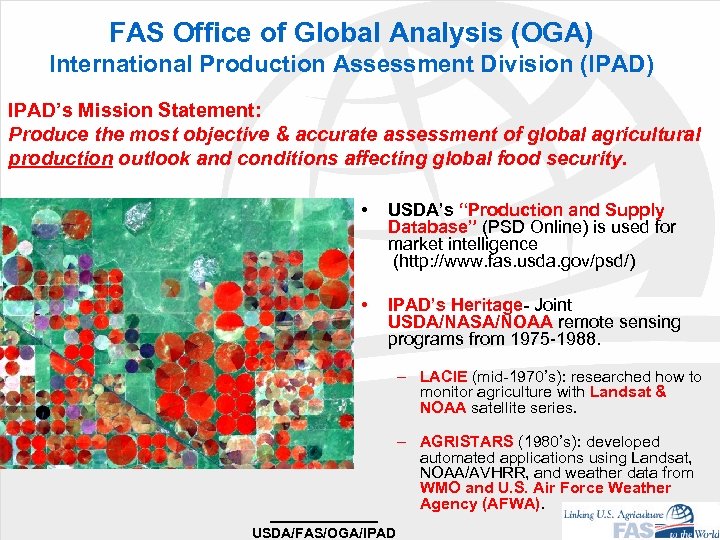
FAS Office of Global Analysis (OGA) International Production Assessment Division (IPAD) IPAD’s Mission Statement: Produce the most objective & accurate assessment of global agricultural production outlook and conditions affecting global food security. • USDA’s “Production and Supply Database” (PSD Online) is used for market intelligence (http: //www. fas. usda. gov/psd/) • IPAD’s Heritage- Joint USDA/NASA/NOAA remote sensing programs from 1975 -1988. – LACIE (mid-1970’s): researched how to monitor agriculture with Landsat & NOAA satellite series. – AGRISTARS (1980’s): developed automated applications using Landsat, NOAA/AVHRR, and weather data from WMO and U. S. Air Force Weather Agency (AFWA). USDA/FAS/OGA/IPAD
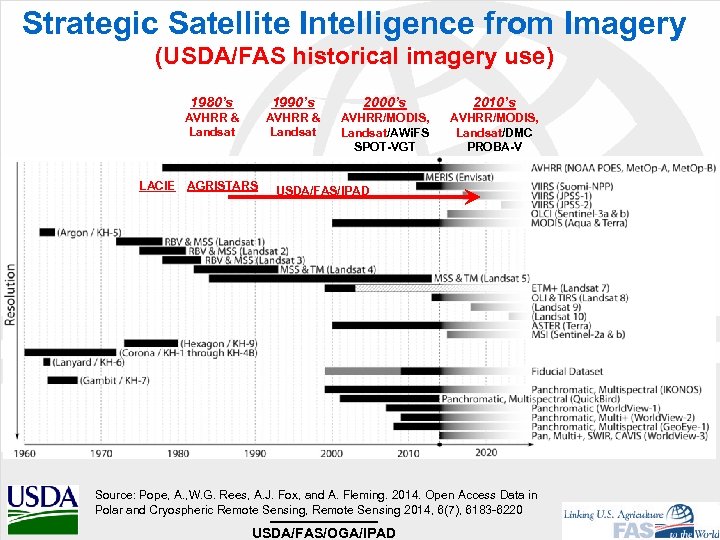
Strategic Satellite Intelligence from Imagery (USDA/FAS historical imagery use) 1980’s 1990’s 2000’s 2010’s AVHRR & Landsat AVHRR/MODIS, Landsat/AWi. FS SPOT-VGT AVHRR/MODIS, Landsat/DMC PROBA-V LACIE AGRISTARS USDA/FAS/IPAD Source: Pope, A. , W. G. Rees, A. J. Fox, and A. Fleming. 2014. Open Access Data in Polar and Cryospheric Remote Sensing, Remote Sensing 2014, 6(7), 6183 -6220 USDA/FAS/OGA/IPAD
Commodity Markets Require: • Crop area estimates mid-season: – July/Aug critical for northern hemisphere crops (~80% grain production) – Feb/Mar critical for southern hemisphere crops • Crop area estimates from satellite imagery to complement national crop statistics from ground surveys. USDA/FAS/OGA/IPAD
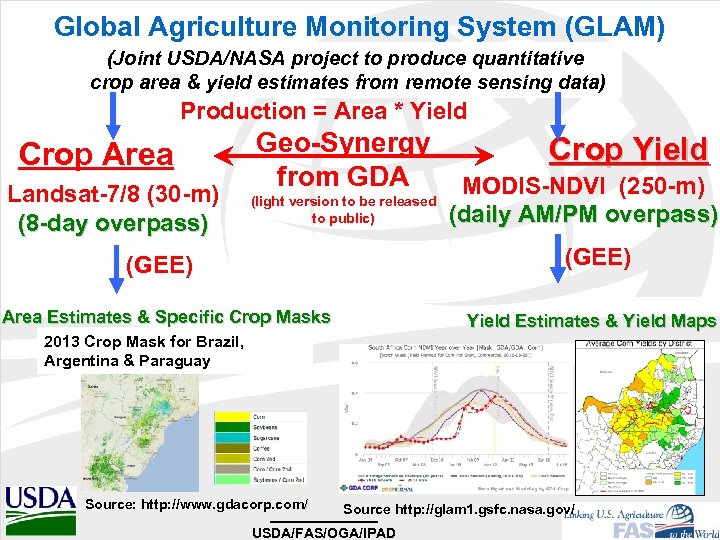
Global Agriculture Monitoring System (GLAM) (Joint USDA/NASA project to produce quantitative crop area & yield estimates from remote sensing data) Production = Area * Yield Crop Area Landsat-7/8 (30 -m) (8 -day overpass) Geo-Synergy from GDA (light version to be released to public) Crop Yield MODIS-NDVI (250 -m) (daily AM/PM overpass) (GEE) Area Estimates & Specific Crop Masks Yield Estimates & Yield Maps 2013 Crop Mask for Brazil, Argentina & Paraguay Source: http: //www. gdacorp. com/ Source http: //glam 1. gsfc. nasa. gov/ USDA/FAS/OGA/IPAD
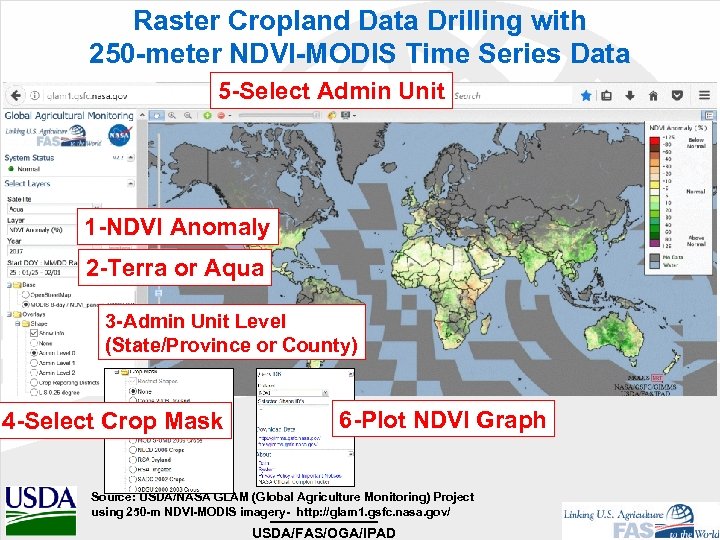
Raster Cropland Data Drilling with 250 -meter NDVI-MODIS Time Series Data 5 -Select Admin Unit 1 -NDVI Anomaly 2 -Terra or Aqua 3 -Admin Unit Level (State/Province or County) 4 -Select Crop Mask 6 -Plot NDVI Graph Source: USDA/NASA GLAM (Global Agriculture Monitoring) Project using 250 -m NDVI-MODIS imagery- http: //glam 1. gsfc. nasa. gov/ USDA/FAS/OGA/IPAD
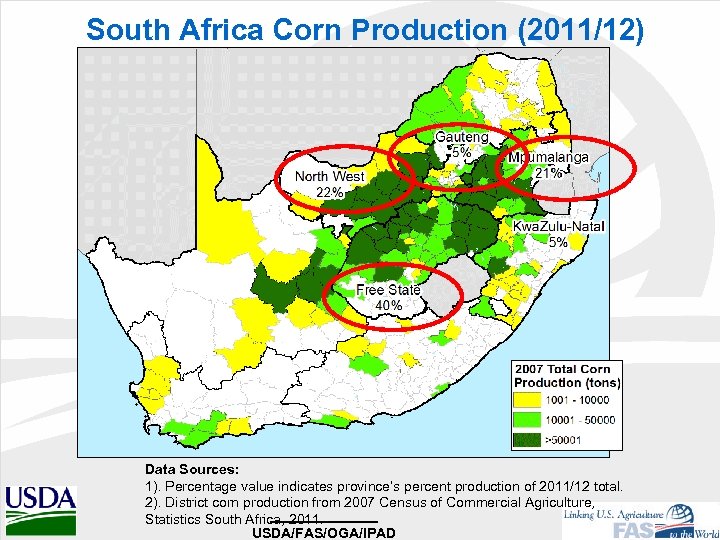
South Africa Corn Production (2011/12) Data Sources: 1). Percentage value indicates province’s percent production of 2011/12 total. 2). District corn production from 2007 Census of Commercial Agriculture, Statistics South Africa, 2011. USDA/FAS/OGA/IPAD
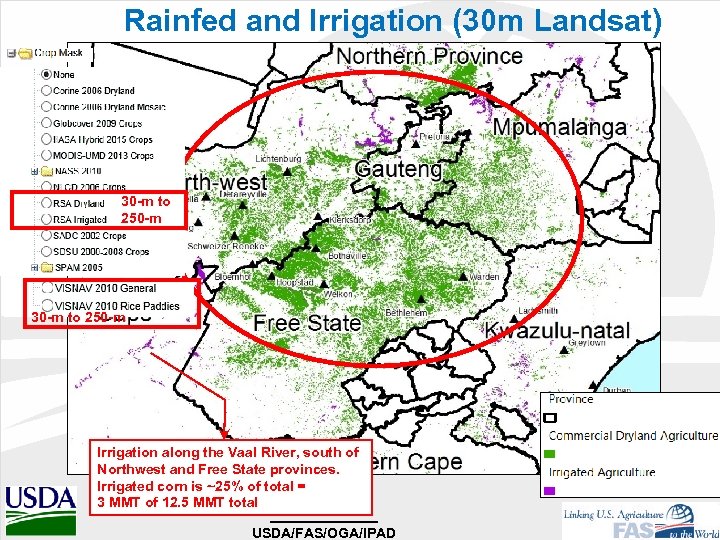
Rainfed and Irrigation (30 m Landsat) 30 -m to 250 -m Irrigation along the Vaal River, south of Northwest and Free State provinces. Irrigated corn is ~25% of total = 3 MMT of 12. 5 MMT total USDA/FAS/OGA/IPAD
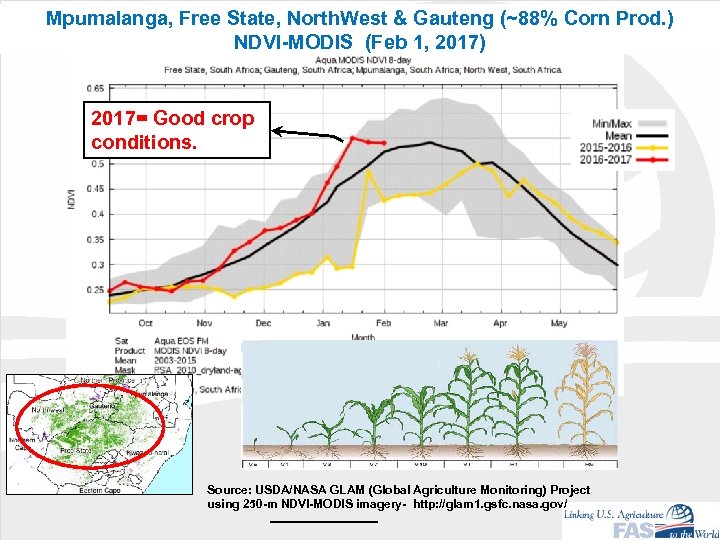
Mpumalanga, Free State, North. West & Gauteng (~88% Corn Prod. ) NDVI-MODIS (Feb 1, 2017) 2017= Good crop conditions. Source: USDA/NASA GLAM (Global Agriculture Monitoring) Project using 250 -m NDVI-MODIS imagery- http: //glam 1. gsfc. nasa. gov/
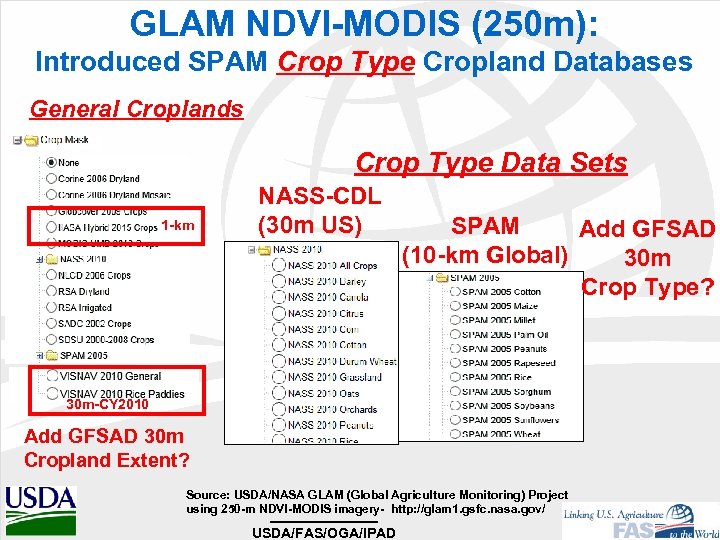
GLAM NDVI-MODIS (250 m): Introduced SPAM Crop Type Cropland Databases General Croplands Crop Type Data Sets 1 -km NASS-CDL (30 m US) SPAM Add GFSAD (10 -km Global) 30 m Crop Type? 30 m-CY 2010 Add GFSAD 30 m Cropland Extent? Source: USDA/NASA GLAM (Global Agriculture Monitoring) Project using 250 -m NDVI-MODIS imagery- http: //glam 1. gsfc. nasa. gov/ USDA/FAS/OGA/IPAD
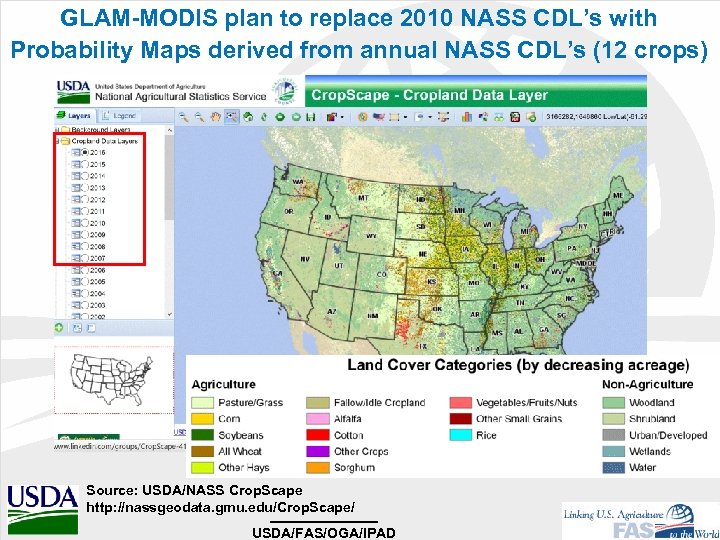
GLAM-MODIS plan to replace 2010 NASS CDL’s with Probability Maps derived from annual NASS CDL’s (12 crops) Source: USDA/NASS Crop. Scape http: //nassgeodata. gmu. edu/Crop. Scape/ USDA/FAS/OGA/IPAD
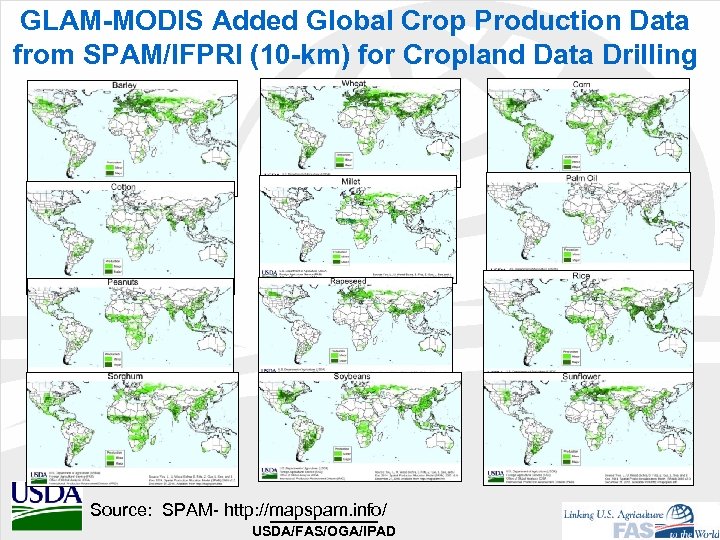
GLAM-MODIS Added Global Crop Production Data from SPAM/IFPRI (10 -km) for Cropland Data Drilling Source: SPAM- http: //mapspam. info/ USDA/FAS/OGA/IPAD
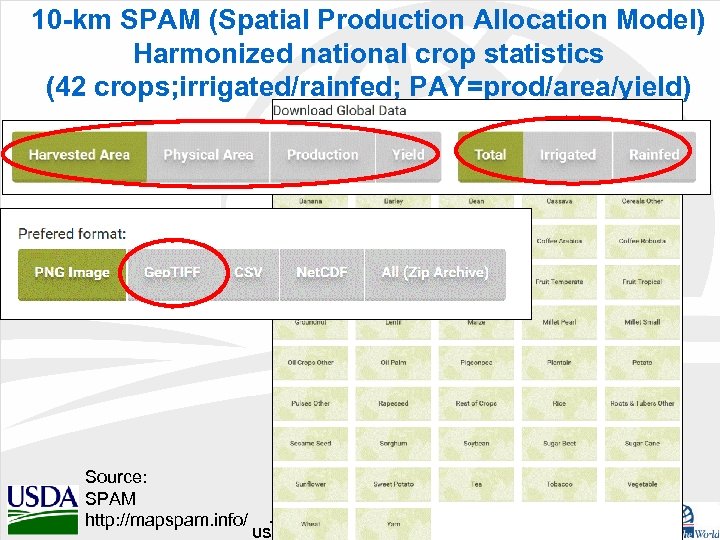
10 -km SPAM (Spatial Production Allocation Model) Harmonized national crop statistics (42 crops; irrigated/rainfed; PAY=prod/area/yield) Source: SPAM http: //mapspam. info/ USDA/FAS/OGA/IPAD
GLAM-MODIS (250 m) for Crop Yield: • Installed C 6 NDVI-MODIS (250 -m) time series (Aqua/Terra) – C 5 discontinue in March 2017 • Introduced SPAM (12 crops) for raster cropland data drilling – Barley, corn, cotton, millet, peanuts, palm oil, sorghum, rapeseed, rice, soybeans, sorghum, sunflower, wheat • Plan to stage NDVI-VIIRS (375 -m) archive from NASA-LANCE – Suomi-NPP launched Nov 2011 USDA/FAS/OGA/IPAD
GLAM-Landsat-7/8 (30 m) for Crop Area: • Landsat-7/8 (30 -m) 16 -day Composites – Automated cloud/shadow removal – Operational Surface Reflectance Correction • Landsat temporal data gap fill – Sentinel-2 A (10/20 m) – Sentinel-2 B (10/20 m) to be launched March 7 – IRS-2/AWi. FS-LISS 3 imagery for 50 US States • Available from USGS Earth Explorer (beginning April 2017? ) – IRS-2/AWi. FS-LISS 3 imagery for S. America USDA/FAS/OGA/IPAD
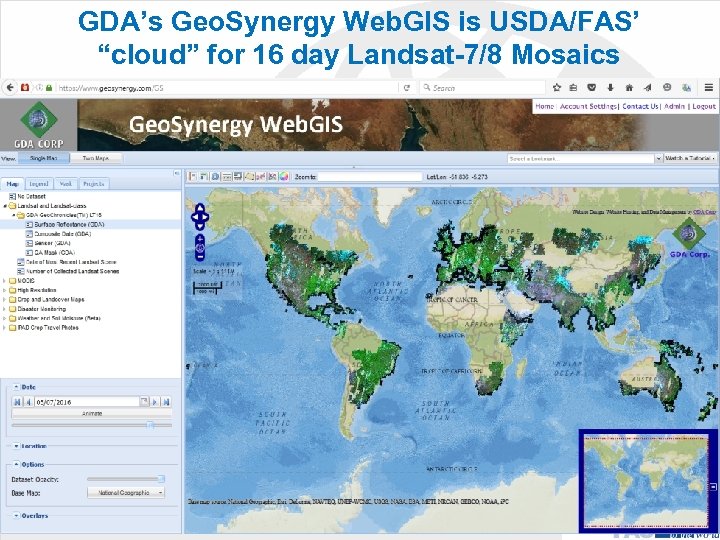
GDA’s Geo. Synergy Web. GIS is USDA/FAS’ “cloud” for 16 day Landsat-7/8 Mosaics
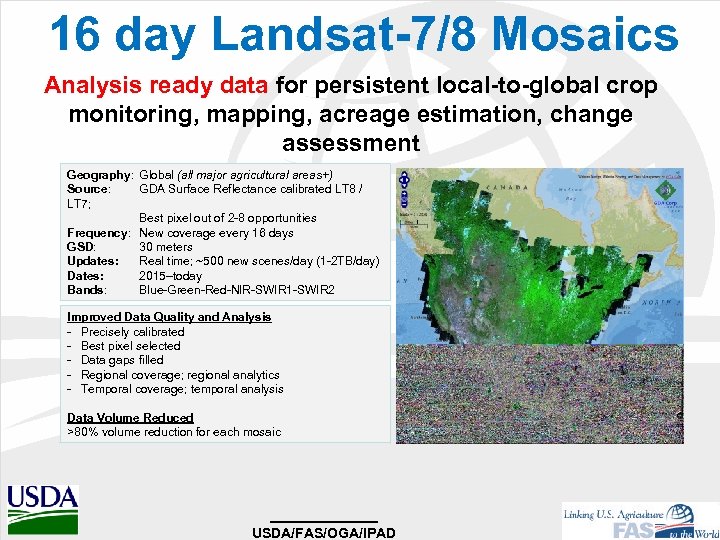
16 day Landsat-7/8 Mosaics Analysis ready data for persistent local-to-global crop monitoring, mapping, acreage estimation, change assessment Geography: Global (all major agricultural areas+) Source: GDA Surface Reflectance calibrated LT 8 / LT 7; Best pixel out of 2 -8 opportunities Frequency: New coverage every 16 days GSD: 30 meters Updates: Real time; ~500 new scenes/day (1 -2 TB/day) Dates: 2015–today Bands: Blue-Green-Red-NIR-SWIR 1 -SWIR 2 Improved Data Quality and Analysis - Precisely calibrated - Best pixel selected - Data gaps filled - Regional coverage; regional analytics - Temporal coverage; temporal analysis Data Volume Reduced >80% volume reduction for each mosaic USDA/FAS/OGA/IPAD
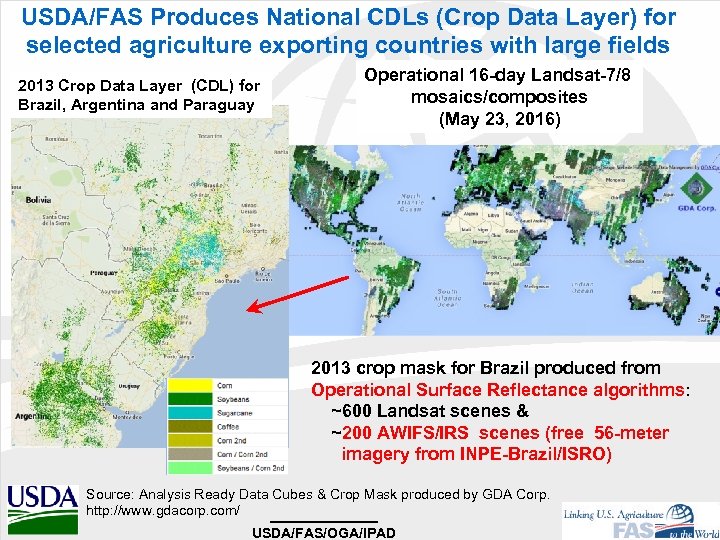
USDA/FAS Produces National CDLs (Crop Data Layer) for selected agriculture exporting countries with large fields 2013 Crop Data Layer (CDL) for Brazil, Argentina and Paraguay Operational 16 -day Landsat-7/8 mosaics/composites (May 23, 2016) 2013 crop mask for Brazil produced from Operational Surface Reflectance algorithms: ~600 Landsat scenes & ~200 AWIFS/IRS scenes (free 56 -meter imagery from INPE-Brazil/ISRO) Source: Analysis Ready Data Cubes & Crop Mask produced by GDA Corp. http: //www. gdacorp. com/ USDA/FAS/OGA/IPAD
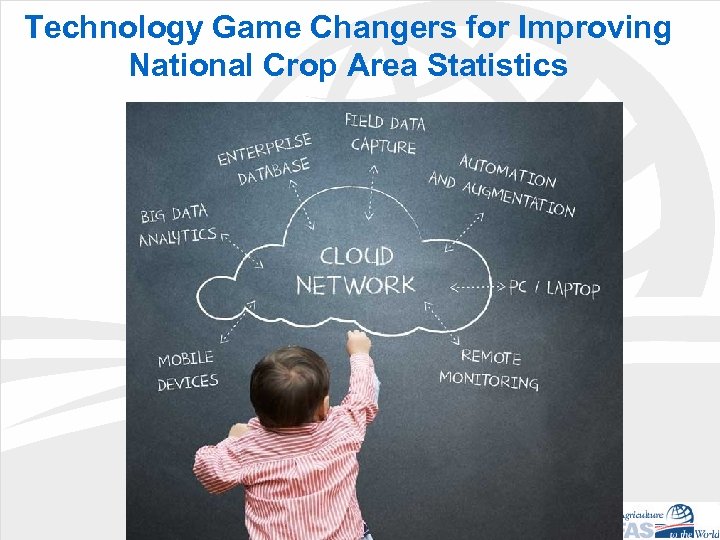
Technology Game Changers for Improving National Crop Area Statistics
New Tools for Improving National Crop Area Statistics • Free Landsat-7/8 (30 -m) Imagery – Free Sentinel-2 A/2 B (10/20 m) Imagery for data fill • Free Cloud Computing – Google Earth Engine (GEE) • Smart phone photos for training sites collections: – GPS – Electronic Compass (bearing) – Notes (crop type) – Shout for GFSAD 30 Street View app USDA/FAS/OGA/IPAD
Perfect World: Every Ag Ministry (in every country) produces their own Landsat-derived CDL’s for Complementing National Crop Area Statistics • Free Landsat-7/8 Imagery & generate 16 -day Composites • Fill Landsat data gaps with Sentinel-2 A/2 B (S-2 B to be launched on March 7, 2017) • Image frequency matters for improving accuracy!!! • Accuracy increases during growing season (as more cloud free images are stacked by end of season). • Google Earth Engine (GEE) for processing each monthly CDL • Collect & upload training sites from mid-season. • Smart phones with GPS, e-compass bearing & crop type notes. • Finalize end-of-season CDL product. – Classified Geotiff image at end of each crop season. – Extract crop area statistics by Administration Unit USDA/FAS/OGA/IPAD
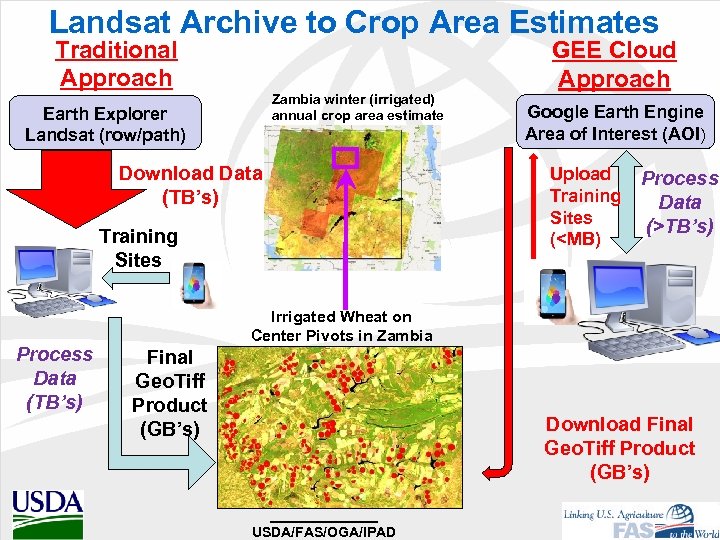
Landsat Archive to Crop Area Estimates Traditional Approach Zambia winter (irrigated) annual crop area estimate Earth Explorer Landsat (row/path) Download Data (TB’s) Training Sites Process Data (TB’s) GEE Cloud Approach Google Earth Engine Area of Interest (AOI) Upload Training Sites (<MB) Process Data (>TB’s) Irrigated Wheat on Center Pivots in Zambia Final Geo. Tiff Product (GB’s) Download Final Geo. Tiff Product (GB’s) USDA/FAS/OGA/IPAD
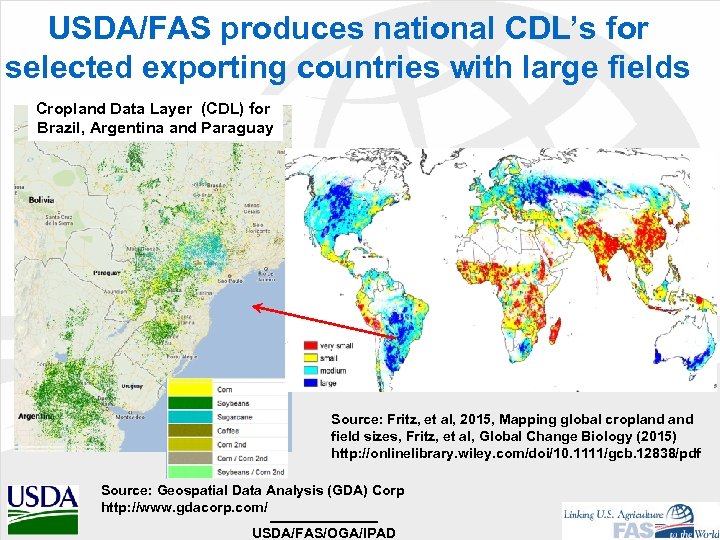
USDA/FAS produces national CDL’s for selected exporting countries with large fields Cropland Data Layer (CDL) for Brazil, Argentina and Paraguay Source: Fritz, et al, 2015, Mapping global cropland field sizes, Fritz, et al, Global Change Biology (2015) http: //onlinelibrary. wiley. com/doi/10. 1111/gcb. 12838/pdf Source: Geospatial Data Analysis (GDA) Corp http: //www. gdacorp. com/ USDA/FAS/OGA/IPAD
GLAM (Landsat & MODIS) Summary • National CDL’s produced by national ag departments (via Landsat-7/8 & S-2 A on GEE) would be useful for complementing national crop statistics. – Deliverable: CDL in Geo. Tiff format • Several years of CDLs would assist in producing cropland probability maps. • National CDL’s and global crop type Geo. Tiffs are useful for raster cropland data drilling (synergy between MODIS & Landsat) – Annual NASS CDL’s (geotiff) – SPAM (42 crops) archive (geotiff) USDA/FAS/OGA/IPAD
Global Cropland Additions to GEE? Require Baseline Cropland Data Sets for cropland data drilling with NDVI-MODIS time-series – Stage existing Global Cropland data sets (30 -1000 m) • 30 m Landsat Cropland data sets from China • 1 -km Hybrid/IIASA • 350 m MERIS Glob. Cover (irrigated/rainfed) • 500 m MODIS Land Cover Type product (MCD 12 Q 1) – Land Cover Types 1 & 2 (IGBP & UMD) – Stage 10 -km SPAM/IFPRI data sets for 42 crops; • PAY (prod, area and yield) • Total, rainfed and irrigated – GFSAD 30 global products USDA/FAS/OGA/IPAD
Thank you for sharing your research, cropland products and innovations • GFSAD 30 workshops & GEE Summits (web outreach) made me a “GEE believer”. • Denis (“Dee”) Mutiibwa from Inu. Teq will discuss using Landsat imagery to classify irrigated vs. dryland agriculture USDA/FAS/OGA/IPAD
Скачать презентацию Latest Updates to USDA s GLAM Global Agriculture Monitoring
96d3dc647b7a511900f638e3d603a2d9.ppt