


 Скачать презентацию Last Week Tonight with John Oliver Scientific Studies
1938527273e16abd9beba2cf99a143eb.ppt
- Количество слайдов: 47
 Last Week Tonight with John Oliver: Scientific Studies (HBO) The Practice of Statistics, 5 th Edition 1
 Activity: Female Mathematicians A company has 11 mathematicians on its staff, 3 of which are women. The president of the company is concerned about the small number of women mathematicians. The president learns that about 40% of the mathematicians in the US are women, and asks you to investigate whether or not the number of women mathematicians in the company is consistent with the national pool. Q: What is the president worried about? Q: What is the percentage of women mathematicians on staff? 40% is “the truth”. It will NEVER CHANGE! The number of women mathematicians on staff could change from company to company. The Practice of Statistics, 5 th Edition 2
 Activity: Female Mathematicians A company has 11 mathematicians on its staff, 3 of which are women. The president of the company is concerned about the small number of women mathematicians. The president learns that about 40% of the mathematicians in the US are women, and asks you to investigate whether or not the number of women mathematicians in the company is consistent with the national pool. There should be a total of 11 10 -sided dice at your desk. These represent each mathematician at the company. Q: How would you design this experiment to see if the number of women mathematicians in the company is consistent with the national pool? We want to have some of the numbers on the dice represent women and some represent men. Q: What percentage of the numbers should represent women? The Practice of Statistics, 5 th Edition 3
 Activity: Female Mathematicians A company has 11 mathematicians on its staff, 3 of which are women. The president of the company is concerned about the small number of women mathematicians. The president learns that about 40% of the mathematicians in the US are women, and asks you to investigate whether or not the number of women mathematicians in the company is consistent with the national pool. Let’s assign the numbers 0 -3 to represent women (a total of 4 out of 10 numbers) and assign the numbers 4 -9 to represent men (a total of 6 out of 10 numbers). Roll the dice 5 times and record your results of the number of female and male mathematicians using the assigned numbers. On a poster paper, I will draw and label a number line for a class dotplot. Use a sticky to mark how many females you had in each experiment. You should only need 5 sticky’s to show what you got in each of the experiments. The Practice of Statistics, 5 th Edition 4
 Activity: Female Mathematicians A company has 11 mathematicians on its staff, 3 of which are women. The president of the company is concerned about the small number of women mathematicians. The president learns that about 40% of the mathematicians in the US are women, and asks you to investigate whether or not the number of women mathematicians in the company is consistent with the national pool. Q: Do we have evidence that the company has a small percentage of women mathematicians? What advice would you give the president of the company? Q: Would your advice change if the number of female mathematicians decreased to 1? Increased to 8? Q: How could we improve the experiment to better see if the number of female mathematicians is unjust? The Practice of Statistics, 5 th Edition 5
 CHAPTER 4 Designing Studies 4. 1 Samples and Surveys The Practice of Statistics, 5 th Edition Starnes, Tabor, Yates, Moore Bedford Freeman Worth Publishers
 Samples and Surveys Learning Objectives After this section, you should be able to: ü IDENTIFY the population and sample in a statistical study. ü IDENTIFY voluntary response samples and convenience samples. EXPLAIN how these sampling methods can lead to bias. ü DESCRIBE how to obtain a random sample using slips of paper, technology, or a table of random digits. ü DISTINGUISH a simple random sample from a stratified random sample or cluster sample. Give the advantages and disadvantages of each sampling method. ü EXPLAIN how undercoverage, nonresponse, question wording, and other aspects of a sample survey can lead to bias. The Practice of Statistics, 5 th Edition 7
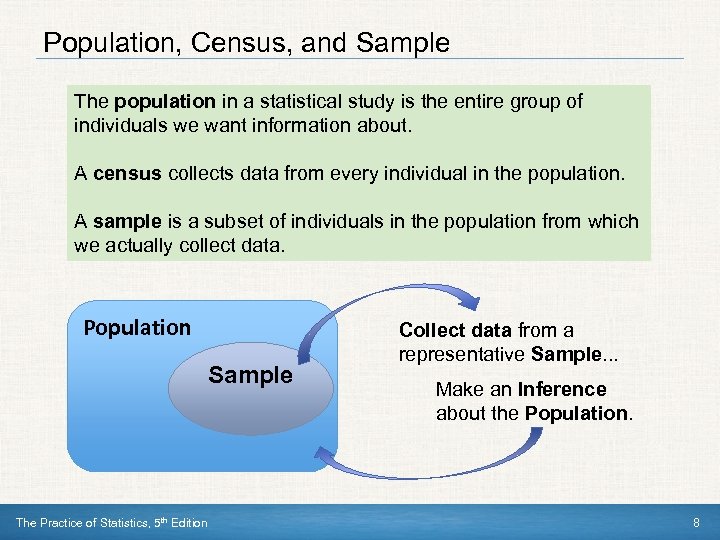 Population, Census, and Sample The population in a statistical study is the entire group of individuals we want information about. A census collects data from every individual in the population. A sample is a subset of individuals in the population from which we actually collect data. Population Sample The Practice of Statistics, 5 th Edition Collect data from a representative Sample. . . Make an Inference about the Population. 8
 Against All Odds: Census and Sampling https: //www. learner. org/courses/againstallodds/unitpages/unit 16. html The Practice of Statistics, 5 th Edition 9
 Example 1: Sampling Hardwood and Humans Identify the population and the sample in each of the following settings. a. A furniture maker buys hardwood in large batches. The supplier is supposed to dry the wood before shipping (wood that isn’t dry won’t hold its size and shape). The furniture maker chooses five pieces of wood from each batch and test their moisture content. If any piece exceeds 12% moisture content, the entire batch is sent back. Population: all the pieces of hardwood in a batch Sample: the five pieces of wood that are selected from that batch and tested for moisture content b. Each week, the Gallup Poll questions a sample of about 1500 adult U. S. residents to determine national opinion on a wide variety of issues. Population: all adult U. S. residents Sample: the 1500 adults who actually respond to the survey questions The Practice of Statistics, 5 th Edition 10
 The Idea of a Sample Survey We often draw conclusions about a whole population on the basis of a sample. Have you ever tasted a sample of ice cream and ordered a cone if the sample tastes good? Because ice cream is fairly uniform, the single taste represents the whole. Choosing a sample from a large, varied population (like all young U. S. drivers) is not that easy. Choosing a Sample Step 1: Define the population we want to describe. Step 2: Say exactly what we want to measure. A “sample survey” is a study that uses an organized plan to choose a sample that represents some specific population. Step 3: Decide how to choose a sample from the population. The Practice of Statistics, 5 th Edition 11
 How to Sample Badly How can we choose a sample that we can trust to represent the population? There a number of different methods to select samples. Choosing individuals from the population who are easy to reach results in a convenience sample. Ex: Suppose we want to know how long students at a large high school spent doing homework last week. We might go to the school library and ask the first 30 students we see about their homework time. The Practice of Statistics, 5 th Edition 12
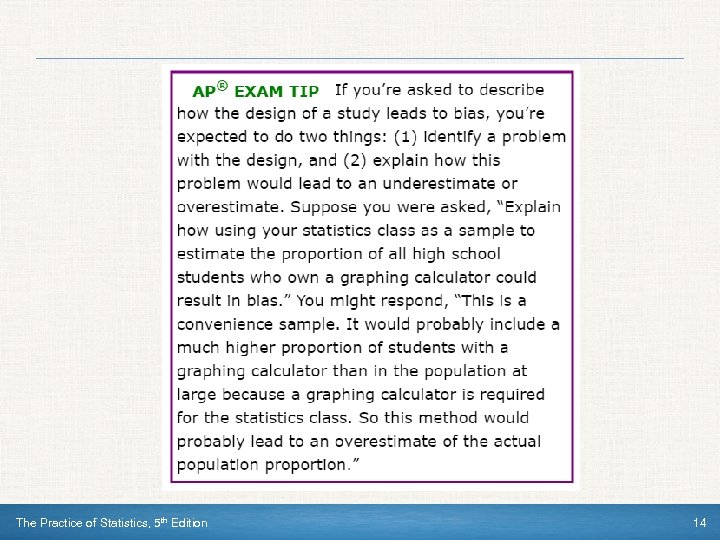
 How to Sample Badly Convenience samples often produce unrepresentative data…why? The design of a statistical study shows bias if it would consistently underestimate or consistently overestimate the value you want to know. Note: We would almost always overestimate the average homework time in the population by asking those students in a library since they probably are more studious. The Practice of Statistics, 5 th Edition 13
 The Practice of Statistics, 5 th Edition 14
 How to Sample Badly Bias is not just bad luck in one sample. It’s the result of a bad study design that will consistently miss the truth about the population in the same way. Convenience samples are almost guaranteed to show bias. So are voluntary response samples, in which people decide whether to join the sample in response to an open invitation. A voluntary response sample consists of people who choose themselves by responding to a general invitation. Voluntary response samples show bias because people with strong opinions (often in the same direction) are most likely to respond. The Practice of Statistics, 5 th Edition 15
 Example 2: Illegal Immigration Former CNN commentator Lou Dobbs doesn’t like illegal immigration. One of his shows was largely devoted to attacking a proposal to offer driver’s licenses to illegal immigrants. During the show, Mr. Dobbs invited his viewers to go to loudobbs. com to vote on the question “Would you be more or less likely to vote for a presidential candidate who supports giving driver’s licenses to illegal aliens? ” The result: 97% of the 7359 people who voted by the end of the show said, “Less likely. ” What type of sample did Mr. Dobbs use in his poll? Explain how this sampling method could lead to bias in the poll results. Mr. Dobbs used a voluntary response sample: people chose to go online and respond. Those who voted were viewers of Mr. Dobb’s program, which means that they are likely to support his views. The 97% poll result is probably an extreme overestimate of the proportion of the percent of people in the population who would be less likely to support a presidential candidate with this position. The Practice of Statistics, 5 th Edition 16
 On Your Own: For each of the following situation, identify the sampling method used. Then explain how the sampling method could lead to bias. a. A farmer brings a juice company several crates of oranges each week. A company inspector looks at 10 oranges from the top of each crate before deciding whether to buy all the oranges. b. The ABC program Nightline once asked whether the United Nations should continue to have its headquarters in the United States. Viewers were invited to call one telephone number to respond “Yes” and another for “No. ” There was a charge for calling either number. More than 186, 000 callers responded, and 67% said “No. ” The Practice of Statistics, 5 th Edition 17
 How to Sample Well: Simple Random Sampling A sample chosen by chance rules out both favoritism by the sampler (convenience sampling) and self-selection by respondents (voluntary response sampling). Random sampling involves using a chance process to determine which members of a population are included in the sample. The Practice of Statistics, 5 th Edition 18
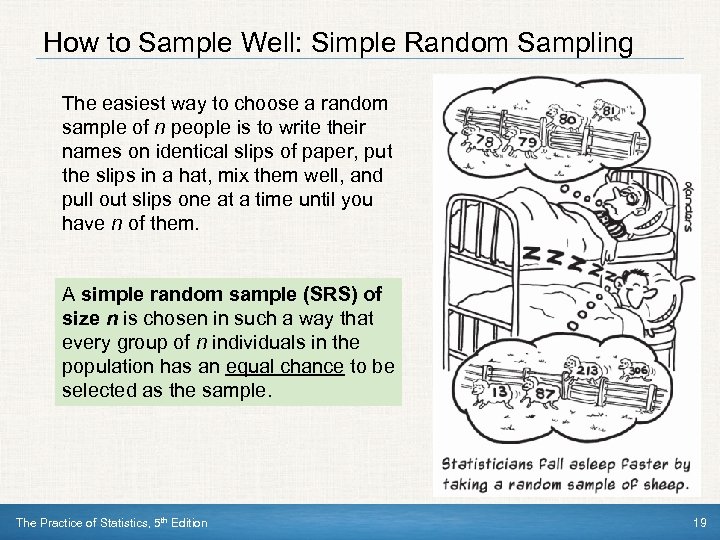 How to Sample Well: Simple Random Sampling The easiest way to choose a random sample of n people is to write their names on identical slips of paper, put the slips in a hat, mix them well, and pull out slips one at a time until you have n of them. A simple random sample (SRS) of size n is chosen in such a way that every group of n individuals in the population has an equal chance to be selected as the sample. The Practice of Statistics, 5 th Edition 19
 How to Sample Well: Simple Random Sampling The “hat method” above is unfortunately very time consuming and won’t work well if the population is large… Imagine trying to take a simple random sample of 1000 U. S. adults! In practice, people use random numbers generated by a computer or calculator to choose samples. If you don’t have technology handy, you can use a table of random digits. The Practice of Statistics, 5 th Edition 20
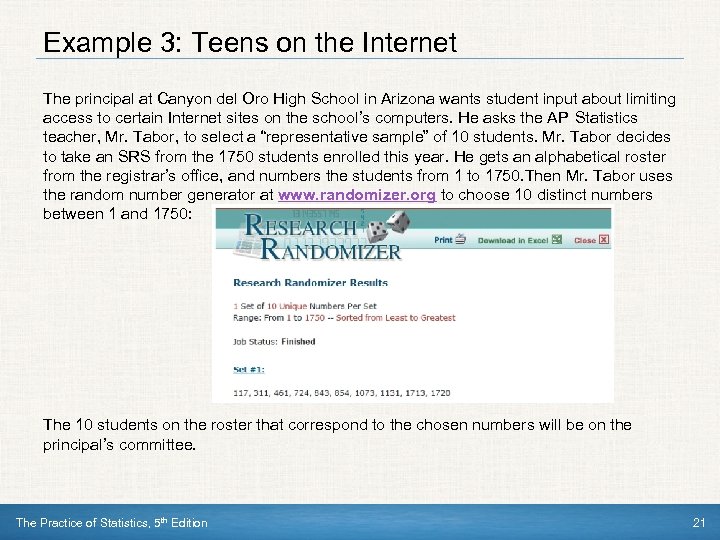 Example 3: Teens on the Internet The principal at Canyon del Oro High School in Arizona wants student input about limiting access to certain Internet sites on the school’s computers. He asks the AP Statistics teacher, Mr. Tabor, to select a “representative sample” of 10 students. Mr. Tabor decides to take an SRS from the 1750 students enrolled this year. He gets an alphabetical roster from the registrar’s office, and numbers the students from 1 to 1750. Then Mr. Tabor uses the random number generator at www. randomizer. org to choose 10 distinct numbers between 1 and 1750: The 10 students on the roster that correspond to the chosen numbers will be on the principal’s committee. The Practice of Statistics, 5 th Edition 21
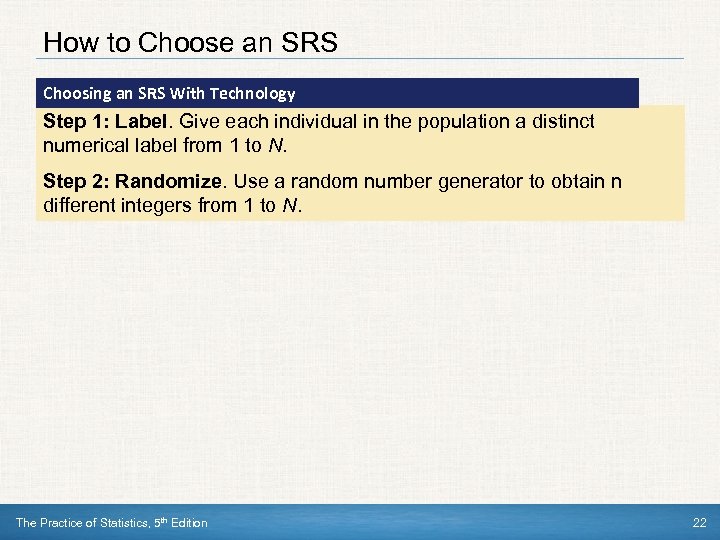 How to Choose an SRS Choosing an SRS With Technology Step 1: Label. Give each individual in the population a distinct numerical label from 1 to N. Step 2: Randomize. Use a random number generator to obtain n different integers from 1 to N. The Practice of Statistics, 5 th Edition 22
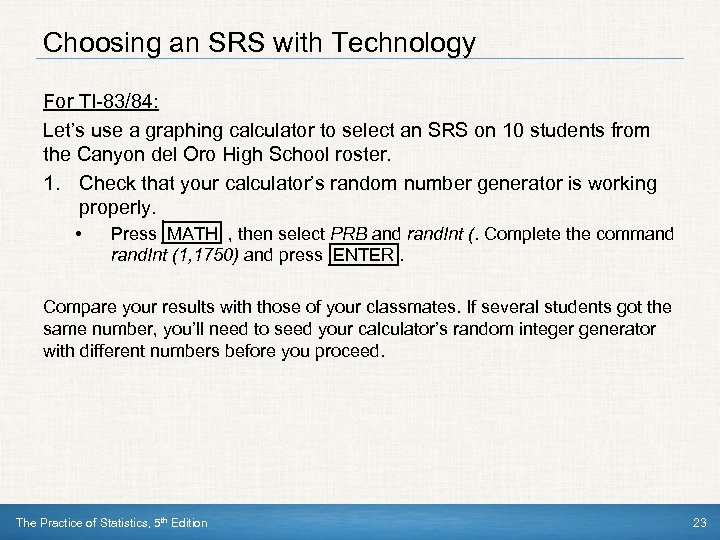 Choosing an SRS with Technology For TI-83/84: Let’s use a graphing calculator to select an SRS on 10 students from the Canyon del Oro High School roster. 1. Check that your calculator’s random number generator is working properly. • Press MATH , then select PRB and rand. Int (. Complete the command rand. Int (1, 1750) and press ENTER. Compare your results with those of your classmates. If several students got the same number, you’ll need to seed your calculator’s random integer generator with different numbers before you proceed. The Practice of Statistics, 5 th Edition 23
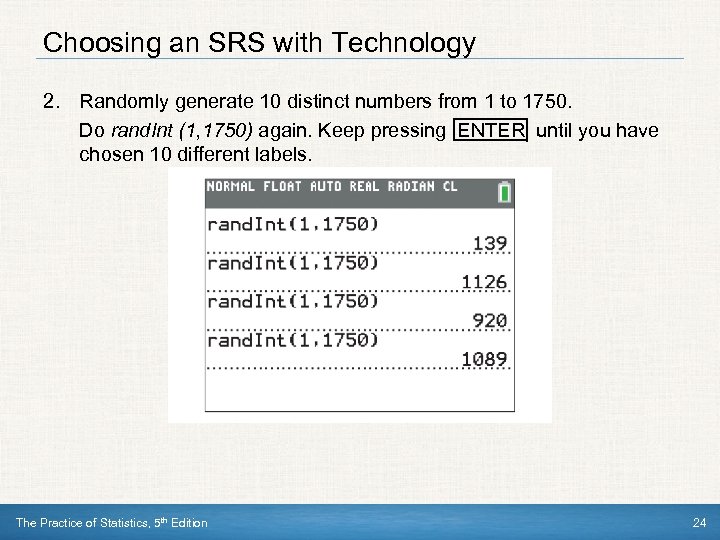 Choosing an SRS with Technology 2. Randomly generate 10 distinct numbers from 1 to 1750. Do rand. Int (1, 1750) again. Keep pressing ENTER until you have chosen 10 different labels. The Practice of Statistics, 5 th Edition 24
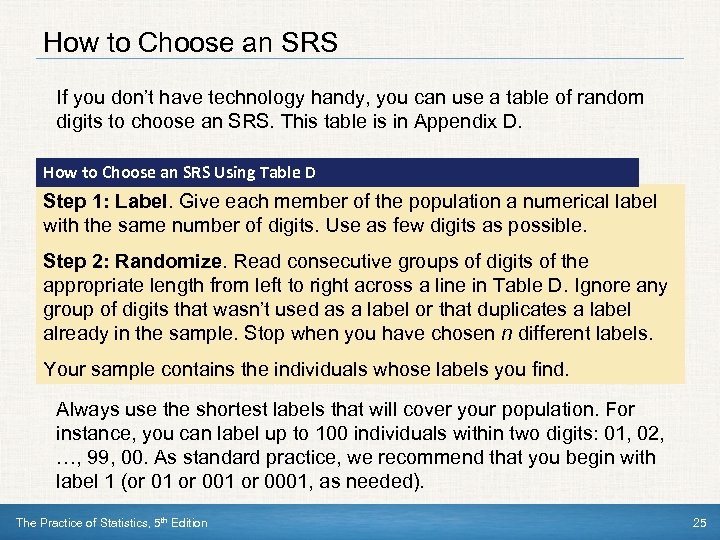 How to Choose an SRS If you don’t have technology handy, you can use a table of random digits to choose an SRS. This table is in Appendix D. How to Choose an SRS Using Table D Step 1: Label. Give each member of the population a numerical label with the same number of digits. Use as few digits as possible. Step 2: Randomize. Read consecutive groups of digits of the appropriate length from left to right across a line in Table D. Ignore any group of digits that wasn’t used as a label or that duplicates a label already in the sample. Stop when you have chosen n different labels. Your sample contains the individuals whose labels you find. Always use the shortest labels that will cover your population. For instance, you can label up to 100 individuals within two digits: 01, 02, …, 99, 00. As standard practice, we recommend that you begin with label 1 (or 01 or 0001, as needed). The Practice of Statistics, 5 th Edition 25
 Example 4: Spring Break! The school newspaper is planning an article on family-friendly places to stay over spring break at a nearby beach town. The editors intend to call 4 randomly chosen hotels to ask about their amenities for families with children. They have an alphabetized list of all 28 hotels in the town. Problem: Use Table D at line 130 to choose an SRS of 4 hotels. Solution on next slide… The Practice of Statistics, 5 th Edition 26
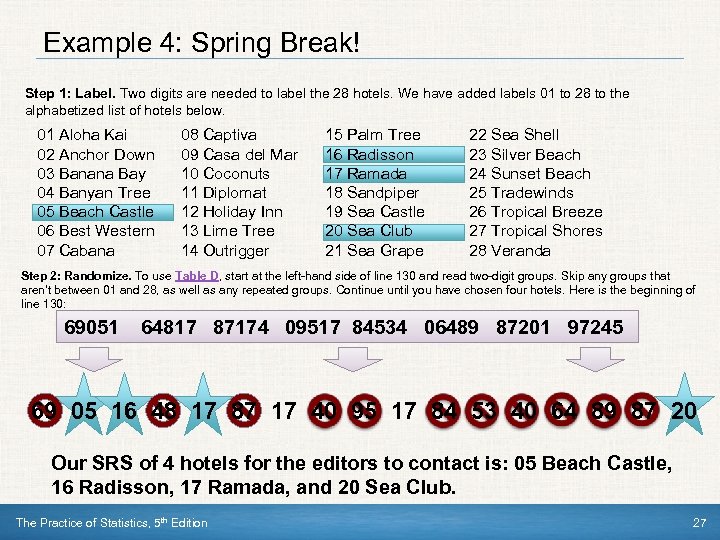 Example 4: Spring Break! Step 1: Label. Two digits are needed to label the 28 hotels. We have added labels 01 to 28 to the alphabetized list of hotels below. 01 Aloha Kai 02 Anchor Down 03 Banana Bay 04 Banyan Tree 05 Beach Castle 06 Best Western 07 Cabana 08 Captiva 09 Casa del Mar 10 Coconuts 11 Diplomat 12 Holiday Inn 13 Lime Tree 14 Outrigger 15 Palm Tree 16 Radisson 17 Ramada 18 Sandpiper 19 Sea Castle 20 Sea Club 21 Sea Grape 22 Sea Shell 23 Silver Beach 24 Sunset Beach 25 Tradewinds 26 Tropical Breeze 27 Tropical Shores 28 Veranda Step 2: Randomize. To use Table D, start at the left-hand side of line 130 and read two-digit groups. Skip any groups that aren’t between 01 and 28, as well as any repeated groups. Continue until you have chosen four hotels. Here is the beginning of line 130: 69051 64817 87174 09517 84534 06489 87201 97245 69 05 16 48 17 87 17 40 95 17 84 53 40 64 89 87 20 Our SRS of 4 hotels for the editors to contact is: 05 Beach Castle, 16 Radisson, 17 Ramada, and 20 Sea Club. The Practice of Statistics, 5 th Edition 27
 Problem with SRS The basic idea of sampling is straightforward: take an SRS from the population and use your sample results to gain information about the population. Unfortunately, it’s usually difficult to get an SRS from the population of interest. Imagine trying to get a simple random sample of all the batteries produced in one day at a factory. Or an SRS of all U. S. high school students. In either case, it would be difficult to obtain an accurate list of the population from which to draw the sample. It would also be very time-consuming to collect data from each individual that’s randomly selected. The Practice of Statistics, 5 th Edition 28
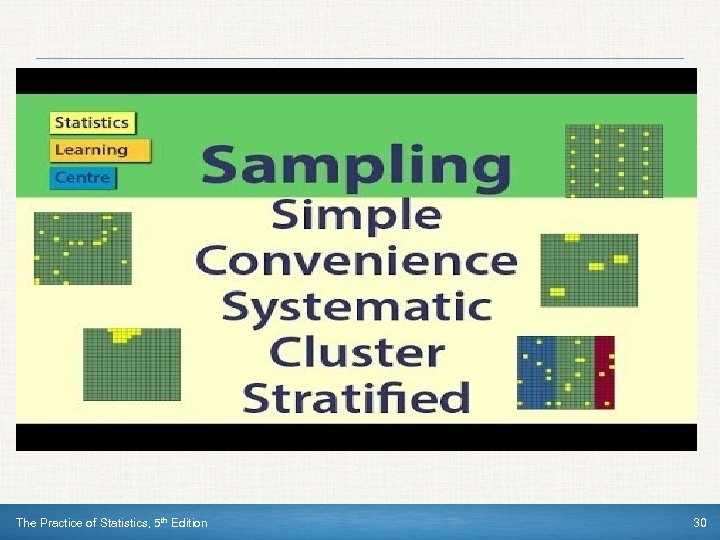
 Stratified Random Sample Sometimes there are statistical advantages to using more complex sampling methods. To get a stratified random sample, start by classifying the population into groups of similar individuals, called strata. Then choose a separate SRS in each stratum and combine these SRS’s to form the sample. Choose the strata based on facts known before the sample is taken. For example, in a study of sleep habits on school nights, the population of students in a large high school might be divided into freshman, sophomore, junior, and senior strata. In a pre-election poll, a population of election districts might be divided into urban, suburban, and rural strata. Stratified random sampling works best when the individuals within each stratum are similar with respect to what is being measured and when there are large differences between strata. The Practice of Statistics, 5 th Edition 29
 The Practice of Statistics, 5 th Edition 30
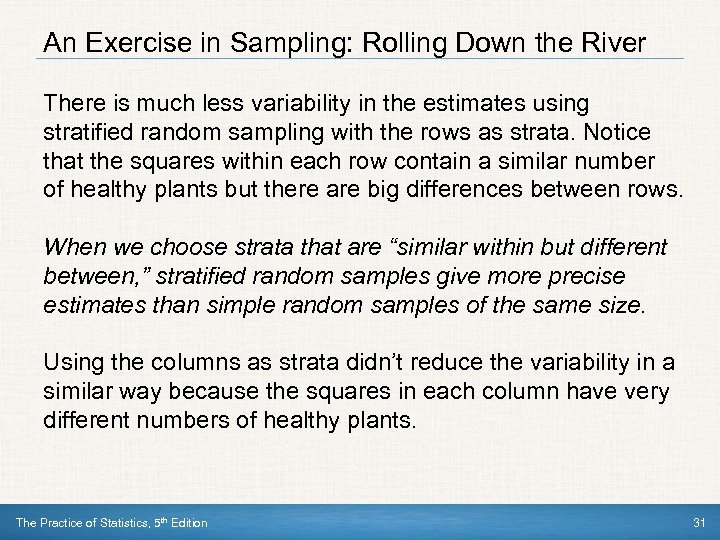 An Exercise in Sampling: Rolling Down the River There is much less variability in the estimates using stratified random sampling with the rows as strata. Notice that the squares within each row contain a similar number of healthy plants but there are big differences between rows. When we choose strata that are “similar within but different between, ” stratified random samples give more precise estimates than simple random samples of the same size. Using the columns as strata didn’t reduce the variability in a similar way because the squares in each column have very different numbers of healthy plants. The Practice of Statistics, 5 th Edition 31
 Cluster Sample Although a stratified random sample can sometimes give more precise information about a population than an SRS, both sampling methods are hard to use when populations are large and spread out over a wide area. In that situation, we’d prefer a method that selects groups of individuals that are “near” one another. To get a cluster sample, start by classifying the population into groups of individuals that are located near each other, called clusters. Then choose an SRS of the clusters. All individuals in the chosen clusters are included in the sample. The Practice of Statistics, 5 th Edition 32
 Cluster Sample • • Cluster samples are often used for practical reasons, like saving time and money. Cluster sampling works best when the clusters look just like the population but on a smaller scale. Imagine a large high school that assigns its students to homerooms alphabetically by last name. The school administration is considering a new schedule and would like student input. Administrators decide to survey 200 randomly selected students. It would be difficult to track down an SRS of 200 students, so the administration opts for a cluster sample of homerooms. The principal (who knows some statistics) takes a simple random sample of 8 homerooms and gives the survey to all 25 students in each homeroom. Cluster samples don’t offer the statistical advantage of better information about the population that stratified random samples do. That’s because clusters are often chosen for ease so they may have as much variability as the population itself. Be sure you understand the difference between strata and clusters! We want each stratum to contain similar individuals and for there to be large differences between strata. For a cluster sample, we’d like each cluster to look just like the population, but on a smaller scale. Remember: strata are ideally “similar within, but different between, ” while clusters are ideally “different within, but similar between. ” The Practice of Statistics, 5 th Edition 33
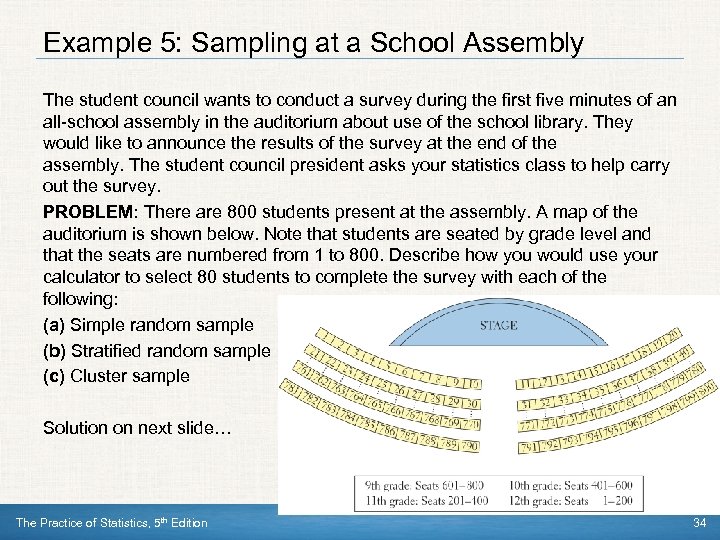 Example 5: Sampling at a School Assembly The student council wants to conduct a survey during the first five minutes of an all-school assembly in the auditorium about use of the school library. They would like to announce the results of the survey at the end of the assembly. The student council president asks your statistics class to help carry out the survey. PROBLEM: There are 800 students present at the assembly. A map of the auditorium is shown below. Note that students are seated by grade level and that the seats are numbered from 1 to 800. Describe how you would use your calculator to select 80 students to complete the survey with each of the following: (a) Simple random sample (b) Stratified random sample (c) Cluster sample Solution on next slide… The Practice of Statistics, 5 th Edition 34
 Example 5: Sampling at a School Assembly SOLUTION: (a) To take an SRS, we need to choose 80 of the seat numbers at random. Use rand. Int(1, 800) on your calculator until 80 different seats are selected. Then give the survey to the students in those seats. (b) The students in the assembly are seated by grade level. Because students’ library use might be similar within grade levels but different across grade levels, we’ll use the grade level seating areas as our strata. Within each grade’s seating area, we’ll select 20 seats at random. For the 9 th grade, use rand. Int(601, 800) to select 20 different seats. Use rand. Int(401, 600) to pick 20 different sophomore seats, rand. Int(201, 400) to get 20 different junior seats, and rand. Int(1, 200) to choose 20 different senior seats. Give the survey to the students in the selected seats. (c) With the way students are seated, each column of seats from the stage to the back of the auditorium could be used as a cluster. Note that each cluster contains students from all four grade levels, so each should represent the population well. Because there are 20 clusters, each with 40 seats, we need to choose 2 clusters at random to get 80 students for the survey. Use rand. Int(1, 20) to select two clusters, and then give the survey to all 40 students in each column of seats. The Practice of Statistics, 5 th Edition 35
 On Your Own: The manager of a sports arena wants to learn more about the financial status of the people who are attending an NBA basketball game. He would like to give a survey to a representative sample of the more than 20, 000 fans in attendance. Ticket prices for the game vary a great deal: seats near the court cost over $100 each, while seats in the top rows of the arena cost $25 each. The arena is divided into 30 numbered sections, from 101 to 130. Each section has rows of seats labeled with letters from A (nearest the court) to ZZ (top row of the arena). 1. Explain why it might be difficult to give the survey to an SRS of 200 fans. 2. Which would be a better way to take a stratified random sample of fans: using the lettered rows or the numbered sections as strata? Explain. 3. Which would be a better way to take a cluster sample of fans: using the lettered rows or the numbered sections as clusters? Explain. The Practice of Statistics, 5 th Edition 36
 Inference for Sampling The purpose of a sample is to give us information about a larger population. The process of drawing conclusions about a population on the basis of sample data is called inference because we infer information about the population from what we know about the sample. Why should we rely on random sampling? 1. To avoid bias in selecting samples from the list of available individuals. 2. The laws of probability allow trustworthy inference about the population • Results from random samples come with a margin of error that sets bounds on the size of the likely error. • Larger random samples give better information about the population than smaller samples. The Practice of Statistics, 5 th Edition 37
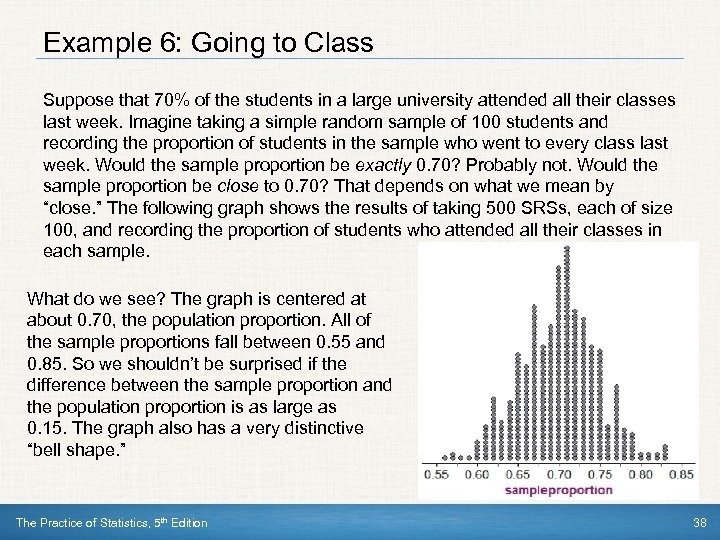 Example 6: Going to Class Suppose that 70% of the students in a large university attended all their classes last week. Imagine taking a simple random sample of 100 students and recording the proportion of students in the sample who went to every class last week. Would the sample proportion be exactly 0. 70? Probably not. Would the sample proportion be close to 0. 70? That depends on what we mean by “close. ” The following graph shows the results of taking 500 SRSs, each of size 100, and recording the proportion of students who attended all their classes in each sample. What do we see? The graph is centered at about 0. 70, the population proportion. All of the sample proportions fall between 0. 55 and 0. 85. So we shouldn’t be surprised if the difference between the sample proportion and the population proportion is as large as 0. 15. The graph also has a very distinctive “bell shape. ” The Practice of Statistics, 5 th Edition 38
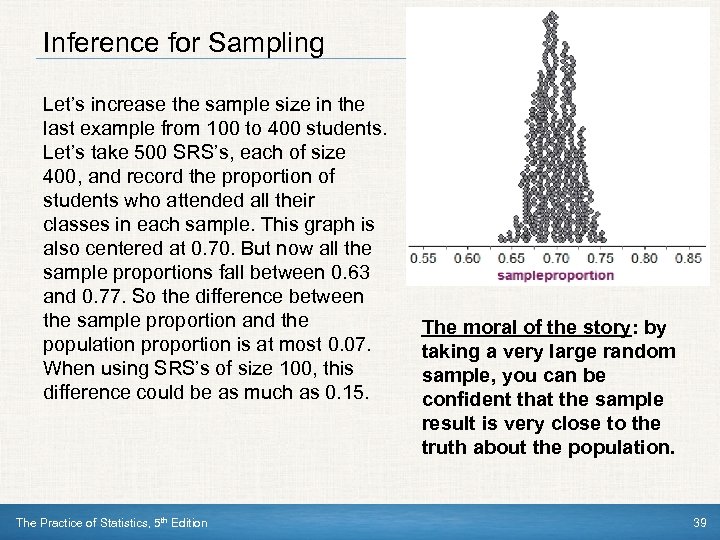 Inference for Sampling Let’s increase the sample size in the last example from 100 to 400 students. Let’s take 500 SRS’s, each of size 400, and record the proportion of students who attended all their classes in each sample. This graph is also centered at 0. 70. But now all the sample proportions fall between 0. 63 and 0. 77. So the difference between the sample proportion and the population proportion is at most 0. 07. When using SRS’s of size 100, this difference could be as much as 0. 15. The Practice of Statistics, 5 th Edition The moral of the story: by taking a very large random sample, you can be confident that the sample result is very close to the truth about the population. 39
 Sample Surveys: What Can Go Wrong? Most sample surveys are affected by errors in addition to sampling variability. Good sampling technique includes the art of reducing all sources of error. Undercoverage occurs when some members of the population cannot be chosen in a sample. Ex: A sample survey of households will miss not only homeless people but also prison inmates and students in dormitories. Ex: An opinion poll conducted by calling landline telephone numbers will miss households that have only cell phones as well as households without a phone. The Practice of Statistics, 5 th Edition 40
 Sample Surveys: What Can Go Wrong? The real problems start after the sample is chosen. Nonresponse occurs when an individual chosen for the sample can’t be contacted or refuses to participate. Nonresponse to surveys often exceeds 50%. Even with careful planning and several follow-up calls. If the people who respond differ from those who don’t, in a way that is related to the response, bias results. CAUTION: Some students misuse the term “voluntary response” to explain why certain individuals don’t respond in a sample survey. Their idea is that participation in the survey is optional(voluntary), so anyone can refuse to take part. What the students are describing is nonresponse. Think about it this way: nonresponse can occur only after a sample has been selected. In a voluntary response sample, every individual has opted to take part, so there won’t be any nonresponse. The Practice of Statistics, 5 th Edition 41
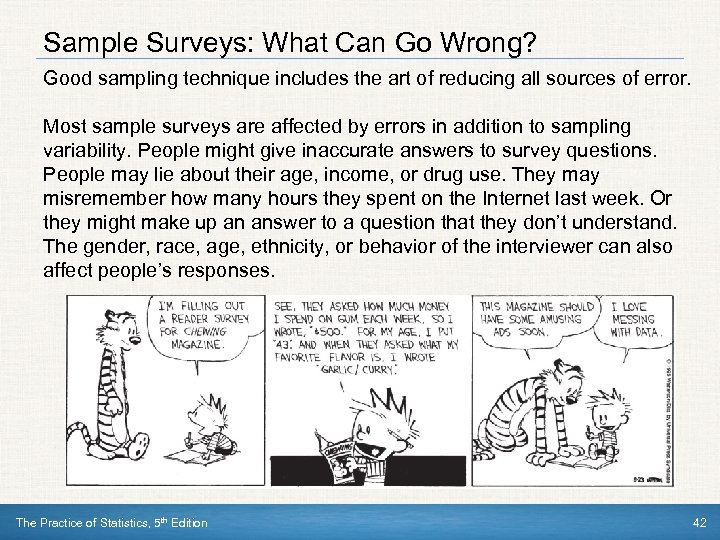 Sample Surveys: What Can Go Wrong? Good sampling technique includes the art of reducing all sources of error. Most sample surveys are affected by errors in addition to sampling variability. People might give inaccurate answers to survey questions. People may lie about their age, income, or drug use. They may misremember how many hours they spent on the Internet last week. Or they might make up an answer to a question that they don’t understand. The gender, race, age, ethnicity, or behavior of the interviewer can also affect people’s responses. The Practice of Statistics, 5 th Edition 42
 Sample Surveys: What Can Go Wrong? A systematic pattern of incorrect responses in a sample survey leads to response bias. The wording of questions is the most important influence on the answers given to a sample survey. Confusing or leading questions can introduce strong bias. Changes in wording can greatly affect a survey’s outcome. The Practice of Statistics, 5 th Edition 43
 Example 7: How Do Americans Feel about Illegal Immigrants? “Should illegal immigrants be prosecuted and deported for being in the U. S. illegally, or shouldn’t they? ” Asked this question in an opinion poll, 69% favored deportation. But when the very same sample was asked whether illegal immigrants who have worked in the United States for two years “should be given a chance to keep their jobs and eventually apply for legal status, ” 62% said that they should. Different questions give quite different impressions of attitudes toward illegal immigrants. Moral of the story: Even the order in which questions are asked matters. Don’t trust the results of a sample survey until you have read the exact questions asked. The Practice of Statistics, 5 th Edition 44
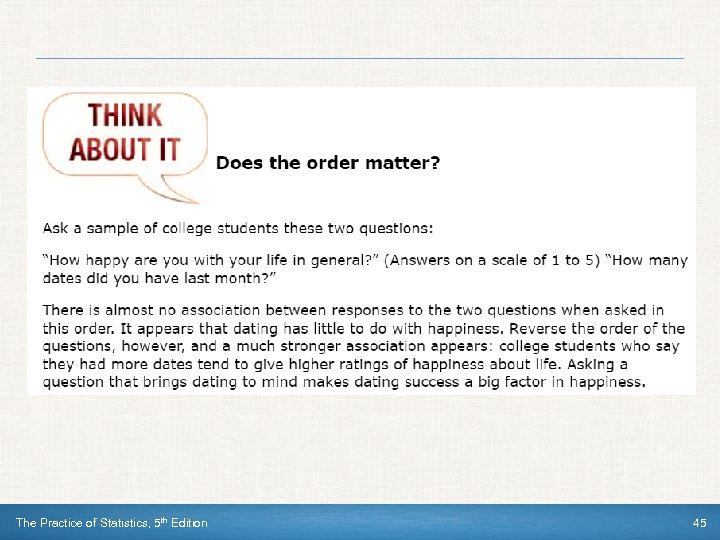 The Practice of Statistics, 5 th Edition 45
 On Your Own: 1. Each of the following is a possible source of bias in a sample survey. Name the type of bias that could result. a. The sample is chosen at random from a telephone directory. b. Some people cannot be contacted in five calls. c. Interviewers choose people walking by on the sidewalk to interview. 2. A survey paid for by makers of disposable diapers found that 84% of the sample opposed banning disposable diapers. Here is the actual question: It is estimated that disposable diapers account for less than 2% of the trash in today’s landfills. In contrast, beverage containers, third-class mail, and yard wastes are estimated to account for about 21% of the trash in landfills. Given this, in your opinion, would it be fair to ban disposable diapers? Explain how the wording of the question could result in bias. Be sure to specify the direction of the bias. The Practice of Statistics, 5 th Edition 46
 Samples and Surveys Section Summary In this section, we learned how to… ü IDENTIFY the population and sample in a statistical study. ü IDENTIFY voluntary response samples and convenience samples. EXPLAIN how these sampling methods can lead to bias. ü DESCRIBE how to obtain a random sample using slips of paper, technology, or a table of random digits. ü DISTINGUISH a simple random sample from a stratified random sample or cluster sample. Give the advantages and disadvantages of each sampling method. ü EXPLAIN how undercoverage, nonresponse, question wording, and other aspects of a sample survey can lead to bias. The Practice of Statistics, 5 th Edition 47