


 Скачать презентацию Laser interferometric gravitational wave detectors The search for
94d3110e1ccc14a5717a6f4b2abe0f8e.ppt
- Количество слайдов: 42
 Laser interferometric gravitational wave detectors The search for the elusive wave Nergis Mavalvala (LIGO Scientific Collaboration) ICOLS, June 2007
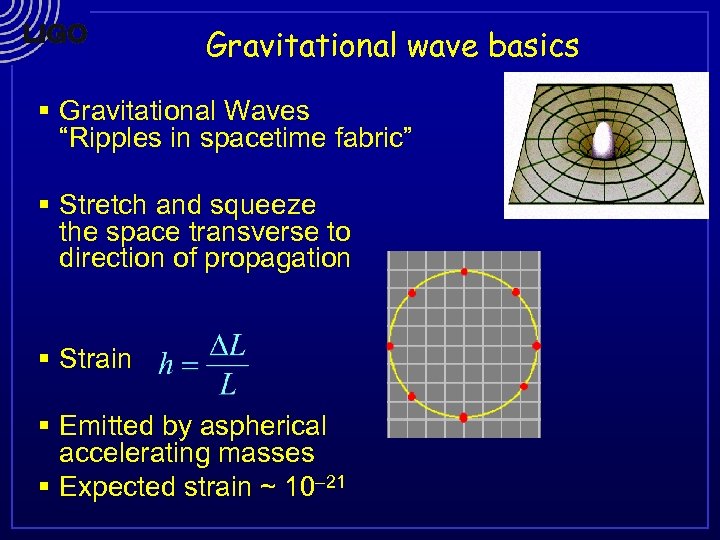 Gravitational wave basics § Gravitational Waves “Ripples in spacetime fabric” § Stretch and squeeze the space transverse to direction of propagation § Strain § Emitted by aspherical accelerating masses § Expected strain ~ 10 -21
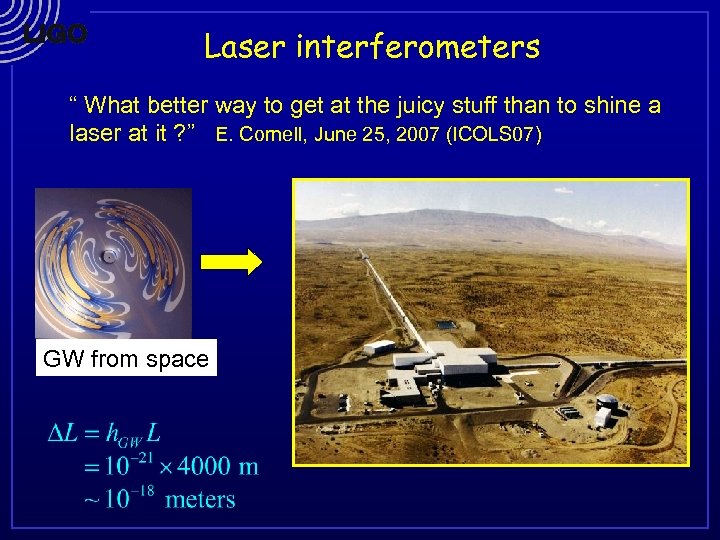 Laser interferometers “ What better way to get at the juicy stuff than to shine a laser at it ? ” E. Cornell, June 25, 2007 (ICOLS 07) Laser Photodetector GW from space Photodetector
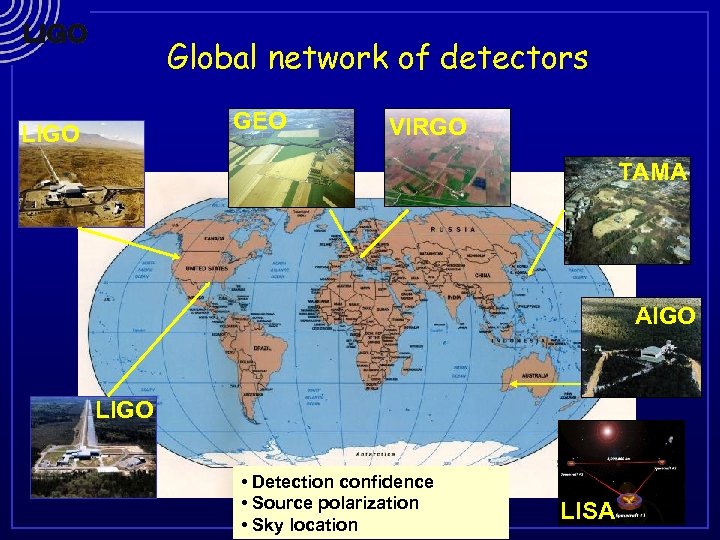 Global network of detectors GEO LIGO VIRGO TAMA AIGO LIGO • Detection confidence • Source polarization • Sky location LISA
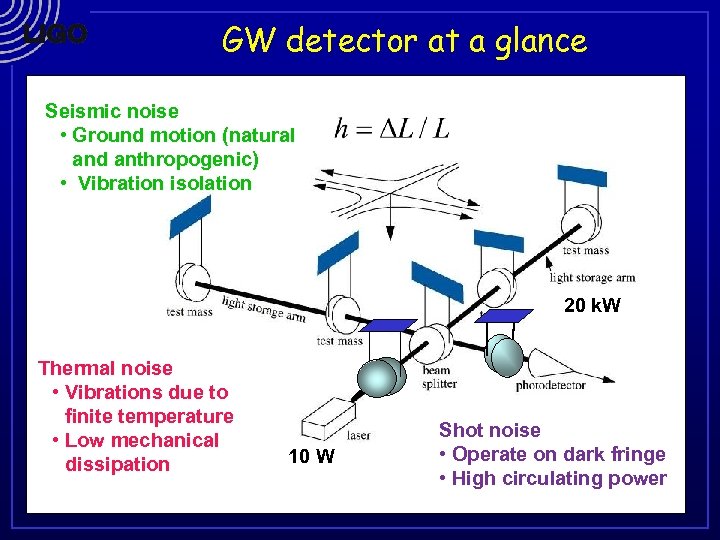 GW detector at a glance Seismic noise • Ground motion (natural and anthropogenic) • Vibration isolation 20 k. W Thermal noise • Vibrations due to finite temperature • Low mechanical dissipation 10 W Shot noise • Operate on dark fringe • High circulating power
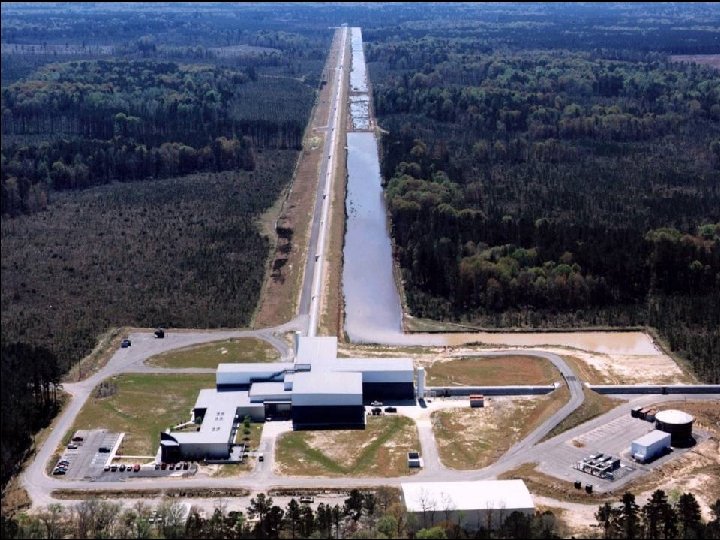
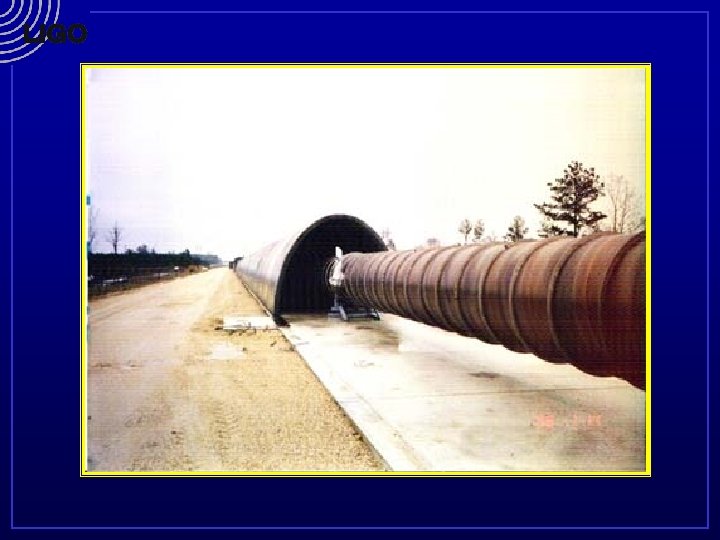
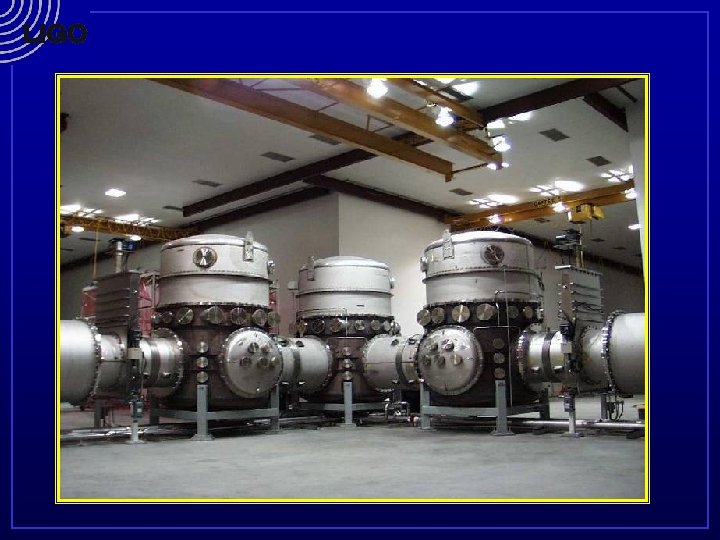
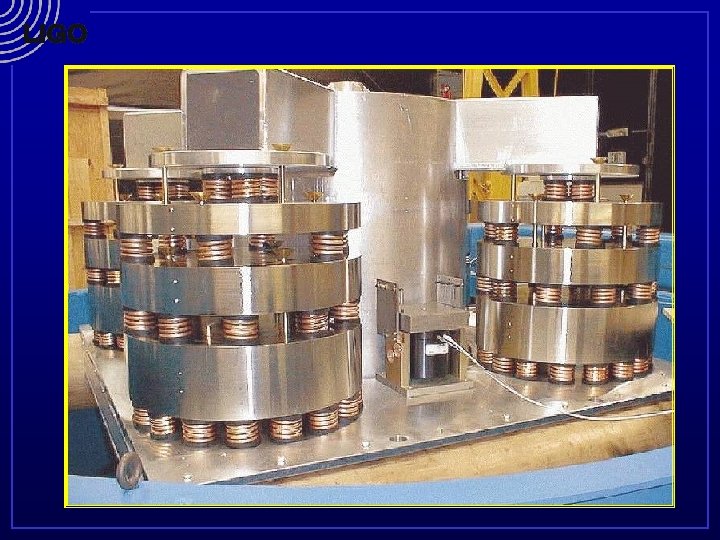
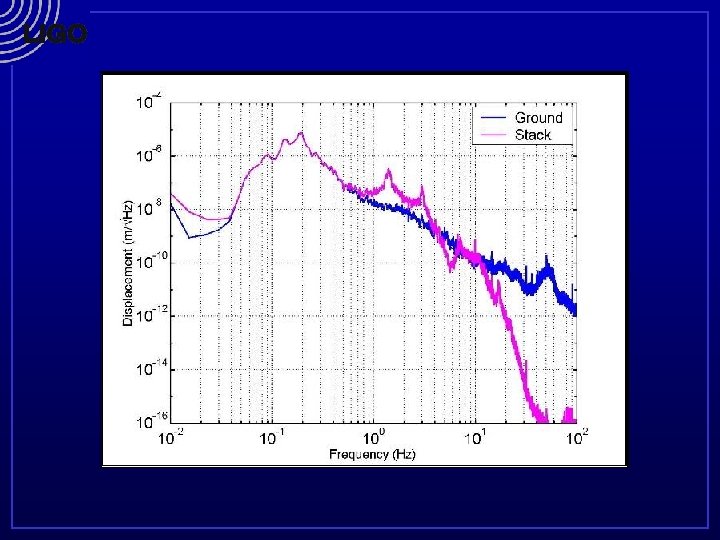
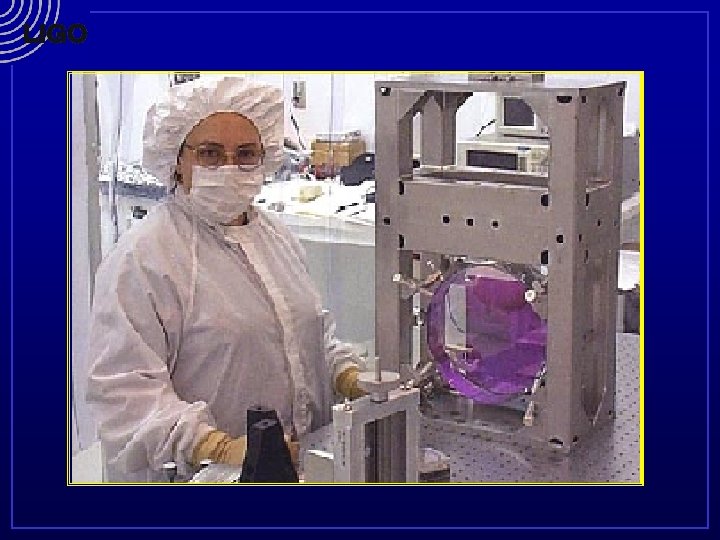
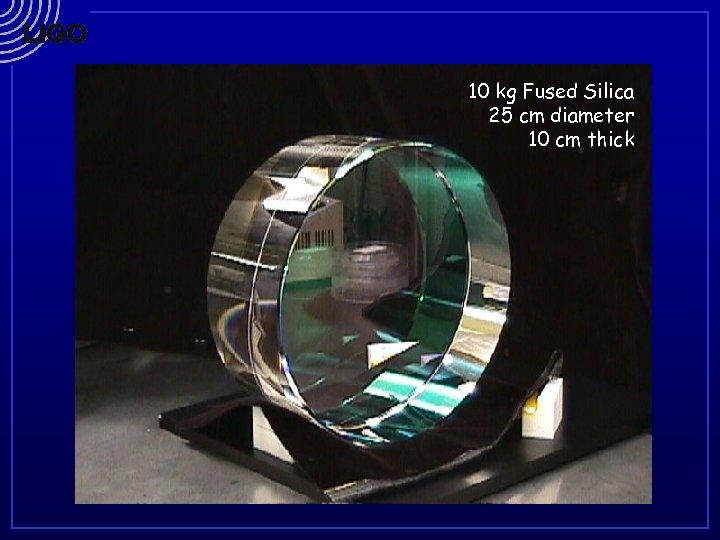 10 kg Fused Silica 25 cm diameter 10 cm thick
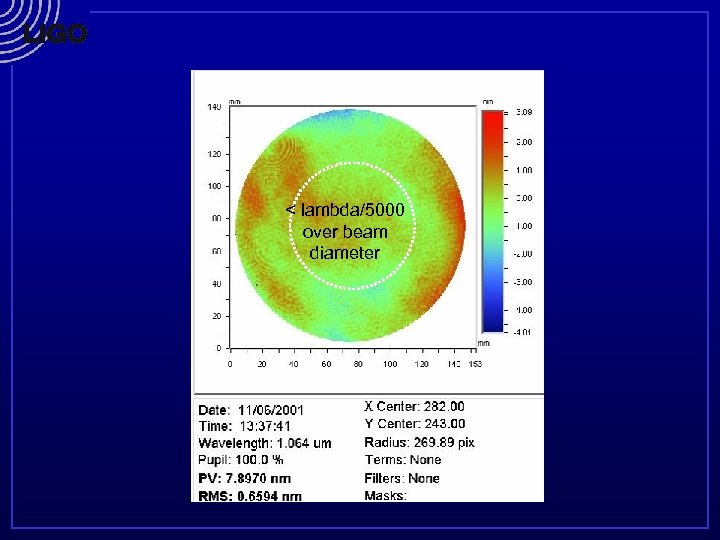 < lambda/5000 over beam diameter
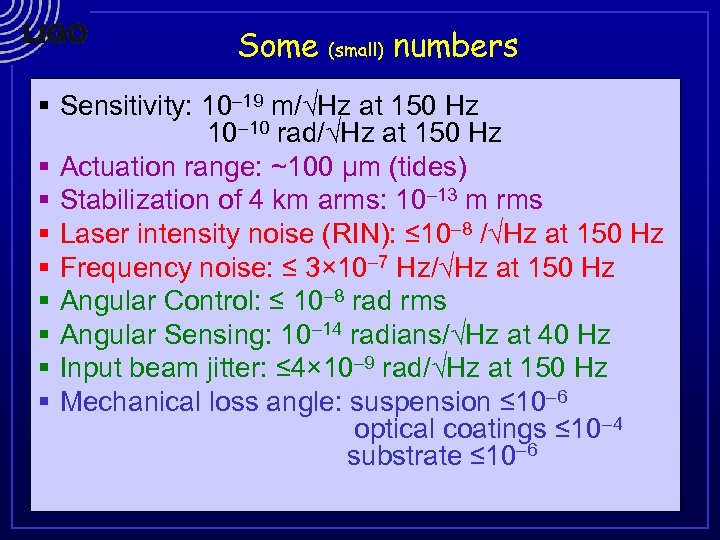 Some (small) numbers § Sensitivity: 10 -19 m/√Hz at 150 Hz 10 -10 rad/√Hz at 150 Hz § Actuation range: ~100 µm (tides) § Stabilization of 4 km arms: 10 -13 m rms § Laser intensity noise (RIN): ≤ 10 -8 /√Hz at 150 Hz § Frequency noise: ≤ 3× 10 -7 Hz/√Hz at 150 Hz § Angular Control: ≤ 10 -8 rad rms § Angular Sensing: 10 -14 radians/√Hz at 40 Hz § Input beam jitter: ≤ 4× 10 -9 rad/√Hz at 150 Hz § Mechanical loss angle: suspension ≤ 10 -6 optical coatings ≤ 10 -4 substrate ≤ 10 -6
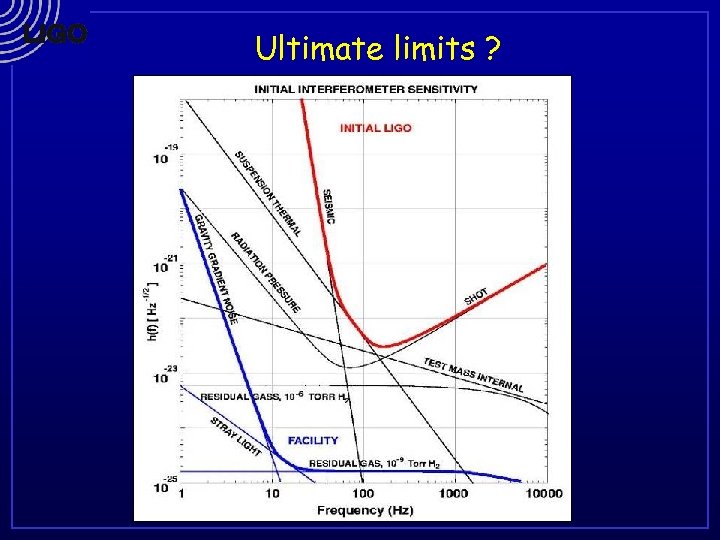
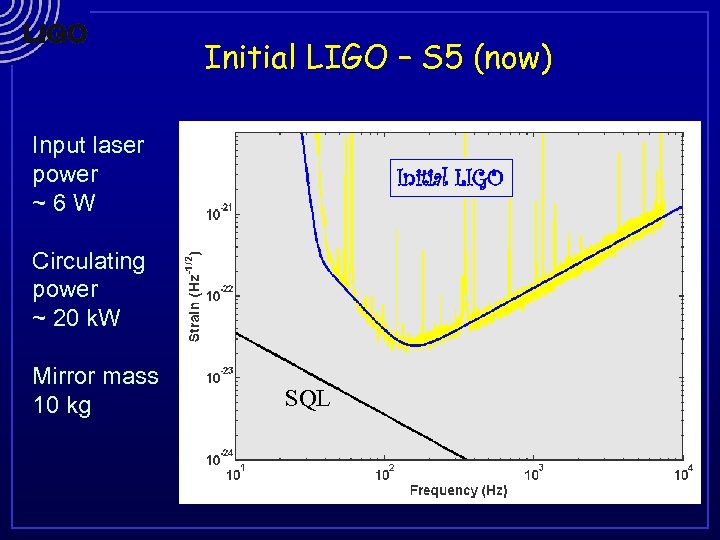
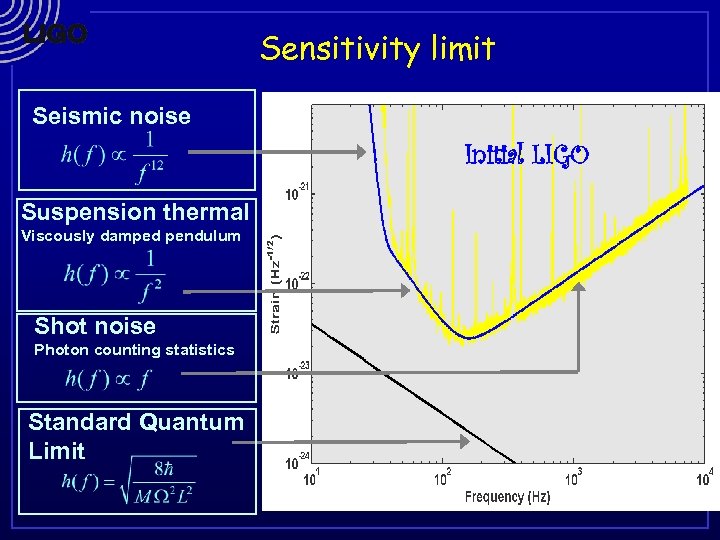 Sensitivity limit Seismic noise Initial LIGO Suspension thermal Viscously damped pendulum Shot noise Photon counting statistics Standard Quantum Limit
 Gravitational-wave searches Instrument and data
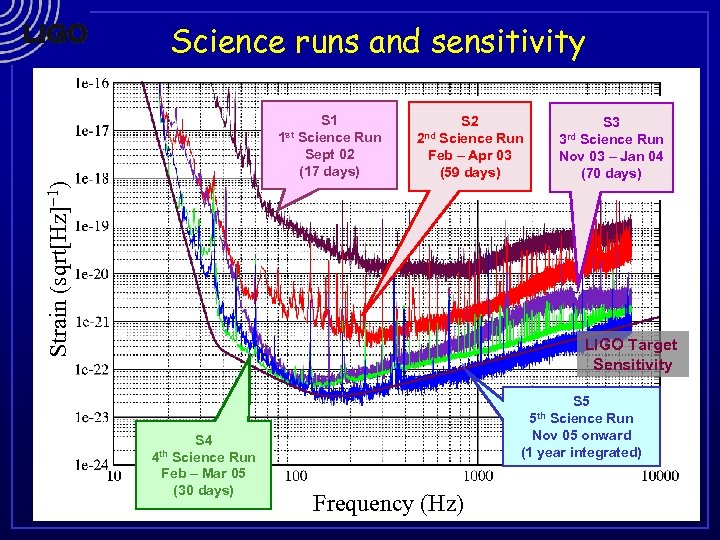 Science runs and sensitivity S 1 Science Run Sept 02 (17 days) S 2 Science Run Feb – Apr 03 (59 days) S 3 3 rd Science Run Nov 03 – Jan 04 (70 days) 2 nd Strain (sqrt[Hz]-1) 1 st LIGO Target Sensitivity S 5 Science Run Nov 05 onward (1 year integrated) 5 th S 4 Science Run Feb – Mar 05 (30 days) 4 th Frequency (Hz)
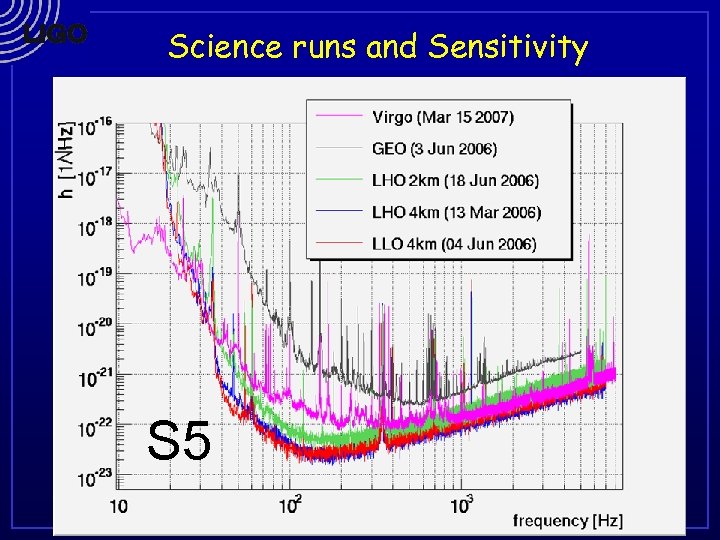 Science runs and Sensitivity S 5
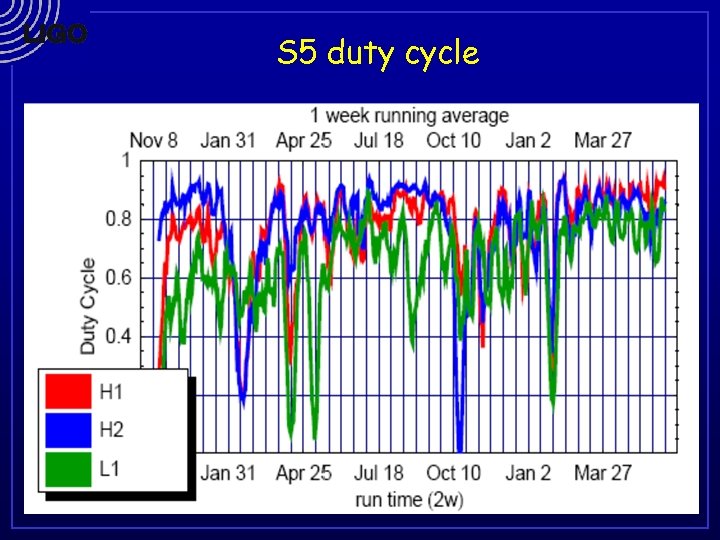 S 5 duty cycle
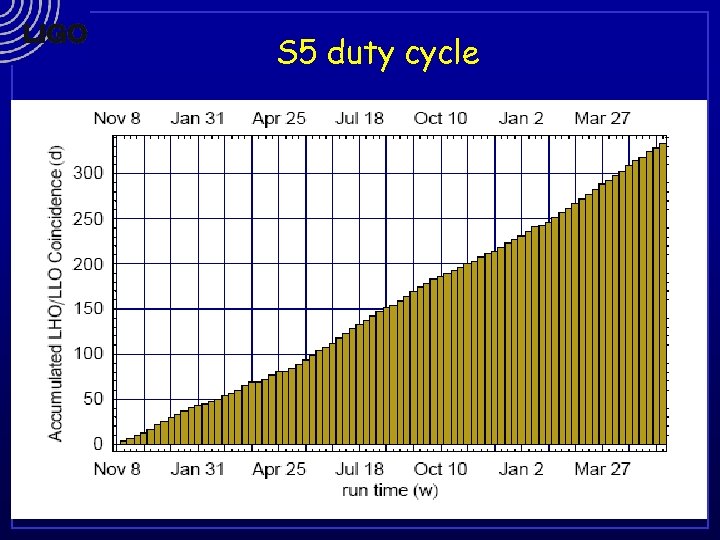 S 5 duty cycle
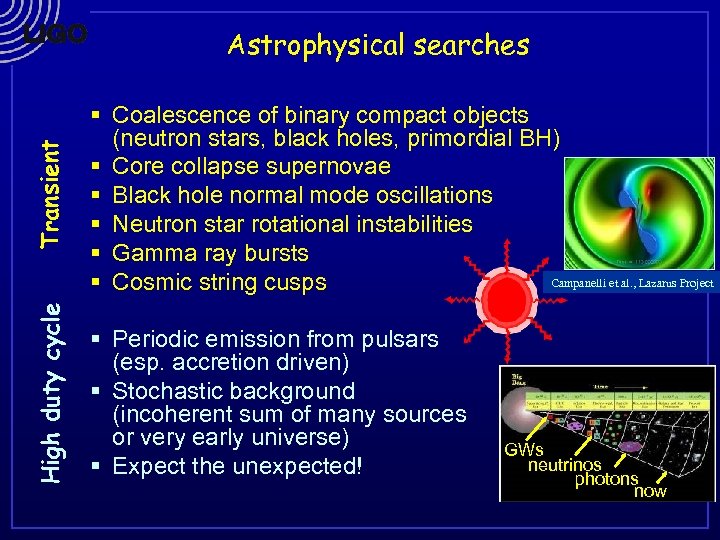 Transient § Coalescence of binary compact objects (neutron stars, black holes, primordial BH) § Core collapse supernovae § Black hole normal mode oscillations § Neutron star rotational instabilities § Gamma ray bursts Campanelli et al. , Lazarus Project § Cosmic string cusps High duty cycle Astrophysical searches § Periodic emission from pulsars (esp. accretion driven) § Stochastic background (incoherent sum of many sources or very early universe) § Expect the unexpected! GWs neutrinos photons now
 Sampling of current GW searches Stochastic Background
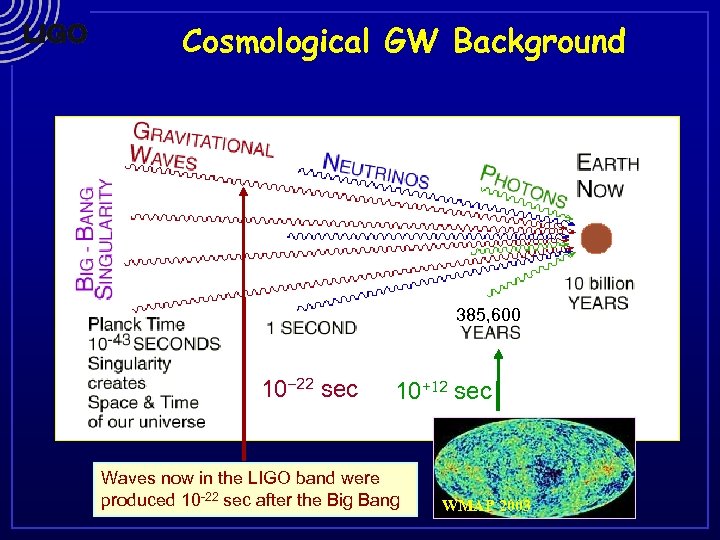 Cosmological GW Background 385, 600 10 -22 sec 10+12 sec Waves now in the LIGO band were produced 10 -22 sec after the Big Bang WMAP 2003
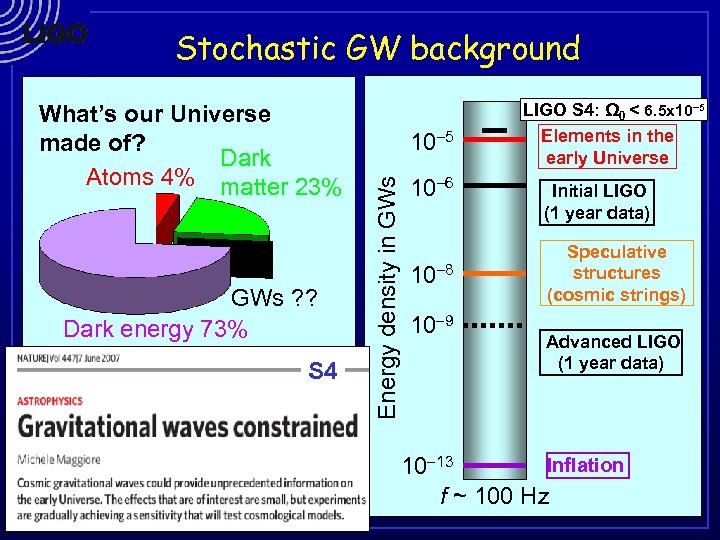 Stochastic GW background GWs ? ? Dark energy 73% S 4 10 -5 Energy density in GWs What’s our Universe made of? Dark Atoms 4% matter 23% 10 -6 10 -8 10 -9 LIGO S 4: Ω 0 < 6. 5 x 10 -5 Elements in the early Universe Initial LIGO (1 year data) Speculative structures (cosmic strings) Advanced LIGO (1 year data) Inflation 10 -13 f ~ 100 Hz
 Example of current GW searches Binary Inspirals
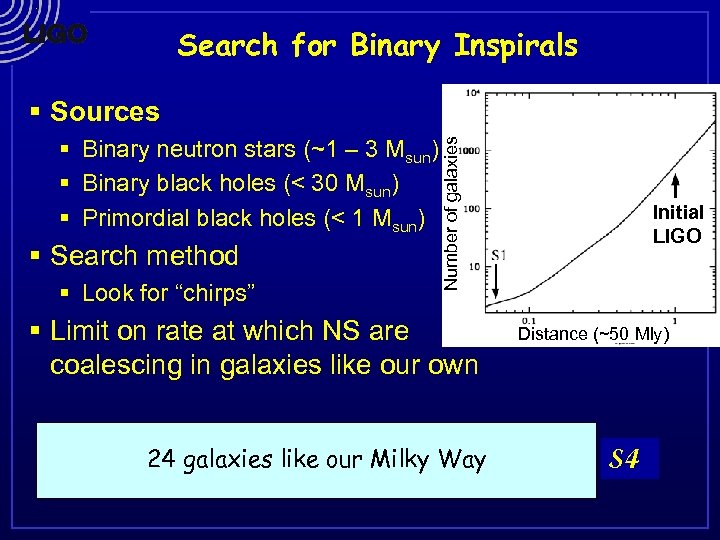 Search for Binary Inspirals § Binary neutron stars (~1 – 3 Msun) § Binary black holes (< 30 Msun) § Primordial black holes (< 1 Msun) § Search method § Look for “chirps” Number of galaxies § Sources Initial LIGO BBH BNS § Limit on rate at which NS are coalescing in galaxies like our own 24 galaxies like our Milky Way Distance (~50 Mly) S 4
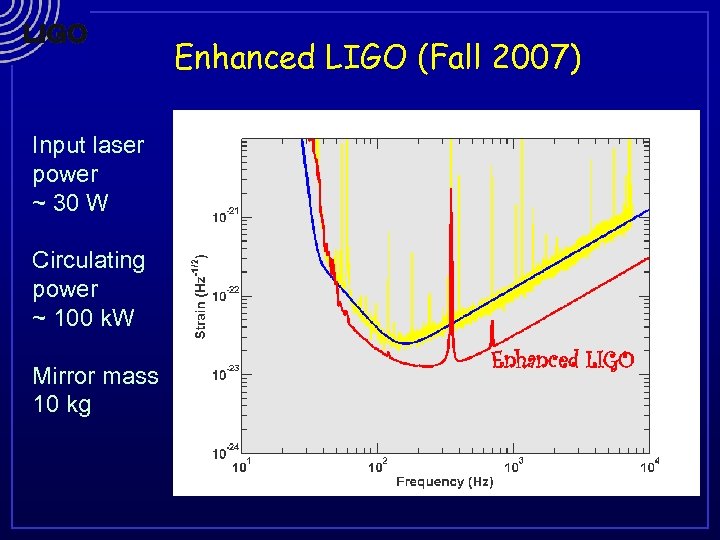
 Coming soon… to an interferometer near you Enhanced LIGO Advanced LIGO
 Ultimate limits ?
 Initial LIGO – S 5 (now) Input laser power ~6 W Initial LIGO Circulating power ~ 20 k. W Mirror mass 10 kg SQL
 Enhanced LIGO (Fall 2007) Input laser power ~ 30 W Circulating power ~ 100 k. W Mirror mass 10 kg Enhanced LIGO
 Advanced LIGO (2011) Input laser power > 100 W Circulating power > 0. 5 MW Mirror mass 40 kg Advanced LIGO
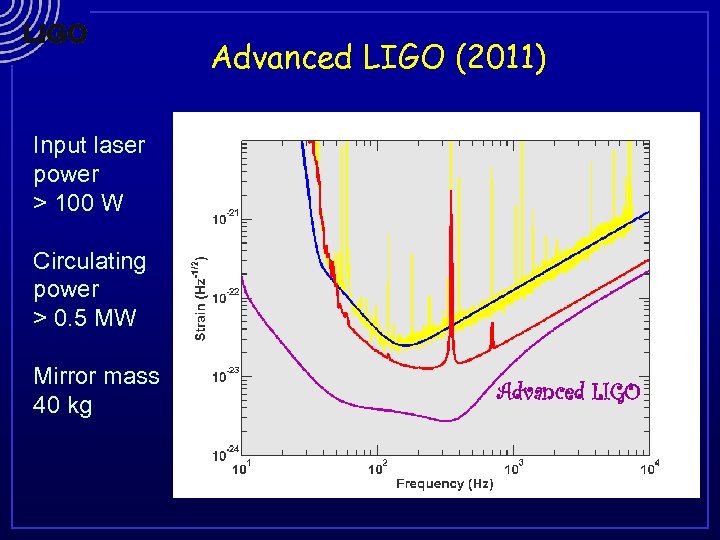
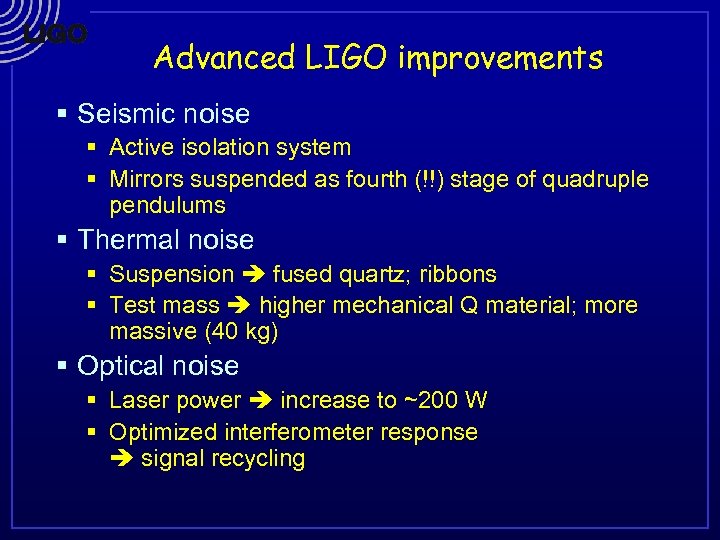 Advanced LIGO improvements § Seismic noise § Active isolation system § Mirrors suspended as fourth (!!) stage of quadruple pendulums § Thermal noise § Suspension fused quartz; ribbons § Test mass higher mechanical Q material; more massive (40 kg) § Optical noise § Laser power increase to ~200 W § Optimized interferometer response signal recycling
 Farther in the future Sub-quantum interferometry Space observatory
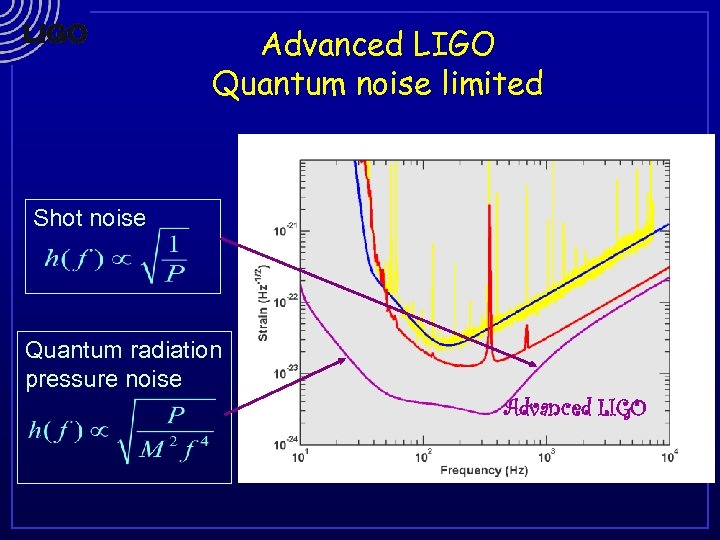 Advanced LIGO Quantum noise limited Shot noise Quantum radiation pressure noise Advanced LIGO
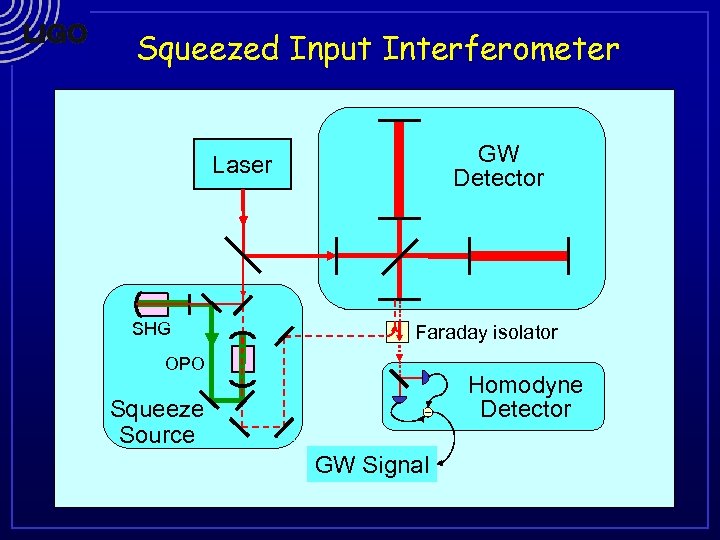 Squeezed Input Interferometer GW Detector Laser SHG Faraday isolator OPO Homodyne Detector Squeeze Source GW Signal
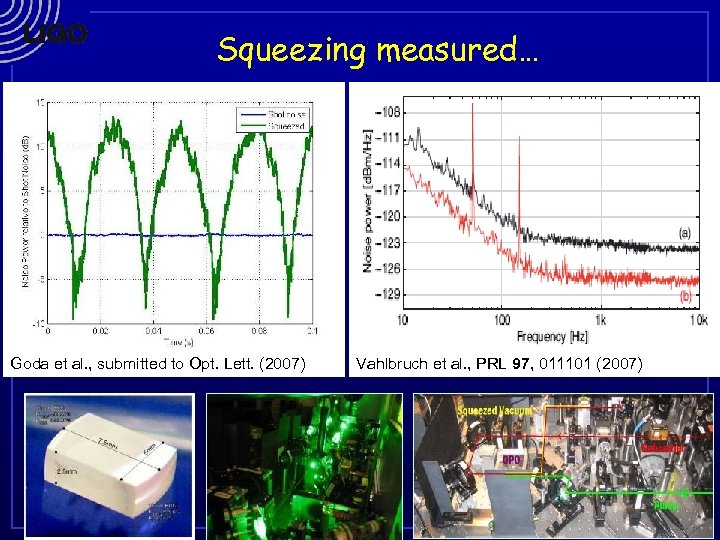 Squeezing measured… Goda et al. , submitted to Opt. Lett. (2007) Vahlbruch et al. , PRL 97, 011101 (2007)
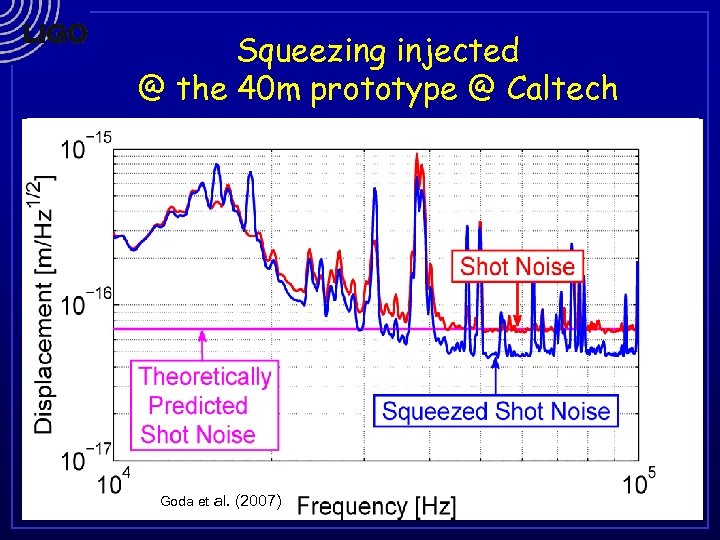 Squeezing injected @ the 40 m prototype @ Caltech Goda et al. (2007)
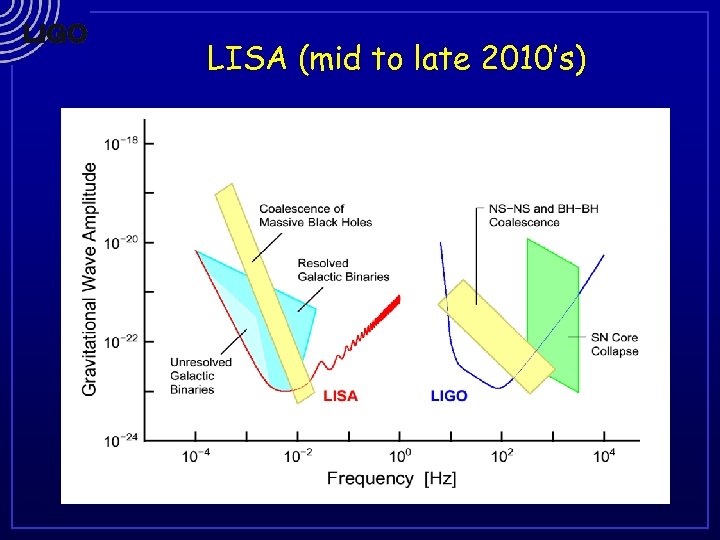 LISA (mid to late 2010’s)
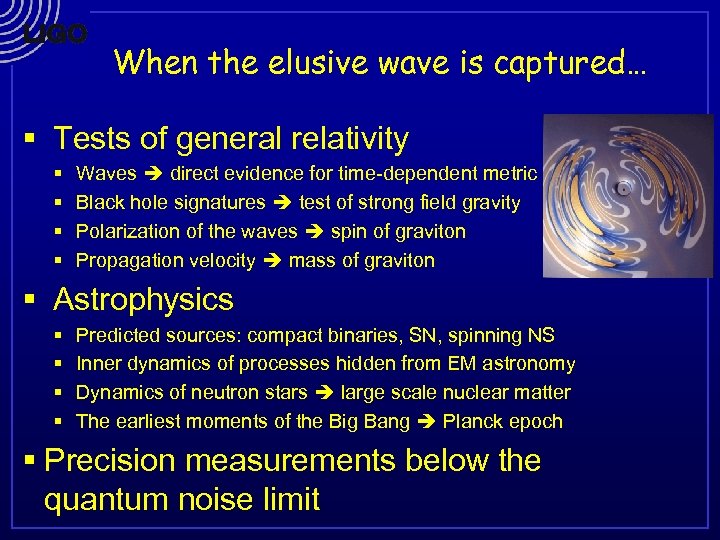 When the elusive wave is captured… § Tests of general relativity § § Waves direct evidence for time-dependent metric Black hole signatures test of strong field gravity Polarization of the waves spin of graviton Propagation velocity mass of graviton § Astrophysics § § Predicted sources: compact binaries, SN, spinning NS Inner dynamics of processes hidden from EM astronomy Dynamics of neutron stars large scale nuclear matter The earliest moments of the Big Bang Planck epoch § Precision measurements below the quantum noise limit
 In closing. . . § Astrophysical searches from early science data runs completed § The most sensitive search yet (S 5) nearly complete with plan to get 1 year of data at initial LIGO sensitivity § Joint searches with partner observatories § Planned enhancements that give 2 x improvement in sensitivity underway § Advanced LIGO § Approved by the NSB in 2006 § “Marked up” by US House last week (still Senate and to go) § Construction funding expected to begin in FY 2008 § Promising prospects for direct GW detection in coming years (and GWB’s exit)
 The End