


 Скачать презентацию Large Area Low Cost PMTs Neutrinos and Arms
dc8f53d4bff776b77e1dae4167816fbf.ppt
- Количество слайдов: 23
 Large Area, Low Cost PMTs Neutrinos and Arms Control Workshop Paul Hink 6 February 2004 BURLE INDUSTRIES 6 Feb 2004 Neutrinos and Arms Control Workshop
 BURLE INDUSTRIES Overview BURLE INDUSTRIES, INC. Conversion Tubes Power Tubes Real Estate BURLE ELECTRO-OPTICS, INC. BURLE INDUSTRIES Gmb. H BURLE INDUSTRIES UK LIMITED BURLE de. Mexico 6 Feb 2004 Neutrinos and Arms Control Workshop
 Core Competencies u Conversion Tubes, Lancaster PA Ø Conventional PMT design and fabrication Ø Photocathode processing Ø Image tube design and fabrication Ø PMT packaging Ø Electronics: VDN, Miniature HVPS, Frontend electronics 6 Feb 2004 u Power Tubes, Lancaster PA Ø Design and fabrication of vacuum tubes for power generation and switching Ø Plating and environmental testing Ø Ceramic-to-Metal joining techniques u BEO, Sturbridge MA Ø Microchannel plates Ø Channel multipliers Ø Fiber optics Neutrinos and Arms Control Workshop
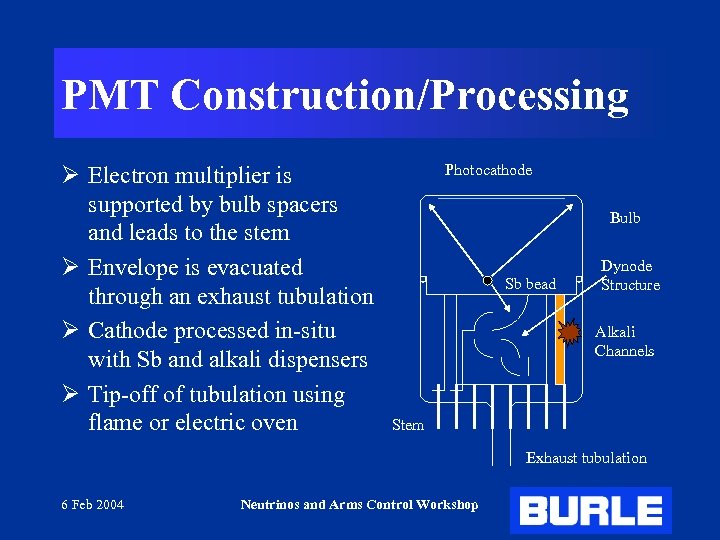 PMT Construction/Processing Ø Electron multiplier is supported by bulb spacers and leads to the stem Ø Envelope is evacuated through an exhaust tubulation Ø Cathode processed in-situ with Sb and alkali dispensers Ø Tip-off of tubulation using flame or electric oven Photocathode Bulb Sb bead Dynode Structure Alkali Channels Stem Exhaust tubulation 6 Feb 2004 Neutrinos and Arms Control Workshop
 Manufacturing Ø Discrete multiplier fabrication is labor intensive Ø Materials and processes are critical Ø Sealing of bulb to stem assembly is semiautomated Ø Multiple PMTs can be processed simultaneously on an exhaust system Ø Post-exhaust processing can be done in large batches Ø Testing is semi-automated 6 Feb 2004 Neutrinos and Arms Control Workshop
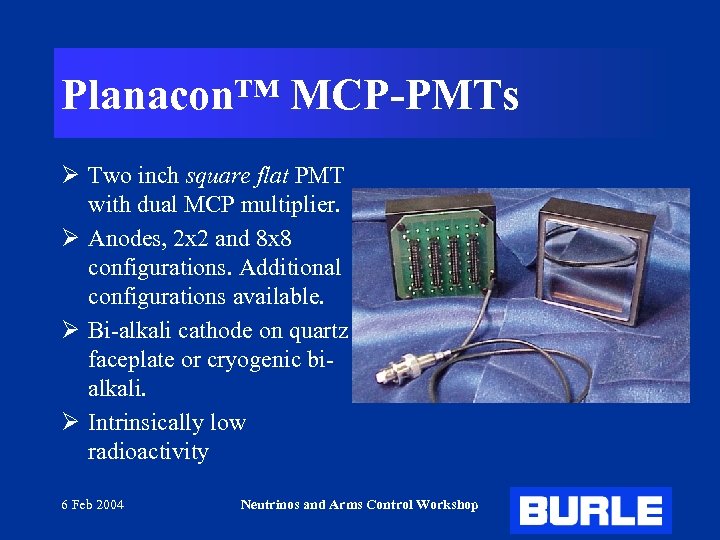 Planacon™ MCP-PMTs Ø Two inch square flat PMT with dual MCP multiplier. Ø Anodes, 2 x 2 and 8 x 8 configurations. Additional configurations available. Ø Bi-alkali cathode on quartz faceplate or cryogenic bialkali. Ø Intrinsically low radioactivity 6 Feb 2004 Neutrinos and Arms Control Workshop
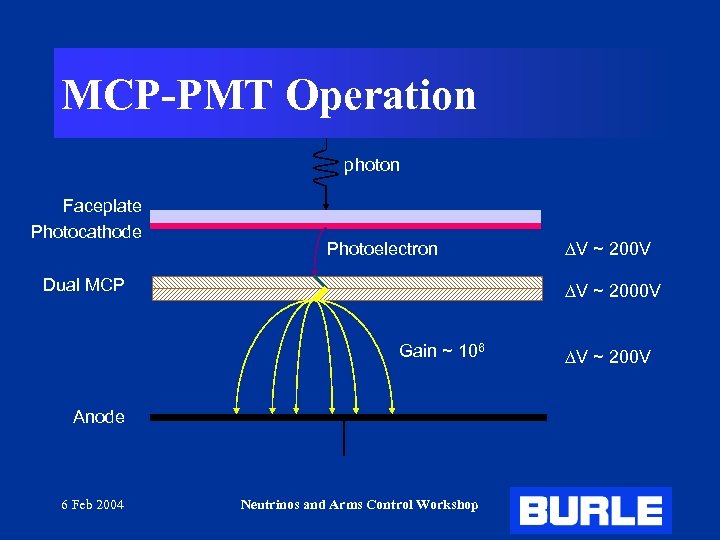 MCP-PMT Operation photon Faceplate Photocathode Photoelectron Dual MCP DV ~ 2000 V Gain ~ 106 Anode 6 Feb 2004 DV ~ 200 V Neutrinos and Arms Control Workshop DV ~ 200 V
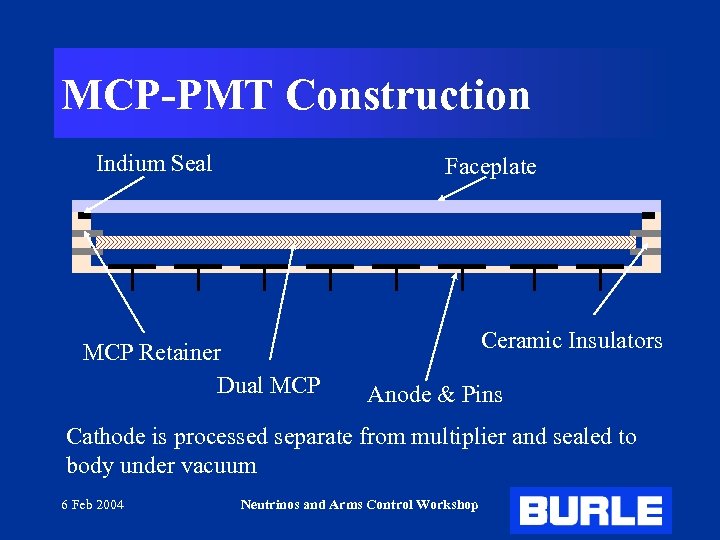 MCP-PMT Construction Indium Seal Faceplate MCP Retainer Dual MCP Ceramic Insulators Anode & Pins Cathode is processed separate from multiplier and sealed to body under vacuum 6 Feb 2004 Neutrinos and Arms Control Workshop
 Transfer Cathode Manufacturing Ø Ø Ø Large UHV chambers required Parts and materials preparation critical Movement of parts inside vacuum chamber(s) difficult Only a few PMTs can be processed simultaneously Indium sealing is reliable but expensive material costs. § Alternative sealing techniques available. Ø Can become highly automated, but large capital investments required 6 Feb 2004 Neutrinos and Arms Control Workshop
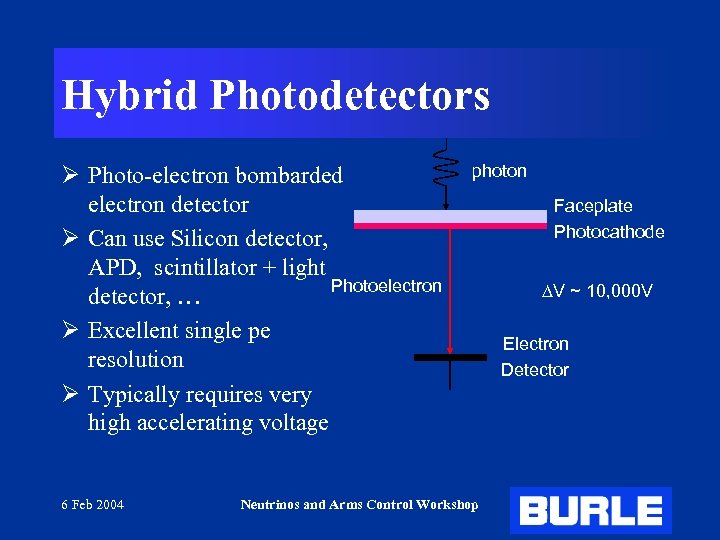 Hybrid Photodetectors Ø Photo-electron bombarded electron detector Ø Can use Silicon detector, APD, scintillator + light Photoelectron detector, … Ø Excellent single pe resolution Ø Typically requires very high accelerating voltage 6 Feb 2004 photon Neutrinos and Arms Control Workshop Faceplate Photocathode DV ~ 10, 000 V Electron Detector
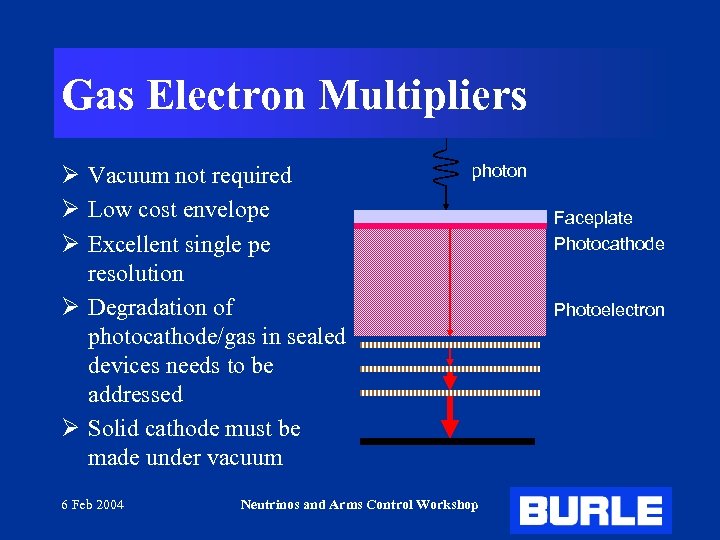 Gas Electron Multipliers Ø Vacuum not required Ø Low cost envelope Ø Excellent single pe resolution Ø Degradation of photocathode/gas in sealed devices needs to be addressed Ø Solid cathode must be made under vacuum 6 Feb 2004 photon Neutrinos and Arms Control Workshop Faceplate Photocathode Photoelectron
 Large Area PMT Program Ø Selected for a DOE SBIR to develop a large area PMT Ø Phase I began in July 2003 and has proceeded well Ø Focus is to design a low-cost bulb that can be manufactured using automated techniques and allows the use of simple electron-optics Ø Also investigating low-cost processing techniques 6 Feb 2004 Neutrinos and Arms Control Workshop
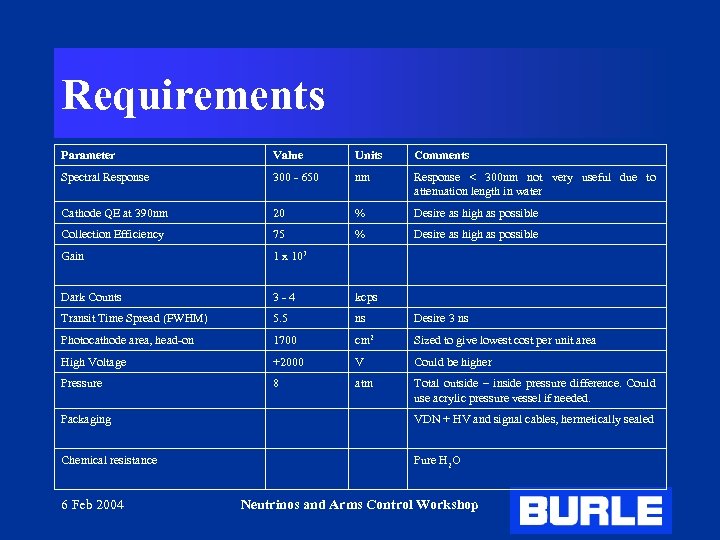 Requirements Parameter Value Units Comments Spectral Response 300 - 650 nm Response < 300 nm not very useful due to attenuation length in water Cathode QE at 390 nm 20 % Desire as high as possible Collection Efficiency 75 % Desire as high as possible Gain 1 x 10⁷ Dark Counts 3 -4 kcps Transit Time Spread (FWHM) 5. 5 ns Desire 3 ns Photocathode area, head-on 1700 cm 2 Sized to give lowest cost per unit area High Voltage +2000 V Could be higher Pressure 8 atm Total outside – inside pressure difference. Could use acrylic pressure vessel if needed. Packaging VDN + HV and signal cables, hermetically sealed Chemical resistance Pure H 2 O 6 Feb 2004 Neutrinos and Arms Control Workshop
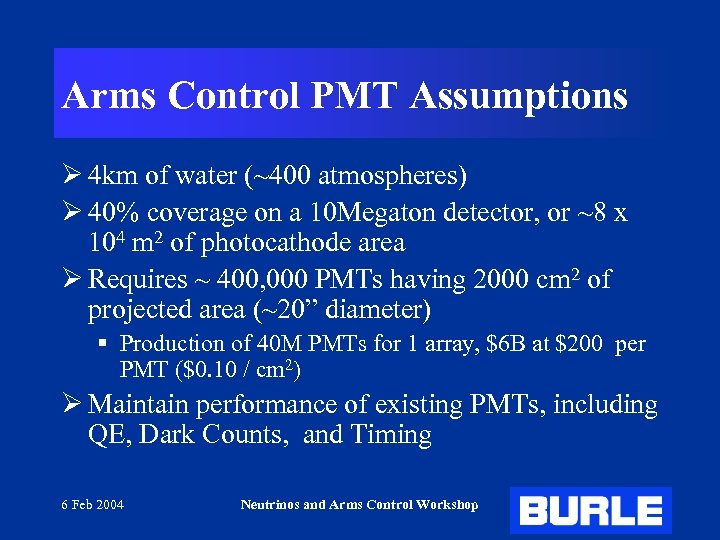 Arms Control PMT Assumptions Ø 4 km of water (~400 atmospheres) Ø 40% coverage on a 10 Megaton detector, or ~8 x 10⁴ m 2 of photocathode area Ø Requires ~ 400, 000 PMTs having 2000 cm 2 of projected area (~20” diameter) § Production of 40 M PMTs for 1 array, $6 B at $200 per PMT ($0. 10 / cm 2) Ø Maintain performance of existing PMTs, including QE, Dark Counts, and Timing 6 Feb 2004 Neutrinos and Arms Control Workshop
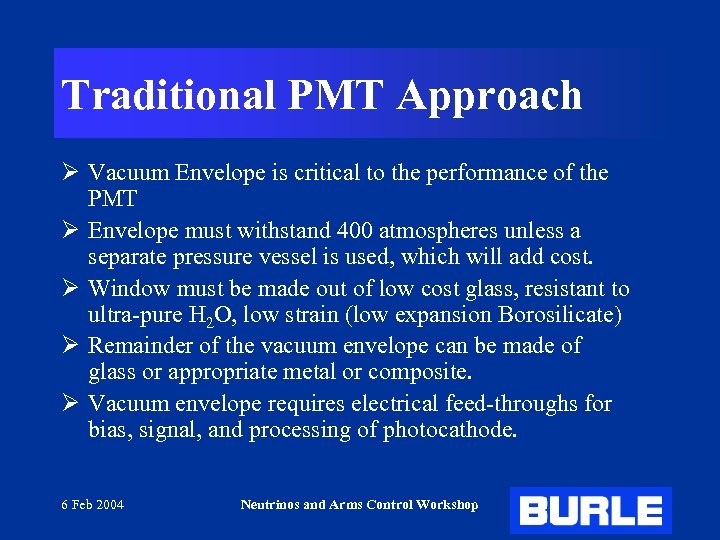 Traditional PMT Approach Ø Vacuum Envelope is critical to the performance of the PMT Ø Envelope must withstand 400 atmospheres unless a separate pressure vessel is used, which will add cost. Ø Window must be made out of low cost glass, resistant to ultra-pure H 2 O, low strain (low expansion Borosilicate) Ø Remainder of the vacuum envelope can be made of glass or appropriate metal or composite. Ø Vacuum envelope requires electrical feed-throughs for bias, signal, and processing of photocathode. 6 Feb 2004 Neutrinos and Arms Control Workshop
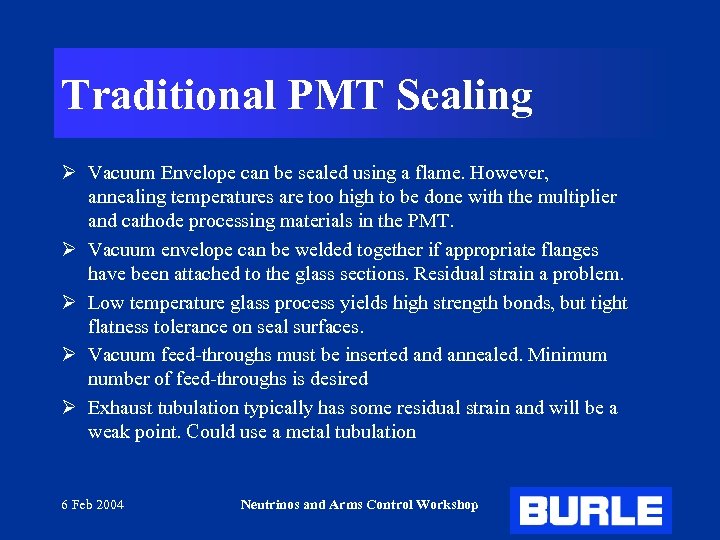 Traditional PMT Sealing Ø Vacuum Envelope can be sealed using a flame. However, annealing temperatures are too high to be done with the multiplier and cathode processing materials in the PMT. Ø Vacuum envelope can be welded together if appropriate flanges have been attached to the glass sections. Residual strain a problem. Ø Low temperature glass process yields high strength bonds, but tight flatness tolerance on seal surfaces. Ø Vacuum feed-throughs must be inserted annealed. Minimum number of feed-throughs is desired Ø Exhaust tubulation typically has some residual strain and will be a weak point. Could use a metal tubulation 6 Feb 2004 Neutrinos and Arms Control Workshop
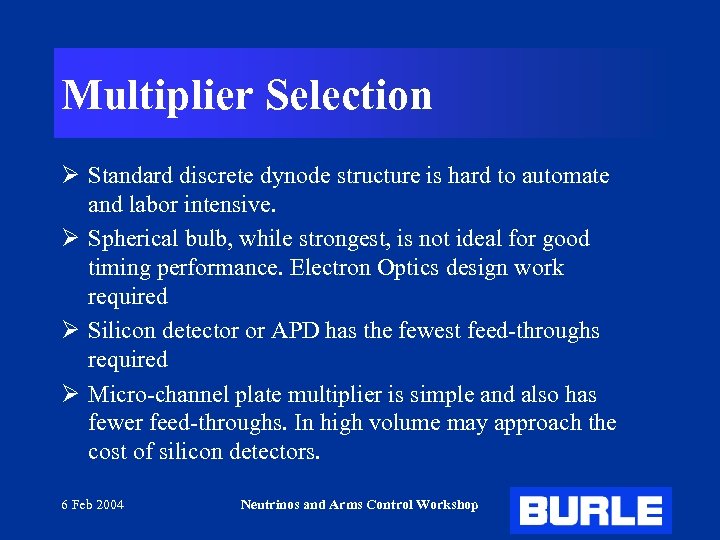 Multiplier Selection Ø Standard discrete dynode structure is hard to automate and labor intensive. Ø Spherical bulb, while strongest, is not ideal for good timing performance. Electron Optics design work required Ø Silicon detector or APD has the fewest feed-throughs required Ø Micro-channel plate multiplier is simple and also has fewer feed-throughs. In high volume may approach the cost of silicon detectors. 6 Feb 2004 Neutrinos and Arms Control Workshop
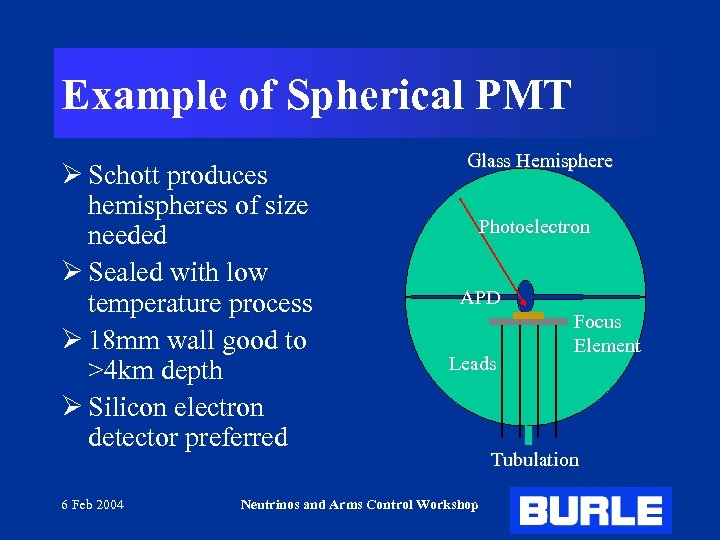 Example of Spherical PMT Ø Schott produces hemispheres of size needed Ø Sealed with low temperature process Ø 18 mm wall good to >4 km depth Ø Silicon electron detector preferred 6 Feb 2004 Glass Hemisphere Photoelectron APD Leads Neutrinos and Arms Control Workshop Focus Element Tubulation
 Example Fabrication Flow Ø Ø Ø Ø Ø Glass hemispheres are formed out of a melt Sealing surfaces are machined to high tolerance Feed-throughs are installed in one hemisphere Both hemispheres are annealed Multiplier/Detector, electron optics, and process materials are installed on rear hemisphere Low temperature glass-to-glass seal of two halves Tube is exhausted and processed Tubulation is tipped-off PMT is aged and tested 6 Feb 2004 Neutrinos and Arms Control Workshop
 Design Challenges Ø High precision machining of the hemisphere seal surfaces (few microns) Ø Installation of electrical feed-throughs and tubulation Ø Annealing the rear hemisphere to remove all strain Ø Exhaust and processing of tube needs to be automated with no handling of PMTs between processes. 6 Feb 2004 Neutrinos and Arms Control Workshop
 Feasibility of this Design Ø Requires significant glass manufacturing capabilities. At 28 kg per bulb, three 1 Gton arrays, and 15 years to manufacture, ~8 large glass lines (100, 000 kg/day/line) would be required. Ø Raw glass cost could be ~$15 per bulb. Ø Hemispheres could be pressed/molded out of the melt or vacuum formed out of float glass. Ø Precision machining and grinding of seal surfaces would need to be highly automated Ø All basic technologies are developed, but requires development of automated processing 6 Feb 2004 Neutrinos and Arms Control Workshop
 Alternative Design Ø Alternative designs could provide lower manufacturing costs, but have some technology developments associated with them. Ø Transfer design could be lowest cost per unit, but may have higher capital requirements. Ø The pressure requirement drives all designs. 6 Feb 2004 Neutrinos and Arms Control Workshop
 Conclusions Ø PMTs for < $0. 10/cm 2 photocathode area are not limited by existing technology Ø Manufacturing and processing techniques require significant R&D § Can learn from picture tube and semiconductor industries Ø Questions about business strategies in responding to this opportunity. § Partnering opportunities § Government involvement § Concerns about limited lifetime of project 6 Feb 2004 Neutrinos and Arms Control Workshop