


 Скачать презентацию LAr TPC Large Liquid Argon TPC for the
8e038a2e9c4a01f5a0aae8487d71d099.ppt
- Количество слайдов: 48
 LAr. TPC: Large Liquid Argon TPC for the Nu. MI Off-axis Beam Context: Neutrinos and Fermilab etc Status Report on LAr. TPC Activities David Finley, Fermilab / Sept. 22, 2005 to ISS @ CERN/ A Large Liqud Argon TPC for the Nu. MI Off-axis Beam 1
 Synopsis • This talk presents some of the efforts of the LAr. TPC group which is pushing the development of large liquid argon TPCs. Our small group is currently composed of 6 University groups and 6 Fermilab staff physicists, and the number of people is growing. • Large neutrino detectors, including large liquid argon TPCs, clearly are needed for upcoming neutrino experiments and into the neutrino factory era. David Finley, Fermilab / Sept. 22, 2005 to ISS @ CERN/ A Large Liqud Argon TPC for the Nu. MI Off-axis Beam 2
 ICARUS • The LAr. TPC group recognizes that the technical concept and any possibility that such a detector may be feasible owes a huge debt to the work done by the ICARUS collaboration. David Finley, Fermilab / Sept. 22, 2005 to ISS @ CERN/ A Large Liqud Argon TPC for the Nu. MI Off-axis Beam 3
 The Big Picture Sensitivity = detector mass x detector efficiency x protons on target/yr x # of years David Finley, Fermilab / Sept. 22, 2005 to ISS @ CERN/ A Large Liqud Argon TPC for the Nu. MI Off-axis Beam 4
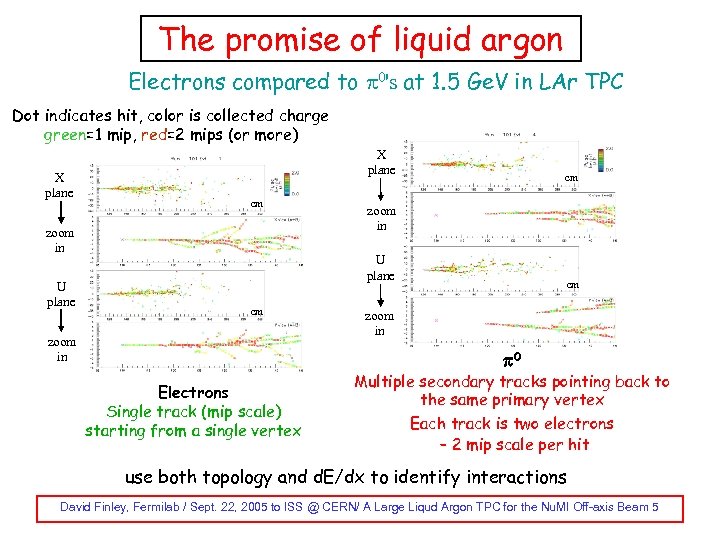 The promise of liquid argon Electrons compared to p 0's at 1. 5 Ge. V in LAr TPC Dot indicates hit, color is collected charge green=1 mip, red=2 mips (or more) X plane cm zoom in U plane cm zoom in p 0 Electrons Single track (mip scale) starting from a single vertex Multiple secondary tracks pointing back to the same primary vertex Each track is two electrons – 2 mip scale per hit use both topology and d. E/dx to identify interactions David Finley, Fermilab / Sept. 22, 2005 to ISS @ CERN/ A Large Liqud Argon TPC for the Nu. MI Off-axis Beam 5
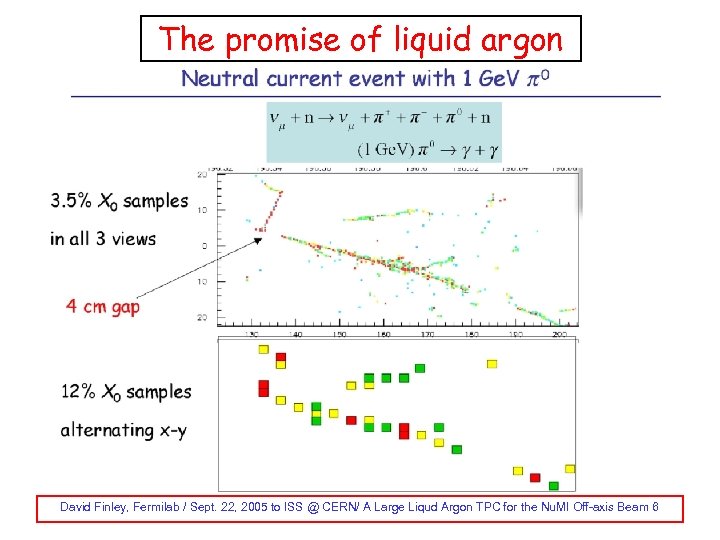 The promise of liquid argon David Finley, Fermilab / Sept. 22, 2005 to ISS @ CERN/ A Large Liqud Argon TPC for the Nu. MI Off-axis Beam 6
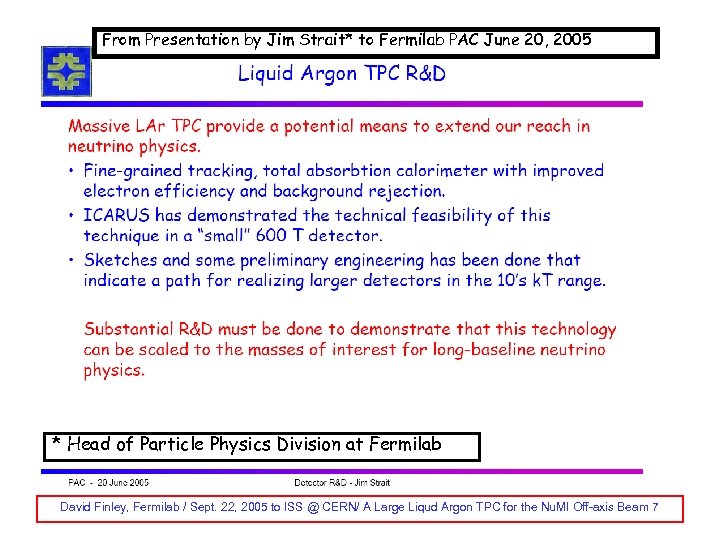 From Presentation by Jim Strait* to Fermilab PAC June 20, 2005 * Head of Particle Physics Division at Fermilab David Finley, Fermilab / Sept. 22, 2005 to ISS @ CERN/ A Large Liqud Argon TPC for the Nu. MI Off-axis Beam 7
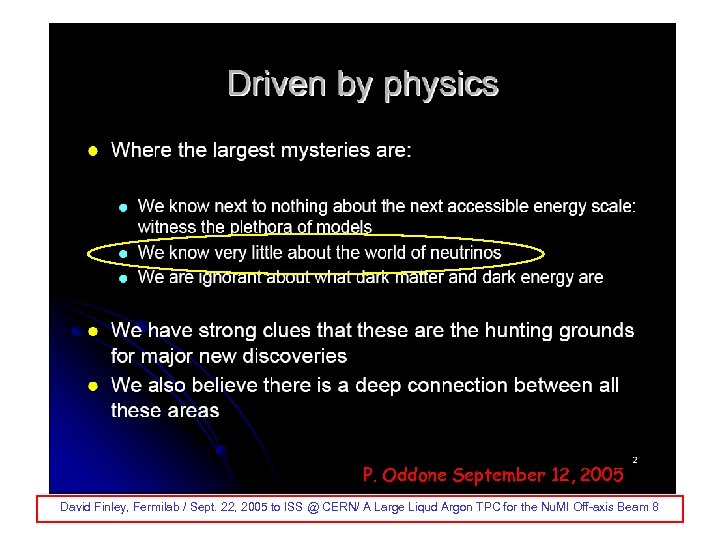 P. Oddone September 12, 2005 David Finley, Fermilab / Sept. 22, 2005 to ISS @ CERN/ A Large Liqud Argon TPC for the Nu. MI Off-axis Beam 8
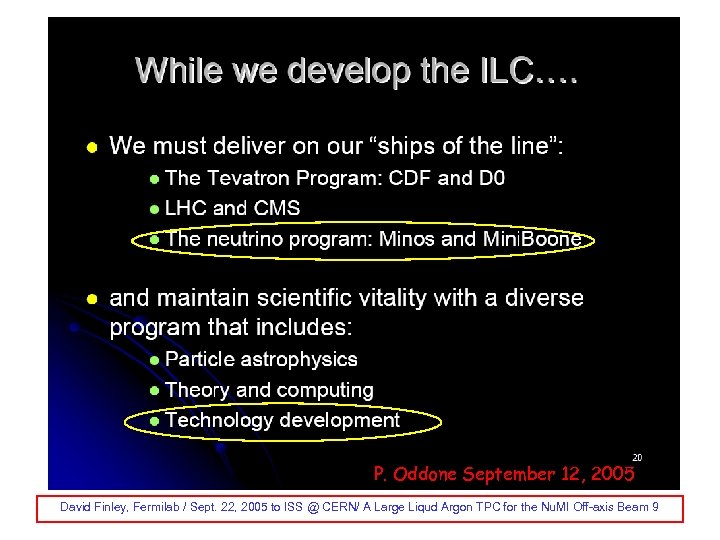 P. Oddone September 12, 2005 David Finley, Fermilab / Sept. 22, 2005 to ISS @ CERN/ A Large Liqud Argon TPC for the Nu. MI Off-axis Beam 9
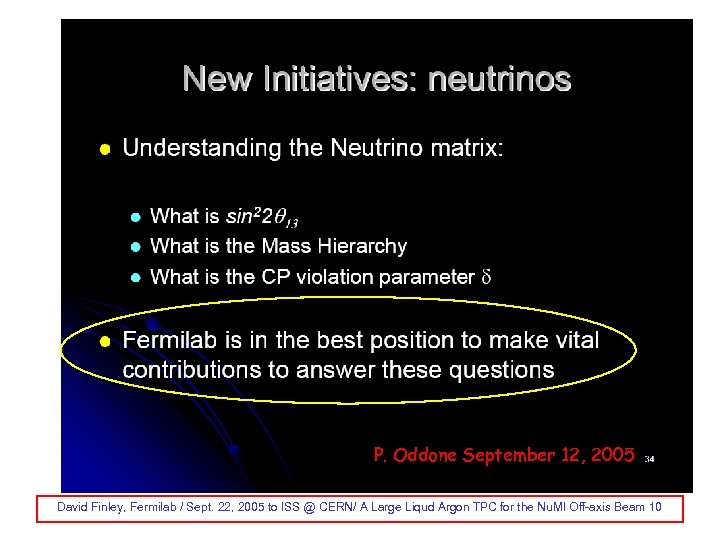 P. Oddone September 12, 2005 David Finley, Fermilab / Sept. 22, 2005 to ISS @ CERN/ A Large Liqud Argon TPC for the Nu. MI Off-axis Beam 10
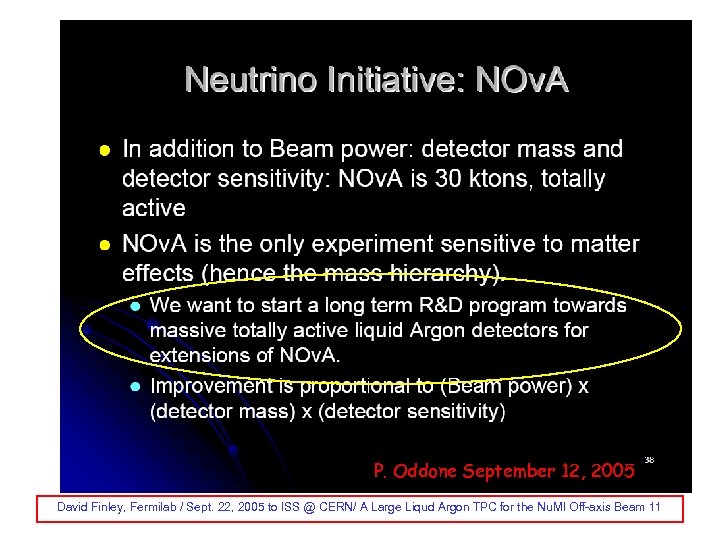 P. Oddone September 12, 2005 David Finley, Fermilab / Sept. 22, 2005 to ISS @ CERN/ A Large Liqud Argon TPC for the Nu. MI Off-axis Beam 11
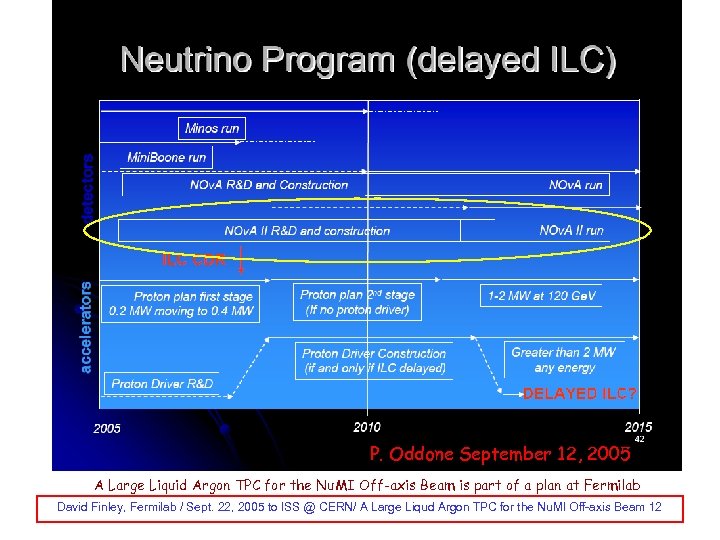 P. Oddone September 12, 2005 A Large Liquid Argon TPC for the Nu. MI Off-axis Beam is part of a plan at Fermilab David Finley, Fermilab / Sept. 22, 2005 to ISS @ CERN/ A Large Liqud Argon TPC for the Nu. MI Off-axis Beam 12
 LAr. TPC’s report to Nu. SAG* Fermilab Note: FN-0776 -E A Large Liquid Argon Time Projection Chamber for Long-baseline, Off-Axis Neutrino Oscillation Physics with the Nu. MI Beam Submission to Nu. SAG September 15, 2005 D. Finley, D. Jensen, H. Jostlein, A. Marchionni, S. Pordes, P. A. Rapidis Fermi National Accelerator Laboratory, Batavia, Illinois C. Bromberg Michigan State University C. Lu, K. T. Mc. Donald Princeton University H. Gallagher, A. Mann, J. Schneps Tufts University D. Cline, F. Sergiampietri, H. Wang University of California at Los Angeles A. Curioni, B. T. Fleming Yale University * The Neutrino S. Menary Scientific York University Assessment Group for the DOE/NSF Soon to be on the hep -ex preprint server Contact Persons: B. T. Fleming and P. A. Rapidis David Finley, Fermilab / Sept. 22, 2005 to ISS @ CERN/ A Large Liqud Argon TPC for the Nu. MI Off-axis Beam 13
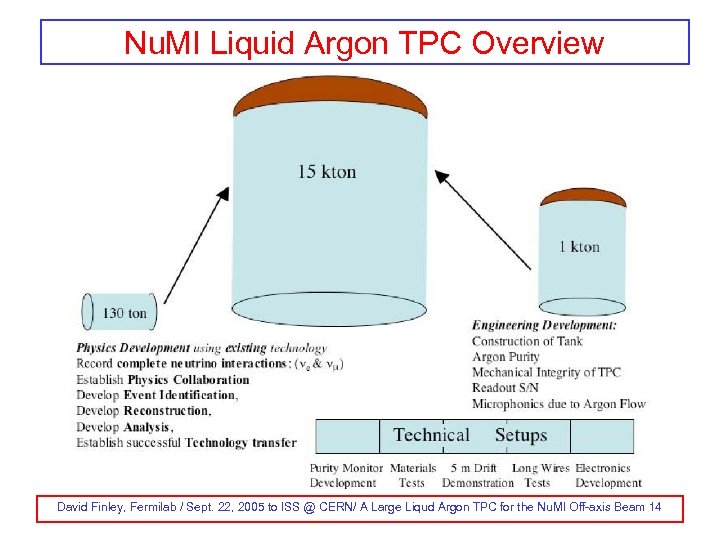 Nu. MI Liquid Argon TPC Overview David Finley, Fermilab / Sept. 22, 2005 to ISS @ CERN/ A Large Liqud Argon TPC for the Nu. MI Off-axis Beam 14
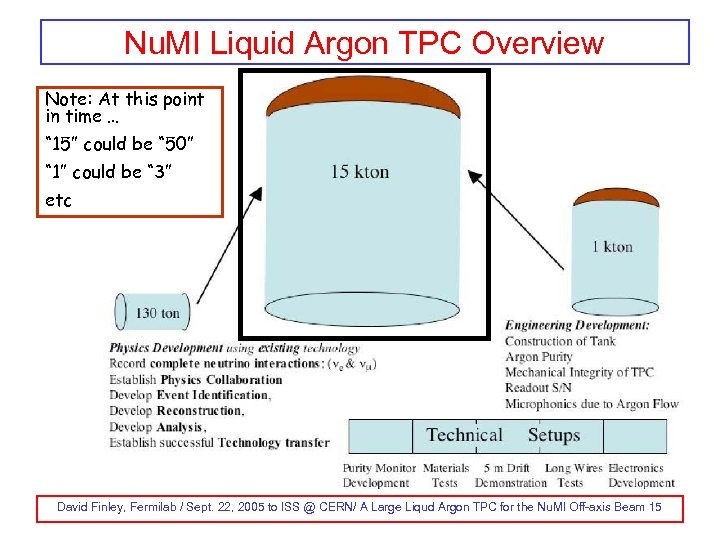 Nu. MI Liquid Argon TPC Overview Note: At this point in time … “ 15” could be “ 50” “ 1” could be “ 3” etc David Finley, Fermilab / Sept. 22, 2005 to ISS @ CERN/ A Large Liqud Argon TPC for the Nu. MI Off-axis Beam 15
 The Large Liquid Argon TPC Aim is to produce a viable design for a 15 kt - 50 kt liquid argon detector. Basic concept follows ICARUS: TPC, drift ionization electrons to 3 sets of wires (2 induction, 1 collection) record signals on all wires with continuous waveform digitizing electronics Differences aimed at making a multi-kton detector feasible; Construction of detector tank using industrial LNG tank as basic structure Long(er) signal wires Single device (not modular) Basic parameters: Drift distance - 3 meters; Drift field - 500 V/cm (gives v drift = 1. 5 m/ms) Wire planes - 3 (+/-300 and vertical); wire spacing 5 mm; plane spacing 5 mm Number of signal channels ~ 100, 000 (15 kt), 220, 000 (50 kt) LRadiation = 14 cm, d. E/dx = 2. 1 Me. V/cm, 55, 000 electrons/cm liberated David Finley, Fermilab / Sept. 22, 2005 to ISS @ CERN/ A Large Liqud Argon TPC for the Nu. MI Off-axis Beam 16
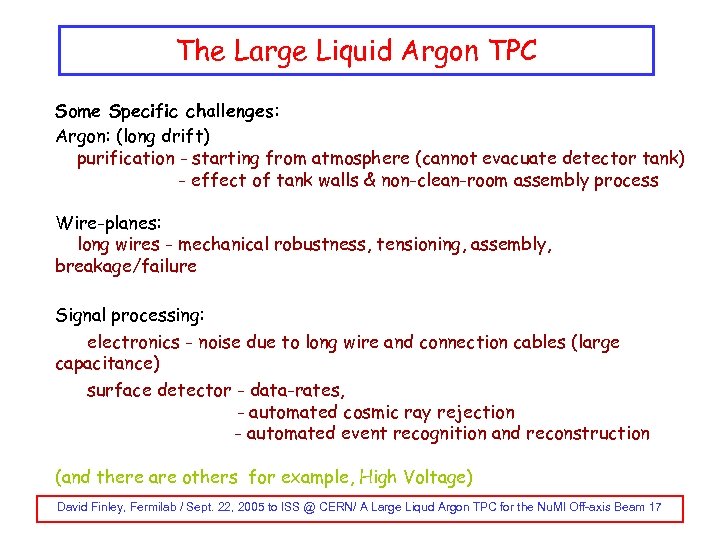 The Large Liquid Argon TPC Some Specific challenges: Argon: (long drift) purification - starting from atmosphere (cannot evacuate detector tank) - effect of tank walls & non-clean-room assembly process Wire-planes: long wires - mechanical robustness, tensioning, assembly, breakage/failure Signal processing: electronics - noise due to long wire and connection cables (large capacitance) surface detector - data-rates, - automated cosmic ray rejection - automated event recognition and reconstruction (and there are others for example, High Voltage) David Finley, Fermilab / Sept. 22, 2005 to ISS @ CERN/ A Large Liqud Argon TPC for the Nu. MI Off-axis Beam 17
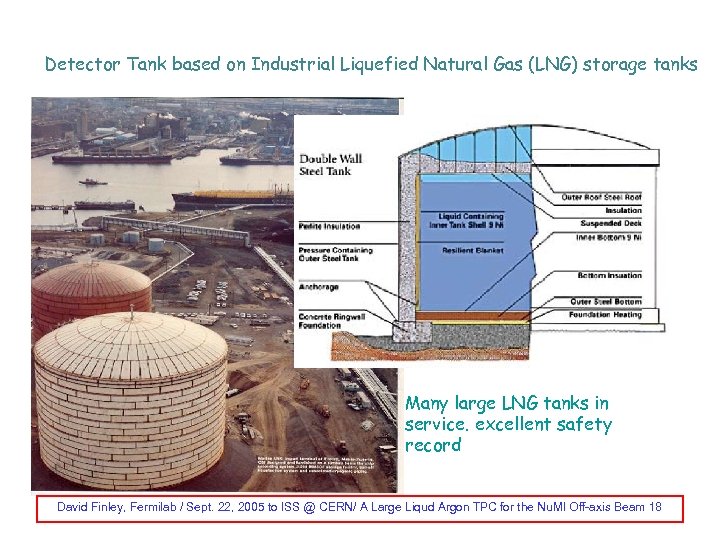 Detector Tank based on Industrial Liquefied Natural Gas (LNG) storage tanks Many large LNG tanks in service. excellent safety record David Finley, Fermilab / Sept. 22, 2005 to ISS @ CERN/ A Large Liqud Argon TPC for the Nu. MI Off-axis Beam 18
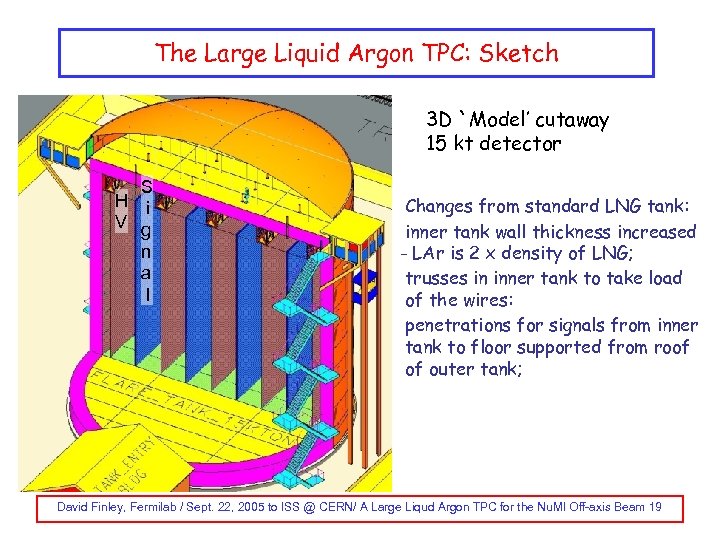 The Large Liquid Argon TPC: Sketch 3 D `Model’ cutaway 15 kt detector S H i V g n a l Changes from standard LNG tank: inner tank wall thickness increased - LAr is 2 x density of LNG; trusses in inner tank to take load of the wires: penetrations for signals from inner tank to floor supported from roof of outer tank; David Finley, Fermilab / Sept. 22, 2005 to ISS @ CERN/ A Large Liqud Argon TPC for the Nu. MI Off-axis Beam 19
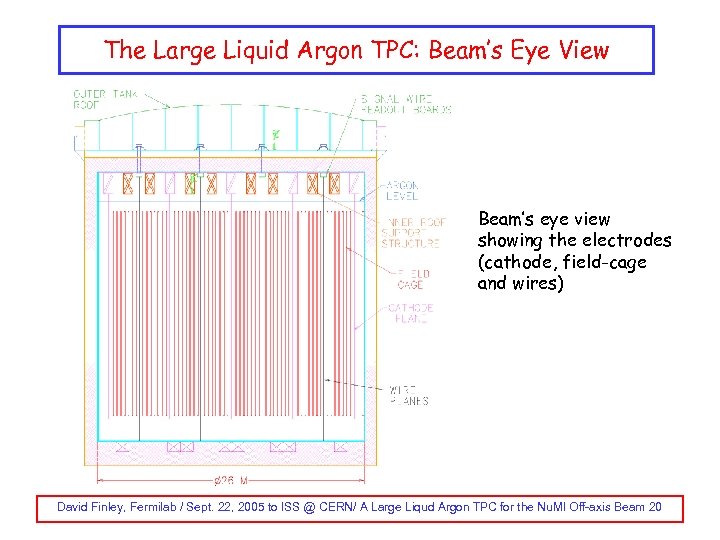 The Large Liquid Argon TPC: Beam’s Eye View Beam’s eye view showing the electrodes (cathode, field-cage and wires) David Finley, Fermilab / Sept. 22, 2005 to ISS @ CERN/ A Large Liqud Argon TPC for the Nu. MI Off-axis Beam 20
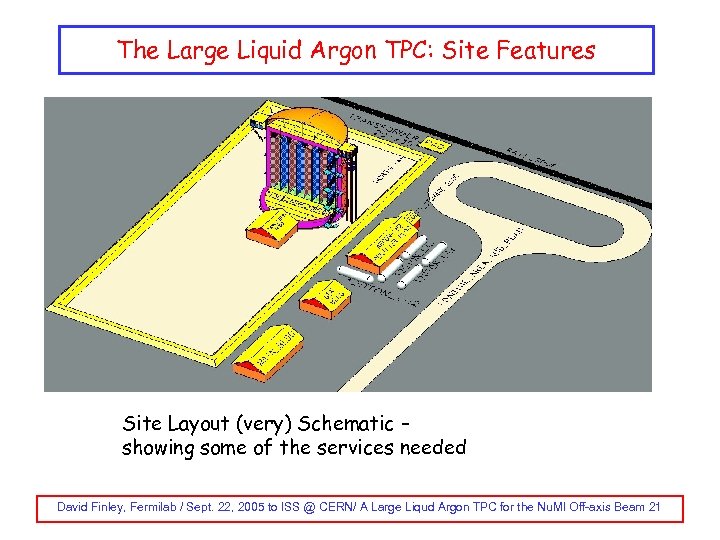 The Large Liquid Argon TPC: Site Features Site Layout (very) Schematic – showing some of the services needed David Finley, Fermilab / Sept. 22, 2005 to ISS @ CERN/ A Large Liqud Argon TPC for the Nu. MI Off-axis Beam 21
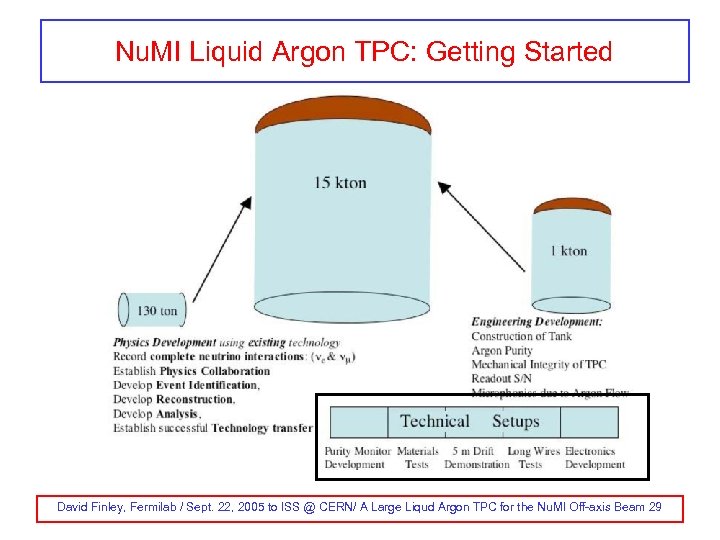
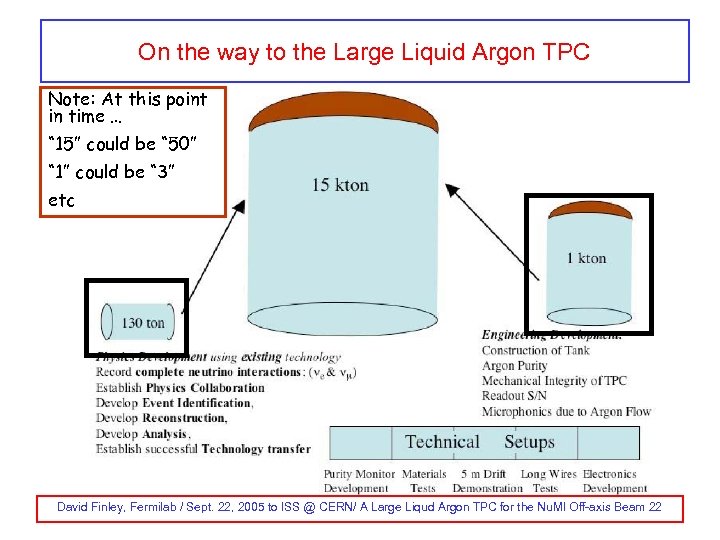 On the way to the Large Liquid Argon TPC Note: At this point in time … “ 15” could be “ 50” “ 1” could be “ 3” etc David Finley, Fermilab / Sept. 22, 2005 to ISS @ CERN/ A Large Liqud Argon TPC for the Nu. MI Off-axis Beam 22
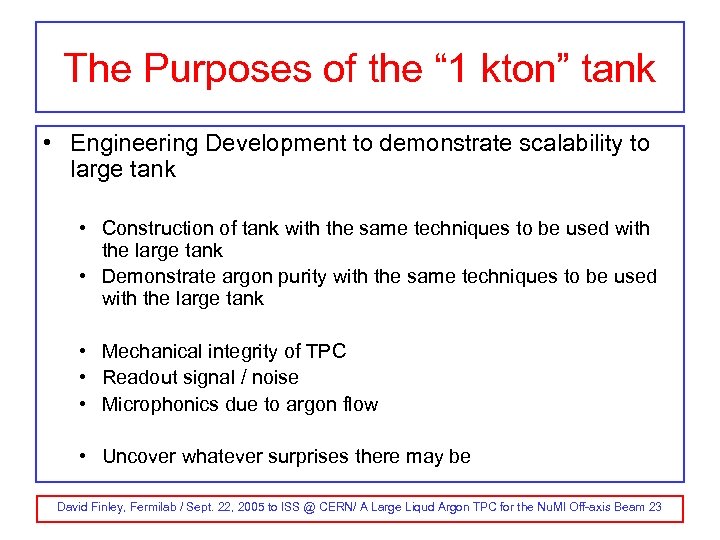 The Purposes of the “ 1 kton” tank • Engineering Development to demonstrate scalability to large tank • Construction of tank with the same techniques to be used with the large tank • Demonstrate argon purity with the same techniques to be used with the large tank • Mechanical integrity of TPC • Readout signal / noise • Microphonics due to argon flow • Uncover whatever surprises there may be David Finley, Fermilab / Sept. 22, 2005 to ISS @ CERN/ A Large Liqud Argon TPC for the Nu. MI Off-axis Beam 23
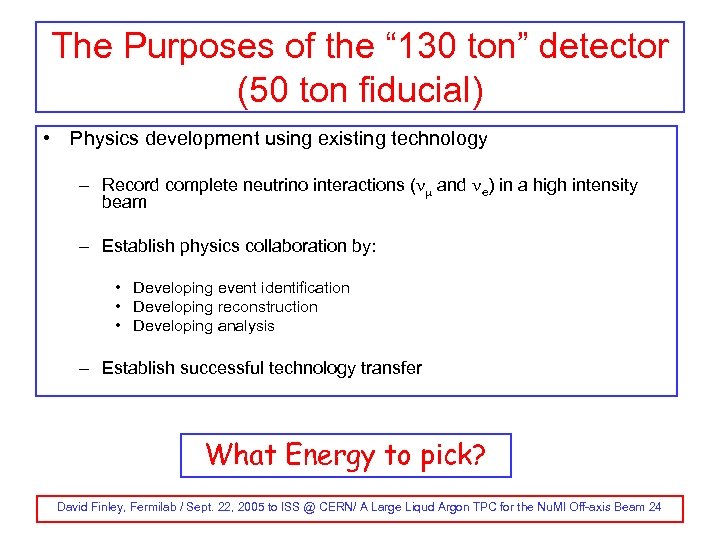 The Purposes of the “ 130 ton” detector (50 ton fiducial) • Physics development using existing technology – Record complete neutrino interactions ( m and e) in a high intensity beam – Establish physics collaboration by: • Developing event identification • Developing reconstruction • Developing analysis – Establish successful technology transfer What Energy to pick? David Finley, Fermilab / Sept. 22, 2005 to ISS @ CERN/ A Large Liqud Argon TPC for the Nu. MI Off-axis Beam 24
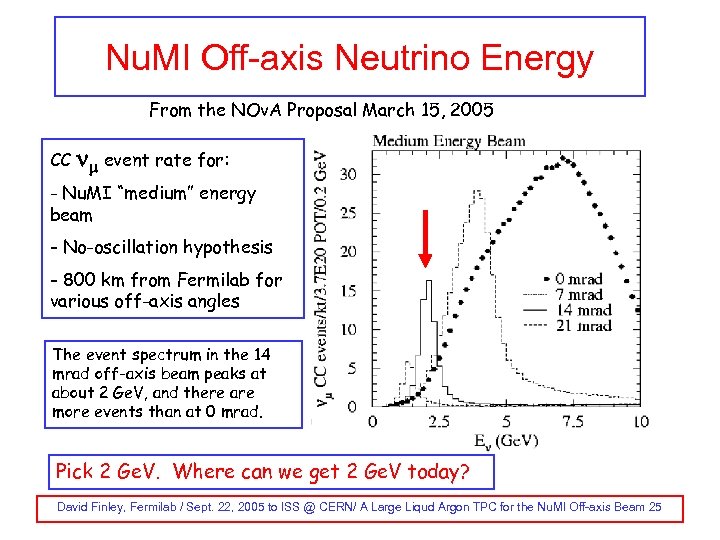 Nu. MI Off-axis Neutrino Energy From the NOv. A Proposal March 15, 2005 CC nm event rate for: - Nu. MI “medium” energy beam - No-oscillation hypothesis - 800 km from Fermilab for various off-axis angles The event spectrum in the 14 mrad off-axis beam peaks at about 2 Ge. V, and there are more events than at 0 mrad. Pick 2 Ge. V. Where can we get 2 Ge. V today? David Finley, Fermilab / Sept. 22, 2005 to ISS @ CERN/ A Large Liqud Argon TPC for the Nu. MI Off-axis Beam 25
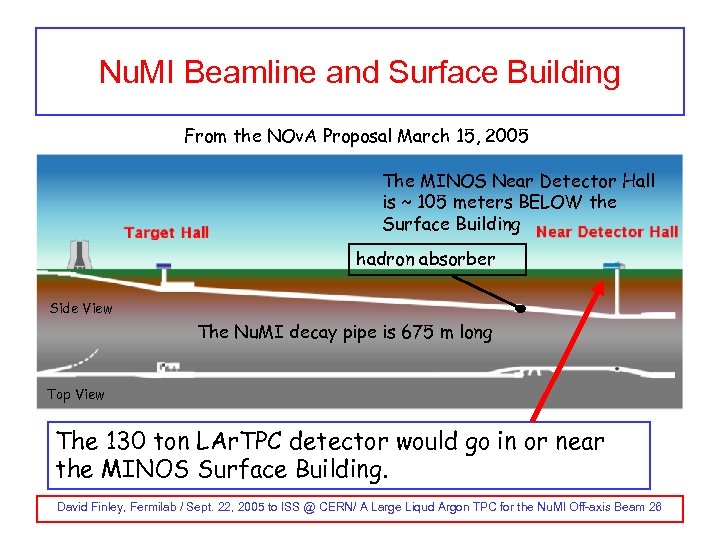 Nu. MI Beamline and Surface Building From the NOv. A Proposal March 15, 2005 The MINOS Near Detector Hall is ~ 105 meters BELOW the Surface Building hadron absorber Side View The Nu. MI decay pipe is 675 m long Top View The 130 ton LAr. TPC detector would go in or near the MINOS Surface Building. David Finley, Fermilab / Sept. 22, 2005 to ISS @ CERN/ A Large Liqud Argon TPC for the Nu. MI Off-axis Beam 26
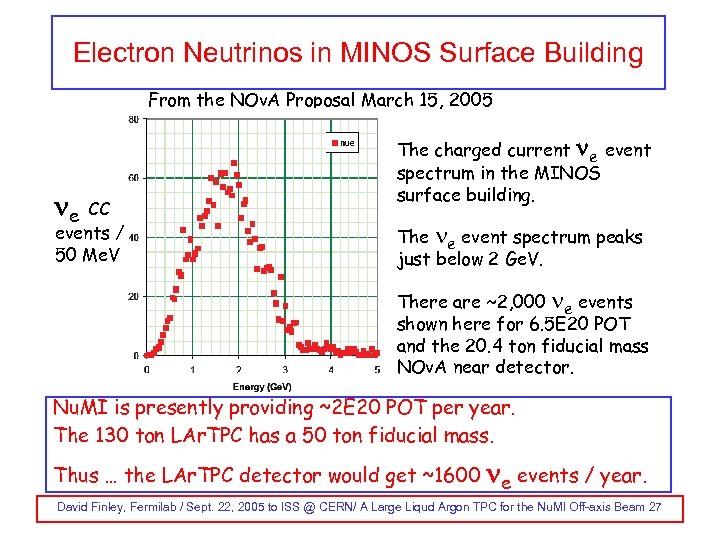 Electron Neutrinos in MINOS Surface Building From the NOv. A Proposal March 15, 2005 ne CC events / 50 Me. V The charged current ne event spectrum in the MINOS surface building. The e event spectrum peaks just below 2 Ge. V. There are ~2, 000 e events shown here for 6. 5 E 20 POT and the 20. 4 ton fiducial mass NOv. A near detector. Nu. MI is presently providing ~2 E 20 POT per year. The 130 ton LAr. TPC has a 50 ton fiducial mass. Thus … the LAr. TPC detector would get ~1600 ne events / year. David Finley, Fermilab / Sept. 22, 2005 to ISS @ CERN/ A Large Liqud Argon TPC for the Nu. MI Off-axis Beam 27
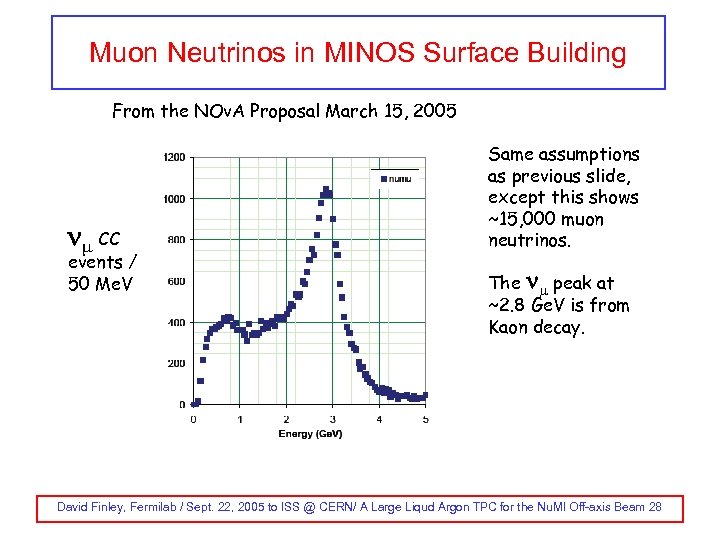 Muon Neutrinos in MINOS Surface Building From the NOv. A Proposal March 15, 2005 nm CC events / 50 Me. V Same assumptions as previous slide, except this shows ~15, 000 muon neutrinos. The nm peak at ~2. 8 Ge. V is from Kaon decay. David Finley, Fermilab / Sept. 22, 2005 to ISS @ CERN/ A Large Liqud Argon TPC for the Nu. MI Off-axis Beam 28
 Nu. MI Liquid Argon TPC: Getting Started David Finley, Fermilab / Sept. 22, 2005 to ISS @ CERN/ A Large Liqud Argon TPC for the Nu. MI Off-axis Beam 29
 Materials Tests System at Fermilab for testing filter materials and the contaminating effects of detector materials (e. g. tank-walls, cables) ICARUS purity monitor G. Carugno et al. , NIM. A 292 (1990 Filter Test Samples Dewar David Finley, Fermilab / Sept. 22, 2005 to ISS @ CERN/ A Large Liqud Argon TPC for the Nu. MI Off-axis Beam 30
 Materials Tests setup for lifetime measurements (effect of materials and effectiveness of different filters) under assembly at Fermilab. Test Tank Argon storage Filtration Tank David Finley, Fermilab / Sept. 22, 2005 to ISS @ CERN/ A Large Liqud Argon TPC for the Nu. MI Off-axis Beam 31
 LAr. TPC Test Setup at Yale Purity monitor in liquid argon Purity and light collection David Finley, Fermilab / Sept. 22, 2005 to ISS @ CERN/ A Large Liqud Argon TPC for the Nu. MI Off-axis Beam 32
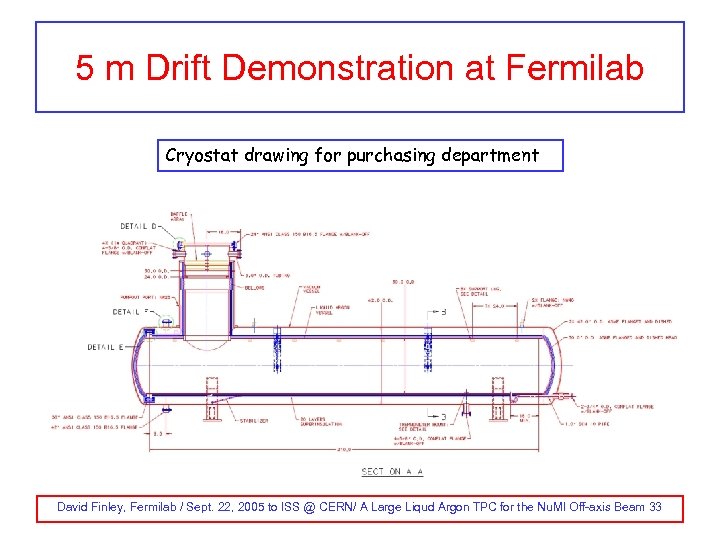 5 m Drift Demonstration at Fermilab Cryostat drawing for purchasing department David Finley, Fermilab / Sept. 22, 2005 to ISS @ CERN/ A Large Liqud Argon TPC for the Nu. MI Off-axis Beam 33
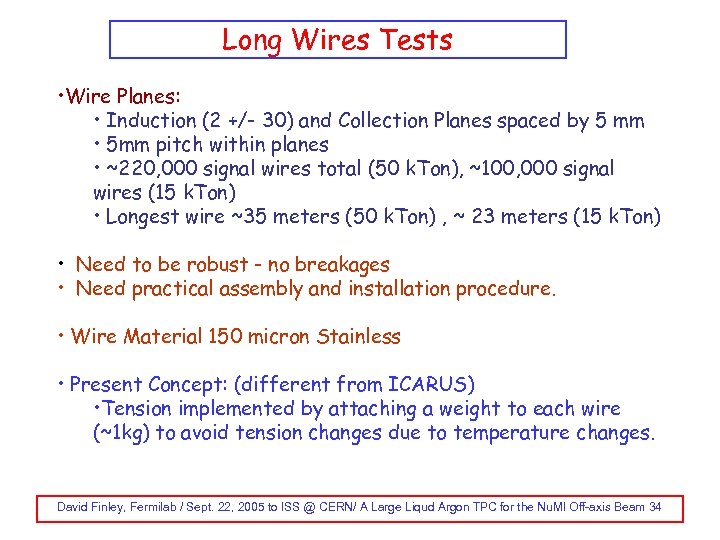 Long Wires Tests • Wire Planes: • Induction (2 +/- 30) and Collection Planes spaced by 5 mm • 5 mm pitch within planes • ~220, 000 signal wires total (50 k. Ton), ~100, 000 signal wires (15 k. Ton) • Longest wire ~35 meters (50 k. Ton) , ~ 23 meters (15 k. Ton) • Need to be robust - no breakages • Need practical assembly and installation procedure. • Wire Material 150 micron Stainless • Present Concept: (different from ICARUS) • Tension implemented by attaching a weight to each wire (~1 kg) to avoid tension changes due to temperature changes. David Finley, Fermilab / Sept. 22, 2005 to ISS @ CERN/ A Large Liqud Argon TPC for the Nu. MI Off-axis Beam 34
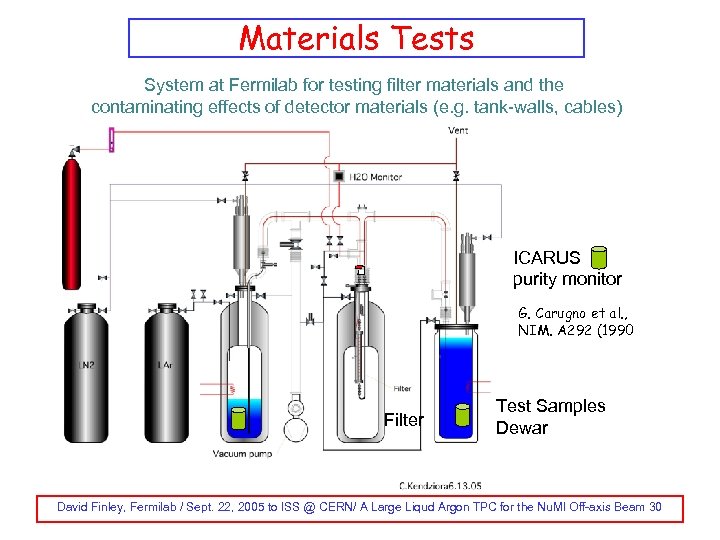
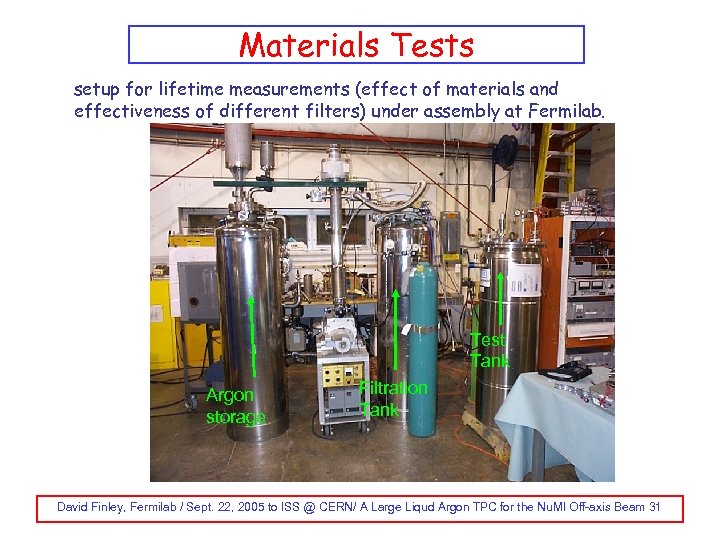
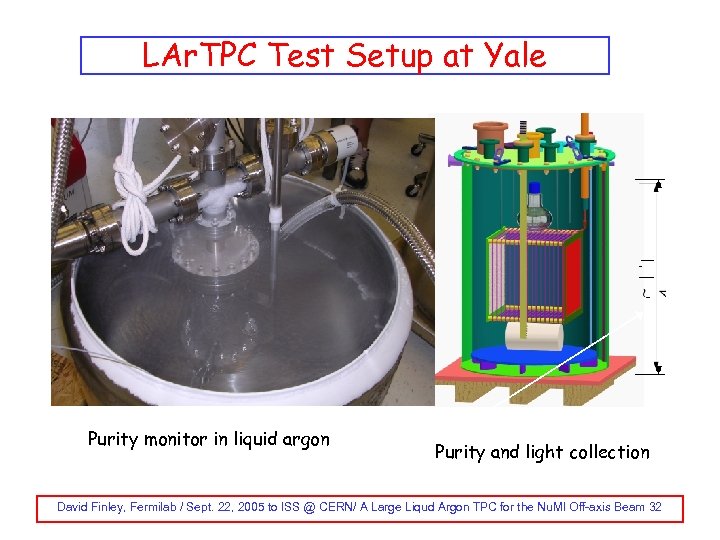
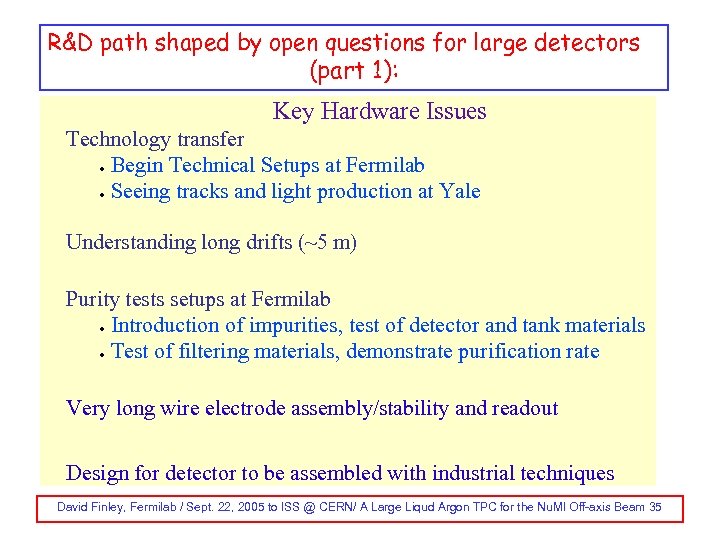 R&D path shaped by open questions for large detectors (part 1): Key Hardware Issues Technology transfer ● Begin Technical Setups at Fermilab ● Seeing tracks and light production at Yale Understanding long drifts (~5 m) Purity tests setups at Fermilab ● Introduction of impurities, test of detector and tank materials ● Test of filtering materials, demonstrate purification rate Very long wire electrode assembly/stability and readout Design for detector to be assembled with industrial techniques David Finley, Fermilab / Sept. 22, 2005 to ISS @ CERN/ A Large Liqud Argon TPC for the Nu. MI Off-axis Beam 35
 R&D path shaped by open questions for large detectors (part 2): Key software issues Simulation Monte Carlo(s) Reconstruction / automated event reconstruction Physics analysis Key collaboration and physics issues Developing defensible cost and schedule Growing a strong collaboration Navigating a global, developing, exciting neutrino physics program David Finley, Fermilab / Sept. 22, 2005 to ISS @ CERN/ A Large Liqud Argon TPC for the Nu. MI Off-axis Beam 36
 Final Slide Receiving support from Fermilab – both in engineering and with recently increased funding Growing support from University groups in smaller technical setups, software efforts, etc Receiving generous support for technology transfer from experts in Europe, and hoping to learn more from ongoing tests Hoping for continued interest from the US Government for neutrino physics in general and LAr. TPCs in particular Continuing along the path to develop Large Liquid Argon TPCs - not only in the ongoing Nu. MI era, but also into the neutrino factory era, and for other physics Would like to develop our efforts with wider participation David Finley, Fermilab / Sept. 22, 2005 to ISS @ CERN/ A Large Liqud Argon TPC for the Nu. MI Off-axis Beam 37
 Back- ups, extras David Finley, Fermilab / Sept. 22, 2005 to ISS @ CERN/ A Large Liqud Argon TPC for the Nu. MI Off-axis Beam 38
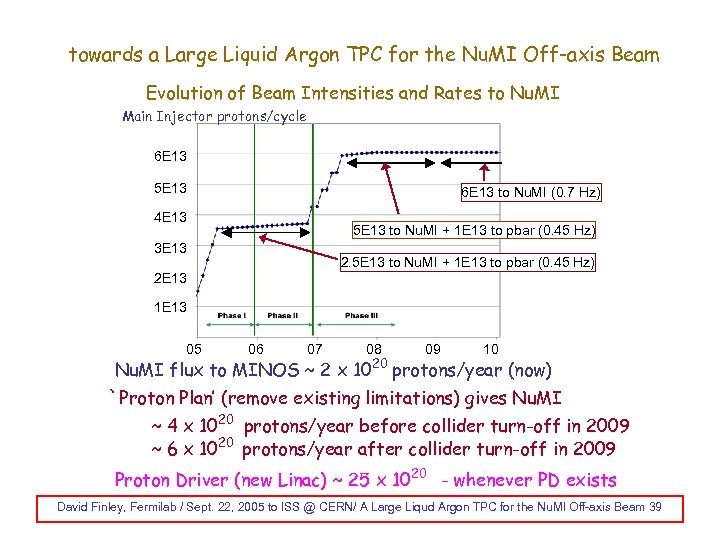 towards a Large Liquid Argon TPC for the Nu. MI Off-axis Beam Evolution of Beam Intensities and Rates to Nu. MI Main Injector protons/cycle 6 E 13 5 E 13 6 E 13 to Nu. MI (0. 7 Hz) 4 E 13 5 E 13 to Nu. MI + 1 E 13 to pbar (0. 45 Hz) 3 E 13 2. 5 E 13 to Nu. MI + 1 E 13 to pbar (0. 45 Hz) 2 E 13 1 E 13 05 06 07 08 Nu. MI flux to MINOS ~ 2 x 10 20 09 10 protons/year (now) `Proton Plan’ (remove existing limitations) gives Nu. MI ~ 4 x 10²⁰ protons/year before collider turn-off in 2009 ~ 6 x 10²⁰ protons/year after collider turn-off in 2009 Proton Driver (new Linac) ~ 25 x 1020 - whenever PD exists David Finley, Fermilab / Sept. 22, 2005 to ISS @ CERN/ A Large Liqud Argon TPC for the Nu. MI Off-axis Beam 39
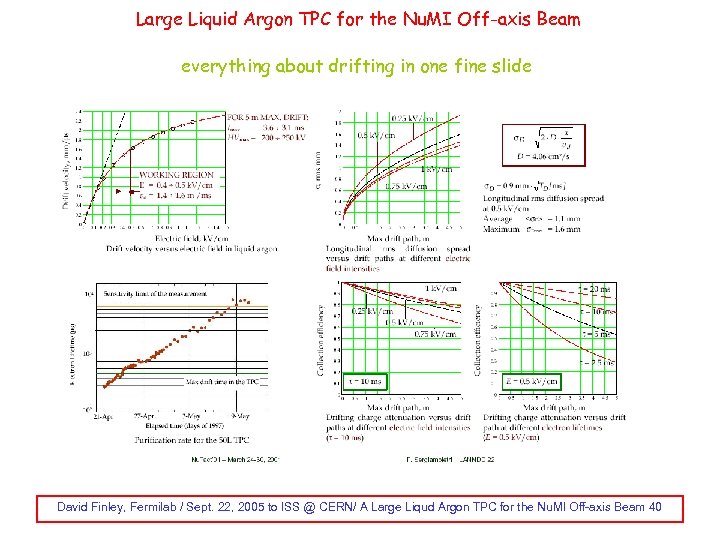 Large Liquid Argon TPC for the Nu. MI Off-axis Beam everything about drifting in one fine slide David Finley, Fermilab / Sept. 22, 2005 to ISS @ CERN/ A Large Liqud Argon TPC for the Nu. MI Off-axis Beam 40
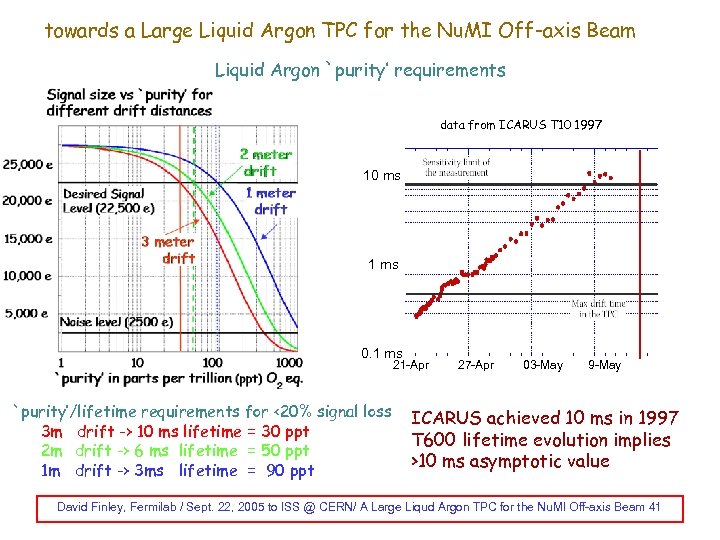 towards a Large Liquid Argon TPC for the Nu. MI Off-axis Beam Liquid Argon `purity’ requirements data from ICARUS T 10 1997 10 ms 1 ms 0. 1 ms 21 -Apr `purity’/lifetime requirements for <20% signal loss 3 m drift -> 10 ms lifetime = 30 ppt 2 m drift -> 6 ms lifetime = 50 ppt 1 m drift -> 3 ms lifetime = 90 ppt 27 -Apr 03 -May 9 -May ICARUS achieved 10 ms in 1997 T 600 lifetime evolution implies >10 ms asymptotic value David Finley, Fermilab / Sept. 22, 2005 to ISS @ CERN/ A Large Liqud Argon TPC for the Nu. MI Off-axis Beam 41
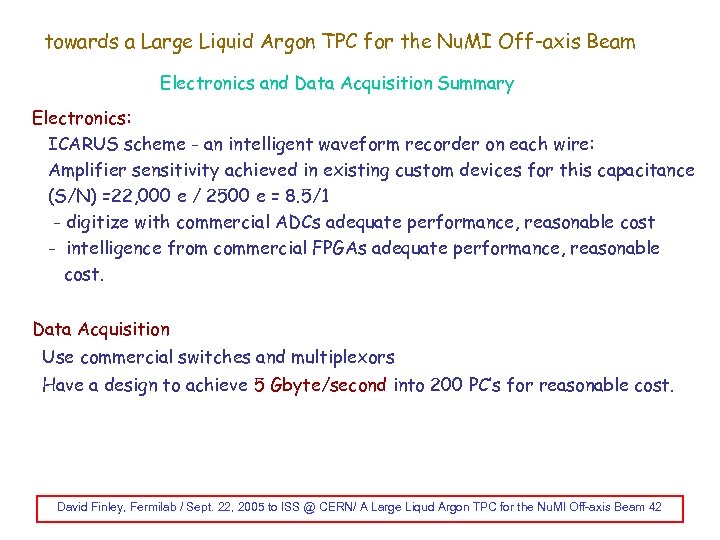 towards a Large Liquid Argon TPC for the Nu. MI Off-axis Beam Electronics and Data Acquisition Summary Electronics: ICARUS scheme - an intelligent waveform recorder on each wire: Amplifier sensitivity achieved in existing custom devices for this capacitance (S/N) =22, 000 e / 2500 e = 8. 5/1 - digitize with commercial ADCs adequate performance, reasonable cost - intelligence from commercial FPGAs adequate performance, reasonable cost. Data Acquisition Use commercial switches and multiplexors Have a design to achieve 5 Gbyte/second into 200 PC’s for reasonable cost. David Finley, Fermilab / Sept. 22, 2005 to ISS @ CERN/ A Large Liqud Argon TPC for the Nu. MI Off-axis Beam 42
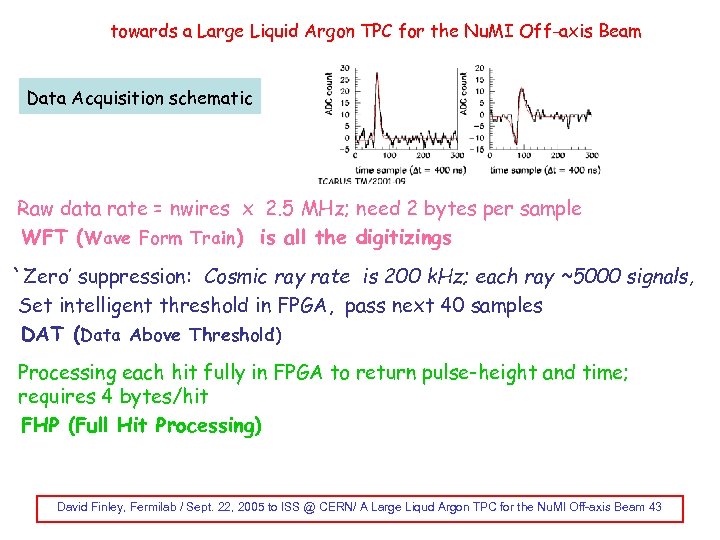 towards a Large Liquid Argon TPC for the Nu. MI Off-axis Beam Data Acquisition schematic Raw data rate = nwires x 2. 5 MHz; need 2 bytes per sample WFT (Wave Form Train) is all the digitizings `Zero’ suppression: Cosmic ray rate is 200 k. Hz; each ray ~5000 signals, Set intelligent threshold in FPGA, pass next 40 samples DAT (Data Above Threshold) Processing each hit fully in FPGA to return pulse-height and time; requires 4 bytes/hit FHP (Full Hit Processing) David Finley, Fermilab / Sept. 22, 2005 to ISS @ CERN/ A Large Liqud Argon TPC for the Nu. MI Off-axis Beam 43
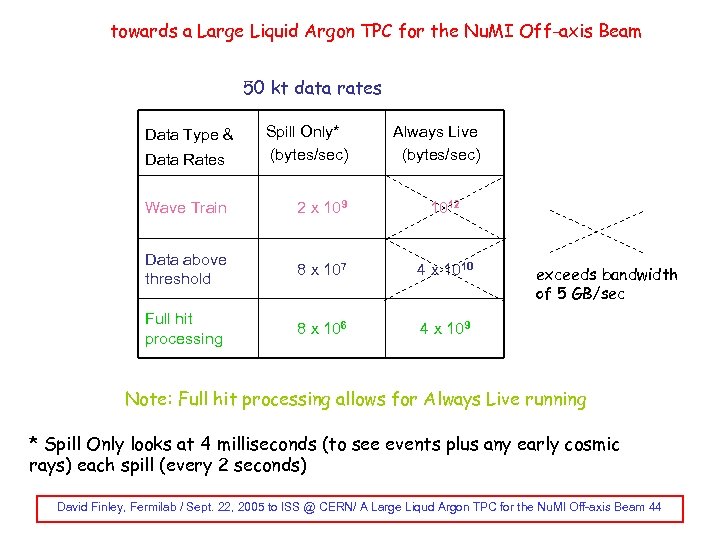 towards a Large Liquid Argon TPC for the Nu. MI Off-axis Beam 50 kt data rates Data Rates Spill Only* (bytes/sec) Wave Train 2 x 10⁹ 1012 Data above threshold 8 x 10⁷ 4 x 10¹⁰ Full hit processing 8 x 10⁶ 4 x 10⁹ Data Type & Always Live (bytes/sec) exceeds bandwidth of 5 GB/sec Note: Full hit processing allows for Always Live running * Spill Only looks at 4 milliseconds (to see events plus any early cosmic rays) each spill (every 2 seconds) David Finley, Fermilab / Sept. 22, 2005 to ISS @ CERN/ A Large Liqud Argon TPC for the Nu. MI Off-axis Beam 44
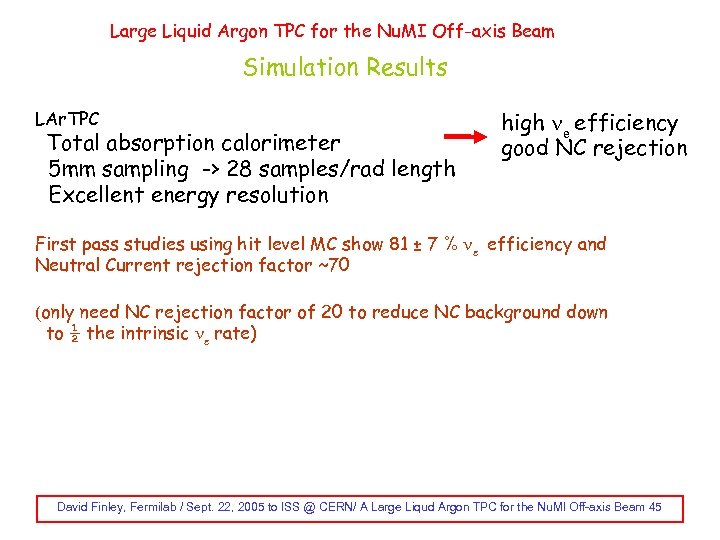 Large Liquid Argon TPC for the Nu. MI Off-axis Beam Simulation Results LAr. TPC Total absorption calorimeter 5 mm sampling -> 28 samples/rad length Excellent energy resolution high e efficiency good NC rejection First pass studies using hit level MC show 81 ± 7 % e efficiency and Neutral Current rejection factor ~70 (only need NC rejection factor of 20 to reduce NC background down to ½ the intrinsic e rate) David Finley, Fermilab / Sept. 22, 2005 to ISS @ CERN/ A Large Liqud Argon TPC for the Nu. MI Off-axis Beam 45
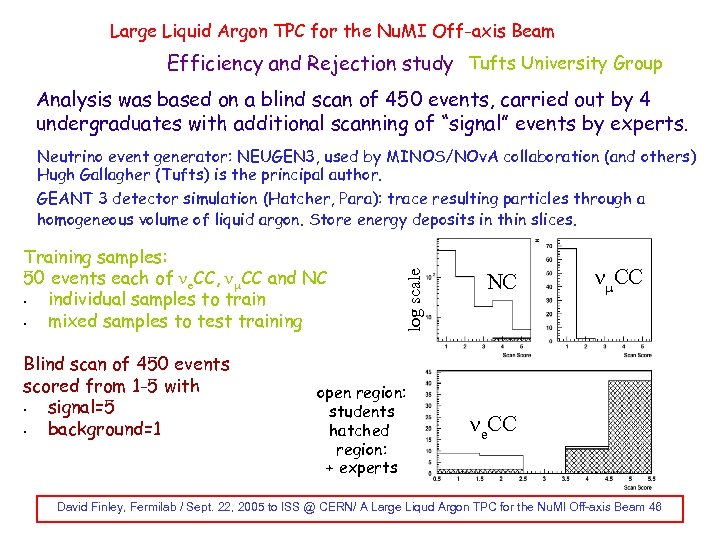 Large Liquid Argon TPC for the Nu. MI Off-axis Beam Efficiency and Rejection study Tufts University Group Analysis was based on a blind scan of 450 events, carried out by 4 undergraduates with additional scanning of “signal” events by experts. Neutrino event generator: NEUGEN 3, used by MINOS/NOv. A collaboration (and others) Hugh Gallagher (Tufts) is the principal author. Training samples: 50 events each of e. CC, m. CC and NC • individual samples to train • mixed samples to test training Blind scan of 450 events scored from 1 -5 with • signal=5 • background=1 log scale GEANT 3 detector simulation (Hatcher, Para): trace resulting particles through a homogeneous volume of liquid argon. Store energy deposits in thin slices. open region: students hatched region: + experts NC m. CC e. CC David Finley, Fermilab / Sept. 22, 2005 to ISS @ CERN/ A Large Liqud Argon TPC for the Nu. MI Off-axis Beam 46
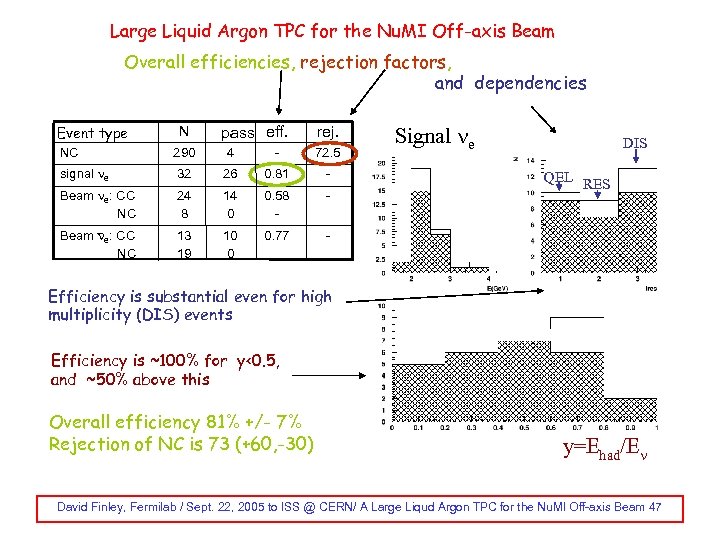 Large Liquid Argon TPC for the Nu. MI Off-axis Beam Overall efficiencies, rejection factors, and dependencies Event type N pass eff. rej. NC 290 4 - 72. 5 signal e 32 26 0. 81 - Beam e: CC NC 24 8 14 0 0. 58 - - Beam e: CC NC 13 19 10 0 0. 77 Signal e DIS - QEL RES Efficiency is substantial even for high multiplicity (DIS) events Efficiency is ~100% for y<0. 5, and ~50% above this Overall efficiency 81% +/- 7% Rejection of NC is 73 (+60, -30) y=Ehad/E David Finley, Fermilab / Sept. 22, 2005 to ISS @ CERN/ A Large Liqud Argon TPC for the Nu. MI Off-axis Beam 47
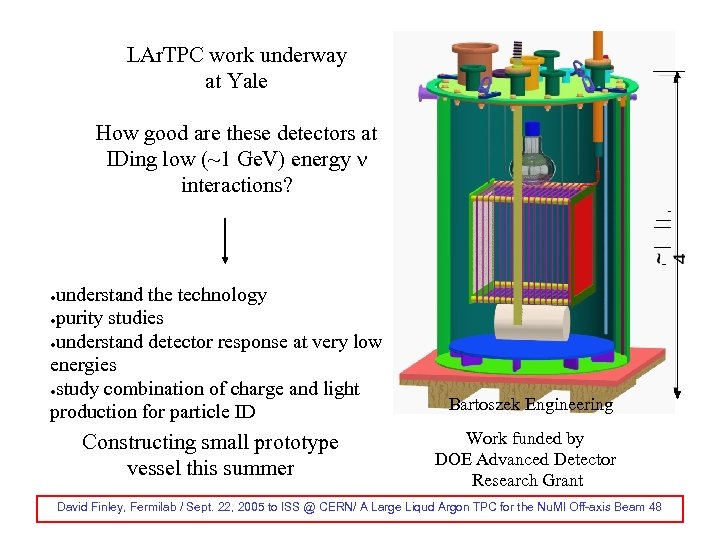 LAr. TPC work underway at Yale How good are these detectors at IDing low (~1 Ge. V) energy interactions? understand the technology ●purity studies ●understand detector response at very low energies ●study combination of charge and light production for particle ID ● Constructing small prototype vessel this summer Bartoszek Engineering Work funded by DOE Advanced Detector Research Grant David Finley, Fermilab / Sept. 22, 2005 to ISS @ CERN/ A Large Liqud Argon TPC for the Nu. MI Off-axis Beam 48