 Скачать презентацию Languages and Compilers SProg og Oversættere Bent Thomsen
e974f359db9f342099493fdfffec4795.ppt
- Количество слайдов: 84



Languages and Compilers (SProg og Oversættere) Bent Thomsen Department of Computer Science Aalborg University With acknowledgement to Norm Hutchinson whose slides this lecture is based on. 1
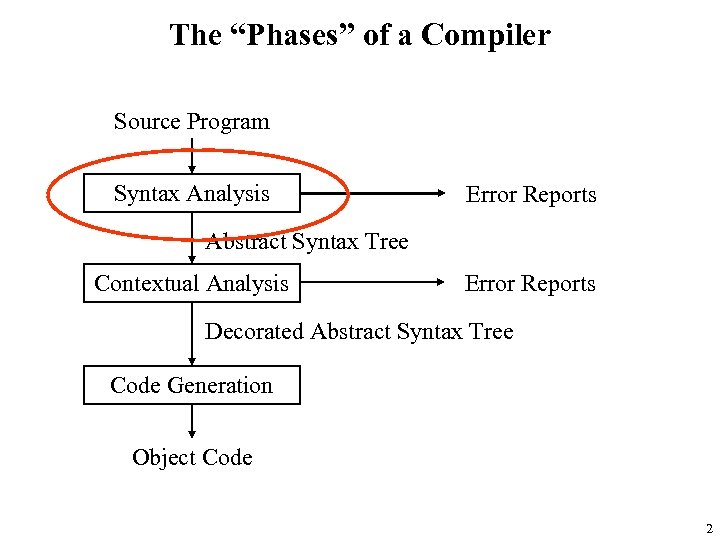
The “Phases” of a Compiler Source Program Syntax Analysis Error Reports Abstract Syntax Tree Contextual Analysis Error Reports Decorated Abstract Syntax Tree Code Generation Object Code 2
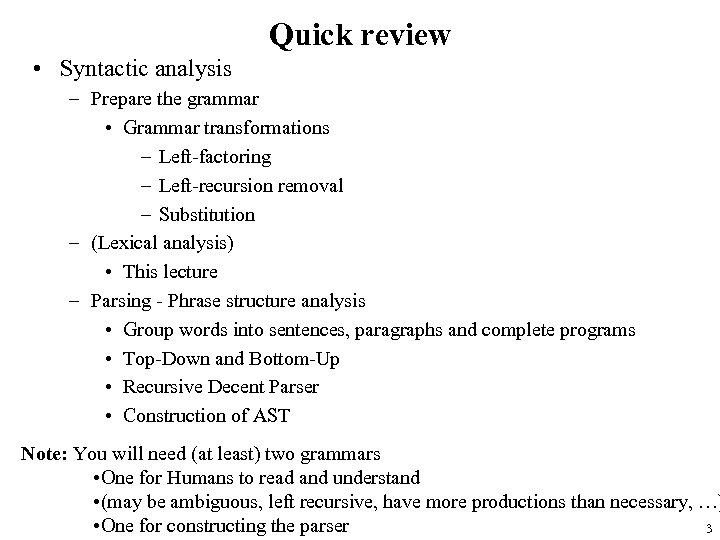
Quick review • Syntactic analysis – Prepare the grammar • Grammar transformations – Left-factoring – Left-recursion removal – Substitution – (Lexical analysis) • This lecture – Parsing - Phrase structure analysis • Group words into sentences, paragraphs and complete programs • Top-Down and Bottom-Up • Recursive Decent Parser • Construction of AST Note: You will need (at least) two grammars • One for Humans to read and understand • (may be ambiguous, left recursive, have more productions than necessary, …) • One for constructing the parser 3
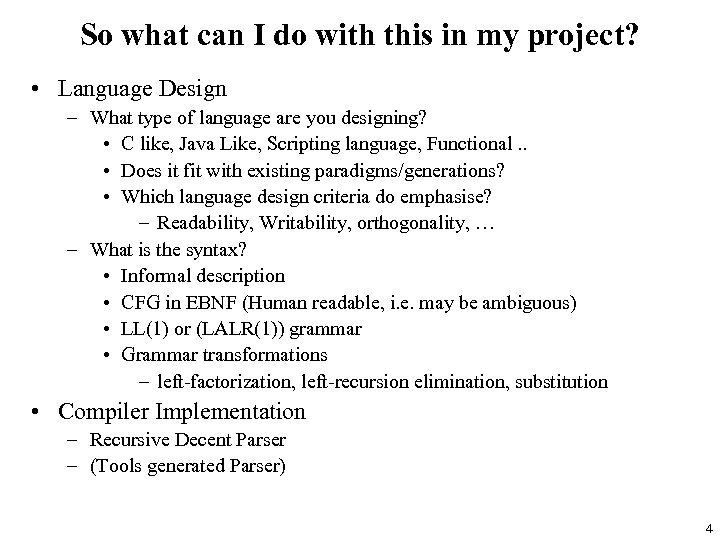
So what can I do with this in my project? • Language Design – What type of language are you designing? • C like, Java Like, Scripting language, Functional. . • Does it fit with existing paradigms/generations? • Which language design criteria do emphasise? – Readability, Writability, orthogonality, … – What is the syntax? • Informal description • CFG in EBNF (Human readable, i. e. may be ambiguous) • LL(1) or (LALR(1)) grammar • Grammar transformations – left-factorization, left-recursion elimination, substitution • Compiler Implementation – Recursive Decent Parser – (Tools generated Parser) 4
Different Phases of a Compiler The different phases can be seen as different transformation steps to transform source code into object code. The different phases correspond roughly to the different parts of the language specification: • Syntax analysis <-> Syntax • Contextual analysis <-> Contextual constraints • Code generation <-> Semantics 5
SPO or SS as PE course? That is a good question! 6
SPO as PE course 6. 3. 2. 1 Projektenhed DAT 2 A Tema: Sprog og oversættelse / Language and Compilation. Omfang: 22 ECTS. Formål: At kunne anvende væsentlige principper i programmeringssprog og teknikker til beskrivelse og oversættelse af sprog generelt. Indhold: Projektet består i en analyse af en datalogisk problemstilling, hvis løsning naturligt kan beskrives i form af et design af væsentlige begreber for et konkret programmeringssprog. I tilknytning hertil skal konstrueres en oversætter/fortolker for sproget, som viser dels at man kan vurdere anvendelsen af kendte parserværktøjer og/eller -teknikker, dels at man har opnået en forståelse for hvordan konkrete sproglige begreber repræsenteres på køretidspunktet. PE-kurser: MVP, SPO og DA Studieenhedskurser: NA, SS og PSS. 7
SS as PE course 6. 3. 2. 3 Projektenhed DAT 2 C Tema: Syntaks og semantik / Formal Languages - Syntax and Semantics. Omfang: 22 ECTS. Formål: At kunne anvende modeller for beskrivelse af syntaktiske og semantiske aspekter af programmeringssprog og anvende disse i implementation af sprog og verifikation/analyse af programmer. Indhold: Et typisk projekt vil bl. a. indeholde præcis definition af de væsentlige dele af et sprogs syntaks og semantik og anvendelser af disse definitioner i implementation af en oversætter/fortolker for sproget og/eller verifikation. PE-kurser: MVP, SS og DA. Studieenhedskurser: NA, SPO og PSS. 8
SPO or SS as PE course • A good DAT 2/SW 4/F 6 S project group can – – Design a language (or language extensions) Define the language syntax using CFG Define the language semantics using SOS Implement compiler/interpreter • in Java (or C/C++, C#, SML, …) – Build a recursive decent parse by hand – Or by using front-end tools such as Java. CC or Sable. CC • Do code generation for abstract machine – TAM, JVM (Perl. VM or. Net CLR) or new VM – Prove correctness of compiler • Using SOS for Prg. Lang. and VM 9
SPO or SS as PE course • Choose SPO as PE course – If your focus is on language design and/or implementation of a compiler/interpreter – If you like to talk about SS at the course exam • Choose SS as PE course – If your focus is on language definition and/or correctness proofs of implementation – If you like to talk about SPO at the course exam 10
Back to today's topic 11
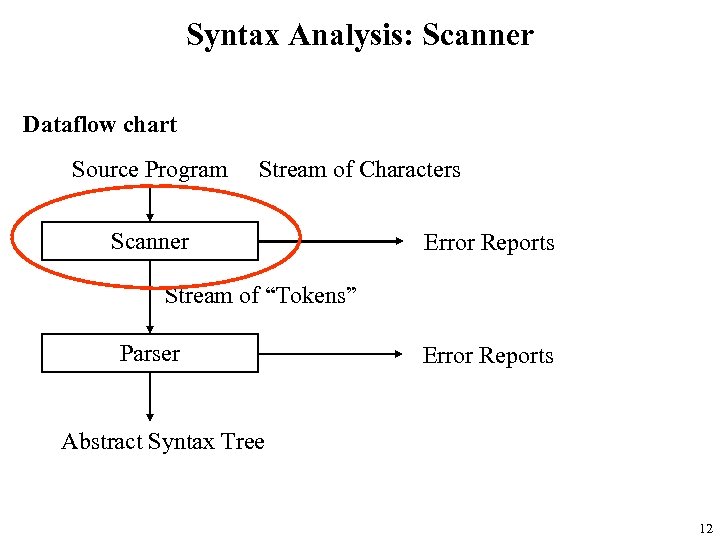
Syntax Analysis: Scanner Dataflow chart Source Program Stream of Characters Scanner Error Reports Stream of “Tokens” Parser Error Reports Abstract Syntax Tree 12
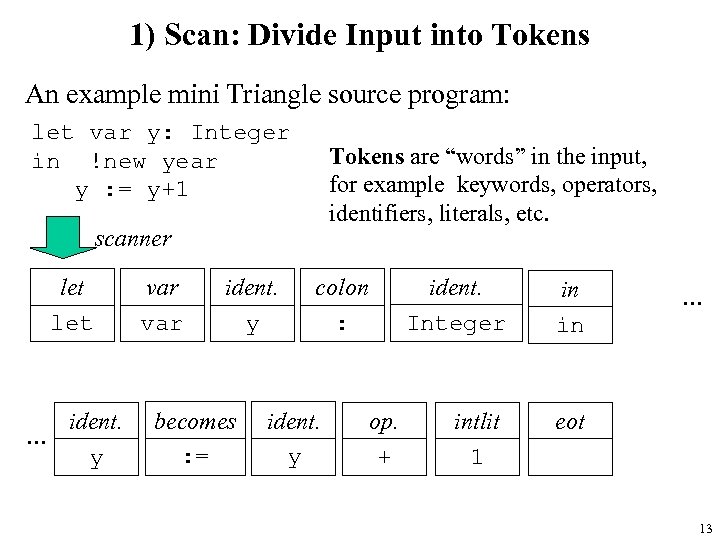
1) Scan: Divide Input into Tokens An example mini Triangle source program: let var y: Integer in !new year y : = y+1 Tokens are “words” in the input, for example keywords, operators, identifiers, literals, etc. scanner let . . . ident. y var ident. y becomes : = ident. Integer colon : ident. y op. + in in intlit 1 eot . . . 13
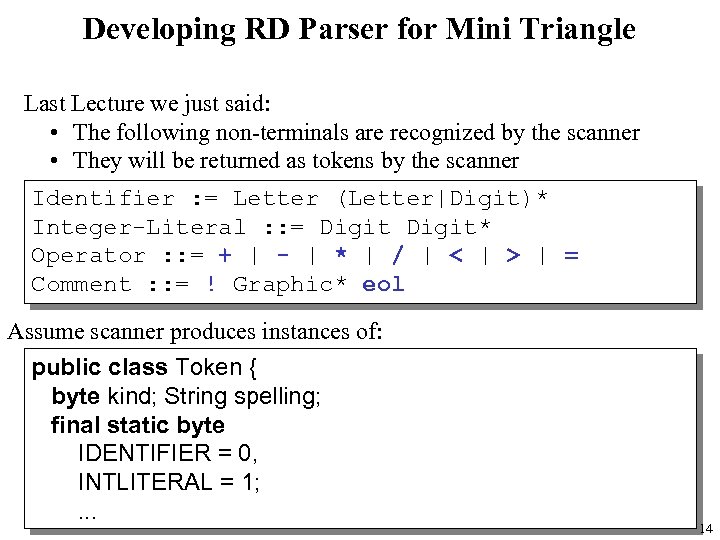
Developing RD Parser for Mini Triangle Last Lecture we just said: • The following non-terminals are recognized by the scanner • They will be returned as tokens by the scanner Identifier : = Letter (Letter|Digit)* Integer-Literal : : = Digit* Operator : : = + | - | * | / | < | > | = Comment : : = ! Graphic* eol Assume scanner produces instances of: public class Token { byte kind; String spelling; final static byte IDENTIFIER = 0, INTLITERAL = 1; . . . 14
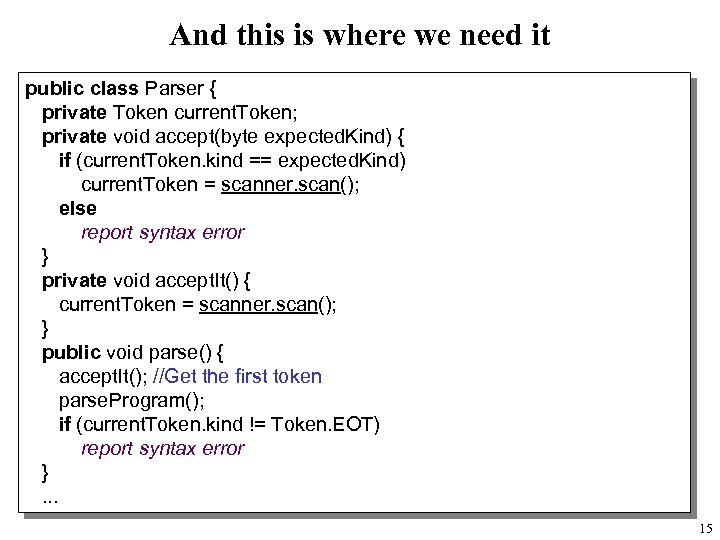
And this is where we need it public class Parser { private Token current. Token; private void accept(byte expected. Kind) { if (current. Token. kind == expected. Kind) current. Token = scanner. scan(); else report syntax error } private void accept. It() { current. Token = scanner. scan(); } public void parse() { accept. It(); //Get the first token parse. Program(); if (current. Token. kind != Token. EOT) report syntax error } . . . 15
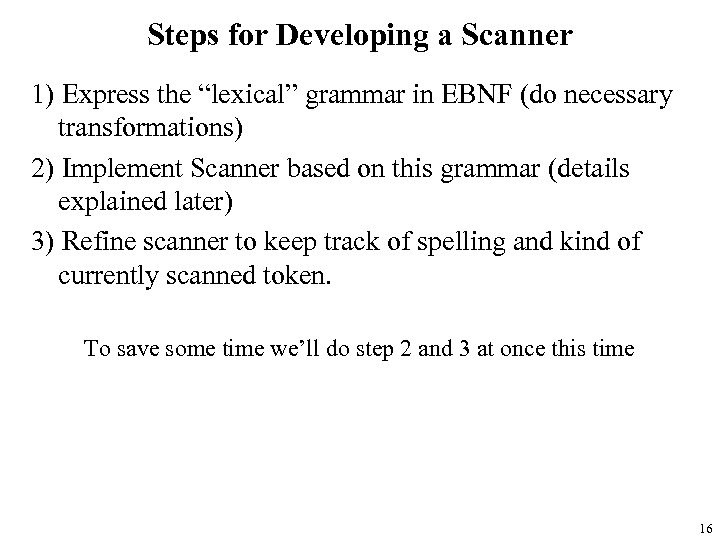
Steps for Developing a Scanner 1) Express the “lexical” grammar in EBNF (do necessary transformations) 2) Implement Scanner based on this grammar (details explained later) 3) Refine scanner to keep track of spelling and kind of currently scanned token. To save some time we’ll do step 2 and 3 at once this time 16
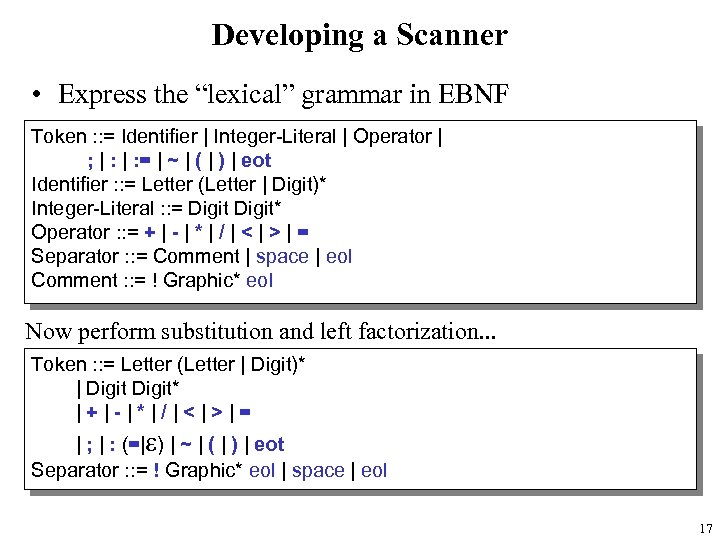
Developing a Scanner • Express the “lexical” grammar in EBNF Token : : = Identifier | Integer-Literal | Operator | ; | : = | ~ | ( | ) | eot Identifier : : = Letter (Letter | Digit)* Integer-Literal : : = Digit* Operator : : = + | - | * | / | < | > | = Separator : : = Comment | space | eol Comment : : = ! Graphic* eol Now perform substitution and left factorization. . . Token : : = Letter (Letter | Digit)* | Digit* | + | - | * | / | < | > | = | ; | : (=|e) | ~ | ( | ) | eot Separator : : = ! Graphic* eol | space | eol 17
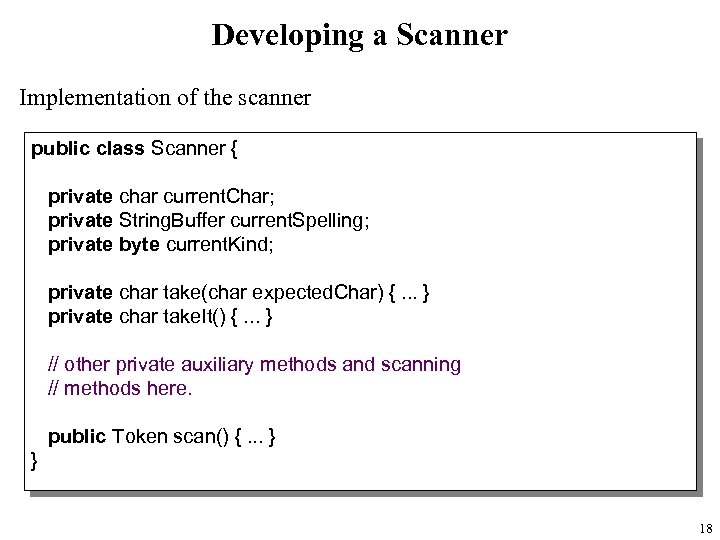
Developing a Scanner Implementation of the scanner public class Scanner { private char current. Char; private String. Buffer current. Spelling; private byte current. Kind; private char take(char expected. Char) {. . . } private char take. It() {. . . } // other private auxiliary methods and scanning // methods here. public Token scan() {. . . } } 18
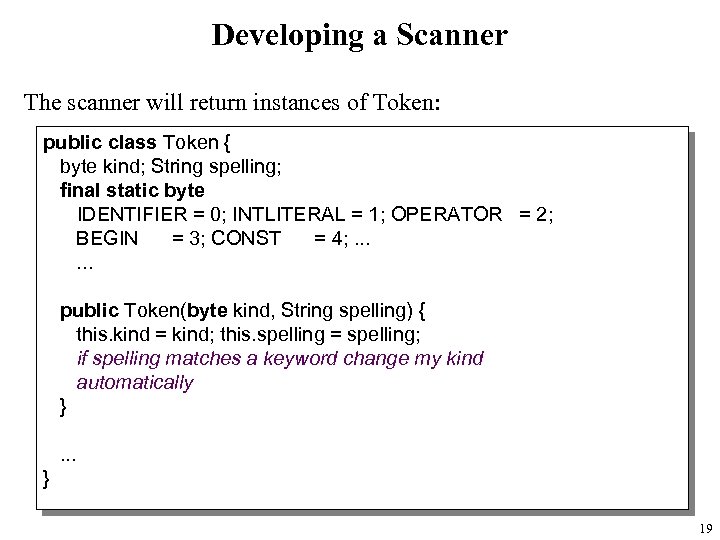
Developing a Scanner The scanner will return instances of Token: public class Token { byte kind; String spelling; final static byte IDENTIFIER = 0; INTLITERAL = 1; OPERATOR = 2; BEGIN = 3; CONST = 4; . . . public Token(byte kind, String spelling) { this. kind = kind; this. spelling = spelling; if spelling matches a keyword change my kind automatically } . . . } 19
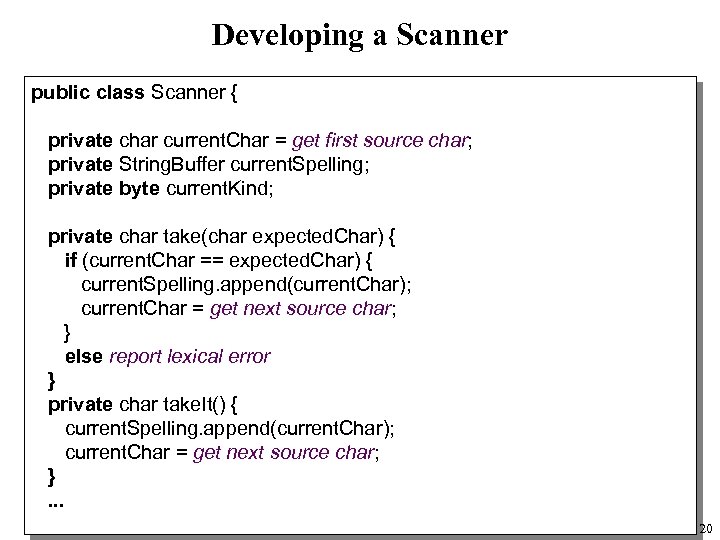
Developing a Scanner public class Scanner { private char current. Char = get first source char; private String. Buffer current. Spelling; private byte current. Kind; private char take(char expected. Char) { if (current. Char == expected. Char) { current. Spelling. append(current. Char); current. Char = get next source char; } else report lexical error } private char take. It() { current. Spelling. append(current. Char); current. Char = get next source char; }. . . 20
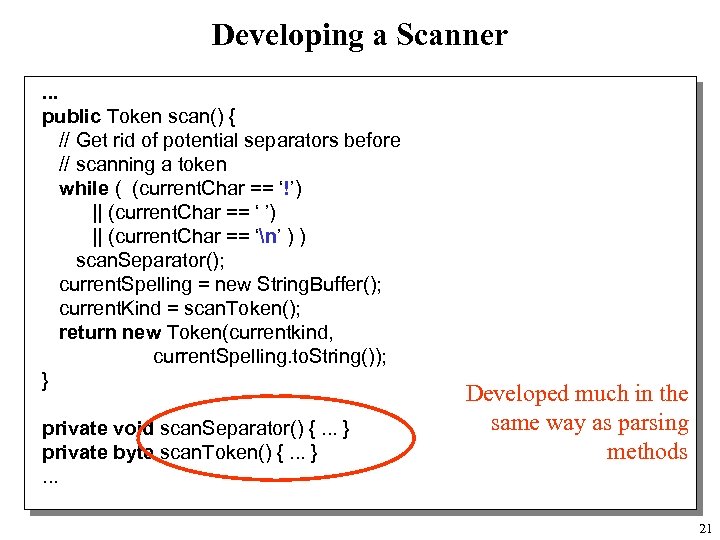
Developing a Scanner. . . public Token scan() { // Get rid of potential separators before // scanning a token while ( (current. Char == ‘!’) || (current. Char == ‘n’ ) ) scan. Separator(); current. Spelling = new String. Buffer(); current. Kind = scan. Token(); return new Token(currentkind, current. Spelling. to. String()); } private void scan. Separator() {. . . } private byte scan. Token() {. . . } . . . Developed much in the same way as parsing methods 21
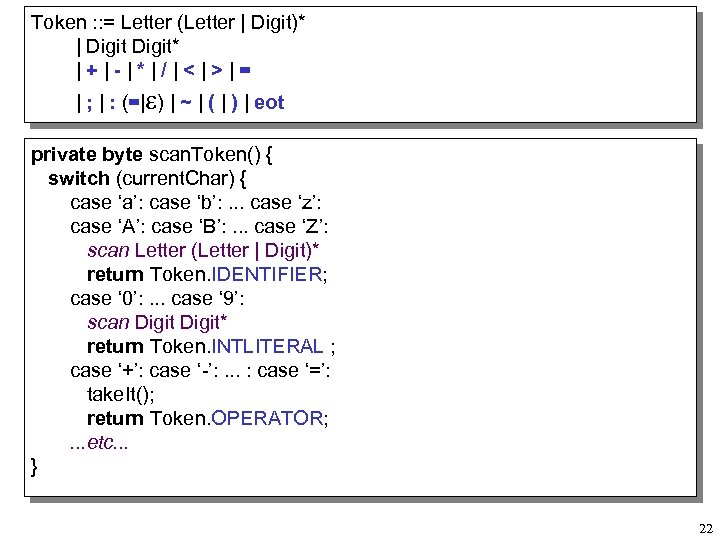
Token : : = Letter (Letter | Digit)* | Digit* | + | - | * | / | < | > | = Developing a Scanner | ; | : (=|e) | ~ | ( | ) | eot private byte scan. Token() { switch (current. Char) { case ‘a’: case ‘b’: . . . case ‘z’: case ‘A’: case ‘B’: . . . case ‘Z’: scan Letter (Letter | Digit)* return Token. IDENTIFIER; case ‘ 0’: . . . case ‘ 9’: scan Digit* return Token. INTLITERAL ; case ‘+’: case ‘-’: . . . : case ‘=’: take. It(); return Token. OPERATOR; . . . etc. . . } 22
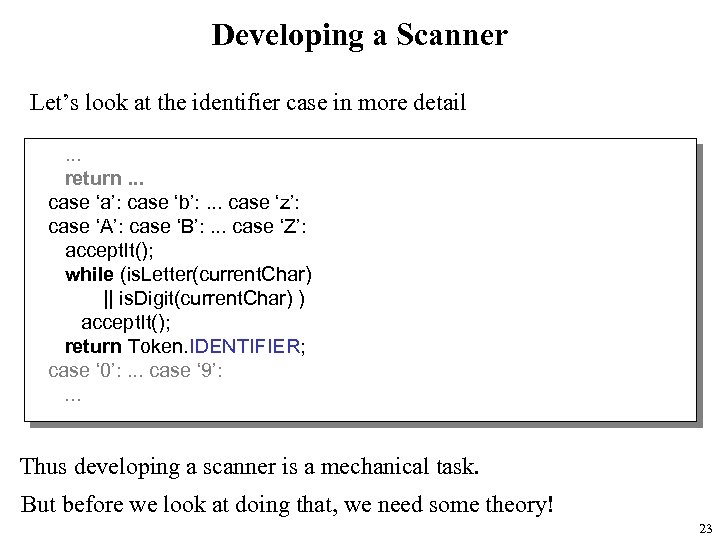
Developing a Scanner Let’s look at the identifier case in more detail . . . return. . . case ‘a’: case ‘b’: . . . case ‘z’: case ‘A’: case ‘B’: . . . case ‘Z’: accept. It(); scan Letter (Letter | Digit)* while Token. IDENTIFIER; scan (Letter | Digit)* return(is. Letter(current. Char) || is. Digit(current. Char) ) return Token. IDENTIFIER; case ‘ 0’: . . . case ‘ 9’: accept. It(); scan (Letter | Digit) case ‘ 0’: . . . case ‘ 9’: . . . return Token. IDENTIFIER; . . . case ‘ 0’: . . . case ‘ 9’: . . . Thus developing a scanner is a mechanical task. But before we look at doing that, we need some theory! 23
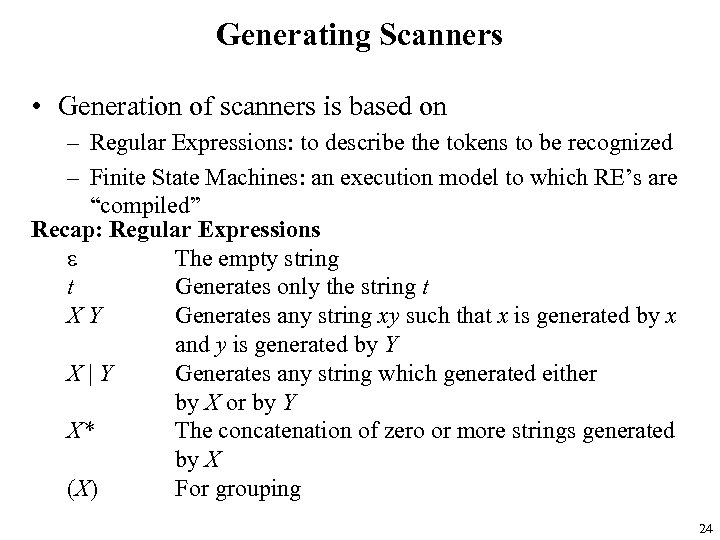
Generating Scanners • Generation of scanners is based on – Regular Expressions: to describe the tokens to be recognized – Finite State Machines: an execution model to which RE’s are “compiled” Recap: Regular Expressions e The empty string t Generates only the string t XY Generates any string xy such that x is generated by x and y is generated by Y X | Y Generates any string which generated either by X or by Y X* The concatenation of zero or more strings generated by X (X) For grouping 24
Generating Scanners • Regular Expressions can be recognized by a finite state machine. (often used synonyms: finite automaton (acronym FA)) Definition: A finite state machine is an N-tuple (States, S, start, d , End) States A finite set of “states” S An “alphabet”: a finite set of symbols from which the strings we want to recognize are formed (for example: the ASCII char set) start A “start state” Start States d Transition relation d States x S. These are “arrows” between states labeled by a letter from the alphabet. End A set of final states. End States 25
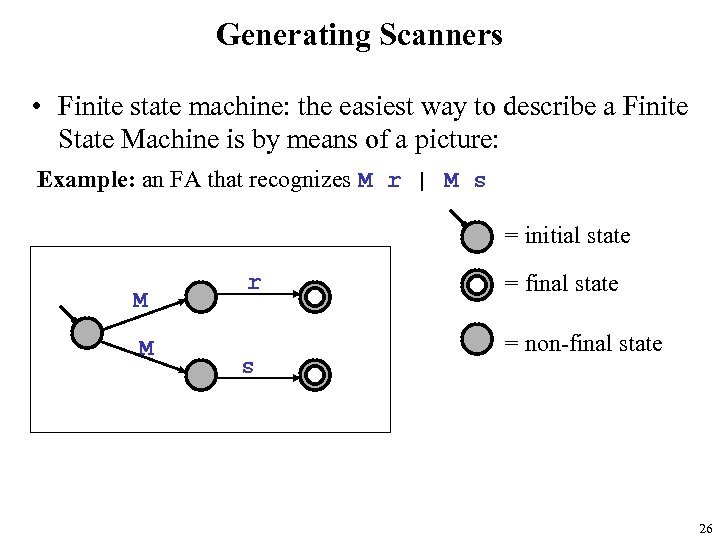
Generating Scanners • Finite state machine: the easiest way to describe a Finite State Machine is by means of a picture: Example: an FA that recognizes M r | M s = initial state M M r s = final state = non-final state 26
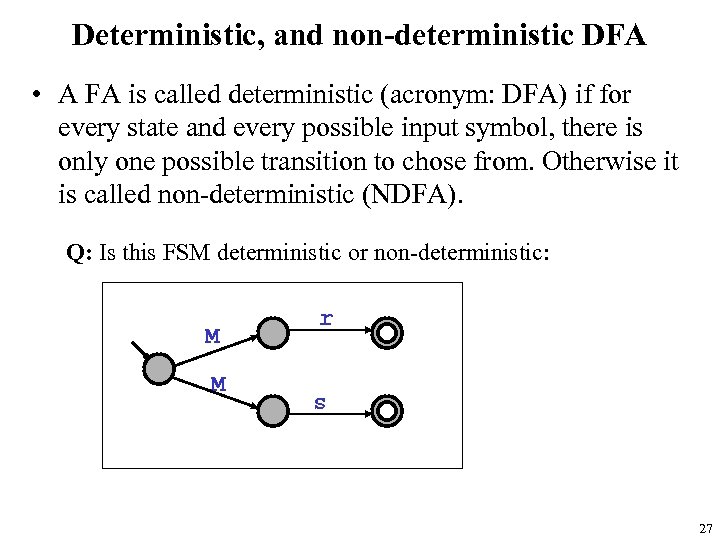
Deterministic, and non-deterministic DFA • A FA is called deterministic (acronym: DFA) if for every state and every possible input symbol, there is only one possible transition to chose from. Otherwise it is called non-deterministic (NDFA). Q: Is this FSM deterministic or non-deterministic: M M r s 27
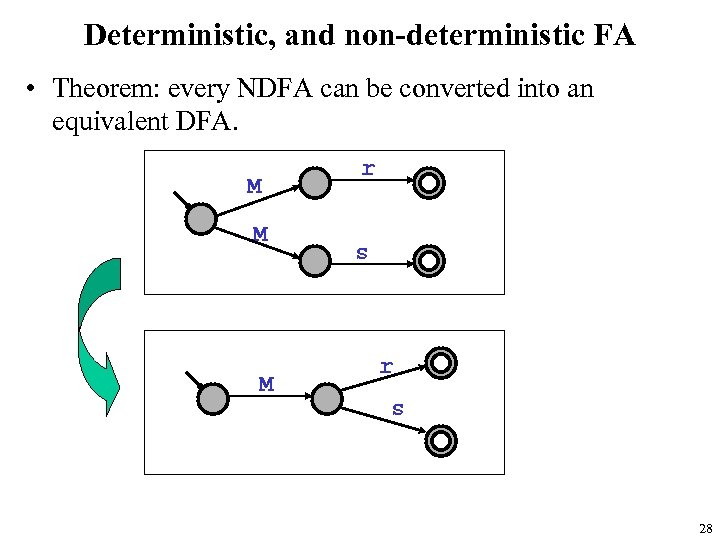
Deterministic, and non-deterministic FA • Theorem: every NDFA can be converted into an equivalent DFA. M M DFA ? M r s 28
Deterministic, and non-deterministic FA • Theorem: every NDFA can be converted into an equivalent DFA. Algorithm: The basic idea: DFA is defined as a machine that does a “parallel simulation” of the NDFA. • The states of the DFA are subsets of the states of the NDFA (i. e. every state of the DFA is a set of states of the NDFA) => This state can be interpreted as meaning “the simulated DFA is now in any of these states” 29
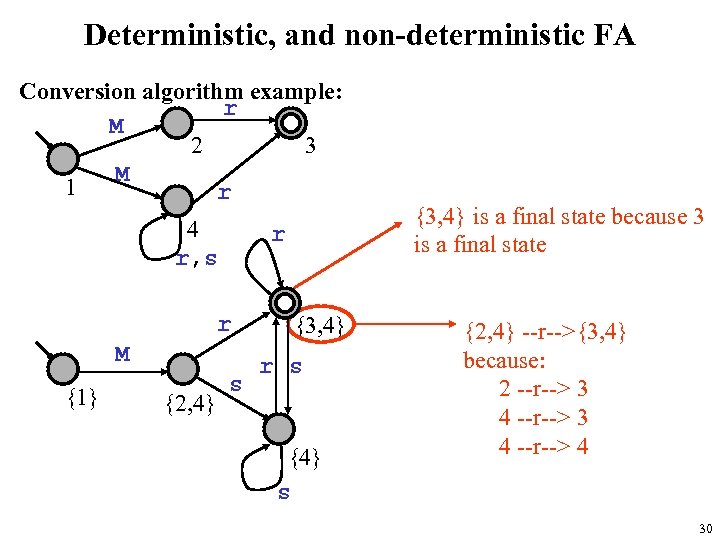
Deterministic, and non-deterministic FA Conversion algorithm example: r M 2 3 M 1 r 4 r, s r r M {1} {2, 4} s {3, 4} r s {4} s {3, 4} is a final state because 3 is a final state {2, 4} --r-->{3, 4} because: 2 --r--> 3 4 --r--> 4 30
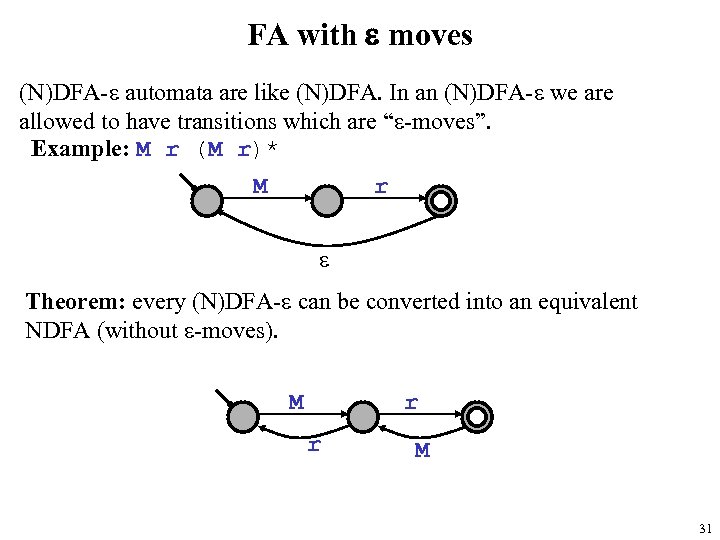
FA with e moves (N)DFA-e automata are like (N)DFA. In an (N)DFA-e we are allowed to have transitions which are “e-moves”. Example: M r (M r)* M r e Theorem: every (N)DFA-e can be converted into an equivalent NDFA (without e-moves). M r r M 31
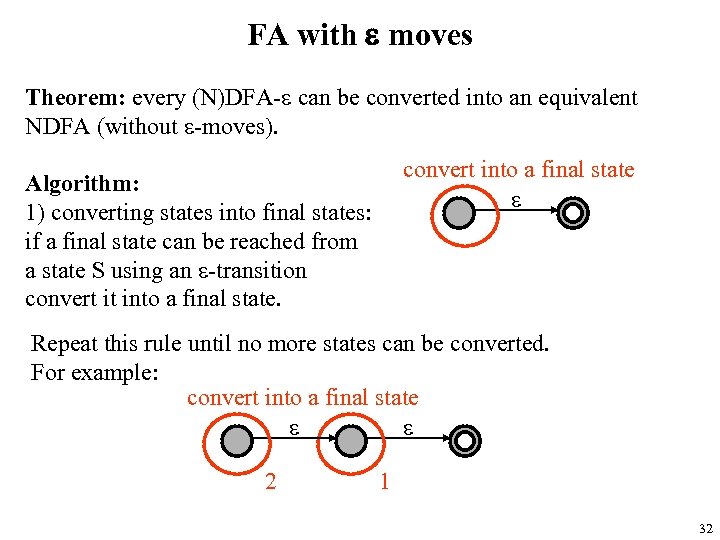
FA with e moves Theorem: every (N)DFA-e can be converted into an equivalent NDFA (without e-moves). convert into a final state e Algorithm: 1) converting states into final states: if a final state can be reached from a state S using an e-transition convert it into a final state. Repeat this rule until no more states can be converted. For example: convert into a final state e e 2 1 32
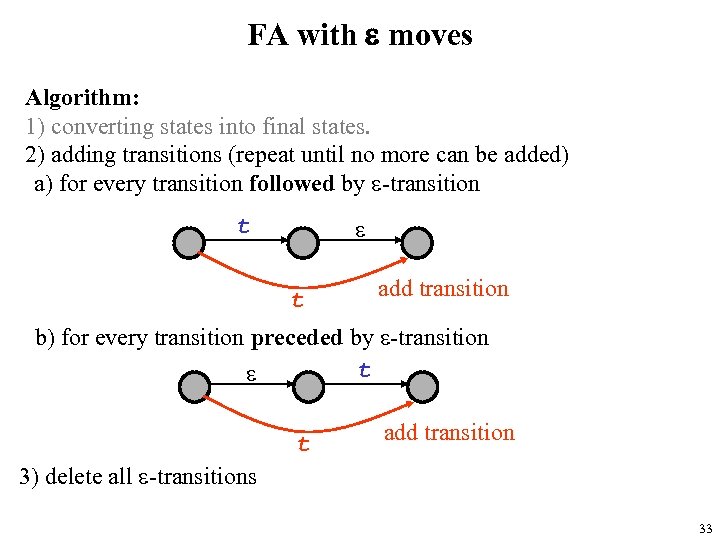
FA with e moves Algorithm: 1) converting states into final states. 2) adding transitions (repeat until no more can be added) a) for every transition followed by e-transition e t t add transition b) for every transition preceded by e-transition t e t add transition 3) delete all e-transitions 33
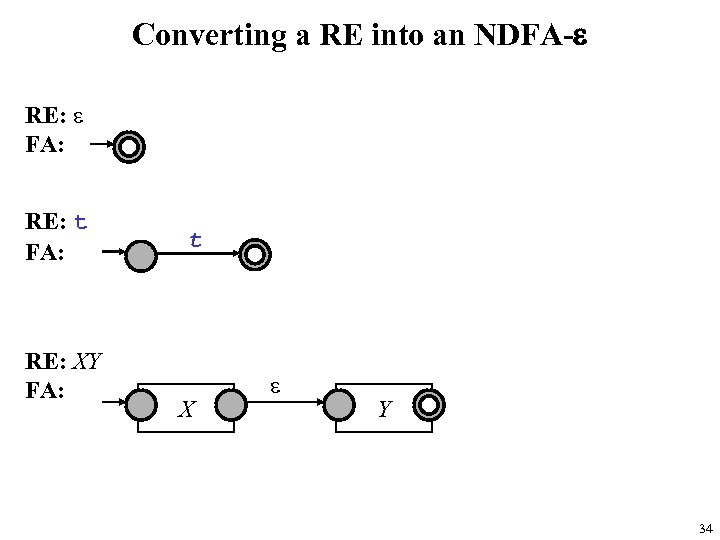
Converting a RE into an NDFA-e RE: e FA: RE: t FA: RE: XY FA: t X e Y 34
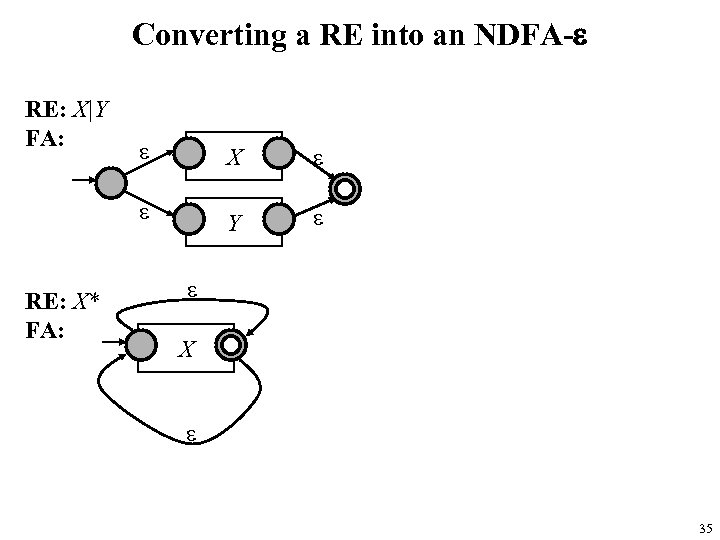
Converting a RE into an NDFA-e RE: X|Y FA: X e e RE: X* FA: e Y e e X e 35
FA and the implementation of Scanners • Regular expressions, (N)DFA-e and NDFA and DFA’s are all equivalent formalism in terms of what languages can be defined with them. • Regular expressions are a convenient notation for describing the “tokens” of programming languages. • Regular expressions can be converted into FA’s (the algorithm for conversion into NDFA-e is straightforward) • DFA’s can be easily implemented as computer programs. will explain this in subsequent slides 36
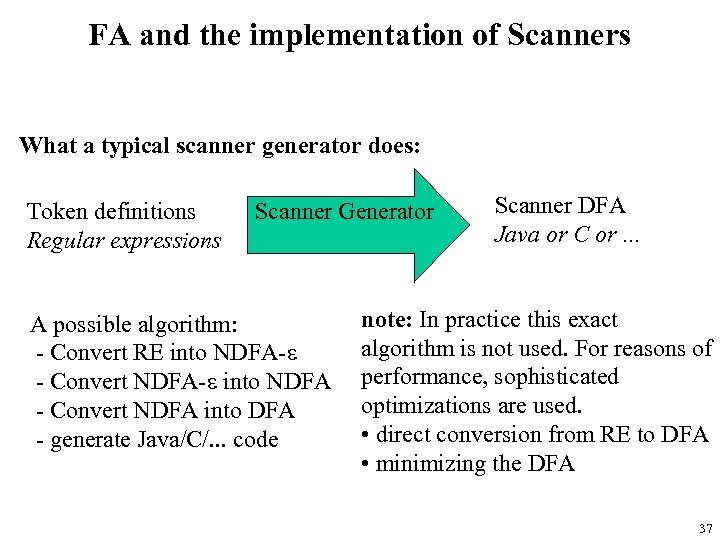
FA and the implementation of Scanners What a typical scanner generator does: Token definitions Regular expressions Scanner Generator A possible algorithm: - Convert RE into NDFA-e - Convert NDFA-e into NDFA - Convert NDFA into DFA - generate Java/C/. . . code Scanner DFA Java or C or. . . note: In practice this exact algorithm is not used. For reasons of performance, sophisticated optimizations are used. • direct conversion from RE to DFA • minimizing the DFA 37
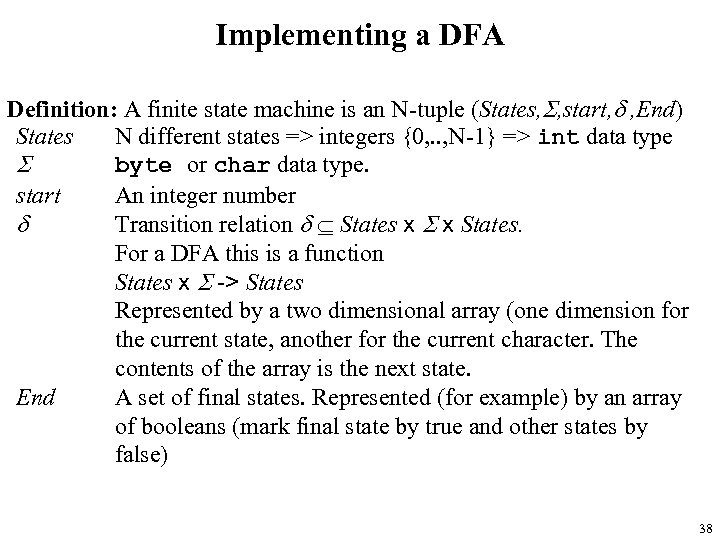
Implementing a DFA Definition: A finite state machine is an N-tuple (States, S, start, d , End) States N different states => integers {0, . . , N-1} => int data type S byte or char data type. start An integer number d Transition relation d States x States. For a DFA this is a function States x S -> States Represented by a two dimensional array (one dimension for the current state, another for the current character. The contents of the array is the next state. End A set of final states. Represented (for example) by an array of booleans (mark final state by true and other states by false) 38
![Implementing a DFA public class Recognizer { static boolean[] final. State = final state](https://present5.com/presentation/e974f359db9f342099493fdfffec4795/image-39.jpg "Implementing a DFA public class Recognizer { static boolean[] final. State = final state")
Implementing a DFA public class Recognizer { static boolean[] final. State = final state table ; static int[][] delta = transition table ; private byte current. Char. Code = get first char ; private int current. State = start state ; public boolean recognize() { while (current. Char. Code is not end of file) && (current. State is not error state ) { current. State = delta[current. State][current. Char. Code]; current. Char. Code = get next char ; return final. State[current. State]; } } 39
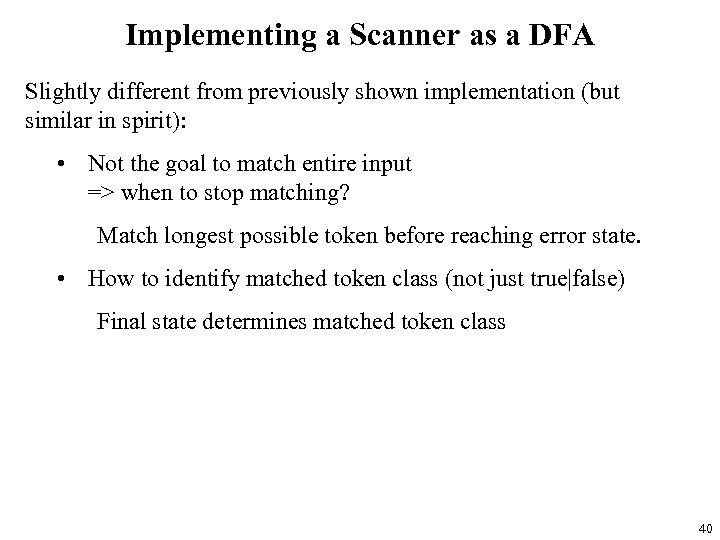
Implementing a Scanner as a DFA Slightly different from previously shown implementation (but similar in spirit): • Not the goal to match entire input => when to stop matching? Match longest possible token before reaching error state. • How to identify matched token class (not just true|false) Final state determines matched token class 40
![Implementing a Scanner as a DFA public class Scanner { static int[] matched. Token](https://present5.com/presentation/e974f359db9f342099493fdfffec4795/image-41.jpg "Implementing a Scanner as a DFA public class Scanner { static int[] matched. Token")
Implementing a Scanner as a DFA public class Scanner { static int[] matched. Token = maps state to token class static int[][] delta = transition table ; private byte current. Char. Code = get first char ; private int current. State = start state ; private int tokbegin = begining of current token ; private int tokend = end of current token private int token. Kind ; . . . 41
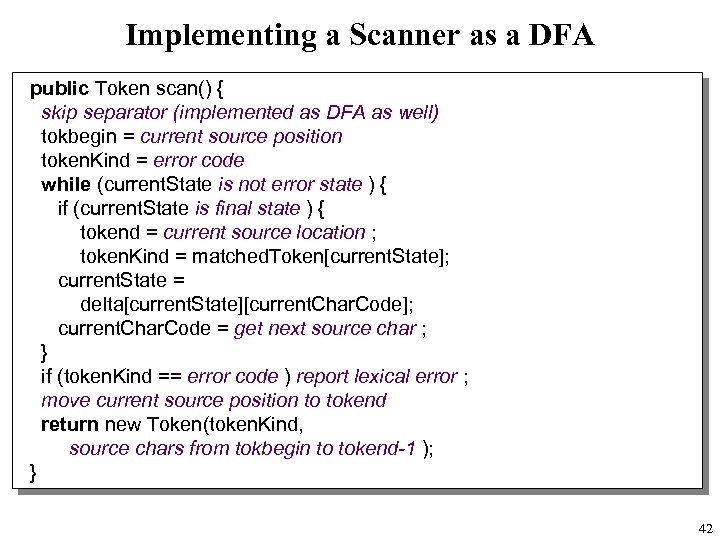
Implementing a Scanner as a DFA public Token scan() { skip separator (implemented as DFA as well) tokbegin = current source position token. Kind = error code while (current. State is not error state ) { if (current. State is final state ) { tokend = current source location ; token. Kind = matched. Token[current. State]; current. State = delta[current. State][current. Char. Code]; current. Char. Code = get next source char ; } if (token. Kind == error code ) report lexical error ; move current source position to tokend return new Token(token. Kind, source chars from tokbegin to tokend-1 ); } 42
We don’t do this by hand anymore! Writing scanners is a rather “robotic” activity which can be automated. • JLex – input: • a set of REs and action code – output • a fast lexical analyzer (scanner) – based on a DFA • Or the lexer is built into the parser generator as in Java. CC 43
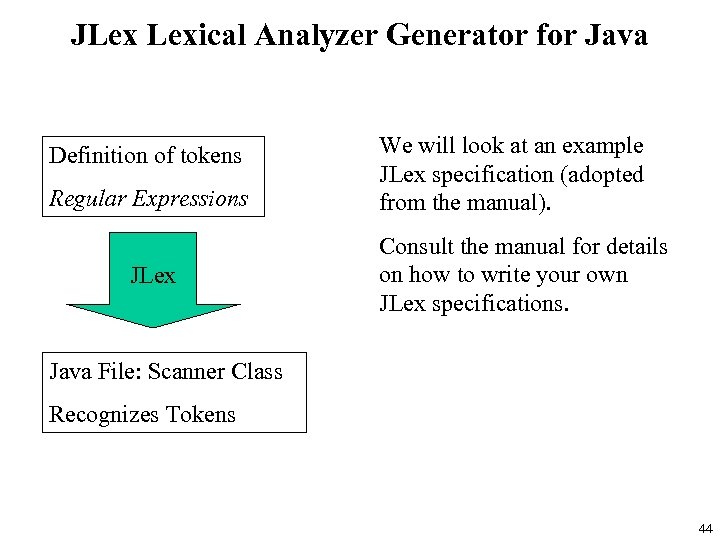
JLex Lexical Analyzer Generator for Java Definition of tokens Regular Expressions JLex We will look at an example JLex specification (adopted from the manual). Consult the manual for details on how to write your own JLex specifications. Java File: Scanner Class Recognizes Tokens 44
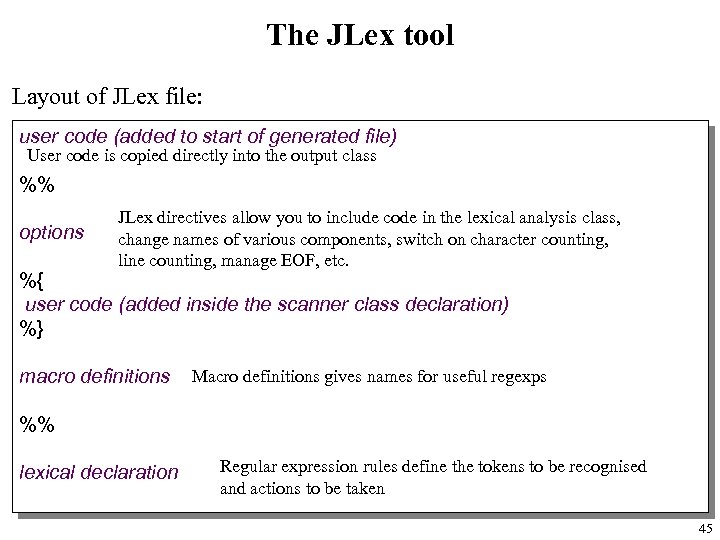
The JLex tool Layout of JLex file: user code (added to start of generated file) User code is copied directly into the output class %% options JLex directives allow you to include code in the lexical analysis class, change names of various components, switch on character counting, line counting, manage EOF, etc. %{ user code (added inside the scanner class declaration) %} macro definitions Macro definitions gives names for useful regexps %% lexical declaration Regular expression rules define the tokens to be recognised and actions to be taken 45
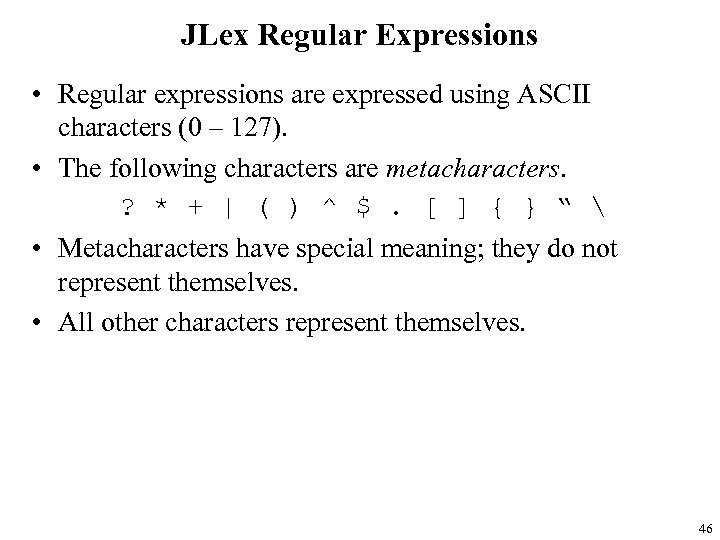
JLex Regular Expressions • Regular expressions are expressed using ASCII characters (0 – 127). • The following characters are metacharacters. ? * + | ( ) ^ $. [ ] { } “ • Metacharacters have special meaning; they do not represent themselves. • All other characters represent themselves. 46
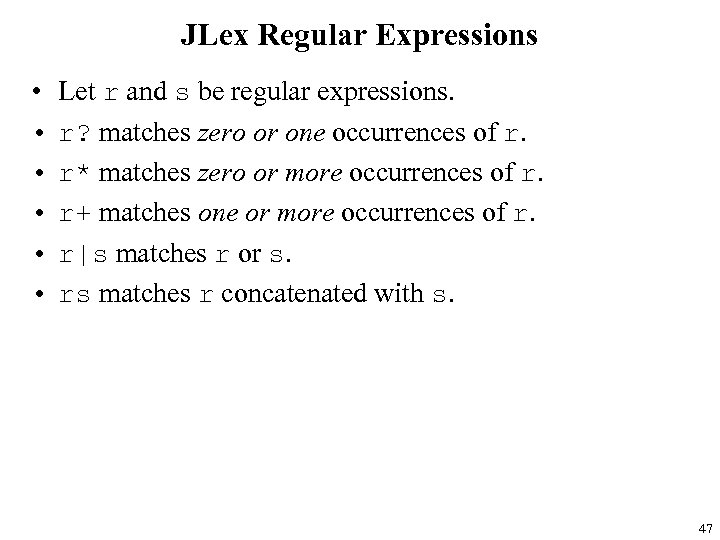
JLex Regular Expressions • • • Let r and s be regular expressions. r? matches zero or one occurrences of r. r* matches zero or more occurrences of r. r+ matches one or more occurrences of r. r|s matches r or s. rs matches r concatenated with s. 47
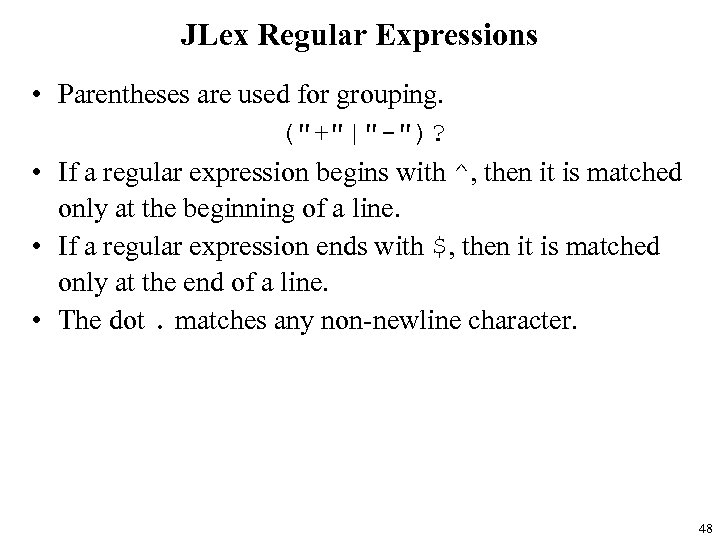
JLex Regular Expressions • Parentheses are used for grouping. ("+"|"-")? • If a regular expression begins with ^, then it is matched only at the beginning of a line. • If a regular expression ends with $, then it is matched only at the end of a line. • The dot. matches any non-newline character. 48
![JLex Regular Expressions • Brackets [ ] match any single character listed within the](https://present5.com/presentation/e974f359db9f342099493fdfffec4795/image-49.jpg "JLex Regular Expressions • Brackets [ ] match any single character listed within the")
JLex Regular Expressions • Brackets [ ] match any single character listed within the brackets. – [abc] matches a or b or c. – [A-Za-z] matches any letter. • If the first character after [ is ^, then the brackets match any character except those listed. – [^A-Za-z] matches any nonletter. 49
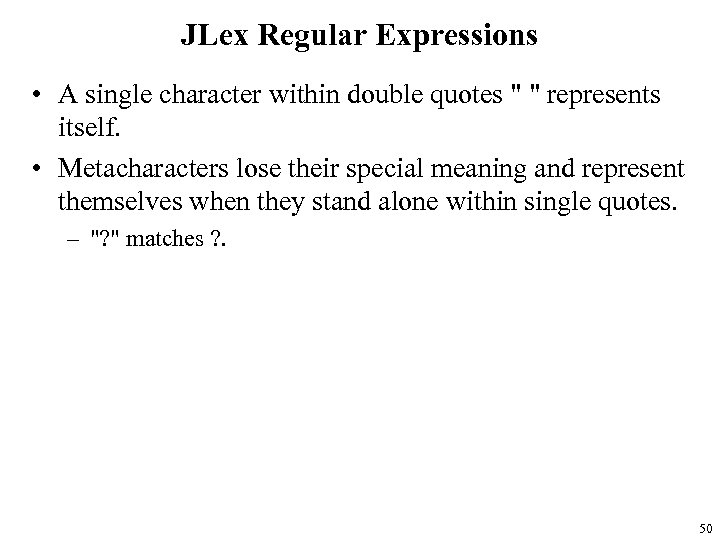
JLex Regular Expressions • A single character within double quotes " " represents itself. • Metacharacters lose their special meaning and represent themselves when they stand alone within single quotes. – "? " matches ? . 50
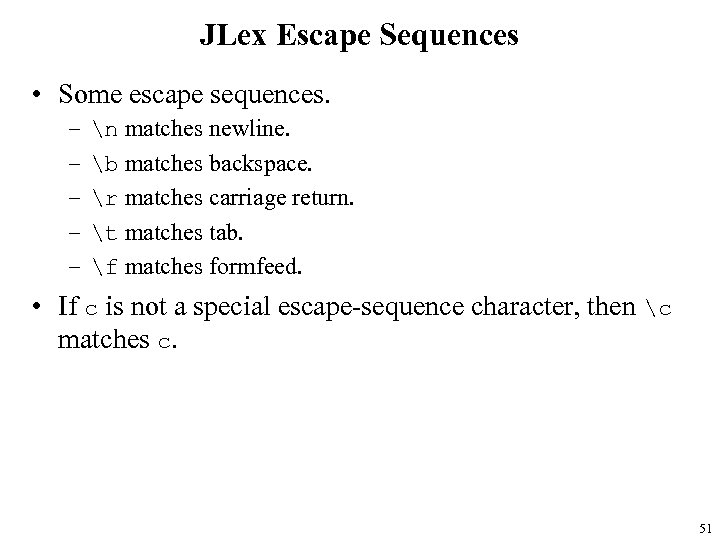
JLex Escape Sequences • Some escape sequences. – – – n matches newline. b matches backspace. r matches carriage return. t matches tab. f matches formfeed. • If c is not a special escape-sequence character, then c matches c. 51
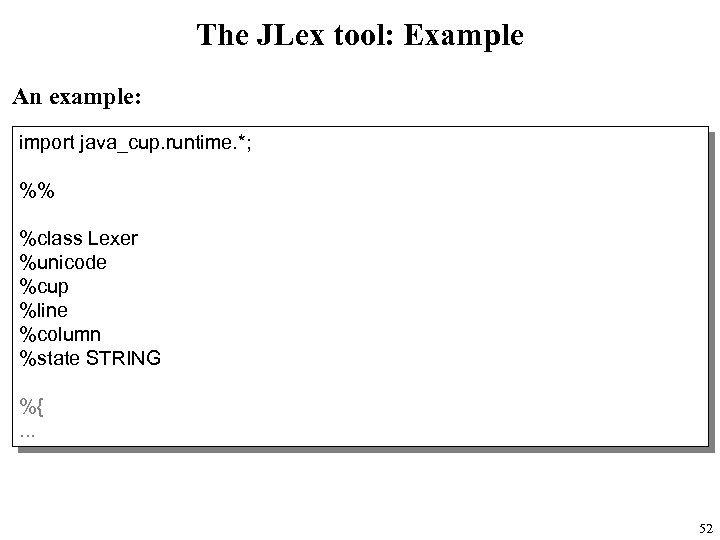
The JLex tool: Example An example: import java_cup. runtime. *; %% %class Lexer %unicode %cup %line %column %state STRING %{. . . 52
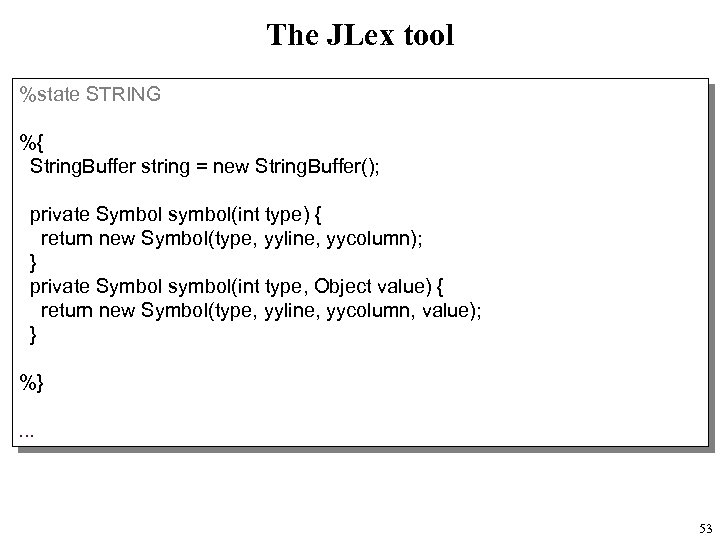
The JLex tool %state STRING %{ String. Buffer string = new String. Buffer(); private Symbol symbol(int type) { return new Symbol(type, yyline, yycolumn); } private Symbol symbol(int type, Object value) { return new Symbol(type, yyline, yycolumn, value); } %}. . . 53
![The JLex tool %} Line. Terminator = r|n|rn Input. Character = [^rn] White. Space](https://present5.com/presentation/e974f359db9f342099493fdfffec4795/image-54.jpg "The JLex tool %} Line. Terminator = r|n|rn Input. Character = [^rn] White. Space")
The JLex tool %} Line. Terminator = r|n|rn Input. Character = [^rn] White. Space = {Line. Terminator} | [ tf] /* comments */ Comment = {Traditional. Comment} | {End. Of. Line. Comment} | Traditional. Comment = "/*" {Comment. Content} "*"+ "/" End. Of. Line. Comment= "//"{Input. Character}* {Line. Terminator} Comment. Content = ( [^*] | *+ [^/*] )* Identifier = [: jletter: ] [: jletterdigit: ]* Dec. Integer. Literal = 0 | [1 -9][0 -9]* %%. . . 54
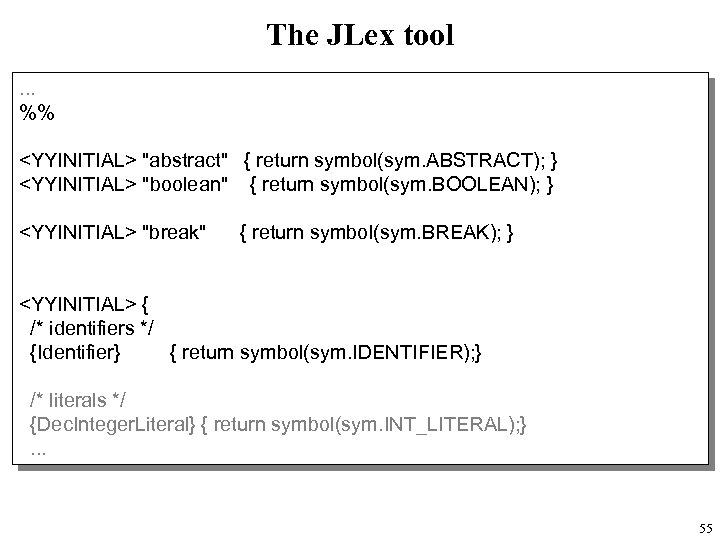
The JLex tool. . . %% <YYINITIAL> "abstract" { return symbol(sym. ABSTRACT); } <YYINITIAL> "boolean" { return symbol(sym. BOOLEAN); } <YYINITIAL> "break" { return symbol(sym. BREAK); } <YYINITIAL> { /* identifiers */ {Identifier} { return symbol(sym. IDENTIFIER); } /* literals */ {Dec. Integer. Literal} { return symbol(sym. INT_LITERAL); } . . . 55
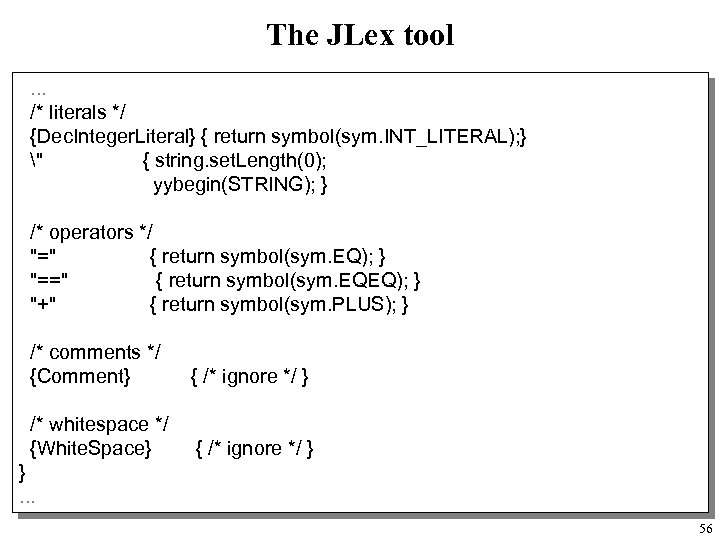
The JLex tool . . . /* literals */ {Dec. Integer. Literal} { return symbol(sym. INT_LITERAL); } " { string. set. Length(0); yybegin(STRING); } /* operators */ "=" { return symbol(sym. EQ); } "==" { return symbol(sym. EQEQ); } "+" { return symbol(sym. PLUS); } /* comments */ {Comment} { /* ignore */ } /* whitespace */ {White. Space} { /* ignore */ } }. . . 56
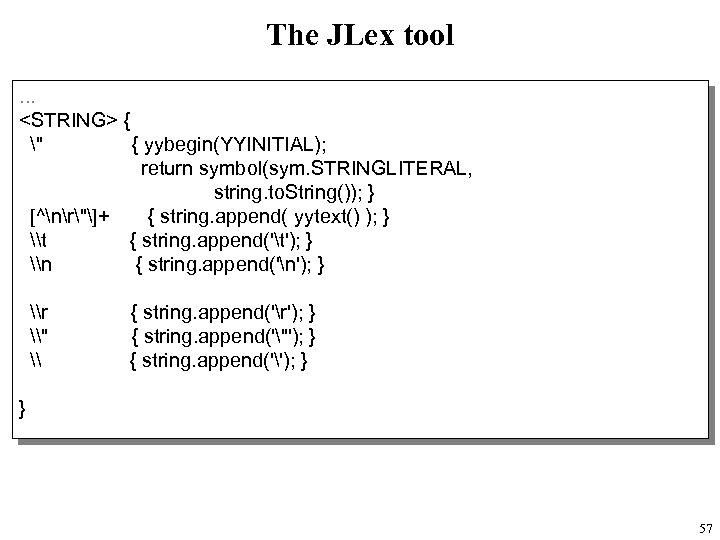
The JLex tool. . . <STRING> { " { yybegin(YYINITIAL); return symbol(sym. STRINGLITERAL, string. to. String()); } [^nr"]+ { string. append( yytext() ); } \t { string. append('t'); } \n { string. append('n'); } \r { string. append('r'); } \" { string. append('"'); } \ { string. append(''); } } 57
JLex generated Lexical Analyser • Class Yylex – Name can be changed with %class directive – Default construction with one arg – the input stream • You can add your own constructors – The method performing lexical analysis is yylex() • Public Yytoken yylex() which return the next token • You can change the name of yylex() with %function directive – String yytext() returns the matched token string – Int yylenght() returns the length of the token – Int yychar is the index of the first matched char (if %char used) • Class Yytoken – Returned by yylex() – you declare it or supply one already defined – You can supply one with %type directive • Java_cup. runtime. Symbol is useful – Actions typically written to return Yytoken(…) 58
Conclusions • Don’t worry too much about DFAs • You do need to understand how to specify regular expressions • Note that different tools have different notations for regular expressions. • You would probably only need to use JLex (Lex) if you use also use CUP (or Yacc or SML-Yacc) 59
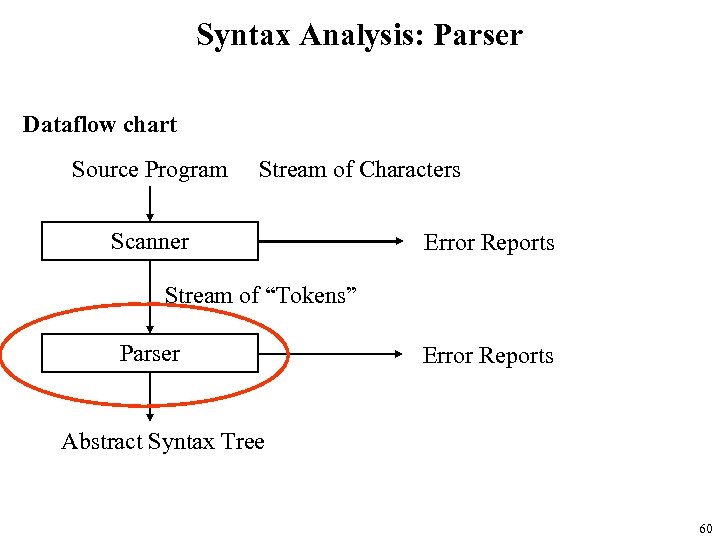
Syntax Analysis: Parser Dataflow chart Source Program Stream of Characters Scanner Error Reports Stream of “Tokens” Parser Error Reports Abstract Syntax Tree 60
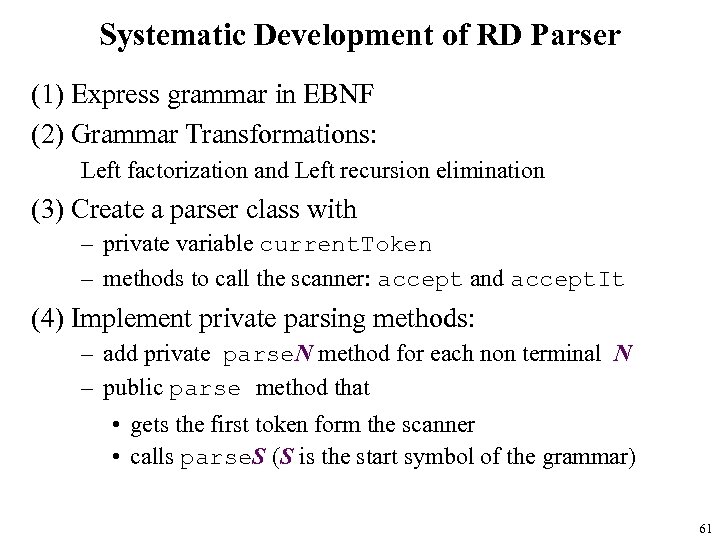
Systematic Development of RD Parser (1) Express grammar in EBNF (2) Grammar Transformations: Left factorization and Left recursion elimination (3) Create a parser class with – private variable current. Token – methods to call the scanner: accept and accept. It (4) Implement private parsing methods: – add private parse. N method for each non terminal N – public parse method that • gets the first token form the scanner • calls parse. S (S is the start symbol of the grammar) 61
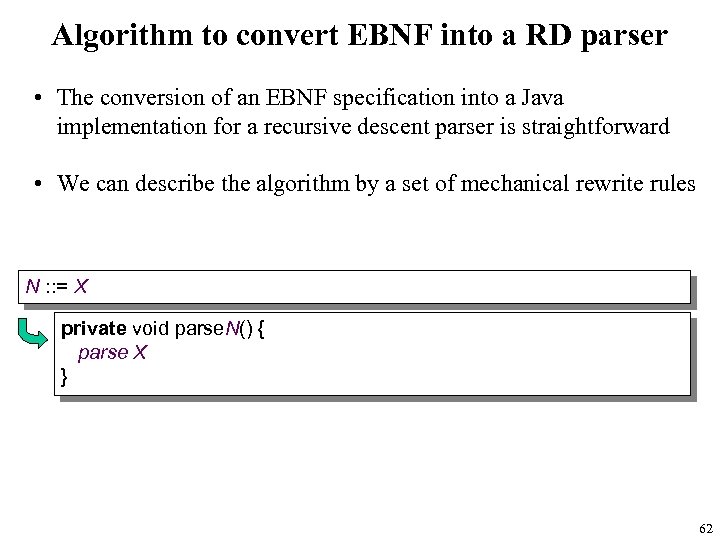
Algorithm to convert EBNF into a RD parser • The conversion of an EBNF specification into a Java implementation for a recursive descent parser is straightforward • We can describe the algorithm by a set of mechanical rewrite rules N : : = X private void parse. N() { parse X } 62
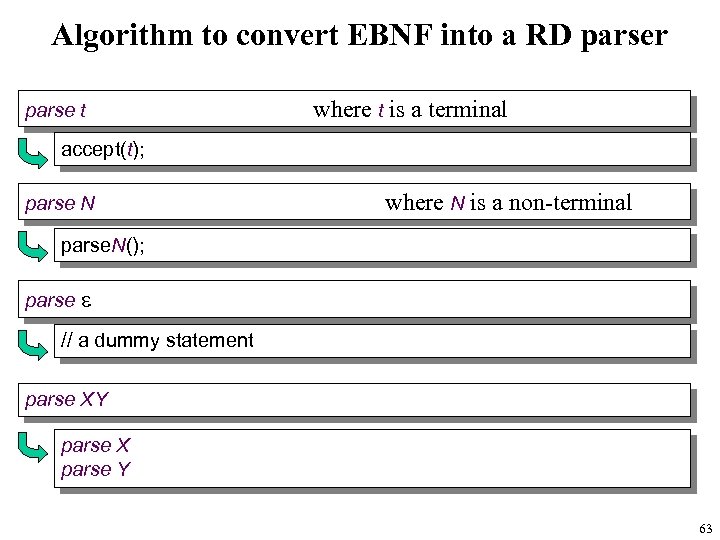
Algorithm to convert EBNF into a RD parser parse t where t is a terminal accept(t); parse N where N is a non-terminal parse. N(); parse e // a dummy statement parse XY parse X parse Y 63
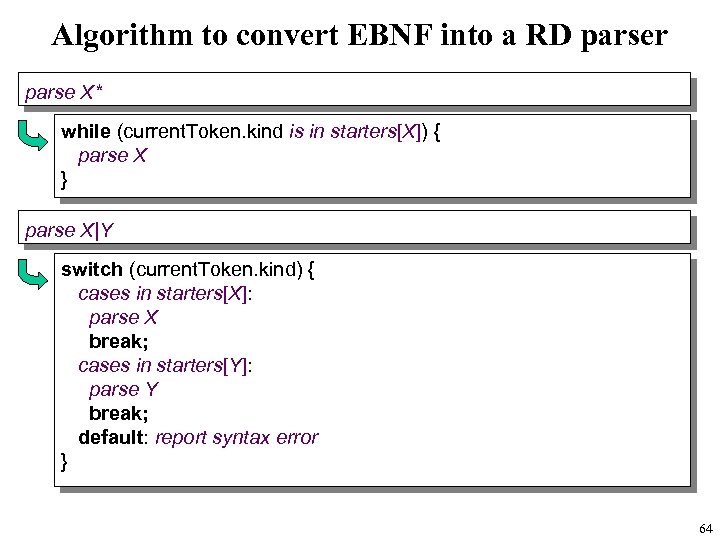
Algorithm to convert EBNF into a RD parser parse X* while (current. Token. kind is in starters[X]) { parse X } parse X|Y switch (current. Token. kind) { cases in starters[X]: parse X break; cases in starters[Y]: parse Y break; default: report syntax error } 64
LL(1) Grammars • The presented algorithm to convert EBNF into a parser does not work for all possible grammars. • It only works for so called “LL(1)” grammars. • What grammars are LL(1)? • Basically, an LL 1 grammar is a grammar which can be parsed with a top-down parser with a lookahead (in the input stream of tokens) of one token. How can we recognize that a grammar is (or is not) LL 1? ÞWe can deduce the necessary conditions from the parser generation algorithm. ÞThere is a formal definition we can use. 65
![LL 1 Grammars parse X* while (current. Token. kind is in starters[X]) { parse](https://present5.com/presentation/e974f359db9f342099493fdfffec4795/image-66.jpg "LL 1 Grammars parse X* while (current. Token. kind is in starters[X]) { parse")
LL 1 Grammars parse X* while (current. Token. kind is in starters[X]) { parse X Condition: starters[X] must be } parse X|Y disjoint from the set of tokens that can immediately follow X * switch (current. Token. kind) { cases in starters[X]: parse X break; cases in starters[Y]: parse Y break; default: report syntax error } Condition: starters[X] and starters[Y] must be disjoint sets. 66
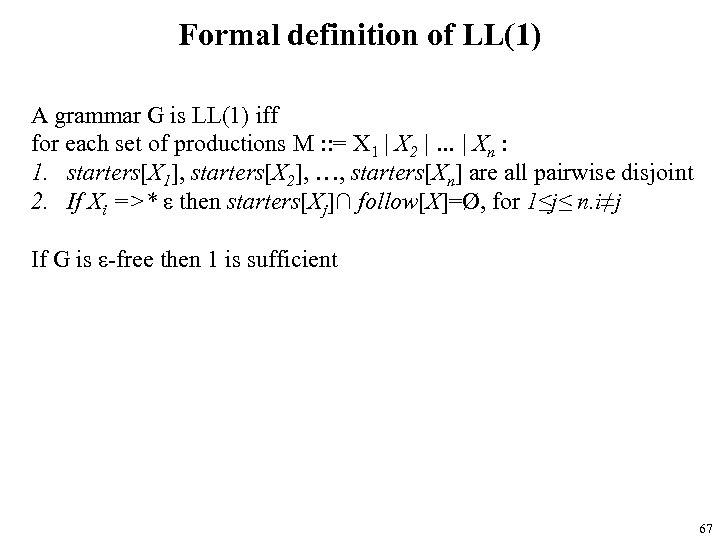
Formal definition of LL(1) A grammar G is LL(1) iff for each set of productions M : : = X 1 | X 2 | … | Xn : 1. starters[X 1], starters[X 2], …, starters[Xn] are all pairwise disjoint 2. If Xi =>* ε then starters[Xj]∩ follow[X]=Ø, for 1≤j≤ n. i≠j If G is ε-free then 1 is sufficient 67
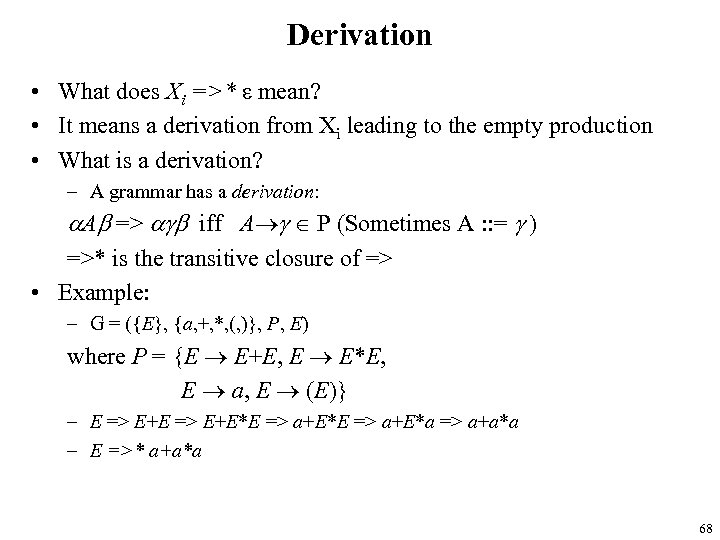
Derivation • What does Xi =>* ε mean? • It means a derivation from Xi leading to the empty production • What is a derivation? – A grammar has a derivation: A => iff A P (Sometimes A : : = ) =>* is the transitive closure of => • Example: – G = ({E}, {a, +, *, (, )}, P, E) where P = {E E+E, E E*E, E a, E (E)} – E => E+E*E => a+E*a => a+a*a – E =>* a+a*a 68
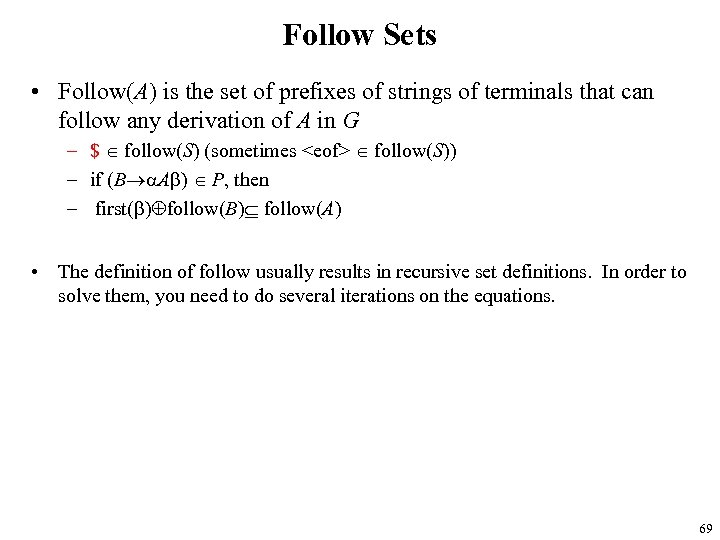
Follow Sets • Follow(A) is the set of prefixes of strings of terminals that can follow any derivation of A in G – $ follow(S) (sometimes <eof> follow(S)) – if (B A ) P, then – first( ) follow(B) follow(A) • The definition of follow usually results in recursive set definitions. In order to solve them, you need to do several iterations on the equations. 69
A few provable facts about LL(1) grammars • • No left-recursive grammar is LL(1) No ambiguous grammar is LL(1) Some languages have no LL(1) grammar A ε-free grammar, where each alternative Xj for N : : = Xj begins with a distinct terminal, is a simple LL(1) grammar 70
Converting EBNF into RD parsers • The conversion of an EBNF specification into a Java implementation for a recursive descent parser is so “mechanical” that it can easily be automated! => Java. CC “Java Compiler” 71
Java. CC • Java. CC is a parser generator • Java. CC can be thought of as “Lex and Yacc” for implementing parsers in Java • Java. CC is based on LL(k) grammars • Java. CC transforms an EBNF grammar into an LL(k) parser • The lookahead can be change by writing LOOKAHEAD(…) • The Java. CC can have action code written in Java embedded in the grammar • Java. CC has a companion called JJTree which can be used to generate an abstract syntax tree 72
Java. CC and JJTree • Java. CC is a parser generator – Inputs a set of token definitions, grammar and actions – Outputs a Java program which performs lexical analysis • Finding tokens • Parses the tokens according to the grammar • Executes actions • JJTree is a preprocessor for Java. CC – Inputs a grammar file – Inserts tree building actions – Outputs Java. CC grammar file • From this you can add code to traverse the tree to do static analysis, code generation or interpretation. 73
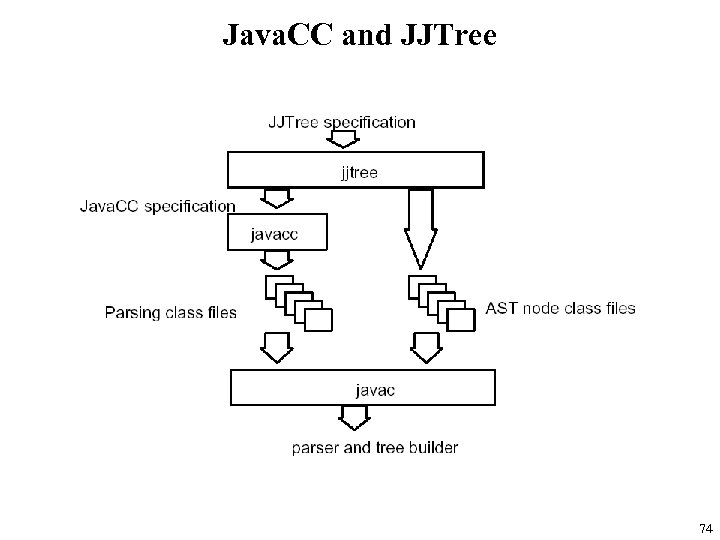
Java. CC and JJTree 74
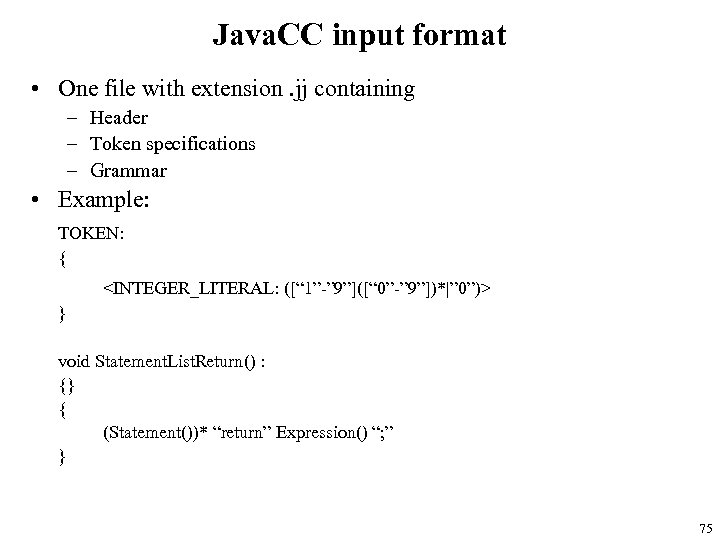
Java. CC input format • One file with extension. jj containing – Header – Token specifications – Grammar • Example: TOKEN: { <INTEGER_LITERAL: ([“ 1”-” 9”]([“ 0”-” 9”])*|” 0”)> } void Statement. List. Return() : {} { (Statement())* “return” Expression() “; ” } 75
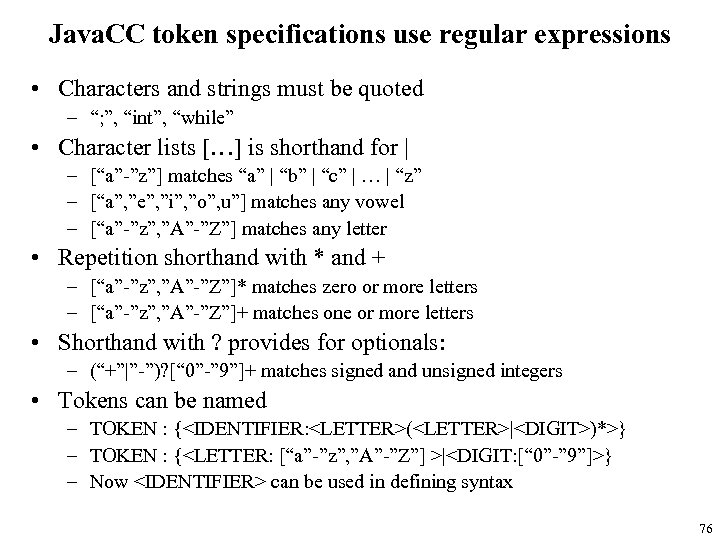
Java. CC token specifications use regular expressions • Characters and strings must be quoted – “; ”, “int”, “while” • Character lists […] is shorthand for | – [“a”-”z”] matches “a” | “b” | “c” | … | “z” – [“a”, ”e”, ”i”, ”o”, u”] matches any vowel – [“a”-”z”, ”A”-”Z”] matches any letter • Repetition shorthand with * and + – [“a”-”z”, ”A”-”Z”]* matches zero or more letters – [“a”-”z”, ”A”-”Z”]+ matches one or more letters • Shorthand with ? provides for optionals: – (“+”|”-”)? [“ 0”-” 9”]+ matches signed and unsigned integers • Tokens can be named – TOKEN : {<IDENTIFIER: <LETTER>(<LETTER>|<DIGIT>)*>} – TOKEN : {<LETTER: [“a”-”z”, ”A”-”Z”] >|<DIGIT: [“ 0”-” 9”]>} – Now <IDENTIFIER> can be used in defining syntax 76
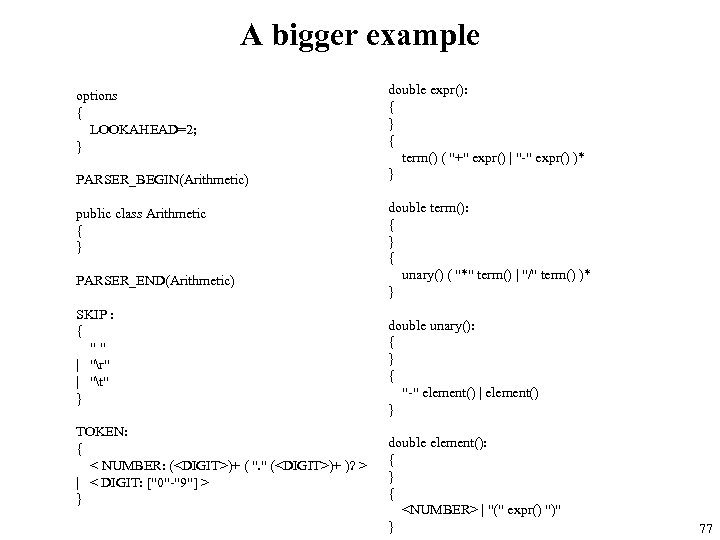
A bigger example options { LOOKAHEAD=2; } PARSER_BEGIN(Arithmetic) public class Arithmetic { } PARSER_END(Arithmetic) SKIP : { " " | "r" | "t" } TOKEN: { < NUMBER: (<DIGIT>)+ ( ". " (<DIGIT>)+ )? > | < DIGIT: ["0"-"9"] > } double expr(): { } { term() ( "+" expr() | "-" expr() )* } double term(): { } { unary() ( "*" term() | "/" term() )* } double unary(): { } { "-" element() | element() } double element(): { } { <NUMBER> | "(" expr() ")" } 77
Generating a parser with Java. CC • Javacc filename. jj – generates a parser with specified name – Lots of. java files • Javac *. java – Compile all the. java files • Note the parser doesn’t do anything on its own. • You have to either – Add actions to grammar by hand – Use JJTree to generate actions for building AST – Use JBT to generate AST and visitors 78
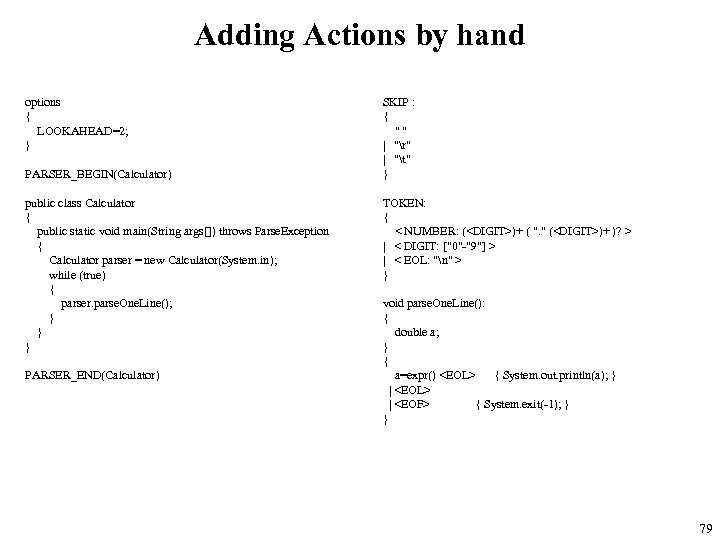
Adding Actions by hand options { LOOKAHEAD=2; } PARSER_BEGIN(Calculator) public class Calculator { public static void main(String args[]) throws Parse. Exception { Calculator parser = new Calculator(System. in); while (true) { parser. parse. One. Line(); } } } PARSER_END(Calculator) SKIP : { " " | "r" | "t" } TOKEN: { < NUMBER: (<DIGIT>)+ ( ". " (<DIGIT>)+ )? > | < DIGIT: ["0"-"9"] > | < EOL: "n" > } void parse. One. Line(): { double a; } { a=expr() <EOL> { System. out. println(a); } | <EOL> | <EOF> { System. exit(-1); } } 79
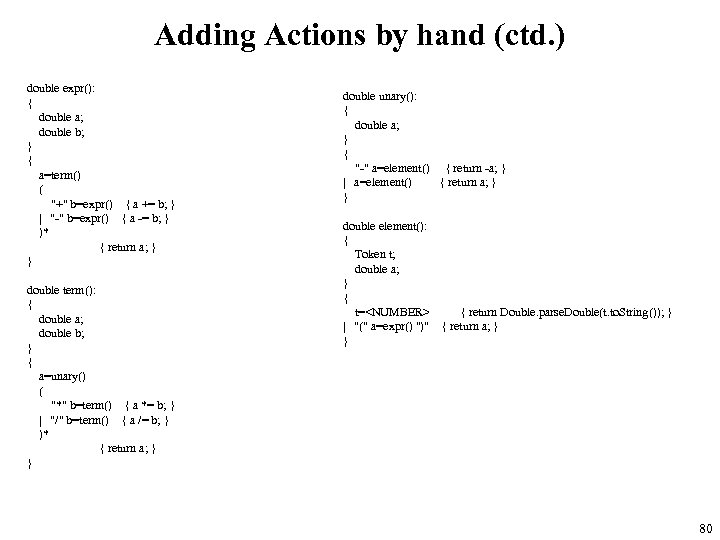
Adding Actions by hand (ctd. ) double expr(): { double a; double b; } { a=term() ( "+" b=expr() { a += b; } | "-" b=expr() { a -= b; } )* { return a; } } double term(): { double a; double b; } { a=unary() ( "*" b=term() { a *= b; } | "/" b=term() { a /= b; } )* { return a; } } double unary(): { double a; } { "-" a=element() { return -a; } | a=element() { return a; } } double element(): { Token t; double a; } { t=<NUMBER> { return Double. parse. Double(t. to. String()); } | "(" a=expr() ")" { return a; } } 80
Using JJTree • JJTree is a preprocessor for Java. CC • JTree transforms a bare Java. CC grammar into a grammar with embedded Java code for building an AST – Classes Node and Simple. Node are generated – Can also generate classes for each type of node • All AST nodes implement interface Node – Useful methods provided include: • Public void jjt. Get. Num. Children() – Which returns the number of children • Public void jjt. Get. Child(int i) – Which returns the I’th child – The “state” is in a parser field called jjtree • The root is at Node root. Node() • You can display the tree with • ((Simple. Node)parser. jjtree. root. Node()). dump(“ “); • JJTree supports the building of abstract syntax trees which can be traversed using visitors 81
JBT • JBT – Java Tree Builder is an alternative to JJTree • It takes a plain Java. CC grammar file as input and automatically generates the following: – A set of syntax tree classes based on the productions in the grammar, utilizing the Visitor design pattern. – Two interfaces: Visitor and Object. Visitor. Two depth-first visitors: Depth. First. Visitor and Object. Depth. First, whose default methods simply visit the children of the current node. – A Java. CC grammar with the proper annotations to build the syntax tree during parsing. • New visitors, which subclass Depth. First. Visitor or Object. Depth. First, can then override the default methods and perform various operations on and manipulate the generated syntax tree. 82
The Visitors Pattern For object-oriented programming the visitors pattern enables the definition of a new operator on an object structure without changing the classes of the objects When using visitor pattern • The set of classes must be fixed in advanced • Each class must have an accept method • Each accept method takes a visitor as argument • The purpose of the accept method is to invoke the visitor which can handle the current object. • A visitor contains a visit method for each class (overloading) • A method for class C takes an argument of type C • The advantage of Visitors: New methods without recompilation! 83
Parser Generator Tools • Java. CC is a Parser Generator Tool • It can be thought of as Lex and Yacc for Java • There are several other Parser Generator tools for Java – We shall look at some of them later • Beware! To use Parser Generator Tools efficiently you need to understand what they do and what the code they produce does • Note, there can be bugs in the tools and/or in the code they generate! 84
Скачать презентацию Languages and Compilers SProg og Oversættere Bent Thomsen
e974f359db9f342099493fdfffec4795.ppt