


 Скачать презентацию Language use and identification Centralization of vowels
1d8222447269c4e246956af903d7cbf6.ppt
- Количество слайдов: 29
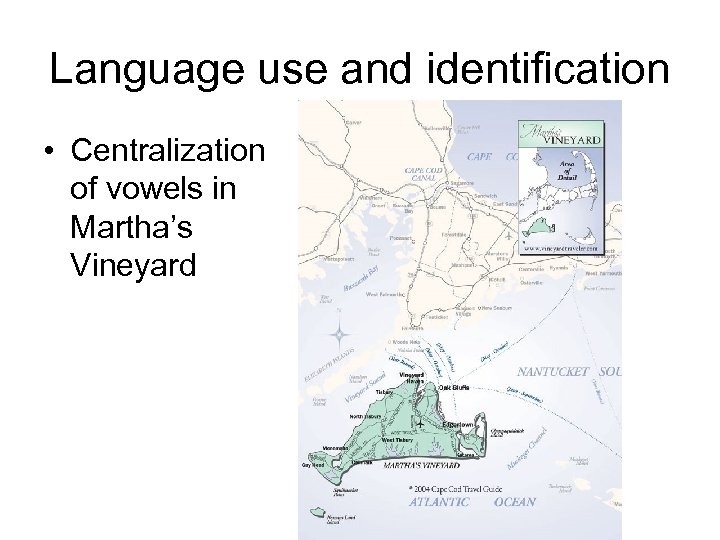 Language use and identification • Centralization of vowels in Martha’s Vineyard
![Language use and identification • Centralization of vowels in Martha’s Vineyard [ ] and](https://present5.com/presentation/1d8222447269c4e246956af903d7cbf6/image-2.jpg "Language use and identification • Centralization of vowels in Martha’s Vineyard [ ] and") Language use and identification • Centralization of vowels in Martha’s Vineyard [ ] and [ ] – while, pie, night – out, house, trout
Language use and identification • Centralization of vowels in Martha’s Vineyard [ ] and [ ] – while, pie, night – out, house, trout
![Language use and identification • Centralization of vowels in Martha’s Vineyard [ ] and](https://present5.com/presentation/1d8222447269c4e246956af903d7cbf6/image-3.jpg "Language use and identification • Centralization of vowels in Martha’s Vineyard [ ] and") Language use and identification • Centralization of vowels in Martha’s Vineyard [ ] and [ ] Age 7561 -75 46 -60 31 -45 14 -30 ay 25 35 62 81 37 aw 22 37 44 88 46
Language use and identification • Centralization of vowels in Martha’s Vineyard [ ] and [ ] Age 7561 -75 46 -60 31 -45 14 -30 ay 25 35 62 81 37 aw 22 37 44 88 46
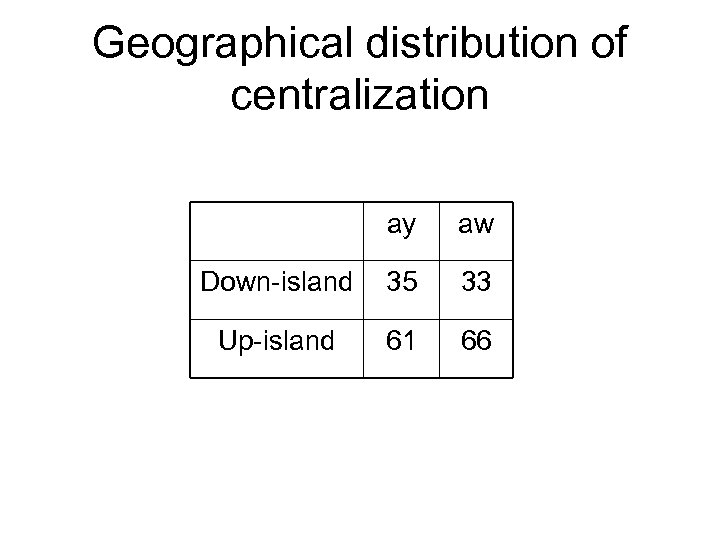 Geographical distribution of centralization ay aw Down-island 35 33 Up-island 61 66
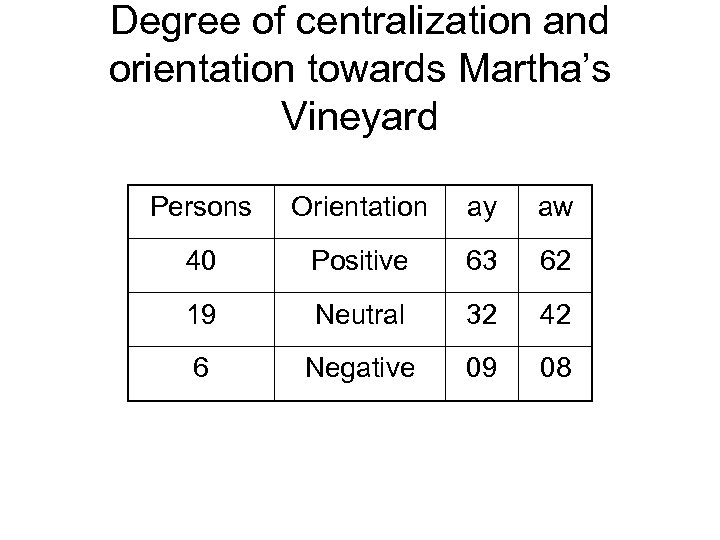 Degree of centralization and orientation towards Martha’s Vineyard Persons Orientation ay aw 40 Positive 63 62 19 Neutral 32 42 6 Negative 09 08
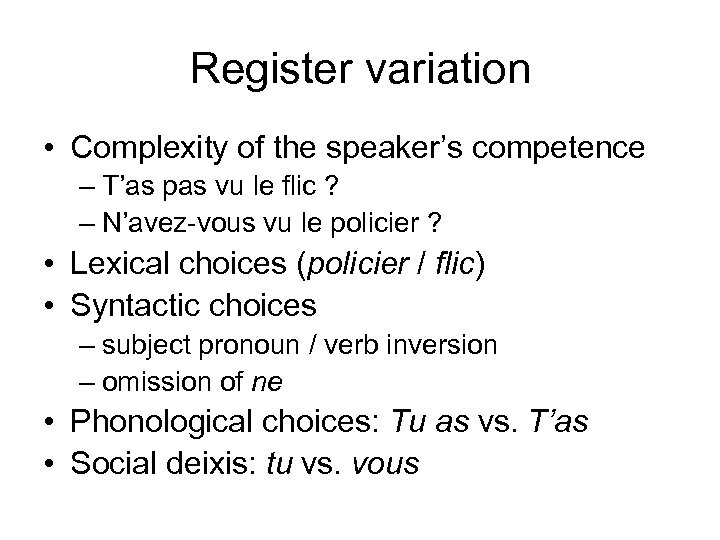 Register variation • Complexity of the speaker’s competence – T’as pas vu le flic ? – N’avez-vous vu le policier ? • Lexical choices (policier / flic) • Syntactic choices – subject pronoun / verb inversion – omission of ne • Phonological choices: Tu as vs. T’as • Social deixis: tu vs. vous
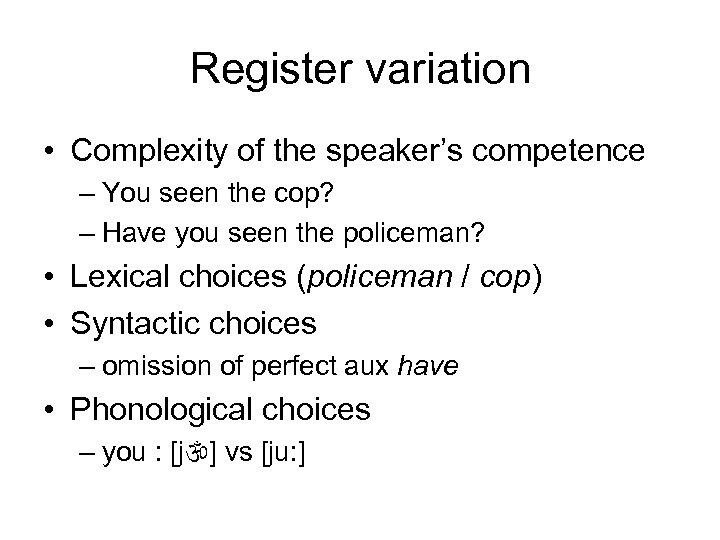 Register variation • Complexity of the speaker’s competence – You seen the cop? – Have you seen the policeman? • Lexical choices (policeman / cop) • Syntactic choices – omission of perfect aux have • Phonological choices – you : [j ] vs [ju: ]
 Register variation • Complexity of the speaker’s competence – Have you seen the policeman? – Might you perhaps have seen the policeman • Addition of modal elements might, perhaps
 Register variation • Complexity of the speaker’s competence – She don’t talk to them boys no more. – She doesn’t talk to those boys any more. • Morphological choices – don’t vs doesn’t (as 3 rd pers sg auxiliary) – them vs those (as plural demonstrative) • Syntactic choices – double negation
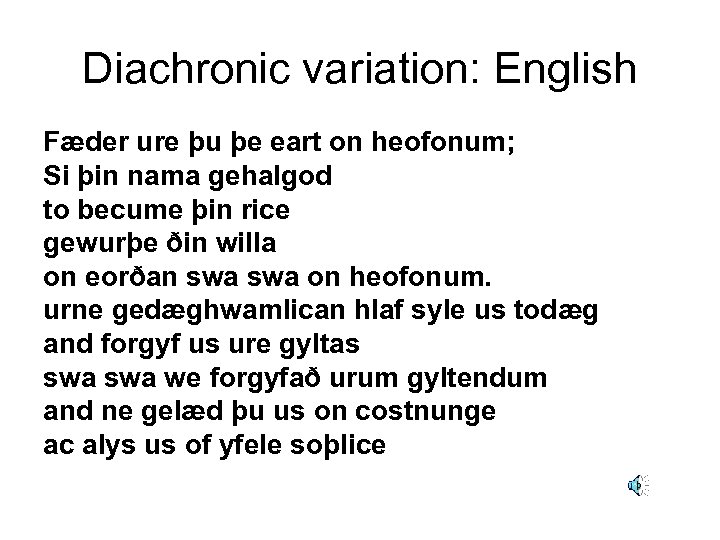 Diachronic variation: English Fæder ure þu þe eart on heofonum; Si þin nama gehalgod to becume þin rice gewurþe ðin willa on eorðan swa on heofonum. urne gedæghwamlican hlaf syle us todæg and forgyf us ure gyltas swa we forgyfað urum gyltendum and ne gelæd þu us on costnunge ac alys us of yfele soþlice
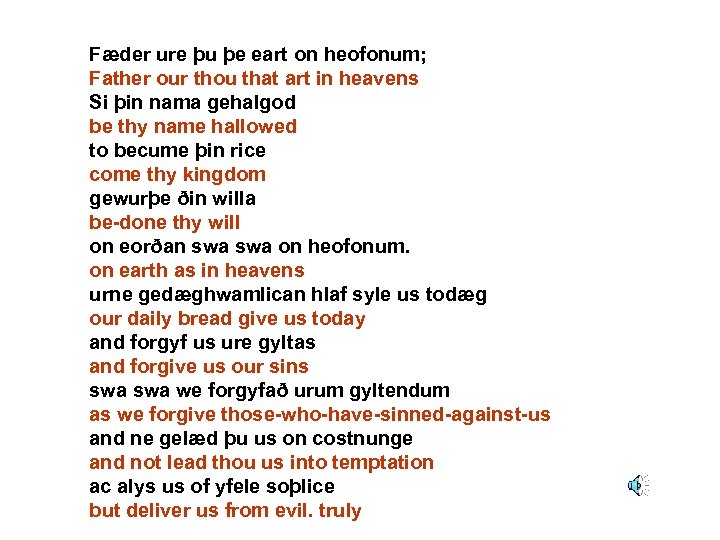 Fæder ure þu þe eart on heofonum; Father our thou that art in heavens Si þin nama gehalgod be thy name hallowed to becume þin rice come thy kingdom gewurþe ðin willa be-done thy will on eorðan swa on heofonum. on earth as in heavens urne gedæghwamlican hlaf syle us todæg our daily bread give us today and forgyf us ure gyltas and forgive us our sins swa we forgyfað urum gyltendum as we forgive those-who-have-sinned-against-us and ne gelæd þu us on costnunge and not lead thou us into temptation ac alys us of yfele soþlice but deliver us from evil. truly
![This version of the Lord's Prayer is from Cambridge, Corpus Christi College 140 [WSCp],](https://present5.com/presentation/1d8222447269c4e246956af903d7cbf6/image-12.jpg "This version of the Lord's Prayer is from Cambridge, Corpus Christi College 140 [WSCp],") This version of the Lord's Prayer is from Cambridge, Corpus Christi College 140 [WSCp], a translation of the Gospels written in Bath in the first half of the 11 th century; edited by Liuzza (1994). Read by Cathy Ball (Department of Linguistics, Georgetown University) for Edward Vanetten's Sunday School class. http: //www. georgetown. edu/faculty/ballc/oe/patern oster-oe. html
This version of the Lord's Prayer is from Cambridge, Corpus Christi College 140 [WSCp], a translation of the Gospels written in Bath in the first half of the 11 th century; edited by Liuzza (1994). Read by Cathy Ball (Department of Linguistics, Georgetown University) for Edward Vanetten's Sunday School class. http: //www. georgetown. edu/faculty/ballc/oe/patern oster-oe. html
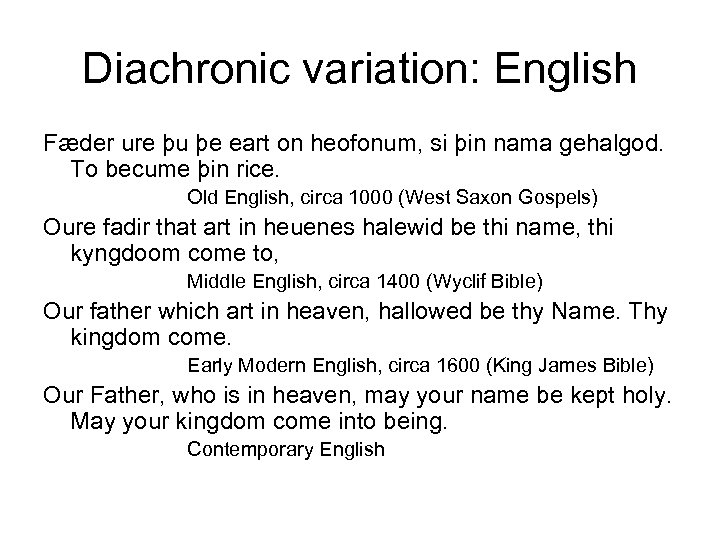 Diachronic variation: English Fæder ure þu þe eart on heofonum, si þin nama gehalgod. To becume þin rice. Old English, circa 1000 (West Saxon Gospels) Oure fadir that art in heuenes halewid be thi name, thi kyngdoom come to, Middle English, circa 1400 (Wyclif Bible) Our father which art in heaven, hallowed be thy Name. Thy kingdom come. Early Modern English, circa 1600 (King James Bible) Our Father, who is in heaven, may your name be kept holy. May your kingdom come into being. Contemporary English
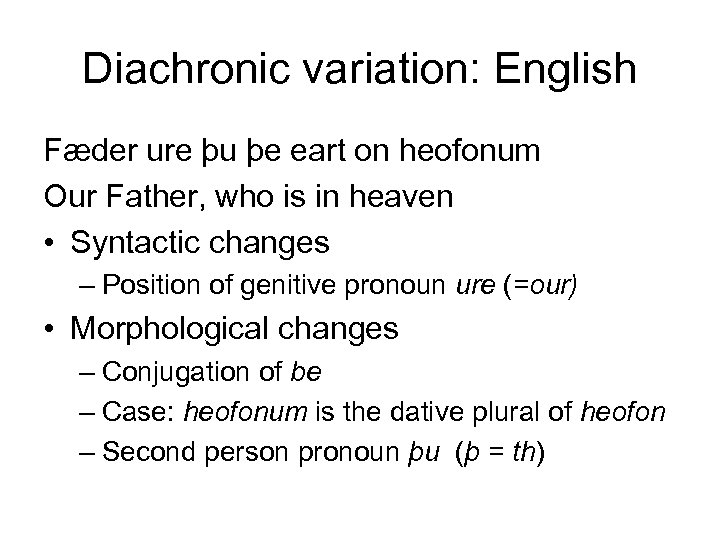 Diachronic variation: English Fæder ure þu þe eart on heofonum Our Father, who is in heaven • Syntactic changes – Position of genitive pronoun ure (=our) • Morphological changes – Conjugation of be – Case: heofonum is the dative plural of heofon – Second person pronoun þu (þ = th)
 Diachronic variation: English • Semantic change – on > in • Phonetic change – Fæder [fæd r] – ure [ur ] • Spelling system –æþð
![Diachronic variation: French Carles li reis, nostre emper[er]e magnes Set anz tuz pleins ad](https://present5.com/presentation/1d8222447269c4e246956af903d7cbf6/image-16.jpg "Diachronic variation: French Carles li reis, nostre emper[er]e magnes Set anz tuz pleins ad") Diachronic variation: French Carles li reis, nostre emper[er]e magnes Set anz tuz pleins ad estet en Espaigne: Tresqu'en la mer cunquist la tere altaigne. N'i ad castel ki devant lui remaigne; (Chanson de Roland, environ 1090) Phonological change: Carles/Charles, castel/château ; reis / roi ; nostre / notre, altaigne/hautaine Pronunciation of final s
Diachronic variation: French Carles li reis, nostre emper[er]e magnes Set anz tuz pleins ad estet en Espaigne: Tresqu'en la mer cunquist la tere altaigne. N'i ad castel ki devant lui remaigne; (Chanson de Roland, environ 1090) Phonological change: Carles/Charles, castel/château ; reis / roi ; nostre / notre, altaigne/hautaine Pronunciation of final s
![Diachronic variation: French Carles li reis, nostre emper[er]e magnes Set anz tuz pleins ad](https://present5.com/presentation/1d8222447269c4e246956af903d7cbf6/image-17.jpg "Diachronic variation: French Carles li reis, nostre emper[er]e magnes Set anz tuz pleins ad") Diachronic variation: French Carles li reis, nostre emper[er]e magnes Set anz tuz pleins ad estet en Espaigne: Tresqu'en la mer cunquist la tere altaigne. N'i ad castel ki devant lui remaigne; (Chanson de Roland, environ 1090) Morphological change: Carles, reis, magnes : -s = subject case
Diachronic variation: French Carles li reis, nostre emper[er]e magnes Set anz tuz pleins ad estet en Espaigne: Tresqu'en la mer cunquist la tere altaigne. N'i ad castel ki devant lui remaigne; (Chanson de Roland, environ 1090) Morphological change: Carles, reis, magnes : -s = subject case
![Diachronic variation: French Carles li reis, nostre emper[er]e magnes Set anz tuz pleins ad](https://present5.com/presentation/1d8222447269c4e246956af903d7cbf6/image-18.jpg "Diachronic variation: French Carles li reis, nostre emper[er]e magnes Set anz tuz pleins ad") Diachronic variation: French Carles li reis, nostre emper[er]e magnes Set anz tuz pleins ad estet en Espaigne: Tresqu'en la mer cunquist la tere altaigne. N'i ad castel ki devant lui remaigne; (Chanson de Roland, environ 1090) Syntactic change: *Charles sept ans a été en Espagne *Jusqu’à la mer (il) conquit la terre haute
Diachronic variation: French Carles li reis, nostre emper[er]e magnes Set anz tuz pleins ad estet en Espaigne: Tresqu'en la mer cunquist la tere altaigne. N'i ad castel ki devant lui remaigne; (Chanson de Roland, environ 1090) Syntactic change: *Charles sept ans a été en Espagne *Jusqu’à la mer (il) conquit la terre haute
![Diachronic variation: French Carles li reis, nostre emper[er]e magnes Set anz tuz pleins ad](https://present5.com/presentation/1d8222447269c4e246956af903d7cbf6/image-19.jpg "Diachronic variation: French Carles li reis, nostre emper[er]e magnes Set anz tuz pleins ad") Diachronic variation: French Carles li reis, nostre emper[er]e magnes Set anz tuz pleins ad estet en Espaigne: Tresqu'en la mer cunquist la tere altaigne. N'i ad castel ki devant lui remaigne; (Chanson de Roland, environ 1090) Lexical change (word replacement): magne > grand; tresque > jusque; remanoir > rester
Diachronic variation: French Carles li reis, nostre emper[er]e magnes Set anz tuz pleins ad estet en Espaigne: Tresqu'en la mer cunquist la tere altaigne. N'i ad castel ki devant lui remaigne; (Chanson de Roland, environ 1090) Lexical change (word replacement): magne > grand; tresque > jusque; remanoir > rester
![Diachronic variation: French Carles li reis, nostre emper[er]e magnes Set anz tuz pleins ad](https://present5.com/presentation/1d8222447269c4e246956af903d7cbf6/image-20.jpg "Diachronic variation: French Carles li reis, nostre emper[er]e magnes Set anz tuz pleins ad") Diachronic variation: French Carles li reis, nostre emper[er]e magnes Set anz tuz pleins ad estet en Espaigne: Tresqu'en la mer cunquist la tere altaigne. N'i ad castel ki devant lui remaigne; (Chanson de Roland, environ 1090) Lexical semantic change: altaigne = hautain, only the metaphorical sense remains
Diachronic variation: French Carles li reis, nostre emper[er]e magnes Set anz tuz pleins ad estet en Espaigne: Tresqu'en la mer cunquist la tere altaigne. N'i ad castel ki devant lui remaigne; (Chanson de Roland, environ 1090) Lexical semantic change: altaigne = hautain, only the metaphorical sense remains
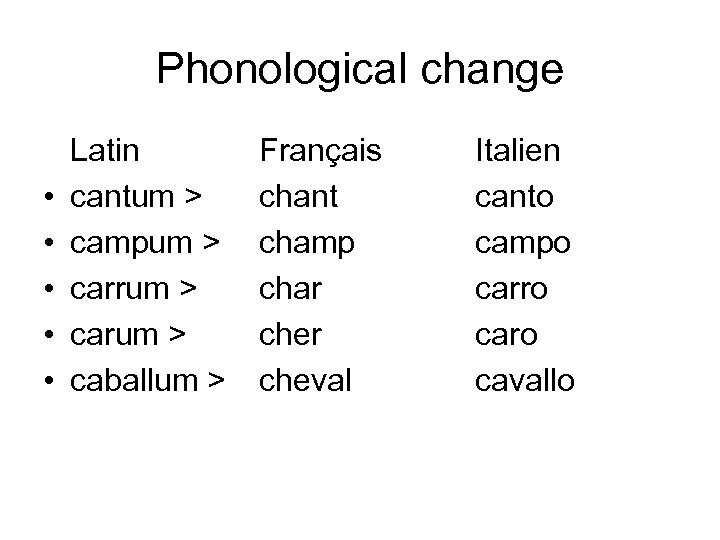 Phonological change • • • Latin cantum > campum > carrum > caballum > Français chant champ char cheval Italien canto campo carro cavallo
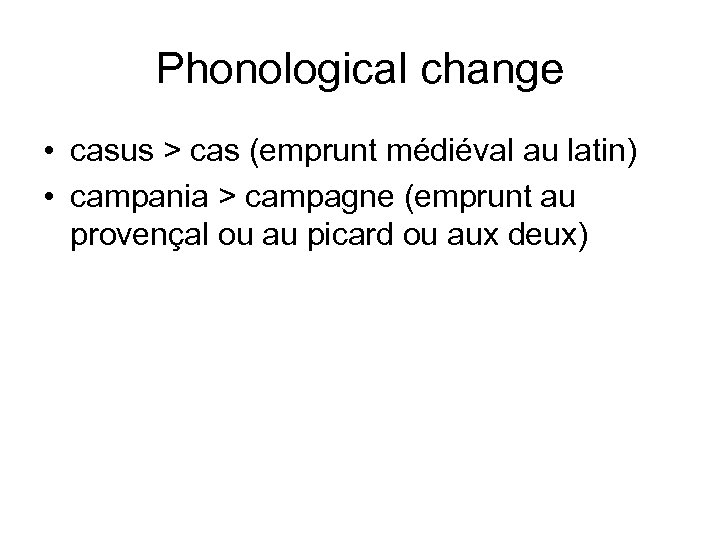 Phonological change • casus > cas (emprunt médiéval au latin) • campania > campagne (emprunt au provençal ou au picard ou aux deux)
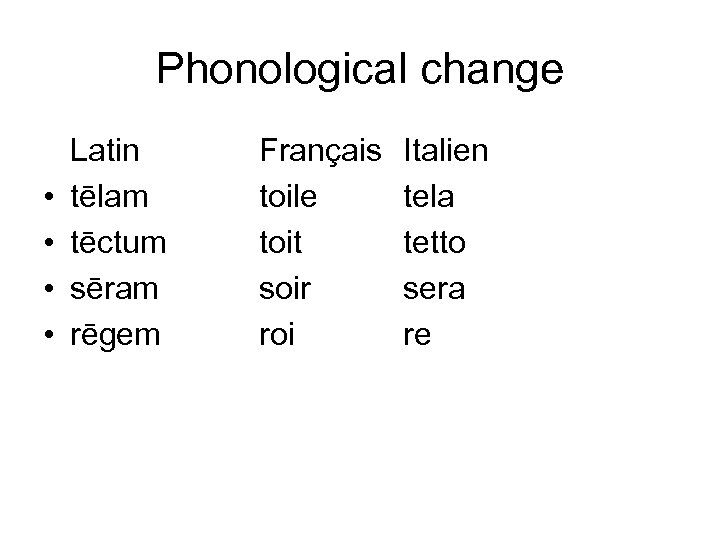 Phonological change • • Latin tēlam tēctum sēram rēgem Français toile toit soir roi Italien tela tetto sera re
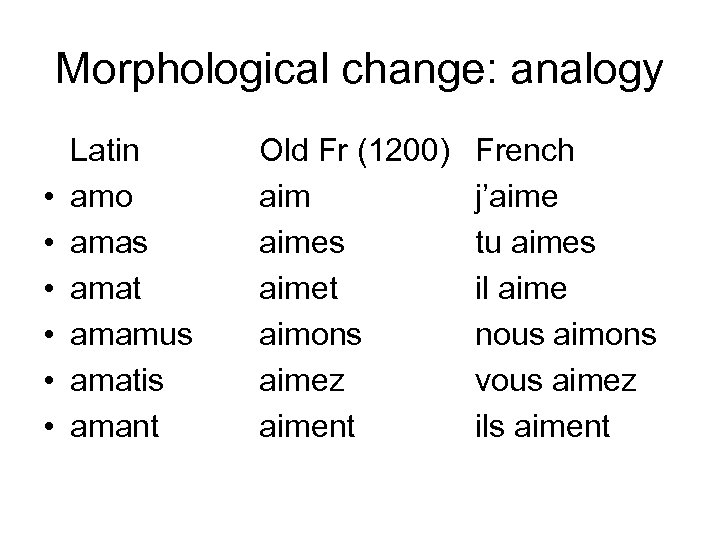 Morphological change: analogy • • • Latin amo amas amat amamus amatis amant Old Fr (1200) aimes aimet aimons aimez aiment French j’aime tu aimes il aime nous aimons vous aimez ils aiment
 Conclusion • Why the interest in variation? – Not all variation is possible. Possible variation tells us about the structure of linguistic knowledge – Avoid simplistic analyses: • double negation is illogical • meaning and syntax of modal auxiliaries in English • confusion of diachronic and synchronic explanations
 Conclusion • Central object of linguistic inquiry: the individual speaker’s competence • But – Complexity of that competence (multiple systems for one speaker) – Inter-speaker variation