


 Скачать презентацию Language of Culture Life Ministry of the
1536072ba34de97db8b73e74456b1cab.ppt
- Количество слайдов: 34
 Language of Culture “Life & Ministry of the Messiah, Part 2” from “That the World May Know” series
 Understanding the World in Which Jesus Lived • Jesus’ entire life overlapped the Herodian dynasty – Herod the Great (Matt 2: 1 -8, 12 -18) – Herod Archelaus (Matt 2: 22) – Herod Antipas (Matt 14: 1 -12; Luke 3: 19; 9: 7 -9; 13: 32; 23: 7 -12) • The only one he met face-to-face
 Understanding the World in Which Jesus Lived • Herod the Great – Had 10 wives • Cleopatra: son Philip (Luke 3: 1, built Caesarea Philippi) • Miriam: grandson Herod Agrippa I (Acts 12: 1 -14, killed James, imprisoned Peter) – Great grandson Herod Agrippa II (Acts 25: 13 -26: 32, Paul appears before him) – Great granddaughters (sisters of Agrippa II) Drusilla (Acts 24: 24, wife of Felix) and Bernice (Acts 25: 13, companion of Agrippa II) • Malthace: sons Antipas and Archelaus
 Understanding the World in Which Jesus Lived • Responses to Jesus – Herod the Great • Sought to kill the baby, Jesus – Philip • Married Herodias, mother of Salome – Antipas • Married Herodias (his brother’s wife) • Killed John the Baptist • Tried Jesus
 Understanding the World in Which Jesus Lived • Responses to Jesus – Archelaus • Mary and Joseph refused to stay in his kingdom – Agrippa I • Killed the Apostle James (brother of John) • Imprisoned the Apostle Peter – Agrippa II • Heard Paul’s defense before Felix • “Married” his own sister, Bernice
 Cultural Images in Jesus’ Teaching • Jesus was neither rich nor politically powerful • Jesus was aware of current events and recent history • Luke 19: 11 -27 • Luke 14: 31 -33 • Matt 20: 25 -28 • Matt 23: 23 -28 • Matt 6: 11 -18
 Cultural Images in Jesus’ Teaching • Luke 19: 11 -27 re Archelaus – King goes to far country to receive his kingdom – Some go to oppose him – Kills those who oppose him
 Cultural Images in Jesus’ Teaching • Luke 14: 31 -33 re Antipas vs Aretas – King won’t go to battle w/out believing he can win – This arose when Antipas divorced Aretas’ daughter and war ensued
 Cultural Images in Jesus’ Teaching • Matt 20: 25 -28 re politicians/Gentile rulers – Roman and Greek rulers lord it over – God’s leaders are intended to be servants
 Cultural Images in Jesus’ Teaching • Matt 23: 23 -28 re Pharisees & theater actors – Hypocrites and Pharisees – Clean the outside/whitewashed tombs (actors makeup)
 Cultural Images in Jesus’ Teaching • Matt 6: 2, 5, 16 -18 re Pharisees & theater actors – Actors announced by trumpet – Fake faces like actors
 Cultural Images in Jesus’ Teaching • Jesus and Pharisees – Not all Pharisees were bad or despicable – Mark 12: 34 (not far from the kingdom) – Luke 7: 36 & 14: 1 (supported Jesus, invited him into their houses) – John 3: 1 -2; 7: 50 -51; Luke 13: 31 (tried to protect Jesus) – Acts 15: 5 (some followed Jesus)
 Cultural Images in Jesus’ Teaching • Jesus and Pharisees had common beliefs – Physical resurrection of the dead – Judgment day with reward or punishment – Expected a Messiah to return – Belief in angels – Need to obey God’s whole will – God is all-wise, all-knowing, just, merciful & loving
 Jesus the Master Builder • He was trained as a tekton, a builder • He used examples from that world – Matt 16: 18 (I build my church) – John 2: 19 -22 (destroy the temple and raise it up in 3 days – while viewing Herod’s temple) – Luke 14: 28 -30 (count the cost of building to illustrate the cost of discipleship) – Matt 21: 42 (rejected stone was in fact the cornerstone)
 Jesus the Master Builder • NT examples from that world – Acts 4: 11 -12 (rejected cornerstone, and the only one who has salvation is Jesus) – I Peter 2: 4 -8 (we are living stones in a spiritual house, Jesus is the cornerstone that was rejected) • As the cornerstone, Jesus holds everything together
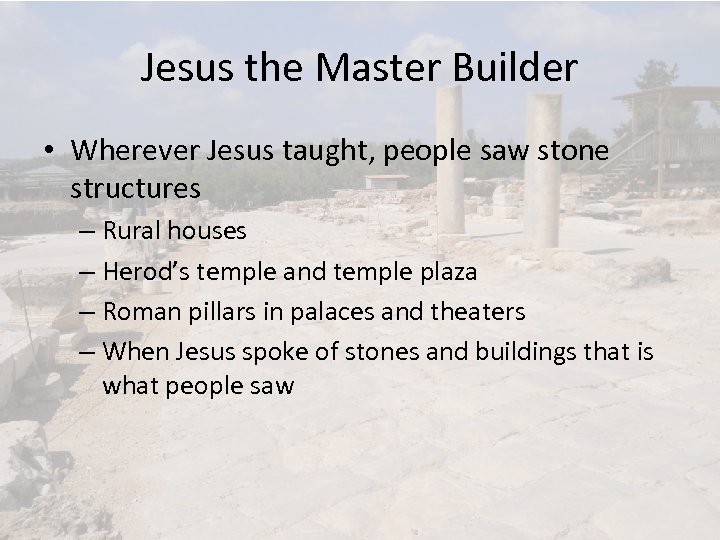 Jesus the Master Builder • Wherever Jesus taught, people saw stone structures – Rural houses – Herod’s temple and temple plaza – Roman pillars in palaces and theaters – When Jesus spoke of stones and buildings that is what people saw
 Jesus the Master Builder • Jesus, as the builder shapes us • Are we willing to let him use and shape us? • Acts 4: 12 – And there is salvation in no one else, for there is no other name under heaven given among people by which we must be saved.
 Jesus the Master Builder • Acts 4: 12 bothers people today, but – Jesus is the only way – He is stone specifically crafted to be THE cornerstone – There is no other
 The Significance of Nazareth • After leaving Egypt, Joseph and Mary decided to go to Nazareth, vice Bethlehem – Archelaus was king – They were afraid of him – Fulfilled prophecy
 The Significance of Nazareth • The passage is Matthew 2: 19 -23 – Clearly Joseph was planning on returning to Bethlehem or Judea – But instead they settled in Nazareth of Galilee – This fulfilled a prophecy • There is no prophecy that mentions Nazareth or Nazarene!
 The Significance of Nazareth • However the Greek word transliterated as Nazareth is probably derived from the Hebrew word netzer, which means “shoot” or “branch” – That term is often used to refer to David’s royal line
 The Significance of Nazareth • Isaiah 11: 1 -2, 10 (1 A shoot will grow out of Jesse’s root… 2 The Lord’s spirit will rest on him… 10 At that time a root from Jesse will stand like a signal flag for the nations…) • Isaiah 53: 2 (He sprouted up like a twig before God, like a root out of parched soil…) • Jer 23: 5 (I, the Lord, promise…when I raise up for them a righteous branch, a descendant of David)
 The Significance of Nazareth • Jer 33: 15 (In those days…I will raise up for them a righteous descendant (sprig or shoot) of David…) • Zech 3: 8 (Listen now…all of you are a symbol that I am about to introduce my servant, the Branch. ) • Zech 6: 12 (…“The Lord who rules over all says, “Look here is the man whose name is Branch, …and build the temple of the Lord”)
 The Significance of Nazareth • Jesus the “Nazarene” means Jesus the “Branch” from the root of Jesse (the father of David) • Jesus was in this way identified as a descendant of King David – This identified Jesus as the promised descendant – God’s promise to always have someone from David’s line on the throne
 The Significance of Nazareth • In Rev 22: 16, Jesus says – I, Jesus, have sent my angel to testify to you about…I am the root and the descendant of David… • Luke 4: 16 -30 – The people at first accepted, cheered Jesus’ claim (vs 22) – It would seem that Nazareth also believed they would be the home of the Messiah
 The Significance of Nazareth • Luke 4: 16 -30 – BUT – Then Jesus says “no prophet is acceptable in his hometown” and promised no miracles for them (vs 24 -27) – The people are enraged! (vs 28)
 The Significance of Nazareth • While Nazareth seems to have had a high opinion of themselves (they were Shootville, Branchtown), others did not share that idea • John 1: 45 -46 (“…”Can anything good come out of Nazareth? ”…)
 Jesus, The “Shoot” from Jesse’s Stump • Isaiah 11 “ 1 A shoot will grow out of Jesse’s root stock, a bud will sprout from his roots. 2 The Lord’s Spirit will rest on him – a Spirit that gives extraordinary wisdom, a Spirit that provides the ability to execute plans, a Spirit that produces absolute loyalty to the Lord. ”
 Jesus, The “Shoot” from Jesse’s Stump • Old olive trees will quit producing olives – The farmer cuts off all the branches – Leaving just the stump – Soon new shoots will start growing out of the old stump – Sometimes the farmer grafts new branches into the old stump – Again the new branches take hold and produce
 Jesus, The “Shoot” from Jesse’s Stump • The stump, Jesse, is Israel • Jesus is the branch, maybe the new growth from the dead stump • And, we (Christians) are also branches (Gentiles are grafted in) • Jesus also speaks of the vine and the branches in John 15
 Jesus, The “Shoot” from Jesse’s Stump • Vine – Jesus • Gardner – God – Prunes the non-productive – Branches that are pruned (not connected to the vine, Jesus) do not produce – Branches that are connected to the vine, Jesus, do bear fruit
 Jesus, The “Shoot” from Jesse’s Stump • Jesus uses more gardening/farming examples in – Matt 3: 8 -10 (cut down non productive trees) – Matt 7: 17 -19 (good trees bear, bad trees don’t) • Paul uses a similar illustration in Rom 11: 13 -24 – To describe how God is bringing Gentiles into His family
 Jesus, The “Shoot” from Jesse’s Stump • The olive tree and vine illustrations clearly teach that to be saved one must be connected to Jesus
 Anointed • Jesus is the Anointed One – In Greek that is Christ – In Hebrew that is Messiah – There are more than 375 occurrences of “anointed” in the NT • Israel generally used olive oil to anoint its leaders (priests, kings, etc) – Making the olive tree image for Jesus appropriate