 Скачать презентацию Language Issues in Universiti Brunei Darussalam Dr Gary
48b35f0e601fe91ba90975f26707f2f4.ppt
- Количество слайдов: 37



Language Issues in Universiti Brunei Darussalam Dr Gary M Jones Faculty of Arts & Social Sciences Universiti Brunei Darussalam (gmjones@fass. ubd. edu. bn ) (Language Issues in English-Medium Universities Across Asia Hong Kong University, 8 th-9 th June 2006)
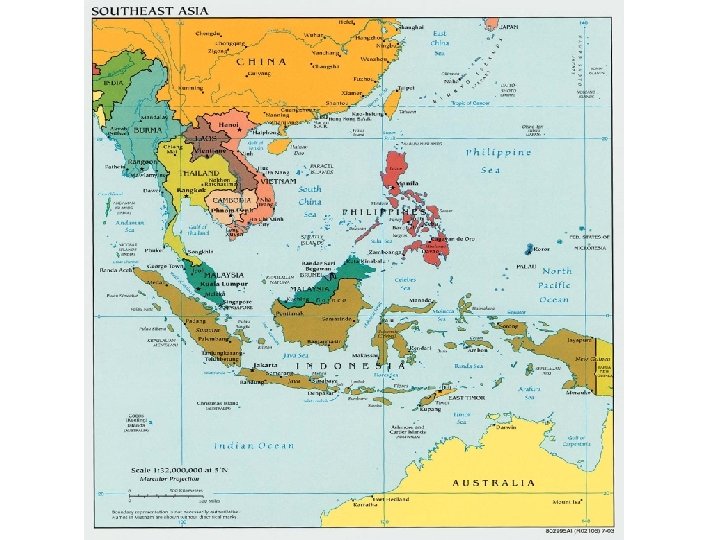
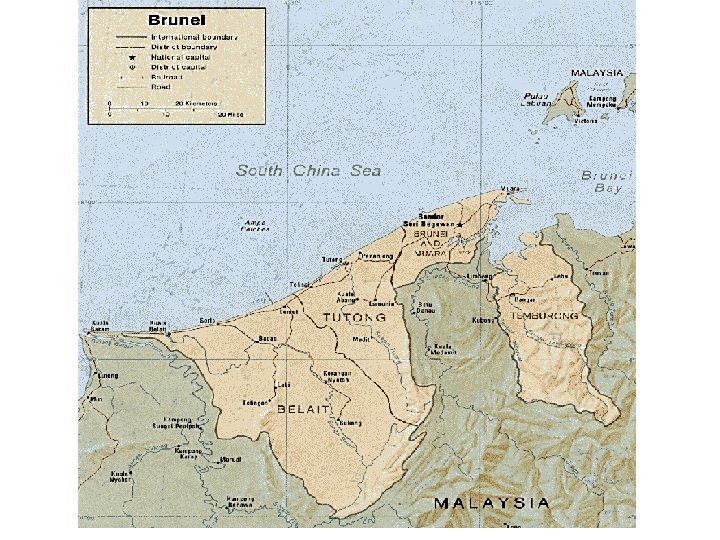
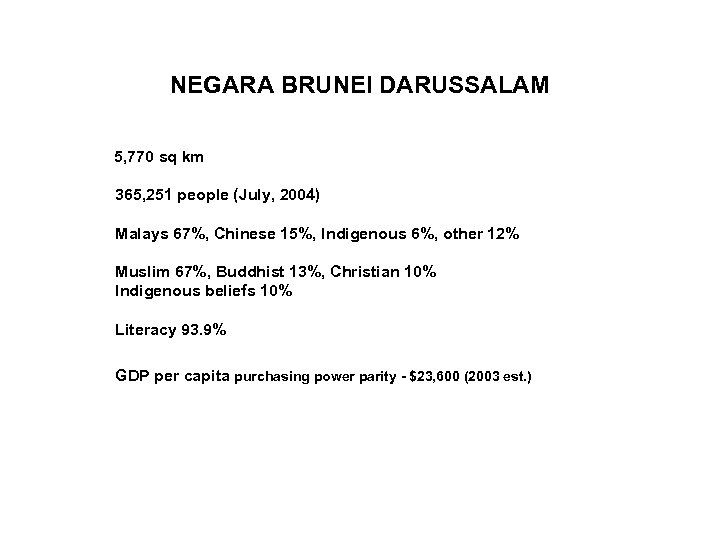
NEGARA BRUNEI DARUSSALAM 5, 770 sq km 365, 251 people (July, 2004) Malays 67%, Chinese 15%, Indigenous 6%, other 12% Muslim 67%, Buddhist 13%, Christian 10% Indigenous beliefs 10% Literacy 93. 9% GDP per capita purchasing power parity - $23, 600 (2003 est. )
The official language of the State shall be the Malay language and shall be in such script as may by written law be provided. 1959 State Constitution Article 82(1)
(i) To make Malay the main medium of instruction in National Primary and Secondary schools as soon as possible in line with the requirement of the constitution. (ii) To raise the standard of the usage of English in the primary and secondary schools in the country Report of the Brunei Education Commission, 1972: 4
1. 2 In accordance with the recommendations of the above mentioned Education Commission Report, this working paper attempts to establish firmly the dominance of the Malay Language, while at the same time emphasising the importance of English Language in order to achieve the educational objective by means of a bilingual system of education. Brunei Government Publication, 1984: 3
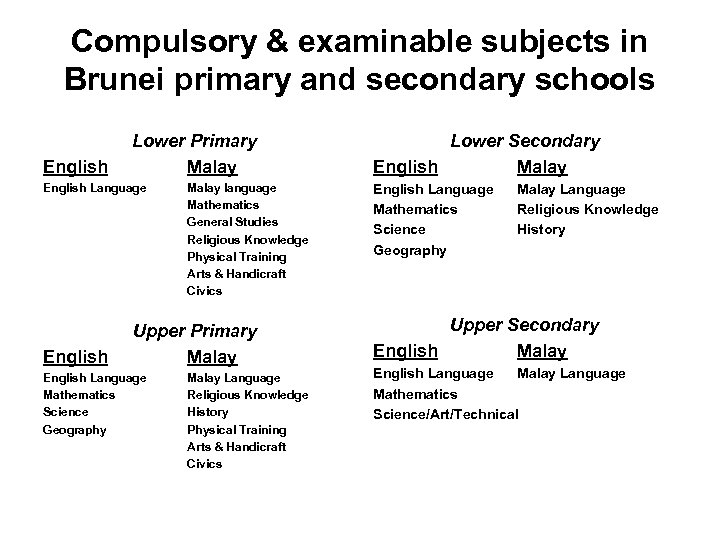
Compulsory & examinable subjects in Brunei primary and secondary schools English Lower Primary Malay English Language English Malay language Mathematics General Studies Religious Knowledge Physical Training Arts & Handicraft Civics Upper Primary Malay English Language Mathematics Science Geography Malay Language Religious Knowledge History Physical Training Arts & Handicraft Civics Lower Secondary English Malay English Language Mathematics Science Geography Malay Language Religious Knowledge History Upper Secondary English Malay English Language Malay Language Mathematics Science/Art/Technical
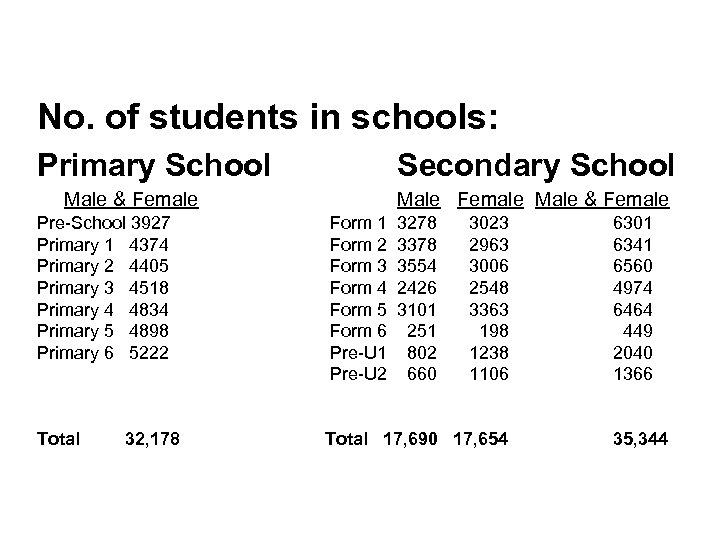
No. of students in schools: Primary School Secondary School Male & Female Pre-School 3927 Primary 1 4374 Primary 2 4405 Primary 3 4518 Primary 4 4834 Primary 5 4898 Primary 6 5222 Form 1 Form 2 Form 3 Form 4 Form 5 Form 6 Pre-U 1 Pre-U 2 Total 17, 690 17, 654 32, 178 3278 3378 3554 2426 3101 251 802 660 3023 2963 3006 2548 3363 198 1238 1106 6301 6341 6560 4974 6464 449 2040 1366 35, 344
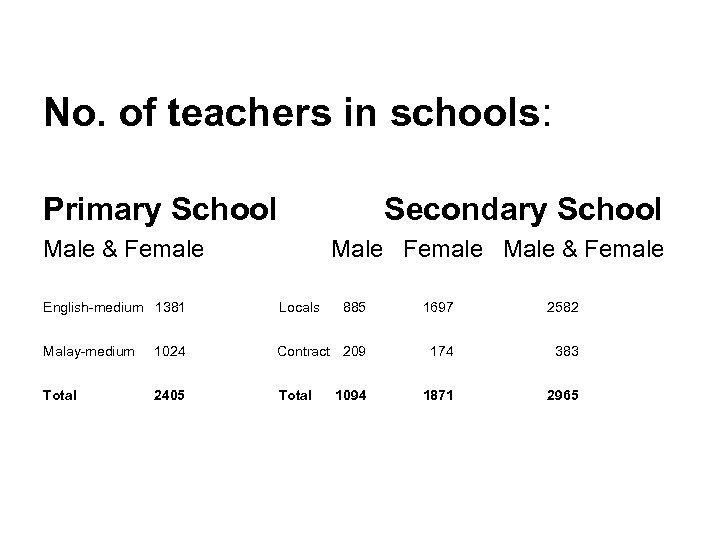
No. of teachers in schools: Primary School Secondary School Male & Female English-medium 1381 Locals 885 1697 2582 Malay-medium 1024 Contract 209 174 383 Total 2405 Total 1871 2965 1094
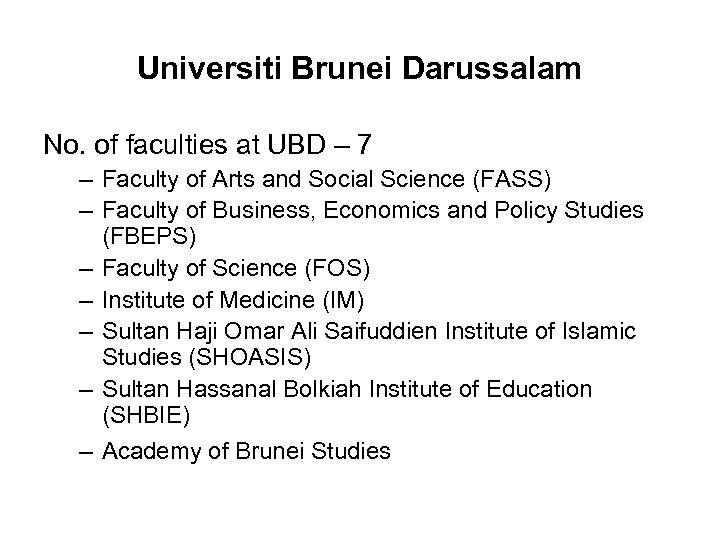
Universiti Brunei Darussalam No. of faculties at UBD – 7 – Faculty of Arts and Social Science (FASS) – Faculty of Business, Economics and Policy Studies (FBEPS) – Faculty of Science (FOS) – Institute of Medicine (IM) – Sultan Haji Omar Ali Saifuddien Institute of Islamic Studies (SHOASIS) – Sultan Hassanal Bolkiah Institute of Education (SHBIE) – Academy of Brunei Studies
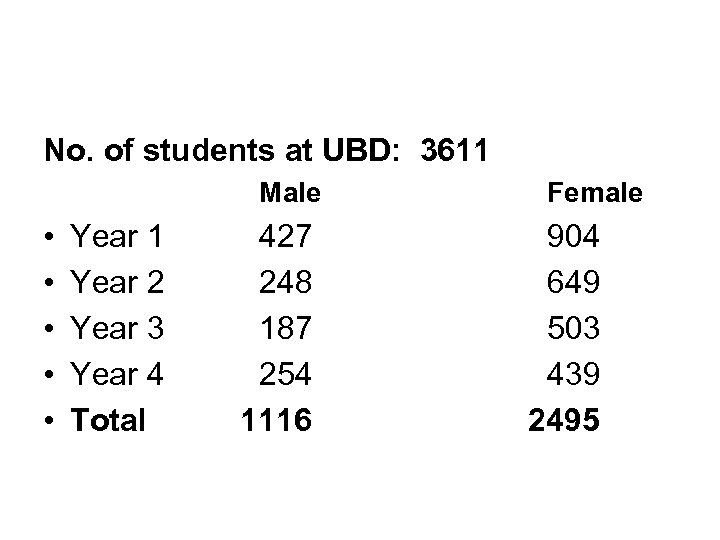
No. of students at UBD: 3611 Male • • • Year 1 Year 2 Year 3 Year 4 Total 427 248 187 254 1116 Female 904 649 503 439 2495
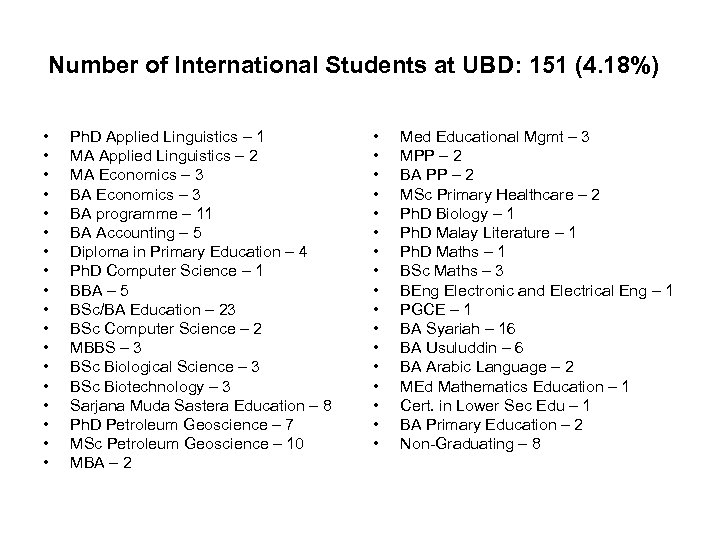
Number of International Students at UBD: 151 (4. 18%) • • • • • Ph. D Applied Linguistics – 1 MA Applied Linguistics – 2 MA Economics – 3 BA programme – 11 BA Accounting – 5 Diploma in Primary Education – 4 Ph. D Computer Science – 1 BBA – 5 BSc/BA Education – 23 BSc Computer Science – 2 MBBS – 3 BSc Biological Science – 3 BSc Biotechnology – 3 Sarjana Muda Sastera Education – 8 Ph. D Petroleum Geoscience – 7 MSc Petroleum Geoscience – 10 MBA – 2 • • • • • Med Educational Mgmt – 3 MPP – 2 BA PP – 2 MSc Primary Healthcare – 2 Ph. D Biology – 1 Ph. D Malay Literature – 1 Ph. D Maths – 1 BSc Maths – 3 BEng Electronic and Electrical Eng – 1 PGCE – 1 BA Syariah – 16 BA Usuluddin – 6 BA Arabic Language – 2 MEd Mathematics Education – 1 Cert. in Lower Sec Edu – 1 BA Primary Education – 2 Non-Graduating – 8
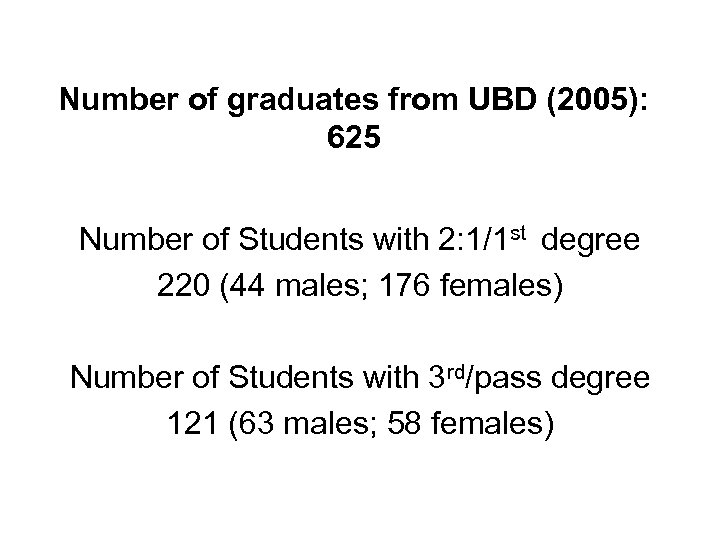
Number of graduates from UBD (2005): 625 Number of Students with 2: 1/1 st degree 220 (44 males; 176 females) Number of Students with 3 rd/pass degree 121 (63 males; 58 females)
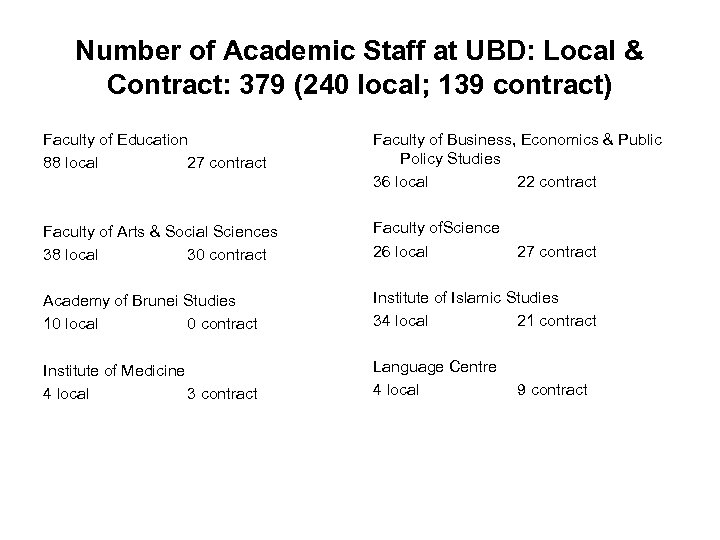
Number of Academic Staff at UBD: Local & Contract: 379 (240 local; 139 contract) Faculty of Education 88 local 27 contract Faculty of Business, Economics & Public Policy Studies 36 local 22 contract Faculty of Arts & Social Sciences 38 local 30 contract Faculty of. Science 26 local Academy of Brunei Studies 10 local 0 contract Institute of Islamic Studies 34 local 21 contract Institute of Medicine 4 local 3 contract Language Centre 4 local 27 contract 9 contract
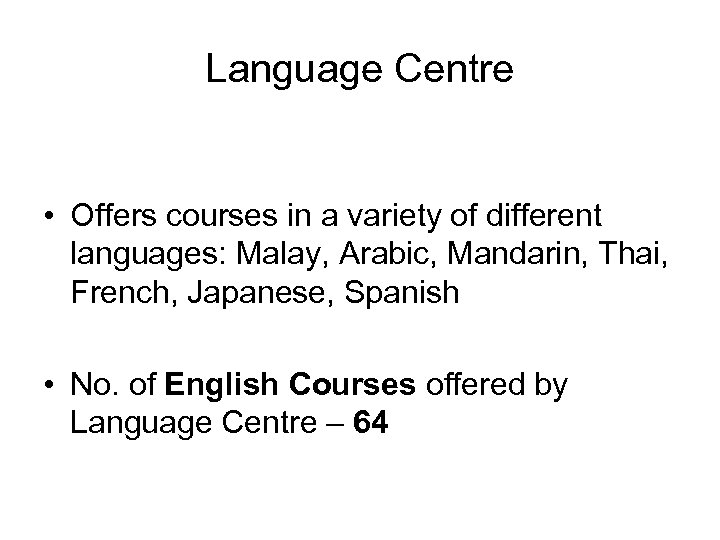
Language Centre • Offers courses in a variety of different languages: Malay, Arabic, Mandarin, Thai, French, Japanese, Spanish • No. of English Courses offered by Language Centre – 64
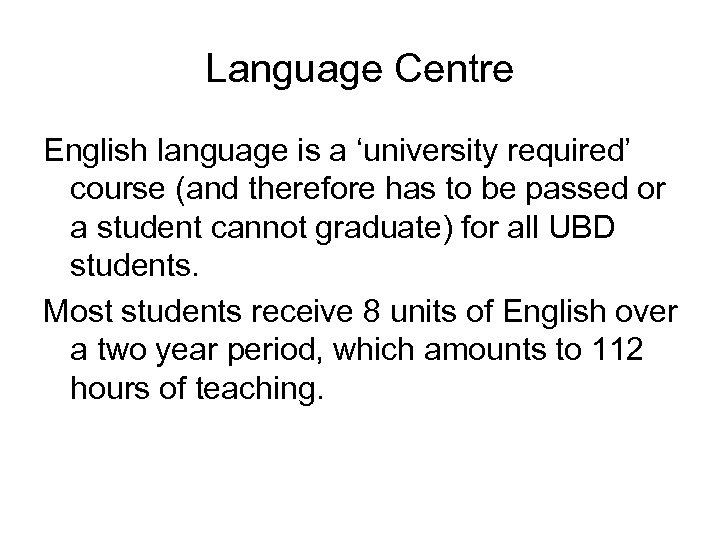
Language Centre English language is a ‘university required’ course (and therefore has to be passed or a student cannot graduate) for all UBD students. Most students receive 8 units of English over a two year period, which amounts to 112 hours of teaching.
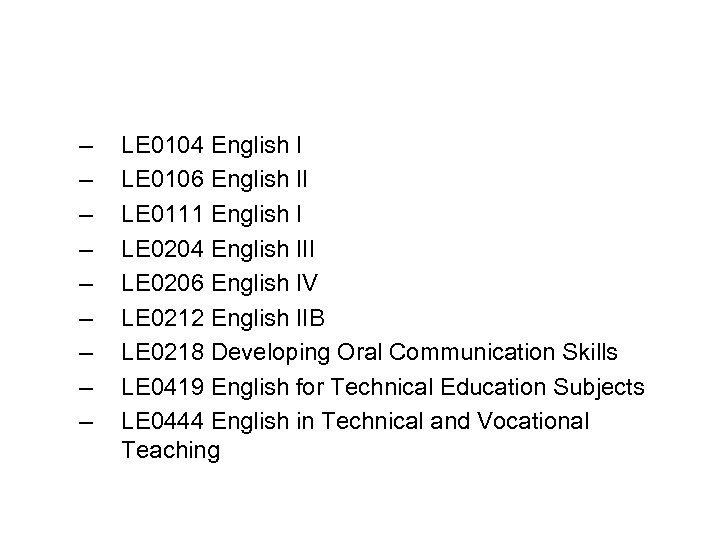
– – – – – LE 0104 English I LE 0106 English II LE 0111 English I LE 0204 English III LE 0206 English IV LE 0212 English IIB LE 0218 Developing Oral Communication Skills LE 0419 English for Technical Education Subjects LE 0444 English in Technical and Vocational Teaching
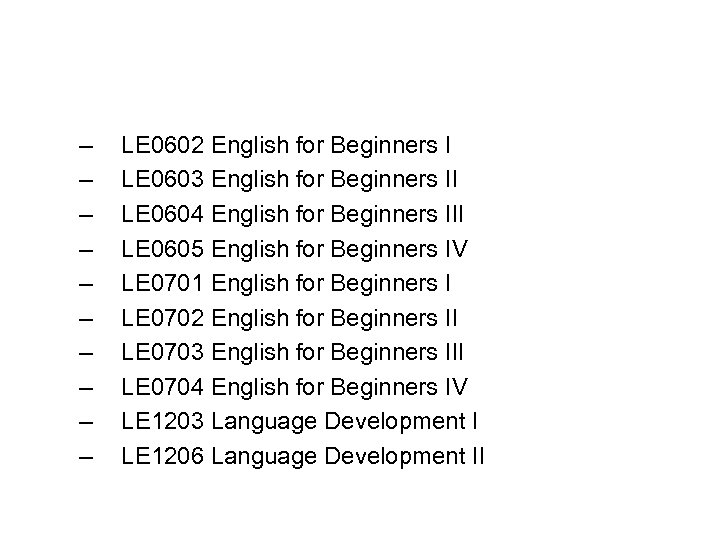
– – – – – LE 0602 English for Beginners I LE 0603 English for Beginners II LE 0604 English for Beginners III LE 0605 English for Beginners IV LE 0701 English for Beginners I LE 0702 English for Beginners II LE 0703 English for Beginners III LE 0704 English for Beginners IV LE 1203 Language Development I LE 1206 Language Development II
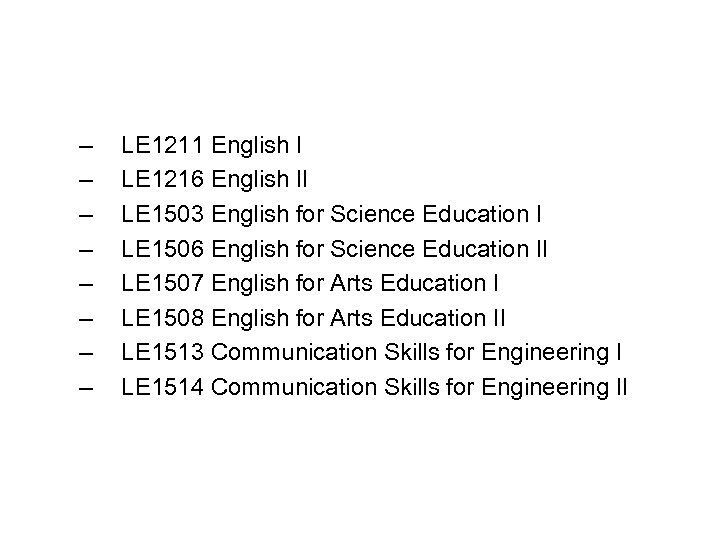
– – – – LE 1211 English I LE 1216 English II LE 1503 English for Science Education I LE 1506 English for Science Education II LE 1507 English for Arts Education I LE 1508 English for Arts Education II LE 1513 Communication Skills for Engineering I LE 1514 Communication Skills for Engineering II
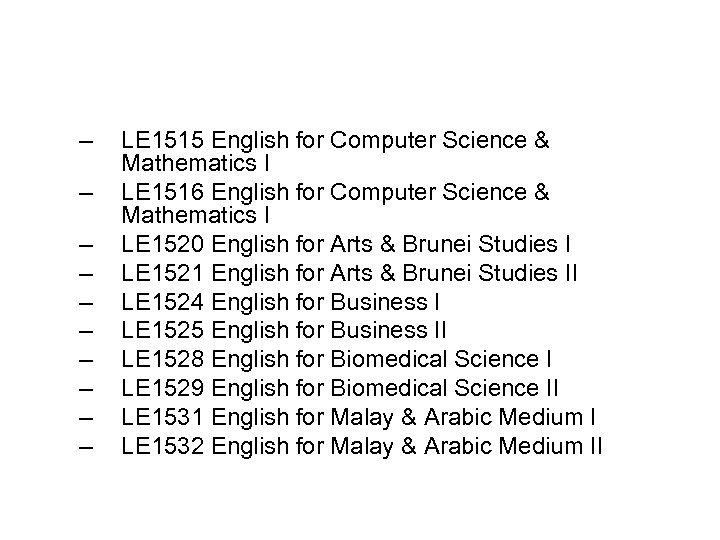
– – – – – LE 1515 English for Computer Science & Mathematics I LE 1516 English for Computer Science & Mathematics I LE 1520 English for Arts & Brunei Studies I LE 1521 English for Arts & Brunei Studies II LE 1524 English for Business I LE 1525 English for Business II LE 1528 English for Biomedical Science I LE 1529 English for Biomedical Science II LE 1531 English for Malay & Arabic Medium I LE 1532 English for Malay & Arabic Medium II
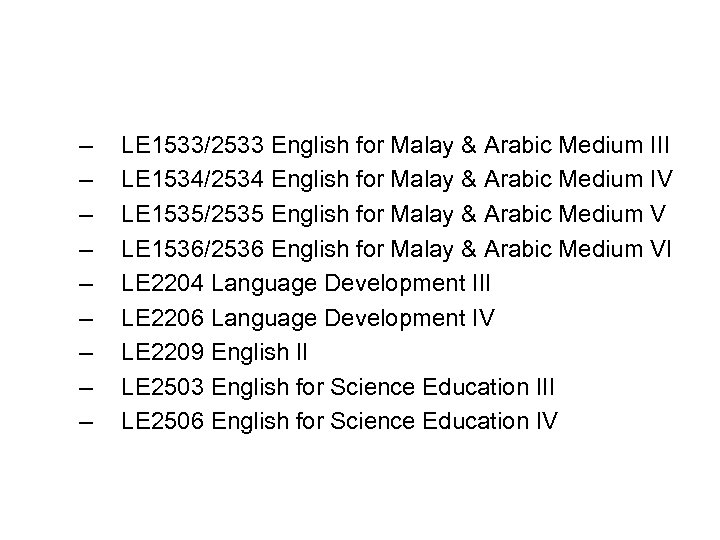
– – – – – LE 1533/2533 English for Malay & Arabic Medium III LE 1534/2534 English for Malay & Arabic Medium IV LE 1535/2535 English for Malay & Arabic Medium V LE 1536/2536 English for Malay & Arabic Medium VI LE 2204 Language Development III LE 2206 Language Development IV LE 2209 English II LE 2503 English for Science Education III LE 2506 English for Science Education IV
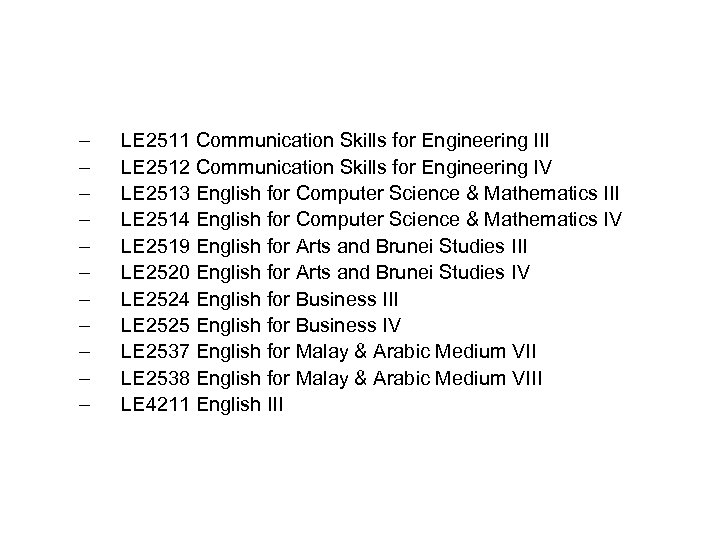
– – – LE 2511 Communication Skills for Engineering III LE 2512 Communication Skills for Engineering IV LE 2513 English for Computer Science & Mathematics III LE 2514 English for Computer Science & Mathematics IV LE 2519 English for Arts and Brunei Studies III LE 2520 English for Arts and Brunei Studies IV LE 2524 English for Business III LE 2525 English for Business IV LE 2537 English for Malay & Arabic Medium VII LE 2538 English for Malay & Arabic Medium VIII LE 4211 English III
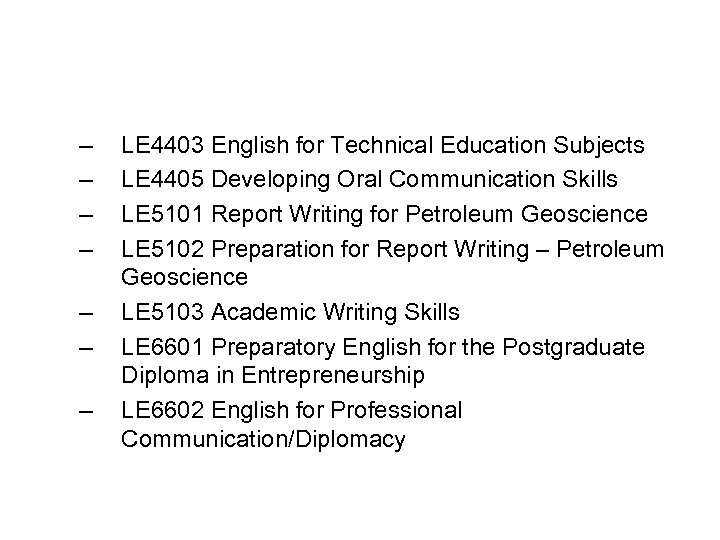
– – – – LE 4403 English for Technical Education Subjects LE 4405 Developing Oral Communication Skills LE 5101 Report Writing for Petroleum Geoscience LE 5102 Preparation for Report Writing – Petroleum Geoscience LE 5103 Academic Writing Skills LE 6601 Preparatory English for the Postgraduate Diploma in Entrepreneurship LE 6602 English for Professional Communication/Diplomacy
Problems? On the whole, I am pleased to note that English Language Results in PCE (PSR) and PMB have steadily improved over the last five years … However, these results are not reflected in GCE ‘O’ level results Pehin Dato Hj Awg Abd Rahman, Minister of Education, 26 th Aug 2005
General Certificate of Education Ordinary Level (GCE ‘O’ Level) • Designed in the United Kingdom for native English speaking children. • An academic examination, meant for only the best pupils. • Weaker pupils studied for the Certificate in Secondary Education (CSE). • Today, children in the UK take the General Certificate of Secondary Education (GCSE).
Responses from pupils to questions about English language teaching in schools § § § lessons are boring no home support O level too difficult too shy lazy exam too tough § § § nobody reads lousy teachers no guidelines no interest no practice no motivation
Despite these criticisms, pupils and students responded that they usually prefer their English classes to other lessons because English is more vibrant and less boring!
The most frequent observation: do not use the language lack of practice limited daily use
The second most frequent comment: poor teaching lousy teachers lazy teachers
The third most frequent comment: emphasis on Malay not encouraged to use English users frowned upon
Various comments were made about the nature and validity of GCE ‘O’ level, including degrees of difficulty of the various papers, but the most pertinent comment is that the examination is meant for native speakers whereas for virtually all local pupils English is a second, third, fourth or even fifth language.
General Certificate of Education Ordinary level (GCE ‘O’ level) Inevitably teachers teach towards an examination. If the examination reflects the needs of the pupils then there shouldn’t be a problem. ‘O’ level does not reflect these needs. At the moment we have a native speaker examination being taught to non-native speakers by teachers who, for the most part, have been trained as TESL teachers.
A more conducive learning environment? One of the causes for inattentiveness and a lack of motivation among pupils is the environment in which they learn. For instance, very few classrooms have air-conditioning.
Outside the Classroom MTV; VTV; Cartoon Network; HBO; Star Movies; ESPN; Star Sport; CNN; BBC… Copy DVDs and music CDs A recent development: English has become ‘cool’ At the same time, East Asian culture has become very popular among young Bruneians, particularly Korean films and music,
Problems at UBD? • Lack of suitable staff to teach Language Centre English courses • Lack of motivation among students to improve their own English (all English medium students already have a credit in GCE O level or IELTS 6. 5)
To conclude on a positive note Advantages at UBD • A multinational, multilingual staff • English language classes compulsory and fully supported • As previously mentioned, all English medium students must have a credit in GCE O level or IELTS 6. 5
Скачать презентацию Language Issues in Universiti Brunei Darussalam Dr Gary
48b35f0e601fe91ba90975f26707f2f4.ppt