


 Скачать презентацию Language Development in FL-Medium Learning Environment Eeva Rauto
72f9aa28c282a11f9d96c96818a5ad04.ppt
- Количество слайдов: 14
 Language Development in FL-Medium Learning Environment Eeva Rauto Vaasa University of Applied Sciences eeva. rauto@puv. fi
 This Presentation Covers n Theoretical framework for interpreting the research results (current local project) n Basic concepts related to naturalistic language acquisition, drawing on SLA (Second Language Acquisition) literature
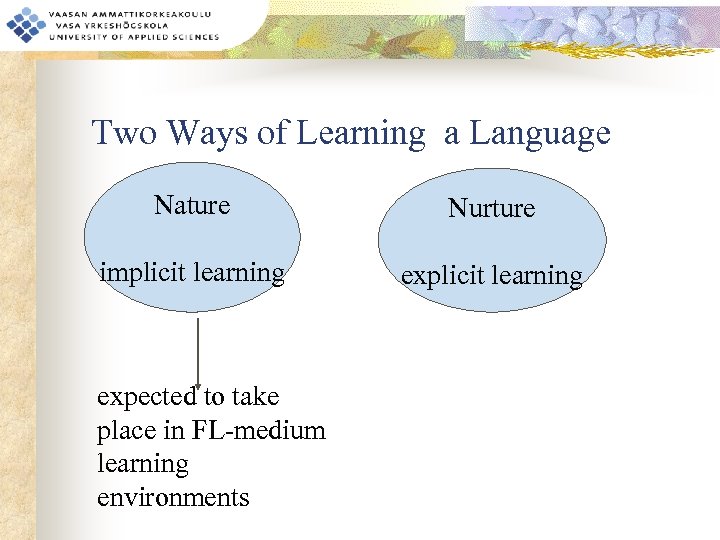 Two Ways of Learning a Language Nature Nurture implicit learning expected to take place in FL-medium learning environments
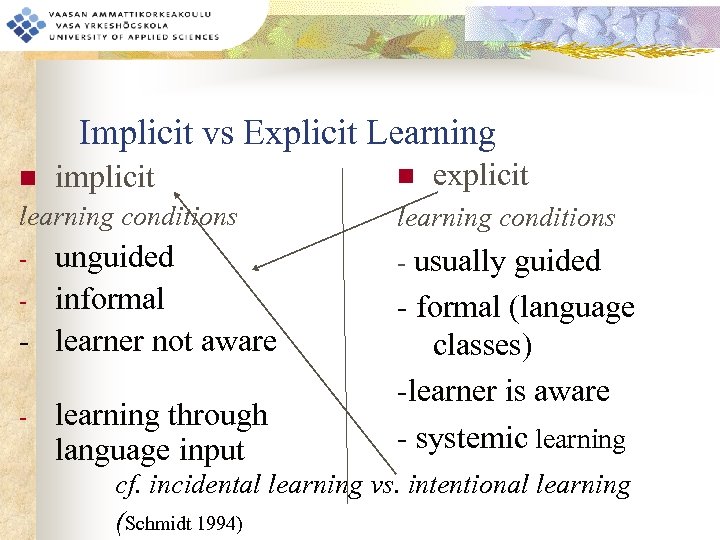 Implicit vs Explicit Learning n implicit n explicit learning conditions unguided - informal - learner not aware - usually guided - - learning through language input - formal (language classes) -learner is aware - systemic learning cf. incidental learning vs. intentional learning (Schmidt 1994)
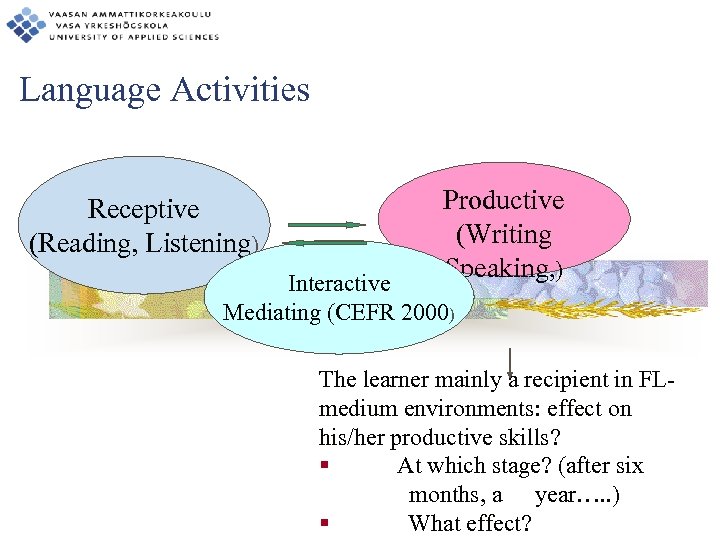 Language Activities Receptive (Reading, Listening) Productive (Writing Speaking, ) Interactive Mediating (CEFR 2000) The learner mainly a recipient in FLmedium environments: effect on his/her productive skills? § At which stage? (after six months, a year…. . ) § What effect?
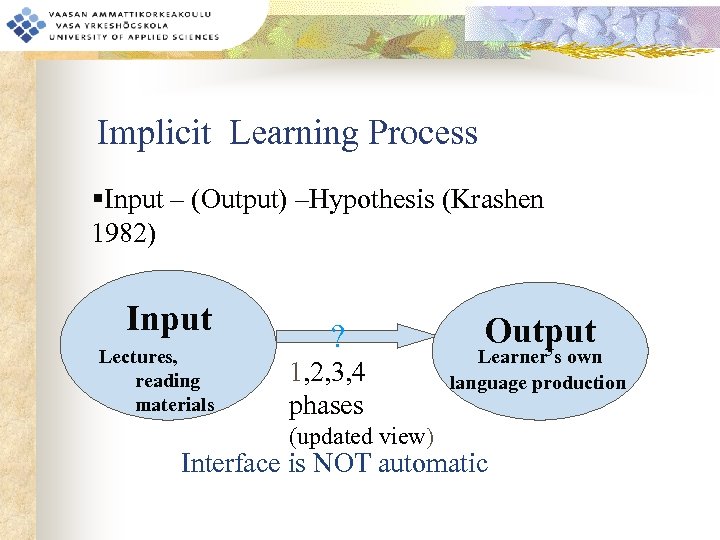 Implicit Learning Process §Input – (Output) –Hypothesis (Krashen 1982) Input Lectures, reading materials ? 1, 2, 3, 4 phases (updated view) Output Learner’s own language production Interface is NOT automatic
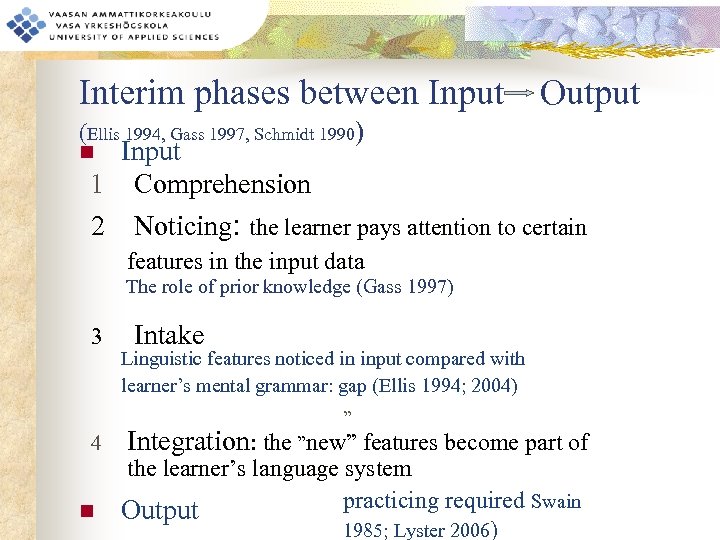 Interim phases between Input Output (Ellis 1994, Gass 1997, Schmidt 1990) Input 1 Comprehension n 2 Noticing: the learner pays attention to certain features in the input data The role of prior knowledge (Gass 1997) 3 Intake Linguistic features noticed in input compared with learner’s mental grammar: gap (Ellis 1994; 2004) ” 4 n Integration: the ”new” features become part of the learner’s language system practicing required Swain Output 1985; Lyster 2006)
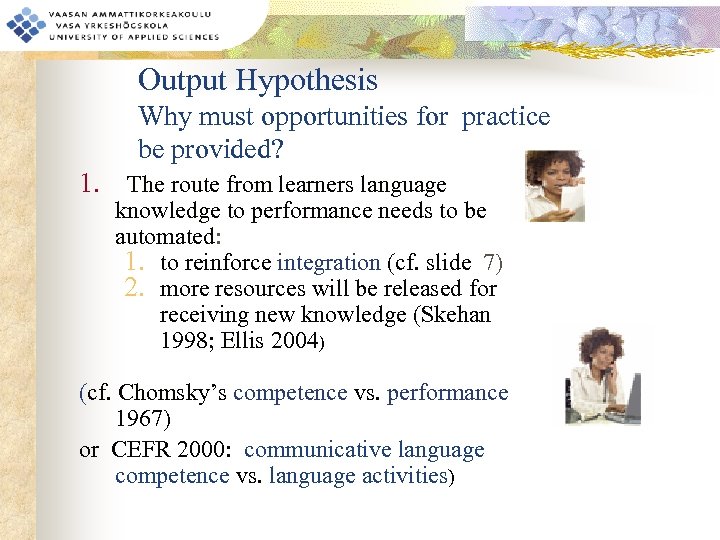 Output Hypothesis Why must opportunities for practice be provided? 1. The route from learners language knowledge to performance needs to be automated: 1. to reinforce integration (cf. slide 7) 2. more resources will be released for receiving new knowledge (Skehan 1998; Ellis 2004) (cf. Chomsky’s competence vs. performance 1967) or CEFR 2000: communicative language competence vs. language activities)
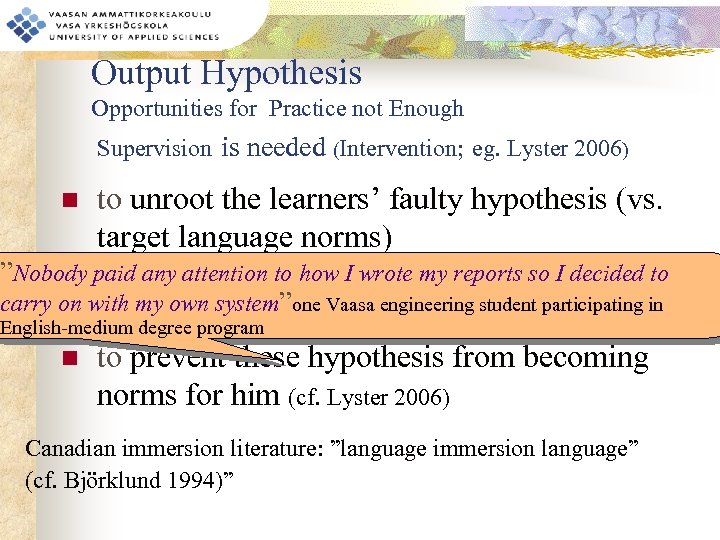 Output Hypothesis Opportunities for Practice not Enough Supervision is needed (Intervention; eg. Lyster 2006) n to unroot the learners’ faulty hypothesis (vs. target language norms) ”Nobody paid any attention to how I wrote my reports so I decided to n faulty hypothesis: intake data vs input data carry on with my own system”one Vaasa engineering student participating in as model (Van Patten 1996) English-medium degree program n to prevent these hypothesis from becoming norms for him (cf. Lyster 2006) Canadian immersion literature: ”language immersion language” (cf. Björklund 1994)”
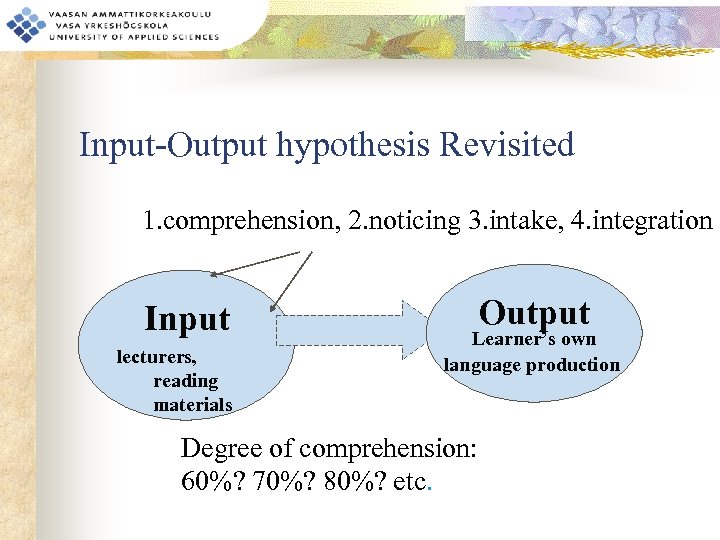 Input-Output hypothesis Revisited 1. comprehension, 2. noticing 3. intake, 4. integration Input lecturers, reading materials Output Learner’s own language production Degree of comprehension: 60%? 70%? 80%? etc.
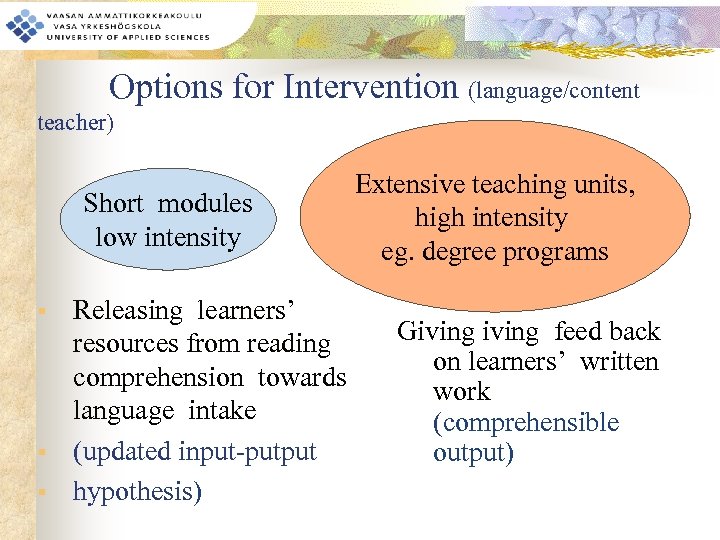 Options for Intervention (language/content teacher) Short modules low intensity § § § Releasing learners’ resources from reading comprehension towards language intake (updated input-putput hypothesis) Extensive teaching units, high intensity eg. degree programs Giving feed back on learners’ written work (comprehensible output)

 Literature Ellis, R. (1994). A Theory of Instructed Second Language Acquisition. In N Ellis (ed. )Implicit and Explicit Learning of Languages. Ellis, R. (2004). Principles of Instructed Language Learning. Available at www. sciencedirect. com Gass, S. (1997). Input, Interaction and the Second language Learner. Mahwah, N. J: Erlbaum Krashen, S. (1982). Principles and Practice in Second Language Acquisition. Oxford: Pergamon Press. . Skehan, P. (1998). A Coginitive Approach to Language Learning. Oxford: Oxford University Press. Schmidt, R. (1990). The Role of Consciousness in Second Language Learning. Applied Linguistics 11. Swain, M. 1985. Communicative Competence: Some Roles of Comprehensible In ut and Comprehensible p Output in its Development. In S. Gass & C. Madden (toim. ) Input in Second Language Acquisition. Rowley, MA: Newbury House, 235 253. Van. Patten, B. 1996. Input Processing and Grammar Instruction in Second Language Acquisition. Norwood, NJ: Ablex.
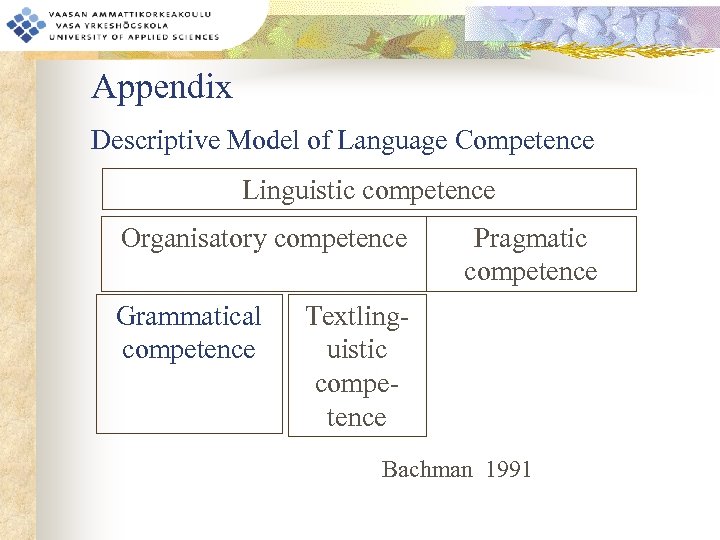 Appendix Descriptive Model of Language Competence Linguistic competence Organisatory competence Grammatical competence Pragmatic competence Textlinguistic competence Bachman 1991