


 Скачать презентацию Language Awareness 2 Morphological and Phonological Competence TEFL Office
aa8636dc1e7da07da99fc051f6546429.ppt
- Количество слайдов: 35
 Language Awareness 2—Morphological and Phonological Competence TEFL Office of Overseas Programming & Training Support (OPATS)
 A Review--Language Awareness TRY TO ANSWER THE QUESTIONS THEN CLICK TO SEE ANSWERS • What Is Language Awareness? • Being conscious and interested in patterns in language • What are some behaviors that show language awareness? • Making puns, mentioning interesting speech rhythms, trying out new idioms—in general playing with language • Why does language awareness help high competent English speakers become better teachers sooner? • You can use your language awareness to analyze language patterns, provide model examples, and from those, develop explanations for your students.
 Communicative Competence • You may remember we looked at Language Awareness in terms of Communicative Competence. Which trait below is not about Communicative Competence? [Click slide to see the answer] a) Skills & knowledge for communicative language teaching b) Adequately structuring & using language to communicate c) The basis of successful real world communication d) Knowing how to interact appropriately with others.
![Match the communicative competence with its example [when finished click for the answers] a)](https://present5.com/presentation/aa8636dc1e7da07da99fc051f6546429/image-4.jpg "Match the communicative competence with its example [when finished click for the answers] a)") Match the communicative competence with its example [when finished click for the answers] a) PHONOLOGY: how sounds become speech 1. Knowing the language to use to be formal or informal b) SOCIO-CULTURAL COMPETENCE: how to interpret social context 2. Knowing that ideas can’t sleep but dogs can c) MORPHOLOGY: how words are formed 3. Producing “str” as a single sound. d) SYNTAX (Grammar): how language is structured 4. Know the cross-culturally appropriate way to signal someone to come e) SEMANTICS: the meaning of words 5. Making an adjective into an adverb f) 6. Using correct subject-verb agreement PRAGMATICS: how we use language Answers: A 3, B 4, C 5, D 6, E 2, F 1
Match the communicative competence with its example [when finished click for the answers] a) PHONOLOGY: how sounds become speech 1. Knowing the language to use to be formal or informal b) SOCIO-CULTURAL COMPETENCE: how to interpret social context 2. Knowing that ideas can’t sleep but dogs can c) MORPHOLOGY: how words are formed 3. Producing “str” as a single sound. d) SYNTAX (Grammar): how language is structured 4. Know the cross-culturally appropriate way to signal someone to come e) SEMANTICS: the meaning of words 5. Making an adjective into an adverb f) 6. Using correct subject-verb agreement PRAGMATICS: how we use language Answers: A 3, B 4, C 5, D 6, E 2, F 1
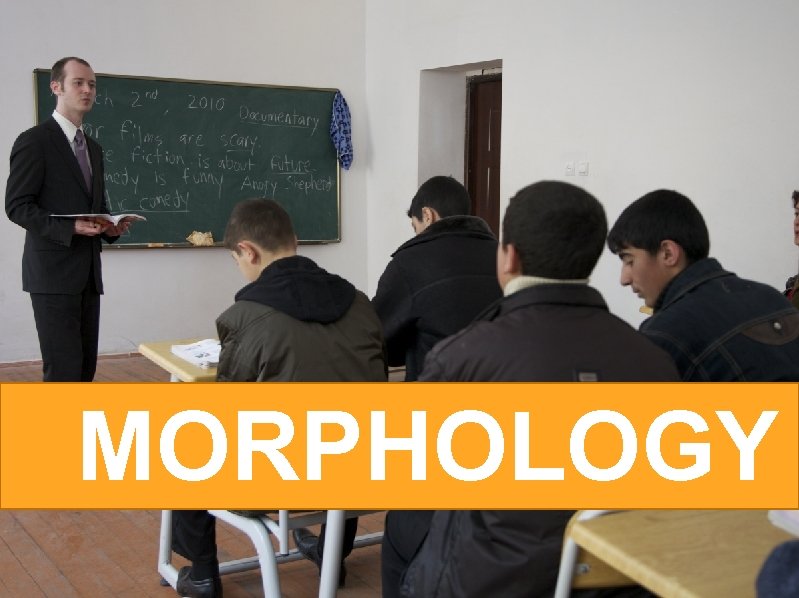 PHONOLOGY MORPHOLOGY
 Quick test of your language awareness • • What does “therm” mean? What does “meter” mean? What does “sub” mean? What does “marine” mean? • What is the difference in between motivate, motivation, motivational, and motivationally? • These chunks of words that have meaning are morphemes.
 Morphology is… …about the form of words (morph = form) or the components of words (e. g. , prefixes, roots, or suffixes) that go together to make words and give them meaning. Each of these components is called a “morpheme. ” For example “television has three morphemes: tele- = far; vis- = see(ing) and sion a noun.

 Classroom Activities on Morphology In Morphology we talk about prefixes and suffixes (together “affixes”) and roots or stems. There are two main types of morphological elements: 1. “Grammatical” affixes aid in identifying parts of speech (verbs, nouns, adjectives) and in strategizing how to make nouns into verbs, adjectives into adverbs, etc. 2. “Content” roots and affixes help students guess the meaning of new words
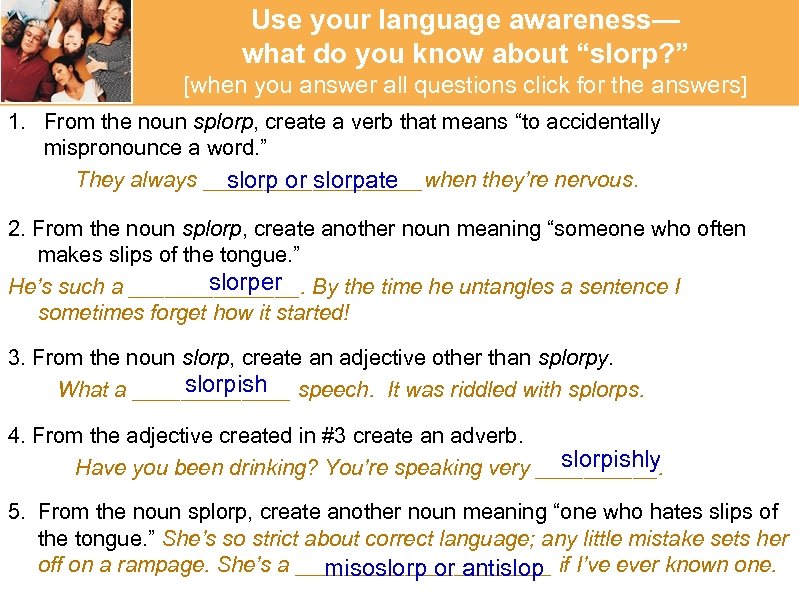 Use your language awareness— what do you know about “slorp? ” [when you answer all questions click for the answers] 1. From the noun splorp, create a verb that means “to accidentally mispronounce a word. ” They always _________when they’re nervous. slorp or slorpate 2. From the noun splorp, create another noun meaning “someone who often makes slips of the tongue. ” slorper He’s such a _______. By the time he untangles a sentence I sometimes forget how it started! 3. From the noun slorp, create an adjective other than splorpy. slorpish What a _______ speech. It was riddled with splorps. 4. From the adjective created in #3 create an adverb. slorpishly Have you been drinking? You’re speaking very _____. 5. From the noun splorp, create another noun meaning “one who hates slips of the tongue. ” She’s so strict about correct language; any little mistake sets her off on a rampage. She’s a ___________ if I’ve ever known one. misoslorp or antislop
![Morphemes: = units of meaning that make up words [answers on next slide] EXAMPLE:](https://present5.com/presentation/aa8636dc1e7da07da99fc051f6546429/image-11.jpg "Morphemes: = units of meaning that make up words [answers on next slide] EXAMPLE:") Morphemes: = units of meaning that make up words [answers on next slide] EXAMPLE: Uneven Un | even • UN means “not” or “contrary to” and negates the meaning of unequal. It is also used in unfair. EVEN is a word meaning “free of variation, uniform, regular, consistent, level. ” Now, try your hand: 1. underline 2. revise 3. sweeten 4. disapproval 5. persuasively 6. foolish 7. revival 8. nondrinker 9. pointless 10. demystify 11. unbelievable
Morphemes: = units of meaning that make up words [answers on next slide] EXAMPLE: Uneven Un | even • UN means “not” or “contrary to” and negates the meaning of unequal. It is also used in unfair. EVEN is a word meaning “free of variation, uniform, regular, consistent, level. ” Now, try your hand: 1. underline 2. revise 3. sweeten 4. disapproval 5. persuasively 6. foolish 7. revival 8. nondrinker 9. pointless 10. demystify 11. unbelievable
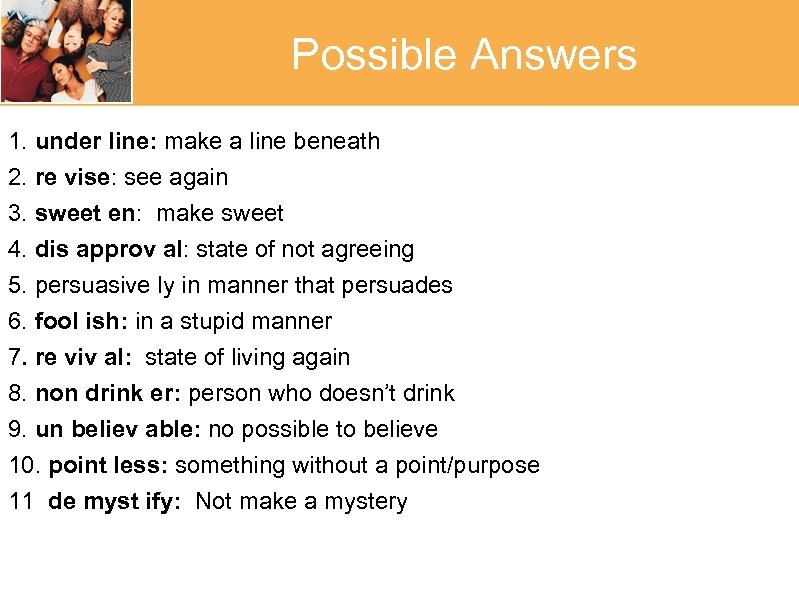 Possible Answers 1. under line: make a line beneath 2. re vise: see again 3. sweet en: make sweet 4. dis approv al: state of not agreeing 5. persuasive ly in manner that persuades 6. fool ish: in a stupid manner 7. re viv al: state of living again 8. non drink er: person who doesn’t drink 9. un believ able: no possible to believe 10. point less: something without a point/purpose 11 de myst ify: Not make a mystery
 MORPHOLOGY PHONOLOGY
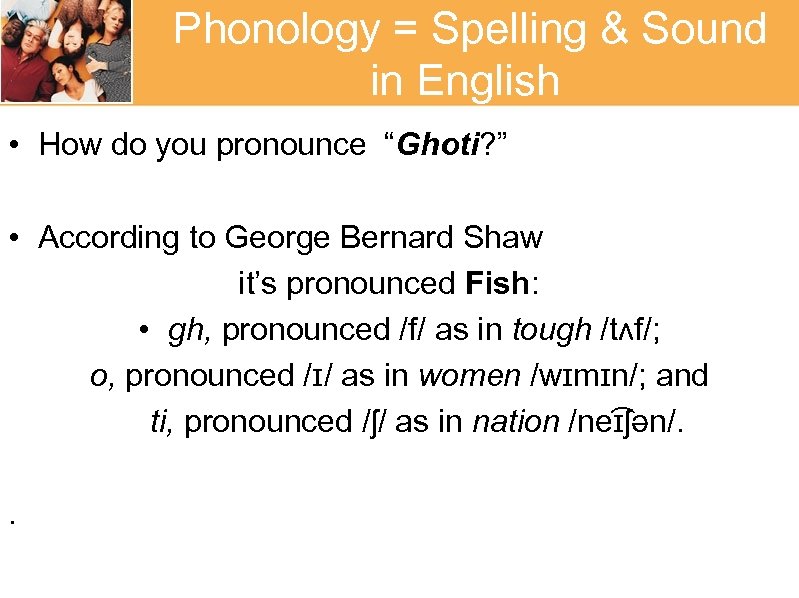 Phonology = Spelling & Sound in English • How do you pronounce “Ghoti? ” • According to George Bernard Shaw it’s pronounced Fish: • gh, pronounced /f/ as in tough /tʌf/; o, pronounced /ɪ/ as in women /wɪmɪn/; and ti, pronounced /ʃ/ as in nation /ne ɪʃən/. .
 True, English is not “phonetically transparent…” …like languages such as Spanish, Italian or most African languages (because the writing systems of these languages were created by missionary linguists). However, be fair to your students. Don’t stress exceptions, that only demoralizes students. Sound/symbol correspondences are often more complicated in English, but that doesn’t mean there are not rules.
 One Strategy for Pronouncing Written Words Give them comparison base words that they are sure that they can pronounce, for example- it, but, red, five and ask them to associate new words of the same sound with these base words. • For example: “liv” in deliver is pronounced like “give, ” but hive is pronounced like “five” • Or “the vowel in “this” is like “it, ” not like the vowel in “please. ” If you pronounce “this” like “please” I here “these. ”
 Stop, take a break from the slide show and look at Handout 1: • Handout 1 provides examples of different types of classroom activities you can build to teach morphology. • You can find it at the link in this STE session labeled: “Examples of Classroom Examples on Morphology”
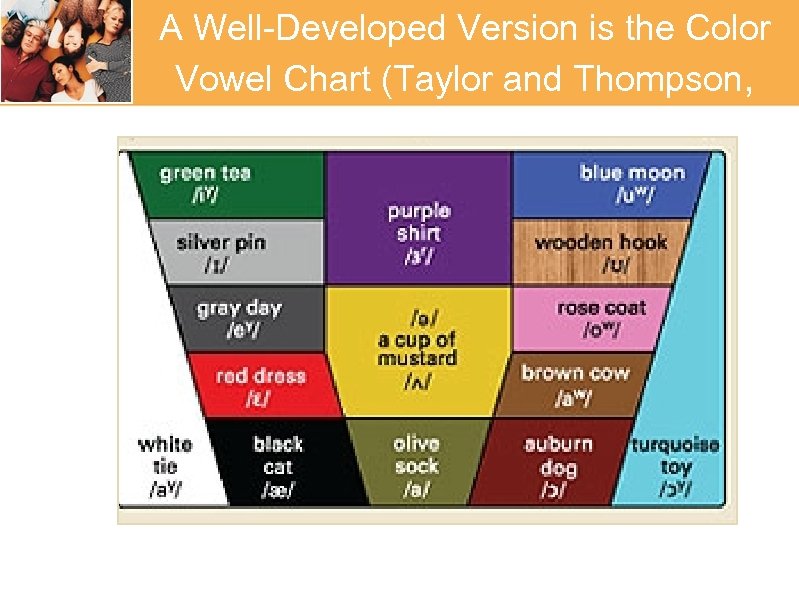 A Well-Developed Version is the Color Vowel Chart (Taylor and Thompson,
 The Phoneme: a useful concept Phoneme: units of sounds that speakers of a language perceive as different (and important), that help distinguish one word from another; e. g. , pad and pat bad and pad However each language perceives meaningful differences between some sounds that are not meaningful in other languages. Some examples of distinctions English and not heard in other languages include: l & r = election/erection: v & b = vase & base d (or t) & th = “dis ting” for this thing; v/w = vater for water For Anglophones, the “Spanish r” or the difference between the aspirated and unaspirated “p” in Korean, or tu/tout in French.
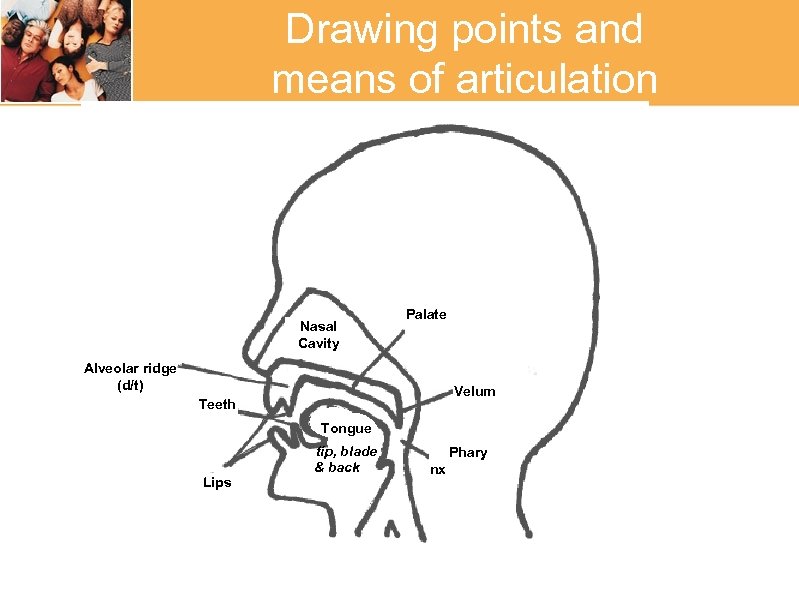
 IMPORTANT UNDERSTANDING! If someone does not have a phonemic distinction in their language which exists in another language, speakers of that language will likely never be able to perceive the distinction between those small sounds. 1. This means that “listen to me and repeat” will not work in these cases. In fact, it is never a good idea to use the “listen and repeat” technique for correction pronunciation more than three times. All you will do is frustrate the learner. Remember, often pronunciation change only comes with “fullness of time. ” 2. However we can learn how to model and describe these sounds are learners can’t hear so they can produce the sound correctly even if they don’t hear the difference. 3. This process is called describing the “points and means of (auditory) articulation. ”
 By describing how they articulate sounds, native speakers can provide insights: A French teacher with a native English speaker: 1. The “u” in “pu” is always pronounced in the front of the mouth, in the middle with very rounded lips 2. The vowel in“peux” pronounced in the middle of the mouth but high, the lips are pressed flat and quite tense (note: “x” is silent). 3. The vowel in “poux” is pronounced quite like two/to/too, high in the back of the mouth (x silent).
 Practice • Pronounce the following list of words and see if you notice the different places in the mouth where their vowels are produced. Think in terms of front/middle/back and high/mid/low. • beet, bit, bet, ban, bird, but, bat, bought, book, boot. • Leek, lit, late, LAN, (lit)tle, (la)ter, lot look, lute • Talk with a partner to find ways to describe the changes.
 Questions to ask yourself when describing articulation: 1. Where is the sound produced in the mouth? 2. What is the tongue doing? What part of the tongue (tip, middle, back)? What is the shape of the tongue? 3. How open or closed is the mouth. 4. Is the sound produced in part in the nasal cavity? 5. What are the lips doing? 6. Is the consonant voiced (the vocal cords vibrate—[th]at) vs. unvoiced (the vocal cords don’t vibrate [th]is)?
 NOTE: Voiced or Voiceless Consonants? • Voiced sound is made with vocal cords vibrating (for example: b, d, g, v, ch, m) • Voiceless vocal cords don’t vibrate (for example: p, t, k, f, sh) TWO WAYS TO TEST: 1. Put hand on larynx to feel vibration 2. Put hands over your ears
 Drawing points and means of articulation Nasal Cavity Alveolar ridge (d/t) Palate Velum Teeth Tongue Lips tip, blade & back Phary nx
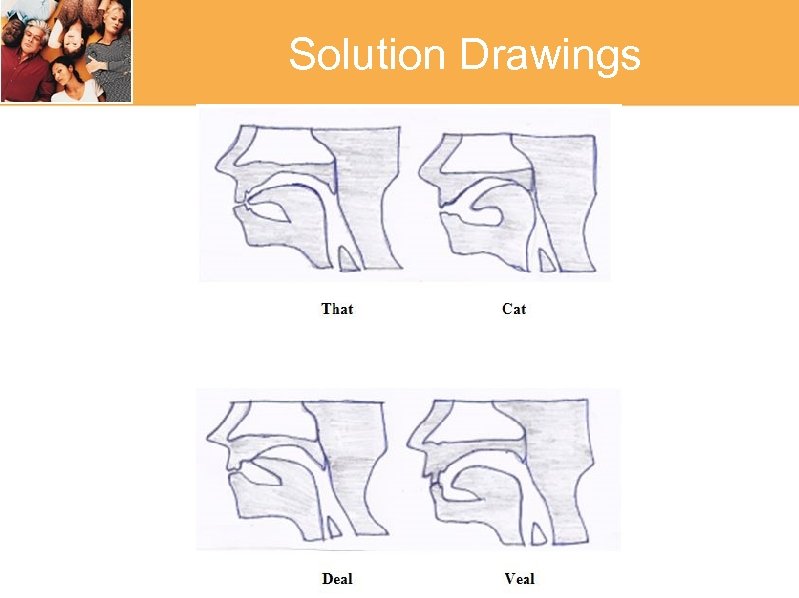
 We can model or describe articulation or show it visually 1. Drawing points & means of articulation usually means visually representing a cross-section from the side of the head. 2. This helps you show students what needs to happen inside the mouth (which is hard to see) 3. This helps if you have students for are naturally shy or who come from a culture where using the inside of one’s mouth is impolite.
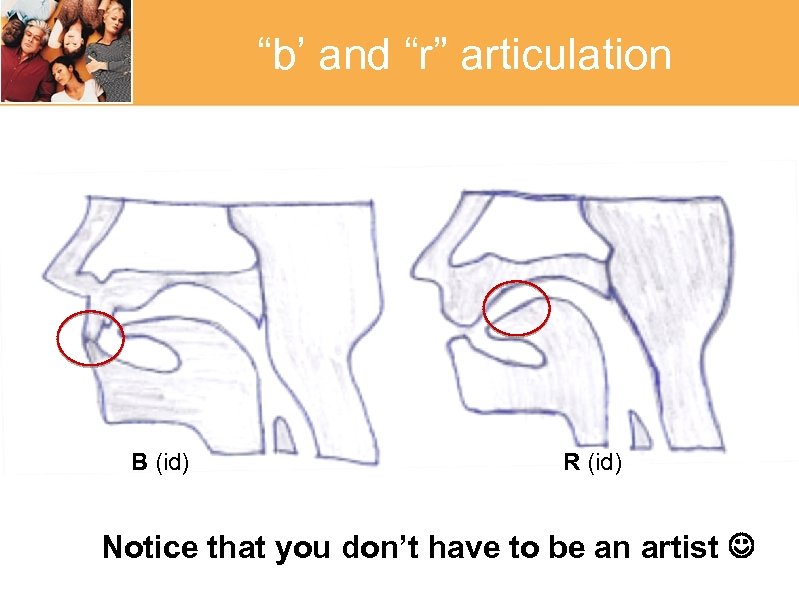 “b’ and “r” articulation B (id) R (id) Notice that you don’t have to be an artist articists. No
 Now you try it! • Draw a cross-section representation of a person’s oral apparatus for the first consonant/vowel sound of one member (first or last) in each pair. Think too about how the articulation changes between the two sounds. Try drawing at least one of these two differences. That Cat Deal Veal After you’ve finished compare your drawing to those on the next slide.
 Solution Drawings
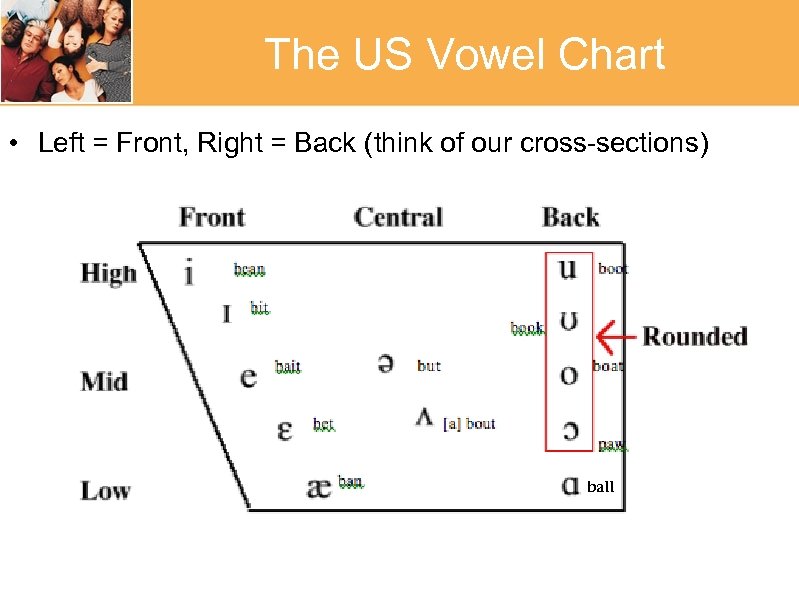 The US Vowel Chart • Left = Front, Right = Back (think of our cross-sections) ball
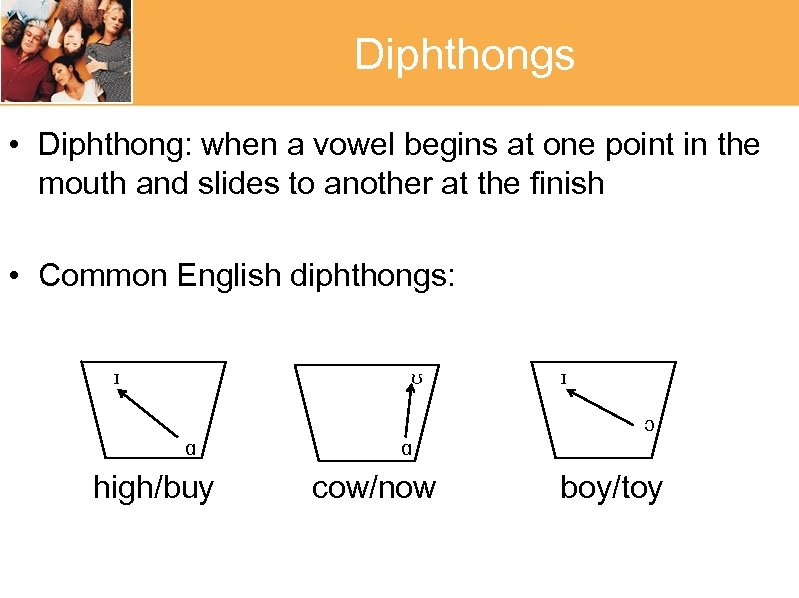 Diphthongs • Diphthong: when a vowel begins at one point in the mouth and slides to another at the finish • Common English diphthongs: ɪ ʊ ɪ ɔ ɑ high/buy cow/now boy/toy
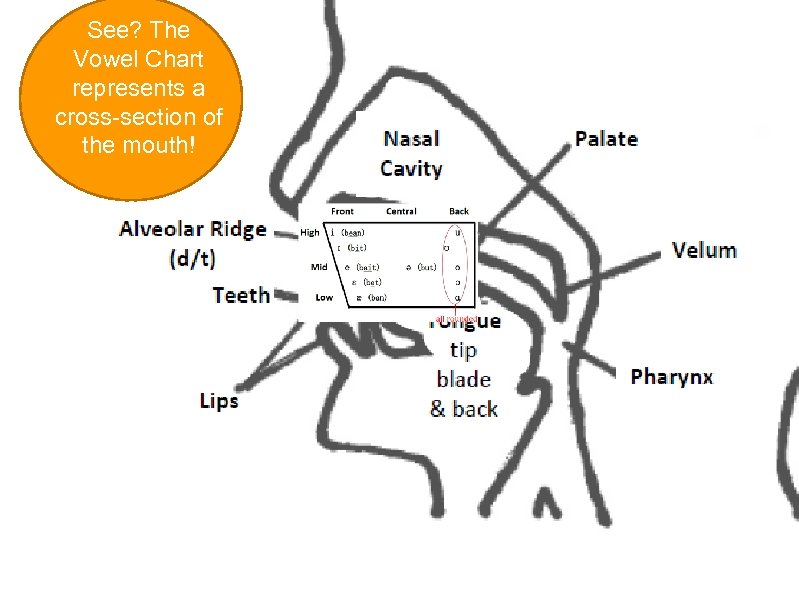 See? The Vowel Chart represents a cross-section of the mouth!
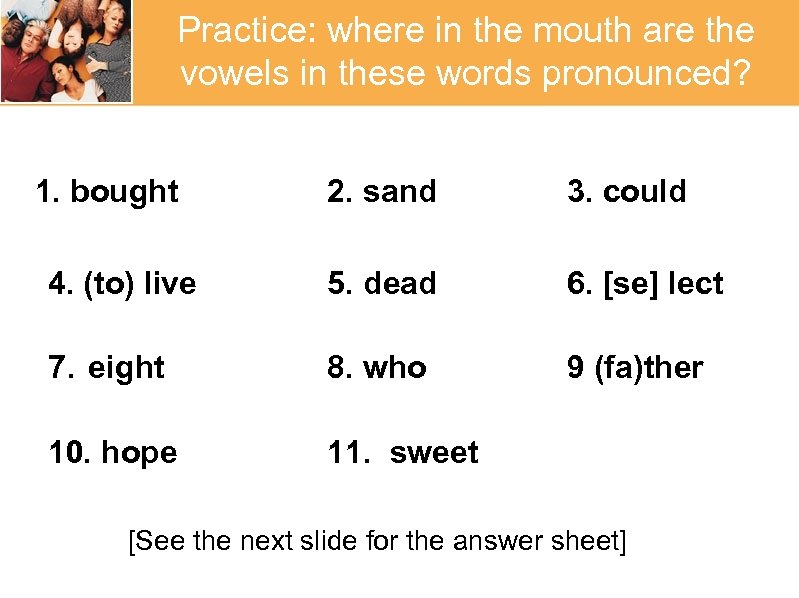 Practice: where in the mouth are the vowels in these words pronounced? 1. bought 4. (to) live 2. sand 3. could 5. dead 6. [se] lect 7. eight 8. who 9 (fa)ther 10. hope 11. sweet [See the next slide for the answer sheet]
![ANSWER SHEET sweet who live eight could [se]lect hope dead bought sand father](https://present5.com/presentation/aa8636dc1e7da07da99fc051f6546429/image-34.jpg "ANSWER SHEET sweet who live eight could [se]lect hope dead bought sand father") ANSWER SHEET sweet who live eight could [se]lect hope dead bought sand father
ANSWER SHEET sweet who live eight could [se]lect hope dead bought sand father
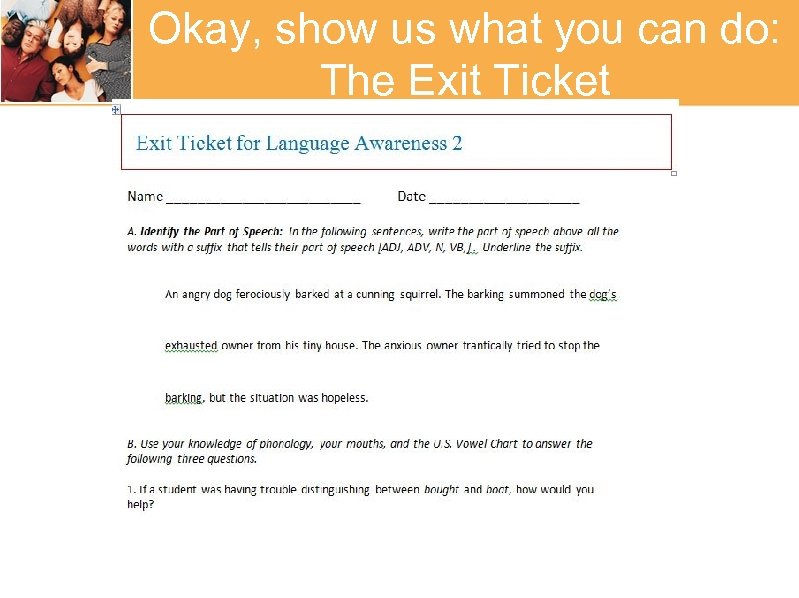 Okay, show us what you can do: The Exit Ticket