


 Скачать презентацию Landsat Long-Term Acquisition Plan Jim Lacasse USGS Landsat
abd9857eef468fa77819de230ae9211e.ppt
- Количество слайдов: 12
 Landsat Long-Term Acquisition Plan Jim Lacasse USGS Landsat Mission Management Officer January 9, 2007 U. S. Department of the Interior U. S. Geological Survey Landsat/LDCM Science Team Meeting
 Agenda l l l Background What is the LTAP? Why is there a need for an LTAP? How does the LTAP work? What are the results of having the LTAP? 2 Landsat/LDCM Science Team Meeting
 Background l In the past, most Landsat efforts to define image acquisition approaches were ad hoc: u u l l l NASA: 1972 -1978 NOAA: 1979 -1985 EOSAT: 1985 -2003 USGS: 2003 -present Times where NASA Landsat program managers of large-area missions had significant impact in defining mission acquisitions Innovation of an automated long-term acquistion plan originated in ad hoc Landsat science team discussions Current LTAP implementation taken up by Landsat Project Science Office in 1995 to support Landsat 7 operations 3 Landsat/LDCM Science Team Meeting
 Agenda l l l Background What is the LTAP? Why is there a need for an LTAP? How does the LTAP work? What are the results of having the LTAP? 4 Landsat/LDCM Science Team Meeting
 What is the LTAP? The LTAP is a method to ensure a seasonally refreshed US-held archive, with substantially cloudfree observations for all land areas of the Earth. . . with maximum radiometric fidelity Primary Tasks • Defines land by WRS • Defines Seasons (NDVI, Niches) • Attempts to avoid clouds (ISSCP, NCEP, ACCA) • Optimizes radiometry (gains and thresholds) 5 Landsat/LDCM Science Team Meeting
 Agenda l l l Background What is the LTAP? Why is there a need for an LTAP? How does the LTAP work? What are the results of having the LTAP? 6 Landsat/LDCM Science Team Meeting
 Why is there a need for an LTAP? l No Landsat to-date has collected data continuously while in orbit; if it did… u u u l l l Large data volumes Expensive Value of additional data to users Maximize science value Consider system constraints and spacecraft management All this is implemented through MOC scheduler 7 Landsat/LDCM Science Team Meeting
 Agenda l l l Background What is the LTAP? Why is there a need for an LTAP? How does the LTAP work? What are the results of having the LTAP? 8 Landsat/LDCM Science Team Meeting
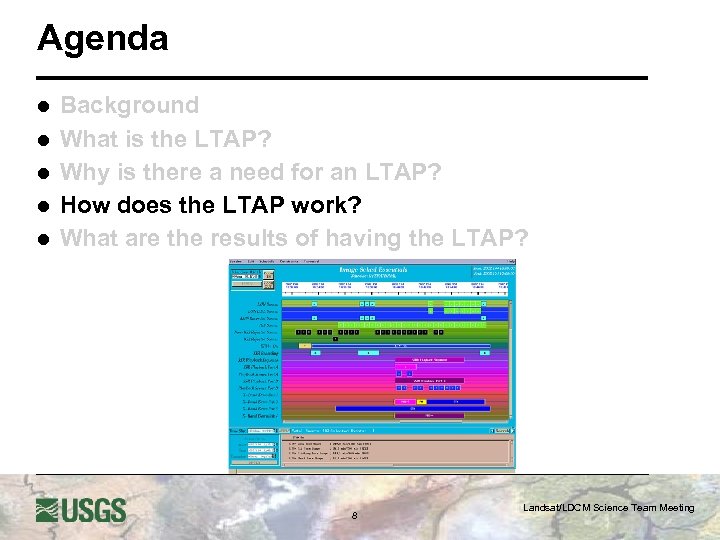
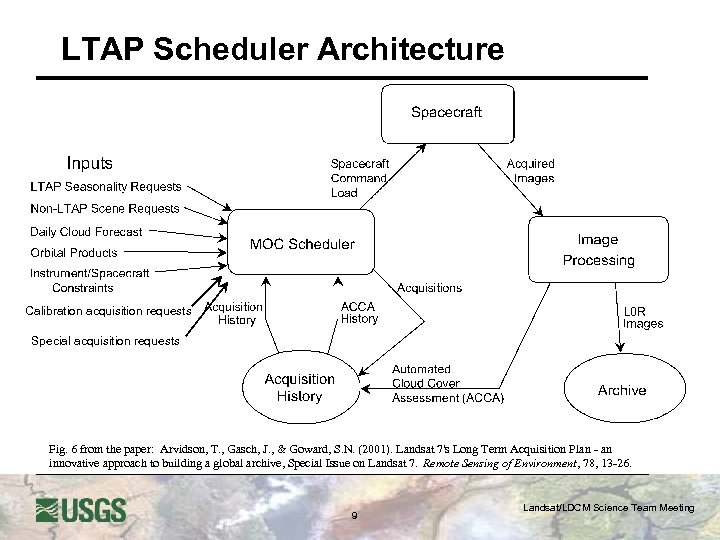 LTAP Scheduler Architecture Calibration acquisition requests Special acquisition requests Fig. 6 from the paper: Arvidson, T. , Gasch, J. , & Goward, S. N. (2001). Landsat 7's Long Term Acquisition Plan - an innovative approach to building a global archive, Special Issue on Landsat 7. Remote Sensing of Environment, 78, 13 -26. 9 Landsat/LDCM Science Team Meeting
 Agenda l l l Background What is the LTAP? Why is there a need for an LTAP? How does the LTAP work? What are the results of having the LTAP? 10 Landsat/LDCM Science Team Meeting
 What are the results of having the LTAP? l Improved seasonality coverage Good global cloud-free coverage obtained quarterly Cloud Avoidance u Reduced cloud contamination in archived imagery Radiometry u Multiple gain change approach u Changed solar zenith threshold to 75° from 85° u Recommended that future missions include requirements such that gain changes will be unnecessary u l l 11 Landsat/LDCM Science Team Meeting
 LTAP Enhancements l l Implemented u Reduced desert and winter acquisitions u Focused Boreal and tropical forest acquisitions u Converted niches to campaigns Potential u Continuous Variable Seasonality (NDVI) l u u Better use of LTAP decision making capability Include Land Mask for ACCA Assessment Low-Gain-Only Operations l Gain changes are more of a problem than a solution Reference for Presentation: PE&RS Landsat Special Edition, October 2006, Volume 72, Number 10 12 Landsat/LDCM Science Team Meeting