


 Скачать презентацию Landsat Data Continuity Mission LDCM USGS Project Status
3b5b5edeef99b5a04afc1a4a586e2538.ppt
- Количество слайдов: 14
 Landsat Data Continuity Mission (LDCM) USGS Project Status Report June 23, 2009 John Dwyer USGS LDCM Project Scientist dwyer@usgs. gov
 Topics w w w w USGS LDCM Project Team Update Status Highlights Review Progress Budget Shortfall & Mitigation TIRS Development Strategy Algorithm Delivery Status Summary U. S. Department of the Interior 2
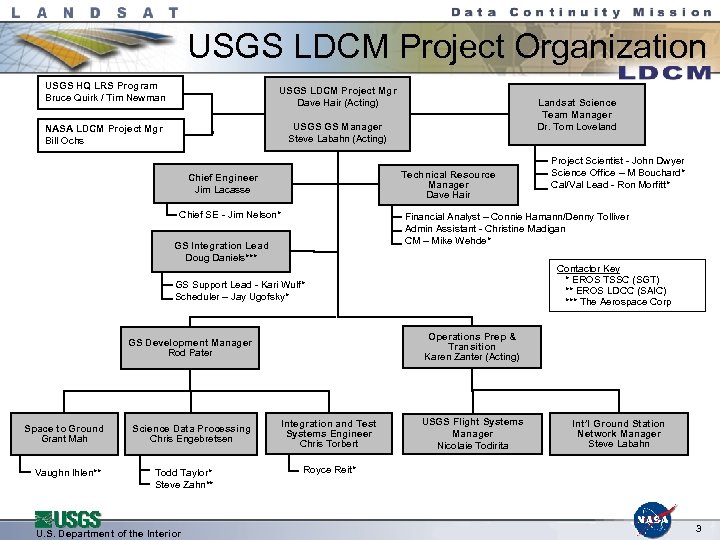 USGS LDCM Project Organization USGS HQ LRS Program Bruce Quirk / Tim Newman USGS LDCM Project Mgr Dave Hair (Acting) NASA LDCM Project Mgr Bill Ochs USGS GS Manager Steve Labahn (Acting) Landsat Science Team Manager Dr. Tom Loveland Technical Resource Manager Dave Hair Chief Engineer Jim Lacasse Chief SE - Jim Nelson* Financial Analyst – Connie Hamann/Denny Tolliver Admin Assistant - Christine Madigan CM – Mike Wehde* GS Integration Lead Doug Daniels*** Contactor Key * EROS TSSC (SGT) ** EROS LDCC (SAIC) *** The Aerospace Corp GS Support Lead - Kari Wulf* Scheduler – Jay Ugofsky* Operations Prep & Transition Karen Zanter (Acting) GS Development Manager Rod Pater Space to Ground Grant Mah Vaughn Ihlen** Science Data Processing Chris Engebretsen Todd Taylor* Steve Zahn** U. S. Department of the Interior Project Scientist - John Dwyer Science Office – M Bouchard* Cal/Val Lead - Ron Morfitt* Integration and Test Systems Engineer Chris Torbert USGS Flight Systems Manager Nicolaie Todirita Int’l Ground Station Network Manager Steve Labahn Royce Reit* 3
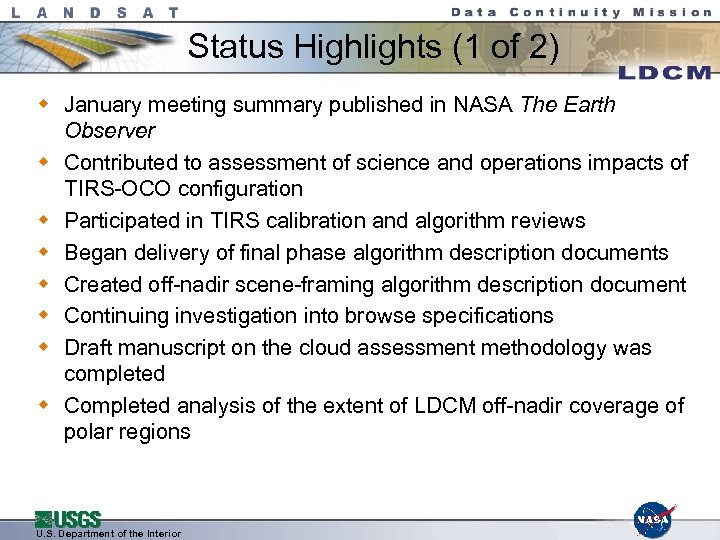 Status Highlights (1 of 2) w January meeting summary published in NASA The Earth Observer w Contributed to assessment of science and operations impacts of TIRS-OCO configuration w Participated in TIRS calibration and algorithm reviews w Began delivery of final phase algorithm description documents w Created off-nadir scene-framing algorithm description document w Continuing investigation into browse specifications w Draft manuscript on the cloud assessment methodology was completed w Completed analysis of the extent of LDCM off-nadir coverage of polar regions U. S. Department of the Interior
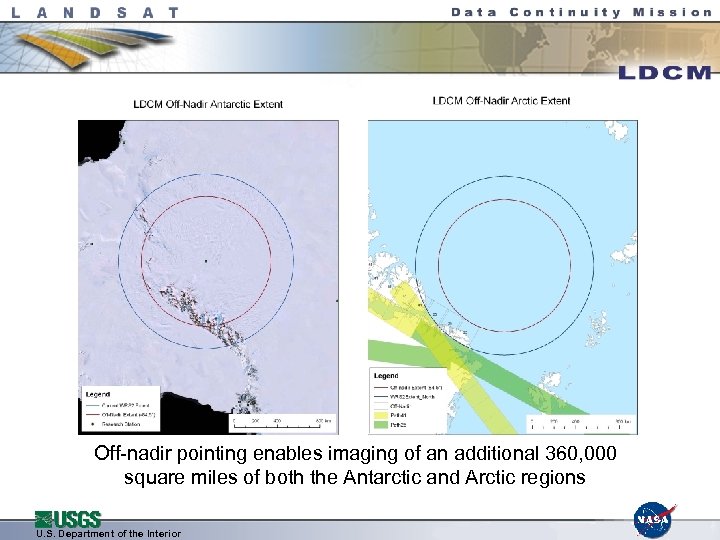 Off-nadir pointing enables imaging of an additional 360, 000 square miles of both the Antarctic and Arctic regions U. S. Department of the Interior
 Status Highlights (2 of 2) w CAPE equipment has all been ordered and deliveries have started w Worked through Integration & Test plans with NASA to set up CAPE in the MOC w Work continues on schedule for CAPE code and unit test and development integration w Completed work to define the DPAS Architecture w Baselined the DPAS requirements for the July SRR w Managed Integration of TIRS Requirements into the DPAS Baseline w Started Scenarios for the DPAS Operational Concept Document, including TIRS w Initiated work to define the operations transition roles and responsibilities, as well as the operational structure w Significant progress working to mitigate budget shortfall U. S. Department of the Interior
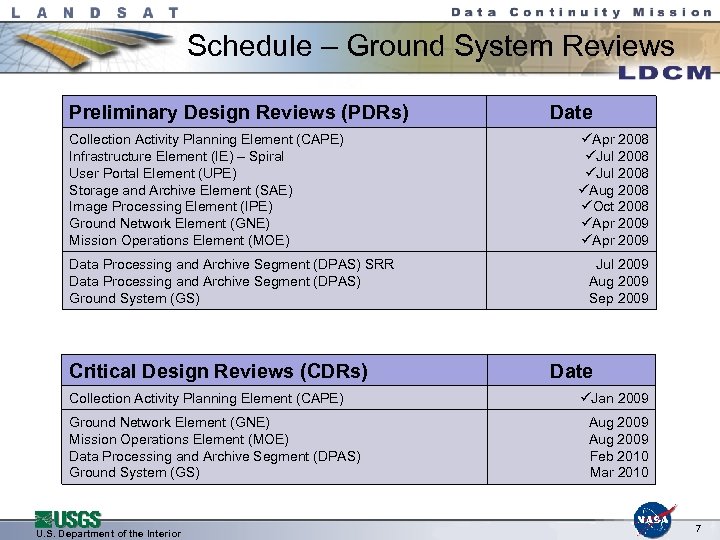 Schedule – Ground System Reviews Preliminary Design Reviews (PDRs) Collection Activity Planning Element (CAPE) Infrastructure Element (IE) – Spiral User Portal Element (UPE) Storage and Archive Element (SAE) Image Processing Element (IPE) Ground Network Element (GNE) Mission Operations Element (MOE) Data Processing and Archive Segment (DPAS) SRR Data Processing and Archive Segment (DPAS) Ground System (GS) Critical Design Reviews (CDRs) Collection Activity Planning Element (CAPE) Ground Network Element (GNE) Mission Operations Element (MOE) Data Processing and Archive Segment (DPAS) Ground System (GS) U. S. Department of the Interior Date üApr 2008 üJul 2008 üAug 2008 üOct 2008 üApr 2009 Jul 2009 Aug 2009 Sep 2009 Date üJan 2009 Aug 2009 Feb 2010 Mar 2010 7
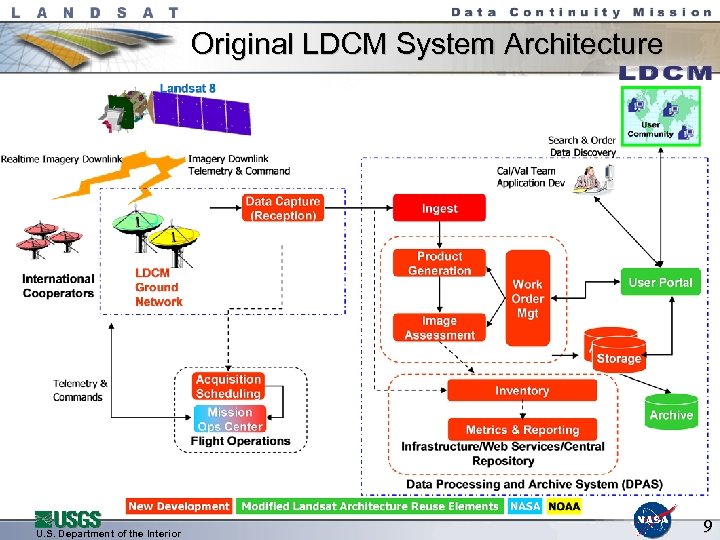
 Budget Shortfall & Mitigation (1 of 2) Key drivers and circumstances resulting in project shortfall: w Original USGS budget for LDCM based on commercial “data buy”, with flat funding profile w LDCM was later recast to a free-flyer mission from the NPOESS platform w Rigorous latency requirements tied to NPOESS network were transitioned to freeflyer model w Additional scope was required to address new mission definition: • • Mission Operations Center and Flight Operations Team Mission Operations Element Science Data Scheduling and Acquisition Ground Network w Addition of the TIRS instrument w Original ground system architecture approach was based on a block replacement every mission U. S. Department of the Interior
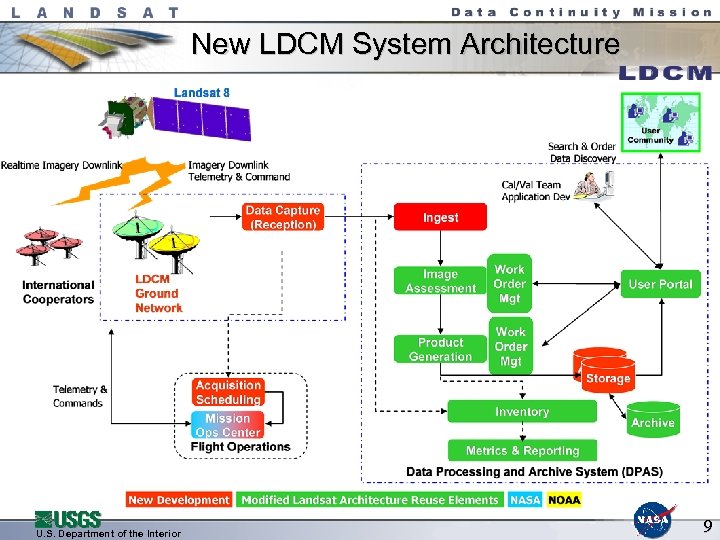
 Budget Shortfall & Mitigation (2 of 2) w Budget Shortfall Mitigation w Clear that no “single change” would mitigate the entire budget shortfall w Ground System team identified mitigation options that related to: • Schedule/deliverable delays due to change in launch readiness date • Cost savings & avoidance options • System architecture options w Joint USGS, NASA meeting, Dec 2008, to discuss budget shortfall and mitigation options • Resulted in a joint recommendation to: – – Change approach to ground system architecture Implement a single MOC at GSFC through early operations Change Flight Operations Team to support a single MOC Push the staffing curve over by taking advantage of the change in launch readiness date w Additional changes include: • Reducing EROS Center overhead costs • Reducing offsite facility costs • Seeking additional funding w Recommended changes briefed to USGS HQ Geography, Contracts, and Legal • USGS Contractors received new direction Feb 2009 U. S. Department of the Interior
 Original LDCM System Architecture U. S. Department of the Interior 9
 New LDCM System Architecture U. S. Department of the Interior 9
 TIRS Strategy w USGS is cautiously taking steps to support TIRS, while it has not yet received funding to support the instrument w Near-Term Purpose & Goals w Identify a TIRS Ground System design approach, which: • Minimizes risk to the mission and launch schedule – focusing on Mission PDR, DPAS PDR, and Ground System PDR • Minimizes the impacts to already approved and funded OLI efforts w Notional Approach & Assumptions w Recognizing that the Ground System's knowledge about the specific TIRS algorithms is limited at the moment, the near-term strategy is primarily tied to algorithm maturity knowledge • Assume instrument scheduling, downlinking, ingesting, archiving mission data, and storing L 0 Ra data is a given. This is our minimal/basic capability. • Subsequent processing steps, including product generation and distribution, preliminary design to be presented as 'plans' for developing preliminary design and 'impacts' to those parts of the Ground System instead of actual preliminary design. – Our plan is to develop preliminary design for IAS and LPGS, once we have more information about the specific TIRS algorithms at some anticipated date. It is expected that we will have more specific TIRS algorithm knowledge immediately following the Cal/Val TIM in early July. U. S. Department of the Interior
 Algorithm Delivery Status w Total of 45 algorithms to be delivered for implementation to support onorbit initialization and verification w w Ingest Image Assessment Product Generation Cal. Val Toolkit w An additional 14 algorithms to be implemented by Initial Operations w Algorithms are delivered in phases according to progression in the design and development of OLI instrument and Ground System Image Processing Element (IPE) w Phase 1 – completed for IPE PDR (Oct ’ 08) w Phase 2 – to be completed by Data Processing & Archive Segment CDR (Jul ’ 09) w Phase 3 – to be completed by Ground Readiness Tests (GRTs) w Phase 4 – delivered post-launch U. S. Department of the Interior
 Summary w. Significant progress has been made on the Ground System w. Ground System approach and architecture is now taking advantage of existing capabilities to the extent possible w. Ground System preliminary design is underway to accommodate TIRS w. Budget shortfall has been mitigated to the greatest extent possible and additional funding has been requested w. On track to complete Ground System preliminary design review in September 14 U. S. Department of the Interior